REVIEW 3 major objections 4 minor 44 references
Time Delay in the Swing Equation: A Variety of Bifurcations
T0 review · 3 major / 4 minor · reviewed 2026-08-14 · deepseek-v4-flash
Pith's one-line read Adding a time delay to the damping term of the swing equation provably produces a repeating alternation of supercritical and subcritical Hopf bifurcations, with every resulting limit cycle born toward larger delays.
desk verdict A genuinely useful Lyapunov-coefficient formula and a correct alternating-Hopf result for the delayed swing equation, with wording-level stability overreach that revision can fix. read the letter →
The pith
A machine-rendered reading of the paper's core claim, the machinery that carries it, and where it could break.
The reading
What carries the argument
The load-bearing object is the first Lyapunov coefficient $L$ of the Hopf bifurcation, whose sign distinguishes supercritical from subcritical bifurcations. The paper derives a closed-form expression for $\operatorname{sgn} L$ for a damped oscillator with one delayed damping term and an arbitrary analytic, delay-free nonlinearity $h(y)$, displayed in (30) in terms of $\beta$ and $\det\Delta(2i\omega)$. It combines this with Cooke--Grossman-type stability-switching formulas (13)--(14), which give the delay sequences and crossing frequencies $\omega_1, \omega_2$, and with the standard center-manifold reduction for retarded functional differential equations, which justifies using the sign of $L$ to decide the direction and stability of the emerging limit cycle.
What would settle it
Compute the first Lyapunov coefficient directly from a center-manifold or normal-form reduction at $\tau_{1,1} = 1.93$ for the parameters (11): the paper predicts a negative value. More generally, evaluate (30) numerically along the $\tau_{1n}$ and $\tau_{2n}$ sequences and check the predicted alternating signs; a single sign reversal at any $\tau_{2n}$, or a vanishing coefficient at some $a < \tilde a$, would refute the claim that all bifurcations head toward larger delays.
Extended reading notes
Core claim
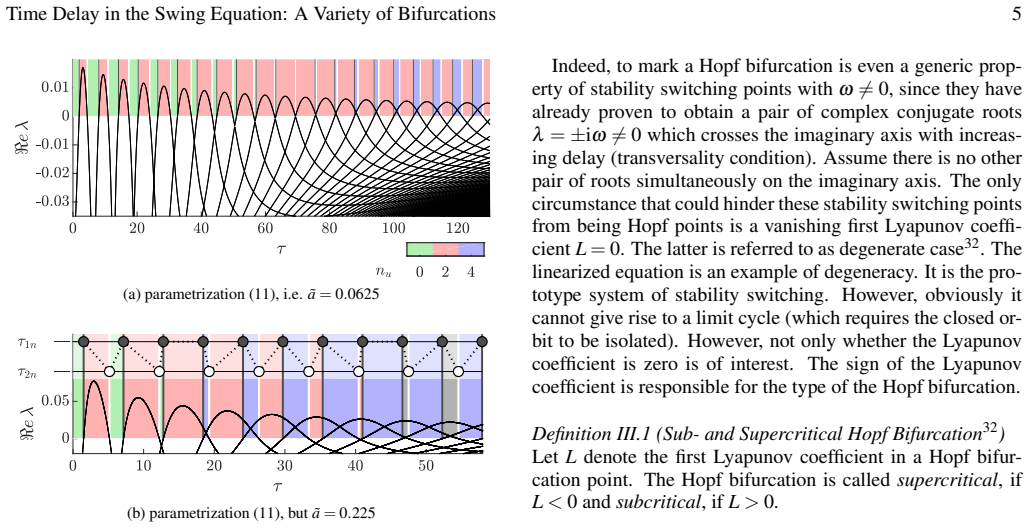
For the delayed swing equation with $a < \tilde a$ and the parameter set (11), at every delay $\tau_{1n}$ the equilibrium loses stability through a supercritical Hopf bifurcation (negative first Lyapunov coefficient), and at every $\tau_{2n}$ it regains stability through a subcritical one (positive coefficient). Therefore stable and unstable limit cycles alternate as the delay increases, and each branch continues locally toward larger delay values. The proof rests on a new formula for the first Lyapunov coefficient for equations of the form $\ddot y + a\dot y + \tilde a \dot y(t-\tau) + h(y(t)) = 0$, whose sign is determined by the closed expression given in Theorem III.1 and equation (30). Applying that formula to $h(y) = \sin(y) - w$ with the parameters of the paper shows that the term containing $\Re(1/\beta)$ dominates, giving negative signs at the $\tau_{1n}$ sequence and positive signs at the $\tau_{2n}$ sequence.
Load-bearing premise
The conclusion relies on the standard reduction of a delayed system near a Hopf point to its two-dimensional slow dynamics: if that reduction fails, for example because another eigenvalue pair already lies on the imaginary axis or the unstable manifold interferes, the sign of the first Lyapunov coefficient no longer guarantees which side the cycle appears on, and the uniform 'larger delays' direction would not follow.
Editorial extensions
If this is right
- At each of the finitely many stability intervals, stability is lost at a $\tau_{1n}$ and regained at a $\tau_{2n}$, with a stable limit cycle born at the first and an unstable limit cycle born at the second.
- All Hopf-originating limit-cycle branches extend locally toward larger delays, so cycles accumulate and coexist as the delay is increased.
- The general Lyapunov-coefficient formula applies to any feedback system whose control uses a delayed derivative measurement, so the alternating-bifurcation mechanism is not restricted to the sine nonlinearity.
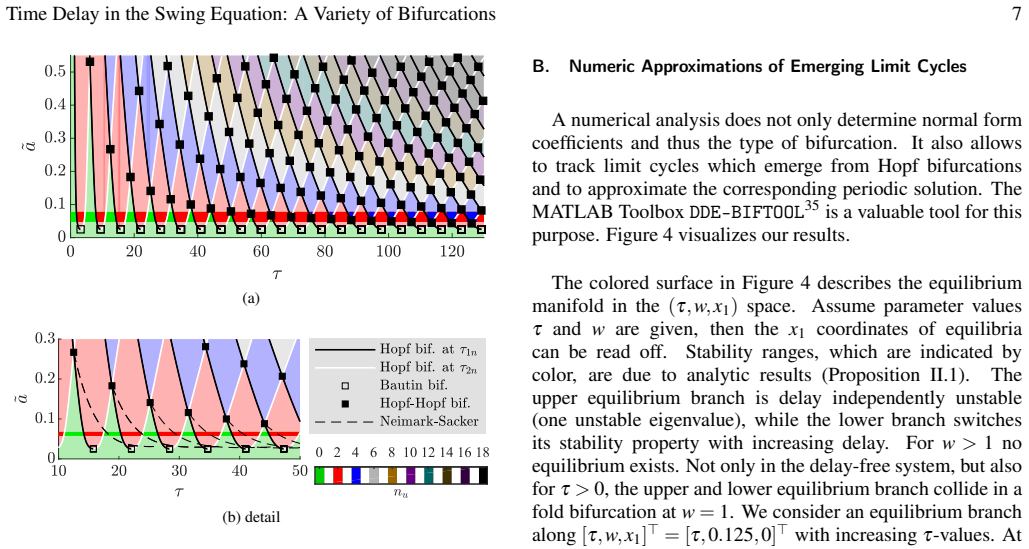
- Numerical continuation shows the first stable cycle undergoes period doubling and then a homoclinic explosion, and later Neimark-Sacker bifurcations produce invariant tori before a cascade of period doublings.
- Stability of the equilibrium alone is not enough to describe the delayed swing equation: at larger delays, coexisting stable and unstable periodic orbits dominate the local dynamics.
Reading between the lines
- Inference: because the sign formula (30) depends only on $h$ and its derivatives at the equilibrium, the alternating pattern may persist for other power-system nonlinearities whenever the $\Re(1/\beta)$ term dominates; evaluating (30) for a given nonlinearity is a direct test.
- Inference: the numerical period-doubling cascade shows geometrically accumulating bifurcation values, but the paper does not prove the cascade is infinite; verifying convergence and computing the dimension of the resulting attractor is a natural extension.
- Inference: in smart-grid frequency control, a delayed damping term could be tuned to place the operating point inside a stable limit cycle rather than letting it diverge, though this goes beyond the paper's local bifurcation analysis.
- Inference: at parameter values where the $\tau_{1n}$ and $\tau_{2m}$ curves cross in the $(\tau, \tilde a)$ plane, the paper identifies Hopf-Hopf bifurcations; exploring the resulting two-torus dynamics would be a natural next step beyond the alternating pattern.
Signed reviews
Editorial analysis
A structured set of objections, weighed in public.
Referee Report
Summary. The paper analyzes the delayed swing equation (2), a second-order RFDE with delayed damping, and shows that increasing the delay produces repeated Hopf bifurcations with alternating sign of the first Lyapunov coefficient. The linear stability analysis relies on the Cooke-Grossman switching result (Lemma II.1), extended to the nonlinear system in Proposition II.1. The main analytical contribution is Theorem III.1, a formula for the first Lyapunov coefficient for a general class of second-order systems with delayed damping and delay-free nonlinearity. Applied to the swing equation with parameters (11), it yields Proposition III.1 (supercritical at each τ1n, subcritical at each τ2n) and Corollary III.1 (every emerging limit cycle locally continues toward larger delays). The paper then numerically tracks limit cycles, detecting period-doubling cascades, Neimark-Sacker bifurcations, folds, and homoclinic orbits, using DDE-BIFTOOL. The appendix contains the derivation of the Lyapunov-coefficient formula.
Significance. If the results hold, this is a useful contribution to the bifurcation theory of RFDEs with delayed damping. The general Lyapunov-coefficient formula is nontrivial and the appendix derivation is coherent; the application to the swing equation gives a complete alternation of sub- and supercritical Hopf bifurcations with delay as the parameter. The paper is honest about numerical aspects: Figure 4 colors limit cycles by the number of unstable Floquet multipliers, and DDE-BIFTOOL is used for confirmation rather than to impose any of the analytical constants. The stress-test concern about type-k equilibria is real: the direction-of-continuation claim survives, but global stability statements need qualification. The main missing items are a missing nondegeneracy assumption in the theorem, an ambiguous and under-verified sign expression in Proposition III.1, and a proof gap in Corollary III.1 regarding equilibria with k>0 unstable pairs.
major comments (3)
- [Section III.A, Theorem III.1, Eq. (30)] The theorem statement assumes only h in C^ω, h(y_e)=0, h'_e>0, but formula (30) contains the factor (h''_e)^{-2} in its second term; for h''_e=0 the formula is undefined. Please add the assumption h''_e≠0 or treat the degenerate case separately. The swing equation application is unaffected since h''_e=-w=-0.125 for the parameter set used, but the advertised generality of the theorem is overstated as stated.
- [Section III.A, Lemma III.1 and Corollary III.1] Lemma III.1 is formulated for a Hopf bifurcation at a stability switching point, which in the standard interpretation is the k=0 to k=2 switch; Corollary III.1 nevertheless applies it to every τ1n and τ2n, including points after nmax where the equilibrium already has k>0 unstable eigenvalue pairs. At such points the conclusions 'stable limit cycle' and 'unstable limit cycle' are not valid in the full space C([-τ,0],R^2): for L<0 the cycle is stable only within the two-dimensional center manifold and inherits k unstable Floquet multipliers from the equilibrium. The continuation-direction claim survives, but the proof must cite a Hopf theorem for RFDEs applicable to type-k equilibria and qualify the stability statements, or restrict global stability language to the k=0 windows. The paragraph after Lemma III.1 already notes the type-k issue, so this is a proof-gap that can be fixed by rewriting, not a numerical error.
- [Section III.A, proof of Proposition III.1] The displayed sign evaluations, e.g. 'sgn L = sgn (0.692n+0.260)+(-149.155n-47.057)/(n^2+4.691n+27.137)', are typeset ambiguously: it is unclear whether the sign function applies to the whole sum or only to the first term, and in either natural reading the expression does not have a constant sign for all n∈N because the linear term eventually dominates the decaying rational part. Since Proposition III.1 claims L<0 for all τ1n and L>0 for all τ2n, please supply the correctly bracketed expression and a verification of the sign over the intended range of n, or state explicitly whether the claim is restricted to n≤nmax or to the range examined numerically.
minor comments (4)
- [Appendix, Eq. (58)] In the transformed characteristic equation, the argument of the exponential should presumably be -i\hatω rather than -iω; as written the equation is not consistent with the preceding comparison of imaginary parts.
- [Section I, paragraph 2] The text 'Schaefer al al. 2' should read 'Schaefer et al. 2'.
- [Figure 6(c)] The caption states τ∈[5,12.21306] while the text gives τ∞=12.21308; please reconcile these numbers.
- [Figure 4 caption] The phrase 'The bended surface' should be 'The bent surface'.
Circularity Check
No circularity: the Hopf-direction theorem follows from an externally based Lyapunov-coefficient formula evaluated directly, not from fitted or self-cited inputs.
full rationale
The paper's central derivation chain is self-contained with respect to the claimed result. Linear stability switching is imported from Cooke and Grossman (external), and the crossing directions (24) are stated with a sketch and reference. The first Lyapunov coefficient formula in Theorem III.1 is derived in the appendix from the standard normal-form formula Lemma V.1, citing Bosschaert, Wage, and Kuznetsov (external), not the present authors. Proposition III.1 is then a direct evaluation of that derived formula at the externally chosen parameter set (11) from Schaefer et al.; the explicit sign expressions for sgn L are numerical evaluations of the derived formula, not fits. DDE-BIFTOOL is used only to confirm nondegeneracy and to continue limit cycles, not to set constants or to define the Lyapunov coefficient. The single self-citation, [40] Scholl et al., appears in Remark III.2 as an illustrative remark about domain-of-attraction bounds and is not load-bearing for the Hopf-direction theorem. Corollary III.1 follows from the computed sign of L together with the transverse crossing directions (24). There is no fitted input renamed as a prediction, no load-bearing self-citation, and no uniqueness or ansatz imported from the authors' prior work. The k>0 caveat about inherited unstable Floquet multipliers is a precision issue regarding global stability wording, not a circularity in the derivation.
Assumptions & free parameters
assumptions (3)
- standard math Hopf bifurcation theorem for RFDEs and center manifold reduction apply at stability switching points, including when additional unstable eigenvalues are present.
- standard math First Lyapunov coefficient formula for RFDEs (Lemma V.1) from Hassard et al. and DDE-BIFTOOL normal form literature.
- standard math Cooke-Grossman stability switching lemma (Lemma II.1): existence of two delay sequences, transversality inequalities in (24), and simplicity of imaginary roots.
Cite this review
Pith. "Pith review of Time Delay in the Swing Equation: A Variety of Bifurcations." pith.science (2026). https://pith.science/paper/NQW4IQ5Y
@misc{pith2026190807996,
  author       = {Pith},
  title        = {Pith review of: Time Delay in the Swing Equation: A Variety of Bifurcations},
  year         = {2026},
  howpublished = {\url{https://pith.science/paper/NQW4IQ5Y}},
  note         = {Machine review of arXiv:1908.07996}
}
read the original abstract
The present paper addresses the swing equation with additional delayed damping as an example for pendulum-like systems. In this context, it is proved that recurring sub- and supercritical Hopf bifurcations occur if time delay is increased. To this end, a general formula for the first Lyapunov coefficient in second order systems with additional delayed damping and delay-free nonlinearity is given. In so far the paper extends results about stability switching of equilibria in linear time delay systems from Cooke and Grossman. In addition to the analytical results, periodic solutions are numerically dealt with. The numerical results demonstrate how a variety of qualitative behaviors is generated in the simple swing equation by only introducing time delay in a damping term.
Figures

Figures from the paper (3 more)


Reference graph
Works this paper leans on
-
[1]
author author H. K. \ Khalil ,\ @noop title Nonlinear systems \ ( publisher Prentice Hall ,\ address Upper Saddle River ,\ year 2002 ) NoStop
work page 2002
-
[2]
author author B. Sch \"a fer , author M. Matthiae , author M. Timme , \ and\ author D. Witthaut ,\ title title Decentral smart grid control , \ @noop journal journal New Journal of Physics \ volume 17 ,\ pages 059502 ( year 2015 ) NoStop
work page 2015
-
[3]
author author D. G. \ Schaeffer \ and\ author J. W. \ Cain ,\ @noop title Ordinary differential equations: Basics and beyond \ ( publisher Springer ,\ address New York ,\ year 2016 ) NoStop
work page 2016
-
[4]
author author A. A. \ Andronov , author A. A. \ Vitt , \ and\ author S. E. \ Khaikin ,\ @noop title Theory of Oscillators: Adiwes International Series in Physics \ ( publisher Elsevier Science ,\ address Burlington ,\ year 1966 ) NoStop
work page 1966
-
[5]
author author G. A. \ Leonov , author I. M. \ Burkin , \ and\ author A. I. \ Shepeljavyi ,\ @noop title Frequency Methods in Oscillation Theory \ ( publisher Springer ,\ address Dordrecht ,\ year 1996 ) NoStop
work page 1996
-
[6]
Manik , author D
author author D. Manik , author D. Witthaut , author B. Sch \"a fer , author M. Matthiae , author A. Sorge , author M. Rohden , author E. Katifori , \ and\ author M. Timme ,\ title title Supply networks: Instabilities without overload , \ @noop journal journal The European Physical Journal Special Topics \ volume 223 ,\ pages 2527--2547 ( year 2014 ) NoStop
2014
-
[7]
author author M. Levi , author F. C. \ Hoppensteadt , \ and\ author W. L. \ Miranker ,\ title title Dynamics of the J osephson junction , \ @noop journal journal Quarterly of Applied Mathematics \ volume 36 ,\ pages 167--198 ( year 1978 ) NoStop
work page 1978
-
[8]
author author O. Diekmann , author S. M. \ Verduyn Lunel , author S. A. \ Gils , \ and\ author H.-O. \ Walther ,\ @noop title Delay equations: Functional-, complex-, and nonlinear analysis \ ( publisher Springer ,\ address New York ,\ year 1995 ) NoStop
work page 1995
Show all 44 references
-
[9]
author author J. K. \ Hale \ and\ author S. M. \ Verduyn Lunel ,\ @noop title Introduction to functional differential equations \ ( publisher Springer ,\ address New York ,\ year 1993 ) NoStop
1993
-
[10]
author author K. L. \ Cooke \ and\ author Z. Grossman ,\ title title Discrete delay, distributed delay and stability switches , \ @noop journal journal Journal of Mathematical Analysis and Applications \ volume 86 ,\ pages 592--627 ( year 1982 ) NoStop
1982
-
[11]
author author D. S. \ Gilliam , author V. I. \ Shubov , author C. I. \ Byrnes , \ and\ author E. D. \ Vugrin ,\ title title Output regulation for delay systems: tracking and disturbance rejection for an oscillator with delayed damping , \ in\ @noop booktitle Proceedings of the...
2002
-
[12]
Sherman ,\ title title A note on stability calculations and time lag , \ @noop journal journal Quarterly of Applied Mathematics \ volume 5 ,\ pages 92--97 ( year 1947 ) NoStop
author author S. Sherman ,\ title title A note on stability calculations and time lag , \ @noop journal journal Quarterly of Applied Mathematics \ volume 5 ,\ pages 92--97 ( year 1947 ) NoStop
1947
-
[13]
author author H. I. \ Ansoff \ and\ author J. Krumhansl ,\ title title A general stabilty criterion for linear oscillating systems with constant time lag , \ @noop journal journal Quarterly of Applied Mathematics \ volume 6 ,\ pages 337--341 ( year 1948 ) NoStop
1948
-
[14]
Pinney ,\ @noop title Ordinary difference-differential equations \ ( publisher University of California Press ,\ year 1958 ) NoStop
author author E. Pinney ,\ @noop title Ordinary difference-differential equations \ ( publisher University of California Press ,\ year 1958 ) NoStop
1958
-
[15]
author author N. Minorsky ,\ title title Self-excited oscillations in dynamical systems possessing retarded action , \ @noop journal journal Journal of Applied Mechanics \ volume 9 ,\ pages 65--71 ( year 1942 ) NoStop
1942
-
[16]
Minorsky ,\ title title Self--excited mechanical oscillations , \ @noop journal journal Journal of Applied Physics \ volume 19 ,\ pages 332--338 ( year 1948 ) NoStop
author author N. Minorsky ,\ title title Self--excited mechanical oscillations , \ @noop journal journal Journal of Applied Physics \ volume 19 ,\ pages 332--338 ( year 1948 ) NoStop
1948
-
[17]
Erneux ,\ @noop title Applied Delay Differential Equations \ ( publisher Springer ,\ address New York ,\ year 2009 ) NoStop
author author T. Erneux ,\ @noop title Applied Delay Differential Equations \ ( publisher Springer ,\ address New York ,\ year 2009 ) NoStop
2009
-
[18]
author author S. A. \ Campbell , author J. B \'e lair , author T. Ohira , \ and\ author J. Milton ,\ title title Limit cycles, tori, and complex dynamics in a second-order differential equation with delayed negative feedback , \ @noop journal journal Journal of Dynamics and Di...
1995
-
[19]
Mithulananthan , author C
author author N. Mithulananthan , author C. A. \ Canizares , \ and\ author J. Reeve ,\ title title Indices to detect hopf bifurcation in power systems , \ in\ @noop booktitle Proceedings of NAPS-2000 \ ( year 2000 )\ pp.\ pages 15--23 NoStop
2000
-
[20]
Ji \ and\ author V
author author W. Ji \ and\ author V. Venkatasubramanian ,\ title title Dynamics of a minimal power system: Invariant tori and quasi-periodic motions , \ @noop journal journal IEEE Transactions on Circuits and Systems I: Fundamental Theory and Applications \ volume 42 ,\ pages ...
1995
-
[21]
\ Tan , author M
author author C.-W. \ Tan , author M. Varghese , author P. Varaiya , \ and\ author F. F. \ Wu ,\ title title Bifurcation, chaos, and voltage collapse in power systems , \ @noop journal journal Proceedings of the IEEE \ volume 83 ,\ pages 1484--1496 ( year 1995 ) NoStop
1995
-
[22]
Bellman \ and\ author K
author author R. Bellman \ and\ author K. L. \ Cooke ,\ @noop title Differential-difference equations \ ( publisher Rand Corporation ,\ year 1963 ) NoStop
1963
-
[23]
Hahn ,\ @noop title Stability of Motion \ ( publisher Springer ,\ address Berlin and Heidelberg ,\ year 1967 ) NoStop
author author W. Hahn ,\ @noop title Stability of Motion \ ( publisher Springer ,\ address Berlin and Heidelberg ,\ year 1967 ) NoStop
1967
-
[24]
author author J. J. \ Grainger \ and\ author W. D. \ Stevenson ,\ @noop title Power system analysis \ ( publisher McGraw Hill ,\ address New York ,\ year 1994 ) NoStop
1994
-
[25]
author author A. R. \ Bergen \ and\ author V. Vittal ,\ @noop title Power systems analysis \ ( publisher Prentice Hall ,\ address Upper Saddle River ,\ year 2000 ) NoStop
2000
-
[26]
author author P. M. \ Anderson \ and\ author A.-A. A. \ Fouad ,\ @noop title Power system control and stability \ ( publisher Iowa State Univ. Press ,\ address Ames ,\ year 1982 ) NoStop
1982
-
[27]
editor P. S. \ Kundur \ and\ editor N. J. \ Balu ,\ eds.,\ @noop title Power system stability and control \ ( publisher McGraw-Hill ,\ address New York, NY ,\ year 1994 ) NoStop
1994
-
[28]
Michiels \ and\ author S.-I
author author W. Michiels \ and\ author S.-I. \ Niculescu ,\ @noop title Stability, control, and computation for time-delay systems: An eigenvalue-based approach \ ( publisher SIAM Soc. for Indust. and Appl. Math ,\ address Philadelphia ,\ year 2014 ) NoStop
2014
-
[29]
St \'e p \'a n ,\ @noop title Retarded dynamical systems: Stability and characteristic functions \ ( publisher Longman Scientif
author author G. St \'e p \'a n ,\ @noop title Retarded dynamical systems: Stability and characteristic functions \ ( publisher Longman Scientif. & Techn ,\ address Harlow ,\ year 1989 ) NoStop
1989
-
[30]
author author J. Neimark ,\ title title D-subdivisions and spaces of quasi-polynomials , \ @noop journal journal Prikladnaya Matematika i Mekhanika \ volume 13 ,\ pages 349--380 ( year 1949 ) NoStop
1949
-
[31]
Insperger \ and\ author G
author author T. Insperger \ and\ author G. St \'e p \'a n ,\ @noop title Semi-discretization for time-delay systems: Stability and engineering applications \ ( publisher Springer ,\ address New York ,\ year 2011 ) NoStop
2011
-
[32]
author author Y. A. \ Kuznetsov ,\ @noop title Elements of applied bifurcation theory \ ( publisher Springer ,\ address New York ,\ year 1998 ) NoStop
1998
-
[33]
author author B. D. \ Hassard , author N. D. \ Kazarinoff , \ and\ author Y.-H. \ Wan ,\ @noop title Theory and applications of Hopf bifurcation \ ( publisher Cambridge University Press ,\ address Cambridge ,\ year 1981 ) NoStop
1981
-
[34]
author author N. D. \ Kazarinoff , author Y.-H. \ Wan , \ and\ author P. van den Driessche ,\ title title Hopf bifurcation and stability of periodic solutions of differential-difference and integro-differential equations , \ @noop journal journal IMA Journal of Applied Mathema...
1978
-
[35]
Engelborghs , author T
author author K. Engelborghs , author T. Luzyanina , \ and\ author D. Roose ,\ title title Numerical bifurcation analysis of delay differential equations using DDE-BIFTOOL , \ @noop journal journal ACM Transactions on Mathematical Software \ volume 28 ,\ pages 1--21 ( year 200...
2002
-
[36]
author author F. G. \ Boese ,\ title title The stability chart for the linearized cushing equation with a discrete delay and with gamma-distributed delays , \ @noop journal journal Journal of Mathematical Analysis and Applications \ volume 140 ,\ pages 510--536 ( year 1989 ) NoStop
1989
-
[37]
Abdallah , author P
author author C. Abdallah , author P. Dorato , author J. Benites-Read , \ and\ author R. Byrne ,\ title title Delayed positive feedback can stabilize oscillatory systems , \ in\ @noop booktitle American Control Conference \ ( year 1993 )\ pp.\ pages 3106--3107 NoStop
1993
-
[38]
author author P. J. \ Menck , author J. Heitzig , author N. Marwan , \ and\ author J. Kurths ,\ title title How basin stability complements the linear-stability paradigm , \ @noop journal journal Nature Physics \ volume 9 ,\ pages 89--92 ( year 2013 ) NoStop
2013
-
[39]
Leng , author W
author author S. Leng , author W. Lin , \ and\ author J. Kurths ,\ title title Basin stability in delayed dynamics , \ @noop journal journal Scientific reports \ volume 6 ,\ pages 21449 ( year 2016 ) NoStop
2016
-
[40]
author author T. H. \ Scholl , author V. Hagenmeyer , \ and\ author L. Gr \"o ll ,\ title title On norm-based estimations for domains of attraction in nonlinear time delay systems , \ @noop journal journal preprint arXiv:1907.12146 [eess.SY] \ ( year 2019 ) NoStop
1907 arXiv
-
[41]
Roose \ and\ author R
author author D. Roose \ and\ author R. Szalai ,\ title title Continuation and bifurcation analysis of delay differential equations , \ in\ @noop booktitle Numerical Continuation Methods for Dynamical Systems ,\ editor edited by\ editor B. Krauskopf , editor H. M. \ Osinga , \...
2007
-
[42]
Breda , author S
author author D. Breda , author S. Maset , \ and\ author R. Vermiglio ,\ @noop title Stability of linear delay differential equations: A numerical approach with MATLAB \ ( publisher Springer ,\ address New York ,\ year 2015 ) NoStop
2015
-
[43]
Bosschaert , author B
author author M. Bosschaert , author B. Wage , \ and\ author Y. Kuznetsov ,\ title title Description of the extension ddebiftool \_ nmfm , \ @noop \ ( year 2015 ) NoStop
2015
-
[44]
author author B. Wage ,\ title Normal form computations for Delay Differential Equations in DDE-BIFTOOL ,\ dspace.library.uu.nl/handle/1874/296912 type Master thesis ,\ school Utrecht University ( year 2014 ) NoStop
2014
Reviewed August 14, 2026 · model on record in the stance chip above.
Discussion (0). Continue with ORCID to comment.