Nonlinear Optical Probing of Ferroic-Octupolar Order Parameter in Collinear Altermagnet
Pith reviewed 2026-06-26 22:47 UTC · model grok-4.3
The pith
Second-harmonic generation detects the ferroic magnetic octupole order parameter in the altermagnet CoF2 below 38 K.
A machine-rendered reading of the paper's core claim, the machinery that carries it, and where it could break.
Core claim
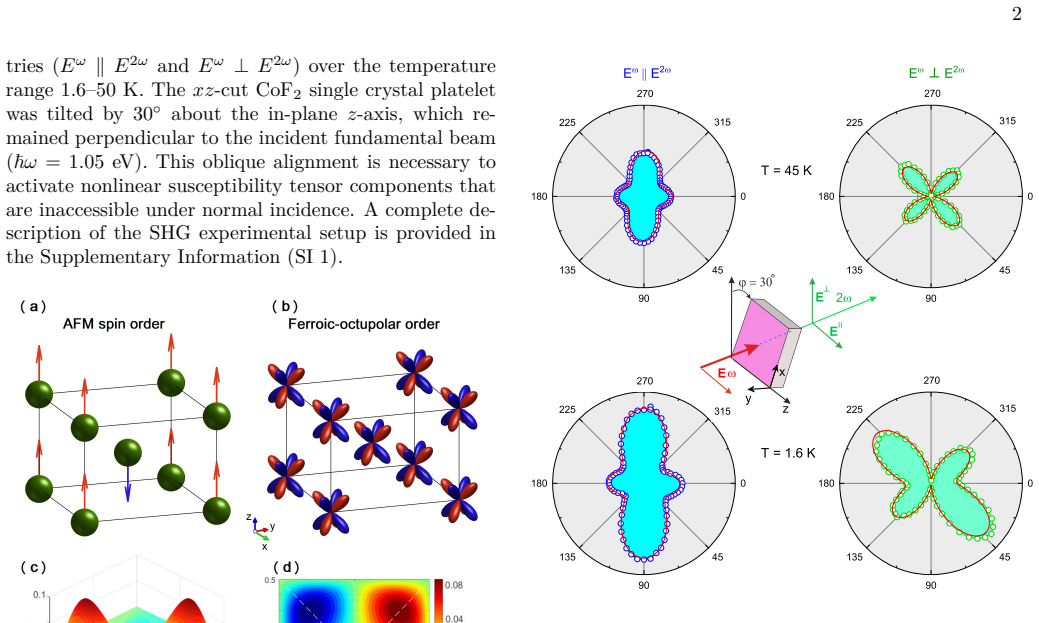
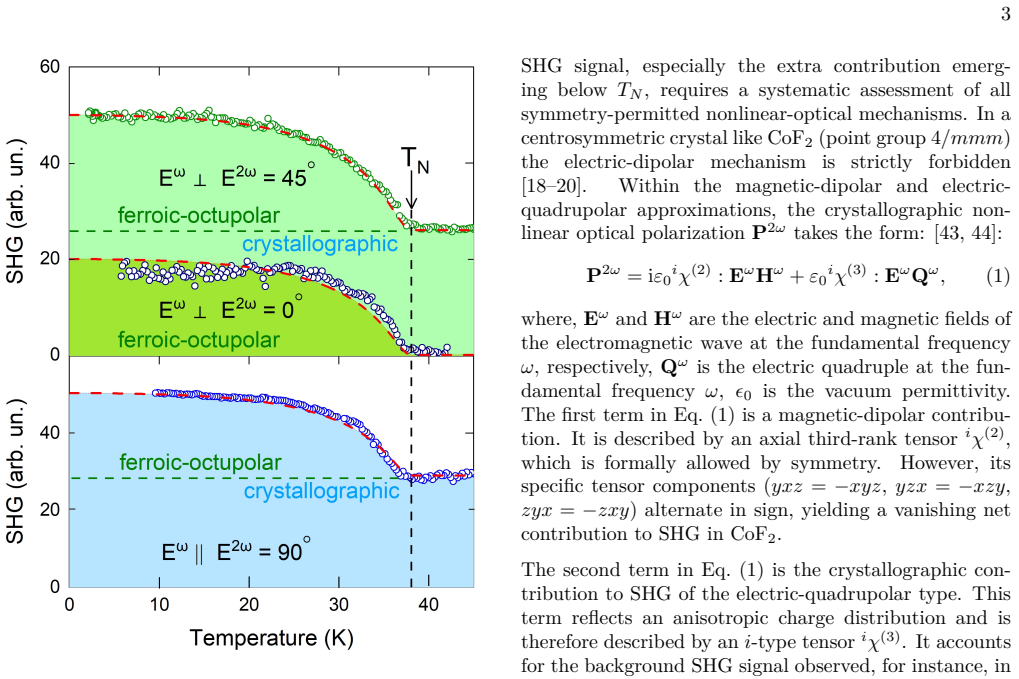
Below the Néel temperature TN = 38 K the SHG signal is sensitive to the ferrotype magnetic octupole O^M which is the order parameter in the antiferromagnetic phase, enabling a ferroic-octupole-induced electric-quadrupolar nonlinear polarization P^{2ω} = i ε0 ^c χ^{(3)}(O^M) : E^ω ∇E^ω.
What carries the argument
The ferroic magnetic octupole O^M, a higher-order multipole of the spin arrangement that induces a third-order nonlinear susceptibility tensor responsible for the electric-quadrupolar SHG polarization.
If this is right
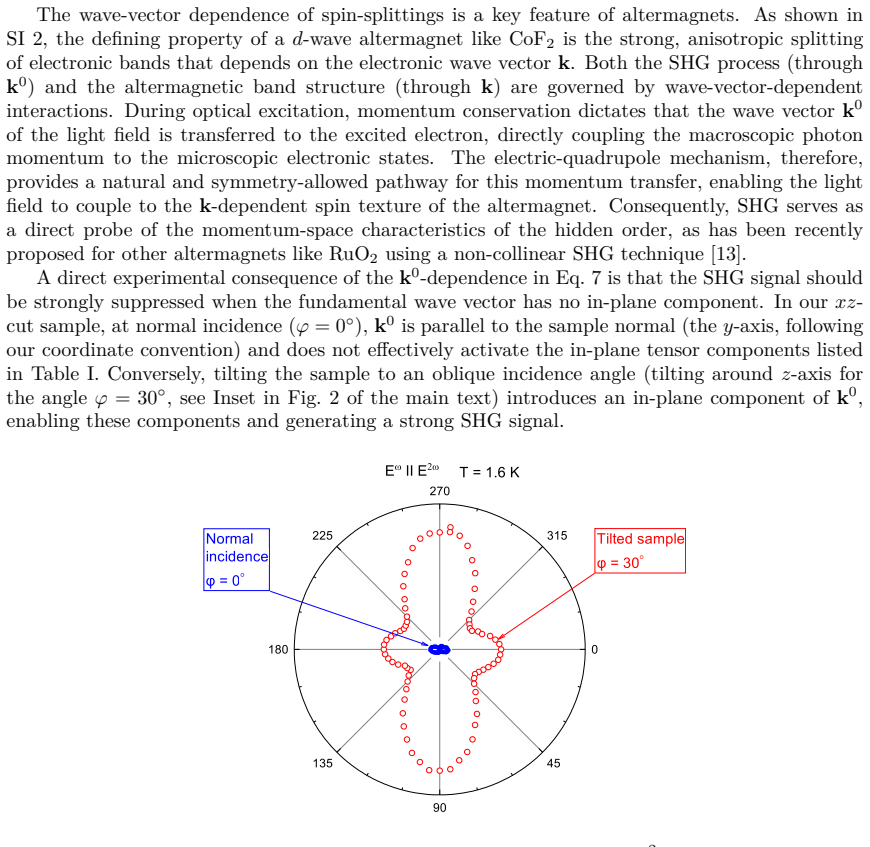
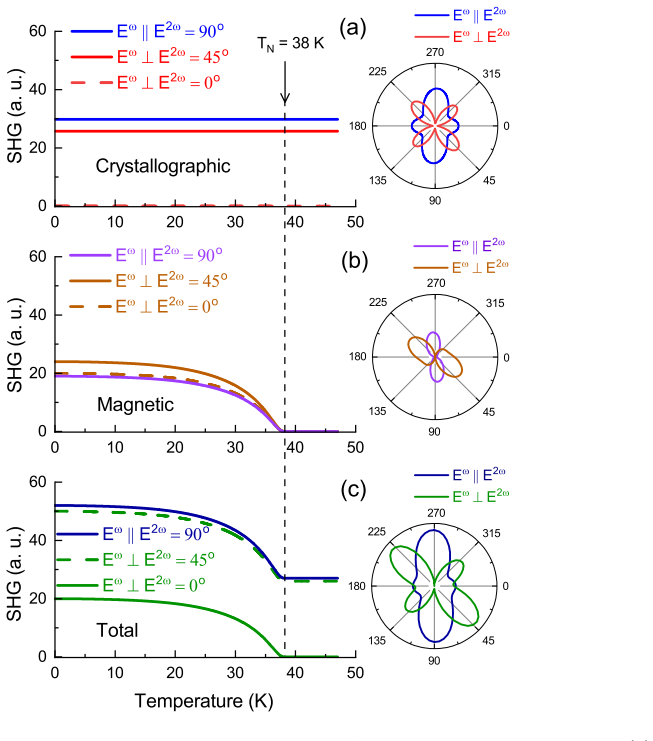
- The SHG intensity vanishes above TN, confirming its spin origin tied to the octupole order parameter.
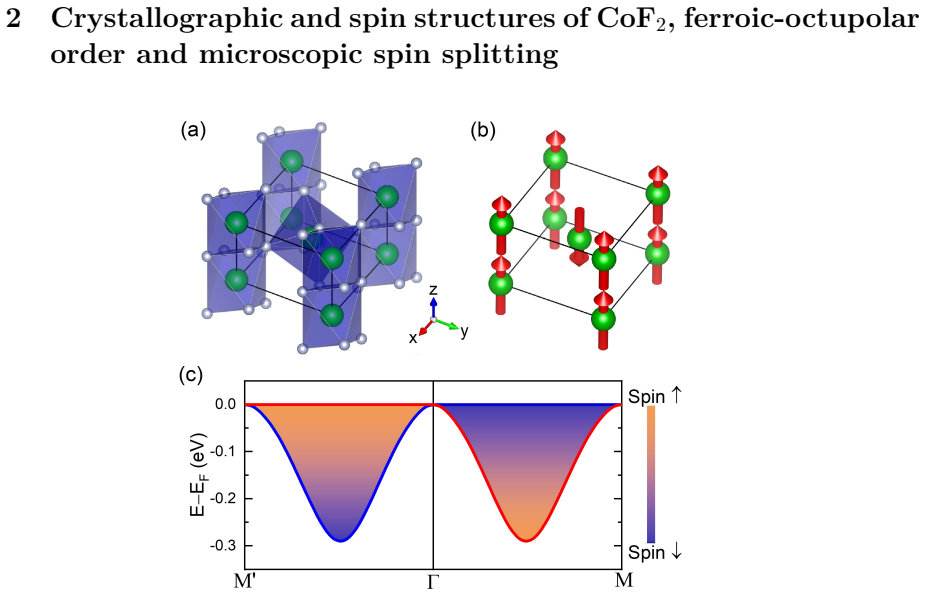
- Polarization-resolved anisotropies agree with model calculations based on the altermagnetic spin structure of CoF2.
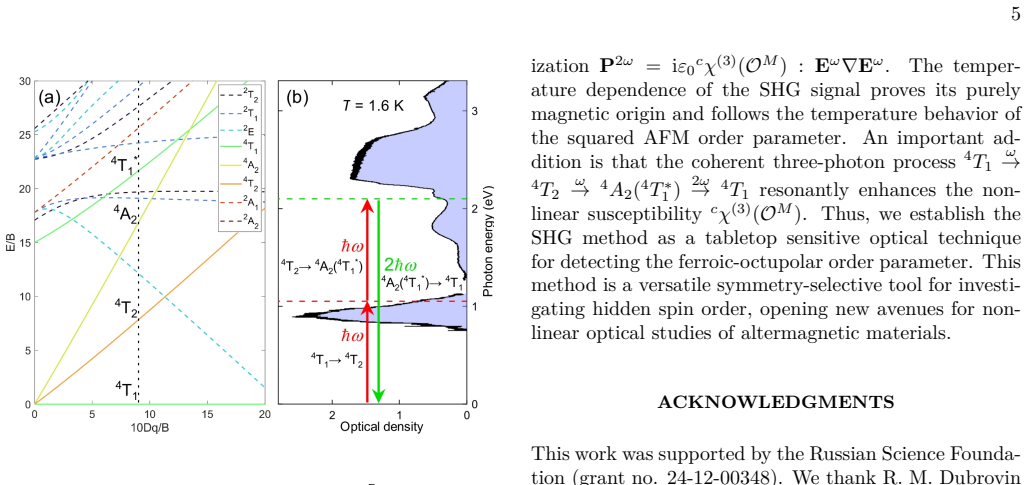
- The SHG response shows resonant enhancement from coherent three-photon processes involving Co^{2+} d-d transitions.
Where Pith is reading between the lines
- The same optical approach may detect ferroic octupoles in other centrosymmetric altermagnets where net magnetization is absent.
- Nonlinear optics could serve as a general probe for higher multipolar orders in materials where linear responses are symmetry-forbidden.
Load-bearing premise
The phenomenological symmetry analysis correctly assigns the observed SHG exclusively to the ferroic-octupole contribution without significant interference from other allowed terms or experimental artifacts in the centrosymmetric lattice.
What would settle it
Detection of the same SHG intensity and polarization dependence persisting above the Néel temperature of 38 K, or a mismatch between measured rotational anisotropies and those calculated from the octupole model.
Figures
read the original abstract
Altermagnetism as a new concept in condensed matter physics is currently being thoroughly investigated. Despite the absence of macroscopic magnetization, altermagnets host a hidden spin order whose direct detection remains a challenge. Here we report on the observation of electric and magnetic dipole forbidden optical second-harmonic generation (SHG) in the altermagnet CoF$_2$ with a centrosymmetric lattice and spin order. We demonstrate that below the N\'eel temperature $T_N = 38$ K the SHG signal is sensitive to the ferrotype magnetic octupole $\mathbf{\mathcal{O}}^M$ which is the order parameter in the antiferromagnetic phase. By combining polarization-resolved SHG experimental data and a phenomenological symmetry analysis, we show that the altermagnetic spin structure of CoF$_2$ enables a ferroic-octupole-induced electric-quadrupolar nonlinear polarization $\mathbf{P}^{2\omega} = \mathrm i\varepsilon_{0}{ }^c\mathbf{\chi}^{(3)}(\mathbf{\mathcal{O}}^M) :\mathbf{E}^{\omega} \nabla \mathbf{E}^{\omega}$. The temperature dependence of SHG reveals a phase transition at $T_N$ confirming the spin origin of the observed signal. The SHG response is resonantly enhanced by a coherent three-photon process caused by the electronic $d$-$d$ transitions of the Co$^{2+}$ ion. Model calculations of SHG polarization rotational anisotropies and temperature dependencies give a reasonable agreement with experimental data, proving the disclosed nonlinear contribution. Our results establish SHG as a novel sensitive tool of ferroic-octupolar spin ordering and highlight the potential of CoF$_2$ and other altermagnets for further nonlinear optical investigations and applications.
Editorial analysis
A structured set of objections, weighed in public.
Referee Report
Summary. The manuscript reports observation of electric- and magnetic-dipole-forbidden SHG in centrosymmetric collinear altermagnet CoF2 below TN=38 K. Polarization-resolved data, temperature dependence, and resonant enhancement near Co2+ d-d transitions are combined with a phenomenological symmetry analysis to attribute the signal to a ferroic-octupole-induced electric-quadrupolar term P^{2ω}=iε0 ^c χ^{(3)}(O^M):E^ω ∇E^ω, with model calculations of rotational anisotropies and T-dependence claimed to agree with experiment. This is presented as establishing SHG as a probe of hidden ferroic-octupolar order in altermagnets.
Significance. If the central assignment of the observed SHG exclusively to the octupole channel is robust, the result would supply a new, symmetry-selective optical handle on altermagnetic order parameters that lack net magnetization, complementing existing neutron and transport probes. The reported resonant three-photon enhancement and the clear onset at TN are concrete experimental strengths that would remain useful even if the multipole assignment requires refinement.
major comments (1)
- [Symmetry analysis paragraph] Symmetry analysis paragraph (and abstract): the phenomenological assignment of the observed polarization-resolved SHG exclusively to the ferroic-octupole channel P^{2ω}=iε0 ^c χ^{(3)}(O^M):E^ω ∇E^ω does not include an explicit enumeration of all third-rank tensors allowed by the magnetic point group of the altermagnetic phase of CoF2, nor a quantitative comparison demonstrating that alternative magnetic-multipole or strain-coupled contributions are symmetry-forbidden or numerically negligible. This enumeration is load-bearing for the claim that the signal isolates the octupole order parameter.
minor comments (2)
- Abstract and experimental sections: quantitative error bars, full data-exclusion criteria, and statistical significance of the temperature-dependent onset are not provided, weakening the supporting evidence for the phase-transition claim.
- Figure captions and model section: the degree of quantitative agreement between the calculated and measured rotational anisotropies should be stated with a metric (e.g., reduced χ²) rather than the qualitative phrase 'reasonable agreement'.
Simulated Author's Rebuttal
We thank the referee for the careful reading of our manuscript and for highlighting the experimental strengths of the resonant SHG onset at TN. We address the single major comment below.
read point-by-point responses
-
Referee: Symmetry analysis paragraph (and abstract): the phenomenological assignment of the observed polarization-resolved SHG exclusively to the ferroic-octupole channel P^{2ω}=iε0 ^c χ^{(3)}(O^M):E^ω ∇E^ω does not include an explicit enumeration of all third-rank tensors allowed by the magnetic point group of the altermagnetic phase of CoF2, nor a quantitative comparison demonstrating that alternative magnetic-multipole or strain-coupled contributions are symmetry-forbidden or numerically negligible. This enumeration is load-bearing for the claim that the signal isolates the octupole order parameter.
Authors: We agree that an explicit enumeration of all third-rank tensors permitted by the magnetic point group of the altermagnetic phase would make the symmetry analysis more complete and would directly address the load-bearing nature of the assignment. In the revised manuscript we will add a dedicated subsection (or table) that lists every independent component of the third-rank nonlinear susceptibility tensor allowed by the magnetic point group, together with the corresponding multipole or strain origin. We will then show, using the measured polarization anisotropies, that only the ferroic-octupole channel reproduces the observed rotational patterns while the remaining allowed terms are either symmetry-forbidden for the collinear altermagnetic structure or produce angular dependencies inconsistent with experiment. This addition will be placed immediately after the current phenomenological discussion. revision: yes
Circularity Check
No significant circularity; claim rests on independent experiment and symmetry analysis.
full rationale
The paper derives its central claim from polarization-resolved SHG measurements below TN combined with a phenomenological symmetry analysis that assigns the observed signal to the octupole-induced term P^{2ω} = i ε0 ^c χ^{(3)}(O^M) : E^ω ∇E^ω. No load-bearing step reduces by the paper's own equations to a fitted parameter or self-citation chain; temperature dependence and resonant enhancement are presented as independent confirmation of spin origin. The derivation is self-contained against external benchmarks of symmetry-allowed tensors and experimental data.
Axiom & Free-Parameter Ledger
Reference graph
Works this paper leans on
-
[1]
Momma, and F
K. Momma, and F. Izumi, VESTA 3 for three-dimensional visualization of crystal, volumetric and morphology data, J. Appl. Crystallogr. 44, 1272 (2011), http://dx.doi.org/10.1107/ S0021889811038970
2011
-
[2]
Y. Guo, H. Liu, O. Janson, C. Fulga, J. van den Brink, and J. I. Facio, Spin-split collinear antiferromagnets: A large-scale ab-initio study, Mater. Today Phys. 32, 100991 (2023), https: //doi.org/10.1016/j.mtphys.2023.100991
-
[3]
B.-W. Yu, and B.-G. Liu, Flat-bands-induced two-dimensional hole gases and quantum Hall effect in three-dimensional altermagnetic semiconductor, J. Phys. D: Appl. Phys. 58, 335302 (2025), https://doi.org/10.1088/1361-6463/adf7b5
-
[4]
J. W. Stout, The crystal structure of MnF 2, FeF2, CoF 2, NiF 2 and ZnF 2, J. Am. Chem. Soc. 76, 5279 (1954), https://doi.org/10.1021/ja01650a005
-
[5]
S. Bhowal, N. A. Spaldin, Ferroically ordered magnetic octupoles in d-wave altermagnets, Phys. Rev. X 14, 011019 (2024), https://doi.org/10.1103/PhysRevX.14.011019. 12
-
[6]
R. R. Birss, Symmetry and Magnetism (North-Holland, Amsterdam, 1966)
1966
-
[7]
M. Fiebig, V. V. Pavlov, and R. V. Pisarev, Second-harmonic generation as a tool for studying electronic and magnetic structures of crystals: review, J. Opt. Soc. Am. B 22, 96 (2005), https://doi.org/10.1364/JOSAB.22.000096
-
[8]
R. V. Pisarev, Second harmonic generation spectroscopy in magnetic and multiferroic materi- als, J. Luminescence, 133, 169 (2013), https://doi.org/10.1016/j.jlumin.2011.12.038
-
[9]
Fiebig, Nonlinear Optics on Ferroic Materials (Wiley-VCH, Weinheim, 2023)
M. Fiebig, Nonlinear Optics on Ferroic Materials (Wiley-VCH, Weinheim, 2023)
2023
-
[10]
Schiff, A
H. Schiff, A. Corticelli, A. Guerreiro, J. Romhányi, P. McClarty, The crystallographic spin point groups and their representations, SciPost Phys. 18, 109 (2025), https://doi.org/10. 21468/SciPostPhys.18.3.109
2025
-
[11]
L. Šmejkal, J. Sinova, and T. Jungwirth, Beyond conventional ferromagnetism and antiferro- magnetism: a phase with nonrelativistic spin and crystal rotation symmetry, Phys. Rev. X 12, 031042 (2022), https://doi.org/10.1103/PhysRevX.12.031042
-
[12]
V. M. Agranovich, V. L. Ginsburg, Crystal Optics With Spatial Dispersion and Excitons (Berlin, Springer-Verlag, 1984)
1984
-
[13]
Y. X. Ma, J. Z. Chang, Y. D. Liu, M. S. Si, G. P. Zhang, and Z. M. Zhang, Probing spin-split bands in altermagnets through second harmonic generation, Phys. Rev. B 111, 064311 (2025), https://doi.org/10.1103/PhysRevB.111.064311
-
[14]
V. C. Morano, Z. Maesen, S. E. Nikitin, J. Lass, D. G. Mazzone, O. Zaharko, Absence of altermagnetic magnon band splitting in MnF 2, Phys. Rev. Lett. 134, 226702 (2025), https: //doi.org/10.1103/PhysRevLett.134.226702
- [15]
-
[16]
Bloembergen, Nonlinear Optics (Benjamin, New York, 1965)
N. Bloembergen, Nonlinear Optics (Benjamin, New York, 1965)
1965
-
[17]
Y. R. Shen, The Principles of Nonlinear Optics (Wiley, New York, 1984)
1984
-
[18]
R. W. Boyd, Nonlinear Optics , 3rd Ed. (Academic Press, 2003)
2003
-
[19]
Adler, Nonlinear optical frequency polarization in a dielectric, Phys
E. Adler, Nonlinear optical frequency polarization in a dielectric, Phys. Rev. 134, A728 (1964), https://doi.org/10.1103/PhysRev.134.A728
-
[20]
H. Hoshi, T. Yamada, K. Ishikawa, H. Takezoe, A. Fukuda, Second-harmonic generation in centrosymmetric molecular films: Analysis under anisotropic conditions, Phys. Rev. B 52, 12355 (1995), https://doi.org/10.1103/PhysRevB.52.12355
-
[21]
Neumann, Vorlesungen über die Theorie der Elastizität der festen Körper und des Lichtäthers, ed
F. Neumann, Vorlesungen über die Theorie der Elastizität der festen Körper und des Lichtäthers, ed. O. E. Meyer (Leipzig, BG Teubner-Verlag, 1885)
-
[22]
A. V. Shubnikov, N. V. Belov, Colored Symmetry (Pergamon Press, Oxford, 1964). 13
1964
-
[23]
C. J. Bardley, A. P. Cracknell, The Mathematical Theory of Symmetry in Solids: Representation Theory for Point Groups and Space Groups (Clarendon Press, Oxford, 1972)
1972
-
[24]
Xiao, D.-F.Shao, W
R.-C. Xiao, D.-F.Shao, W. Gan, et al. Classification of second harmonic generation effect in magnetically ordered materials. npj Quantum Mater. 8, 62 (2023), https://doi.org/10. 1038/s41535-023-00594-3
2023
-
[25]
B. Ya. Zel’dovich, Theory of second-harmonic generation of light in focused beams, Sov. Phys. JETP 23, 451 (1966), http://jetp.ras.ru/cgi-bin/dn/e_023_03_0451.pdf
1966
-
[26]
D. A. Kleinman, A. Ashkin, and G. D. Boyd, Second-harmonic generation of light by focused laser beams, Phys. Rev. 145, 338 (1966), https://doi.org/10.1103/PhysRev.145.338
-
[27]
P. Chmela, Theory of second harmonic generation in focused light beam of fundamental fre- quency with the Gaussian distribution of light intensity under the interaction of type o + oe, Czech. J. Phys. B 24, 1 (1974), https://doi.org/10.1007/BF01596439
-
[28]
T. Chatterji, M. Zbiri, S. Rols, Phonon–magnon coupling in CoF 2 investigated by time-of-flight neutron spectroscopy, Sol. St. Comm. 174, 55 (2013), http://dx.doi.org/10.1016/j.ssc. 2013.08.012
-
[29]
J. A. Barreda-Argüeso, F. Aguado, J. González, R. Valiente, L. Nataf, M. N. Sanz-Ortiz, and F. Rodríguez, Volume and bond length dependences of the electronic structure of 6-fold and 8-fold coordinated Co 2+ in pressure transformed CoF 2, J. Phys.: Conf. Ser. 950 042016 (2017), https://doi.org/10.1088/1742-6596/950/4/042016
-
[30]
F. Formisano, R. M. Dubrovin, R. V. Pisarev, A. M. Kalashnikova, and A. V. Kimel, Laser- induced THz magnetism of antiferromagnetic CoF 2, J. Phys.: Condens. Matter 34, 225801 (2022). https://doi.org/10.1088/1361-648X/ac5c20
-
[31]
Hanamura, M
E. Hanamura, M. Fiebig, and Y. Tanabe, Nonlinear optics of antiferromagnetic compounds, in Magneto-Optics, edited by S. Sugano and N. Kojima (Springer-Verlag, Berlin, Heidelberg, New York, 2000). 14
2000
discussion (0)
Sign in with ORCID, Apple, or X to comment. Anyone can read and Pith papers without signing in.