Backstepping Control of Multidimensional Coupled First-Order Hyperbolic PDEs with Collinear Velocities
Pith reviewed 2026-06-27 12:29 UTC · model grok-4.3
The pith
A change of variables along spatial characteristic curves reduces multidimensional hyperbolic PDEs with collinear velocities to a stabilizable continuum of one-dimensional systems.
A machine-rendered reading of the paper's core claim, the machinery that carries it, and where it could break.
Core claim
By converting the multidimensional system into a continuum of one-dimensional systems via a change of variables based on spatial characteristic curves, and applying backstepping control to each, finite-time stabilization is achieved when transit times are uniformly bounded.
What carries the argument
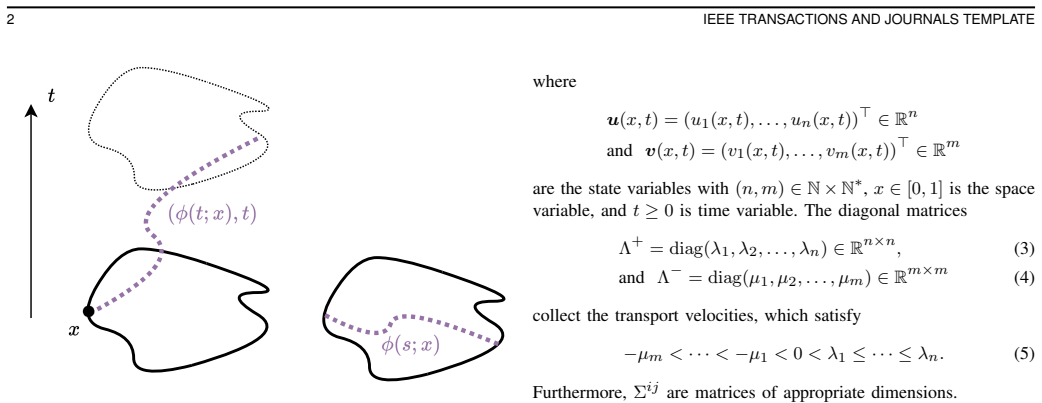
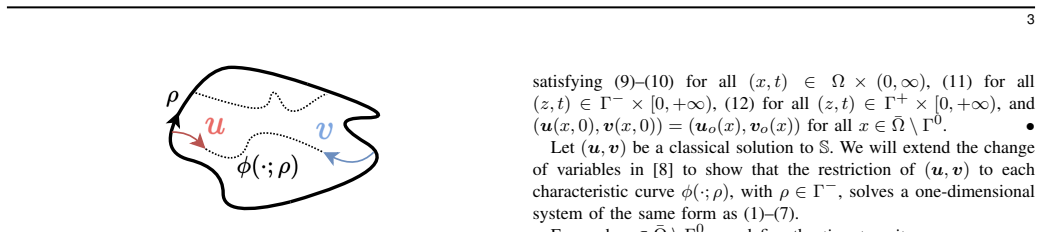
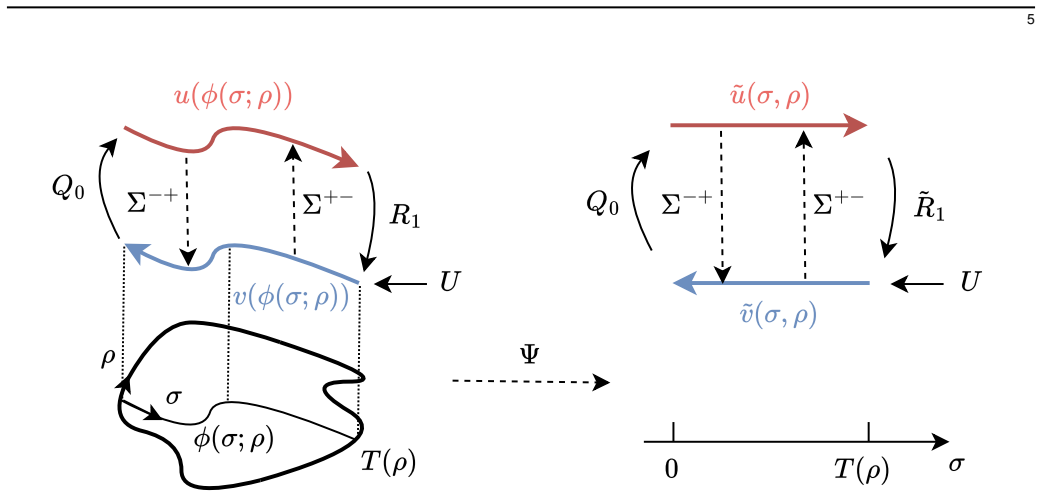
Change of variables based on characteristic curves defined entirely in the spatial domain, converting the multidimensional system into a continuum of coupled one-dimensional first-order hyperbolic systems.
If this is right
- Finite-time stabilization holds for the full multidimensional system.
- The scalar multidimensional framework extends directly to the coupled case.
- Each one-dimensional system in the continuum receives its own backstepping controller.
- The collinear-velocity assumption is essential for the spatial characteristic curves to be well-defined.
Where Pith is reading between the lines
- The same spatial-characteristic reduction may apply to other transport-dominated PDEs whose velocities share a common direction.
- Removing the uniform-boundedness condition would likely replace finite-time convergence with asymptotic stability only.
- The continuum representation could support designs that act on multiple members of the family simultaneously rather than separately.
Load-bearing premise
The transit times of the characteristic curves are uniformly bounded.
What would settle it
A concrete multidimensional example with collinear velocities where the designed backstepping controller is applied yet the state fails to reach zero in finite time because transit times along some curves are unbounded.
Figures
read the original abstract
This paper addresses the backstepping boundary stabilization of coupled multidimensional first-order hyperbolic systems. We consider systems whose transport velocity fields are collinear, meaning that each velocity field is a scalar multiple of a common base velocity field. Building upon a recent framework developed for scalar multidimensional first-order hyperbolic equations, we introduce a change of variables, based on characteristic curves defined entirely in the spatial domain, that converts the original multidimensional system into a continuum of coupled one-dimensional first-order hyperbolic systems. By designing a backstepping controller for each system in the continuum representation, and assuming that the transit times of the characteristic curves are uniformly bounded, we achieve finite-time stabilization of the multidimensional system.
Editorial analysis
A structured set of objections, weighed in public.
Referee Report
Summary. The manuscript develops a backstepping boundary stabilization method for multidimensional coupled first-order hyperbolic PDEs whose velocity fields are collinear (each a scalar multiple of a common base field). It introduces a spatial-domain change of variables along characteristic curves that converts the system into a continuum of coupled 1-D hyperbolic systems; backstepping controllers are then designed for each member of the continuum. Finite-time stabilization of the original multidimensional system is obtained provided the transit times of the characteristic curves are uniformly bounded.
Significance. If the transformation and per-system backstepping constructions are rigorously justified, the result extends the scalar multidimensional framework cited in the abstract to the coupled case under the collinear-velocity hypothesis. This supplies a concrete route to finite-time boundary control for a class of higher-dimensional transport systems and demonstrates that the continuum-reduction technique remains viable when coupling is present.
major comments (2)
- [§4, Theorem 1] §4, Theorem 1: the finite-time claim rests on uniform boundedness of transit times, but the proof sketch does not explicitly verify that the backstepping kernels remain bounded uniformly across the continuum when the coupling coefficients are non-constant; a counter-example or explicit bound would strengthen the result.
- [§3.2, Eq. (18)] §3.2, Eq. (18): the change-of-variables operator is stated to preserve the hyperbolic structure, yet the derivation of the resulting 1-D coupling terms does not address whether the collinear assumption prevents characteristic crossing inside the spatial domain; an explicit Jacobian non-degeneracy argument is needed.
minor comments (3)
- Notation for the continuum parameter should be introduced once and used consistently; currently the symbol ξ is overloaded between the spatial coordinate and the continuum index.
- Figure 2 caption should state the numerical values of the velocity scaling functions used in the simulation.
- Reference [12] is cited for the scalar case but the precise statement being invoked (finite-time result or only well-posedness) is not repeated; a one-sentence recap would help readers.
Simulated Author's Rebuttal
We thank the referee for the careful reading of the manuscript and the constructive comments. We address each major comment below and have revised the manuscript to incorporate the requested clarifications, which we believe strengthen the presentation.
read point-by-point responses
-
Referee: [§4, Theorem 1] §4, Theorem 1: the finite-time claim rests on uniform boundedness of transit times, but the proof sketch does not explicitly verify that the backstepping kernels remain bounded uniformly across the continuum when the coupling coefficients are non-constant; a counter-example or explicit bound would strengthen the result.
Authors: We agree that an explicit uniform bound on the kernels strengthens the finite-time claim. Although the assumptions of bounded, sufficiently smooth coefficients and uniformly bounded transit times imply the result via standard 1-D kernel estimates applied pointwise in the continuum, we have added a new lemma (Lemma 4.2) in the revised §4. The lemma applies a continuum-parameterized Gronwall inequality to obtain an explicit bound on the kernel L^∞ norms that depends only on the sup-norms of the coupling coefficients and the maximum transit time, thereby confirming uniformity across the family of 1-D systems. revision: yes
-
Referee: [§3.2, Eq. (18)] §3.2, Eq. (18): the change-of-variables operator is stated to preserve the hyperbolic structure, yet the derivation of the resulting 1-D coupling terms does not address whether the collinear assumption prevents characteristic crossing inside the spatial domain; an explicit Jacobian non-degeneracy argument is needed.
Authors: The collinear-velocity hypothesis is precisely what guarantees that the characteristic curves remain non-crossing. We have inserted a new paragraph immediately after Eq. (18) that computes the Jacobian matrix of the spatial change-of-variables map. Because every velocity field is a scalar multiple of the same base field, the map is a composition of flows along a single direction; its Jacobian determinant is shown to equal the product of the positive scalar multipliers and is therefore strictly positive on the interior of a convex spatial domain. This establishes that the transformation is a diffeomorphism and that the resulting 1-D systems inherit the hyperbolic structure without characteristic crossing. revision: yes
Circularity Check
No significant circularity; derivation is a direct constructive extension
full rationale
The paper's central procedure—change of variables along spatial-domain characteristics to obtain a continuum of 1-D coupled hyperbolic systems, followed by per-system backstepping design—directly extends the cited scalar multidimensional framework without reducing the stabilization result to a fitted quantity, self-definition, or unverified self-citation chain. The finite-time claim is explicitly conditional on the stated uniform boundedness of transit times, which is an external hypothesis rather than an output of the derivation. No load-bearing step equates a prediction to its input by construction, and the collinear-velocity hypothesis is used only to ensure the transformation is feasible. The result remains self-contained against the paper's own equations and assumptions.
Axiom & Free-Parameter Ledger
axioms (1)
- domain assumption Transit times of the characteristic curves are uniformly bounded
Reference graph
Works this paper leans on
-
[1]
O. M. Aamo, Disturbance rejection in2×2linear hyperbolic systems, IEEE Transactions on Automatic Control, 58(5), 1095-1106, 2012
2012
-
[2]
Alleaume, M
V . Alleaume, M. Krstic, Ensembles of hyperbolic PDEs: Stabilization by backstepping,IEEE Trans. on Aut. Control, 70(2), 905-920, 2024
2024
-
[3]
Auriol, F
J. Auriol, F. Bribiesca-Argomedo, F. Di Meglio, Robustification of stabilizing controllers for ODE-PDE-ODE systems: a filtering approach, Automatica, 147, 110724, 2023
2023
-
[4]
Auriol, F
J. Auriol, F. Di Meglio, Minimum time control of heterodirectional linear coupled hyperbolic PDEs,Automatica, 71, 300–307, 2016
2016
-
[5]
Y . Bai, A. Hayat, Lyapunov functions and stabilization of linear two- dimensional hyperbolic systems, HAL:〈hal-05455719v2〉, 2026
2026
-
[6]
Bastin, J.-M
G. Bastin, J.-M. Coron, Stability and boundary stabilization of1-D hyperbolic systems,Progress in Nonlinear Differential Equations and their Applications, vol. 88, Birkh ¨auser/Springer, [Cham], Subseries in Control, 2016
2016
-
[7]
M. C. Belhadjoudja, Backstepping Control of PDEs on Directionally- Convex Domains,Under review, Available at SSRN 6447745
-
[8]
M. C. Belhadjoudja, Backstepping Control of First-Order Hyperbolic Equations in Arbitrary Dimensions with Non-Trapping Characteristics, Under review, arXiv:2605.25217
-
[9]
Chitour, S
Y . Chitour, S. Fueyo, G. Mazanti, and M. Sigalotti, Approximate and exact controllability criteria for linear one-dimensional hyperbolic systems,Systems & Control Letters, 190, 105834, 2024
2024
-
[10]
Chitour, G
Y . Chitour, G. Mazanti, and M. Sigalotti, Stability of non-autonomous difference equations with applications to transport and wave propagation on networks,Netw. Heterog. Media, 11(4):563–601, 2016
2016
-
[11]
Coron, A
J.-M. Coron, A. Hayat, PI controllers for1-D nonlinear transport equation,IEEE Trans. on Aut. Control, 64(11), 4570-4582, 2019
2019
-
[12]
Coron, A
J.-M. Coron, A. Hayat, G. Bastin, A necessary and sufficient robustness condition for boundary observer-controllers that stabilize2×2hyper- bolic systems,HAL:〈hal-05406888〉, 2025
2025
-
[13]
Coron, L
J.-M. Coron, L. Hu, G. Olive, Finite-time boundary stabilization of general linear hyperbolic balance laws via Fredholm backstepping transformation,Automatica, 84, 95-100, 2017
2017
-
[14]
Coron and H.-M
J.-M. Coron and H.-M. Nguyen, Optimal time for the controllability of linear hyperbolic systems in one-dimensional space,SIAM Journal on Control and Optimization, 57(2):1127–1156, 2019
2019
-
[15]
Coron, R
J.-M. Coron, R. Vazquez, M. Krstic, G. Bastin, Local exponentialH 2 stabilization of a2×2quasilinear hyperbolic system using backstepping, SIAM Journal on Control and Optimization, 51(3), 2005–2035, 2013
2005
-
[16]
L. C. Evans, Partial differential equations,American mathematical society, (V ol. 19), 1998
1998
-
[17]
Ghousein, E
M. Ghousein, E. Witrant, Backstepping control for a class of coupled hyperbolic-parabolic PDE systems,2020 American Control Conference (ACC), Denver, CO, USA, pp. 1600-1605, 2020
2020
-
[18]
Ghousein, E
M. Ghousein, E. Witrant, Adaptive observer design for uncertain hyperbolic PDEs coupled with uncertain LTV ODEs: Application to refrigeration systems,Automatica, 154, 111096, 2023
2023
-
[19]
L. Guan, C. Prieur, L. Zhang, R. Vazquez, State observation for hetero- geneous quasilinear traffic flow system with disturbances,Mathematics of Control, Signals, and Systems, 36, 601–628, 2023
2023
-
[20]
Hayat, Boundary stability of1-D nonlinear inhomogeneous hyper- bolic systems for theC 1 norm,SIAM J
A. Hayat, Boundary stability of1-D nonlinear inhomogeneous hyper- bolic systems for theC 1 norm,SIAM J. Control Optim., 57, no. 6, 3603–3638, 2019
2019
-
[21]
Hayat, On boundary stability of inhomogeneous2×2 1-D hyperbolic systems for theC 1 norm,ESAIM Control Optim
A. Hayat, On boundary stability of inhomogeneous2×2 1-D hyperbolic systems for theC 1 norm,ESAIM Control Optim. Calc. Var., 25, Paper No. 82, 31, 2019
2019
-
[22]
Herty and F
M. Herty and F. Thein, Boundary feedback control for hyperbolic systems,ESAIM Control Optim. Calc. Var., 30, Paper No. 71, 16, 2024
2024
-
[23]
Herty and F
M. Herty and F. Thein, Stabilization of a multi-dimensional system of hyperbolic balance laws,Mathematical Control and Related Fields, 14, no. 3, 1033–1047, 2024
2024
-
[24]
L. Hu, F. Di Meglio, R. Vazquez, M. Krstic, Control of homodirectional and general heterodirectional linear coupled hyperbolic PDEs,IEEE Transactions on Automatic Control, 61(11), 3301–3314, 2016
2016
-
[25]
J. P. Humaloja, N. Bekiaris-Liberis, Stabilization of a Class of Large- Scale Systems of Linear Hyperbolic PDEs via Continuum Approxima- tion of Exact Backstepping Kernels,IEEE Transactions on Automatic Control, vol. 70, no. 9, pp. 5957-5972, 2025
2025
-
[26]
J. P. Humaloja, N. Bekiaris-Liberis, Backstepping control of continua of linear hyperbolic PDEs and application to stabilization of large-scale n+mcoupled hyperbolic PDE systems,Automatica, 183, 112647, 2026
2026
-
[27]
J. P. Humaloja, N. Bekiaris-Liberis, Observer Design for a Class of ODE–Continuum-PDE Cascade Systems Inspired by a Control- Theoretic Model of Large-Scale Arterial Networks of Blood Flow,arXiv: 2605.10524, 2026
Pith/arXiv arXiv 2026
-
[28]
Irscheid, J
A. Irscheid, J. Deutscher, N. Gehring, J. Rudolph, Output regulation for general heterodirectional linear hyperbolic PDEs coupled with nonlinear ODEs,Automatica, 148, 110748, 2023
2023
-
[29]
M. Krstic, Feedback Linearization of Hyperbolic PDEs with V olterra Nonlinearities, arXiv:2604.27400, 2026
Pith/arXiv arXiv 2026
-
[30]
Krstic, A
M. Krstic, A. Smyshlyaev, Backstepping boundary control for first-order hyperbolic PDEs and application to systems with actuator and sensor delays,Systems & Control Letters, 57(9), 750-758, 2008
2008
-
[31]
Liu and C
X. Liu and C. Xie, Boundary control of reaction–diffusion equations on higher-dimensional symmetric domains,Automatica, 114, 108832, 2020
2020
-
[32]
Meurer, Control of Higher-Dimensional PDEs: Flatness and Back- stepping Designs,Springer, 2013
T. Meurer, Control of Higher-Dimensional PDEs: Flatness and Back- stepping Designs,Springer, 2013
2013
-
[33]
Prieur, A
C. Prieur, A. Girard, E. Witrant, Stability of switched linear hyperbolic systems by Lyapunov techniques,IEEE Transactions on Automatic control, 59(8), 2196-2202, 2014
2014
-
[34]
R. Vazquez, Backstepping control laws for higher-dimensional PDEs: spatial invariance and domain extension methods,IMA Journal of Mathematical Control and Information, 42(2), dnaf018, 2025
2025
-
[35]
Vazquez, J
R. Vazquez, J. Auriol, F. Bribiesca-Argomedo, M. Krstic, Backstepping for partial differential equations: A survey,Automatica, 183, 112572, 2026
2026
-
[36]
Vazquez, M
R. Vazquez, M. Krstic, J.-M. Coron, Backstepping boundary stabilization and state estimation of a2×2linear hyperbolic system,In 2011 50th IEEE conference on decision and control and European control conference(pp. 4937–4942), IEEE, 2011
2011
-
[37]
Vazquez and M
R. Vazquez and M. Krstic, A closed-form feedback controller for stabilization of the linearized 2-D Navier– Stokes Poiseuille system, IEEE Transactions on Automatic Control, 52(12):2298–2312, 2007
2007
-
[38]
Vazquez and M
R. Vazquez and M. Krstic, Boundary observer for output-feedback stabilization of thermal convection loop,IEEE Transactions on Control Systems Technology, 18:789–797, 2010
2010
-
[39]
Vazquez and M
R. Vazquez and M. Krstic, Boundary control of a singular reaction- diffusion equation on a disk,IFAC- PapersOnLine, 49(8):74–79, 2016
2016
-
[40]
Vazquez and M
R. Vazquez and M. Krstic, Boundary control and estimation of reaction- diffusion equations on the sphere under revolution symmetry conditions, International Journal of Control, 92(1):2–11, 2019
2019
-
[41]
Vazquez, E
R. Vazquez, E. Schuster, M. Krstic, Magnetohydrodynamic state estimation with boundary sensors,Automatica, 44(10):2517–2527, 2008
2008
-
[42]
Vazquez, J
R. Vazquez, J. Zhang, J. Qi, and M. Krstic, Kernel well-posedness and computation by power series in backstepping output feedback for radially-dependent reaction-diffusion PDEs on multidimensional balls, Systems & Control Letters, 177:105538, 2023
2023
-
[43]
C. Xu, E. Schuster, R. Vazquez, and M. Krstic, Stabilization of linearized 2D magnetohydrodynamic channel flow by backstepping boundary con- trol,Systems & Control Letters, 57(10):805–812, 2008
2008
-
[44]
Yang and W.-A
H. Yang and W.-A. Yong, Feedback boundary control of multidimen- sional hyperbolic systems with relaxation,Automatica, 167, Paper No. 111791, 7, 2024
2024
-
[45]
H. Yu, M. Krstic, Traffic congestion control by PDE backstepping, Cham, Switzerland: Birkh ¨auser, 2022
2022
discussion (0)
Sign in with ORCID, Apple, or X to comment. Anyone can read and Pith papers without signing in.