REVIEW 3 minor 26 references
Large Deviation Analysis for Canonical Gibbs Measures
T0 review · 0 major / 3 minor · reviewed 2026-08-12 · deepseek-v4-flash
Pith's one-line read Fixed-particle Gibbs point processes satisfy a large-deviation principle, with the rate function given by the grand-canonical entropy-plus-interaction formula re-centered to have minimum zero.
desk verdict Genuinely new LDPs for canonical Gibbs processes; the unbounded-interaction theorem is conditional in a way the abstract doesn't say. read the letter →
The pith
A machine-rendered reading of the paper's core claim, the machinery that carries it, and where it could break.
The reading
What carries the argument
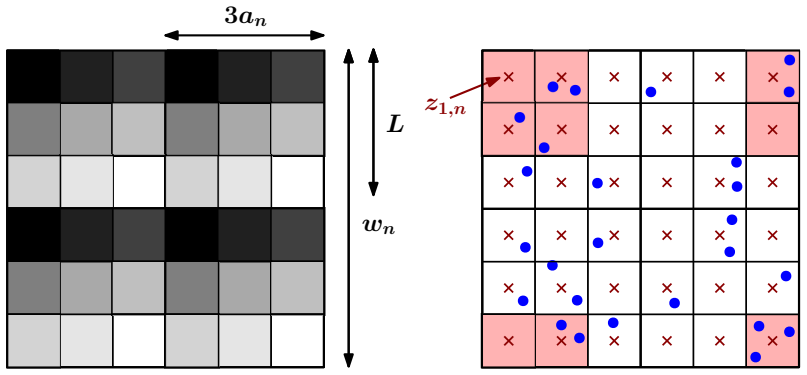
The bridge is the elementary identity that the binomial point process is the Poisson point process conditioned on the point count, $\mathrm{d}B_n=\Pi_n(|\omega|=n)^{-1}\mathbf 1_{[|\omega|=n]}\,\mathrm{d}\Pi_n$, combined with the grand-canonical LDP in the $\tau_{L_0}$-topology. Since the conditioning event is closed, upper bounds are immediate; the technical work is a family of couplings for the lower bounds. In the unbounded case the deletion/sprinkling operations of the Poisson setting are replaced by a move operation that relocates so-called $b$-dense points into sparse cubes, keeping the particle number fixed, while the hard-core case couples the binomial and Poisson processes and thins away inadmissible close pairs.
What would settle it
For the unbounded theorem, check the free-energy condition: if a concrete $V$ (say, a superlinearly growing increasing local interaction) has $\lim_n |W_n|^{-1}\log Z_n=-\infty$, the claimed LDP cannot hold, and Remark 2.12 already flags such cases. For the bounded theorem, a numerical test of $\mathbb P(R^o_{n,\rho_n}\in U)$ against $\exp(-|W_n|\inf_U J)$ for a small interaction radius would quickly expose any failure of the rate function.
Extended reading notes
Core claim
The sequence of individual empirical fields $R^o_{n,\rho_n}$ driven by the binomial Gibbs process satisfies the LDP with speed $|W_n|$ and rate $J(m)=\widetilde J(m)-\inf_{m'}\widetilde J(m')$, where $\widetilde J(m)=I(P)+P^o(V)$ when $m=P^o$ for some stationary probability $P$ satisfying $P^o(1)=\lambda$, and $+\infty$ otherwise. Here $I(P)$ is the specific entropy and $P^o(V)$ the Palm expectation of the interaction. Thus the canonical rate differs from the grand-canonical one only by the normalization that makes its minimum zero. This is proved first for bounded local interactions, then for unbounded increasing interactions under the additional condition that $\lim |W_n|^{-1}\log Z_n>-\infty$, and for the hard-core Strauss process under $\lambda R^d v_d<1$; boundary-condition variants are also treated.
Load-bearing premise
For the unbounded case, the load-bearing premise is that the canonical partition function $Z_n$ does not decay faster than exponentially, i.e. $\lim |W_n|^{-1}\log Z_n>-\infty$; the stated assumptions on $V$ do not force this, and the paper notes it can fail.
Editorial extensions
If this is right
- For any bounded local observable, the empirical average satisfies the same LDP, so deviations of such statistics are exponentially controlled by the canonical rate.
- For unbounded observables such as edge counts in random geometric graphs, the results give lower-tail upper bounds and two-sided lower bounds, reflecting localization effects that can make full LDPs fail.
- The canonical partition function has the free-energy limit $-A$ in the bounded case, and in the unbounded case when the finite-limit condition holds.
- The hard-core Strauss process obeys the LDP for local bounded functionals whenever $\lambda R^d v_d<1$, including a formula for its free energy.
- Similar LDPs hold for Gibbs measures with alternative boundary-condition Hamiltonians in the bounded setting, so the results are not tied to periodicity alone.
Reading between the lines
- If the finite-free-energy condition in the unbounded theorem can be verified for Riesz-type interactions, the move coupling may supply the first canonical LDP for such fixed-charge systems; the paper already draws on the move idea from number-rigidity work.
- The normalization $J(m)=\widetilde J(m)-\inf\widetilde J$ means the minimizers of $\widetilde J$ are exactly the typical empirical fields; testing this against simulations at moderate $n$ could measure the practical radius of the LDP.
- The hard-core constraint $\lambda R^d v_d<1$ is exactly the regime in which the partition function is positive; an analogous obstruction should appear for more general infinite interactions, so the finite free-energy condition is likely necessary rather than technical.
Editorial analysis
A structured set of objections, weighed in public.
Referee Report
Summary. This paper develops large-deviation principles for canonical (binomial) Gibbs point processes in growing windows. The central object is the individual empirical field R^o_{n,rho_n} under the binomial Gibbs measure. Theorem 2.7 gives a full LDP for bounded r-local interactions with rate function J(m)=tilde J(m)-inf tilde J(m), where tilde J(m)=I(P)+P^o(V). Theorem 2.11 extends this to non-negative increasing r-local cardinality-bounded interactions, but only under the explicit additional hypothesis that lim |W_n|^{-1} log Z_n > -infinity; Remark 2.12 notes that this limit can be -infinity. Theorem 2.16 treats the hard-core Strauss process under lambda v_d R^d < 1 for bounded local score functions, and Theorem 2.18 covers two boundary-condition Hamiltonians. The proofs condition the Poisson process on {|omega|=n}, use the Georgii-Zessin LDP as an external benchmark, and construct couplings via move operations for unbounded interactions and thinning/sprinkling for the hard-core case.
Significance. If the results hold, the paper fills a real gap by giving systematic canonical analogues of grand-canonical variational LDPs for Gibbs point processes, with an explicit rate function in the spirit of Georgii-Zessin. The move-operation coupling is a substantive technical contribution, particularly because deletion/addition is not available in the canonical setting. The hard-core result and the boundary-condition extensions broaden the applicability, and the examples (Strauss process, k-wise interactions) are useful illustrations. The proofs are detailed and all lemmas are proved, with the exception of Lemma 4.3, which is presented as a sketch. The paper is also honest about the conditional nature of the unbounded-interaction result: Remark 2.12 states that the relevant free-energy limit can be -infinity. The explicit hypotheses and the careful statements are strengths of the paper.
minor comments (3)
- [Abstract and Section 1, bullet (1)] The abstract and the introduction describe Theorem 2.11 as establishing an LDP for a possibly unbounded non-negative increasing local interaction without mentioning the additional condition lim |W_n|^{-1} log Z_n > -infinity. Since Remark 2.12 explicitly notes that this limit can be -infinity, in which case the LDP is not established, the advertised scope should carry this caveat. Theorem 2.11 itself is correctly conditional; the issue is purely one of presentation.
- [Section 4, Lemma 4.3] The proof of Lemma 4.3 is presented only as a sketch. Because Corollaries 2.10 and 2.14 depend on this lemma, it would be helpful to write out the reduction of (45) to (30) explicitly, or at least to state precisely how the parameters b, delta, and epsilon are chosen for vector-valued thresholds a.
- [Section 2.2.1, Theorem 2.16] Theorem 2.16 is stated at the level of bounded local score functions, i.e., finite-dimensional projections, rather than for the individual empirical field itself. The abstract says the large-deviation principle is formulated for distributions of individual empirical fields, so the hard-core section should explicitly clarify that the stated result is at the functional level, or state the corresponding empirical-field version.
Circularity Check
No significant circularity: the canonical LDP is derived from the external grand-canonical LDP of Georgii-Zessin plus new coupling arguments; the conditional finite-free-energy hypothesis is an explicit assumption, not a disguised input.
full rationale
The paper's central derivation is self-contained against the external benchmark [14]. The rate function J(m)=tilde J(m)-inf tilde J is the canonical analogue of the Georgii-Zessin variational formula, but the whole content of Theorems 2.7, 2.11, and 2.16 is to show that the fixed-number binomial Gibbs measures satisfy an LDP with that rate function. The upper bounds are direct applications of Corollary 3.2 in [14] to the closed event {|omega|=n}, which is legitimate because the binomial process is the Poisson process conditioned on n points. The lower bounds require new coupling constructions (moving points from dense to sparse regions) and are proved in detail in Sections 3.1, 5, and 6; they do not reduce to the statement being proved. The paper cites the authors' earlier work [15] for the b-dense-point technique, but it re-proves the needed rareness lemma (Lemma 5.2) and constructs its own move coupling, so the citation is a proof tool rather than a load-bearing self-citation. The finite-free-energy condition in Theorem 2.11 ((lim 1/|W_n|) log Z_n > -infinity) is an explicit hypothesis, and Remark 2.12 acknowledges it can fail; this is a scoping limitation, not a circular reduction. No fitted parameter is renamed as a prediction, no uniqueness theorem is imported from the authors' prior work, and no ansatz is smuggled in via citation. The derivation chain is legitimate and the central claims have independent content.
Assumptions & free parameters
assumptions (5)
- standard math Georgii-Zessin LDP for tau_Lo-continuous local bounded functionals of Poisson point processes (Corollary 3.2 in [14])
- standard math Tail bound for binomial distributions (Lemma 1.1 in [19])
- standard math Stirling's formula gives lim (1/|W_n|) log Pi_n(|omega|=n) = 0 (Lemma 3.7)
- domain assumption Intensity constraint lambda R^d v_d < 1 for hard-core interactions
- domain assumption Finiteness of lim (1/|W_n|) log Z_n in the unbounded case
Cite this review
Pith. "Pith review of Large Deviation Analysis for Canonical Gibbs Measures." pith.science (2026). https://pith.science/paper/NSGMJICF
@misc{pith2026241118483,
  author       = {Pith},
  title        = {Pith review of: Large Deviation Analysis for Canonical Gibbs Measures},
  year         = {2026},
  howpublished = {\url{https://pith.science/paper/NSGMJICF}},
  note         = {Machine review of arXiv:2411.18483}
}
read the original abstract
In this paper, we present a large-deviation theory developed for functionals of canonical Gibbs processes, i.e., Gibbs processes with respect to the binomial point process. We study the regime of a fixed intensity in a sequence of increasing windows. Our method relies on the traditional large-deviation result for local bounded functionals of Poisson point processes noting that the binomial point process is obtained from the Poisson point process by conditioning on the point number. Our main methodological contribution is the development of coupling constructions allowing us to handle delicate and unlikely pathological events. The presented results cover three types of Gibbs models - a model given by a bounded local interaction, a model given by a non-negative possibly unbounded increasing local interaction and the hard-core interaction model. The derived large deviation principle is formulated for the distributions of individual empirical fields driven by canonical Gibbs processes, with its special case being a large deviation principle for local bounded observables of the canonical Gibbs processes. We also consider unbounded non-negative increasing local observables, but the price for treating this more general case is that we only get large-deviation bounds for the tails of such observables. Our primary setting is the one with periodic boundary condition, however, we also discuss generalizations for different choices of the boundary condition.
Figures
Reference graph
Works this paper leans on
- [1]
-
[2]
S. Adams and Q. Vogel. Space-time random walk loop measur es. Stochastic Process. Appl. , 130(4):2086–2126, 2020
work page 2020
-
[3]
S. Chatterjee and M. Harel. Localization in random geome tric graphs with too many edges. Ann. Probab., 48(1):574–621, 2020
work page 2020
-
[4]
D. Dereudre, A. Hardy, T. Lebl´ e, and M. Ma ¨ ıda. DLR equations and rigidity for the sine-beta process. Comm. Pure Appl. Math., 74(1):172–222, 2021
work page 2021
-
[5]
D. Dereudre and P. Houdebert. Phase transition for conti nuum Widom-Rowlinson model with random radii. J. Stat. Phys. , 174(1):56–76, 2019
work page 2019
-
[6]
D. Dereudre and C. Renaud-Chan. Liquid-gas phase transi tion for Gibbs point process with Quermass interaction. arXiv preprint arXiv:2309.08338, 2023
-
[7]
D. Dereudre and T. Vasseur. Number-rigidity and β -circular Riesz gas. Ann. Probab., 51(3):1025–1065, 2023
work page 2023
-
[8]
M. Dickson and Q. Vogel. Formation of infinite loops for an interacting bosonic loop soup. Electron. J. Probab. , 29:Paper No. 24, 39, 2024
work page 2024
Show all 26 references
-
[9]
Eichelsbacher and U
P. Eichelsbacher and U. Schmock. Exponential approxima tions in completely regular topological spaces and extensi ons of sanov’s theorem. Stochastic Process. Appl. , 77(2):233–251, 1998. 39
1998
-
[10]
Friedli and Y
S. Friedli and Y. Velenik. Statistical Mechanics of Lattice Systems . Cambridge University Press, Cambridge, 2018
2018
-
[11]
H.-O. Georgii. Large deviations and maximum entropy pr inciple for interacting random fields on Zd. Ann. Probab. , 21(4):1845–1875, 1993
1993
-
[12]
H.-O. Georgii. Large deviations and the equivalence of ensembles for Gibbsian particle systems with superstable i nteraction. Probab. Theory Related Fields , 99(2):171–195, 1994
1994
-
[13]
H.-O. Georgii. Gibbs Measures and Phase Transitions . W alter de Gruyter & Co., Berlin, second edition, 2011
2011
-
[14]
Georgii and H
H.-O. Georgii and H. Zessin. Large deviations and the ma ximum entropy principle for marked point random fields. Probab. Theory Related Fields , 96:177–204, 1993
1993
-
[15]
Hirsch, B
C. Hirsch, B. Jahnel, and A. T´ obi´ as. Lower large deviations for geometric functionals. Electron. Commun. Probab., 25:1–12, 2020
2020
-
[16]
Jansen and L
S. Jansen and L. Kolesnikov. Cluster expansions: neces sary and sufficient convergence conditions. J. Stat. Phys. , 189(3):Pa- per No. 33, 47, 2022
2022
-
[17]
Lebl´ e and S
T. Lebl´ e and S. Serfaty. Large deviation principle for empirical fields of Log and Riesz gases. Invent. Math. , 209:1–113, 2017
2017
-
[18]
Moller and R
J. Moller and R. W aagepetersen. Statistical Inference and Simulation for Spatial Point Pro cesses. Chapman and Hall/CRC, 2003
2003
-
[19]
M. Penrose. Random Geometric Graphs . OUP Oxford, Oxford, 2003
2003
-
[20]
Rassoul-Agha and T
F. Rassoul-Agha and T. Sepp¨ al¨ ainen.A Course on Large Deviations with an Introduction to Gibbs Me asures. American Mathematical Society, Providence, RI, 2015
2015
-
[21]
Rœlly and A
S. Rœlly and A. Zass. Marked Gibbs point processes with u nbounded interaction: an existence result. J. Stat. Phys. , 179(4):972–996, 2020
2020
-
[22]
Rougerie and S
N. Rougerie and S. Serfaty. Higher-dimensional Coulom b gases and renormalized energy functionals. Comm. Pure Appl. Math., 69(3):519–605, 2016
2016
-
[23]
D. Ruelle. Statistical Mechanics: Rigorous Results . W. A. Benjamin, Inc., New York-Amsterdam, 1969
1969
-
[24]
Schreiber and J
T. Schreiber and J. E. Yukich. Large deviations for func tionals of spatial point processes with applications to ran dom packing and spatial graphs. Stochastic Process. Appl. , 115(8):1332–1356, 2005
2005
-
[25]
Sepp¨ al¨ ainen and J
T. Sepp¨ al¨ ainen and J. E. Yukich. Large deviation principles for Euclidean functionals and other nearly additive processes. Probab. Theory Related Fields , 120(3):309–345, 2001
2001
-
[26]
S. Serfaty. Coulomb Gases and Ginzburg-Landau Vortices . European Mathematical Society (EMS), Z¨ urich, 2015. 40
2015
Reviewed August 12, 2026 · model on record in the stance chip above.
Discussion (0). Continue with ORCID to comment.