REVIEW 3 major objections 6 minor 37 references
Towards high power broad-band OPCPA at 3000 nm
T0 review · 3 major / 6 minor · reviewed 2026-08-14 · deepseek-v4-flash
Pith's one-line read A four-stage OPCPA seeded by a Ti:sapphire oscillator produces 430-µJ pulses at 3000 nm with 490 nm bandwidth, compressed to about 65 fs.
desk verdict A solid four-stage OPCPA engineering demonstration at 3 μm with credible spectra and energy, but the 65 fs compressed duration rests on a Gaussian deconvolution that the data do not independently support. read the letter →
The pith
A machine-rendered reading of the paper's core claim, the machinery that carries it, and where it could break.
The reading
What carries the argument
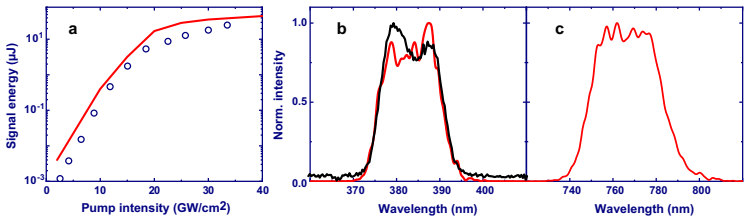
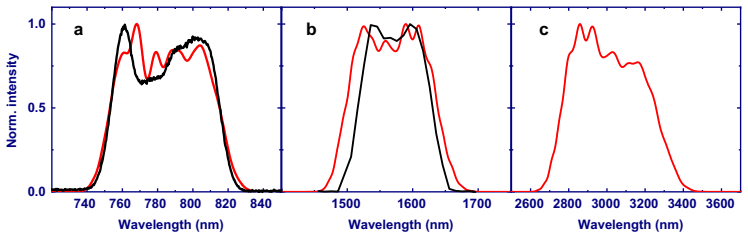
The load-bearing element is the cascaded nonlinear conversion chain: stage 1 uses type I BBO in a non-collinear geometry to amplify the stretched 800 nm seed; stage 2 difference-frequency generates 1560 nm in collinear BBO; stage 3 non-collinearly amplifies the 1560 nm idler in type II KTA; stage 4 produces 3000 nm in collinear type I LiIO$_3$, whose broad amplification bandwidth in collinear geometry gives the wide spectrum without introducing angular chirp. Each stage is pumped by the 1030 nm Yb-based channel or its second harmonic at 515 nm, with active delay stabilization in the first stage. A custom two-dimensional split-step numerical model is used to calculate the nonlinear processes in all stages, and the claimed near-optimum operation is established by matching measured spectra and energies across stages.
What would settle it
Measure the compressed 3000 nm pulses with a FROG or SPIDER; if the reconstructed duration is much longer than 65 fs, or the intensity profile deviates from Gaussian, the autocorrelation-based estimate fails.
Extended reading notes
Core claim
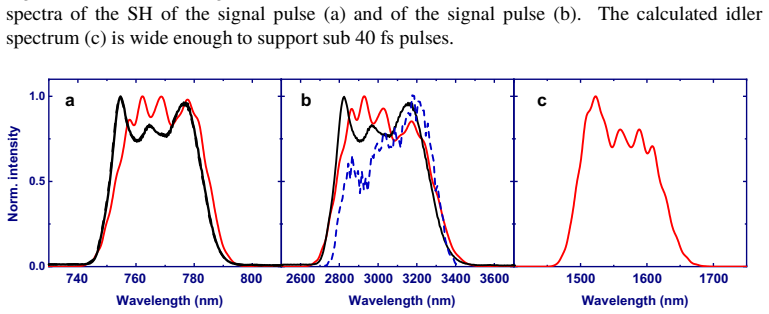
The central discovery is that a four-stage OPCPA chain based on bulk crystals—broadband non-collinear amplification in BBO at 800 nm, difference-frequency conversion to 1560 nm, amplification in KTA, and final collinear generation at 3000 nm in LiIO$_3$—can deliver $430\,\mu$J pulses with a $490$ nm bandwidth at 3000 nm, compressible to about $65$ fs. The system is seeded entirely by one Ti:sapphire oscillator, which also seeds the 1030 nm pump channel, so all stages are synchronized by construction. The measured spectrum, recorded by upconversion in a thin KTA crystal to avoid water-vapor absorption, exceeds 490 nm FWHM and supports 35 fs transform-limited pulses; the compressed duration is estimated from a 90 fs second-order autocorrelation trace using a Gaussian deconvolution factor of 1.4. Quantitative two-dimensional split-step calculations reproduce the stage energies and spectra and indicate that the configuration runs near optimum efficiency with minimal absorption. The authors conclude that the same architecture should operate at much higher repetition rates and average power, for example above 5 W at 20 kHz.
Load-bearing premise
The compressed pulse duration is estimated from a 90 fs autocorrelation trace assuming a Gaussian pulse profile, so the 65 fs figure is only as reliable as that shape assumption.
Editorial extensions
If this is right
- The demonstrated 490 nm bandwidth supports 35 fs transform-limited pulses, so adding higher-order dispersion compensation should shorten the compressed duration below the current 65 fs.
- Because KTA and LiIO$_3$ have low absorption at the operating wavelengths, the same chain should tolerate multi-kHz repetition rates; keeping 430 µJ per pulse at 20 kHz would give more than 5 W of average power.
- At 100 Hz and 430 µJ, the source is directly usable for strong-field experiments, including high-order harmonic generation and pump-probe studies of molecular and condensed-matter excitations.
- The active delay stabilization on the first stage locks the pump-seed timing, which is necessary for stable multi-stage OPCPA operation.
Reading between the lines
- If the 65 fs duration is verified by direct pulse measurement, the peak power of the 430 µJ pulses will be in the multi-gigawatt range, opening the same source to nonlinear self-compression and white-light seeding experiments; the paper does not state peak power.
- The upconversion spectral measurement, which records the MIR idler spectrum with a CCD in single-shot mode while avoiding water-vapor absorption, could be adopted as a standard diagnostic for other mid-infrared parametric amplifiers.
- The argument that the design scales to high average power rests not only on crystal absorption but also on the Yb pump chain delivering sufficient average power; the paper's outlook assumes that pump engineering will keep pace.
- A natural next test is to replace the sapphire compressor with a higher-order dispersion compensator and measure the autocorrelation again; if the pulse duration drops toward 35 fs, the full bandwidth claim is confirmed, and if not, residual phase errors are the culprit.
Signed reviews
Editorial analysis
A structured set of objections, weighed in public.
Referee Report
Summary. The manuscript reports a four-stage optical parametric chirped-pulse amplifier (OPCPA) seeded by a Ti:sapphire oscillator, generating 430 µJ pulses at 3000 nm with 490 nm FWHM bandwidth at 100 Hz. The first two stages operate at 800 nm and 1560 nm in BBO, the third at 1560 nm in KTA, and the fourth generates the 3000 nm idler in LiIO3. The authors compress the pulses to an estimated 65 fs using sapphire plates and support their measurements with a 2D split-step numerical model that reproduces the measured spectra and energies in the four stages.
Significance. If the results are confirmed, the system provides a notable combination of multi-µJ energy, broad bandwidth, and femtosecond duration in the mid-infrared, with a transform limit of 35 fs that is among the broadest reported in this spectral range. The paper's strength is the quantitative comparison between simulation and experiment across all stages, which lends credibility to the energy and spectral measurements. The main weakness is the compressed-duration estimate, which rests on a single autocorrelation trace and a Gaussian deconvolution assumption.
major comments (3)
- [Sec. 2.2, Fig. 6b] The claim that the pulses are compressed to about 65 fs is derived from the 90 fs FWHM second-order autocorrelation trace shown in Fig. 6b by applying the 1.4 deconvolution factor for a Gaussian temporal profile. The Gaussian shape is not verified, and the measured 490 nm bandwidth supports a 35 fs transform-limited duration, so a 90 fs AC width already implies that the pulse contains substantial uncompensated spectral phase or a non-Gaussian intensity profile (e.g., a pedestal). Since a second-order autocorrelation cannot distinguish a short main pulse from a longer structured pulse, the abstract and conclusion statements 'compressed to the duration of about 65 fs' (and 'sub-70 fs' in the introduction) are not sufficiently supported. Please provide independent phase-sensitive characterization at 3000 nm, or rephrase the claim to report the autocorrelation width and the Gaussian-deconvolved estimate with a clear caveat.
- [Sec. 2.2, fourth OPCPA stage] The output energy of 430 µJ at 3000 nm is a headline value, but the manuscript does not state how this energy (and the intermediate-stage energies) were measured, nor the associated uncertainty. For reproducibility and to allow the saturation and efficiency statements to be judged, please specify the detector type (e.g., thermal power meter, calibrated photodiode), calibration, and any averaging or error estimation.
- [Sec. 2.2, Fig. 5b, upconversion measurement] The MIR spectrum is measured by upconversion in a thin KTA crystal, and the authors argue that the measured spectrum can be mapped directly to the MIR idler because the 1030 nm pump is narrowband. This argument ignores the phase-matching acceptance bandwidth of the upconversion crystal, which could spectrally distort the idler. Please provide the thickness and phase-matching geometry of the upconversion KTA crystal and quantify the acceptance bandwidth, or compare the upconverted spectrum with the directly measured PbSe spectrum over a range that avoids water absorption lines. The agreement with the calculated spectrum in Fig. 5b is supportive, but the acceptance-bandwidth issue should be addressed.
minor comments (6)
- [Sec. 2.2, first stage] The measured signal energy is stated to be obtained with a 'calibrated fast photodiode' but no calibration or uncertainty is given; please add a sentence describing the calibration method and typical error bar.
- [Sec. 2.2, Fig. 6b] The AC trace appears to be a single measurement; please indicate whether the 90 fs width is an average over multiple traces and provide an error estimate.
- [Sec. 3, Conclusions] The statement that 'average power >5 W is achievable at the repetition rate of 20 kHz' is an extrapolation that does not account for thermal lensing or absorption-induced heating in the nonlinear crystals at high average power; please label this as a speculative outlook or support it with a thermal analysis.
- [Sec. 2.2, Fig. 6c] The beam profile would be more informative with the beam diameter (e.g., 1/e²) and the distance from the crystal stated in the caption.
- [Sec. 2.2 heading] The heading 'OPCP A' contains a stray space; please correct to 'OPCPA'.
- [Sec. 3, Conclusions] The absorption coefficients for KTA and LiIO3 are given in the conclusions, but the values used in the numerical model should be listed in the experimental section or figure captions, since the claim of 'minimum absorption losses' depends on them.
Circularity Check
No significant circularity: the central claims are experimental measurements whose supporting estimates rest on independent standard conversions and externally cited parameters.
full rationale
The paper's central quantitative claims (430 µJ at 3000 nm, 490 nm FWHM bandwidth, about 65 fs compressed duration) are experimental results, not derivations from an assumed conclusion. The 65 fs pulse duration is estimated from a measured 90 fs second-order autocorrelation FWHM using the standard deconvolution factor of 1.4 for Gaussian pulses; this factor is an independent mathematical input, not a parameter fitted from the claimed duration. The statement that the 490 nm bandwidth supports 35 fs is a separate Fourier-transform-limit calculation, and the paper explicitly acknowledges that reaching 35 fs would require compensation of higher-order dispersion. The split-step 2D simulations are compared against measured spectra and output energies in Figs. 2-5 rather than being used to define those measured quantities, so the 'close to optimum efficiency' statement is an independent model-measurement comparison. No load-bearing self-citations appear: the references cited for system components and crystal properties are external literature, and the authors' own previous work is not invoked as justification for any central premise. The Gaussian-pulse assumption in the autocorrelation deconvolution is a legitimate correctness or verification concern, since no independent spectral-phase retrieval is reported, but it is not circularity: the measured AC width and the deconvolution factor are not derived from the 65 fs claim. Accordingly, no circular step can be exhibited, and the appropriate score is 0.
Assumptions & free parameters
assumptions (5)
- domain assumption The split-step 2D Matlab code accurately models nonlinear propagation in the crystals (BBO, KTA, LiIO3) using standard Sellmeier equations and nonlinear coefficients.
- domain assumption The upconversion measurement in thin KTA directly maps the MIR idler spectrum to the visible without spectral distortion.
- ad hoc to paper The compressed pulse has a Gaussian temporal profile, so the AC deconvolution factor of 1.4 applies.
- domain assumption The B-integral remains below π/4 using the cited n2 values for BBO, KTA, and LiIO3.
- domain assumption Water vapor absorption is the cause of the 2700-2800 nm cut in the direct MIR spectrum.
Cite this review
Pith. "Pith review of Towards high power broad-band OPCPA at 3000 nm." pith.science (2026). https://pith.science/paper/NSPKG27R
@misc{pith2026190801879,
  author       = {Pith},
  title        = {Pith review of: Towards high power broad-band OPCPA at 3000 nm},
  year         = {2026},
  howpublished = {\url{https://pith.science/paper/NSPKG27R}},
  note         = {Machine review of arXiv:1908.01879}
}
abstract
High-energy femtosecond laser pulses in the mid-infrared (MIR) wavelength range are essential for a wide range of applications from strong-field physics to selectively pump and probe low energy excitations in condensed matter and molecular vibrations. Here we report a four stage optical parametric chirped pulse amplifier (OPCPA) which generates ultrashort pulses at a central wavelength of 3000 nm with 430 $\mu$J energy per pulse at a bandwidth of 490 nm. Broadband emission of a Ti:sapphire oscillator seeds synchronously the four OPCPA stages at 800 nm and the pump line at 1030 nm. The first stage amplifies the 800 nm pulses in BBO using a non-collinear configuration. The second stage converts the wavelength to 1560 nm using difference frequency generation in BBO in a collinear geometry. The third stage amplifies this idler frequency non-collinearly in KTA. Finally, the fourth stage generates the 3000 nm radiation in a collinear configuration in LiIO$_3$ due the broad amplification bandwidth this crystal provides. We compress these pulses to 65 fs by transmission through sapphire. Quantitative calculations of the individual non-linear processes in all stages verify that our OPCPA architecture operates close to optimum efficiency at minimum absorption losses, which suggests that this particular design is very suitable for operation a high average power at multi kHz repetition rates.
Figures


Figures from the paper (4 more)


Reference graph
Works this paper leans on
-
[1]
T.Tajima and J.M.Dawson, “Laser electron accelerator,” Phys. Rev. Lett. 43, 267–270 (1979)
work page 1979
-
[2]
D. Woodbury, L. Feder, V . Shumakova, C. Gollner, R. Schwar tz, B. Miao, F. Salehi, A. Korolov, A. Pugžlys, A. Baltuška, and H. M. Milchberg, “Powerful femtosecond pulse generation by chirped and stretched pulse parametric amplification in BBO crystal,” Opt. Lett. 43, 1131–1134 (2018)
work page 2018
-
[3]
Phase matching of high harmonic generation in t he soft and hard X-ray regions of the spectrum,
T. Popmintchev, M.-C. Chen, A. Bahabad, M. Gerrity, P . Sid orenko, O. Cohen, I. Christov, M. Murnane, and H. Kapteyn, “Phase matching of high harmonic generation in t he soft and hard X-ray regions of the spectrum,” PNAS 106, 10,516–10,521 (2009)
work page 2009
-
[4]
Bright Cohere nt Ultrahigh Harmonics in the ke V X-ray Regime from Mid-Infrared Femtosecond Lasers,
T. Popmintchev, M.-C. Chen, D. Popmintchev, P . Arpin, S. B rown, S. Ališauskas, G. Andriukaitis, T. Balčiunas, O. Mücke, A. Pugžlys, A. Baltuška, B. Shim, S. Schrauth, A. Ga eta, C. Hernández-García, L. Plaja, A. Becker, A. Jaron-Becker, M. Murnane, and H. Kapteyn, “Bright Cohere nt Ultrahigh Harmonics in the ke V X-ray Regime from Mid-Infrared Femtoseco...
work page 2012
-
[5]
Optical attosecond pulses and tracking the nonlinear response of bound electrons,
M. T. Hassan, T. T. Luu, A. Moulet, O. Raskazovskaya, P . Zho khov, M. Garg, N. Karpowicz, A. M. Zheltikov, V . Pervak, F. Krausz, and E. Goulielmakis, “Optical attosecond pulses and tracking the nonlinear response of bound electrons,” Nature 530, 66–70 (2016)
work page 2016
-
[6]
Linking high harmonics from gases and solids,
G. Vampa, T. J. Hammond, B. E. S. N. Thiré and, F. Légaré, C. R . McDonald, T. Brabec, and P . B. Corkum, “Linking high harmonics from gases and solids,” Nature 522, 462–464 (2015)
work page 2015
-
[7]
High-brightness table-top hard X-ray source drivenby sub -100-femtosecond mid-infrared pulses,
J. Weisshaupt, V . Juvé, M. Holtz, S. Ku, M. Woerner, T. Elsa esser, S. Ališauskas, A. Pugžlys, and A. Baltuška, “High-brightness table-top hard X-ray source drivenby sub -100-femtosecond mid-infrared pulses,” Nature Photon. 8, 927–930 (2014)
work page 2014
-
[8]
P . Komm, U. Sheintop, S. Noach, and G. Marcus, “Carrier-to -envelope phase-stable, mid-infrared, ultrashort pulses from a hybrid parametric generator: Cr:ZnSe laser amplifier system,” Opt. Express 27, 18,522–18,532 (2019)
work page 2019
Show all 37 references
-
[9]
High average pow er, high-repetition rate femtosecond pulse generation in the 1–5 µ m region using an optical parametric oscillator,
D. E. Spence, S. Wielandy, and C. L. Tang, “High average pow er, high-repetition rate femtosecond pulse generation in the 1–5 µ m region using an optical parametric oscillator,” Appl. Phy s. Lett. 68, 452–454 (1996)
1996
-
[10]
Fe mtosecond pulses tunable beyond 4 µ m from a KTA-based optical parametric oscillator,
C. McGowan, D. Reid, M. Ebrahimzadeh, and W. Sibbett, “Fe mtosecond pulses tunable beyond 4 µ m from a KTA-based optical parametric oscillator,” Opt. Commun. 134, 186–190 (1997)
1997
-
[11]
Seeded femtosecond optical parametric amplification in the mid-infrared spectral region above 3 µ m,
V . Petrov, F. Noack, and R. Stolzenberger, “Seeded femtosecond optical parametric amplification in the mid-infrared spectral region above 3 µ m,” Appl. Opt. 36, 1164–1172 (1997)
1997
-
[12]
Femtosecond pulses tunable beyond 4 µ m from a KTA-based optical parametric oscillator,
R. A. Kaindl, M. Wurm, K. Reimann, P . Hamm, A. M. Weiner, an d M. Woerner, “Femtosecond pulses tunable beyond 4 µ m from a KTA-based optical parametric oscillator,” J. Opt. S oc. Am. B 17, 2086–2094 (2000)
2000
-
[13]
Generation of broadband mid- infrared pulses from an optical parametric amplifier,
D. Brida, C. Manzoni, G. Cirmi, M. Marangoni, S. D. Silves tri, and G. Cerullo, “Generation of broadband mid- infrared pulses from an optical parametric amplifier,” Opt. Express 15, 15,035–15,040 (2007)
2007
-
[14]
Optical param etric amplification of carrier-envelope phase-stabilized mid-infrared pulses generated by intra-pulse difference fr equency generation,
N. Ishii, P . Xia, T. Kanai, and J. Itatani, “Optical param etric amplification of carrier-envelope phase-stabilized mid-infrared pulses generated by intra-pulse difference fr equency generation,” Opt. Express 27(8), 11,447–11,454 (2019)
2019
-
[15]
Powerf ul femtosecond pulse generation by chirped and stretched pulse parametric amplification in BBO crystal,
A. Dubietis, G. Jonušauskas, and A. Piskarskas, “Powerf ul femtosecond pulse generation by chirped and stretched pulse parametric amplification in BBO crystal,” Opt. Commun . 88, 437–440 (1992)
1992
-
[16]
Sub-four-cycle laser pulses directly from a high-repetition-rate optical parametric chirped-pulse a mplifier at 3.4 µ m,
B. W. Mayer, C. R. Phillips, L. Gallmann, M. M. Fejer, and U . Keller, “Sub-four-cycle laser pulses directly from a high-repetition-rate optical parametric chirped-pulse a mplifier at 3.4 µ m,” Opt. Lett. 38, 4265–4268 (2013)
2013
-
[17]
Kanai, Y
T. Kanai, Y . Lee, M. Seo, and D. E. Kim, “Supercontinuum-s eeded, carrier-envelope phase-stable, 4.5-W, 3.8 µ m, 6-cycle, KTA optical parametric amplifier driven by a 1.4-ps Yb:YAG thin-disk amplifier for nonperturbative spectroscopy in solids,” J. Opt. Soc. Am. B 36(9), 2407–2...
2019
-
[18]
2D IR spectroscopy at 100 kHz utilizing a Mid-IR OPCPA laser source,
B. M. Luther, K. M. Tracy, M. Gerrity, S. Brown, and A. T. Kr ummel, “2D IR spectroscopy at 100 kHz utilizing a Mid-IR OPCPA laser source,” Opt. Express 24(4), 4117–4127 (2016)
2016
-
[19]
Generation of millijoule few-cycle pulses at 5 µ m by indirect spectral shaping of the idler in an optical paramet ric chirped pulse amplifier,
M. Bock, L. von Grafenstein, U. Griebner, and T. Elsaesse r, “Generation of millijoule few-cycle pulses at 5 µ m by indirect spectral shaping of the idler in an optical paramet ric chirped pulse amplifier,” J. Opt. Soc. Am. B 35(12), C18–C24
-
[20]
Multi-millijoule few-cycle mid-infrared pulses through nonlinear self-compression in bulk,
V . Shumakova, P . Malevich, S. Ališauskas, A. Voronin, A. Zheltikov, D. Faccio, D. Kartashov, A. Baltuška, and A. Pugžlys, “Multi-millijoule few-cycle mid-infrared pulses through nonlinear self-compression in bulk,” Nat. Commun. 7, 12,877 (2016)
2016
-
[21]
90 GW peak power few-cycle mid-infrared pulses from an optical parametric amplifier,
G. Andriukaitis, T. Balči¯ unas, S. Ališauskas, A. Pugžl ys, A. Baltuška, T. Popmintchev, M.-C. Chen, M. Murnane, and H. Kapteyn, “90 GW peak power few-cycle mid-infrared pulses from an optical parametric amplifier,” Opt. Lett. 36, 2755–2757 (2011)
2011
-
[22]
Ultrafast Optical Parametric Chirped-Pulse Amplification,
S. Witte and K. Eikema, “Ultrafast Optical Parametric Chirped-Pulse Amplification,” IEEE J. Sel. Topics Quantum Electron. 18, 296–307 (2013)
2013
-
[23]
Non-collinear optical param etric chirped-pulse amplifier for few-cycle pulses,
J. Zheng and H. Zacharias, “Non-collinear optical param etric chirped-pulse amplifier for few-cycle pulses,” Appl. Phys. B 97, 765–779 (2009)
2009
-
[24]
Pulse-front -matched optical parametric amplificationfor sub-10-fs pulse generationtunable in the visible and near infrared,
A. Shirakawa, I. Sakane, and T. Kobayashi, “Pulse-front -matched optical parametric amplificationfor sub-10-fs pulse generationtunable in the visible and near infrared,” Opt. Lett. 23, 1292–1294 (1998)
1998
-
[25]
Broadband noncollinear optical parametric amplification without angularly dispersed idler,
S.-W. Huang, J. Moses, and F. Kärtner, “Broadband noncollinear optical parametric amplification without angularly dispersed idler,” Opt. Lett. 37, 2796–2798 (2012)
2012
-
[26]
Pulse-front matching of ult rabroadband near-infrared noncollinear optical parametr ic amplified pulses,
O. Isaienko and E. Borguet, “Pulse-front matching of ult rabroadband near-infrared noncollinear optical parametr ic amplified pulses,” J. Opt. Soc. Am. B 26, 965–972 (2009)
2009
-
[27]
High-power OPCPA generating 1.7 cycle pulses at 2.5 µ m,
N. Bigler, J. Pupeikis, S. Hrisafov, L. Gallmann, C. R. Ph illips, and U. Keller, “High-power OPCPA generating 1.7 cycle pulses at 2.5 µ m,” Opt. Express 26(20), 26,750–26,757 (2018)
2018
-
[28]
Highly sta ble, 15 W, few-cycle, 65 mrad CEP-noise mid-IR OPCPA for statistical physics,
N. Thiré, R. Maksimenka, B. Kiss, C. Ferchaud, G. Gitzing er, T. Pinoteau, H. Jousselin, S. Jarosch, P . Bizouard, V . D. Pietro, E. Cormier, K. Osvay, and N. Forget, “Highly sta ble, 15 W, few-cycle, 65 mrad CEP-noise mid-IR OPCPA for statistical physics,” Opt. Express 26(21)...
2018
-
[29]
300 µ J, 3 W, few-cycle, 3 µ m OPCPA based on periodically poled stoichiometric lithium tantalate crys tals,
X. Zou, W. Li, H. Liang, K. Liu, S. Qu, Q. J. Wang, and Y . Zhan g, “300 µ J, 3 W, few-cycle, 3 µ m OPCPA based on periodically poled stoichiometric lithium tantalate crys tals,” Opt. Lett. 44(11), 2791–2794 (2019)
2019
-
[30]
Supercontinuum-seeded few-cycle mid-infrared OPCPA system,
P . Rigaud, A. V . de Walle, M. Hanna, N. Forget, F. Guichard , Y . Zaouter, K. Guesmi, F. Druon, and P . Georges, “Supercontinuum-seeded few-cycle mid-infrared OPCPA system,” Opt. Express 24, 26,494–26,502 (2016)
2016
-
[31]
Transmission measurements in KTP and isomorphic compounds,
G. Hansson, H. Karlsson, S. Wang, and F. Laurell, “Transmission measurements in KTP and isomorphic compounds,” Appl. Opt. 39, 5058–5069 (2000)
2000
-
[32]
High- power dual mode IR and NIR OPCPA,
K. Mecseki, M. K. R. Windeler, M. J. Prandolini, J. S. Robi nson, J. M. Fraser, A. R. Fry, and F. Tavella, “High- power dual mode IR and NIR OPCPA,” in Proc. SPIE 11033, High-Power, High-Energy, and High-Intensity Laser Technology IV, J. Hein and T. J. Butcher, eds., p. 110330I (2019)
2019
-
[33]
High average power 88 W OPCPA system for high-repetition-rate experimen ts at the LCLS x-ray free-electron laser,
K. Mecseki, M. K. R. Windeler, A. Miahnahri, J. S. Robinso n, J. M. Fraser, A. R. Fry, and F. Tavella, “High average power 88 W OPCPA system for high-repetition-rate experimen ts at the LCLS x-ray free-electron laser,” Opt. Lett. 44, 1257–1260 (2019)
2019
-
[34]
400 W Yb:YAG Innoslab fs-amplifier,
P . Russbueldt, T. Mans, G. Rotarius, J. Weitenberg, H. Ho ffmann, and R. Poprawe, “400 W Yb:YAG Innoslab fs-amplifier,” Opt. Express 17, 12,230–12,245 (2009)
2009
-
[35]
Improving carrier-envelope phase stability in optical parametric chirped-pulse ampli fiers by control of timing jitter,
S. Hädrich, J. Rothhardt, M. Krebs, S. Demmler, J. Limper t, and A. Tünnermann, “Improving carrier-envelope phase stability in optical parametric chirped-pulse ampli fiers by control of timing jitter,” Opt. Lett. 37, 4910–4912 (2012)
2012
-
[36]
Close to transform- limited, few-cycle 12µ J pulses at 400 kHz for applications in ultrafast spectroscopy,
F. J. Furch, A. Giree, F. Morales, A. Anderson, Y . Wang, C. P . Schulz, and M. J. J. Vrakking, “Close to transform- limited, few-cycle 12µ J pulses at 400 kHz for applications in ultrafast spectroscopy,” Opt. Express24, 19,293–19,310 (2016)
2016
-
[37]
Some Optical Properties of KTP, LiIO3, and LiNbO3,
D. J. Gettemy, W. C. Harker, G. Lindholm, and N. P . Barnes,“Some Optical Properties of KTP, LiIO3, and LiNbO3,” IEEE J. of QE 24, 2231–2237 (1988)
1988
Reviewed August 14, 2026 · model on record in the stance chip above.
Discussion (0). Continue with ORCID to comment.