Mass Conservation as an Inductive Bias for Self-Organized Criticality in NCA Reservoirs
Pith reviewed 2026-06-26 06:04 UTC · model grok-4.3
The pith
Mass conservation acts as an inductive bias that makes evolved NCA reservoirs reach self-organized criticality more reliably while preserving task performance.
A machine-rendered reading of the paper's core claim, the machinery that carries it, and where it could break.
Core claim
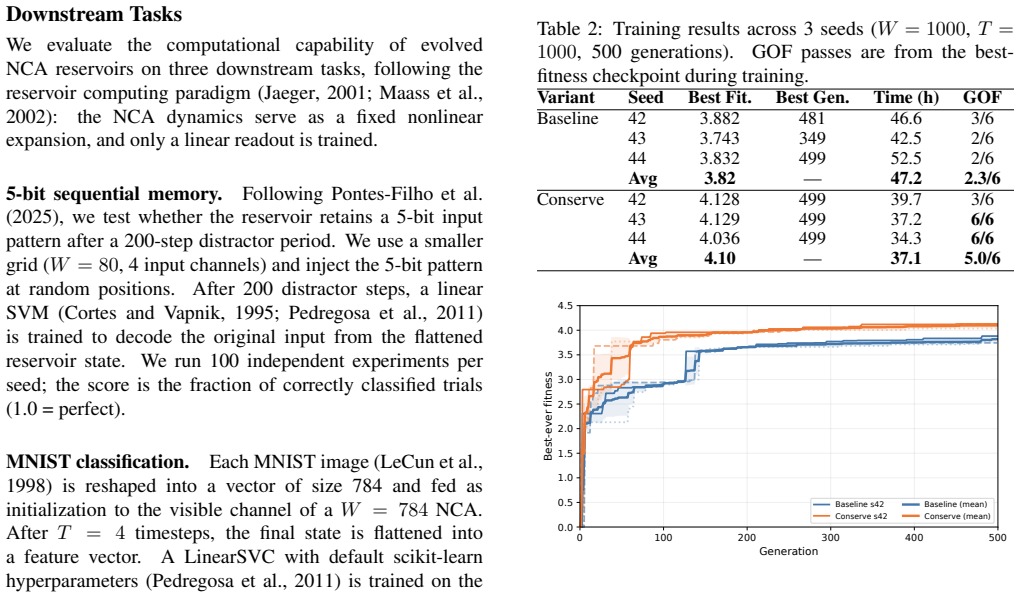
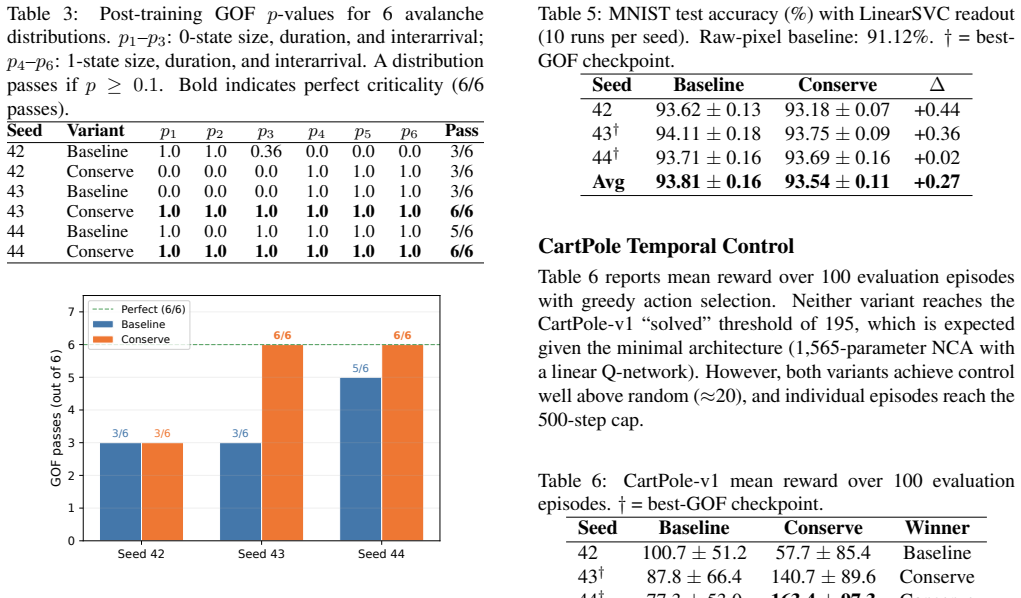
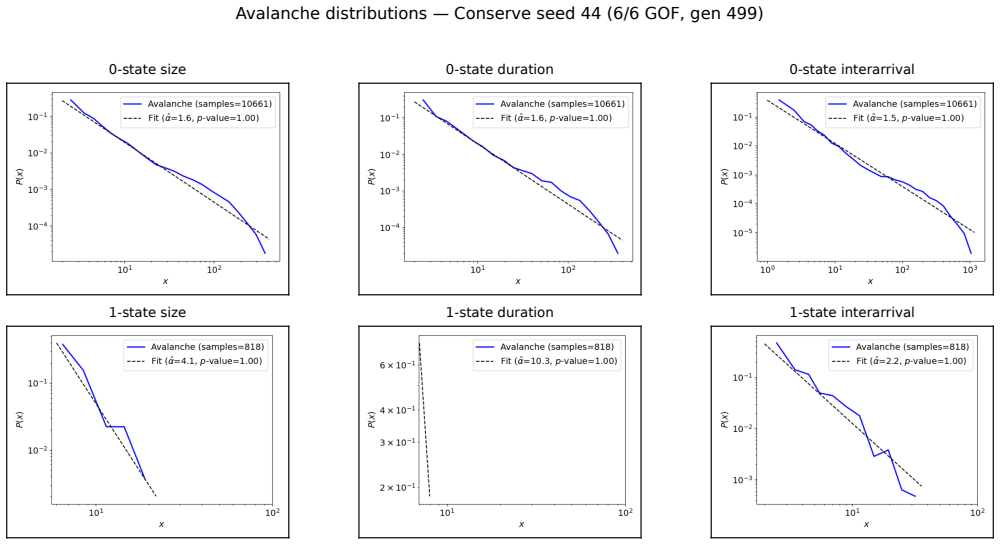
Evolved mass-conserving NCA reservoirs exhibit stronger and more consistent self-organized criticality, measured by perfect power-law fits to avalanche distributions, than otherwise identical non-conserving NCA while showing no loss in downstream utility across three tasks.
What carries the argument
The mass-conservation rule, a local redistribution step that keeps total lattice mass fixed, used as an inductive bias during evolutionary search for critical reservoir dynamics.
If this is right
- A larger fraction of evolutionary runs reach perfect power-law avalanche statistics.
- Evolutionary search completes 1.27 times faster on average.
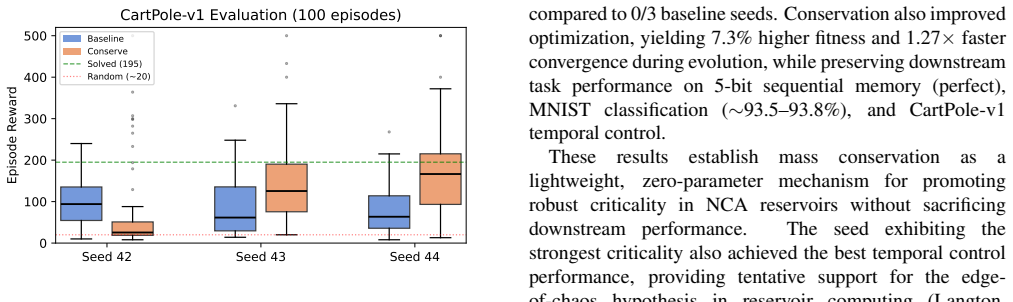
- Reservoir performance remains statistically indistinguishable on 5-bit memory, MNIST classification, and CartPole control.
- The single reservoir with the strongest criticality signature also achieves the highest temporal-control score.
Where Pith is reading between the lines
- Conservation constraints could be tested as a general stabilizer of criticality in other spatially extended dynamical systems used for computation.
- The observed correlation between perfect criticality and peak control performance could be probed by injecting artificial conservation or criticality penalties into non-conserving models.
- Physical reservoir hardware built from mass-conserving update rules might require fewer design iterations to reach usable critical regimes.
Load-bearing premise
That perfect power-law fits to avalanche distributions reliably indicate self-organized criticality whose presence improves computational utility, and that evolutionary search behaves equivalently for the two NCA variants.
What would settle it
A controlled comparison in which non-conserving NCA are given additional evolutionary generations or altered fitness functions until their avalanche distributions match those of conserving NCA, followed by re-testing on the same three tasks to check whether performance stays equal.
Figures
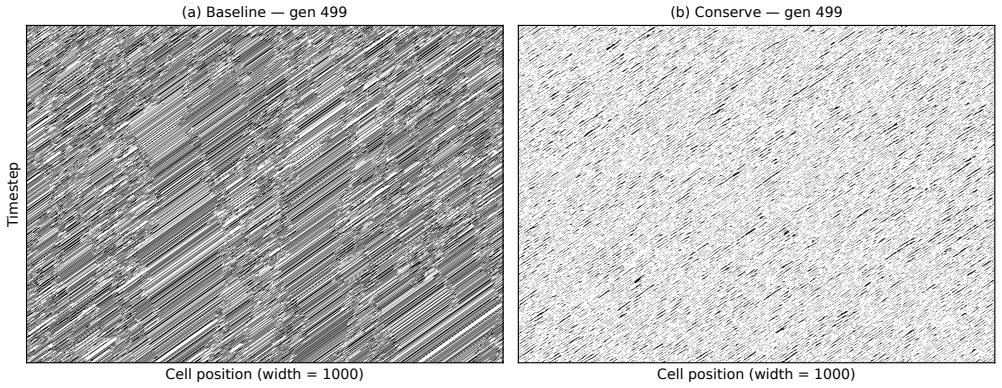
read the original abstract
Self-organized criticality (SOC), a dynamical regime associated with maximal information processing, offers a promising foundation for reservoir computing. Recent work has shown that neural cellular automata (NCA) can be evolved toward critical avalanche dynamics and employed as effective reservoirs for memory and classification tasks. Here, we investigate whether mass conservation -- a local redistribution rule that preserves total lattice mass -- serves as an inductive bias toward SOC in evolved NCA reservoirs. We compare mass-conserving and standard NCA across multiple independent runs and evaluate both on three downstream benchmarks: 5-bit sequential memory, MNIST digit classification, and CartPole-v1 temporal control. Mass-conserving NCA consistently exhibit stronger criticality, with more runs achieving perfect power-law fits across avalanche distributions, while also being 1.27$\times$ faster during evolution. Importantly, conservation does not impair downstream utility: both variants achieve comparable performance across all three tasks. Furthermore, the reservoir with perfect criticality achieves the highest temporal control score, suggesting a positive link between SOC quality and sequential computation. Our results demonstrate that mass conservation is a simple, effective mechanism for promoting robust criticality in evolved NCA reservoirs without sacrificing downstream performance.
Editorial analysis
A structured set of objections, weighed in public.
Referee Report
Summary. The paper claims that mass conservation acts as an inductive bias promoting robust self-organized criticality (SOC) in evolved neural cellular automata (NCA) reservoirs. Across multiple independent evolutionary runs, mass-conserving NCA achieve more instances of perfect power-law fits to avalanche size and duration distributions than standard NCA, evolve 1.27× faster, and deliver statistically comparable performance on 5-bit sequential memory, MNIST classification, and CartPole-v1 control tasks, with the single reservoir exhibiting the strongest criticality also attaining the highest control score.
Significance. If the empirical distinction in criticality measures is robust, the result supplies a simple, local, parameter-free rule that biases NCA evolution toward SOC without downstream cost. This could streamline the design of reservoir computers that exploit critical dynamics for sequential tasks. The reported evolutionary speedup and the apparent correlation between criticality quality and temporal-control performance are practically useful observations that merit follow-up.
major comments (3)
- [Methods] Methods (power-law fitting protocol): the abstract and results repeatedly invoke 'perfect power-law fits' as the primary indicator of stronger SOC, yet no section specifies the fitting procedure (MLE vs. least-squares), xmin selection method, KS-statistic threshold, scale range examined, or goodness-of-fit tests against log-normal or exponential alternatives. Because the central claim rests on the differential count of such fits, this omission is load-bearing.
- [Methods] Methods (evolutionary search equivalence): the comparison assumes identical evolutionary dynamics (population size, mutation rates, fitness evaluation, selection) between the two NCA variants, but the text provides no explicit confirmation that these hyperparameters and the fitness function itself are held constant. Any unintended difference in search pressure could produce the observed difference in criticality statistics.
- [Results] Results (downstream-task statistics): while the abstract states 'comparable performance,' no table or section reports means, standard deviations, or statistical significance tests across the multiple runs for the three benchmarks. Without these, the claim that conservation 'does not impair downstream utility' cannot be quantitatively assessed.
minor comments (2)
- [Abstract / Results] The abstract states 'more runs achieving perfect power-law fits' but does not give the total number of independent runs or the exact fraction for each variant; this numerical detail should appear in the results section or a table.
- [Background] Notation for avalanche observables (size, duration, lifetime) should be defined once in a dedicated subsection rather than introduced piecemeal.
Simulated Author's Rebuttal
We thank the referee for their constructive and detailed comments. We address each major point below and have revised the manuscript to incorporate the requested clarifications and additional reporting.
read point-by-point responses
-
Referee: [Methods] Methods (power-law fitting protocol): the abstract and results repeatedly invoke 'perfect power-law fits' as the primary indicator of stronger SOC, yet no section specifies the fitting procedure (MLE vs. least-squares), xmin selection method, KS-statistic threshold, scale range examined, or goodness-of-fit tests against log-normal or exponential alternatives. Because the central claim rests on the differential count of such fits, this omission is load-bearing.
Authors: We agree that the power-law fitting protocol requires explicit documentation. In the revised manuscript we have added a new subsection in Methods that specifies the maximum-likelihood estimation procedure, the KS-statistic method for xmin selection, the examined scale ranges, the KS-statistic threshold employed, and the comparative goodness-of-fit tests against log-normal and exponential alternatives. The criteria used to classify a fit as 'perfect' are now also stated. revision: yes
-
Referee: [Methods] Methods (evolutionary search equivalence): the comparison assumes identical evolutionary dynamics (population size, mutation rates, fitness evaluation, selection) between the two NCA variants, but the text provides no explicit confirmation that these hyperparameters and the fitness function itself are held constant. Any unintended difference in search pressure could produce the observed difference in criticality statistics.
Authors: The evolutionary hyperparameters and fitness function were in fact identical; the sole difference between conditions was the addition of the mass-conservation rule. We have now inserted an explicit statement in the Methods section confirming that population size, mutation rates, selection operator, and the fitness function were held constant across both NCA variants. revision: yes
-
Referee: [Results] Results (downstream-task statistics): while the abstract states 'comparable performance,' no table or section reports means, standard deviations, or statistical significance tests across the multiple runs for the three benchmarks. Without these, the claim that conservation 'does not impair downstream utility' cannot be quantitatively assessed.
Authors: We accept that quantitative statistics are needed to support the comparability claim. The revised manuscript now contains a new table in Results that reports mean performance, standard deviations, and the outcomes of statistical significance tests (two-sample t-tests) across the independent evolutionary runs for the 5-bit memory, MNIST, and CartPole benchmarks. revision: yes
Circularity Check
No circularity: empirical comparison of NCA variants with independent measurements
full rationale
The paper reports an experimental comparison between mass-conserving and standard NCA reservoirs. Criticality is assessed via avalanche statistics on evolved models, and utility is measured on separate downstream tasks (memory, classification, control). No equations, predictions, or central claims reduce by construction to fitted parameters, self-defined quantities, or load-bearing self-citations within the paper. The derivation chain consists of independent evolutionary runs and benchmark evaluations whose outcomes are not forced by the inputs or prior author work.
Axiom & Free-Parameter Ledger
axioms (1)
- domain assumption Avalanche size and duration distributions that fit power laws indicate the presence of self-organized criticality
Reference graph
Works this paper leans on
-
[1]
Artificial Life Conference Proceedings , volume =
Pontes-Filho, Sidney and Nichele, Stefano and Lepperød, Mikkel , title =. Artificial Life Conference Proceedings , volume =. 2025 , publisher =
2025
-
[2]
Artificial Life Conference Proceedings , volume =
Papadopoulos, Vassilis and Guichard, Etienne , title =. Artificial Life Conference Proceedings , volume =. 2025 , publisher =
2025
-
[3]
Physical Review Letters , volume =
Bak, Per and Tang, Chao and Wiesenfeld, Kurt , title =. Physical Review Letters , volume =
-
[4]
, title =
Langton, Christopher G. , title =. Physica D: Nonlinear Phenomena , volume =
-
[5]
GMD Technical Report , volume =
Jaeger, Herbert , title =. GMD Technical Report , volume =
-
[6]
Real-time computing without stable states: A new framework for neural computation based on perturbations , journal =
Maass, Wolfgang and Natschl\". Real-time computing without stable states: A new framework for neural computation based on perturbations , journal =
-
[7]
Reservoir computing using cellular automata , journal =
Yilmaz, Ozg\". Reservoir computing using cellular automata , journal =
-
[8]
Evolutionary Computation , volume =
Hansen, Nikolaus and Ostermeier, Andreas , title =. Evolutionary Computation , volume =
-
[9]
Clauset, Aaron and Shalizi, Cosma Rohilla and Newman, Mark E. J. , title =. SIAM Review , volume =
-
[10]
Real-time computation at the edge of chaos in recurrent neural networks , journal =
Bertschinger, Nils and Natschl\". Real-time computation at the edge of chaos in recurrent neural networks , journal =
-
[11]
Gradient-based learning applied to document recognition , journal =
LeCun, Yann and Bottou, L\'. Gradient-based learning applied to document recognition , journal =
-
[12]
Brockman, Greg and Cheung, Vicki and Pettersson, Ludwig and Schneider, Jonas and Schulman, John and Tang, Jie and Zaremba, Wojciech , title =. arXiv preprint arXiv:1606.01540 , year =
work page internal anchor Pith review Pith/arXiv arXiv
-
[13]
Complex Systems , volume =
Nichele, Stefano and Molund, Andreas , title =. Complex Systems , volume =
-
[14]
Distill , year =
Mordvintsev, Alexander and Randazzo, Ettore and Niklasson, Eyvind and Levin, Michael , title =. Distill , year =
-
[15]
and Lind, Pedro and Yazidi, Anis and Osipov, Evgenii and Nichele, Stefano , title =
Glover, Thomas E. and Lind, Pedro and Yazidi, Anis and Osipov, Evgenii and Nichele, Stefano , title =. Complex Systems , volume =
-
[16]
arXiv preprint arXiv:2407.09501 , year =
Glover, Thomas and Osipov, Evgenii and Nichele, Stefano , title =. arXiv preprint arXiv:2407.09501 , year =
-
[17]
Machine Learning , volume =
Cortes, Corinna and Vapnik, Vladimir , title =. Machine Learning , volume =
-
[18]
and Sandvig, Ioanna and Tufte, Gunnar and Nichele, Stefano , title =
Pontes-Filho, Sidney and Lind, Pedro and Yazidi, Anis and Zhang, Jianhua and Hammer, Hugo and Mello, Gustavo B. and Sandvig, Ioanna and Tufte, Gunnar and Nichele, Stefano , title =. Cognitive Neurodynamics , volume =
-
[19]
Scikit-learn: Machine learning in
Pedregosa, Fabian and Varoquaux, Ga\". Scikit-learn: Machine learning in. Journal of Machine Learning Research , volume =
-
[20]
Innovations in Machine Intelligence , volume =
Variengien, Alexandre and Nichele, Stefano and Glover, Thomas and Pontes-Filho, Sidney , title =. Innovations in Machine Intelligence , volume =
-
[21]
Guichard, Etienne , title =
-
[22]
and Nichele, Stefano , title =
Pontes-Filho, Sidney and Lind, Pedro G. and Nichele, Stefano , title =. Physica D: Nonlinear Phenomena , volume =
-
[23]
ALIFE 2023: Ghost in the Machine Workshop , year =
Pontes-Filho, Sidney and Nichele, Stefano and Lepperød, Mikkel , title =. ALIFE 2023: Ghost in the Machine Workshop , year =
2023
-
[24]
Pontes-Filho, Sidney and Lind, Pedro and Yazidi, Anis and Zhang, Jianhua and Hammer, Hugo and Mello, Gustavo B. M. and Sandvig, Ioanna and Tufte, Gunnar and Nichele, Stefano , title =. International Conference on the Applications of Evolutionary Computation (EvoStar) , pages =
-
[25]
Plantec, Erwan and Hamon, Gautier and Etcheverry, Mayalen and Oudeyer, Pierre-Yves and Moulin-Frier, Cl\'. Flow. Companion Proceedings of the Conference on Artificial Life (ALIFE) , year =
discussion (0)
Sign in with ORCID, Apple, or X to comment. Anyone can read and Pith papers without signing in.