REVIEW 4 major objections 6 minor 91 references
SHINE: A Scalable HNSW Index in Disaggregated Memory
T0 review · 4 major / 6 minor · reviewed 2026-08-06 · deepseek-v4-flash
Pith's one-line read Shine proposes a distributed HNSW index that keeps every graph edge and therefore matches the recall of a single-machine HNSW.
desk verdict Graph-preserving HNSW for disaggregated memory is a genuine contribution; the evaluation needs an oracle ablation and an operationalized CSP before the throughput claims are airtight. read the letter →
The pith
A machine-rendered reading of the paper's core claim, the machinery that carries it, and where it could break.
The reading
What carries the argument
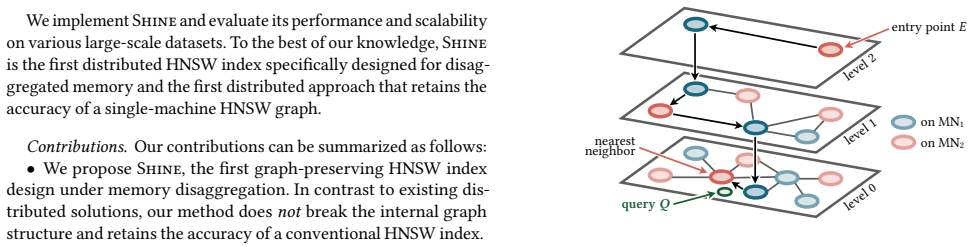
The load-bearing mechanism is the pairing of logical index partitioning with adaptive query routing over a global HNSW graph that keeps all edges. The index is divided only logically: balanced k-means clusters a small representative sample of nodes into as many near-equal partitions as there are compute nodes, using vector coordinates, and an oracle ranks compute nodes by the distance between the query vector and each partition's centroid. A router forwards each query to the best-ranked compute node that still has capacity in the current batch, relaying messages through a random memory node with two-sided RDMA, and the per-node limits are adjusted by broadcasting working-queue lengths. The cache itself is a lock-free hash table with a cooling-table replacement policy that admits upper-level nodes always and base-level nodes with a small fixed probability.
What would settle it
Run the full system on a workload whose query vectors are uniform in coordinate space but whose HNSW traversal repeatedly crosses cluster boundaries, for example a synthetic manifold where all queries arrive near the same few hub vectors; if the oracle routes to the closest centroid yet cache hit rate and throughput stay at the no-routing level, coordinate clustering is not predicting cache locality.
Extended reading notes
Core claim
The central claim is that a distributed ANN index in disaggregated memory can have the exact graph structure, and therefore the exact accuracy, of a single-machine HNSW, and that the network bottleneck this creates can be addressed by treating the union of compute-node caches as one logical cache. Shine stores node records, each holding vector components and remote pointers to neighbor lists, on arbitrary memory nodes, and leaves the HNSW search algorithm unchanged except that neighbor lists and vectors are fetched by RDMA. Because a query touches thousands of nodes, Shine clusters the HNSW nodes into as many balanced partitions as there are compute nodes, ranks partitions by centroid distance to the query through an oracle, and adaptively routes each query to the best-ranked compute node with spare capacity. The cache segmentation penalty formalizes how much hit rate is lost because separate caches duplicate entries; in the evaluation, routing reduces this penalty from roughly 70 percent to between 12 and 55 percent and raises throughput by up to 1.7x.
Load-bearing premise
The load-bearing premise is that vector-space proximity, as captured by balanced k-means centroids, predicts which compute node will serve a query with the best cache hit rate; if graph-walk popularity does not align with coordinate clusters, best-fit routing will not raise hit rates and the throughput gains disappear.
Editorial extensions
If this is right
- A deployment can scale to billions of vectors by adding memory nodes without rebuilding or re-sharding the index, since the HNSW graph is global and individual nodes live on arbitrary memory nodes.
- Recall parity with single-machine HNSW means accuracy parameters can be tuned on a small machine and carried over unchanged to the distributed setting.
- Uniform query workloads, the worst case for caching, still gain throughput because partitioned caches collectively hold more distinct graph nodes.
- Skewed workloads gain the most, with measured throughput up to 27.8k queries per second and cache hit rates of 70 to 81 percent when routing and caching are combined.
Reading between the lines
- If coordinate proximity tracks graph-walk co-access, the same partition-and-route pattern should transfer to other graph-based ANN indexes, and the centroid oracle could be replaced by a learned router on harder workloads.
- The cache segmentation penalty is a reusable diagnostic for any distributed cache: measuring it before and after a routing change separates the contribution of cache specialization from the contribution of load balancing.
- A stress test the paper does not run is a workload with uniform query vectors but hub-heavy graph traversal; such a workload would reveal whether the oracle depends on coordinate space matching traversal locality.
- The two-sided routing path through a random memory node could become the bottleneck at very high query rates or with many compute nodes, so routing scalability under those conditions is a natural next experiment.
Editorial analysis
A structured set of objections, weighed in public.
Referee Report
Summary. The paper proposes SHINE, a distributed HNSW index for disaggregated memory. The index stores a global HNSW graph on memory nodes and preserves all edges, so the exact traversal and hence the accuracy of a single-machine HNSW is retained by construction. To reduce RDMA read amplification, SHINE adds per-compute-node caching, a logical partition of the graph built with balanced k-means, and an adaptive query-routing policy that sends each query to the compute node whose partition centroid is closest to the query. The evaluation on five 100M-vector datasets reports throughput improvements over three variants of SHINE and a new cache segmentation penalty metric. The paper also positions SHINE as the first graph-preserving HNSW index for disaggregated memory.
Significance. If the empirical claims hold, SHINE is a useful contribution to systems for approximate nearest neighbor search on disaggregated memory. The graph-preserving design is a clean and principled way to avoid the accuracy loss that comes from sharding HNSW graphs, and the same-accuracy claim is definitional if the graph and traversal are indeed preserved. The caching, logical partitioning, and adaptive routing address a real bandwidth bottleneck, and the authors provide an open-source implementation. The main risk is that the key mechanism behind the reported gains—the k-means oracle—is not independently validated. The evaluation also lacks measured recall values, error bars, and a comparison with existing distributed HNSW systems. These are addressable with additional experiments, so the paper merits major revision rather than rejection.
major comments (4)
- [§6.2, §7.2, Table 2] The central efficiency claim—that logical index partitioning and adaptive routing raise throughput by up to 1.7×—rests on an unvalidated assumption: that balanced k-means clustering on the first HNSW level with at least 1000 nodes (i.e., high-level hub nodes) predicts base-level cache locality. The discussion in §5 notes that for TTI, 5770 of 6020 visited nodes are at the base level, so the sample used for clustering is not representative of the nodes that dominate cache misses. Moreover, Figure 7 compares routing policies that all use the same k-means oracle; there is no random-routing control or ablation that isolates the oracle's contribution. Please add a random-routing baseline and a variant that routes according to a ground-truth partition derived from base-level query traversal; report CHR and throughput for each. Without this, the 1.7× improvement cannot be attributed to the proposed routing scheme.
- [§6.1, Table 2] The cache segmentation penalty is defined in Eq. (1) as CSP = 1 − CHR/CHRmax, where CHRmax is the hit rate of a hypothetical single shared cache of the same total size. The paper reports CSP values in Table 2, but CHRmax is never measured or described. A reader cannot verify whether the reported CSP values are consistent with Definition 6.1, and the metric is not falsifiable from the data as presented. Please report how CHRmax is obtained (e.g., by simulating a global cache with deduplicated entries across all compute nodes) and include the CHRmax values used for each dataset and workload.
- [§8.1, §8.2] The abstract and Section 3 claim that SHINE 'reaches the same accuracy as a single-machine HNSW.' This is justified by construction, because the graph is preserved, but the paper explicitly states that accuracy is not evaluated ('our goal is not to evaluate the accuracy'). No end-to-end recall measurement is reported for the actual distributed implementation, so the claim is not verified experimentally. Please report R@10 for SHINE and for a single-machine HNSW on the same query sets and efS values, even for a single configuration, to confirm that the distributed remote-pointer traversal and caching do not introduce any accuracy regression.
- [§8.2–§8.4] The throughput improvements are reported without error bars or repeated runs. The statements such as 'improvement of 1.7× w.r.t. Shine' are single numbers from presumably one run, and the comparison is only against the authors' own baselines. Since the efficiency claim is central, please report the number of runs and the variance, or clearly state that each point is a single run. It would also strengthen the paper to include at least one comparison against a partitioned distributed HNSW baseline (e.g., the d-HNSW approach discussed in §9) to contextualize the gains.
minor comments (6)
- [§5.2] The admission probability for base-level nodes (1%) is a tuned parameter that strongly affects cache behavior. Please provide a sensitivity plot or a short discussion of how this value was chosen.
- [§6.2] The choice of the first level from the top with at least 1000 nodes as the clustering sample is heuristic. Please justify this choice or show that results are robust to the sample level.
- [§7.1] The statement 'a single core on our MNs can route about 167k queries per second' is given without a measurement or citation. Either provide the measurement or remove the specific number.
- [§3.1] In the text, 'modern CPUs use only 248 bits of the address space' should be '48 bits' (or '2^48 addresses').
- [§8.4] The cache size sensitivity is only shown for uniform workloads. A brief statement or figure for skewed workloads would make the sensitivity analysis complete.
- [§3.4] The limitation that the index does not support efficient updates is acknowledged in the text. Given that this is a static index, a short statement in the conclusion reiterating this scope would help readers.
Circularity Check
No significant circularity: the accuracy claim is a direct consequence of preserving the HNSW graph, and the efficiency claims are empirically evaluated against internal baselines rather than derived from fitted inputs.
full rationale
The paper's central accuracy claim is not circular. Shine explicitly preserves the original HNSW graph (Section 3.1: 'we build a global HNSW index that preserves the original HNSW structure'), and the search procedure is identical to standard HNSW except for remote reads (Section 3.2). 'Same accuracy as a single-machine HNSW' is a logical consequence of this construction, not a prediction fitted from data. The efficiency claims rest on measured cache hit rates, cache segmentation penalties, and throughputs in Section 8, with comparisons among Shine-Baseline, Shine-Cached, and Shine-Cached-Aqr. The oracle in Section 6.2 is a heuristic (balanced k-means on a sampled HNSW level) whose routing decisions are evaluated empirically, not derived from the target metric. No parameter is fitted to a subset of the data and then used to predict that same subset. The cache admission probability and batch size are tuned constants, not predictions. The only self-citation in the paper, reference [72], appears in related work and is not load-bearing for any central claim. The cache segmentation penalty definition compares CHR to a hypothetical shared cache, which is a normalization choice rather than a circular reduction. No step in the derivation chain reduces by construction to its own inputs, so no circularity is present.
Assumptions & free parameters
free parameters (5)
- efS search candidate size per dataset =
BIGANN 80, DEEP 100, SPACEV 100, TTI 250, TURING 150
- base-level cache admission probability =
0.01 (1%)
- cache size ratio =
0.05 default, varied 2-10%
- routing batch size b =
1000
- router synchronization threshold t =
1000
assumptions (4)
- domain assumption HNSW traversal is identical when nodes are placed on remote memory, so preserving edges preserves recall exactly.
- ad hoc to paper Balanced k-means on vector coordinates approximates HNSW graph traversal locality.
- domain assumption A single shared cache of size C models the best possible distributed cache hit rate CHRmax.
- domain assumption Memory-node CPUs can sustain two-sided RDMA routing for the achieved query rates.
invented entities (1)
-
Cache segmentation penalty (CSP)
Cite this review
Pith. "Pith review of SHINE: A Scalable HNSW Index in Disaggregated Memory." pith.science (2026). https://pith.science/paper/NTPI2WDU
@misc{pith2026250717647,
  author       = {Pith},
  title        = {Pith review of: SHINE: A Scalable HNSW Index in Disaggregated Memory},
  year         = {2026},
  howpublished = {\url{https://pith.science/paper/NTPI2WDU}},
  note         = {Machine review of arXiv:2507.17647}
}
read the original abstract
Approximate nearest neighbor (ANN) search is a fundamental problem in computer science for which in-memory graph-based methods, such as Hierarchical Navigable Small World (HNSW), perform exceptionally well. To scale beyond billions of high-dimensional vectors, the index must be distributed. The disaggregated memory architecture physically separates compute and memory into two distinct hardware units and has become popular in modern data centers. Both units are connected via RDMA networks that allow compute nodes to directly access remote memory and perform all the computations, posing unique challenges for disaggregated indexes. In this work, we propose a scalable HNSW index for ANN search in disaggregated memory. In contrast to existing distributed approaches, which partition the graph at the cost of accuracy, our method builds a graph-preserving index that reaches the same accuracy as a single-machine HNSW. Continuously fetching high-dimensional vector data from remote memory leads to severe network bandwidth limitations, which we overcome by employing an efficient caching mechanism. Since answering a single query involves processing numerous unique graph nodes, caching alone is not sufficient to achieve high scalability. We logically combine the caches of the compute nodes to increase the overall cache effectiveness and confirm the efficiency and scalability of our method in our evaluation.
Figures


Figures from the paper (9 more)


Reference graph
Works this paper leans on
-
[1]
Aguilera, Naama Ben-David, Rachid Guerraoui, Antoine Murat, Athanasios Xygkis, and Igor Zablotchi
Marcos K. Aguilera, Naama Ben-David, Rachid Guerraoui, Antoine Murat, Athanasios Xygkis, and Igor Zablotchi. 2023. uBFT: Microsecond-Scale BFT using Disaggregated Memory. In Proceedings of the 28th ACM International Conference on Architectural Support for Programming Languages and Operating Systems, Volume 2, ASPLOS 2023, Vancouver, BC, Canada, March 25-2...
arXiv 2023
-
[2]
Daniel Aloise, Amit Deshpande, Pierre Hansen, and Preyas Popat. 2009. NP-hardness of Euclidean sum-of-squares clustering.Mach. Learn. 75, 2 (2009), 245–248. https://doi.org/10.1007/S10994-009-5103-0
-
[3]
Hang An, Fang Wang, Dan Feng, Xiaomin Zou, Zefeng Liu, and Jianshun Zhang. 2023. Marlin: A Concurrent and Write-Optimized B+-tree Index on Disaggregated Memory. In Proceedings of the 52nd International Conference on Parallel Processing, ICPP 2023, Salt Lake City, UT, USA, August 7-10, 2023 . ACM, 695–704. https://doi.org/10.1145/3605573.3605576
-
[4]
Akari Asai, Sewon Min, Zexuan Zhong, and Danqi Chen. 2023. Retrieval-based Language Models and Applications. In Proceedings of the 61st Annual Meeting of the Association for Computational Linguistics: Tutorial Abstracts, ACL 2023, Toronto, Canada, July 9-14, 2023 , Yun-Nung Vivian Chen, Margot Mieskes, and Siva Reddy (Eds.). Association for Computational ...
-
[5]
Martin Aumüller, Erik Bernhardsson, and Alexander John Faithfull. 2020. ANN-Benchmarks: A benchmarking tool for approximate nearest neighbor algorithms. Inf. Syst. 87 (2020). https://doi.org/10.1016/J.IS.2019.02.006
-
[6]
Bennett, P.S
K.P. Bennett, P.S. Bradley, and A. Demiriz. 2000.Constrained K-Means Clustering. Technical Report MSR-TR-2000-65. 8 pages. https://www.microsoft.com/en- us/research/publication/constrained-k-means-clustering/
2000
-
[7]
Wei Cao, Yingqiang Zhang, Xinjun Yang, Feifei Li, Sheng Wang, Qingda Hu, Xuntao Cheng, Zongzhi Chen, Zhenjun Liu, Jing Fang, Bo Wang, Yuhui Wang, Haiqing Sun, Ze Yang, Zhushi Cheng, Sen Chen, Jian Wu, Wei Hu, Jianwei Zhao, Yusong Gao, Songlu Cai, Yunyang Zhang, and Jiawang Tong. 2021. PolarDB Serverless: A Cloud Native Database for Disaggregated Data Cent...
arXiv 2021
-
[8]
Qi Chen, Bing Zhao, Haidong Wang, Mingqin Li, Chuanjie Liu, Zengzhong Li, Mao Yang, and Jingdong Wang. 2021. SPANN: Highly-efficient Billion-scale Approximate Nearest Neighborhood Search. InAdvances in Neural Information Processing Systems 34: Annual Conference on Neural Information Processing Systems 2021, NeurIPS 2021, December 6-14, 2021, virtual, Marc...
2021
Show all 91 references
-
[9]
Rihan Chen, Bin Liu, Han Zhu, Yaoxuan Wang, Qi Li, Buting Ma, Qingbo Hua, Jun Jiang, Yunlong Xu, Hongbo Deng, and Bo Zheng. 2022. Approximate Nearest Neighbor Search under Neural Similarity Metric for Large-Scale Recommendation. In Proceedings of the 31st ACM International Con...
2022
-
[10]
Xinyu Chen, Jiannan Tian, Ian Beaver, Cynthia Freeman, Yan Yan, Jianguo Wang, and Dingwen Tao. 2024. FCBench: Cross-Domain Benchmarking of Lossless Compression for Floating-point Data. Proc. VLDB Endow. 17, 6 (2024), 1418–1431. https://doi.org/10.14778/3648160.3648180
2024
-
[11]
Rieke de Maeyer, Sami Sieranoja, and Pasi Fränti. 2023. Balanced k- means revisited. Applied Computing and Intelligence 3, 2 (2023), 145–179. https://doi.org/10.3934/aci.2023008
2023 doi
-
[12]
Shiyuan Deng, Xiao Yan, Kelvin Kai Wing Ng, Chenyu Jiang, and James Cheng
-
[13]
Razenshteyn, and Tal Wagner
Yihe Dong, Piotr Indyk, Ilya P. Razenshteyn, and Tal Wagner. 2023. Learning Space Partitions for Nearest Neighbor Search.IEEE Data Eng. Bull. 47, 3 (2023), 55–68. http://sites.computer.org/debull/A23sept/p55.pdf
2023
-
[14]
Ishita Doshi, Dhritiman Das, Ashish Bhutani, Rajeev Kumar, Rushi Bhatt, and Niranjan Balasubramanian. 2021. LANNS: A Web-Scale Approximate Nearest Neighbor Lookup System. Proc. VLDB Endow. 15, 4 (2021), 850–858. https://doi.org/10.14778/3503585.3503594
2021
-
[15]
Aleksandar Dragojevic, Dushyanth Narayanan, Miguel Castro, and Orion Hodson
-
[16]
Cong Fu, Chao Xiang, Changxu Wang, and Deng Cai. 2019. Fast Approximate Nearest Neighbor Search With The Navigating Spreading-out Graph.Proc. VLDB Endow. 12, 5 (2019), 461–474. https://doi.org/10.14778/3303753.3303754
2019
-
[17]
Narendra
Keinosuke Fukunaga and Patrenahalli M. Narendra. 1975. A Branch and Bound Algorithms for Computing k-nearest Neighbors. IEEE Trans. Computers 24, 7 (1975), 750–753. https://doi.org/10.1109/T-C.1975.224297
1975
-
[18]
Jianyang Gao and Cheng Long. 2024. RaBitQ: Quantizing High-Dimensional Vectors with a Theoretical Error Bound for Approximate Nearest Neighbor Search. Proc. ACM Manag. Data 2, 3 (2024), 167. https://doi.org/10.1145/3654970
2024 doi
- [19]
-
[20]
Tiezheng Ge, Kaiming He, Qifa Ke, and Jian Sun. 2013. Optimized Product Quantization for Approximate Nearest Neighbor Search. In2013 IEEE Conference on Computer Vision and Pattern Recognition, Portland, OR, USA, June 23-28, 2013. IEEE Computer Society, 2946–2953. https://doi.o...
2013 doi
-
[21]
Aristides Gionis, Piotr Indyk, and Rajeev Motwani. 1999. Similarity Search in High Dimensions via Hashing. In VLDB’99, Proceedings of 25th Interna- tional Conference on Very Large Data Bases, September 7-10, 1999, Edinburgh, Scotland, UK , Malcolm P. Atkinson, Maria E. Orlowsk...
1999
-
[22]
Siddharth Gollapudi, Neel Karia, Varun Sivashankar, Ravishankar Krishnaswamy, Nikit Begwani, Swapnil Raz, Yiyong Lin, Yin Zhang, Neelam Mahapatro, Premkumar Srinivasan, Amit Singh, and Harsha Vardhan Simhadri. 2023. Filtered-DiskANN: Graph Algorithms for Approximate Nearest Ne...
2023
- [23]
-
[24]
Fabian Groh, Lukas Ruppert, Patrick Wieschollek, and Hendrik P. A. Lensch. 2023. GGNN: Graph-Based GPU Nearest Neighbor Search. IEEE Trans. Big Data 9, 1 (2023), 267–279. https://doi.org/10.1109/TBDATA.2022.3161156
2023
-
[25]
Jing Guo, Zihao Chang, Sa Wang, Haiyang Ding, Yihui Feng, Liang Mao, and Yungang Bao. 2019. Who limits the resource efficiency of my datacenter: an analysis of Alibaba datacenter traces. In Proceedings of the International Symposium on Quality of Service, IWQoS 2019, Phoenix, ...
2019
-
[26]
Zhiyuan Guo, Yizhou Shan, Xuhao Luo, Yutong Huang, and Yiying Zhang. 2022. Clio: a hardware-software co-designed disaggregated memory system. InASPLOS ’22: 27th ACM International Conference on Architectural Support for Programming Languages and Operating Systems, Lausanne, Swi...
2022
-
[27]
Kiana Hajebi, Yasin Abbasi-Yadkori, Hossein Shahbazi, and Hong Zhang. 2011. Fast Approximate Nearest-Neighbor Search with k-Nearest Neighbor Graph. In IJCAI 2011, Proceedings of the 22nd International Joint Conference on Artificial Intelligence, Barcelona, Catalonia, Spain, Ju...
2011 doi
-
[28]
Piotr Indyk and Rajeev Motwani. 1998. Approximate Nearest Neighbors: Towards Removing the Curse of Dimensionality. In Proceedings of the Thirtieth Annual ACM Symposium on the Theory of Computing, Dallas, Texas, USA, May 23-26, 1998, Jeffrey Scott Vitter (Ed.). ACM, 604–613. ht...
1998
-
[29]
Junhyeok Jang, Hanjin Choi, Hanyeoreum Bae, Seungjun Lee, Miryeong Kwon, and Myoungsoo Jung. 2023. CXL-ANNS: Software-Hardware Col- laborative Memory Disaggregation and Computation for Billion-Scale Approximate Nearest Neighbor Search. In Proceedings of the 2023 USENIX Annual ...
2023
-
[30]
Hervé Jégou, Matthijs Douze, and Cordelia Schmid. 2011. Product Quantization for Nearest Neighbor Search. IEEE Trans. Pattern Anal. Mach. Intell.33, 1 (2011), 117–128. https://doi.org/10.1109/TPAMI.2010.57
2011 doi
-
[31]
Wenqi Jiang, Shigang Li, Yu Zhu, Johannes de Fine Licht, Zhenhao He, Runbin Shi, Cédric Renggli, Shuai Zhang, Theodoros Rekatsinas, Torsten Hoefler, and Gustavo Alonso. 2023. Co-design Hardware and Algorithm for Vector Search. In Proceedings of the International Conference for...
2023
-
[32]
Jeff Johnson, Matthijs Douze, and Hervé Jégou. 2021. Billion-Scale Sim- ilarity Search with GPUs. IEEE Trans. Big Data 7, 3 (2021), 535–547. https://doi.org/10.1109/TBDATA.2019.2921572
2021
-
[33]
Andersen
Anuj Kalia, Michael Kaminsky, and David G. Andersen. 2016. Design Guidelines for High Performance RDMA Systems. InProceedings of the 2016 USENIX Annual 13 Technical Conference, USENIX ATC 2016, Denver, CO, USA, June 22-24, 2016, Ajay Gulati and Hakim Weatherspoon (Eds.). USENI...
2016
-
[34]
Kimberly Keeton. 2015. The Machine: An Architecture for Memory-centric Com- puting. In Proceedings of the 5th International Workshop on Runtime and Operating Systems for Supercomputers, ROSS 2015, Portland, OR, USA, June 16, 2015, Torsten Hoefler and Kamil Iskra (Eds.). ACM, 1...
2015
-
[35]
Seoyoung Ko, Hyunjeong Shim, Wanju Doh, Sungmin Yun, Jinin So, Yongsuk Kwon, Sang-Soo Park, Si-Dong Roh, Minyong Yoon, Taeksang Song, and Jung Ho Ahn. 2025. Cosmos: A CXL-Based Full In-Memory System for Approximate Nearest Neighbor Search. IEEE Comput. Archit. Lett. 24, 1 (202...
2025
-
[36]
Seung-Seob Lee, Yanpeng Yu, Yupeng Tang, Anurag Khandelwal, Lin Zhong, and Abhishek Bhattacharjee. 2021. MIND: In-Network Memory Management for Disaggregated Data Centers. In SOSP ’21: ACM SIGOPS 28th Symposium on Operating Systems Principles, Virtual Event / Koblenz, Germany,...
2021
-
[37]
Viktor Leis, Michael Haubenschild, Alfons Kemper, and Thomas Neumann. 2018. LeanStore: In-Memory Data Management beyond Main Memory. In34th IEEE International Conference on Data Engineering, ICDE 2018, Paris, France, April 16-19,
2018
-
[38]
Pengfei Li, Yu Hua, Pengfei Zuo, Zhangyu Chen, and Jiajie Sheng. 2023. ROLEX: A Scalable RDMA-oriented Learned Key-Value Store for Dis- aggregated Memory Systems. In 21st USENIX Conference on File and Storage Technologies, FAST 2023, Santa Clara, CA, USA, February 21-23, 2023,...
2023
-
[39]
Wen Li, Ying Zhang, Yifang Sun, Wei Wang, Mingjie Li, Wenjie Zhang, and Xuemin Lin. 2020. Approximate Nearest Neighbor Search on High Dimensional Data - Experiments, Analyses, and Improvement.IEEE Trans. Knowl. Data Eng. 32, 8 (2020), 1475–1488. https://doi.org/10.1109/TKDE.20...
2020
-
[40]
Yi Liu, Fei Fang, and Chen Qian. 2025. Efficient Vector Search on Disaggregated Memory with d-HNSW. InProceedings of the 17th ACM Workshop on Hot Topics in Storage and File Systems, HotStorage 2025, Boston, MA, USA, July 10-11, 2025 . ACM, 1–8. https://doi.org/10.1145/3736548.3737822
2025
-
[41]
Ying Liu, Dengsheng Zhang, Guojun Lu, and Wei-Ying Ma. 2007. A survey of content-based image retrieval with high-level semantics. Pattern Recognit. 40, 1 (2007), 262–282. https://doi.org/10.1016/J.PATCOG.2006.04.045
2007 doi
-
[42]
Baotong Lu, Kaisong Huang, Chieh-Jan Mike Liang, Tianzheng Wang, and Eric Lo. 2024. DEX: Scalable Range Indexing on Disaggregated Memory.Proc. VLDB Endow. 17, 10 (2024), 2603–2616. https://doi.org/10.14778/3675034.3675050
2024
-
[43]
Lyu, and Yangfan Zhou
Xuchuan Luo, Jiacheng Shen, Pengfei Zuo, Xin Wang, Michael R. Lyu, and Yangfan Zhou. 2024. CHIME: A Cache-Efficient and High-Performance Hybrid Index on Disaggregated Memory. InProceedings of the ACM SIGOPS 30th Symposium on Operating Systems Principles, SOSP 2024, Austin, TX,...
2024
-
[44]
Lyu, and Yangfan Zhou
Xuchuan Luo, Pengfei Zuo, Jiacheng Shen, Jiazhen Gu, Xin Wang, Michael R. Lyu, and Yangfan Zhou. 2023. SMART: A High-Performance Adaptive Radix Tree for Disaggregated Memory. In 17th USENIX Symposium on Operating Systems Design and Implementation, OSDI 2023, Boston, MA, USA, J...
2023
-
[45]
Clifford A. Lynch. 1988. Selectivity Estimation and Query Optimization in Large Databases with Highly Skewed Distribution of Column Values. In Fourteenth International Conference on Very Large Data Bases, August 29 - September 1, 1988, Los Angeles, California, USA, Proceedings...
1988
-
[46]
Malinen and Pasi Fränti
Mikko I. Malinen and Pasi Fränti. 2014. Balanced K-Means for Clustering. In Structural, Syntactic, and Statistical Pattern Recognition - Joint IAPR International Workshop, S+SSPR 2014, Joensuu, Finland, August 20-22, 2014. Proceedings (Lecture Notes in Computer Science) , Pasi...
2014 doi
-
[47]
Yury Malkov, Alexander Ponomarenko, Andrey Logvinov, and Vladimir Krylov
-
[48]
Malkov and Dmitry A
Yury A. Malkov and Dmitry A. Yashunin. 2020. Efficient and Robust Ap- proximate Nearest Neighbor Search Using Hierarchical Navigable Small World Graphs. IEEE Trans. Pattern Anal. Mach. Intell. 42, 4 (2020), 824–836. https://doi.org/10.1109/TPAMI.2018.2889473
2020
-
[49]
Waldspurger
Hasan Al Maruf, Yuhong Zhong, Hongyi Wang, Mosharaf Chowdhury, Asaf Cidon, and Carl A. Waldspurger. 2023. Memtrade: Marketplace for Disaggregated Memory Clouds. Proc. ACM Meas. Anal. Comput. Syst. (2023). https://doi.org/10.1145/3589985
2023 doi
-
[50]
Stanislav Morozov and Artem Babenko. 2018. Non-metric Similarity Graphs for Maximum Inner Product Search. In Advances in Neural Information Processing Systems 31: Annual Conference on Neural Information Processing Systems 2018, NeurIPS 2018, December 3-8, 2018, Montréal, Canad...
2018
-
[51]
Approximate nearest neighbor algorithm based on navigable small world graphs. Inf. Syst. 45 (2014), 61–68. https://doi.org/10.1016/J.IS.2013.10.006
2014 doi
-
[52]
Marius Muja and David G. Lowe. 2014. Scalable Nearest Neighbor Algorithms for High Dimensional Data. IEEE Trans. Pattern Anal. Mach. Intell.36, 11 (2014), 2227–2240. https://doi.org/10.1109/TPAMI.2014.2321376
2014
-
[53]
James Jie Pan, Jianguo Wang, and Guoliang Li. 2024. Survey of vec- tor database management systems. VLDB J. 33, 5 (2024), 1591–1615. https://doi.org/10.1007/S00778-024-00864-X
2024 doi
-
[54]
Koutsovasilis, Andrea Reale, Kostas Katrinis, and H
Christian Pinto, Dimitris Syrivelis, Michele Gazzetti, Panos K. Koutsovasilis, Andrea Reale, Kostas Katrinis, and H. Peter Hofstee. 2020. ThymesisFlow: A Software-Defined, HW/SW co-Designed Interconnect Stack for Rack-Scale Memory Disaggregation. In 53rd Annual IEEE/ACM Intern...
2020
-
[55]
Marius Muja and David G. Lowe. 2009. Fast Approximate Nearest Neighbors with Automatic Algorithm Configuration. InVISAPP 2009 - Proceedings of the Fourth International Conference on Computer Vision Theory and Applications, Lisboa, Portugal, February 5-8, 2009 - Volume 1, Alpes...
2009
-
[56]
Parikshit Ram and Alexander G. Gray. 2012. Maximum inner-product search using cone trees. In The 18th ACM SIGKDD International Conference on Knowledge Discovery and Data Mining, KDD ’12, Beijing, China, August 12-16, 2012, Qiang Yang, Deepak Agarwal, and Jian Pei (Eds.). ACM, ...
2012
-
[57]
Jie Ren, Minjia Zhang, and Dong Li. 2020. HM-ANN: Efficient Billion-Point Nearest Neighbor Search on Heterogeneous Memory. In Advances in Neural Information Processing Systems 33: Annual Conference on Neural Information Processing Systems 2020, NeurIPS 2020, December 6-12, 202...
2020
-
[58]
Ben Schafer, Dan Frankowski, Jonathan L
J. Ben Schafer, Dan Frankowski, Jonathan L. Herlocker, and Shilad Sen. 2007. Collaborative Filtering Recommender Systems. In The Adaptive Web, Methods and Strategies of Web Personalization (Lecture Notes in Computer Science), Peter Brusilovsky, Alfred Kobsa, and Wolfgang Nejdl...
2007 doi
-
[59]
William W. Pugh. 1990. Skip Lists: A Probabilistic Alternative to Balanced Trees. Commun. ACM 33, 6 (1990), 668–676. https://doi.org/10.1145/78973.78977
1990
-
[60]
Anshumali Shrivastava and Ping Li. 2012. Fast Near Neighbor Search in High-Dimensional Binary Data. InMachine Learning and Knowledge Discovery in Databases - European Conference, ECML PKDD 2012, Bristol, UK, September 24-28, 2012. Proceedings, Part I (Lecture Notes in Computer...
2012 doi
-
[61]
Harsha Vardhan Simhadri, George Williams, Martin Aumüller, Matthijs Douze, Artem Babenko, Dmitry Baranchuk, Qi Chen, Lucas Hosseini, Ravishankar Krishnaswamy, Gopal Srinivasa, Suhas Jayaram Subramanya, and Jingdong Wang. 2021. Results of the NeurIPS’21 Challenge on Billion-Sca...
2021
-
[62]
2019.DiskANN: fast accurate billion-point nearest neighbor search on a single node
Suhas Jayaram Subramanya, Devvrit, Rohan Kadekodi, Ravishankar Krishaswamy, and Harsha Vardhan Simhadri. 2019.DiskANN: fast accurate billion-point nearest neighbor search on a single node. Curran Associates Inc., Red Hook, NY, USA
2019
-
[63]
Yizhou Shan, Yutong Huang, Yilun Chen, and Yiying Zhang. 2019. LegoOS: A Disseminated, Distributed OS for Hardware Resource Disaggregation. In Proceedings of the 2019 USENIX Annual Technical Conference, USENIX ATC 2019, Renton, W A, USA, July 10-12, 2019, Dahlia Malkhi and Dan...
2019
-
[64]
Walton, Alfred G
Christopher B. Walton, Alfred G. Dale, and Roy M. Jenevein. 1991. A Taxonomy and Performance Model of Data Skew Effects in Parallel Joins. In17th International Conference on Very Large Data Bases, September 3-6, 1991, Barcelona, Catalonia, Spain, Proceedings, Guy M. Lohman, Am...
1991
-
[65]
Jing Wang, Qing Wang, Yuhao Zhang, and Jiwu Shu. 2025. Deft: A Scalable Tree Index for Disaggregated Memory. InProceedings of the Twentieth European Conference on Computer Systems, EuroSys 2025, Rotterdam, The Netherlands, 30 March 2025 - 3 April 2025. ACM, 886–901. https://do...
2025
-
[66]
Mengzhao Wang, Weizhi Xu, Xiaomeng Yi, Songlin Wu, Zhangyang Peng, Xiangyu Ke, Yunjun Gao, Xiaoliang Xu, Rentong Guo, and Charles Xie. 2024. Starling: An I/O-Efficient Disk-Resident Graph Index Framework for High- Dimensional Vector Similarity Search on Data Segment.Proc. ACM ...
2024 doi
-
[67]
Bing Tian, Haikun Liu, Zhuohui Duan, Xiaofei Liao, Hai Jin, and Yu Zhang
-
[68]
Qing Wang, Youyou Lu, and Jiwu Shu. 2022. Sherman: A Write-Optimized Distributed B+Tree Index on Disaggregated Memory. InSIGMOD ’22: International Conference on Management of Data, Philadelphia, PA, USA, June 12 - 17, 2022 , Zachary G. Ives, Angela Bonifati, and Amr El Abbadi ...
2022
-
[69]
Tamer Özsu, and Walid G
Ruihong Wang, Jianguo Wang, Prishita Kadam, M. Tamer Özsu, and Walid G. Aref. 2023. dLSM: An LSM-Based Index for Memory Disaggregation. In39th IEEE International Conference on Data Engineering, ICDE 2023, Anaheim, CA, USA, April 3-7, 2023. IEEE, 2835–2849. https://doi.org/10.1...
2023
-
[70]
Weaviate. [n.d.]. Vector Indexing. https://weaviate.io/developers/weaviate/ concepts/vector-index#deletions
-
[71]
Roger Weber, Hans-Jörg Schek, and Stephen Blott. 1998. A Quantitative Analysis and Performance Study for Similarity-Search Methods in High-Dimensional Spaces. In VLDB’98, Proceedings of 24rd International Conference on Very Large Data Bases, August 24-27, 1998, New York City, ...
1998
-
[72]
Mengzhao Wang, Xiaoliang Xu, Qiang Yue, and Yuxiang Wang. 2021. A Comprehensive Survey and Experimental Comparison of Graph-Based Approx- imate Nearest Neighbor Search. Proc. VLDB Endow. 14, 11 (2021), 1964–1978. https://doi.org/10.14778/3476249.3476255
2021
-
[73]
Holtmann-Rice, David Simcha, and Felix X
Xiang Wu, Ruiqi Guo, Ananda Theertha Suresh, Sanjiv Kumar, Daniel N. Holtmann-Rice, David Simcha, and Felix X. Yu. 2017. Multiscale Quantization for Fast Similarity Search. InAdvances in Neural Information Processing Systems 30: Annual Conference on Neural Information Processi...
2017
-
[74]
Yubao Wu, Ruoming Jin, and Xiang Zhang. 2014. Fast and unified local search for random walk based k-nearest-neighbor query in large graphs. InInternational Conference on Management of Data, SIGMOD 2014, Snowbird, UT, USA, June 22-27, 2014, Curtis E. Dyreson, Feifei Li, and M. ...
2014
-
[75]
Wentao Xiao, Yueyang Zhan, Rui Xi, Mengshu Hou, and Jianming Liao
-
[76]
Yuanhang Yu, Dong Wen, Ying Zhang, Lu Qin, Wenjie Zhang, and Xuemin Lin. 2022. GPU-accelerated Proximity Graph Approximate Nearest Neighbor Search and Construction. In 38th IEEE International Conference on Data Engi- neering, ICDE 2022, Kuala Lumpur, Malaysia, May 9-12, 2022 ....
2022
-
[77]
Manuel Widmoser, Daniel Kocher, and Nikolaus Augsten. 2024. Scalable Distributed Inverted List Indexes in Disaggregated Memory.Proc. ACM Manag. Data 2, 3 (2024), 171. https://doi.org/10.1145/3654974
2024 doi
-
[78]
Jianjin Zhang, Zheng Liu, Weihao Han, Shitao Xiao, Ruicheng Zheng, Yingxia Shao, Hao Sun, Hanqing Zhu, Premkumar Srinivasan, Weiwei Deng, Qi Zhang, and Xing Xie. 2022. Uni-Retriever: Towards Learning the Unified Embedding Based Retriever in Bing Sponsored Search. InKDD ’22: Th...
2022
-
[79]
Qizhen Zhang, Yifan Cai, Xinyi Chen, Sebastian Angel, Ang Chen, Vincent Liu, and Boon Thau Loo. 2020. Understanding the Effect of Data Center Resource Disaggregation on Production DBMSs. Proc. VLDB Endow.13, 9 (2020), 1568–1581. https://doi.org/10.14778/3397230.3397249
2020
-
[80]
Yanhao Zhang, Pan Pan, Yun Zheng, Kang Zhao, Yingya Zhang, Xiaofeng Ren, and Rong Jin. 2018. Visual Search at Alibaba. In Proceedings of the 24th ACM SIGKDD International Conference on Knowledge Discovery & Data Mining, KDD 2018, London, UK, August 19-23, 2018, Yike Guo and Fa...
2018
- [81]
-
[82]
Tobias Ziegler, Carsten Binnig, and Viktor Leis. 2022. ScaleStore: A Fast and Cost-Efficient Storage Engine using DRAM, NVMe, and RDMA. InSIGMOD ’22: International Conference on Management of Data, Philadelphia, PA, USA, June 12 - 17, 2022, Zachary G. Ives, Angela Bonifati, an...
2022
-
[83]
Shulin Zeng, Zhenhua Zhu, Jun Liu, Haoyu Zhang, Guohao Dai, Zixuan Zhou, Shuangchen Li, Xuefei Ning, Yuan Xie, Huazhong Yang, and Yu Wang. 2023. DF-GAS: a Distributed FPGA-as-a-Service Architecture towards Billion-Scale Graph-based Approximate Nearest Neighbor Search. In Proce...
2023
-
[84]
Tobias Ziegler, Sumukha Tumkur Vani, Carsten Binnig, Rodrigo Fonseca, and Tim Kraska. 2019. Designing Distributed Tree-based Index Structures for Fast RDMA- capable Networks. InProceedings of the 2019 International Conference on Manage- ment of Data, SIGMOD Conference 2019, Am...
2019
-
[85]
Pengfei Zuo, Jiazhao Sun, Liu Yang, Shuangwu Zhang, and Yu Hua. 2021. One-sided RDMA-Conscious Extendible Hashing for Disaggregated Memory. In Proceedings of the 2021 USENIX Annual Technical Conference, USENIX ATC 2021, July 14-16, 2021, Irina Calciu and Geoff Kuenning (Eds.)....
2021
-
[87]
Weijie Zhao, Shulong Tan, and Ping Li. 2020. SONG: Approximate Nearest Neighbor Search on GPU. In 36th IEEE International Conference on Data Engineering, ICDE 2020, Dallas, TX, USA, April 20-24, 2020 . IEEE, 1033–1044. https://doi.org/10.1109/ICDE48307.2020.00094
2020
-
[89]
Tobias Ziegler, Jacob Nelson-Slivon, Viktor Leis, and Carsten Binnig. 2023. Design Guidelines for Correct, Efficient, and Scalable Synchronization us- ing One-Sided RDMA. Proc. ACM Manag. Data 1, 2 (2023), 131:1–131:26. https://doi.org/10.1145/3589276
2023 doi
-
[2014]
InProceedings of the 11th USENIX Symposium on Networked Systems Design and Implementation, NSDI 2014, Seattle, W A, USA, April 2-4, 2014, Ratul Mahajan and Ion Stoica (Eds.)
FaRM: Fast Remote Memory. InProceedings of the 11th USENIX Symposium on Networked Systems Design and Implementation, NSDI 2014, Seattle, W A, USA, April 2-4, 2014, Ratul Mahajan and Ion Stoica (Eds.). USENIX Association, 401–414. https: //www.usenix.org/conference/nsdi14/techn...
2014
-
[2018]
https://doi.org/10.1109/ICDE.2018.00026
IEEE Computer Society, 185–196. https://doi.org/10.1109/ICDE.2018.00026
2018
-
[2019]
In 2019 IEEE International Conference on Big Data (IEEE BigData), Los Angeles, CA, USA, December 9-12, 2019 , Chaitanya K
Pyramid: A General Framework for Distributed Similarity Search on Large-scale Datasets. In 2019 IEEE International Conference on Big Data (IEEE BigData), Los Angeles, CA, USA, December 9-12, 2019 , Chaitanya K. Baru, Jun Huan, Latifur Khan, Xiaohua Hu, Ronay Ak, Yuanyuan Tian,...
2019
-
[2024]
In Proceedings of the 2024 USENIX Annual Technical Conference, USENIX ATC 2024, Santa Clara, CA, USA, July 10-12, 2024 , Saurabh Bagchi and Yiying Zhang (Eds.)
Scalable Billion-point Approximate Nearest Neighbor Search Us- ing SmartSSDs. In Proceedings of the 2024 USENIX Annual Technical Conference, USENIX ATC 2024, Santa Clara, CA, USA, July 10-12, 2024 , Saurabh Bagchi and Yiying Zhang (Eds.). USENIX Association, 1135–1150. https:/...
2024
Reviewed August 6, 2026 · model on record in the stance chip above.
Discussion (0). Continue with ORCID to comment.