REVIEW 2 major objections 3 minor 43 references
Factorization of Schur polynomials twisted by roots of unity and a reciprocal pair
T0 review · 2 major / 3 minor · reviewed 2026-08-11 · deepseek-v4-flash
Pith's one-line read Schur polynomials at roots of unity plus a reciprocal pair evaluate to a signed product of three hyperbolic factors, so every partition is compressed to three integers and a sign.
desk verdict Solid new evaluation theorem with a complete proof; the abstract's 'nothing else' minimality claim outruns what is proved and should be fixed in revision. read the letter →
The pith
A machine-rendered reading of the paper's core claim, the machinery that carries it, and where it could break.
The reading
What carries the argument
The proof runs through the bialternant formula for Schur polynomials. Expanding the numerator by Laplace along the $t$ 'frozen' rows that carry the root-of-unity variables leaves one term for each choice of two un-frozen columns; the fact that there are $t+2$ columns in total and $t$ residue classes forces a trichotomy of residue profiles, and a single cancellation lemma in the symmetric group collapses the surviving terms into the three-factor product. The geometric reading used throughout identifies $d_1,d_2$ as the lengths of two intervals on the beta line and $d_3$ as twice the distance between their centres; this 'interval triple' is what the evaluation sees, and its symmetry is the reason the value records a multiset rather than an ordered triple.
What would settle it
For $t=7$, enumerate all partitions of size at most $20$ and compare the exact bialternant with the right-hand side of (5), then search for pairs with the same multiset $\{d_1,d_2,d_3\}$ and same sign whose exact values differ; either search can falsify the paper's claims at the first counterexample.
Extended reading notes
Core claim
The central claim is Theorem 3.1: for $t\ge 2$ and $\lambda$ a partition with at most $t+2$ parts, with $\beta(\lambda)$ the shifted $\beta$ set and $n_i(\lambda)$ the counts of $\beta$ parts congruent to $i$ modulo $t$, the value $\Phi_t(\lambda;z)=s_\lambda(1,\zeta,\ldots,\zeta^{t-1},z,z^{-1})$ vanishes if any $n_i=0$; otherwise the residue profile is either 'two-class' (two residue classes each contribute two $\beta$ parts) or 'size-three' (one class contributes three), and in both cases one has $$\Phi_t(\$\lambda$;z)=\varepsilon_\$\lambda$\,\frac{\$\sinh$(d_1\$\theta$/2)\$\sinh$(d_2\$\theta$/2)\$\sinh$(d_3\$\theta$/2)}{\$\sinh$^2(t\$\theta$/2)\$\sinh$\$\theta$},\quad z=e^\$\theta$,$$ where $d_1,d_2$ are the gaps inside the two distinguished classes, $d_3$ is the distance between their sums, and $\varepsilon_\lambda=\pm1$ is an explicit sorting sign. The paper proves this for every $\lambda$ with no hypothesis on its shape, and shows that the formula is symmetric in $d_1,d_2,d_3$, so the actual invariant is the multiset $\{d_1,d_2,d_3\}$ plus the sign. Since the right-hand side is a Laurent polynomial in $z$, the theorem also gives, via $\mathfrak{sl}_2$ characters, a uniform character-ratio form with no exponentials.
Load-bearing premise
The load-bearing premise is that the evaluation invariant (multiset of three integers plus sign) captures all the information in the value for every $t$; the formula is proved for all $t$, but the 'nothing else' part is only checked for $t\le6$, so the compression claim for larger $t$ rests on an unproved minimality statement.
Editorial extensions
If this is right
- For any $t\ge2$, computing $s_\lambda$ at this alphabet reduces to reading three integers and a sign off the $t$-residue profile; no expansion of $\lambda$ is needed.
- The value vanishes exactly when a residue class modulo $t$ is empty, or when the two distinguished intervals are concentric (the latter possible only for even $t$).
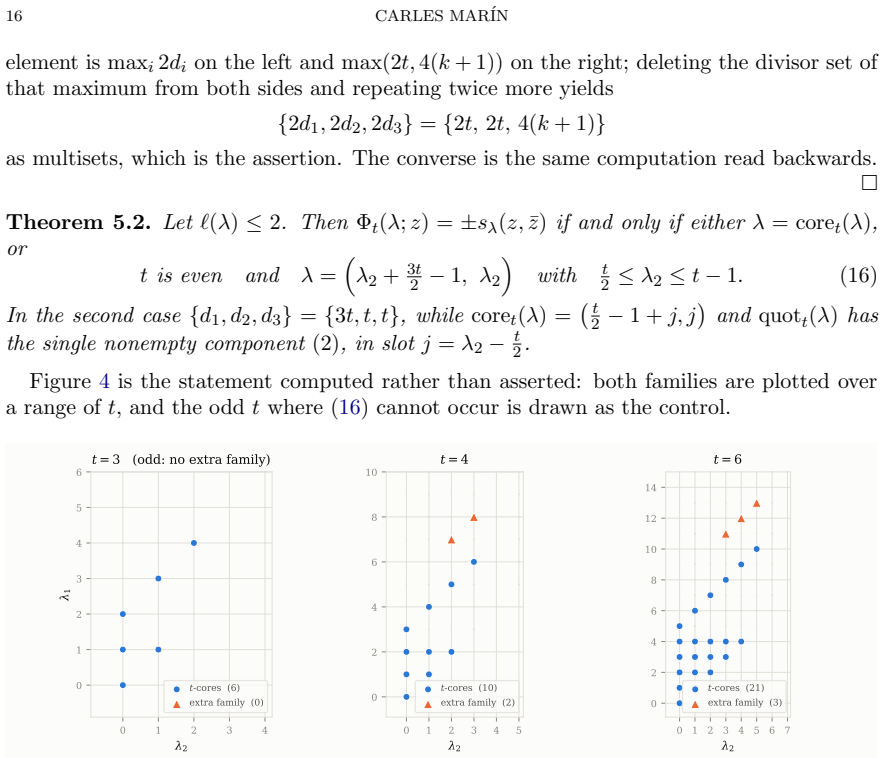
- For two-row shapes, the value equals $\pm s_\lambda(z,z^{-1})$ not only on the $t$-cores but on one additional family classified by its core and quotient; this is the full correction to the independence criterion on the reciprocal locus.
- At $t=2$, the theorem gives a product formula for a $(-1)$-weighted count of plane partitions in a box, refined by a free parameter $z$; at $z=1$ it recovers signed counts such as $(c/2+1)^2$ for $2\times2\times c$ boxes with $c$ even and $0$ for $c$ odd.
- The factorization is isolated: adding a second reciprocal pair, enlarging the root-of-unity orbit, replacing the orbit by a coset, or replacing the reciprocal pair by a free pair all destroy the product; only the zero locus survives for arbitrary numbers of pairs, with two explicit conditions that are proved sufficient and, in the proved ranges, necessary.
Reading between the lines
- If the compression holds for all $t$, the same evaluation invariant may govern other specializations that adjoin exactly one free direction to a full orbit, suggesting a general rank-one evaluation theorem for characters of classical type.
- The counting argument that three factors are forced by translation invariance of an interval pair indicates that any alphabet with excess two, for instance in flagged or skew settings, should exhibit a three-factor product independently of the Laplace-expansion proof.
- The $t=2$ signed enumeration with a free parameter invites a cyclic-sieving refinement: a $q$-analogue of $\Phi_t$ with a cyclic action whose fixed points are counted by the refined signed count; the paper leaves this as an open problem.
- The determinant dichotomy of Section 8, where alphabet determinant $+1$ gives factorization on self-complementary shapes while determinant $-1$ gives vanishing, may transfer to other groups and other order-two fixed letters, providing a test for universal-character analogues.
Signed reviews
Editorial analysis
A structured set of objections, weighed in public.
Referee Report
Summary. The paper studies the Schur polynomial s_λ(1, ζ, ..., ζ^{t-1}, z, z^{-1}) for t ≥ 2 and arbitrary partitions λ with at most t+2 parts. Theorem 3.1 gives a closed form: the value is zero if some residue class modulo t is empty, and otherwise equals a signed product of three hyperbolic sine factors divided by sinh^2(tθ/2) sinh θ, with the three integers d_1, d_2, d_3 and the sign read off the beta set of λ. The proof is a Laplace expansion along the t frozen rows, with explicit lemmas for the Vandermonde minors, the column move, and the cancellation identities. The paper derives several consequences: a geometric vanishing criterion, an extension of an independence criterion of Ayyer–Kumari for two-row shapes, a signed enumeration of plane partitions at t = 2 refined by a free parameter, a discussion of four deformations that destroy the factorization, and a partly conjectural determination of the zero locus of Ψ_r = s_λ(1, -1, z_1^{±1}, ..., z_r^{±1}). The main evaluation theorem is supported by 10,959 exact numerical checks, and all computational claims are documented in an ancillary archive.
Significance. If the main claims hold, Theorem 3.1 is a clean and remarkably complete evaluation for this mixed alphabet, with an explicit sign and no hypothesis on the shape of λ. The proof is detailed and appears sound: it gives a genuine Laplace-expansion argument, explicit lemmas, and a derived (not fitted) sign formula. The paper also provides reproducible code and archived outputs, and it carefully labels conjectural versus proved statements, which is exemplary. The zero-locus section is more speculative but honestly framed. However, the headline compression claim that the value sees 'a multiset of three integers and a sign, and nothing else' is not proved in the printed text; it is verified only for finite ranges. Since this minimality claim is central to the abstract's 'determine exactly how much' assertion, the paper needs either a proof of that claim or a corresponding weakening of the claim.
major comments (2)
- [Abstract; §3.4; §9] The assertion that Φ_t(λ;z) depends on a multiset of three integers and a sign 'and nothing else' is not established by Theorem 3.1. Theorem 3.1 proves that the value factors through the ordered invariant I_t = (d_1, d_2, d_3, ε_λ) defined in (7); symmetry of the numerator in (5) then reduces the ordered triple to a multiset. But the converse direction — that two distinct multisets cannot produce the same rational function — is only checked computationally: §3.4 reports the absence of collisions only over |λ| ≤ 20 for t = 3, 4, and the verification table in §9 contains no row proving minimality for all t. This is not a cosmetic gap, because each factor u^{d_i} − u^{−d_i} in the numerator is reducible (u^d − u^{−d} = u^{−d} ∏_{m|2d} Φ_m(u)), so additive identities among divisor multisets could in principle make distinct triples coincide. The paper should either prove the minimality claim, for example by a cyclotomic-factor argument in the spirit of Lemma 5.1, or explicitly weaken the abstract and §3.4 to the factorization statement that is actually proved.
- [§8.4, sentence after Lemma 8.9] The claim that the converse of Theorem 8.1 holds for every r when |λ| ≤ 2r + 2 outside Littlewood's range is asserted in a single sentence: 'there Littlewood's rule applies verbatim and the converse follows by the argument of Theorem 8.4.' That is not demonstrated. The proof of Theorem 8.4 uses ℓ(λ) ≤ N/2 in several essential places: it uses the β' = ∅ term to get m_μ ≥ 1 for every μ ⊆ λ, it uses ℓ(μ*) > ℓ(λ) when μ = λ, and it uses horizontal-strip constructions that depend on the row structure. When ℓ(λ) > N/2, none of these steps is automatic, and the text gives no witness construction for the unstable band. Since the abstract explicitly claims this converse as proved, the argument needs to be supplied, or the claim should be moved to the conjectural part of Section 8.
minor comments (3)
- [§8.2, Eq. (21)] In the displayed identity (21), the exponent s in (-1)^s is undefined. From the preceding expression it should be the parity of \binom{N}{2} + r (or the sum itself), and this should be stated explicitly.
- [§9, verification table] The row labelled 'Theorem 8.1, both directions' is misleading: Theorem 8.1 as stated contains only the sufficient direction for all r, while the converse for all r is Conjecture 8.6. The numerical verification of the converse over r ≤ 3 should be labelled as a check of the conjecture, not of the theorem.
- [§4, proof of Lemma 4.4] The parity computation in the proof of Lemma 4.4 is hard to audit as printed, especially the step that obtains κ_{1j}/κ_{2j} = -1 from the exponent '2j_{A2} − 1' and the indicator [a_2 < b_j < a_1]. Please expand that display into explicit parity bookkeeping, since the lemma is load-bearing for the sign in Theorem 3.1.
Circularity Check
No circularity: Theorem 3.1 is derived from the bialternant by Laplace expansion; the unproved minimality claim is a completeness gap, not a circular input.
full rationale
The paper's central derivation starts from the bialternant definition of Schur polynomials and from external classical evaluations (Littlewood–Richardson [LR34], Ayyer–Kumari [AK22, AK25]). Theorem 3.1's product formula (5) is obtained by a Laplace expansion along the t frozen rows with a cancellation lemma in the symmetric group; the sign epsilon_lambda is derived in (6) and Proposition 3.10, not fitted to data. No parameter in (5) is calibrated to make the identity true: d1, d2, d3 are read off the beta set, and the formula is independently checked over 10,959 exact cases in Section 9. The compression claim in the abstract, that the value sees 'a multiset of three integers and a sign, and nothing else,' has a genuinely unproved minimality component: the text after Proposition 3.10 says 'that part remains a check rather than a proof,' verified only over t <= 6 and |lambda| <= 14. That is a limitation of the converse direction of the minimality statement, not circularity, because the evaluation formula is not defined in terms of the triple and no equality between distinct triples is assumed by construction. The conjectural parts, including Conjecture 8.6 and the minimality of the multiset, are explicitly labelled as conjectures or checks. Self-citation is limited to [Mar26] in Remark 8.11, where it is contextual (the origin of the alphabet) and not load-bearing for Theorem 3.1, Theorem 5.2, or the zero-locus theorems. The one place where the proof depends on cited results, Lemma 8.8 and the reduction in Section 8.4, cites Ayyer–Kumari's universal character identities and independent symplectic modification rules, not the author's own prior work. No step of the derivation reduces to its own input by construction, so the appropriate finding is no significant circularity.
Assumptions & free parameters
assumptions (6)
- standard math Bialternant formula for Schur polynomials: s_λ = det(x_i^{β_j}) / det(x_i^{N-j}).
- standard math Littlewood-Richardson evaluation: s_λ(1,ζ,...,ζ^{t-1}) is 0 or ±sgn(σ) depending on whether the t-core is empty.
- standard math Core-quotient bijection and Garvan-Kim-Stanton coordinates identify t-cores with root lattice vectors of type A_{t-1}.
- standard math Macdonald's skew form of Littlewood's theorem: s_{λ/ν}(μ_t) vanishes unless λ/ν is tileable by t-ribbons and is otherwise a ribbon sign times a quotient product.
- standard math Koike-Terada universal characters o_ν, sp_ν and their relations, including the reduction o_ν(W,1,-1)=sp_ν(W) via [AK25].
- standard math Littlewood's restriction rule m_ν(λ)=Σ_{β' even} c^λ_{νβ'} holds for ℓ(λ)≤N/2.
Cite this review
Pith. "Pith review of Factorization of Schur polynomials twisted by roots of unity and a reciprocal pair." pith.science (2026). https://pith.science/paper/NUFNL3PA
@misc{pith2026260809619,
  author       = {Pith},
  title        = {Pith review of: Factorization of Schur polynomials twisted by roots of unity and a reciprocal pair},
  year         = {2026},
  howpublished = {\url{https://pith.science/paper/NUFNL3PA}},
  note         = {Machine review of arXiv:2608.09619}
}
abstract
Let $\mu_t$ be the full set of $t$-th roots of unity and $(z,z^{-1})$ a free reciprocal pair. We determine how much of a partition $s_\lambda(\mu_t,z,z^{-1})$ can see: a multiset of three integers and a sign, and nothing else, so partitions of any sizes agreeing on it share the value. The evaluation, for every $t\ge2$ and every $\lambda$ with no hypothesis on its shape, is a signed product of exactly three factors over a fixed denominator, or zero, the three arguments read off the $t$-quotient. The proof is a Laplace expansion along the $t$ frozen rows of the bialternant with one cancellation lemma in the symmetric group, and delivers the sign, the one already in Littlewood's evaluation at $\mu_t$. Three consequences follow. A vanishing criterion: it vanishes exactly when a residue class modulo $t$ is empty, or two distinguished classes are concentric as intervals, the second only for $t$ even. An extension of a recent independence criterion of Ayyer-Kumari: for two-row shapes on the reciprocal locus it acquires exactly one further family, classified by core and quotient. And an enumerative reading: at $t=2$ a $(-1)$-enumeration of plane partitions in a box refined by a parameter that stays free. The factorization is isolated: it fails under each of four deformations of the alphabet, for one reason. A last section treats the zero locus, which survives further pairs. Two conditions make $\Psi_r=s_\lambda(1,-1,z_1^{\pm1},\dots,z_r^{\pm1})$ vanish: the beta set having constant parity, and $\lambda$ being self-complementary of odd width. That direction is a corollary of the complementation identity over an index family Ayyer and Behrend single out. The new content is the converse, that nothing else vanishes, proved for one pair, for every $r$ inside Littlewood's range, and for every $r$ when $|\lambda|\le2r+2$. The rest is conjectural, verified over every shape in the tabulated ranges.
Figures


Figures from the paper (7 more)


Reference graph
Works this paper leans on
-
[1]
S. P. Albion, Universal characters twisted by roots of unity, Algebraic Combinatorics; arXiv:2212.07343
-
[2]
S. P. Albion, Character factorisations, z -asymmetric partitions and plethysm, arXiv:2501.18520
-
[3]
The Cone of Cyclic Sieving Phenomena
P. Alexandersson and N. Amini, The cone of cyclic sieving phenomena, Discrete Math. 342 (2019), no. 6, 1581--1601; arXiv:1804.01447
work page Pith review arXiv 2019
-
[4]
A. Ayyer and R. E. Behrend, Factorization theorems for classical group characters, with applications to alternating sign matrices and plane partitions, J. Combin. Theory Ser. A 165 (2019), 78--105; arXiv:1804.04514
work page Pith review arXiv 2019
-
[5]
Factorization of classical characters twisted by roots of unity
A. Ayyer and N. Kumari, Factorization of classical characters twisted by roots of unity, J. Algebra 609 (2022), 437--483; arXiv:2109.11310
work page Pith review arXiv 2022
-
[6]
A. Ayyer and N. Kumari, Further results for classical and universal characters twisted by roots of unity, J. Algebraic Combin. 63 (2025), no. 1; arXiv:2501.00275
arXiv 2025
-
[7]
M. Ciucu and C. Krattenthaler, A factorization theorem for classical group characters, with applications to plane partitions and rhombus tilings, in: Advances in Combinatorial Mathematics, Springer, Berlin, 2009
work page 2009
- [8]
Show all 43 references
-
[9]
Hidaka and M
M. Hidaka and M. Itoh, The Schur polynomials in all primitive n th roots of unity, J. Combin. Theory Ser. A; arXiv:2403.10817
-
[10]
J. C. Jantzen, Darstellungen halbeinfacher algebraischer Gruppen, Bonner Math. Schriften 67 (1973)
1973
-
[11]
Karmakar, Character factorizations for representations of GL(n, ) , arXiv:2210.03544
C. Karmakar, Character factorizations for representations of GL(n, ) , arXiv:2210.03544
-
[12]
Karmakar, Character values at elements of order two, arXiv:2412.17324
C. Karmakar, Character values at elements of order two, arXiv:2412.17324
-
[13]
Mar\'in, Schur functions at (1,-1,t,t^ -1 ) : a closed form on the non-identity component of O(4) , preprint, 2026; doi:10.5281/zenodo.21463000
C. Mar\'in, Schur functions at (1,-1,t,t^ -1 ) : a closed form on the non-identity component of O(4) , preprint, 2026; doi:10.5281/zenodo.21463000
2026 doi
-
[14]
Z. Jin, N. Jing, Z. Li and D. Wang, Universal symplectic/orthogonal functions and general branching rules, arXiv:2209.00767
-
[15]
Kumar, G
S. Kumar, G. Lusztig and D. Prasad, Characters of simply-laced nonconnected groups versus characters of nonsimply-laced connected groups, Contemp. Math. 478 (2009), 99--101; arXiv:math/0701615
2009 arXiv
-
[16]
Knutson and T
A. Knutson and T. Tao, The honeycomb model of GL_n( ) tensor products I: proof of the saturation conjecture, J. Amer. Math. Soc. 12 (1999), no. 4, 1055--1090
1999
-
[17]
Kumari, Factorization of classical characters twisted by roots of unity: II, J
N. Kumari, Factorization of classical characters twisted by roots of unity: II, J. Pure Appl. Algebra 228 (2024), no. 11, 107714; arXiv:2212.12477
2024 arXiv
-
[18]
Kumari, Characters of classical groups twisted by roots of unity, PhD thesis, Indian Institute of Science, Bangalore, 2023
N. Kumari, Characters of classical groups twisted by roots of unity, PhD thesis, Indian Institute of Science, Bangalore, 2023
2023
-
[19]
Lecouvey, Parabolic Kazhdan--Lusztig polynomials, plethysm and generalized Hall--Littlewood functions for classical types, European J
C. Lecouvey, Parabolic Kazhdan--Lusztig polynomials, plethysm and generalized Hall--Littlewood functions for classical types, European J. Combin. 30 (2009), no. 1, 157--191
2009
-
[20]
D. E. Littlewood and A. R. Richardson, Immanants of some special matrices, Q. J. Math. os-5 (1934), no. 1, 269--282
1934
-
[21]
Lascoux, B
A. Lascoux, B. Leclerc and J.-Y. Thibon, Ribbon tableaux, Hall--Littlewood functions, quantum affine algebras and unipotent varieties, J. Math. Phys. 38 (1997), no. 2, 1041--1068
1997
-
[22]
Lee and Y.-T
S.-Y. Lee and Y.-T. Oh, Skew Schur polynomials and cyclic sieving phenomenon, Electron. J. Combin. 29 (2022), no. 4, Paper 4.6; arXiv:2112.12394
2022 arXiv
-
[23]
I. G. Macdonald, Symmetric Functions and Hall Polynomials, second edition, Oxford University Press, 1995
1995
-
[24]
Reiner, D
V. Reiner, D. Stanton and D. White, The cyclic sieving phenomenon, J. Combin. Theory Ser. A 108 (2004), no. 1, 17--50
2004
-
[25]
J. R. Stembridge, On minuscule representations, plane partitions and involutions in complex Lie groups, Duke Math. J. 73 (1994), no. 2, 469--490
1994
-
[26]
Okada, Applications of minor summation formulas to rectangular-shaped representations of classical groups, J
S. Okada, Applications of minor summation formulas to rectangular-shaped representations of classical groups, J. Algebra 205 (1998), no. 2, 337--367
1998
-
[27]
Prasad, A character relationship on GL_n( ) , Israel J
D. Prasad, A character relationship on GL_n( ) , Israel J. Math. 211 (2016), no. 1, 257--270
2016
-
[28]
Ayyer and I
A. Ayyer and I. Fischer, Bijective proofs of skew Schur polynomial factorizations, J. Combin. Theory Ser. A 174 (2020), 105241; arXiv:1905.05226
2020 arXiv
-
[29]
Eisenk\"olbl, A Schur function identity related to the (-1) -enumeration of self-complementary plane partitions, J
T. Eisenk\"olbl, A Schur function identity related to the (-1) -enumeration of self-complementary plane partitions, J. Combin. Theory Ser. A 115 (2008), 199--212; arXiv:math/0602401
2008 arXiv
-
[30]
Fauser, P
B. Fauser, P. D. Jarvis, R. C. King and B. G. Wybourne, New branching rules induced by plethysm, J. Phys. A 39 (2006), 2611--2655; arXiv:math-ph/0508034
2006 arXiv
-
[31]
Gavarini, A Brauer algebra-theoretic proof of Littlewood's restriction rules, J
F. Gavarini, A Brauer algebra-theoretic proof of Littlewood's restriction rules, J. Algebra 212 (1999), 240--271
1999
-
[32]
T. J. Enright and J. F. Willenbring, Hilbert series, Howe duality and branching for classical groups, Ann. of Math. 159 (2004), 337--375
2004
-
[33]
M. J. Newell, Modification rules for the orthogonal and symplectic groups, Proc. Roy. Irish Acad. Sect. A 54 (1951), 153--163
1951
-
[34]
Sundaram, Tableaux in the representation theory of the classical Lie groups, in Invariant Theory and Tableaux (Minneapolis, MN, 1988), IMA Vol
S. Sundaram, Tableaux in the representation theory of the classical Lie groups, in Invariant Theory and Tableaux (Minneapolis, MN, 1988), IMA Vol. Math. Appl. 19, 191--225, Springer-Verlag, New York, 1990
1988
-
[35]
Ishikawa, S
M. Ishikawa, S. Okada, H. Tagawa and J. Zeng, Generalizations of Cauchy's determinant and Schur's Pfaffian, Adv. in Appl. Math. 36 (2006), 251--287
2006
-
[36]
R. C. King, Modification rules and products of irreducible representations of the unitary, orthogonal, and symplectic groups, J. Math. Phys. 12 (1971), 1588--1598
1971
-
[37]
Koike and I
K. Koike and I. Terada, Young-diagrammatic methods for the representation theory of the classical groups of type B_n , C_n , D_n , J. Algebra 107 (1987), 466--511
1987
-
[38]
Bunder and J
For the name and the surrounding family of identities (Cassini, Catalan, d'Ocagne, Vajda) see e.g.\ M. Bunder and J. Tonien, Cassini, d'Ocagne and Vajda identities for n -step Fibonacci numbers, arXiv:2201.06269
-
[39]
Kumari and A
N. Kumari and A. Stokke, Murnaghan--Nakayama rules for symplectic, orthogonal and orthosymplectic Schur functions, Discrete Math. 349 (2026), no. 2; arXiv:2411.11447
2026 arXiv
-
[40]
Kuperberg, Symmetry classes of alternating-sign matrices under one roof, Ann
G. Kuperberg, Symmetry classes of alternating-sign matrices under one roof, Ann. of Math. (2) 156 (2002), 835--866
2002
-
[41]
D. E. Littlewood, The Theory of Group Characters and Matrix Representations of Groups, 2nd ed., Oxford University Press, 1950
1950
-
[42]
Sathish Kumar, Flagged skew Schur polynomials twisted by roots of unity, arXiv:2306.10289
V. Sathish Kumar, Flagged skew Schur polynomials twisted by roots of unity, arXiv:2306.10289
-
[43]
R. P. Stanley, Symmetries of plane partitions, J. Combin. Theory Ser. A 43 (1986), 103--113
1986
Reviewed August 11, 2026 · model on record in the stance chip above.
Discussion (0). Continue with ORCID to comment.