REVIEW 5 major objections 4 minor 26 references
MAPO: A Multi-Objective Model for IoT Application Placement in a Fog Environment
T0 review · 5 major / 4 minor · reviewed 2026-08-14 · deepseek-v4-flash
Pith's one-line read MAPO claims that Pareto-based multi-objective placement in fog computing can cut IoT application completion time by up to 7.3 times, energy consumption by 23-68%, and economic cost by up to 27% compared with single-objective methods on…
desk verdict A credible multi-objective placement method with a completion-time result that holds up, but the headline energy savings are not supported by the evidence as presented. read the letter →
The pith
A machine-rendered reading of the paper's core claim, the machinery that carries it, and where it could break.
The reading
What carries the argument
The load-bearing mechanism is the combination of a finite-state-machine application model with three analytic objective functions and a non-dominated sorting genetic search. An application is a state machine whose states are lightweight components; placing component $m_i$ on device $r_j$ assigns each component a device, and the objectives are computed from the chain of transitions: completion time $T(A,R)$ from Eqs. (1)-(3) adds computation time (instructions over CPU speed) to communication time (data size over bandwidth); energy $E(A,R)$ from Eqs. (4)-(7) adds computation power $\varrho^p_j$, communication power $\varrho^m_j$, and a hardware constant $\epsilon_j$; cost $C(A,R)$ from Eqs. (8)-(9) sums processing, storage, and ingress communication charges. NSGA-II evolves a population of full placements, ranks them by Pareto dominance, and returns a frontier of non-dominated solutions; an automated decision module then selects one low-latency placement for deployment. The key identity is Pareto dominance itself: one placement beats another only if it is no worse on every objective and strictly better on at least one.
What would settle it
Run the mental health care application on the real-world testbed described in Section VII at the stated workloads and data sizes, measuring actual device power draw with a power meter at each Fog device, and compare measured energy to MAPO's predicted $E(A,R)$; a discrepancy exceeding the claimed improvement margin would refute the energy objective and the headline energy savings.
Extended reading notes
Core claim
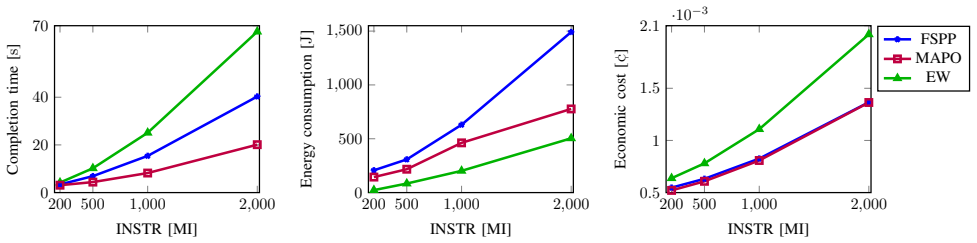
The paper's central claim is that the optimal placement of an IoT application in a fog hierarchy is not a single-objective scheduling problem but a three-way tradeoff among completion time, energy consumption, and economic cost, and that a Pareto search over these three objectives finds placements that dominate single-objective or weighted-sum heuristics. In the medical IoT case studies considered, MAPO reports completion time reductions of up to 7.3 times versus FSPP and Edge-ward, energy reductions of 23-68% versus FSPP in most settings, and cost reductions of up to 27%; the main tradeoff is that MAPO can consume up to about 54% more energy than Edge-ward, a tradeoff the Pareto formulation makes explicit rather than hides. The paper presents these numbers as evidence that near-data placement on low-capability mobile edge devices, chosen by multi-objective search, outperforms Cloud-centric or gateway-centric placement rules for latency-sensitive workloads.
Load-bearing premise
The energy savings are computed from the analytic model in Eqs. (4)-(6) using listed power constants, not measured on the real testbed; if those constants are inaccurate, the claimed 23-68% energy reductions are not empirically validated.
Editorial extensions
If this is right
- For latency-sensitive IoT applications, placing components on mobile edge devices close to sensors can cut completion time by 3-7x compared with Cloud- or gateway-oriented placements.
- Operators who optimize only one objective (e.g., cost or latency) forgo placements that are better on the other two; the Pareto frontier makes the tradeoff explicit and lets a decision rule choose the operating point.
- In the tested workloads, communication latency, not data volume, dominates completion time, so placement algorithms should prioritize device proximity over bandwidth or Cloud power.
- Fog devices are the energy-efficient choice for small applications, while Cloud resources become competitive at high CPU workloads; a placement optimizer needs both tiers to navigate this crossover.
- The search reaches stable solution quality (measured by hypervolume) around 12,500 evaluations and scales to 30 components with a modest increase in optimizer runtime.
Reading between the lines
- Because the objective functions and search procedure are application-agnostic, the same Pareto placement machinery should transfer to other multi-tenant fog workloads (e.g., industrial control or smart retail); only the state machine and device constants need replacing.
- The automated decision module is effectively a policy knob: switching from the low-latency rule to a cost-minimizing rule would select a different point on the same Pareto frontier, letting the same search serve different service-level objectives without re-optimization.
- A cleaner test of the Pareto benefit would compare MAPO against a weighted-sum multi-objective baseline with the same three objectives, not only single-objective baselines; that would isolate whether the gains come from multi-objective search or from simply considering three criteria.
- The analytic energy model could be calibrated per device with actual power measurements and then used not only at placement time but as a runtime scheduling signal; if calibration reveals large discrepancies, the reported 23-68% energy savings would need to be revised.
Signed reviews
Editorial analysis
A structured set of objections, weighed in public.
Referee Report
Summary. The paper proposes MAPO, a Pareto-based NSGA-II approach for placing IoT applications on fog devices, optimizing three conflicting objectives: completion time, energy consumption, and economic cost. Applications are modeled as finite state machines, and the approach is evaluated on three medical IoT case studies (augmented reality, insulin pump, mental health care) in both a simulated fog environment and a small real-world testbed based on Raspberry Pi devices. MAPO is compared against two state-of-the-art methods, FSPP and Edge-ward. The claimed contributions are up to 7.3x lower completion time, 23-68% energy savings, and up to 27% lower economic cost.
Significance. If the evaluation were fully supported, MAPO would be a useful contribution to the IoT-fog placement literature, particularly because it applies a genuine multi-objective Pareto search instead of a weighted sum, and because it reports both simulation and real-testbed evaluations. The state-machine application model and the formulation of the three objectives are clearly presented and follow standard practice. The strengths are the two-tier evaluation, the comparison against two relevant baselines, and the use of the jMetal framework. However, the energy model is incomplete (the static energy term Es is never defined), the energy results are not backed by physical measurements on the real testbed, and the abstract's headline energy and completion-time claims are selectively supported or contradicted by the paper's own tables. These issues are load-bearing for the central claims, but they are addressable in a revision.
major comments (5)
- [Section III.D.2, Eq. (4)] The static energy term Es(mi,rj) is introduced in Eq. (4) but never defined, and no numerical value or formula is provided for any device class. Since the energy objective f2 in Eq. (10) is the sum of Eq. (4) over all components, the energy objective cannot be computed by a reader, and the energy entries in Tables IV-IX and Figures 6-7 are not reproducible from the manuscript. Either define Es as a device idle power scaled by time or provide its constant value; in either case, its contribution can change the Pareto front and the reported energy tradeoffs.
- [Section VII.B, Figures 6-7] The real-testbed experiment is described with Raspberry Pi devices, Docker, tc, and nc, but no power meter or energy measurement instrumentation is mentioned. The reported 'energy consumption' in the real-world evaluation therefore appears to be computed from the same analytic model in Section III rather than measured directly. Since Section VII.A states the goal is to 'validate the simulation results', the energy results should either be based on direct power measurements or explicitly labeled as model-based estimates; the current text does not distinguish these.
- [Abstract, Sections VI.C.1 and VI.C.2] The abstract's claim of 'decreasing the energy requirements by 23-68%' is not supported by the simulation results. In the data-size experiments, Table V and Table VI show EW consuming roughly 61% less energy than MAPO (e.g., 25 kJ vs 50-64 kJ for the insulin pump, and 25.1-26.3 kJ vs 62.5-65 kJ for mental health care). In the CPU-workload experiments, Table IX shows EW consuming 55% less energy than MAPO (e.g., 25 kJ vs 63 kJ at 2000 MI). The 23-68% range appears to be drawn only from the real-testbed comparison against FSPP, which is a selective reading. The energy claim should be revised to reflect the full set of reported results or explicitly qualified to the specific FSPP comparison.
- [Abstract, Sections VI.C, VII.C, and VIII] The headline 'up to 7.3 times' improvement in completion time is not backed by any result in the paper. Section VII.C.1 reports at most 6.9 times improvement compared to EW and 3 times compared to FSPP; Section VI.C.1 reports reductions of up to 70% (approximately 3.3 times). The number 7.3 appears in the abstract and conclusion but does not correspond to any table or figure. Please correct the number or provide the specific result that supports it.
- [Section IV and Section VI.A] The automated decision making module (ADM) that selects a single placement from the Pareto set is described only as 'extends on a simple and computationally efficient a-priori method [17]', without specifying the selection rule, weights, thresholds, or any parameter values. Because all reported objective values are those of the selected solution, the lack of an explicit ADM specification makes the evaluation not reproducible. Please provide the ADM decision formula and its parameter settings, or point to the exact equations in reference [17] that are used.
minor comments (4)
- [Section III.D.1, Eq. (1)] In Eq. (1), the communication delay term appears as 'Datai BW k,j' without a division sign; it should be Datai / BWk,j, as is clear from the context and Eq. (8).
- [Section VI.A, Tables IV-IX] The paper states that objective results are 'averaged over 1000 runs for statistical significance', but no standard deviation, confidence interval, or error bars are reported anywhere. Please include variance information in the tables or an appendix to substantiate the statistical claim.
- [Tables II and III] The power constants ϱp_j and ϱm_j in Tables II and III, as well as the hardware constant ϵ_j, are presented without a source or derivation. Please cite the reference for these values or state explicitly that they are assumed, since they directly determine the energy objective.
- [Section VII.B, Table X] The real testbed uses an Intel Core i7-7700 VM as the CDC and Raspberry Pi 3 B+ as MEs, but Table X lists CPU capacities in MIPS without explaining how they were obtained or mapped from the simulated configuration; a short description of the benchmark or mapping method would improve reproducibility.
Circularity Check
No significant circularity: MAPO's objectives are defined a priori and the reported improvements are measured comparisons, not derived from fitted inputs or self-citation chains.
full rationale
The paper's central claim is an algorithmic comparison: NSGA-II optimizes three a priori objectives (completion time via Eqs. (1)-(3), energy via Eqs. (4)-(7), and cost via Eqs. (8)-(9)), and the reported reductions in time, energy, and cost are evaluated by comparing MAPO placements with FSPP and EW on simulated and real testbeds. No parameter is fitted to the outcome being predicted; the objective functions are stated before the experiments and do not themselves encode the comparison results. The only dependency on prior work by the same authors is the automated decision making module, which 'extends on a simple and computationally efficient a-priori method [17]' (Section IV); this is an implementation choice for selecting one Pareto solution and is not the source of the claimed quantitative improvements. The energy model's static term Es in Eq. (4) is left undefined and Section VII.B does not describe power metering, so the energy savings are not fully reproducible from the manuscript; however, this is an empirical validation gap, not a circular derivation. Consequently, there is no step in which a prediction reduces by construction to its inputs.
Assumptions & free parameters
free parameters (5)
- Per-tier cost coefficients (CP_j, CS_j, CR_j) =
Cloud: 0.03, 1E-6, 3E-6; ISP GW: 0.035, 1.5E-5, 3.5E-6; WiFi/BTS: 0.04-0.05, 1E-5-2E-5, 3E-6-5E-6; ME: 0.02-0.04…
- Per-tier power coefficients (ϱp_j, ϱm_j, ϵ_j) =
Cloud: 1650 W, 1300 W; ISP GW: 530 W, 410 W; WiFi/BTS: 380-410 W, 1.8-2.0 W; ME: 2.5-3.2 W, 1.0-1.5 W; ϵ_j not tabulated
- Inter-tier latencies =
ME: 1 ms, ME-WiFi: 10 ms, WiFi-ISP: 50 ms, ISP-CDC: 100 ms
- ADM selection parameters =
not disclosed
- NSGA-II algorithm parameters =
population = 100, evaluations up to 14000
assumptions (4)
- domain assumption Each application component has exactly one successor and one predecessor within an execution (sequential thread).
- domain assumption Fog device CPU, memory, storage, bandwidth, and power are static and known.
- domain assumption The transition function Γ and data item sizes are known in advance.
- standard math Multi-objective placement with completion time as an objective is NP-complete.
Cite this review
Pith. "Pith review of MAPO: A Multi-Objective Model for IoT Application Placement in a Fog Environment." pith.science (2026). https://pith.science/paper/NUILD74G
@misc{pith2026190801153,
  author       = {Pith},
  title        = {Pith review of: MAPO: A Multi-Objective Model for IoT Application Placement in a Fog Environment},
  year         = {2026},
  howpublished = {\url{https://pith.science/paper/NUILD74G}},
  note         = {Machine review of arXiv:1908.01153}
}
read the original abstract
The emergence of the Fog computing paradigm that leverages in-network virtualized resources raises important challenges in terms of resource and IoT application management in a heterogeneous environment offering only limited computing resources. In this work, we propose a novel Pareto-based approach for application placement close to the data sources called Multiobjective IoT application Placement in fOg (MAPO). MAPO models applications based on a finite state machine and uses three conflicting optimization objectives, namely completion time, energy consumption, and economic cost, considering both the computation and communication aspects. In contrast to existing solutions that optimize a single objective value, MAPO enables multi-objective energy and cost-aware application placement. To evaluate the quality of the MAPO placements, we created both simulated and real-world testbeds tailored for a set of medical IoT application case studies. Compared to the state-of-the-art approaches, MAPO reduces the economic cost by up to 27%, while decreasing the energy requirements by 23-68%, and optimizes the completion time by up to 7.3 times.
Figures


Figures from the paper (3 more)


Reference graph
Works this paper leans on
-
[24]
Multi-objective optimization of resource scheduling in fog computing using an improved nsga-ii
Yan Sun, Fuhong Lin, and Haitao Xu. Multi-objective optimization of resource scheduling in fog computing using an improved nsga-ii. Wireless Personal Communications, pages 1–17, 2018
work page 2018
-
[17]
Multi- objective service oriented network provisioning in ultra-scale systems
Dragi Kimovski, Sashko Ristov, Roland Mathá, and Radu Prodan. Multi- objective service oriented network provisioning in ultra-scale systems. In European Conference on Parallel Processing, pages 529–540. Springer, 2017
work page 2017
-
[1]
Dynamic resource provisioning through fog micro datacenter
Mohammad Aazam and Eui-Nam Huh. Dynamic resource provisioning through fog micro datacenter. In Pervasive Computing and Communi- cation Workshops (PerCom Workshops), International Conference on , pages 105–110. IEEE, 2015
work page 2015
-
[2]
Orchestration of microservices for iot using docker and edge computing
Muhammad Alam, Joao Rufino, Joaquim Ferreira, Syed Hassan Ahmed, Nadir Shah, and Yuanfang Chen. Orchestration of microservices for iot using docker and edge computing. IEEE Communications Magazine , 56(9):118–123, 2018
work page 2018
-
[3]
Tobias Bergen and Thomas Wittenberg. Stitching and surface recon- struction from endoscopic image sequences: A review of applications and methods. IEEE J. Biomedical and Health Informatics , 20(1):304– 321, 2016
work page 2016
-
[4]
Mobility-aware application scheduling in fog computing
Luiz F Bittencourt, Javier Diaz-Montes, Rajkumar Buyya, Omer F Rana, and Manish Parashar. Mobility-aware application scheduling in fog computing. IEEE Cloud Computing , 4(2):26–35, 2017
work page 2017
-
[5]
Fog computing and its role in the internet of things
Flavio Bonomi, Rodolfo Milito, Jiang Zhu, and Sateesh Addepalli. Fog computing and its role in the internet of things. In Proceedings of the first edition of the MCC workshop on Mobile cloud computing , pages 13–16. ACM, 2012
work page 2012
- [6]
Show all 26 references
-
[7]
Challenges and opportunities in edge computing
Jie Cao, Quan Zhang, and Weisong Shi. Challenges and opportunities in edge computing. In Edge Computing: A Primer , pages 59–70. Springer, 2018
2018
-
[8]
First hop mobile offloading of dag computations
Vincenzo De Maio and Ivona Brandic. First hop mobile offloading of dag computations. In 2018 18th IEEE/ACM International Symposium on Cluster, Cloud and Grid Computing (CCGRID) , pages 83–92. IEEE, 2018
2018
-
[9]
A fast and elitist multiobjective genetic algorithm: Nsga-ii
Kalyanmoy Deb, Amrit Pratap, Sameer Agarwal, and TAMT Meyarivan. A fast and elitist multiobjective genetic algorithm: Nsga-ii. IEEE transactions on evolutionary computation , 6(2):182–197, 2002
2002
-
[10]
jmetal: A java framework for multi- objective optimization
Juan J Durillo and Antonio J Nebro. jmetal: A java framework for multi- objective optimization. Advances in Engineering Software , 42(10):760– 771, 2011
2011
-
[11]
Proximity-aware traffic routing in distributed fog computing platforms
Ali Fahs and Guillaume Pierre. Proximity-aware traffic routing in distributed fog computing platforms. In IEEE/ACM International Sym- posium in Cluster, Cloud, and Grid Computing (CCGrid) , 2019
2019
-
[12]
An updated performance comparison of virtual machines and linux contain- ers
Wes Felter, Alexandre Ferreira, Ram Rajamony, and Juan Rubio. An updated performance comparison of virtual machines and linux contain- ers. In 2015 IEEE international symposium on performance analysis of systems and software (ISPASS) , pages 171–172. IEEE, 2015
2015
-
[13]
ifogsim: A toolkit for modeling and simulation of resource man- agement techniques in the internet of things, edge and fog computing environments
Harshit Gupta, Amir Vahid Dastjerdi, Soumya K Ghosh, and Rajkumar Buyya. ifogsim: A toolkit for modeling and simulation of resource man- agement techniques in the internet of things, edge and fog computing environments. Software: Practice and Experience , 47(9):1275–1296, 2017
2017
-
[14]
A review on modern distributed computing paradigms: Cloud computing, jungle computing and fog computing
Majid Hajibaba and Saeid Gorgin. A review on modern distributed computing paradigms: Cloud computing, jungle computing and fog computing. Journal of computing and information technology, 22(2):69– 84, 2014
2014
-
[15]
Towards container orchestration in fog com- puting infrastructures
Saiful Hoque, Mathias Santos de Brito, Alexander Willner, Oliver Keil, and Thomas Magedanz. Towards container orchestration in fog com- puting infrastructures. In 2017 IEEE 41st Annual Computer Software and Applications Conference (COMPSAC) , volume 2, pages 294–299. IEEE, 2017
2017
-
[16]
Adaptive nature-inspired fog architecture
Dragi Kimovski, Humaira Ijaz, Nishant Saurabh, and Radu Prodan. Adaptive nature-inspired fog architecture. In Fog and Edge Computing (ICFEC), 2018 IEEE 2nd International Conference on, pages 1–8. IEEE, 2018
2018
-
[18]
Latency-aware application module management for fog computing en- vironments
Redowan Mahmud, Kotagiri Ramamohanarao, and Rajkumar Buyya. Latency-aware application module management for fog computing en- vironments. ACM Transactions on Internet Technology (TOIT) , 2018
2018
-
[19]
Osmotic flow: Osmotic computing+ iot workflow
Matteo Nardelli, Stefan Nastic, Schahram Dustdar, Massimo Villari, and Rajiv Ranjan. Osmotic flow: Osmotic computing+ iot workflow. IEEE Cloud Computing, 4(2):68–75, 2017. 200 500 1,000 2,0000 20 40 70 INSTR [MI] Completion time [s] 200 500 1,000 2,0000 500 1,000 1,500 INSTR [MI...
2017
-
[20]
Cloud container technologies: a state-of-the-art review
Claus Pahl, Antonio Brogi, Jacopo Soldani, and Pooyan Jamshidi. Cloud container technologies: a state-of-the-art review. IEEE Transactions on Cloud Computing, 2017
2017
-
[21]
Towards task scheduling in a cloud-fog computing system
Xuan-Qui Pham and Eui-Nam Huh. Towards task scheduling in a cloud-fog computing system. In Network Operations and Management Symposium (APNOMS), 2016 18th Asia-Pacific, pages 1–4. IEEE, 2016
2016
-
[22]
Towards qos-aware fog service placement
Olena Skarlat, Matteo Nardelli, Stefan Schulte, and Schahram Dustdar. Towards qos-aware fog service placement. In Fog and Edge Computing (ICFEC), 2017 IEEE 1st International Conference on , pages 89–96. IEEE, 2017
2017
-
[23]
Software engineering 9th edition
Ian Sommerville. Software engineering 9th edition. ISBN-10, 137035152, 2011
2011
-
[25]
A faster algorithm for calculating hypervolume
Lyndon While, Philip Hingston, Luigi Barone, and Simon Huband. A faster algorithm for calculating hypervolume. IEEE transactions on evolutionary computation, 10(1):29–38, 2006
2006
-
[26]
Combining heuristics to optimize and scale the placement of iot applications in the fog
Ye Xia, Xavier Etchevers, Loic Letondeur, Adrien Lebre, Thierry Coupaye, and Frédéric Desprez. Combining heuristics to optimize and scale the placement of iot applications in the fog. In 11th IEEE/ACM Conference on Utility and Cloud Computing, UCC 2018 , 2018
2018
Reviewed August 14, 2026 · model on record in the stance chip above.
Discussion (0). Continue with ORCID to comment.