REVIEW 4 major objections 5 minor 20 references
A Refined Alternating Optimization for Sum Rate Maximization in SIM-Aided Multiuser MISO Systems
T0 review · 4 major / 5 minor · reviewed 2026-08-05 · deepseek-v4-flash
Pith's one-line read Optimizing SIM phase shifts before the digital beamformer, with an iterated projected-gradient loop, raises the achievable sum rate by up to 115.53% over benchmark schemes and lets the rate keep growing with SIM layer count instead of satur
desk verdict Useful design-guideline letter on SIM AO ordering, but the headline gains rest on a single simulation trajectory without error bars. read the letter →
The pith
A machine-rendered reading of the paper's core claim, the machinery that carries it, and where it could break.
The reading
What carries the argument
The load-bearing mechanism is the ordering and refinement inside an alternating optimization loop. Algorithm 1 cycles between an iterative projected-gradient ascent on the SIM phase-shift vector θ—using the closed-form complex gradient of the sum rate from Theorem 1, with backtracking line search and a stopping tolerance—and an SCA-based update of the digital beamforming matrix W. The phase-shift gradient is derived from the Rayleigh–Sommerfeld diffraction model of inter-layer propagation, which makes the entire wave-domain channel a structured function of θ, and the paper's two design rules—optimize θ first, and iterate the PG loop to convergence before returning to W—are what convert that
What would settle it
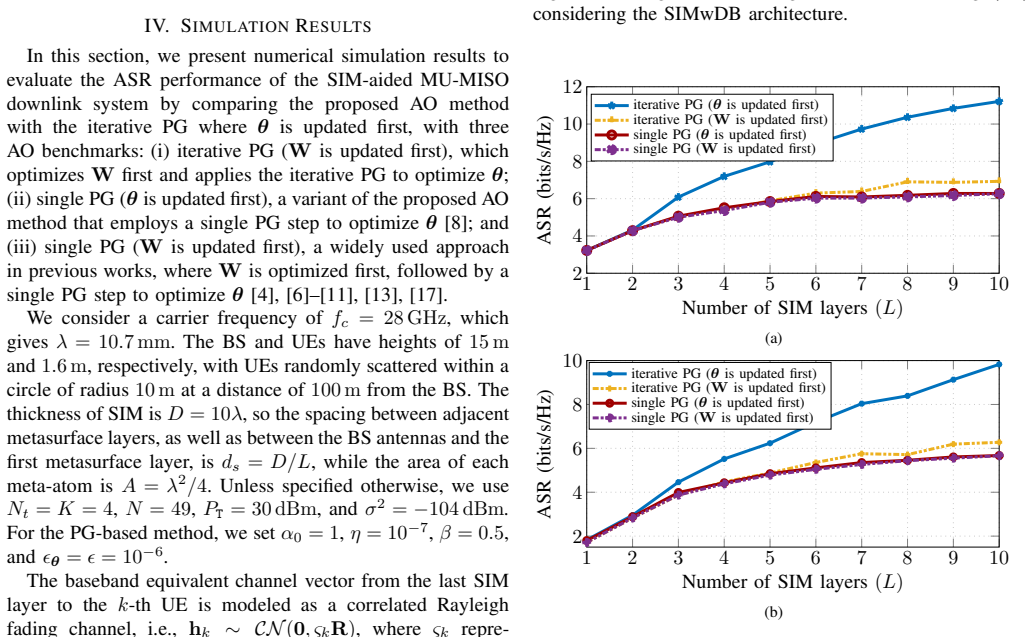
Repeat the comparison of the four algorithm variants (Figs. 1–3) under a different inter-layer propagation law—for example, full-wave electromagnetic simulation of the metasurface stack or measurements from a SIM prototype—and across many random initial points and channel realizations. If the θ-first iterative-PG scheme no longer consistently outperforms the W-first single-PG scheme, or if its sum rate saturates as L grows under the alternative model, the paper's central claims are refuted.
Extended reading notes
Core claim
The paper's discovery is that the performance of alternating optimization for SIM-aided systems hinges on two implementation details prior work treated as interchangeable. First, the update order is not neutral: optimizing the SIM phase-shift vector θ before the digital beamformer W converges to a significantly higher sum rate than the reverse order, because the SIM's wave-domain beamforming is the dominant source of interference suppression and benefits from early optimization. Second, the phase-shift subproblem, usually handled by a single projected-gradient step, is far better solved by an iterative projected-gradient loop that runs to near-convergence inside each AO cycle before switchin
Load-bearing premise
The ranking of the four schemes—including the 115.53% gain and the absence of saturation—is established in simulation under a single propagation model (Rayleigh–Sommerfeld diffraction between layers and sinc-correlated Rayleigh fading to users), started from one randomly generated initial point; if real SIM propagation or the user-channel distribution differs from that simulator, the ordering of the methods could change.
Editorial extensions
If this is right
- Any existing SIM-aided AO design can adopt the two guidelines as a drop-in change—move the phase-shift update to the front of each AO cycle and iterate the PG loop to convergence—without changing the channel model or the objective.
- Within the considered setting, the previously reported sum-rate saturation with increasing SIM layer count (at fixed thickness) is avoided, so a correctly tuned AO can keep extracting gains from added layers.
- The reported gains widen with the number of meta-atoms per layer (roughly 55–78% at N=49 up to 115.53% at N=100), so the benefit of the refined AO matters most in the large-SIM regime.
- The same algorithm and ordering apply to SIM without digital beamforming (power-allocation variant), with comparable gains (up to 73.53% at L=10), making the design principle architecture-independent within the SIM family.
- The ordering advantage is attributed to SIM's interference-suppression capability, which implies the phase-shift subproblem should be solved more thoroughly than the beamforming subproblem in any AO-based SIM design.
Reading between the lines
- An implicit corollary the paper does not develop: because the ordering advantage comes from θ being the higher-leverage variable, the θ-first principle plausibly transfers to other SIM optimization problems (energy efficiency, cell-free networks, joint sensing and communication), all of which currently use AO with single-step phase-shift updates.
- The saturation-avoidance claim is demonstrated starting from a single randomly generated initial point; a natural extension is to test whether θ-first iterative PG preserves its advantage across many random initializations, since AO for non-convex problems is initial-point-sensitive and the paper explicitly identifies that sensitivity.
- If the results generalize beyond the simulated Rayleigh–Sommerfeld/sinc-correlated model, comparative studies of SIM should include a well-tuned AO baseline; otherwise 'saturation' and other reported SIM limits may be algorithmic artifacts rather than physical ones.
- A testable engineering prediction follows: the gap between θ-first iterative PG and the baselines should widen as the number of users K grows, because more users mean more interference for the SIM's wave-domain suppression to handle.
Signed reviews
Editorial analysis
A structured set of objections, weighed in public.
Referee Report
Summary. The paper considers sum-rate maximization for a stacked intelligent metasurface (SIM) aided multiuser MISO downlink, optimizing digital beamforming and SIM phase shifts alternately. The proposed method differs from prior AO schemes in two ways: it optimizes the SIM phase shifts before the digital beamformer, and it uses an iterative projected-gradient (PG) procedure for the phase-shift subproblem instead of a single PG step. The main theoretical contribution is a closed-form expression for the gradient of the sum rate with respect to the phase-shift vector (Theorem 1). The performance claims—that the theta-first ordering and iterative PG yield higher achievable sum rate and avoid saturation as the number of SIM layers grows—are supported only by simulation results for a Rayleigh-Sommerfeld propagation model and correlated Rayleigh user channels. The headline gain is stated as up to 115.53% over benchmark schemes.
Significance. If the empirical claims are robust, the paper offers a simple and practically relevant design guideline for SIM-aided systems: optimize phase shifts first and iterate PG to convergence. The derivation of the gradient is direct and appears correct apart from a likely typographical error in the denominators of Eqs. (9) and (11), and the simulation setup is clearly described, which aids reproducibility. However, the central claims are empirical ordering statements over non-convex problems, and the current evidence is not statistically grounded: Fig. 1 uses a single initial point, Figs. 2–3 show no error bars or trial counts, and the 'no saturation' conclusion is extrapolated from L up to 10. The comparison between iterative PG and single PG also conflates algorithmic refinement with additional computational effort. With additional Monte Carlo results and a corrected gradient expression, the contribution would be a valid and useful engineering insight.
major comments (4)
- [Section IV, Figs. 1–3] The central claims are empirical: the theta-first ordering, the advantage of iterative PG, and the percentage gains in Fig. 3 all depend on random initializations and channel realizations. Fig. 1 is explicitly described as starting 'from the same randomly generated initial point' (singular), and Figs. 2–3 do not report the number of Monte Carlo runs, the number of initial points, or error bars. Since (P1) is non-convex and the paper itself notes in Remark 2 that AO performance is sensitive to the initial point, the observed ordering and the 115.53% gain could be specific to a favorable draw. Please provide statistics over many random channel realizations and initial points (e.g., mean ± standard deviation or box plots) and state the trial count.
- [Eqs. (9) and (11)] The denominator of the second term in the gradient expression is written as Σ_{j≠1} |(θ^l)^T e^l_{k,j}|^2 + σ^2 in both Eq. (9) and Eq. (11). By the derivation in the Appendix, this term should be the interference-plus-noise power for user k, i.e., Σ_{j≠k} |(θ^l)^T e^l_{k,j}|^2 + σ^2. As printed, the PG update is not the gradient of the stated sum-rate objective. If this is a typographical error, please correct it and confirm that the simulations used the correct formula; if it is not a typo, the algorithm description is internally inconsistent and the simulation results may not correspond to the claimed objective.
- [Section IV, Fig. 2 and Conclusion] The conclusion that 'saturation does not occur with the proposed method' is extrapolated from simulations with L only up to 10. A monotonically increasing curve over L=1,...,10 does not establish absence of saturation at larger L; many functions increase for small arguments and flatten later. To support this headline claim, either provide a scaling argument or simulate larger L (with computational cost reported) and show that the ASR continues to grow, for example by plotting the slope or relative increment versus L. As it stands, the evidence is too limited for a 'no saturation' claim.
- [Section IV, Algorithm 1] The comparison between 'iterative PG' and 'single PG' does not equalize computational effort. In the proposed method, PG is repeated until convergence (Lines 12–13 of Algorithm 1) before updating W, whereas the single-PG benchmarks perform only one PG step per outer iteration. The observed gain may therefore be due to more inner iterations rather than to the algorithmic 'refinement' per se. To support the design guideline that iterative PG is inherently better, compare the variants under a matched computational budget (e.g., equal total number of PG iterations, equal runtime, or ASR versus per-iteration cost) and report the additional complexity.
minor comments (5)
- [Algorithm 1, line 4] The notation 'Compute ∇θ(m)R(θ(m))' is awkward; it should be 'Compute ∇θ R(θ)|_{θ=θ(m)}' or simply 'Compute ∇θR(θ(m))'.
- [Fig. 2 caption] The caption '... (a). SIMwDB (b). SIMwoDB' is missing a separator verb; it should read '(a) SIMwDB, (b) SIMwoDB' for clarity.
- [Section IV] When reporting percentage gains, please report the absolute ASR values and, if possible, confidence intervals; a percentage computed from a single point is sensitive to small variations.
- [Section IV] The paper states that the SCA method of [20] achieves the same performance as WMMSE. Since the proposed algorithm relies on this SCA solver, a brief description of its computational complexity or a reference to a version with more details would improve reproducibility.
- [General] Minor typos and notation inconsistencies exist (e.g., 'P A' in Section I, and the use of 'θ(m)' as both a subscript and an argument in Algorithm 1). A careful proofread is recommended.
Circularity Check
No significant circularity: the central claims are empirical comparisons against benchmark schemes and a direct gradient derivation, not predictions that reduce to fitted inputs or self-citation chains.
full rationale
The paper's load-bearing claims are (i) the gradient formula in Theorem 1, (ii) the ordering recommendation (optimize θ first), (iii) the iterative-PG recommendation, and (iv) the numerical ASR gains up to 115.53%. The gradient is derived in Appendix A as a direct calculus derivative of the objective R(θ) with respect to θ*, using the definitions of e_{k,j}^l; it does not assume the result it claims to prove. The ordering and iterative-PG conclusions are obtained by simulating the same system model under four algorithm variants; no parameter is fitted to the target ASR and then reported as a prediction. The SCA method cited as [20] is a self-citation, but it is used symmetrically for the W-subproblem in all compared schemes and does not by itself determine the θ-first vs W-first ordering or the iterative-vs-single-PG comparison. The saturation-avoidance claim is an empirical observation under the stated Rayleigh-Sommerfeld and sinc-correlated Rayleigh fading model; even though the paper reports a single initial point and no error bars, that is a reproducibility/statistical-support concern, not circularity. The apparent denominator typo in Eq. (9)/(11) (j≠1 instead of j≠k) is a correctness issue, not a circularity issue. No step in the derivation reduces by construction to its own input, and no load-bearing result is imported solely from the authors' prior work.
Assumptions & free parameters
free parameters (4)
- PG step size α0 =
1
- line search constants β, η =
0.5, 1e-7
- convergence tolerances εθ, ε =
1e-6
- path-loss constants c1, c2 =
2, 3.5
assumptions (4)
- domain assumption Rayleigh-Sommerfeld diffraction model (eq. 1) describes inter-layer propagation in the SIM
- domain assumption Unit-modulus constraint on phase shifts (4b) with perfect CSI
- domain assumption AO converges to a stationary point of (P1)
- domain assumption sinc-correlated Rayleigh fading for user channels (Section IV)
Cite this review
Pith. "Pith review of A Refined Alternating Optimization for Sum Rate Maximization in SIM-Aided Multiuser MISO Systems." pith.science (2026). https://pith.science/paper/NWBVUPZ7
@misc{pith2026250815257,
  author       = {Pith},
  title        = {Pith review of: A Refined Alternating Optimization for Sum Rate Maximization in SIM-Aided Multiuser MISO Systems},
  year         = {2026},
  howpublished = {\url{https://pith.science/paper/NWBVUPZ7}},
  note         = {Machine review of arXiv:2508.15257}
}
abstract
Stacked intelligent metasurfaces (SIMs) have emerged as a disruptive technology for future wireless networks. To investigate their capabilities, we study the sum rate maximization problem in an SIM-based multiuser (MU) multiple-input single-output (MISO) downlink system. A vast majority of pioneer studies, if not all, address this fundamental problem using the prevailing alternating optimization (AO) framework, where the digital beamforming (DB) and SIM phase shifts are optimized alternately. However, many of these approaches suffer from suboptimal performance, quickly leading to performance saturation, when the number of SIM layers increases assuming the \emph{fixed SIM thickness}. In this letter, we demonstrate that significant performance gains can still be achieved, and such saturation does not occur with the proposed method in the considered setting. To this end, we provide practical design guidelines to improve AO-based optimization of digital precoders and SIM phase shifts. Specifically, we show that (i) optimizing the SIM phase shifts first yields significant performance improvements, compared to optimizing the DB first; and (ii) when applying projected gradient (PG) methods, which are gradually becoming more popular to optimize the phase shifts thanks to their scalability, we find that using an iterative PG method achieves better performance than the single PG step, which is commonly used in existing solutions. Based on these customizations, the proposed method achieves a higher achievable sum rate (ASR) of up to $\ensuremath{115.53\%}$, compared to benchmark schemes for the scenarios under consideration.
Figures


Reference graph
Works this paper leans on
-
[1]
Stacked intelligent metasurface-aided MIMO transceive r design,
J. An et al. , “Stacked intelligent metasurface-aided MIMO transceive r design,” IEEE Wireless Commun. Mag. , vol. 31, no. 4, pp. 123–131, 2024
work page 2024
-
[2]
M. Di Renzo, “State of the art on stacked intelligent meta surfaces communication, sensing and computing in the wave domain,” i n Eur . Conf. Antennas Propag. (EuCAP), Stockholm, Sweden , 2025, pp. 1–3
work page 2025
-
[3]
Efficient beamforming and radiation pattern control using stacked intelligent metasurfaces,
N. U. Hassan et al., “Efficient beamforming and radiation pattern control using stacked intelligent metasurfaces,” IEEE Open J. Commun. Soc. , vol. 5, pp. 599–611, 2024
work page 2024
-
[4]
Stacked intelligent metasurfaces for efficient holograp hic MIMO communications in 6G,
J. An et al. , “Stacked intelligent metasurfaces for efficient holograp hic MIMO communications in 6G,” IEEE J. Sel. Areas Commun. , vol. 41, no. 8, pp. 2380–2396, 2023
2023
-
[5]
Stacked intell igent metasurfaces for multiuser beamforming in the wave domain,
J. An, M. Di Renzo, M. Debbah, and C. Y uen, “Stacked intell igent metasurfaces for multiuser beamforming in the wave domain, ” in ICC 2023-IEEE Int. Conf. Commun. IEEE, 2023, pp. 2834–2839
work page 2023
-
[6]
Stacked intelligent metasurfaces for multiuser downlin k beamforming in the wave domain,
J. An et al. , “Stacked intelligent metasurfaces for multiuser downlin k beamforming in the wave domain,” IEEE Trans. Wireless Commun. , vol. 24, no. 7, pp. 5525–5538, 2025
work page 2025
-
[7]
Stacked intelligent metasurface enabled LEO satellite communications relying on statistical CSI,
S. Lin et al. , “Stacked intelligent metasurface enabled LEO satellite communications relying on statistical CSI,” vol. 13, no. 5, pp. 1295– 1299, 2024
work page 2024
-
[8]
Achievable rate optimization for large stacked intelligent metasurfaces based on statistical CSI ,
A. Papazafeiropoulos et al. , “Achievable rate optimization for large stacked intelligent metasurfaces based on statistical CSI ,” vol. 13, no. 9, pp. 2337–2341, 2024
work page 2024
Show all 20 references
-
[9]
Joint beamforming and power allocation design for stacke d intelligent metasurfaces-aided cell-free massive MIMO sy stems,
Y . Hu et al., “Joint beamforming and power allocation design for stacke d intelligent metasurfaces-aided cell-free massive MIMO sy stems,” IEEE Trans. V eh. Technol., vol. 74, no. 3, pp. 5235–5240, 2025
2025
-
[10]
Joint AP-UE association and precoding for SIM-aided cell - free massive MIMO systems,
E. Shi et al., “Joint AP-UE association and precoding for SIM-aided cell - free massive MIMO systems,” IEEE Trans. Wireless Commun. , vol. 24, no. 6, pp. 5352–5367, 2025
2025
-
[11]
Stacked intelligent metasurfaces for integrated sensin g and communications,
H. Niu et al. , “Stacked intelligent metasurfaces for integrated sensin g and communications,” vol. 13, no. 10, pp. 2807–2811, 2024
2024
-
[12]
Scaling achievable rates in SIM-aided MIMO systems with metasurface layers: A h ybrid optimization framework,
E. E. Bahingayi, N. S. Perovi ´c, and L.-N. Tran, “Scaling achievable rates in SIM-aided MIMO systems with metasurface layers: A h ybrid optimization framework,” 2025, Early Access
2025
-
[13]
Achievable rate optimization for stacked intelligent metasurface-assisted holographic MIMO commu nications,
A. Papazafeiropoulos et al. , “Achievable rate optimization for stacked intelligent metasurface-assisted holographic MIMO commu nications,” IEEE Trans. Wireless Commun. , vol. 23, no. 10, pp. 13 173–13 186, 2024
2024
-
[14]
SIM-enabled hybrid digital-wave beamforming for fronthaul-constrained cell-free massive MIMO systems,
E. Park et al. , “SIM-enabled hybrid digital-wave beamforming for fronthaul-constrained cell-free massive MIMO systems,” arXiv preprint arXiv:2506.19090, 2025
2025
-
[15]
Energy-efficient designs for SIM-based broadcast MIMO systems,
N. S. Perovi ´c, E. E. Bahingayi, and L.-N. Tran, “Energy-efficient designs for SIM-based broadcast MIMO systems,” arXiv preprint arXiv:2409.00628, 2024
2024
-
[16]
Energy-efficient SIM-assisted communications: How many layers do we need?
E. Shi et al., “Energy-efficient SIM-assisted communications: How many layers do we need?” arXiv preprint arXiv:2504.15737 , 2025
2025 arXiv
-
[17]
Mutual information optimization for SIM-based holographic MIMO systems,
N. S. Perovi ´c and L.-N. Tran, “Mutual information optimization for SIM-based holographic MIMO systems,” vol. 28, no. 11, pp. 25 83– 2587, 2024
2024
-
[18]
All-optical machine learning using diffractive deep neu ral networks,
X. Lin et al., “All-optical machine learning using diffractive deep neu ral networks,” Science, vol. 361, no. 6406, pp. 1004–1008, Sep. 2018
2018
-
[19]
An iteratively weighted MMSE approach to distributed sum-utility maximization for a MIMO interfering broadcast channel,
Q. Shi et al. , “An iteratively weighted MMSE approach to distributed sum-utility maximization for a MIMO interfering broadcast channel,” IEEE Trans. Signal Process. , vol. 59, no. 9, pp. 4331–4340, 2011
2011
-
[20]
On the joint beam- forming design for large-scale downlink RIS-assisted mult iuser MIMO systems,
E. E. Bahingayi, N. S. Perovi ´c, and L.-N. Tran, “On the joint beam- forming design for large-scale downlink RIS-assisted mult iuser MIMO systems,” arXiv preprint arXiv:2412.08320 , 2024
2024 arXiv
Reviewed August 5, 2026 · model on record in the stance chip above.
Discussion (0). Continue with ORCID to comment.