REVIEW 3 major objections 5 minor 76 references
Automated simulation-based design via multi-fidelity active learning and optimisation for laser direct drive implosions
T0 review · 3 major / 5 minor · reviewed 2026-08-05 · deepseek-v4-flash
Pith's one-line read A machine-learning design loop that leans on cheap 1D simulations finds a laser-fusion target which, hydrodynamically scaled from 25 kJ to 2 MJ, burns with 217-fold yield amplification instead of collapsing under seeded instabilities.
desk verdict Worth reading for the 25 kJ multi-fidelity design loop; don't quote the 2 MJ high-gain numbers without the hydro-scaling caveat. read the letter →
The pith
A machine-rendered reading of the paper's core claim, the machinery that carries it, and where it could break.
The reading
What carries the argument
The load-bearing mechanism is a multi-fidelity neural-network ensemble trained with transfer learning: a 25-member multilayer-perceptron ensemble learns the 1D design landscape, then all but the last two layers are frozen and the remaining layers are retrained on 2D data, so knowledge of where good designs live transfers across fidelities. Around it sits a pipeline of quasi-random initial sampling, probabilistic-threshold active learning to concentrate 2D runs in promising regions, and Bayesian optimisation with a log Expected Improvement acquisition function using the multi-fidelity surrogate at fixed fidelity. The objective function couples the chi_no_alpha ignition criterion to areal dens
What would settle it
Run the O2D design at 2 MJ with a properly hydro-equivalent re-tuned pulse and target, for example exchanging ablator mass for DT ice as hydro-equivalent ignition theory prescribes, and compare the burn-on yield against the reported 217x amplification; also fire the O2D target on a 25 kJ laser with seeded surface perturbations and compare yield and areal density with the 2D predictions. Agreement would confirm the scaled result, while a collapse toward the 1D-optimised design's 17x amplification would falsify it.
Extended reading notes
Core claim
The central discovery is that the space of designs resilient to hydrodynamic instabilities can be learned almost entirely from 1D simulations, with a modest number of 2D simulations used as transfer data. The authors define a single scalar objective that blends the no-alpha ignition metric chi_no_alpha with post-ignition burn propagation estimated through areal density, scaled by the hydrodynamic scale factor S from 25 kJ to 2 MJ. An ensemble of 25 multilayer-perceptron surrogates trained on the 1D dataset, with all but the last two layers frozen and retrained on the 2D dataset, provides calibrated uncertainties for active learning and Bayesian optimisation. The resulting 2D-optimised design
Load-bearing premise
The 2 MJ high-gain numbers rest on the assumption that a hydrodynamically equivalent implosion can be produced up to stagnation by simple scaling, without re-tuning the laser pulse and target; if that fails, the scaled yields are extrapolations rather than confirmations.
Editorial extensions
If this is right
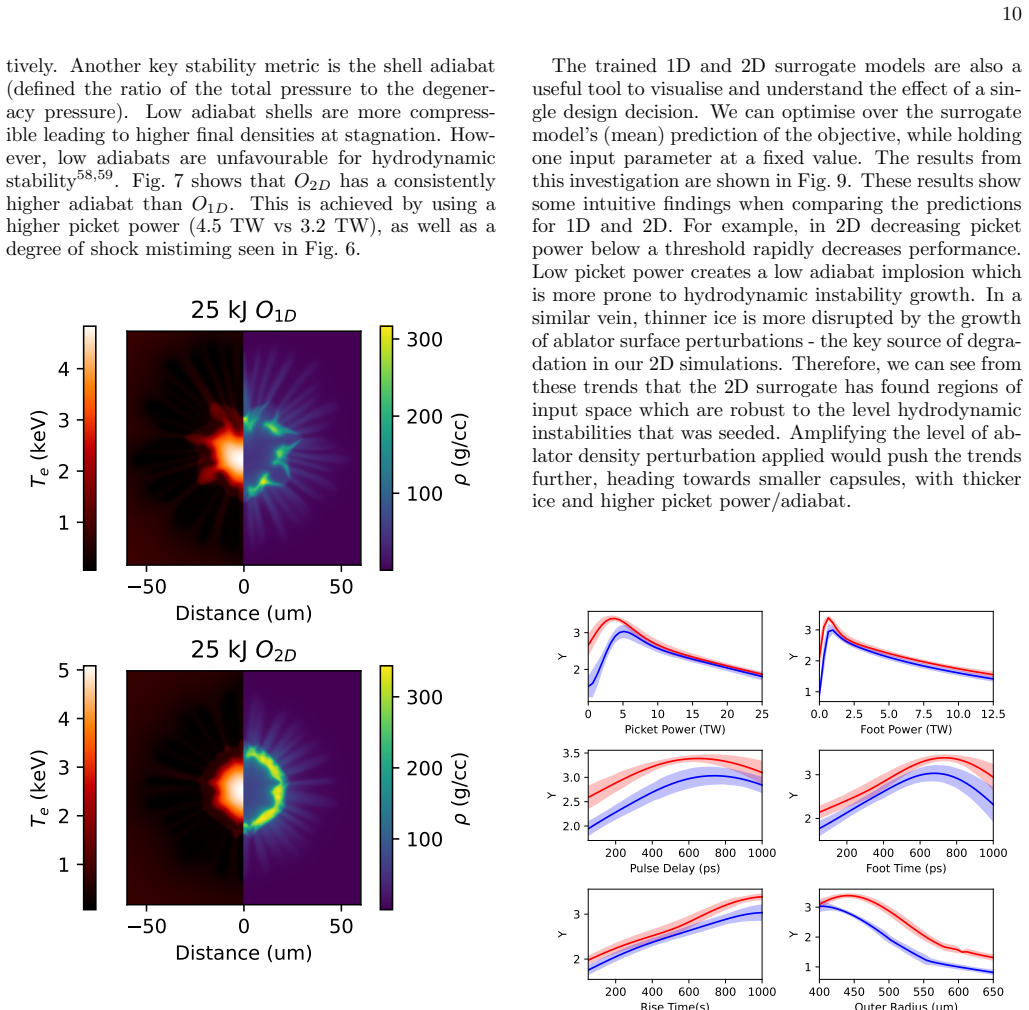
- A 2D-optimised design at 25 kJ is substantially more stable than the 1D-optimised one: peak inflight aspect ratio 30 versus 37, higher shell adiabat, and an intact shell at bang time.
- Hydro-scaling to 2 MJ in 2D with burn-on gives the 2D-optimised design about 2.24e19 neutrons, yield amplification 217, and about 15% burn fraction, versus 1.02e18 neutrons, 17x, and 0.9% for the 1D-optimised design.
- The framework locates resilient designs with only about 128 2D simulations because 1D transfer narrows the search space dramatically.
- The optimiser automatically found shock-timing and stability tradeoffs, such as a higher picket power and thicker ice, without being explicitly asked to tune those quantities.
- The chosen objective rewards designs that would ignite and propagate burn at a larger scale rather than merely maximising 25 kJ yield.
Reading between the lines
- If the hydro-equivalence assumption fails at 2 MJ, the reported O2D yield is an extrapolation; the design should be re-tuned with a full hydro-equivalent pulse and target, then re-simulated, before high gain is treated as confirmed.
- The same transfer-learning loop could be pointed at 3D simulations, experimental data, or additional perturbation sources such as ice roughness and stalk shadows; each would likely shift the resilient design region the surrogate finds.
- A direct 25 kJ laser experiment firing the O2D target with seeded surface perturbations would test whether the predicted resilience appears in measured yield and areal density; agreement would strengthen the scaled 2 MJ claim.
- Amplifying the seeded ablator perturbation level should push the optimised design toward smaller capsules, thicker ice, and higher picket power, as the authors note; this trend is a testable prediction of the surrogate's learned physics.
Editorial analysis
A structured set of objections, weighed in public.
Referee Report
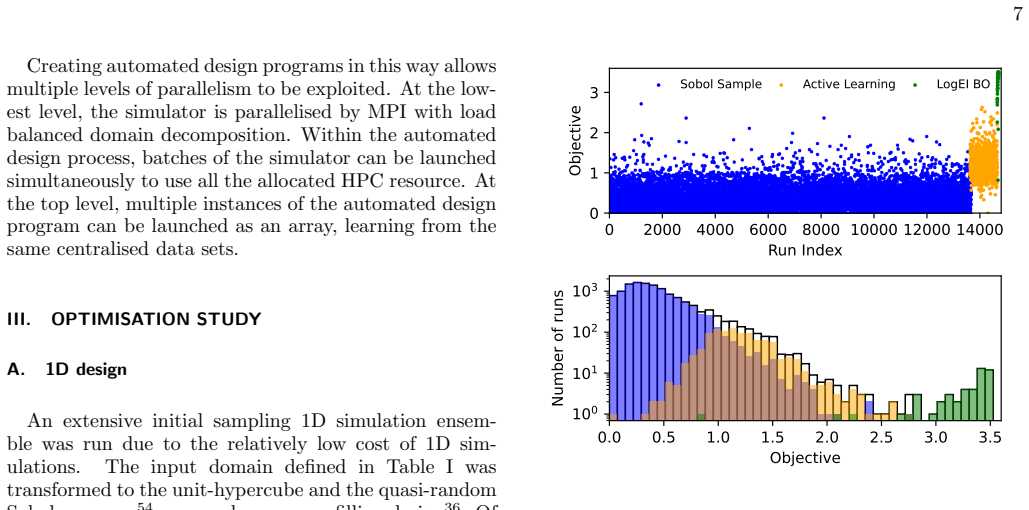
Summary. The paper presents an automated, multi-fidelity simulation-based design framework for laser direct drive inertial confinement fusion. The authors use ~12.5k 1D Chimera simulations to train an ensemble of MLP surrogates, transfer learned features to a much smaller 2D dataset, and then run active learning (probabilistic threshold sampling) and Bayesian optimisation (log expected improvement) over an 8-parameter, OMEGA-relevant design space at 25 kJ. The objective Y (Eq. 3a) combines a hydro-scaled, no-alpha ignition metric with an areal-density term for burn propagation. The 2D-optimised design O2D is reported to be more hydrodynamically stable than the 1D-optimised design O1D at 25 kJ. The paper then hydro-scales the 25 kJ 2D restart fields to 2 MJ and runs 2D burn-off/burn-on simulations, reporting for O2D a yield of 2.24e19 neutrons, yield amplification ~217, and ~15% burn fraction, versus 1.02e18 neutrons and amplification ~17 for O1D.
Significance. If the 25 kJ results are taken at face value, the paper gives a useful demonstration that a multi-fidelity surrogate, active learning, and Bayesian optimisation loop can identify a design that is more robust in 2D than a purely 1D-optimised design while using only a modest number of expensive 2D runs. The open-source orchestration package, the calibrated NN ensembles, and the explicit statement of the hydro-scaling caveat are strengths. However, the headline 2 MJ high-gain claim is not an independent confirmation: it rests on the assumption that a hydro-equivalent implosion can be achieved up to a restart time near stagnation, which the authors explicitly do not test. This makes the central claim conditional, and the conclusion as currently worded overstates the evidence. The paper is a reasonable candidate for publication after the high-gain claim is re-framed and the uncertainty of the 2 MJ results is addressed.
major comments (3)
- [Section IV B / Table II] The 2 MJ high-gain result (O2D: 2.24e19 neutrons, yield amplification 217, ~15% burn fraction) is not a direct confirmation of high gain. The authors state: "we will not perform this re-optimisation but instead apply hydro-scaling to the 2D simulations at a restart time approaching stagnation, making the assumption that a hydro-equivalent implosion can be achieved up to this time." The table footnote repeats that full hydro-equivalent re-tuning was not performed. Nora et al. (Ref. 19), cited by the authors, show that restoring hydro-equivalence requires additional target and pulse changes, mainly exchanging ablator mass for DT ice. Since the conclusion in Section VI says the framework "correctly identified a high-gain scaled-up design," that claim is stronger than the simulation evidence. The stress-test concern therefore lands. I recommend either running a full 2 MJ simulation from the
- [Section IV B / Table II] The 2 MJ burn-on and burn-off values are single 2D simulations for each design, with no error bars or seed-to-seed statistics. This matters because the 25 kJ 2D value of chi_S,no_alpha for O2D is 1.72, close to the nominal ignition threshold, and the 2D simulations intentionally use randomized ablator density perturbations to represent shot-to-shot variability. A different random seed at the 2 MJ scale could plausibly change whether burn propagates and could move the yield by orders of magnitude. The robustness claim therefore needs at least a small ensemble (e.g., 3-5 perturbation realizations) at 2 MJ, or a quantitative propagation of the 25 kJ seed distribution through the scaling procedure. Without this, the 2 MJ performance numbers should be treated as a single realization, not a robust prediction.
- [Section II C 2 / Fig. 1] Quantitative validation of the 2D surrogate on held-out 2D data is not reported. Fig. 1(b)(iii) shows a before/after comparison for the transfer-learned 2D model but gives no R^2, RMSE, or coverage numbers for a 2D test set. Fig. 4 compares 1D and 2D surrogates on inputs from the 1D database, not on held-out 2D simulations. Since the active learning and Bayesian optimisation decisions are driven by the 2D ensemble's mean and calibrated uncertainty, the paper should include a table or plot with held-out 2D prediction error and calibration statistics, ideally in the region around the reported optima. This would let the reader assess how much the 25 kJ and consequently 2 MJ conclusions depend on surrogate accuracy.
minor comments (5)
- [Section II A, Eq. (4c)] The notation d^2 Y_DT / (dt dV) is non-standard and dimensionally confusing. Please write the double integral explicitly (over time and volume) or use a clearer mixed-derivative notation.
- [Section II B] "2.5um" should be "2.5 μm".
- [Section IV B] The sentence "First, both designs have sufficient ignition margin to ignite in 2D at the 2 MJ energy scale" is difficult to reconcile with the O1D result, which is later described as failing to propagate burn into the dense fuel. Recommend distinguishing hot-spot ignition from propagating burn, e.g., "sufficient margin for hot-spot ignition but insufficient confinement for propagating burn."
- [Fig. 1(b)(iii)] The caption says "2D dataset" but does not state whether the points are a held-out 2D test set or the training set. Please clarify and include quantitative performance metrics on the figure.
- [Abstract / Conclusions] The phrase "confirm the achievement of high gain" and similar wording in the conclusion is stronger than the conditional statement in Section IV B. If the major comment about hydro-equivalence is addressed by re-framing, the abstract and conclusions should be aligned with the conditional framing.
Circularity Check
No significant circularity; the 2 MJ high-gain claim is an explicitly qualified hydro-scaling extrapolation, not an equation-level self-derivation.
full rationale
The paper's derivation chain is not circular. The 25 kJ optimization is driven by the physics-informed objective Eq. (3a), which combines the hydro-scaled ignition metric χ_{S,noα} (Eq. 3b) with an areal-density burn-propagation term. The 2 MJ results in Table II are obtained from full 2D Chimera radiation-hydrodynamics burn-on simulations after applying the scaling R→SR, t→St, E→S^3E (Sec. IV B); they are not evaluations of Eq. (3a), nor re-statements of the surrogate predictions. This is why O1D and O2D, which have comparable 1D objective values, differ dramatically in the 2D burn-on yield (1.02e18 vs 2.24e19 neutrons). The load-bearing limitation is explicitly acknowledged: 'we will not perform this re-optimisation but instead apply hydro-scaling to the 2D simulations at a restart time approaching stagnation, making the assumption that a hydro-equivalent implosion can be achieved up to this time.' This is a physical assumption about the validity of hydro-equivalence without re-tuning, which is a correctness/robustness concern, not an instance of a predicted quantity being equal to an input by construction. The self-citations (Chimera, SpK, Tong et al. burn package) are normal code/method references and are not used to forbid alternatives or to import an unverified uniqueness claim. No fitted parameter is renamed as a prediction, and no equation reduces to another by definition. The paper therefore merits a circularity score of 0, with the caveat that the 2 MJ high-gain claim is only as strong as the stated hydro-equivalence assumption.
Assumptions & free parameters
free parameters (6)
- Ensemble uncertainty calibration factor c_v =
~3.5
- Active-learning thresholds and P_min =
Y_threshold=1 (1D), 2 (2D); P_min=0.25 to 0.5
- Ablator density perturbation amplitude =
~1% RMS areal density variation in initial conditions
- MLP hyperparameters =
hidden layers 32,48,48,32; learning rate 0.01 halving every 20 epochs; weight decay 0.05; 80 to 100 epochs; ensemble siz
- Objective normalization rho_R_hat =
0.1 g/cm2
- Design-space bounds and pulse parameterization =
Table I; pulse durations capped at 1 ns; sigma_t=25 ps; beta=9/5
assumptions (8)
- domain assumption Chimera/SOLAS radiation-hydrodynamics simulations faithfully represent 1D and 2D LDD implosions, including alpha heating and burn at the 2 MJ scale.
- domain assumption The seeded perturbations, OMEGA beam mode and randomized density perturbations on the outer 2.5 um of the CH ablator, are a sufficient proxy for hydrodynamic instability sources.
- ad hoc to paper Hydrodynamic scaling without re-optimization gives a representative 2 MJ implosion.
- domain assumption The ignition metric chi_no_alpha and the Fraley burn fraction formula are valid predictors for sub-scale designs.
- ad hoc to paper The scalar objective Y (Eq. 3a) is an adequate proxy for scaled ignition and high gain.
- domain assumption The 25-member neural-network ensemble, after transfer learning and uncertainty calibration, is accurate enough for active learning and Bayesian optimization to locate near-global optima in the 8D design box.
- domain assumption The automatic restart from 2D spherical to 2D cylindrical geometry does not introduce numerical artifacts that dominate the instability seed.
- standard math Bayesian optimization and Gaussian process/neural-network probability models as implemented in BOTorch are correct and converged.
Cite this review
Pith. "Pith review of Automated simulation-based design via multi-fidelity active learning and optimisation for laser direct drive implosions." pith.science (2026). https://pith.science/paper/NWJXHMPL
@misc{pith2026250820878,
  author       = {Pith},
  title        = {Pith review of: Automated simulation-based design via multi-fidelity active learning and optimisation for laser direct drive implosions},
  year         = {2026},
  howpublished = {\url{https://pith.science/paper/NWJXHMPL}},
  note         = {Machine review of arXiv:2508.20878}
}
read the original abstract
The design of inertial fusion experiments is a complex task as driver energy must be delivered in a precise manner to a structured target to achieve a fast, but hydrodynamically stable, implosion. Radiation-hydrodynamics simulation codes are an essential tool in this design process. However, multi-dimensional simulations that capture hydrodynamic instabilities are more computationally expensive than optimistic, 1D, spherically symmetric simulations which are often the primary design tool. In this work, we develop a machine learning framework that aims to effectively use information from a large number of 1D simulations to inform design in the presence of hydrodynamic instabilities. We use an ensemble of neural network surrogate models trained on both 1D and 2D data to capture the space of good designs, i.e. those that are robust to hydrodynamic instabilities. We use this surrogate to perform Bayesian optimisation to find optimal designs for a 25 kJ laser driver. We perform hydrodynamic scaling on these designs to confirm the achievement of high gain for a 2 MJ laser driver, using 2D simulations including alpha heating effects.
Figures


Figures from the paper (7 more)





Reference graph
Works this paper leans on
-
[1]
The Physics of Inertial Fusion: BeamPlasma Interaction, Hydrodynamics, Hot Dense Matter
Stefano Atzeni and J \" u rgen Meyer-ter Vehn. The Physics of Inertial Fusion: BeamPlasma Interaction, Hydrodynamics, Hot Dense Matter . Oxford University Press, Oxford, 2004
work page 2004
-
[2]
John Lindl. Development of the indirect-drive approach to inertial confinement fusion and the target physics basis for ignition and gain. Physics of plasmas , 2(11):3933--4024, 1995
work page 1995
-
[3]
Direct-drive inertial confinement fusion: A review
RS Craxton, KS Anderson, TR Boehly, VN Goncharov, DR Harding, JP Knauer, RL McCrory, PW McKenty, DD Meyerhofer, JF Myatt, et al. Direct-drive inertial confinement fusion: A review. Physics of Plasmas , 22(11), 2015
work page 2015
-
[4]
Lawson criterion for ignition exceeded in an inertial fusion experiment
H Abu-Shawareb, R Acree, P Adams, J Adams, B Addis, R Aden, P Adrian, BB Afeyan, M Aggleton, L Aghaian, et al. Lawson criterion for ignition exceeded in an inertial fusion experiment. Physical Review Letters , 129(7):075001, 2022
work page 2022
-
[5]
A. B. Zylstra, A. L. Kritcher, O. A. Hurricane, D. A. Callahan, J. E. Ralph, D. T. Casey, A. Pak, O. L. Landen, B. Bachmann, K. L. Baker, L. Berzak Hopkins, S. D. Bhandarkar, J. Biener, R. M. Bionta, N. W. Birge, T. Braun, T. M. Briggs, P. M. Celliers, H. Chen, C. Choate, D. S. Clark, L. Divol, T. D\"oppner, D. Fittinghoff, M. J. Edwards, M. Gatu Johnson,...
work page 2022
-
[6]
A. L. Kritcher, A. B. Zylstra, D. A. Callahan, O. A. Hurricane, C. R. Weber, D. S. Clark, C. V. Young, J. E. Ralph, D. T. Casey, A. Pak, O. L. Landen, B. Bachmann, K. L. Baker, L. Berzak Hopkins, S. D. Bhandarkar, J. Biener, R. M. Bionta, N. W. Birge, T. Braun, T. M. Briggs, P. M. Celliers, H. Chen, C. Choate, L. Divol, T. D\"oppner, D. Fittinghoff, M. J....
work page 2022
-
[7]
Inertial-confinement fusion with lasers
R Betti and OA Hurricane. Inertial-confinement fusion with lasers. Nature Physics , 12(5):435--448, 2016
work page 2016
-
[8]
O. A. Hurricane , D. A. Callahan , D. T. Casey , P. M. Celliers , C. Cerjan , E. L. Dewald , T. R. Dittrich , T. D \"o ppner , D. E. Hinkel , L. F. B. Hopkins , J. L. Kline , S. Le Pape , T. Ma , A. G. Macphee , J. L. Milovich , A. Pak , H.-S. Park , P. K. Patel , B. A. Remington , J. D. Salmonson , P. T. Springer , and R. Tommasini . Fuel gain exceeding ...
work page 2014
Show all 76 references
-
[9]
Cross-code comparison of the impact of the fill tube on high yield implosions on the national ignition facility
Brian M Haines, Daniel S Clark, Christopher R Weber, M John Edwards, Steven H Batha, and John L Kline. Cross-code comparison of the impact of the fill tube on high yield implosions on the national ignition facility. Physics of Plasmas , 27(8), 2020
2020
-
[10]
D. S. Clark, C. R. Weber, J. L. Milovich, A. E. Pak, D. T. Casey, B. A. Hammel, D. D. Ho, O. S. Jones, J. M. Koning, A. L. Kritcher, M. M. Marinak, L. P. Masse, D. H. Munro, M. V. Patel, P. K. Patel, H. F. Robey, C. R. Schroeder, S. M. Sepke, and M. J. Edwards. Three-dimension...
2019
-
[11]
Diagnostic signatures of performance degrading perturbations in inertial confinement fusion implosions
K McGlinchey, BD Appelbe, AJ Crilly, JK Tong, CA Walsh, and JP Chittenden. Diagnostic signatures of performance degrading perturbations in inertial confinement fusion implosions. Physics of Plasmas , 25(12):122705, 2018
2018
-
[12]
Practical bayesian optimization of machine learning algorithms
Jasper Snoek, Hugo Larochelle, and Ryan P Adams. Practical bayesian optimization of machine learning algorithms. Advances in neural information processing systems , 25, 2012
2012
-
[13]
Bayesian calibration of computer models
Marc C Kennedy and Anthony O'Hagan. Bayesian calibration of computer models. Journal of the Royal Statistical Society: Series B (Statistical Methodology) , 63(3):425--464, 2001
2001
-
[14]
Nonlinear information fusion algorithms for data-efficient multi-fidelity modelling
Paris Perdikaris, Maziar Raissi, Andreas Damianou, Neil D Lawrence, and George Em Karniadakis. Nonlinear information fusion algorithms for data-efficient multi-fidelity modelling. Proceedings of the Royal Society A: Mathematical, Physical and Engineering Sciences , 473(2198):2...
2017
-
[15]
Alpha heating and burning plasmas in inertial confinement fusion
R Betti, AR Christopherson, BK Spears, R Nora, A Bose, J Howard, KM Woo, MJ Edwards, and J Sanz. Alpha heating and burning plasmas in inertial confinement fusion. Physical review letters , 114(25):255003, 2015
2015
-
[16]
Theory of ignition and burn propagation in inertial fusion implosions
AR Christopherson, R Betti, S Miller, V Gopalaswamy, OM Mannion, and D Cao. Theory of ignition and burn propagation in inertial fusion implosions. Physics of Plasmas , 27(5), 2020
2020
-
[17]
G. S. Fraley, E. J. Linnebur, R. J. Mason, and R. L. Morse. Thermonuclear burn characteristics of compressed deuterium‐tritium microspheres. The Physics of Fluids , 17(2):474--489, 1974
1974
-
[18]
Initial performance results of the omega laser system
TR Boehly, DL Brown, RS Craxton, RL Keck, JP Knauer, JH Kelly, TJ Kessler, SA Kumpan, SJ Loucks, SA Letzring, et al. Initial performance results of the omega laser system. Optics communications , 133(1-6):495--506, 1997
1997
-
[19]
R. Nora, R. Betti, K. S. Anderson, A. Shvydky, A. Bose, K. M. Woo, A. R. Christopherson, J. A. Marozas, T. J. B. Collins, P. B. Radha, S. X. Hu, R. Epstein, F. J. Marshall, R. L. McCrory, T. C. Sangster, and D. D. Meyerhofer. Theory of hydro-equivalent ignition for inertial fu...
2014
-
[20]
The national ignition facility
George H Miller, Edward I Moses, and Craig R Wuest. The national ignition facility. Optical Engineering , 43(12):2841--2853, 2004
2004
-
[21]
Automated and highly parallelized bayesian optimization scheme for direct drive fusion experiments on omega
V Gopalaswamy, A Lees, R Ejaz, CA Thomas, TJB Collins, KS Anderson, W Ebmeyer, and R Betti. Automated and highly parallelized bayesian optimization scheme for direct drive fusion experiments on omega. Physical Review Research , 7(1):013009, 2025
2025
-
[22]
The blind implosion-maker: Automated inertial confinement fusion experiment design
PW Hatfield, SJ Rose, and RHH Scott. The blind implosion-maker: Automated inertial confinement fusion experiment design. Physics of Plasmas , 26(6):062706, 2019
2019
-
[23]
J. P. Chittenden, B. D. Appelbe, F. Manke, K. McGlinchey, and N. P.L. Niasse. Signatures of asymmetry in neutron spectra and images predicted by three-dimensional radiation hydrodynamics simulations of indirect drive implosions . Physics of Plasmas , 23(5), 2016
2016
-
[24]
C. A. Walsh, J. P. Chittenden, K. McGlinchey, N. P.L. Niasse, and B. D. Appelbe. Self-Generated Magnetic Fields in the Stagnation Phase of Indirect-Drive Implosions on the National Ignition Facility . Physical Review Letters , 118(15):1--5, 2017
2017
-
[25]
J.K. Tong, K. McGlinchey, B.D. Appelbe, C.A. Walsh, A.J. Crilly, and J.P. Chittenden. Burn regimes in the hydrodynamic scaling of perturbed inertial confinement fusion hotspots. Nuclear Fusion , 59(8):086015, jun 2019
2019
-
[26]
Neutron backscatter edges as a diagnostic of burn propagation
AJ Crilly, BD Appelbe, OM Mannion, CJ Forrest, JP Knauer, DJ Schlossberg, EP Hartouni, AS Moore, and JP Chittenden. Neutron backscatter edges as a diagnostic of burn propagation. Physics of Plasmas , 29(6):062707, 2022
2022
-
[27]
Spk: A fast atomic and microphysics code for the high-energy-density regime
AJ Crilly, NPL Niasse, AR Fraser, DA Chapman, KM McLean, SJ Rose, and JP Chittenden. Spk: A fast atomic and microphysics code for the high-energy-density regime. arXiv preprint arXiv:2211.16464 , 2022
2022 arXiv
-
[28]
Journal of Computational Physics , 257:594--626, 2014
A stabilized runge–kutta–legendre method for explicit super-time-stepping of parabolic and mixed equations. Journal of Computational Physics , 257:594--626, 2014
2014
-
[29]
Uniformity of energy deposition for laser driven fusion
Stanley Skupsky and Kotik Lee. Uniformity of energy deposition for laser driven fusion. Journal of Applied Physics , 54(7):3662--3671, 1983
1983
-
[30]
Using statistical modeling to predict and understand fusion experiments
V Gopalaswamy, R Betti, JP Knauer, A Lees, D Patel, AR Christopherson, IV Igumenshchev, D Cao, KS Anderson, A Shvydky, et al. Using statistical modeling to predict and understand fusion experiments. Physics of Plasmas , 28(12), 2021
2021
-
[31]
Irradiation uniformity for high-compression laser-fusion experiments
S Skupsky and RS Craxton. Irradiation uniformity for high-compression laser-fusion experiments. Physics of Plasmas , 6(5):2157--2163, 1999
1999
-
[32]
A model of laser imprinting
VN Goncharov, S Skupsky, TR Boehly, JP Knauer, P McKenty, VA Smalyuk, RPJ Town, OV Gotchev, R Betti, and DD Meyerhofer. A model of laser imprinting. Physics of Plasmas , 7(5):2062--2068, 2000
-
[33]
Effects of laser bandwidth in direct-drive high-performance dt-layered implosions on the omega laser
Dhrumir Patel, JP Knauer, D Cao, R Betti, Ryan Nora, A Shvydky, V Gopalaswamy, A Lees, Siddharth Sampat, WR Donaldson, et al. Effects of laser bandwidth in direct-drive high-performance dt-layered implosions on the omega laser. Physical Review Letters , 131(10):105101, 2023
2023
-
[34]
Linear stability analysis of laser-driven spherical implosions
JN Shiau, EB Goldman, and CI Weng. Linear stability analysis of laser-driven spherical implosions. Physical Review Letters , 32(7):352, 1974
1974
-
[35]
A multifidelity bayesian optimization method for inertial confinement fusion design
Jingyi Wang, N Chiang, Andrew Gillette, and J Luc Peterson. A multifidelity bayesian optimization method for inertial confinement fusion design. Physics of Plasmas , 31(3), 2024
2024
-
[36]
The design and analysis of computer experiments , volume 1
Thomas J Santner, Brian J Williams, William I Notz, and Brain J Williams. The design and analysis of computer experiments , volume 1. Springer, 2003
2003
-
[37]
Gaussian processes for machine learning , volume 2
Christopher KI Williams and Carl Edward Rasmussen. Gaussian processes for machine learning , volume 2. MIT press Cambridge, MA, 2006
2006
-
[38]
The kernel cookbook: Advice on covariance functions
David Duvenaud. The kernel cookbook: Advice on covariance functions. URL https://www. cs. toronto. edu/duvenaud/cookbook , 2014
2014
-
[39]
Predicting fusion ignition at the national ignition facility with physics-informed deep learning
Brian K Spears, Scott Brandon, Dan T Casey, John E Field, Jim A Gaffney, Kelli D Humbird, Andrea L Kritcher, Michael KG Kruse, Eugene Kur, Bogdan Kustowski, et al. Predicting fusion ignition at the national ignition facility with physics-informed deep learning. Science , 389(6...
2025
-
[40]
Deep learning-based predictive models for laser direct drive at the omega laser facility
Rahman Ejaz, Varchas Gopalaswamy, A Lees, C Kanan, D Cao, and R Betti. Deep learning-based predictive models for laser direct drive at the omega laser facility. Physics of Plasmas , 31(5), 2024
2024
-
[41]
Data-driven prediction of scaling and ignition of inertial confinement fusion experiments
Jim A Gaffney, Kelli Humbird, Andrea Kritcher, Michael Kruse, Eugene Kur, Bogdan Kustowski, Ryan Nora, and Brian Spears. Data-driven prediction of scaling and ignition of inertial confinement fusion experiments. Physics of Plasmas , 31(9), 2024
2024
-
[42]
Simple and scalable predictive uncertainty estimation using deep ensembles
Balaji Lakshminarayanan, Alexander Pritzel, and Charles Blundell. Simple and scalable predictive uncertainty estimation using deep ensembles. Advances in neural information processing systems , 30, 2017
2017
-
[43]
Pytorch: An imperative style, high-performance deep learning library
Adam Paszke, Sam Gross, Francisco Massa, Adam Lerer, James Bradbury, Gregory Chanan, Trevor Killeen, Zeming Lin, Natalia Gimelshein, Luca Antiga, et al. Pytorch: An imperative style, high-performance deep learning library. Advances in neural information processing systems , 32, 2019
2019
-
[44]
Botorch: A framework for efficient monte-carlo bayesian optimization
Maximilian Balandat, Brian Karrer, Daniel Jiang, Samuel Daulton, Ben Letham, Andrew G Wilson, and Eytan Bakshy. Botorch: A framework for efficient monte-carlo bayesian optimization. Advances in neural information processing systems , 33:21524--21538, 2020
2020
-
[45]
Decoupled weight decay regularization
Ilya Loshchilov and Frank Hutter. Decoupled weight decay regularization. arXiv preprint arXiv:1711.05101 , 2017
2017 arXiv
-
[46]
Random forests
Leo Breiman. Random forests. Machine learning , 45(1):5--32, 2001
2001
-
[47]
Transfer learning to model inertial confinement fusion experiments
Kelli D Humbird, Jayson Luc Peterson, BK Spears, and Ryan G McClarren. Transfer learning to model inertial confinement fusion experiments. IEEE Transactions on Plasma Science , 48(1):61--70, 2019
2019
-
[48]
Shock timing technique for the national ignition facility
David H Munro, Peter M Celliers, Gilbert W Collins, David M Gold, Luiz B Da Silva, Steven W Haan, Robert C Cauble, Bruce A Hammel, and Warren W Hsing. Shock timing technique for the national ignition facility. Physics of Plasmas , 8(5):2245--2250, 2001
2001
-
[49]
Machine learning for biological design
Tom Blau, Iadine Chades, and Cheng Soon Ong. Machine learning for biological design. In Synthetic Biology: Methods and Protocols , pages 319--344. Springer, 2024
2024
-
[50]
o ssische Technische Hochschule Z \
Alkis Gotovos. Active learning for level set estimation. Master's thesis, Eidgen \"o ssische Technische Hochschule Z \"u rich, Department of Computer Science,, 2013
2013
-
[51]
Unexpected improvements to expected improvement for bayesian optimization
Sebastian Ament, Samuel Daulton, David Eriksson, Maximilian Balandat, and Eytan Bakshy. Unexpected improvements to expected improvement for bayesian optimization. Advances in Neural Information Processing Systems , 36:20577--20612, 2023
2023
-
[52]
Combining multi-fidelity modelling and asynchronous batch bayesian optimization
Jose Pablo Folch, Robert M Lee, Behrang Shafei, David Walz, Calvin Tsay, Mark van der Wilk, and Ruth Misener. Combining multi-fidelity modelling and asynchronous batch bayesian optimization. Computers & Chemical Engineering , 172:108194, 2023
2023
-
[53]
mille-feuille: A Bayesian Optimisation wrapper for HPC scale simulations: https://github.com/aidancrilly/mille-feuille , 2025
Aidan Crilly. mille-feuille: A Bayesian Optimisation wrapper for HPC scale simulations: https://github.com/aidancrilly/mille-feuille , 2025
2025
-
[54]
The distribution of points in a cube and the accurate evaluation of integrals (in russian) zh
I Sobol. The distribution of points in a cube and the accurate evaluation of integrals (in russian) zh. Vychisl. Mat. i Mater. Phys , 7:784--802, 1967
1967
-
[55]
Progress toward a self-consistent set of 1d ignition capsule metrics in icf
JD Lindl, SW Haan, OL Landen, AR Christopherson, and R Betti. Progress toward a self-consistent set of 1d ignition capsule metrics in icf. Physics of Plasmas , 25(12), 2018
2018
-
[56]
S. P. Regan, R. Epstein, B. A. Hammel, L. J. Suter, J. Ralph, H. Scott, M. A. Barrios, D. K. Bradley, D. A. Callahan, C. Cerjan, G. W. Collins, S. N. Dixit, T. Doeppner, M. J. Edwards, D. R. Farley, S. Glenn, S. H. Glenzer, I. E. Golovkin, S. W. Haan, A. Hamza, D. G. Hicks, N....
2012
-
[57]
Laser-plasma interactions and applications
Paul McKenna, David Neely, Robert Bingham, and Dino Jaroszynski. Laser-plasma interactions and applications . Springer, 2013
2013
-
[58]
Self-consistent growth rate of the rayleigh--taylor instability in an ablatively accelerating plasma
Hideaki Takabe, K Mima, L Montierth, and RL Morse. Self-consistent growth rate of the rayleigh--taylor instability in an ablatively accelerating plasma. The Physics of fluids , 28(12):3676--3682, 1985
1985
-
[59]
Growth rates of the ablative rayleigh--taylor instability in inertial confinement fusion
R Betti, VN Goncharov, R \'a L McCrory, and C \'a P Verdon. Growth rates of the ablative rayleigh--taylor instability in inertial confinement fusion. Physics of Plasmas , 5(5):1446--1454, 1998
1998
-
[60]
Betti, K
R. Betti, K. Anderson, V. N. Goncharov, R. L. McCrory, D. D. Meyerhofer, S. Skupsky, and R. P. J. Town. Deceleration phase of inertial confinement fusion implosions. Physics of Plasmas , 9(5):2277--2286, 2002
2002
-
[61]
Hohlraum reheating from burning nif implosions
MS Rubery, MD Rosen, N Aybar, OL Landen, L Divol, CV Young, C Weber, J Hammer, JD Moody, AS Moore, et al. Hohlraum reheating from burning nif implosions. Physical Review Letters , 132(6):065104, 2024
2024
-
[62]
Inertially confined fusion plasmas dominated by alpha-particle self-heating
Omar A Hurricane, DA Callahan, DT Casey, EL Dewald, TR Dittrich, T D \"o ppner, S Haan, DE Hinkel, LF Berzak Hopkins, O Jones, et al. Inertially confined fusion plasmas dominated by alpha-particle self-heating. Nature Physics , 12(8):800--806, 2016
2016
-
[63]
A 3d dynamic model to assess the impacts of low-mode asymmetry, aneurysms and mix-induced radiative loss on capsule performance across inertial confinement fusion platforms
PT Springer, OA Hurricane, JH Hammer, R Betti, DA Callahan, EM Campbell, DT Casey, CJ Cerjan, D Cao, E Dewald, et al. A 3d dynamic model to assess the impacts of low-mode asymmetry, aneurysms and mix-induced radiative loss on capsule performance across inertial confinement fus...
2018
-
[64]
Multidimensional modelling of Cross-Beam Energy Transfer for direct-drive Inertial Confinement Fusion
Philip Moloney. Multidimensional modelling of Cross-Beam Energy Transfer for direct-drive Inertial Confinement Fusion . PhD thesis, Imperial College London, 2024
2024
-
[65]
Progress in 2 mm glow discharge polymer mandrel development for nif
A Nikroo, J Bousquet, R Cook, BW McQuillan, R Paguio, and M Takagi. Progress in 2 mm glow discharge polymer mandrel development for nif. Fusion science and technology , 45(2):165--170, 2004
2004
-
[66]
Metrology feasibility study in support of the national direct-drive program
H Huang, K Engelhorn, K Sequoia, A Greenwood, W Sweet, L Carlson, F Elsner, and M Farrell. Metrology feasibility study in support of the national direct-drive program. Fusion Science and Technology , 73(2):98--106, 2018
2018
-
[67]
Impact of stalk on directly driven inertial confinement fusion implosions
Maria Gatu Johnson, Patrick J Adrian, KS Anderson, BD Appelbe, JP Chittenden, AJ Crilly, D Edgell, CJ Forrest, Johan A Frenje, V Yu Glebov, et al. Impact of stalk on directly driven inertial confinement fusion implosions. Physics of Plasmas , 27(3), 2020
2020
-
[68]
Exploring the parameter space of maglif implosions using similarity scaling
DE Ruiz, PF Schmit, DA Yager-Elorriaga, MR Gomez, MR Weis, CA Jennings, AJ Harvey-Thompson, PF Knapp, SA Slutz, DJ Ampleford, et al. Exploring the parameter space of maglif implosions using similarity scaling. ii. current scaling. Physics of Plasmas , 30(3), 2023
2023
-
[69]
Affordable, manageable, practical, and scalable (amps) high-yield and high-gain inertial fusion
Andrew Alexander, Laura Robin Benedetti, Indrani Bhattacharyya, Jared Bowen, June Cabatu, Virgil Cacdac, Chhavi Chhavi, Chiatai Chen, Karen Chen, Dan Clark, et al. Affordable, manageable, practical, and scalable (amps) high-yield and high-gain inertial fusion. arXiv preprint a...
2025 arXiv
-
[70]
A pushered capsule implosion as an alternate approach to the ignition regime for inertial confinement fusion
SA MacLaren, DD-M Ho, OA Hurricane, EL Dewald, DA Martinez, RE Tipton, JE Pino, CV Young, HW Xu, CW Kong, et al. A pushered capsule implosion as an alternate approach to the ignition regime for inertial confinement fusion. Physics of Plasmas , 28(12), 2021
2021
-
[71]
Energy gain of wetted-foam implosions with auxiliary heating for inertial fusion studies
RW Paddock, TS Li, E Kim, JJ Lee, H Martin, RT Ruskov, S Hughes, SJ Rose, CD Murphy, RHH Scott, et al. Energy gain of wetted-foam implosions with auxiliary heating for inertial fusion studies. Plasma Physics and Controlled Fusion , 66(2):025005, 2023
2023
-
[72]
A future of inertial confinement fusion without laser-plasma instabilities
DH Froula, C Dorrer, A Cola \" tis, DH Edgell, RK Follett, EM Hill, IV Igumenshchev, AL Milder, JP Palastro, RC Shah, et al. A future of inertial confinement fusion without laser-plasma instabilities. Physics of Plasmas , 32(5), 2025
2025
-
[73]
Rethinking optimization with differentiable simulation from a global perspective
Rika Antonova, Jingyun Yang, Krishna Murthy Jatavallabhula, and Jeannette Bohg. Rethinking optimization with differentiable simulation from a global perspective. In Conference on robot learning , pages 276--286. PMLR, 2023
2023
-
[74]
Generative neural reparameterization for differentiable pde-constrained optimization
Archis S Joglekar. Generative neural reparameterization for differentiable pde-constrained optimization. arXiv preprint arXiv:2410.12683 , 2024
2024 arXiv
-
[75]
Archer2 service description, December 2024
George Beckett, Josephine Beech-Brandt, Kieran Leach, Zöe Payne, Alan Simpson, Lorna Smith, Andy Turner, and Anne Whiting. Archer2 service description, December 2024
2024
-
[76]
Dropout injection at test time for post hoc uncertainty quantification in neural networks
Emanuele Ledda, Giorgio Fumera, and Fabio Roli. Dropout injection at test time for post hoc uncertainty quantification in neural networks. Information Sciences , 645:119356, 2023
2023
Reviewed August 5, 2026 · model on record in the stance chip above.
Discussion (0). Continue with ORCID to comment.