REVIEW 4 major objections 5 minor 11 references
Conservative Link Adaptation for Ultra Reliable Low Latency Communications
T0 review · 4 major / 5 minor · reviewed 2026-08-14 · deepseek-v4-flash
Pith's one-line read The paper argues that a scheduler can meet URLLC's $10^{-5}$ packet-loss target in fast-fading channels by selecting each MCS from the worst channel degradation observed over a sliding window of past CQI reports rather than from the…
desk verdict Simple, new max-degradation heuristic for URLLC link adaptation, but the 10^-5 reliability claim rests on statistically thin NS-3 evidence and a post-hoc window choice. read the letter →
The pith
A machine-rendered reading of the paper's core claim, the machinery that carries it, and where it could break.
The reading
What carries the argument
The load-bearing object is the sliding-window worst-degradation statistic. On each received CQI report, the base station records the drop from the value received $\Delta t$ earlier and keeps the maximum such drop over the last $W/T_{CQI}$ reports; this maximum is then subtracted from the latest reported CQI before an MCS is chosen. The procedure converts a history of noisy, delayed observations into a conservative point estimate of channel quality, and the truncation at zero plus the MCS 0 fallback for deadline-critical packets prevents the conservative estimate from discarding usable resource blocks. Its role in the argument is to make the MCS robust to CQI obsolescence without falling back to the most robust MCS unconditionally.
What would settle it
Run the algorithm with $W = 100\,T_{CQI}$ in a single-user Rayleigh fading simulator using the paper's parameters, but inject a deep fade immediately after a long calm period that is absent from the window; if the packet-loss ratio exceeds $10^{-5}$ while the always-MCS-0 baseline meets it, the central claim that past worst-case degradation bounds future degradation is refuted.
Extended reading notes
Core claim
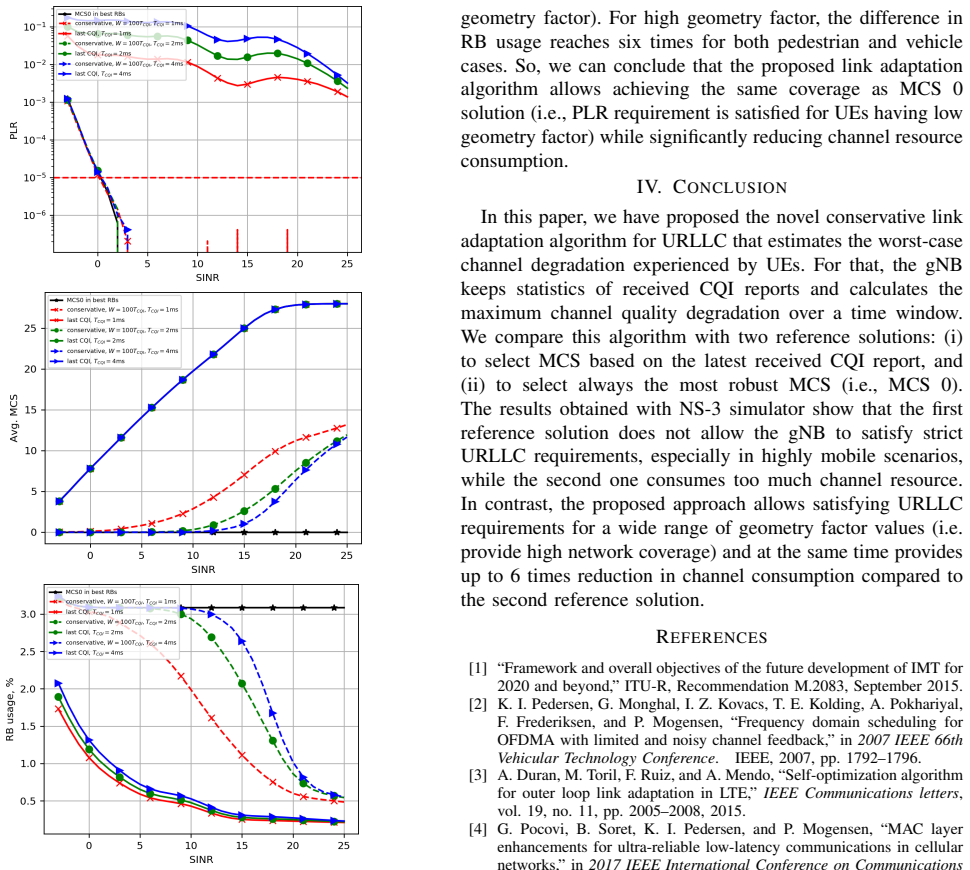
On its own terms, the paper's central claim is that the gNB can satisfy the URLLC requirement $\mathrm{PLR} < 10^{-5}$ for a single user in a Rayleigh-faded channel by computing, for each subband, the statistic $\Delta CQI(\Delta t) = \max_{t'} \big(CQI(t'-\Delta t) - CQI(t')\big)$ over a window $W$ of past reports and using it to form the estimate $\widehat{CQI}(t_{SCH}) = \max(0, CQI(t_{last\,CQI}) - \Delta CQI(\Delta t))$. MCS selection then targets the BLER requirement using this conservative estimate, with a fallback that assigns MCS 0 plus extra resource blocks only to packets that cannot otherwise meet their deadline. With $W = 100\,T_{CQI}$, simulated pedestrian and vehicle users meet the PLR target for geometry factors from $-3$ to $25$ dB, and resource-block usage is up to six times lower than always selecting MCS 0. The paper further shows that the same algorithm keeps PLR stable when the CQI reporting period grows, at the cost of higher resource consumption.
Load-bearing premise
The load-bearing premise is that the worst channel-quality dip observed in the past $W$ reports predicts the worst dip that will happen between a measurement and the actual transmission; if the channel falls further than anything in that window, the chosen modulation and coding can still miss the $10^{-5}$ target.
Editorial extensions
If this is right
- A gNB that uses the worst-dip rule can keep a URLLC link within its $10^{-5}$ packet-loss target in channels where the latest-CQI approach fails badly, including 60 km/h vehicle fading.
- Because resource consumption drops by up to six times compared with always selecting MCS 0 at high geometry factors, the freed resource blocks can serve other traffic without compromising URLLC.
- When the CQI reporting period is increased, the algorithm keeps PLR essentially unchanged but consumes more resources, so the window and reporting period together give an operator a tunable reliability-efficiency trade-off.
- The window size $W$ governs conservatism: values around $10\,T_{CQI}$ miss the PLR target, while $W = 100\,T_{CQI}$ meets it, so practical deployment needs to set $W$ from the expected channel variability.
- The subband statistics can be merged when noise or interference affects the whole band, which lets the same worst-case estimate be found with a shorter observation window.
Reading between the lines
- Beyond the paper, the worst-degradation estimate could be replaced by a high quantile of past dips, which would give an explicit reliability margin instead of relying on the empirical maximum.
- Beyond the paper, the approach could be combined with an outer-loop margin driven by HARQ feedback, allowing the worst-dip estimate to absorb model mismatch; the paper does not explore this.
- Beyond the paper, non-stationary effects such as sudden blockage or handover could break the past-window assumption, so an adaptive window or change detector is a testable extension.
- Beyond the paper, the per-subband, per-user CQI history should carry over to multi-user scheduling, though only a single-user scenario is evaluated here.
Signed reviews
Editorial analysis
A structured set of objections, weighed in public.
Referee Report
Summary. The paper proposes a conservative link adaptation algorithm for URLLC in 5G networks. The gNB estimates the worst-case channel degradation by taking the maximum CQI drop observed over a sliding window of past CQI reports, and then selects an MCS that is robust to that estimated degradation. The algorithm is evaluated with the NS-3 simulator in a single-cell, single-UE scenario with Rayleigh fading at 3 and 60 km/h, and compared with two baselines: selection based on the latest CQI report and fixed selection of MCS 0. The reported results show that the proposed algorithm with W/TCQI=100 achieves packet loss ratios below the 10^-5 URLLC target over a range of geometry factors while reducing resource consumption by up to a factor of six compared with always using MCS 0.
Significance. If the claimed performance is reliable, the algorithm is an attractive gNB-side enhancement: it is simple, requires no changes to UE reporting beyond existing CQI reports, and directly targets the URLLC reliability requirement while conserving channel resources. The paper clearly identifies the outdated-CQI problem for URLLC and proposes a plausible heuristic. However, the central validation is not yet conclusive: the simulation evidence lacks statistical rigor for a 10^-5 target, the window size W is selected post hoc from the same simulation results, and the estimator in Eq. (1) is a heuristic without an analytical bound. The significance of the work is therefore conditional on additional validation and a clearer account of how W should be set in practice.
major comments (4)
- [III.B, Figs. 3-5] The central claim that the proposed algorithm satisfies the URLLC PLR requirement of 10^-5 is supported only by point estimates from the simulation. The paper does not state the number of packets simulated, the number of random seeds, or confidence intervals. For a target of 10^-5, even a run with zero losses over 100,000 packets does not provide a useful statistical bound on the true PLR; substantially more packets are needed. Please report the simulation duration, number of independent runs, and confidence intervals (or at least the number of simulated packets) for all PLR curves, and discuss whether the observed zero-loss or low-loss results actually bound the PLR below 10^-5.
- [II.B, Eq. (1)] The core estimator takes the maximum channel degradation observed over a window W as a prediction of the worst-case degradation between CQI measurement and transmission. This is a heuristic with no analytical bound: if the channel degrades more than anything observed in the window, the selected MCS will not provide the target reliability. The paper validates the heuristic only for one fading model and two speeds. Please add a formal statement of the assumptions under which the estimator is conservative, or at least clearly state that the reliability guarantee is empirical and limited to scenarios similar to those simulated.
- [III.B, Fig. 3] The window size W=100 TCQI is chosen after observing that smaller windows (W/TCQI=10) fail to meet the PLR target. Because the same simulation data are used both to select W and to validate the final PLR, the reported reliability is at risk of being tuned to the test scenario. Please provide an independent validation of the chosen W, a principled method for setting W based on channel dynamics, or a sensitivity analysis over multiple seeds, channel models, and UE speeds to demonstrate that the conclusion is not an artifact of parameter tuning.
- [III.B, Figs. 4-5] The claim of up to 6x reduction in channel resource consumption compared with MCS 0 is reported without confidence intervals on the RB-usage metric. Since PLR is the primary constraint and the PLR estimates are not statistically quantified, the comparison may be misleading. Please report the uncertainty in both PLR and RB usage, and clarify whether the reported resource reduction is achieved at operating points where the PLR requirement is met with statistical confidence.
minor comments (5)
- [III.B] There is a typo: 'resorce' should be 'resource'.
- [III.A] The sentence 'The UEs receives URLLC traffic in downlink' has subject-verb agreement; it should be 'The UEs receive'.
- [III.B, Fig. 3] The caption 'Influence of WND' uses an undefined abbreviation; please write 'window size W' or 'W/TCQI' explicitly.
- [III.B, Fig. 3] The text states that a window of '5−10 TCQI' is not enough, but the figure appears to show only W/TCQI=10 and 100. If results for W/TCQI=5 were obtained, please include them in the figure; otherwise remove the unsupported statement.
- [II.B, Eq. (1)] Equation (1) uses CQI(tSCH) for the estimated CQI at the scheduling instant, while the actual transmission occurs later at tSCH + tsch_delay. Please clarify whether the estimated CQI is intended for the scheduling decision or for the actual transmission time, and align the notation with Fig. 2.
Circularity Check
Core estimator is not self-referential, but the headline URLLC coverage claim is partly a post-hoc fit: W=100 is chosen after observing that smaller windows fail to reach PLR 10^-5 on the same simulations.
-
fitted input called prediction
[Section III-B, 'Analysis of Results', Fig. 3 discussion]
"Figures show that small window ( 5− 10 TCQI ) is not enough to guarantee PLR 10−5. Hence, in the experiments below, we use W = 100 TCQI ."
The observation window W is selected by inspecting the very PLR 10^-5 requirement on the same simulator data that is later summarized as 'the proposed approach allows satisfying URLLC requirements for a wide range of geometry factor values'. Thus the reported success at W=100 is not an independent test of the estimator; it is a post-hoc fit of the free window parameter to the target. The paper gives no analytical bound for Eq. (1) and no out-of-sample validation with a different W, so the central coverage/reliability conclusion is a consequence of the fitted W rather than a prediction or derivation from first principles.
full rationale
The proposed scheme estimates DeltaCQI in Eq. (1) from CQI history independently of the PLR target, and the simulation performance is measured against a separately implemented channel and MCS model; so the algorithm itself is not circular and no load-bearing self-citation chain is present. The one genuine circularity-like step is the selection of the observation window W. The authors show that W=10 TCQI does not guarantee PLR 10^-5 and W=100 does, and then use W=100 for all subsequent experiments; the later conclusion that the proposed approach 'allows satisfying URLLC requirements for a wide range of geometry factor values' is therefore not an out-of-sample prediction or a derivation. It is conditioned on a hyperparameter chosen from the same target metric and the same simulation scenario, with no analytical bound on Eq. (1) and no independent validation set. This makes the central reliability claim partly a consequence of the fitted W, although the algorithm's own max-past-degradation logic has independent content. Accordingly, score 4: partial circularity from a tuned input, not full definitional or self-citation circularity.
Assumptions & free parameters
free parameters (1)
- W (observation window size) =
W = 100 * TCQI
assumptions (3)
- domain assumption The maximum channel degradation observed over the past window W is a valid predictor of the worst-case degradation until the next transmission.
- domain assumption Noise/interference affects all subbands equally, so merging per-subband statistics is valid.
- domain assumption The EESM model from [10] accurately maps per-RB SNRs to a single effective SNR for MCS selection.
Cite this review
Pith. "Pith review of Conservative Link Adaptation for Ultra Reliable Low Latency Communications." pith.science (2026). https://pith.science/paper/NX2U5D3T
@misc{pith2026190802227,
  author       = {Pith},
  title        = {Pith review of: Conservative Link Adaptation for Ultra Reliable Low Latency Communications},
  year         = {2026},
  howpublished = {\url{https://pith.science/paper/NX2U5D3T}},
  note         = {Machine review of arXiv:1908.02227}
}
abstract
Ultra reliable low latency communications (URLLC) is one of the most promising and demanding services in 5G systems. This service requires very low latency of less than $1-10$ ms and very high transmission reliability: the acceptable packet loss ratio is about $10^{-5}$. To satisfy such strict requirements, many issues shall be solved. This paper focuses on the link adaptation problem, i.e., the selection of a modulation and coding scheme (MCS) for transmission based on the received channel quality indicator (CQI) reports. On the one hand, link adaptation should select a robust MCS to provide high reliability. On the other hand, it should select the highest possible MCS to reduce channel resource consumption. The paper shows that even for one URLLC user, link adaptation is still a challenging problem, especially in highly-variant channels. To solve this problem, a conservative link adaptation algorithm is designed. The algorithm estimates the strongest channel degradation at the time moment of the actual packet transmission and selects an MCS taking into account the worst degradation. The obtained results show that the proposed algorithm is efficient in terms of both the packet loss ratio and the channel resource consumption.
Figures



Figures from the paper (1 more)
Reference graph
Works this paper leans on
-
[1]
Framework and overall objectives of the future development of IMT for 2020 and beyond,
“Framework and overall objectives of the future development of IMT for 2020 and beyond,” ITU-R, Recommendation M.2083, September 2015
work page 2020
-
[2]
Frequency domain scheduling for OFDMA with limited and noisy channel feedback,
K. I. Pedersen, G. Monghal, I. Z. Kovacs, T. E. Kolding, A. Pokhariyal, F. Frederiksen, and P. Mogensen, “Frequency domain scheduling for OFDMA with limited and noisy channel feedback,” in 2007 IEEE 66th V ehicular Technology Conference. IEEE, 2007, pp. 1792–1796
work page 2007
-
[3]
Self-optimization algorithm for outer loop link adaptation in LTE,
A. Duran, M. Toril, F. Ruiz, and A. Mendo, “Self-optimization algorithm for outer loop link adaptation in LTE,” IEEE Communications letters , vol. 19, no. 11, pp. 2005–2008, 2015
work page 2005
-
[4]
MAC layer enhancements for ultra-reliable low-latency communications in cellular networks,
G. Pocovi, B. Soret, K. I. Pedersen, and P. Mogensen, “MAC layer enhancements for ultra-reliable low-latency communications in cellular networks,” in 2017 IEEE International Conference on Communications Workshops (ICC Workshops). IEEE, 2017, pp. 1005–1010
work page 2017
-
[5]
Joint link adaptation and scheduling for 5G ultra-reliable low-latency communications,
G. Pocovi, K. I. Pedersen, and P. Mogensen, “Joint link adaptation and scheduling for 5G ultra-reliable low-latency communications,” IEEE Access, vol. 6, pp. 28 912–28 922, 2018
2018
-
[6]
S.-Y . Lien, S.-C. Hung, D.-J. Deng, and Y . J. Wang, “Efficient ultra- reliable and low latency communications and massive machine-type communications in 5G new radio,” in GLOBECOM 2017-2017 IEEE Global Communications Conference . IEEE, 2017, pp. 1–7
work page 2017
-
[7]
Link adaptation design for ultra-reliable communications,
H. Shariatmadari, Z. Li, M. A. Uusitalo, S. Iraji, and R. J ¨antti, “Link adaptation design for ultra-reliable communications,” in 2016 IEEE International Conference on Communications (ICC) . IEEE, 2016, pp. 1–5
work page 2016
-
[8]
CQI reporting mode enhancements for URLLC,
“CQI reporting mode enhancements for URLLC,” Nokia, Tech. Rep. R1-1808575, September 2018
work page 2018
Show all 11 references
-
[9]
Radio resource and traffic management for ultra-reliable low latency communications,
E. Khorov, A. Krasilov, and A. Malyshev, “Radio resource and traffic management for ultra-reliable low latency communications,” in 2018 IEEE Wireless Communications and Networking Conference (WCNC) . IEEE, 2018, pp. 1–6
2018
-
[10]
An accurate model for EESM and its application to analysis of CQI feedback schemes and scheduling in LTE,
S. N. Donthi and N. B. Mehta, “An accurate model for EESM and its application to analysis of CQI feedback schemes and scheduling in LTE,” IEEE Transactions on Wireless Communications , vol. 10, no. 10, pp. 3436–3448, 2011
2011
-
[11]
[Online]
The ns-3 network simulator. [Online]. Available: http://www.nsnam.org/
Reviewed August 14, 2026 · model on record in the stance chip above.
Discussion (0). Continue with ORCID to comment.