REVIEW 4 major objections 3 minor 17 references
Cyclic Oritatami Systems Cannot Fold Infinite Fractal Curves
T0 review · 4 major / 3 minor · reviewed 2026-08-14 · deepseek-v4-flash
Pith's one-line read No deterministic cyclic oritatami system can draw the infinite Koch curve or the tilted Minkowski curve.
desk verdict A genuinely new impossibility result for cyclic oritatami systems, probably correct in outline, but the load-bearing geometry is asserted by inspection of figures rather than proved, so the right verdict is conditional. read the letter →
The pith
A machine-rendered reading of the paper's core claim, the machinery that carries it, and where it could break.
The reading
What carries the argument
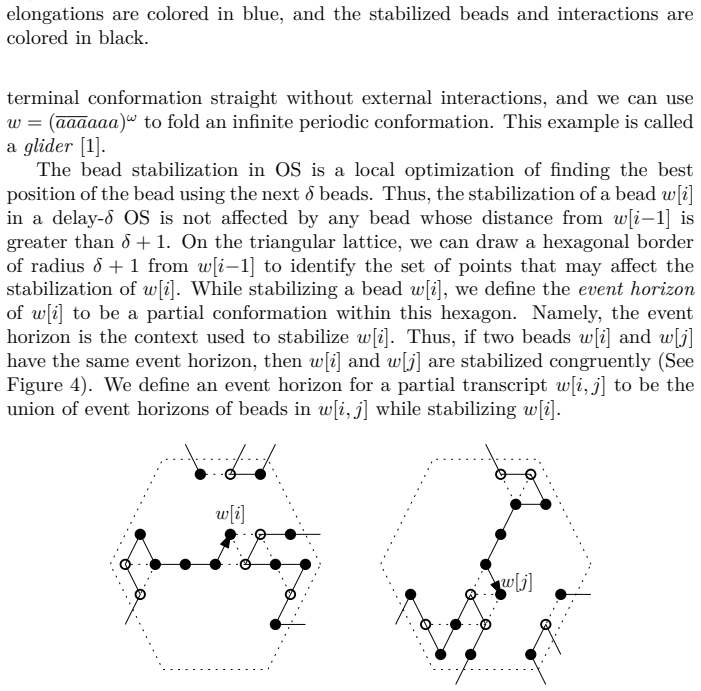
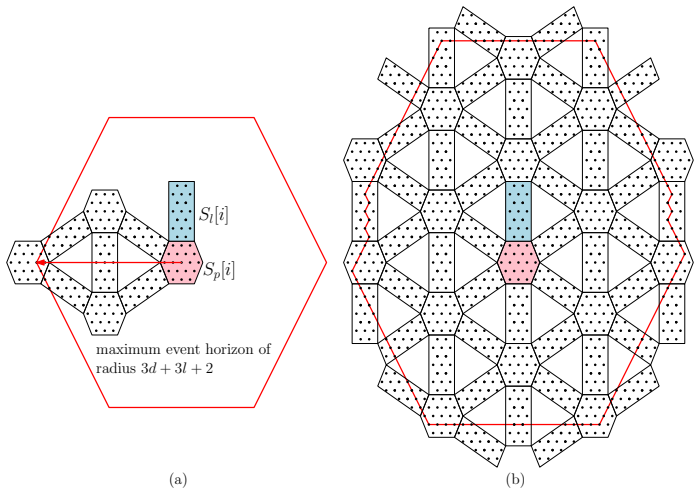
The load-bearing object is the event horizon. In a delay-$\delta$ oritatami system, stabilizing bead $w[i]$ can only be influenced by beads within a hexagonal neighborhood of radius $\delta+1$ centered near $w[i-1]$, and the partial conformation in that hexagon is the event horizon of $w[i]$; identical event horizons produce congruent stabilizations. Because the transcript is periodic, beads separated by the period have identical surrounding transcript, and the paper's shape-dependent counting shows that among enough consecutive blocks some two must have identical event horizons. From that point the fold is forced to draw the same sequence of turns again and again, contradicting the aperiodicity of the target. The drawing relation of Definition 1, which requires each target shape to be covered by a partial transcript folded inside it, is what ties these local repetitions to a global curve.
What would settle it
Refute Theorem 1 by exhibiting a deterministic cyclic oritatami system with explicit transcript, ruleset, delay, period, arity, and seed whose fold covers an infinite sequence of shapes representing the Koch curve, each shape covered by its assigned partial transcript as required by Definition 1; alternatively, refute Theorem 5 by folding an infinite aperiodic curve that satisfies the stated lookback condition with such a system.
Extended reading notes
Core claim
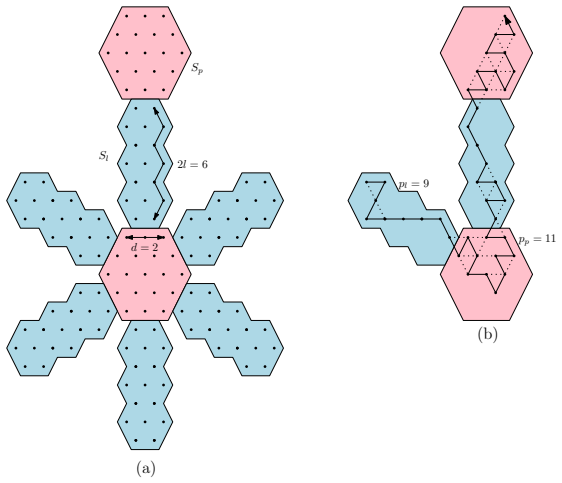
The central discovery is a pair of impossibility theorems plus a generalization. Theorem 1 states that there is no deterministic oritatami system that can draw the Koch curve, and Theorem 2 states the same for the tilted Minkowski curve, with both proofs covering every possible delay $\delta$ and every transcript period. The proofs assume a modular drawing relation: the curve is represented by alternating point shapes $S_p$ and segment shapes $S_l$, and the system covers each shape with the corresponding block of its periodic transcript, folded inside that shape. Within one such block the beads see only a finite maximum event horizon, and because the transcript is periodic, identical partial transcripts repeat; a pigeonhole argument over the finitely many possible paths in a bounded shape forces two blocks with identical event horizons, after which the fold repeats the same segment turns forever. A fractal's turn sequence never repeats periodically, so the assumption that such a system exists is false. Theorems 3–5 formalize the mechanism as sufficient conditions on the lookback $D_{i,n}$ that make a given infinite aperiodic curve undrawable by any cyclic OS regardless of delay and period.
Load-bearing premise
The load-bearing premise is that a drawing must be local: the beads assigned to a point or segment of the curve fold entirely within the shape representing that point or segment, so no transcript block may reach across several shapes or coordinate distant parts of the curve.
Editorial extensions
If this is right
- For the Koch curve and the tilted Minkowski curve, the impossibility is absolute within the model: changing the delay, the period, the ruleset, the bead alphabet, the arity, or the seed cannot make a deterministic cyclic oritatami system draw the curve.
- The sufficient conditions of Theorems 4 and 5 give a reusable test: for any infinite aperiodic curve, if the event horizon reaches back only a bounded number of shapes so that $D_{i,n}$ is independent of $i$, then no cyclic oritatami system can draw it, regardless of delay and period.
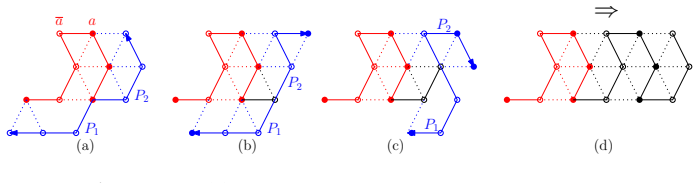
- Infinite periodic curves remain constructible—the glider example from the paper folds an infinite straight periodic conformation—so the obstruction is specifically aperiodicity rather than infinite length.
- Any successful construction of an infinite fractal in this model would have to use a non-cyclic transcript or replace the local shape-by-shape drawing relation with one that permits long-range coordination.
Reading between the lines
- The proof's reliance on the curve staying away from itself suggests that aperiodicity alone is not the true obstruction: self-touching aperiodic curves such as the Heighway dragon evade the argument, and a different technique, or a different conclusion, may hold for them.
- If the locality assumption of Definition 1 is relaxed so that one transcript block may fold across several target shapes, the pigeonhole repetition could in principle be broken; formalizing such long-range drawing is a natural next step, and the paper's theorems would not apply to it.
- The counting bound may be improvable: instead of the coarse path counts used in the proof, one could derive tight bounds from the actual ruleset and arity, which would turn the sufficient conditions into a practical decision procedure for small systems.
Signed reviews
Editorial analysis
A structured set of objections, weighed in public.
Referee Report
Summary. The paper studies the oritatami system (OS), a model of cotranscriptional RNA folding, and asks whether an infinite fractal curve can be drawn by a cyclic OS, i.e., one whose transcript is ultimately periodic. It defines a local drawing relation (Definition 1) in which a curve is represented by alternating point and segment shapes, and each shape must be covered by a partial transcript that folds within that shape. Under this convention and additional modular-design assumptions (constant numbers of beads per point/segment shape, period equal to the sum of those counts), the paper claims two negative results: Theorem 1 states that no deterministic cyclic OS can draw the infinite Koch curve, and Theorem 2 states the analogous statement for a tilted Minkowski curve. The proofs combine a delay-bounded event horizon with a self-similarity observation about the curves, then use a pigeonhole argument over a finite set of possible conformations to force a periodic repetition of turn sequences, contradicting aperiodicity. Sections 4--5 generalize the approach and state sufficient conditions (Theorems 3--5) under which an infinite aperiodic curve cannot be drawn by a cyclic OS. The paper concludes with the conjecture that all fractal curves made by edge replacement are not foldable, while noting that self-touching curves such as Heighway dragons require a different approach.
Significance. If the main theorems are fully established, this would be a valuable negative result for the oritatami literature: it would show that a very natural class of infinite self-similar structures cannot be generated by periodic transcripts under the modular, local drawing semantics used in prior OS constructions. The proof strategy is original and the paper is self-contained: the Koch and Minkowski curves are given by standard L-systems, and the impossibility arguments do not rely on fitting parameters or on earlier claims by the authors. The paper also explicitly identifies the locality assumption in Definition 1 as crucial, which is honest about the scope of the results. However, the current manuscript does not yet provide a complete written proof of the geometric case analyses that carry the main impossibility arguments; those analyses are instead delegated to figures and phrases such as 'We can observe.' Because those observations are load-bearing for Theorems 1 and 2, the paper needs a major revision in which the case enumerations are either proved in full or supplied as machine-checked code.
major comments (4)
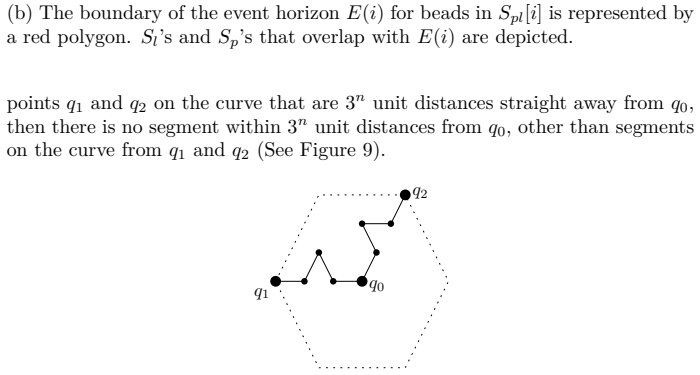
- [§3, Figure 10 and the surrounding text] The proof of Theorem 1 rests on two assertions that are stated as observations rather than proved: (i) the self-similar emptiness property for a point q0 with q1 and q2 at distance 3^n, and (ii) the exhaustiveness of the nine cases in Figure 10. The Koch curve has six orientations on the triangular lattice, but Figure 10 shows representative configurations and does not discuss rotations or reflections, so the figures do not themselves establish that every possible overlap of Sp and Sl shapes with the event horizon E(i) is one of the nine cases. This exhaustiveness is load-bearing because it yields the conclusion that all beads in E(i) come from Sp[i−4] through Sl[i−1], which in turn gives the finite pigeonhole bound that forces periodic turn sequences. Please replace these observations with a written derivation or a machine-checked exhaustive enumeration.
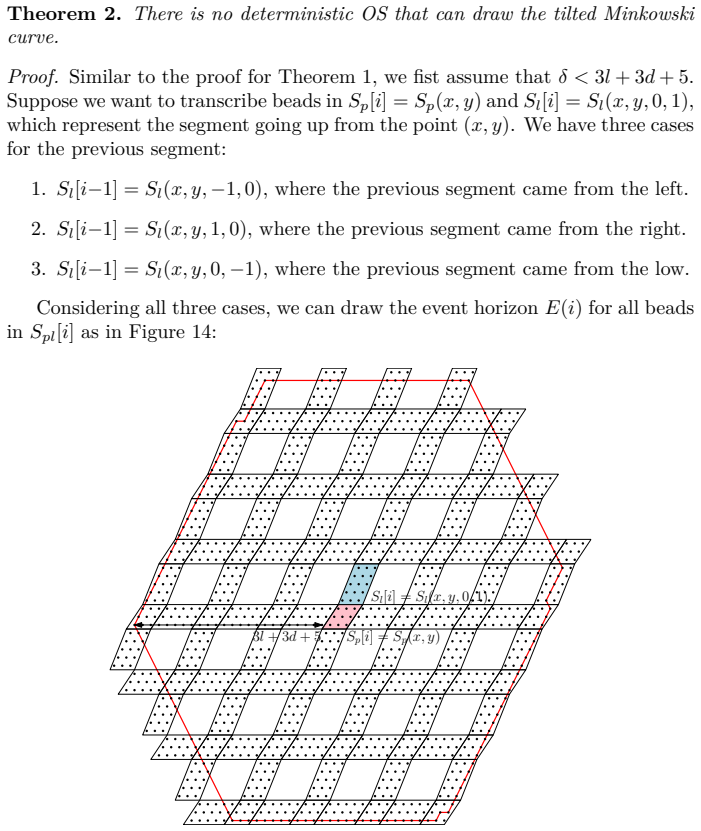
- [§4, Figure 16 and the surrounding text] The proof of Theorem 2 has the same gap: the properties illustrated in Figure 15 and the eleven cases in Figure 16 are asserted by inspection, but no argument is given that the cases cover all possible relative positions of the event horizon. Moreover, the text first says that the relevant shapes range 'from Sp[i−5] to Sp[i+6]' and then concludes that a partial conformation in Spl[i] is dependent on shapes 'from Sp[i−61] to Sl[i−1]'; this numeric mismatch needs clarification. Since the local-dependence bound is the geometric core of Theorem 2, the case analysis must be proved or algorithmically verified before the theorem is established.
- [§3, §4, equality of event horizons] The argument that two equal event horizons E(i) and E(j) force the same stabilized partial conformation, and hence the same turn sequence, presumes that the stabilization rule in Eq. (1) is invariant under the congruence used to identify event horizons and that beads outside the horizon cannot influence the choice. This is plausible given the delay bound, but it is not stated as a formal lemma. Because it is the bridge between equality of horizons and equality of future conformations, it should be proved explicitly.
- [§5, Theorem 3] The proof of Theorem 3 asserts that 'it takes 1 + gcd(po,ppl) · 5^{Di,n ppl}' to find two shapes with the same previous Di,n beads, but this counting bound is not derived. In particular, the role of gcd(po,ppl) and the reason that a repeated pair necessarily appears within that interval are unexplained. The condition of Theorem 3 is therefore not established as written. Please provide a proof of this claim, or state and prove it as a separate lemma.
minor comments (3)
- [Abstract and Section 2] There are several typos: 'an useful' in the abstract, 'Academic Pres' in the bibliography, and 'fist' for 'first' in the proof of Theorem 2. These should be corrected.
- [§3, Theorem 1 statement] The theorem is stated as 'There is no deterministic OS that can draw the Koch curve,' but the proof depends on the drawing convention of Definition 1 and on the modular assumptions listed before the theorem (constant bead counts pp and pl, and initially the period assumption). The statement and the abstract should explicitly qualify the result as holding under those assumptions, since an OS that covers shapes with partial transcripts that fold across shape boundaries is outside the scope of the theorem.
- [§3, proof of Theorem 1] In the paragraph dealing with delays 3l+3d+2 ≤ δ < 12l+12d+11, the text says 'at most 32 Sp's and Si's' where 'Si' should presumably be 'Sl'. Please correct this typo.
Circularity Check
No significant circularity: the impossibility proofs are self-contained relative to a stipulated drawing definition and do not reduce to fitted data or self-cited uniqueness claims.
full rationale
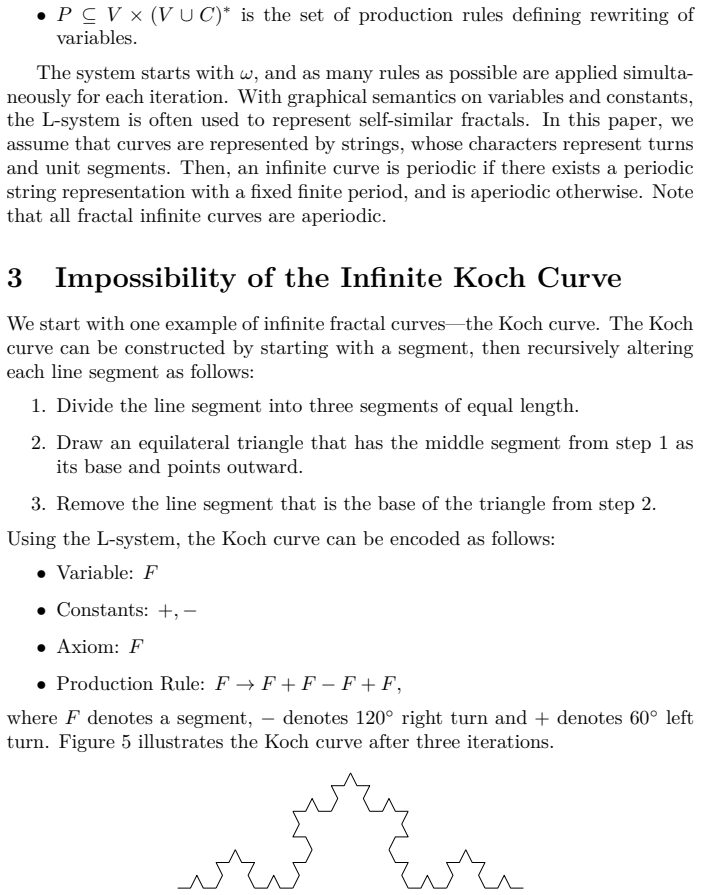
The paper's central claims are conditional impossibility theorems: given the stipulated drawing relation in Definition 1 and the local modularity assumptions (constant bead counts pp and pl, period pp+pl), no deterministic cyclic OS can fold the infinite Koch or tilted Minkowski curves. The Koch and Minkowski curves are supplied externally via standard L-system productions (F -> F+F-F+F and F -> F+F-F-F+F+F-F), not derived from the OS formalism. The proof does not fit any parameter to a subset of data and then 'predict' that same data; the only numerical bounds (5^{4pl+4pp}, 56^{1+61pl+61pp}, etc.) come from a finite pigeonhole argument over event horizons, and the alleged periodic repetition is a consequence of the local delay bound, not an input. The few self-citations ([4], [5], [6]) concern rule-set optimization and hardness results in the introduction and are not load-bearing for Theorems 1-5. No uniqueness theorem or ansatz is imported from the authors' prior work; the local drawing assumption is explicitly stated as 'crucial' and is a definitional restriction of scope, which limits applicability (long-range folds crossing multiple shapes are excluded) but does not make the derivation circular. Concerns about the rigor of the exhaustive case analyses in Figures 10 and 16 are correctness/completeness risks, not circularity, and I therefore do not count them in the circularity score.
Assumptions & free parameters
free parameters (4)
- d (point shape side length)
- l (segment shape length parameter)
- pp (beads per point shape)
- pl (beads per segment shape)
assumptions (5)
- domain assumption The target curve is represented as an infinite alternating sequence of point shapes S_p and segment shapes S_l on the triangular (or rhombus) lattice.
- domain assumption The oritatami system is deterministic, meaning it folds into a unique terminal conformation.
- ad hoc to paper Drawing a curve requires each shape S_k to be covered by a partial transcript folding within S_k (Definition 1).
- domain assumption For the Koch and Minkowski curves, the event horizons E(i) for beads in Spl[i] contain only beads from Sp[i-4] to Sl[i-1] (with longer windows for larger delay), as shown by the case analyses in Figures 10 and 16.
- standard math The Koch and Minkowski curve strings are aperiodic.
Cite this review
Pith. "Pith review of Cyclic Oritatami Systems Cannot Fold Infinite Fractal Curves." pith.science (2026). https://pith.science/paper/NXB4AKAW
@misc{pith2026190804409,
  author       = {Pith},
  title        = {Pith review of: Cyclic Oritatami Systems Cannot Fold Infinite Fractal Curves},
  year         = {2026},
  howpublished = {\url{https://pith.science/paper/NXB4AKAW}},
  note         = {Machine review of arXiv:1908.04409}
}
read the original abstract
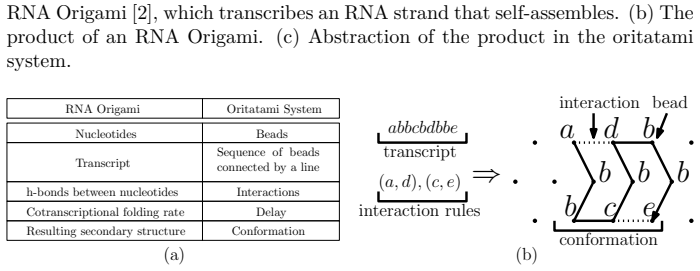
RNA cotranscriptional folding is the phenomenon in which an RNA transcript folds upon itself while being synthesized out of a gene. The oritatami system (OS) is a computation model of this phenomenon, which lets its sequence (transcript) of beads (abstract molecules) fold cotranscriptionally by the interactions between beads according to the binding ruleset. The OS is an useful computational model for predicting and simulating an RNA folding as well as constructing a biological structure. A fractal is an infinite pattern that is self-similar across different scales, and is an important structure in nature. Therefore, the fractal construction using self-assembly is one of the most important problems. We focus on the problem of generating an infinite fractal instead of a partial finite fractal, which is much more challenging. We use a cyclic OS, which has an infinite periodic transcript, to generate an infinite structure. We prove a negative result that it is impossible to make a Koch curve or a Minkowski curve, both of which are fractals, using a cyclic OS. We then establish sufficient conditions of infinite aperiodic curves that a cyclic OS cannot fold.
Figures

Figures from the paper (13 more)





Reference graph
Works this paper leans on
-
[1]
Proving the Turing Universality of Oritatami Co-Transcriptional Folding (Full Text)
C. Geary, P. Meunier, N. Schabanel, and S. Seki. Efficient universal com- putation by greedy molecular folding. CoRR, abs/1508.00510, 2015
work page Pith review arXiv 2015
- [2]
- [3]
- [4]
-
[5]
Y. Han, H. Kim, M. Ota, and S. Seki. Nondeterministic seedless oritatami systems and hardness of testing their equivalence. Natural Computing , 17(1):67–79, 2018
work page 2018
-
[6]
Y. Han, H. Kim, T. A. Rogers, and S. Seki. Self-attraction removal from oritatami systems. In Proceedings of the 19th International Conference on Descriptional Complexity of Formal Systems , pages 164–176, 2017
work page 2017
-
[7]
J. Hendricks, M. Olsen, M. J. Patitz, T. A. Rogers, and H. Thomas. Hierar- chical self-assembly of fractals with signal-passing tiles.Natural Computing, 17(1):47–65, 2018
work page 2018
-
[8]
J. Hendricks and J. Opseth. Self-assembly of 4-sided fractals in the two- handed tile assembly model. In Proceedings of the 16th International Con- ference on Unconventional Computation and Natural Computation , pages 113–128, 2017
work page 2017
Show all 17 references
-
[9]
J. I. Lathrop, J. H. Lutz, and S. M. Summers. Strict self-assembly of discrete sierpinski triangles. Theoretical Computer Science , 410:384–405, 2009
2009
-
[10]
Masuda, S
Y. Masuda, S. Seki, and Y. Ubukata. Parametrizing string assembling systems. In Proceedings of the 23rd International Conference on Imple- mentation and Applications of Automata (To appear) , 2018
2018
-
[11]
Ota and S
M. Ota and S. Seki. Rule set design problems for oritatami systems. The- oretical Computer Science, 671:26–35, 2017
2017
-
[12]
T. A. Rogers and S. Seki. Oritatami system; a survey and the impossibility of simple simulation at small delays. Fundamenta Informaticae, 154(1- 4):359–372, 2017
2017
-
[13]
Rozenburg and A
G. Rozenburg and A. Salomaa. The mathematical theory of L systems . Academic Pres, 1980
1980
-
[14]
Tesoro and S
S. Tesoro and S. E. Ahnert. Nondeterministic self-assembly of two tile types on a lattice. Physical Review E, 93:042412, 2016. 18
2016
-
[15]
Tikhomirov, P
G. Tikhomirov, P. Petersen, and L. Qian. Fractal assembly of micrometre- scale dna origami arrays with arbitrary patterns. Nature, 552(7683):67–71, 2017
2017
-
[16]
G. M. Whitesides and M. Boncheva. Beyond molecules: Self-assembly of mesoscopic and macroscopic components. Proceedings of the National Academy of Sciences of the United States of America , 99(8):4769–4774, 2002
2002
-
[17]
E. Winfree. Algorithmic Self-Assembly of DNA . PhD thesis, California Institute of Technology, 1998. 19
1998
Reviewed August 14, 2026 · model on record in the stance chip above.
Discussion (0). Continue with ORCID to comment.