REVIEW 3 major objections 4 minor 255 references
Variability in Resistive Memories
T0 review · 3 major / 4 minor · reviewed 2026-08-12 · deepseek-v4-flash
Pith's one-line read This review argues that cycle-to-cycle variability—the run-to-run scatter in switching voltages and resistances—is the fundamental obstacle to resistive memory development, and that a compact stochastic model with thermodynamically…
desk verdict A genuinely useful review of RRAM cycle-to-cycle variability with a strong modeling taxonomy; the original B/kBT extraction is shakier than the prose admits, but the synthesis deserves a serious referee. read the letter →
The pith
A machine-rendered reading of the paper's core claim, the machinery that carries it, and where it could break.
The reading
What carries the argument
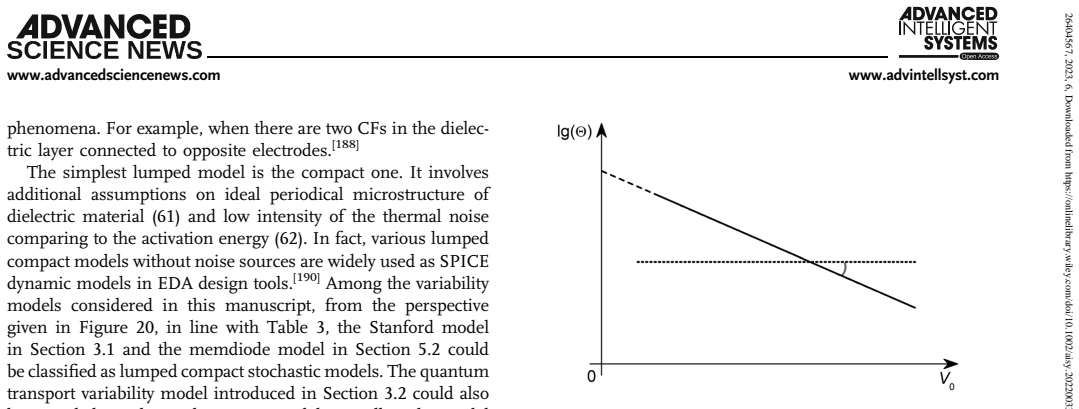
The central object is the compact stochastic model, a coarse-grained Langevin description of the conductive filament length $y(t)$ of a filamentary RRAM. Starting from a tilted periodic potential $U(y,V) = \Phi(y) - B V y$ and an overdamped Brownian-motion equation with white Gaussian thermal noise of intensity $2 k_B T \mu$, the authors coarse-grain over the lattice period to obtain effective drift and diffusion coefficients $v_{\mathrm{eff}}(V) = (2l/\tau_{\mathrm{kr}}) \sinh(BV/k_B T)$ and $D_{\mathrm{eff}}(V) = (2l/\tau_{\mathrm{kr}}) \cosh(BV/k_B T)$. The Fokker–Planck equation for the probability density has a Boltzmann stationary solution, and the mean first-passage time to switch states reduces to Kramers' time $\tau = \tau_0 \exp[(E_a - B|V_0|)/k_B T]$. The ratio $B/k_B T$ is estimated from the slope of $\lg \Theta$ versus $V_0$, and the same model yields predictions for stochastic resonance and transient bimodality.
What would settle it
Measure the mean switching time $\Theta(V_0)$ on a ZrO2(Y) device over a range wider than the 1.0–1.2 V window used here (say 0.8–1.5 V). If the plot of $\lg \Theta$ versus $V_0$ bends downward as described by $\lg \Theta = a_1 + (E_a/k_B(T_0 + A V_0^2)) \lg e - (B V_0/k_B(T_0 + A V_0^2)) \lg e$ with $A \gtrsim 100$, the constant-temperature premise fails and the extracted $B/k_B T = 30.5 \; \mathrm{V}^{-1}$ would be contaminated by Joule heating.
Extended reading notes
Core claim
This review's central claim is that cycle-to-cycle variability is inherently rooted in the resistive-switching mechanism and must therefore be represented by stochastic, not deterministic, compact models. On the modeling side, the paper's distinctive contribution is a lumped compact stochastic model in which the state variable is the length of the conductive filament and the dynamics are governed by a Langevin equation with an effective drift $v_{\mathrm{eff}}(V) = (2l/\tau_{\mathrm{kr}}) \sinh(BV/k_B T)$ and an effective diffusion constant $D_{\mathrm{eff}}(V) = (2l/\tau_{\mathrm{kr}}) \cosh(BV/k_B T)$. Because the noise intensity is tied to dissipation through the Einstein relation and fluctuation–dissipation theorems, the model is thermodynamically consistent, and its stationary solution is the Boltzmann distribution. The paper shows that the model's parameters can be estimated from the slope of the measured mean switching time versus voltage, yielding, for example, $B_{\mathrm{RES}}/k_B T = 30.5 \; \mathrm{V}^{-1}$ for Au/Ta/ZrO2(Y)/Pt devices, and that the same framework reproduces stochastic resonance and transient bimodality observed in experiments.
Load-bearing premise
The model's key fitting step assumes the device stays at a constant temperature while the switching voltage is varied from 1.0 to 1.2 V; if the device heats up as the voltage rises, the extracted parameter is wrong and the model's quantitative predictions no longer follow.
Editorial extensions
If this is right
- RRAM compact models in EDA tools must include stochastic noise sources whose intensity is tied to dissipation via fluctuation–dissipation relations, and the model parameters must be treated as correlated in time, not as independent random draws.
- The model explains quantitatively why the high-resistance state varies more than the low-resistance state: the effective potential has a minimum at the LRS boundary but not at the HRS during reset, so the HRS distribution remains broad and nonstationary.
- Extracted parameters such as $B/k_B T$ give circuit designers a direct route to switching-time statistics and to predicting noise-induced effects (stochastic resonance, transient bimodality) that could be used or suppressed in neuromorphic and security circuits.
- The reviewed hierarchy of models (physical, stochastic, behavioral) provides a practical guide: deep physical models for device physics, compact stochastic models for circuit simulation, and time-series models for system-level forecasting of switching voltages.
- Time-series ARIMA models reproduce the cycle-to-cycle 'memory' of the conductive filament, allowing prediction of set and reset voltages from previous cycles.
Reading between the lines
- If variability is truly inherent to the switching mechanism, then attempts to eliminate it entirely may also suppress the switching itself; the practical design target is to confine and control variability, not to abolish it.
- The constant-temperature assumption could be tested by measuring the $\lg \Theta$ versus $V_0$ slope at several well-controlled ambient temperatures; if the slope scales with $1/T$ as predicted, the extraction is consistent, and if not, Joule heating is likely contaminating the fit.
- The same Langevin machinery could be extended to device-to-device variability by adding a quenched spatial noise term into the potential profile, which the paper sets up but does not develop; that would give a unified treatment of C2C and D2D variability.
- The model's prediction of stochastic resonance in RRAMs suggests that a deliberately applied noise signal could be used as a control knob for switching reliability—a design idea the paper mentions but leaves as an implicit consequence.
Signed reviews
Editorial analysis
A structured set of objections, weighed in public.
Referee Report
Summary. This review manuscript surveys cycle-to-cycle (C2C) variability in resistive switching memories from experimental, physical, stochastic, and behavioral modeling perspectives. It presents original experimental data on 3000-cycle and 10^5-cycle HfO2-based devices, a Stanford-model variability extension, a quantum-point-contact (Landauer) treatment of HRS conduction, a compact stochastic model built from a Langevin/Fokker-Planck description with fluctuation–dissipation-consistent thermal noise, a charge-flux behavioral model with Monte Carlo parameter variability, the dynamic memdiode model with uncorrelated C2C parameter variability, and time-series (ARIMA) models of Vset and Vreset. The central thesis is that C2C variability is inherent to the switching mechanism and must therefore be incorporated into compact models for EDA tools. Original quantitative claims include the extraction of BRES/kBT = 30.5 ± 0.6 V^-1 from ZrO2(Y) data (Section 4.3) and the assertion that the resulting model quantitatively describes stochastic resonance, resonant activation, and transient bimodality.
Significance. The review fills a real gap: it draws together experimental phenomenology, physical transport models, stochastic thermodynamics, and behavioral/statistical compact models into a single framework, and Table 6 provides a useful practical orientation for circuit designers. The derivation of the compact stochastic model from a Langevin equation whose noise intensity satisfies the fluctuation–dissipation relation is a genuine strength, as is the exact analytical mean-first-passage-time expression (Eq. 73). If the quantitative parameter extraction were secured, the paper would provide a practically usable recipe for generating correlated, physics-consistent variability in RRAM compact models. However, the original quantitative support is currently anchored to a single parameter-extraction procedure whose key assumption is not quantitatively justified, and the model-validation claims lack an independent holdout test.
major comments (3)
- [Section 4.3, Eqs. (76) and (80)] The extraction of BRES/kBT = 30.5 ± 0.6 V^-1 from the slope of lg θ(V0) assumes T is independent of V0 over the measured 1.0–1.2 V window. The manuscript argues that because the measured dependence is indistinguishable from a straight line, the temperature increase is insignificant. That inference is not quantitative. Using the paper's own values (Ea/kBT0 = 40.3, B/kBT0 = 30.5 V^-1, T0 = 300 K), Eq. (80) with A = 50 K/V^2 already yields an almost-linear lg θ(V0) whose best-fit slope corresponds to B/kBT ≈ 27 V^-1, about 11% below the constant-T value; with A = 100 K/V^2 the apparent slope is about 24 V^-1, roughly 20% below. The absence of visible curvature therefore does not establish T(V0) = const, and the extracted value is not robust at the stated precision. Because this parameter is subsequently used to support quantitative descriptions of stochastic resonance and transient bimodality (final paragraph of Section 4.3), the quantitative component of the central claim is not yet secured. Please provide an independent bound on A, refit with T(V0), or explicitly reframe the stochastic-resonance and transient-bimodality statements as qualitative.
- [Section 4.3, final paragraph] The claim that the compact stochastic model 'quantitatively describe[s]' stochastic resonance, resonant activation, and transient bimodality is not supported by an independent test. The parameters BSET/kBT and BRES/kBT are estimated from the same lg θ(V0) dataset that is used to demonstrate the model's capability, and no holdout validation is reported—for example, no prediction of a different observable, a different voltage range, or a different temperature. The agreement is therefore a consistency check rather than a quantitative confirmation. The authors should either supply a genuine predictive test or soften the wording to indicate model consistency with the observed phenomena.
- [Section 4.3, ZrO2(Y) measurements] The new parameter extraction is performed on a single device: the text states 'All the measurements were carried out on the same memristive device,' with 114 repetitions per voltage amplitude. Consequently, the reported uncertainty 30.5 ± 0.6 V^-1 reflects only the statistical uncertainty of the averaged mean first-passage time for one device, not device-to-device variability. As written, Table 4 and the surrounding discussion present this as though it were a technology-level parameter. Please state explicitly that the value is single-device and, if possible, augment it with multi-device statistics or clearly restrict the claim.
minor comments (4)
- [Abstract] The word 'adequation' is nonstandard; 'adequacy' or 'suitability' would be clearer.
- [Section 4.3, text after Eq. (77)] The manuscript should state whether the uncertainty in BRES/kBT = 30.5 ± 0.6 V^-1 comes from the linear regression only or also from the repeatability across the 114 waveforms; the current description is ambiguous.
- [Table 4] The row for Au/Ta/ZrO2(Y)/Pt lists BRES/kBT = 30.5 without an uncertainty, while the text reports ±0.6 V^-1; please make the table consistent with the text.
- [Section 5.2, Table 5] The model script is useful but the distinction between 'normal' and 'lognormal' Gaussian additions is shown only by font color; please add an explicit text marker or column so the distinction survives monochrome printing.
Circularity Check
Only a minor in-sample 'prediction' in the TSSA demonstration; the central stochastic model is calibrated from data and backed by external experimental confirmations, so no significant circularity.
-
fitted input called prediction
[Section 5.3 (Time-Series Modeling), Equations (102)-(103) and Figure 37]
"After some algebra to isolate the current set and reset voltages the final models are obtained, see Equation (102) for the set voltage Vsett = Vsett−1 − 0.8634εt−1 and (103) for the reset voltage Vresett = Vresett−1 − 0.5811εt−1 + 0.0924εt−2. These models can be used to predict the values of the series obtained in the laboratory for the devices under study, as shown in Figure 37."
The ARIMA coefficients in (102)-(103) were estimated from the same measured Vset/Vreset series whose ACF/PACF are analyzed in Figures 34-36. Figure 37 then plots the measured and 'predicted' values for that same series. Because the ε terms are the fitted residuals of the identical dataset, the displayed 'predicted' curves are the in-sample fit reconstituted, not an out-of-sample forecast. This is a fitted-input-called-prediction step, but it is a pedagogical demonstration in a review section and does not support the paper's central claims.
full rationale
The paper is primarily a review, and most of its modeling demonstrations are standard model calibrations rather than circular predictions. The central compact stochastic model is constructed from a Langevin equation with a fluctuation-dissipation-consistent thermal noise source (Section 4.2.2), and the key parameter BRES/kBT is extracted by a slope fit to measured mean-first-passage-time data (Equations 76-78, Figure 25). The subsequent statements that the model can 'qualitatively, or even quantitatively, describe' stochastic resonance, resonant activation, and transient bimodality refer to prior experimental studies (refs. 63, 190, 221), which are external evidence rather than a re-use of the same fitted quantity within this paper. I found one concrete reduction by construction: the ARIMA time-series models in Section 5.3 are fitted to the full experimental series and then presented as 'predicted' values on the same series; this is statistically forced, but it is a minor illustrative part of the review and not load-bearing. The skeptic's concern about the constant-temperature assumption in Equation (76) versus the possible T(V0) = T0 + AV0^2 dependence in Equation (80) is a legitimate parameter-identification robustness issue — even moderate Joule heating could bias B/kBT by 10-20% while leaving the plot nearly linear — but it is a fitting validity concern, not circularity. No load-bearing self-citation chain was found: the compact model equations are re-derived Kramers-type results, and the cited confirmations are experimental and externally falsifiable. Overall circularity is minimal.
Assumptions & free parameters
free parameters (9)
- SM C2C variability parameters (delta0g, Tcrit, Tsmth) =
delta0g = 0.5 nm, Tcrit = 450 K, Tsmth = 400 K
- Stanford model I-V fitting parameters (I0, g0, V0, nu0, gamma0, alpha, beta) =
Values in Tables 1 and 2, varying by set/reset
- Series resistance Rseries =
22.3 ohm for TiN/Ti/HfO2/W stack
- Quantum point contact barrier height distribution (phi0i, sigma_i^2) =
Not specified numerically; normal distribution assumed
- Compact stochastic model B/kBT (BSET and BRES) =
BRES/kBT = 30.5 +/- 0.6 V^-1 for ZrO2(Y); literature values in Table 4
- Joule heating coefficient A in T = T0 + A V0^2 =
Illustrative values A = 100 and A = 400
- Charge-flux behavioral model parameters (G0, n) and Monte Carlo error terms =
G1 = 14.31 S, G2 = -7.03 S, sigma = 152e-6 S, mu = -22.4e-6 S; n transition sigma = 0.07, mu = 0.10
- DMM variability sigma values (sigioff, sigion, sigisb, sigvr) =
0.25, 0.1, 5e-6, 0.02
- ARIMA coefficients for Vset and Vreset =
Vset: -0.8634; Vreset: -0.5811 and 0.0924
assumptions (7)
- standard math Landauer-Buttiker formalism with inverse parabolic barrier transmission coefficient
- standard math Fluctuation-dissipation relation D = kBT mu and equivalence between Langevin and Fokker-Planck equations
- domain assumption RRAM switching arises from field- and temperature-assisted migration of oxygen vacancies or metal ions forming and rupturing a conductive filament
- domain assumption Cycle-to-cycle variability can be represented by white Gaussian noise on a lumped state variable (gap g or filament length y) with normal or lognormal parameter dispersion
- domain assumption Active-region temperature T is constant over V0 = 1.0 to 1.2 V in the ZrO2(Y) MFPT experiment
- ad hoc to paper Effective coarse-grained potential Ueff(y,V) = veff(V) y with veff and Deff given by Equations (66) and (67)
- standard math ARIMA stationarity and ACF/PACF model selection assumptions
Cite this review
Pith. "Pith review of Variability in Resistive Memories." pith.science (2026). https://pith.science/paper/NXGLRAS5
@misc{pith2026241112369,
  author       = {Pith},
  title        = {Pith review of: Variability in Resistive Memories},
  year         = {2026},
  howpublished = {\url{https://pith.science/paper/NXGLRAS5}},
  note         = {Machine review of arXiv:2411.12369}
}
read the original abstract
Resistive memories are outstanding electron devices that have displayed a large potential in a plethora of applications such as nonvolatile data storage, neuromorphic computing, hardware cryptography, etc. Their fabrication control and performance have been notably improved in the last few years to cope with the requirements of massive industrial production. However, the most important hurdle to progress in their development is the so-called cycle-to-cycle variability, which is inherently rooted in the resistive switching mechanism behind the operational principle of these devices. In order to achieve the whole picture, variability must be assessed from different viewpoints going from the experimental characterization to the adequation of modeling and simulation techniques. Herein, special emphasis is put on the modeling part because the accurate representation of the phenomenon is critical for circuit designers. In this respect, a number of approaches are used to the date: stochastic, behavioral, mesoscopic..., each of them covering particular aspects of the electron and ion transport mechanisms occurring within the switching material. These subjects are dealt with in this review, with the aim of presenting the most recent advancements in the treatment of variability in resistive memories.
Figures


Figures from the paper (34 more)




Reference graph
Works this paper leans on
-
[1]
Lanza, A
M. Lanza, A. Sebastian, W. D. Lu, M. Le Gallo, M.-F. Chang, D. Akinwande, F. M. Puglisi, H. N. Alshareef, M. Liu, J. B. Roldan, Science 2022, 376, 6597
2022
-
[2]
L. O. Chua, S. M. Kang, Proc. IEEE 1976, 64, 209
1976
-
[3]
Spiga, A
S. Spiga, A. Sebastian, D. Querlioz, B. Rajendran, Memristive Devices for Brain-Inspired Computing, Elsevier, Amsterdam, Netherlands 2020
2020
-
[4]
F. Pan, S. Gao, C. Chen, C. Song, F. Zeng, Mater. Sci. Eng. 2014, 83,1
2014
-
[5]
Variability Behavioral Models 5.1. Variability under the General Memristor Model Formalism In this section, we present an approach tackling with the variabil- ity of the parameters employed in a memristor model, the rela- tion between these parameters and the consequences on the model implementation. Speci fically, we consider a memristor representation de...
2023
-
[6]
Discussion We have shown in Section 2 that variability is an essential issue in resistive memories operation and, as discussed along this manuscript, this issue can be tackled in multiple and intricate manners. From physical to behavioral models, combining sto- chastic approaches as well as purely mathematical tools, all con- verge to point out the import...
2023
-
[7]
Priority-2030
Conclusions Resistive memories have a simple structure and are compatible with CMOS technology; therefore, they can be integrated in the conventional processes of the current electronics industry. However, their huge potential in different applications could be limited by their inherent cycle-to-cycle variability. The variabil- ity issue is essential, and...
2023
-
[8]
J. S. Lee, S. Lee, T. W. Noh, Appl. Phys. Rev. 2015, 2, 031303
2015
Show all 255 references
-
[9]
Lanza, H.-S
M. Lanza, H.-S. P. Wong, E. Pop, D. Ielmini, D. Strukov, B. C. Regan, L. Larcher, M. A. Villena, J. J. Yang, L. Goux, A. Belmonte, Y. Yang, F. M. Puglisi, J. Kang, B. Magyari-Köpe, E. Yalon, A. Kenyon, M. Buckwell, A. Mehonic, A. Shluger, H. Li, T.-H. Hou, B. Hudec, D. Akinwan...
2019
-
[10]
Ielmini, R
D. Ielmini, R. Waser, Resistive Switching: From Fundamentals of Nanoionic Redox Processes to Memristive Device Applications , Wiley-VCH, Hoboken, NJ 2015
2015
-
[11]
Salinga, B
M. Salinga, B. Kersting, I. Ronneberger, V. P. Jonnalagadda, X. T. Vu, M. Le Gallo, I. Giannopoulos, O. Cojocaru-Mirédin, R. Mazzarello, A. Sebastian, Nat. Mater. 2018, 17, 681
2018
-
[12]
A. V. Khvalkovskiy, D. Apalkov, S. Watts, R. Chepulskii, R. S. Beach, A. Ong, X. Tang, A. Driskill-Smith, W. H. Butler, P. B. Visscher, D. Lottis, E. Chen, V. Nikitin, M. Krounbi, J. Phys. D. App. Phys 2013, 46, 139601
2013
-
[13]
Trentzsch, S
M. Trentzsch, S. Flachowsky, R. Richter, J. Paul, B. Reimer, D. Utess, S. Jansen, H. Mulaosmanovic, S. Müller, S. Slesazeck, J. Ocker, M. Noack, J. Müller, P. Polakowski, J. Schreiter, S. Beyer, T. Mikolajick, B. Rice, 2016 IEEE Inter. Electron Devices Meeting (IEDM), IEEE, Pi...
2016
-
[14]
von Witzleben, K
M. von Witzleben, K. Fleck, C. Funck, B. Baumkötter, M. Zuric, A. Idt, T. Breuer, R. Waser, U. Böttger, S. Menzel, Adv. Electron. Mater. 2017, 3, 1700294
2017
-
[15]
Funck, S
C. Funck, S. Menzel, ACS Appl. Electron. Mater. 2021, 3, 3674
2021
-
[16]
Lanza, R
M. Lanza, R. Waser, D. Ielmini, J. J. Yang, L. Goux, J. Su ˜ne, A. J. Kenyon, A. Mehonic, S. Spiga, V. Rana, S. Wiefels, S. Menzel, I. Valov, M. A. Villena, E. Miranda, X. Jing, F. Campabadal, M. Gonzalez, F. Aguirre, F. Palumbo, K. Zhu, J. B. Roldan, F. M. Puglisi, L. Larcher...
2021
-
[17]
Chou, Z.-J
C.-C. Chou, Z.-J. Lin, C.-A. Lai, C.-I. Su, P.-L. Tseng, W.-C. Chen, W.-C. Tsai, W.-T. Chu, T.-C. Ong, H. Chuang, Y.-D. Chih, T.-Y. J. Chang, in 2020 IEEE Symp. on VLSI Circuits , IEEE, Piscataway, NJ 2020, pp. 1 –2
2020
-
[18]
P. Jain, U. Arslan, M. Sekhar, B. C. Lin, L. Wei, T. Sahu, J. Alzate- vinasco, A. Vangapaty, M. Meterelliyoz, N. Strutt, A. B. Chen, P. Hentges, P. A. Quintero, C. Connor, O. Golonzka, K. Fischer, F. Hamzaoglu, in 2019 IEEE Inter. Solid- State Circuits Conf. - (ISSCC), IEEE, P...
2019
-
[19]
Carboni, D
R. Carboni, D. Ielmini, Adv. Electron. Mater. 2019, 5, 1900198
2019
-
[20]
Wei, et al., in 2016 IEEE Inter
Z. Wei, et al., in 2016 IEEE Inter. Electron Devices Meeting (IEDM) , IEEE, San Francisco, CA 2016, pp. 4.8.1 – 4.8.4, https://doi.org/10. 1109/iedm.2016.7838349
2016
-
[21]
Chen, IEEE Electron Device Lett
A. Chen, IEEE Electron Device Lett. 2015, 36, 138
2015
-
[22]
Lanza, C
M. Lanza, C. Wen, X. Li, T. Zanotti, F. M. Puglisi, Y. Shi, F. Saiz, A. Antidormi, S. Roche, W. Zheng, X. Liang, J. Hu, S. Duhm, K. Zhu, F. Hui, J. B. Roldan, B. Garrido, T. Wu, V. Chen, E. Pop, Adv. Mater. 2021, 33, 2100185. www.advancedsciencenews.com www.advintellsyst.com A...
2021 doi
-
[23]
S. Yu, Y. Wu, R. Jeyasingh, D. Kuzum, H.-S. Wong, IEEE Trans. Electron Devices 2011, 58, 2729
2011
-
[24]
Ambrogio, P
S. Ambrogio, P. Narayanan, H. Tsai, R. M. Shelby, I. Boybat, C. di Nolfo, S. Sidler, M. Giordano, M. Bodini, N. C. P. Farinha, B. Killeen, C. Cheng, Y. Jaoudi, G. W. Burr, Nature 2018, 558, 60
2018
-
[25]
P. A. Merolla, J. V. Arthur, R. Alvarez-Icaza, A. S. Cassidy, J. Sawada, F. Akopyan, B. L. Jackson, N. Imam, C. Guo, Y. Nakamura, B. Brezzo, I. Vo, S. K. Esser, R. Appuswamy, B. Taba, A. Amir, M. D. Flickner, W. P. Risk, R. Manohar, D. S. Modha, Science 2014, 345, 668
2014
-
[26]
Alibart, E
F. Alibart, E. Zamanidoost, D. B. Strukov, Nat. Commun. 2013, 4, 2072
2013
-
[27]
Prezioso, F
M. Prezioso, F. Merrikh-Bayat, B. D. Hoskins, G. C. Adam, K. K. Likharev, D. B. Strukov, Nature 2015, 521, 61
2015
-
[28]
M. A. Zidan, J. P. Strachan, W. D. Lu, Nat. Electron. 2018, 1, 22
2018
-
[29]
Romero-Zaliz, E
R. Romero-Zaliz, E. Perez, F. Jiménez-Molinos, C. Wenger, J. B. Roldán, Electronics 2021, 10, 346
2021
-
[30]
Dalgaty, N
T. Dalgaty, N. Castellani, C. Turck, C. K.-E. Harabi, D. Querlioz, E. Vianello, Nat. Electron. 2021, 4, 151
2021
-
[31]
F. Hui, P. Liu, S. A. Hodge, T. Carey, C. Wen, F. Torrisi, D. Thanuja, L. Galhena, F. Tomarchio, Y. Lin, E. Moreno, J. B. Roldan, E. Koren, A. C. Ferrari, M. Lanza, Small 2021, 17, 2101100
2021
-
[32]
Sebastian, M
A. Sebastian, M. Le Gallo, R. Khaddam-Aljameh, E. Eleftheriou, Nat. Nanotechnol. 2020, 15, 529
2020
-
[33]
S. Yu, H. Jiang, S. Huang, X. Peng, A. Lu, IEEE Circuits Syst. Mag. 2021, 21, 31
2021
-
[34]
Dhar, Nat
P. Dhar, Nat. Mach. Intell. 2020, 2, 423
2020
-
[35]
Pérez, D
E. Pérez, D. Maldonado, C. Acal, J. E. Ruiz-Castro, F. J. Alonso, A. M. Aguilera, F. Jiménez-Molinos, Ch Wenger, J. B. Roldán, Microelectron. Eng. 2019, 214, 104
2019
-
[36]
Poblador, M
S. Poblador, M. B. González, F. Campabadal, Microelectron. Eng. 2018, 187–188, 148
2018
-
[37]
A. N. Mikhaylov, D. V. Guseinov, A. I. Belov, D. S. Korolev, V. A. Shishmakova, M. N. Koryazhkina, D. O. Filatov, O. N. Gorshkov, D. Maldonado, F. J. Alonso, J. B. Roldán, A. V. Krichigin, N. V. Agudov, A. A. Dubkov, A. Carollo, B. Spagnolo, Chaos, Solitons Fractals 2021, 144, 110723
2021
-
[38]
Dirkmann, J
S. Dirkmann, J. Kaiser, C. Wenger, T. Mussenbrock, ACS Appl. Mater. Interfaces 2018, 10, 14857
2018
-
[39]
J. B. Roldán, G. González-Cordero, R. Picos, E. Miranda, F. Palumbo, F. Jiménez-Molinos, E. Moreno, D. Maldonado, S. B. Baldomá, M. Moner Al Chawa, C. de Benito, S. G. Stavrinides, J. Su ˜né, L. O. Chua, Nanomaterials 2021, 11, 1261
2021
-
[40]
Aldana, P
S. Aldana, P. García-Fernández, R. Romero-Zaliz, M. B. González, F. Jiménez-Molinos, F. Gómez-Campos, F. Campabadal, J. B. Roldán, J. Phys. D: Appl. Phys. 2020, 53, 225106
2020
-
[41]
Padovani, L
A. Padovani, L. Larcher, O. Pirrotta, L. Vandelli, G. Bersuker, IEEE Trans. Electron Devices 2015, 62, 1998
2015
-
[42]
Waser, R
R. Waser, R. Dittmann, G. Staikov, K. Szot, Adv. Mater. 2009, 21, 2632
2009
-
[43]
Banerjee, A
W. Banerjee, A. Kashir, S. Kamba, Small 2022, 18, 2107575
2022
-
[44]
Matveyev, R
Y. Matveyev, R. Kirtaev, A. Fetisova, S. Zakharchenko, D. Negrov, A. Zenkevich, Nanoscale Res. Lett. 2016, 11, 147
2016
-
[45]
M. J. Lee, C. B. Lee, D. Lee, S. R. Lee, M. Chang, J. H. Hur, Y. B. Kim, C. J. Kim, D. H. Seo, S. Seo, U. I. Chung, I. K. Yoo, K. Kim, Nat. Mater. 2011, 10, 625
2011
-
[46]
Hwang, Y
H.-G. Hwang, Y. Pyo, J.-U. Woo, I.-S. Kim, S.-W. Kim, D.-S. Kim, B. Kim, J. Jeong, S. Nahm, J. Alloys Compd. 2022, 902, 163764
2022
-
[47]
C. Chen, C. Song, J. Yang, F. Zeng, F. Pan, Appl. Phys. Lett. 2012, 100, 253509
2012
-
[48]
F. Wu, P. Cao, Z. Peng, S. Ke, G. Cheng, G. Cao, B. Jiang, C. Ye, IEEE Trans. Electron Devices 2022, 69, 375
2022
-
[49]
Wang, D.-Y
S.-Y. Wang, D.-Y. Lee, T.-Y. Huang, J.-W. Wu, T.-Y. Tseng, Nanotechnology 2010, 21, 495201
2010
-
[50]
X. Wei, H. Huang, C. Ye, W. Wei, H. Zhou, Y. Chen, R. Zhang, L. Zhang, Q. Xia, J. Alloys Compd. 2019, 775, P. 1301
2019
-
[51]
X. D. Huang, Y. Li, H. Y. Li, Y. F. Lu, K. H. Xue, X. S. Miao, Appl. Phys. Lett. 2020, 116, 173504
2020
-
[52]
Ismail, C
M. Ismail, C. Mahata, S. Kim, J. Alloys Compd. 2021, 892, 162141
2021
-
[53]
J.-H. Ryu, S. Kim, Materials 2020, 13, 4201
2020
-
[54]
Govoreanu, G
B. Govoreanu, G. S. Kar, Y.-Y. Chen, V. Paraschiv, S. Kubicek, M. Jurczak, in 2011 Inter. Electron Devices Meeting , IEDM, Washington, DC 2011, p. 31.6.1
2011
-
[55]
Perez, A
E. Perez, A. Grossi, C. Zambelli, P. Olivo, C. Wenger, IEEE J. Electron Devices Soc. 2017, 5, 64
2017
-
[56]
Y. Y. Chen, G. Ludovic, S. Clima, B. Govoreanu, R. Degreve, K. G. Sankar, A. Fantini, G. Groseneken, D. J. Wouters, J. Malgorzata, IEEE Trans. Electron Devices 2013, 60, 1114
2013
-
[57]
Poblador, M
S. Poblador, M. C. Acero, M. B. González, F. Campabadal, in IEEE Proc. 11th Spanish Conf. on Electron Devices (CDE 2017) , IEEE, Piscataway, NJ 2017, pp. 1 –4
2017
-
[58]
Kvatinsky, G
S. Kvatinsky, G. Satat, N. Wald, E. G. Friedman, A. Kolodny, U. C. Weiser, IEEE Trans. Very Large Scale Integr. VLSI Syst. 2014, 22, 2054
2014
-
[59]
Arumí, A
D. Arumí, A. Gomez-Pau, S. Manich, R. Rodríguez-Monta ˜nés, M. B. Gonzalez, F. Campabadal, IEEE Electron Device Lett. 2019, 40, 341
2019
-
[60]
Ielmini, Microelectron
D. Ielmini, Microelectron. Eng. 2018, 190, 44
2018
-
[61]
E. Covi, S. Brivio, A. Serb, T. Prodromakis, M. Fanciulli, S. Spiga, in Proc. IEEE Inter. Symp. on Circuits and Systems (ISCAS) , IEEE, Piscataway, NJ 2016, p. 393
2016
-
[62]
M. B. González, M. Maestro-Izquierdo, S. Poblador, M. Zabala, F. Campabadal, G. González-Cordero, S. Aldana, D. Maldonado, F. Jiménez-Molinos, J. B. Roldán, Mem-Elements for Neuromorphic Circuits with Arti ficial Intelligence Applications , Elsevier, Amsterdam, Netherlands 2021
2021
-
[63]
Ambrogio, S
S. Ambrogio, S. Balatti, A. Cubeta, A. Calderoni, N. Ramaswamy, D. Ielmini, IEEE Trans. Electron Devices 2014, 61, 2912
2014
-
[64]
Abbaspour, S
E. Abbaspour, S. Menzel, C. Jungemann, J. Comput. Electron. 2020, 19, 1426
2020
-
[65]
Maldonado, S
D. Maldonado, S. Aldana, M. B. González, F. Jiménez-Molinos, F. Campabadal, J. B. Roldán, Microelectron. Eng. 2022, 265, 111876
2022
-
[66]
Mikhaylov, A
A. Mikhaylov, A. Belov, D. Korolev, I. Antonov, V. Kotomina, A. Kotina, E. Gryaznov, A. Sharapov, M. Koryazhkina, R. Kryukov, S. Zubkov, A. Sushkov, D. Pavlov, S. Tikhov, O. Morozov, D. Tetelbaum, Adv. Mater. Technol. 2020, 5, 1900607
2020
-
[67]
M. B. Gonzalez, J. M. Rafí, O. Beldarrain, M. Zabala, F. Campabadal, IEEE Trans. Device Mater. Reliab. 2014, 14, 769
2014
-
[68]
Y. Y. Chen, B. Govoreanu, L. Goux, R. Degraeve, A. Fantini, G. S. Kar, D. J. Wouters, G. Groeseneken, J. A. Kittl, M. Jurczak, L. Altimime, IEEE Trans. Electron Devices 2012, 59, 3243
2012
-
[69]
Huang, B
P. Huang, B. Chen, Y. Wang, F. Zhang, L. Shen, R. Liu, L. Zeng, G. Du, X. Zhang, B. Gao, J. Kang, X. Liu, X. Wang, B. Weng, Y. Tang, G.-Q. Lo, D.-L. Kwong, in IEEE IEDM Tech. Dig. , IEEE, Piscataway, NJ 2013, p. 597
2013
-
[70]
Balatti, S
S. Balatti, S. Ambrogio, Z. Wang, S. Sills, A. Calderoni, N. Ramaswamy, D. Ielmini, IEEE Trans. Electron Devices 2015, 62, 3365
2015
-
[71]
F. M. Puglisi, P. Pavan, L. Vandelli, A. Padovani, M. Bertocchi, L. Larcher, in 2015 IEEE Inter. Reliability Physics Symp. Proc. , IEEE, Piscataway, NJ 2015, p. 5B51
2015
-
[72]
M. B. Gonzalez, J. Martin-Martínez, M. Maestro, M. C. Acero, M. Nafría, F. Campabadal, IEEE Trans. Electron Devices 2016, 63, 3116
2016
-
[74]
E.; Ocola, L
Chakrabarti, B.; Chan, H.; Alam, K.; Koneru, A.; Gage, T. E.; Ocola, L. E.; Divan, R.; Rosenmann, D.; Khanna, A.; Grisafe, B.; T. Sanders, S. Datta, I. Arslan, S. K. R. S. Sankaranarayan, S. Guha, ACS Nano 2021, 15, 4155
2021
-
[75]
Y. Lu, K. Liu, J. Yang, T. Zhang, C. Cheng, B. Dang, L. Xu, J. Zhu, Q. Huang, R. Huang, Y. Yang, Adv. Electron. Mater. 2020, 6, 2000204
2020
-
[76]
Medeiros-Ribeiro, F
G. Medeiros-Ribeiro, F. Perner, R. Carter, H. Abdalla, M. D. Pickett, R. S. Williams, Nanotechnology 2011, 22, 095702
2011
-
[77]
H. Yeon, P. Lin, C. Choi, S. H. Tan, Y. Park, D. Lee, J. Lee, F. Xu, B. Gao, H. Wu, H. Qian, Y. Nie, S. Kim, J. Kim, Nat. Nanotechnol. 2020, 15, 574
2020
-
[78]
K. M. Kim, J. J. Yang, J. P. Strachan, E. M. Grafals, N. Ge, N. D. Melendez, Z. Li, R. S. Williams, Sci. Rep. 2016, 6, 20085
2016
-
[79]
M. A. Villena, J. B. Roldán, F. Jiménez-Molinos, E. Miranda, J. Su ˜né, M. Lanza, J. Comput. Electron. 2017, 16, 1095
2017
-
[80]
Z. Fang, H. Y. Yu, X. Li, N. Singh, G. Q. Lo, D. L. Kwong, IEEE Electron Device Lett. 2011, 32, 566
2011
-
[81]
Jiang, K
Y. Jiang, K. Zhang, K. Hu, Y. Zhang, A. Liang, Z. Song, S. Song, F. Wang, Mater. Sci. Semicond. Process. 2021, 136, 106131
2021
-
[82]
C. Pan, Y. Ji, N. Xiao, F. Hui, K. Tang, Y. Guo, X. Xie, F. M. Puglisi, L. Larcher, E. Miranda, L. Jiang, Adv. Funct. Mater. 2017, 27, 1604811
2017
-
[83]
W. Hu, Z. Yang, H. Ye, Adv. Eng. Mater. 2018, 20, 1700516
2018
-
[84]
Kormath Madam Raghupathy, T
R. Kormath Madam Raghupathy, T. D. Kühne, G. Henkelman, H. Mirhosseini, Adv. Theor. Simul. 2019, 2, 1900036
2019
-
[85]
C. Pan, E. Miranda, M. A. Villena, N. Xiao, X. Jing, X. Xie, T. Wu, F. Hui, Y. Shi, M. Lanza, 2D Mater. 2017, 4, 025099
2017
-
[86]
Joksas, A
D. Joksas, A. AlMutairi, O. Lee, M. Cubukcu, A. Lombardo, H. Kurebayashi, A. J. Kenyon, A. Mehonic, Adv. Intell. Syst. 2022, 4, 2200068
2022
-
[87]
K. S. Novoselov, O. A. Mishchenko, O. A. Carvalho, A. H. Castro Neto, Science 2016, 353, aac9439
2016
-
[88]
Sánchez Esqueda, H
I. Sánchez Esqueda, H. Zhao, H. Wang, J. Appl. Phys. 2018, 124, 152133
2018
-
[89]
C. Li, D. Belkin, Y. Li, P. Yan, M. Hu, N. Ge, H. Jiang, E. Montgomery, P. Lin, Z. Wang, W. Song, J. P. Strachan, M. Barnell, Q. Wu, R. S. Williams, J. J. Yang, Q. Xia, Nat. Commun. 2018, 9, 2385
2018
-
[90]
Y. Shi, L. Nguyen, S. Oh, X. Liu, F. Koushan, J. R. Jameson, D. Kuzum, Nat. Commun. 2018, 9, 5312
2018
-
[91]
Ambrogio, S
S. Ambrogio, S. Balatti, V. Milo, R. Carboni, Z.-Q. Wang, A. Calderoni, N. Ramaswamy, D. Ielmini, IEEE Trans. Electron Devices 2016, 63, 15081515
2016
-
[92]
C. H. Wang, C. McClellan, Y. Shi, X. Zheng, V. Chen, M. Lanza, E. Pop, H. S. Wong, in 2018 IEEE Inter. Electron Devices Meeting (IEDM), IEEE, Piscataway, NJ 2018
2018
-
[93]
Zhang, A
L. Zhang, A. Redol fi, C. Adelmann, S. Clima, I. P. Radu, Y. Y. Chen, D. J. Wouters, G. Groeseneken, M. Jurczak, B. Govoreanu, IEEE Electron Device Lett. 2013, 35, 199
2013
-
[94]
Aluguri, T
R. Aluguri, T. Y. Tseng, IEEE J. Electron Devices Soc. 2016, 4, 294
2016
-
[95]
J. Woo, W. Lee, S. Park, S. Kim, D. Lee, G. Choi, E. Cha, J. Hyun Lee, W. Young Jung, C. Gyung Park, H. Hwang, in 2013 Symp. on VLSI Technology, IEEE, Piscataway, NJ 2013, pp. T168 –T169
2013
-
[96]
H. Y. Chen, S. Brivio, C. C. Chang, J. Frascaroli, T. H. Hou, B. Hudec, M. Liu, H. Lv, G. Molas, J. Sohn, S. Spiga, J. Electroceramics 2017, 39, 21
2017
-
[97]
J. Zhou, K. H. Kim, W. Lu, IEEE Trans. Electron Devices 2014, 61, 1369
2014
-
[98]
M. A. Lastras-Montano, K.-T. Cheng, Nat. Electron. 2018, 1, 466
2018
-
[99]
Sivan, Y
M. Sivan, Y. Li, H. Veluri, Y. Zhao, B. Tang, X. Wang, E. Zamburg, J. F. Leong, J. X. Niu, U. Chand, A. V. Y. Thean, Nat. Commun. 2019, 10, 5201
2019
-
[100]
C. H. Wang, C. McClellan, Y. Shi, X. Zheng, V. Chen, M. Lanza, E. Pop, H. S. P. Wong, in 2018 IEEE Inter. Electron Devices Meeting (IEDM), IEEE, Piscataway, NJ 2018, pp. 22 –25
2018
-
[101]
R. Yang, H. Li, K. K. Smithe, T. R. Kim, K. Okabe, E. Pop, J. A. Fan, H. S. P. Wong, in 2017 IEEE Inter. Electron Devices Meeting (IEDM) , IEEE, Piscataway, NJ 2017, pp. 19 – 25
2017
-
[102]
K. Zhu, C. Wen, A. A. Aljarb, F. Xue, X. Xu, V. Tung, X. Zhang, H. N. Alshareef, M. Lanza, Nat. Electron. 2021, 4, 775
2021
-
[103]
J. Ma, H. Liu, N. Yang, J. Zou, S. Lin, Y. Zhang, X. Zhang, J. Guo, H. Wang, Adv. Mater. 2022, 34, 2202371
2022
-
[104]
S. Z. Butler, S. M. Hollen, L. Cao, Y. Cui, J. A. Gupta, H. R. Gutiérrez, T. F. Heinz, S. S. Hong, J. Huang, A. F. Ismach, E. Johnston- Halperin, ACS Nano 2013, 7, 2898
2013
-
[105]
Lembke, A
D. Lembke, A. Kis, ACS Nano 2012, 6, 10070
2012
-
[106]
N. Li, Q. Wang, C. Shen, Z. Wei, H. Yu, J. Zhao, X. Lu, G. Wang, C. He, L. Xie, J. Zhu, Nat. Electron. 2020, 3, 711
2020
-
[107]
Akinwande, N
D. Akinwande, N. Petrone, J. Hone, Nat. Commun. 2014, 5, 5678
2014
-
[108]
H. Zhao, Z. Dong, H. Tian, D. DiMarzi, M. G. Han, L. Zhang, X. Yan, F. Liu, L. Shen, S. J. Han, S. Cronin, Adv. Mater. 2017, 29, 1703232
2017
-
[109]
M. A. Villena, F. Hui, X. Liang, Y. Shi, B. Yuan, X. Jing, K. Zhu, S. Chen, M. Lanza, Microelectron. Reliab. 2019, 102, 113410
2019
-
[110]
X. Jing, F. Puglisi, D. Akinwande, M. Lanza, 2D Mater. 2019, 6, 035021
2019
-
[111]
F. Hui, W. Fang, W. S. Leong, T. Kpulun, H. Wang, H. Y. Yang, M. A. Villena, G. Harris, J. Kong, M. Lanza, ACS Appl. Mater. Interfaces 2017, 9, 39895
2017
-
[112]
Cheng, K
P. Cheng, K. Sun, Y. H. Hu, Nano Lett. 2016, 16, 572
2016
-
[113]
G. H. Shin, C. K. Kim, G. S. Bang, J. Y. Kim, B. C. Jang, B. J. Koo, M. H. Woo, Y. K. Choi, S. Y. Choi, 2D Mater. 2016, 3, 034002
2016
-
[114]
X. Zhao, Z. Fan, H. Xu, Z. Wang, J. Xu, J. Ma, Y. Liu, J. Mater. Chem. C 2018, 6, 7195
2018
-
[115]
Choudhary, M
S. Choudhary, M. Soni, S. K. Sharma, Semicond. Sci. Technol. 2019, 34, 085009
2019
-
[116]
B. Tang, H. Veluri, Y. Li, Z. G. Yu, M. Waqar, J. F. Leong, M. Sivan, E. Zamburg, Y. W. Zhang, J. Wang, A. V. Thean, Nat. Commun. 2022, 13, 3037
2022
-
[117]
Kumar, D
M. Kumar, D. K. Ban, S. M. Kim, J. Kim, C. P. Wong, Adv. Electron. Mater. 2019, 5, 1900467
2019
-
[118]
X. Yan, Q. Zhao, A. P. Chen, J. Zhao, Z. Zhou, J. Wang, H. Wang, L. Zhang, X. Li, Z. Xiao, K. Wang, Small 2019, 15, 1901423
2019
-
[119]
W. Huh, S. Jang, J. Y. Lee, D. Lee, D. Lee, J. M. Lee, H. G. Park, J. C. Kim, H. Y. Jeong, G. Wang, C. H. Lee, Adv. Mater. 2018, 30, 1801447
2018
-
[120]
Y. Shen, W. Zheng, K. Zhu, Y. Xiao, C. Wen, Y. Liu, X. Jing, M. Lanza, Adv. Mater. 2021, 33, 2103656
2021
-
[121]
Y. Shi, C. Pan, V. Chen, N. Raghavan, K. L. Pey, F. M. Puglisi, E. Pop, H. S. Wong, M. Lanza, in 2017 IEEE Inter. Electron Devices Meeting (IEDM), IEEE, Piscataway, NJ 2017, pp. 5 – 4
2017
-
[122]
Y. Li, S. Long, Y. Liu, C. Hu, J. Teng, Q. Liu, H. Lv, J. Su ˜né, M. Lu, Nanoscale Res. Lett. 2015, 10, 420
2015
-
[123]
S. Chen, M. R. Mahmoodi, Y. Shi, C. Mahata, B. Yuan, X. Liang, C. Wen, F. Hui, D. Akinwande, D. B. Strukov, M. Lanza, Nat. Electron. 2020, 3, 638
2020
-
[124]
Y. Shi, X. Liang, B. Yuan, V. Chen, H. Li, F. Hui, Z. Yu, F. Yuan, E. Pop, H. S. P. Wong, M. Lanza, Nat. Electron. 2018, 1, 458
2018
-
[125]
B. Yuan, X. Liang, L. Zhong, Y. Shi, F. Palumbo, S. Chen, F. Hui, X. Jing, M. A. Villena, L. Jiang, M. Lanza, Adv. Electron. Mater. 2020, 6, 1900115
2020
-
[126]
R. Ge, X. Wu, M. Kim, J. Shi, S. Sonde, L. Tao, Y. Zhang, J. C. Lee, D. Akinwande, Nano Lett. 2018, 18, 434
2018
-
[127]
Krishnaprasad, D
A. Krishnaprasad, D. Dev, S. S. Han, Y. Shen, H. S. Chung, T. S. Bae, C. Yoo, Y. Jung, M. Lanza, T. Roy, ACS Nano 2022, 16, 2866
2022
-
[128]
R. Xu, H. Jang, M. H. Lee, D. Amanov, Y. Cho, H. Kim, S. Park, H. J. Shin, D. Ham, Nano Lett. 2019, 19, 2411
2019
-
[130]
Maldonado, S
D. Maldonado, S. Aldana, M. B. González, F. Jiménez-Molinos, M. J. Ibá ˜nez, D. Barrera, F. Campabadal, J. B. Roldán, Microelectron. Eng. 2022, 257, 111736
2022
-
[131]
X. Guan, S. Yu, H.-S. Philip Wong, IEEE Electron Device Lett. 2012, 33, 1405
2012
-
[132]
P. Chen, S. Yu, IEEE Trans. Electron Devices 2015, 62, 4022
2015
-
[133]
Maldonado, F
D. Maldonado, F. Aguirre, G. González-Cordero, A. M. Roldán, M. B. González, F. Jiménez-Molinos, F. Campabadal, E. Miranda, J. B. Roldán, J. Appl. Phys. 2021, 130, 054503
2021
-
[134]
https://nano.stanford.edu/downloads/stanford-rram-model (accessed: December 2022)
2022
-
[135]
Jiang, Y
Z. Jiang, Y. Wu, S. Yu, L. Yang, K. Song, Z. Karim, H.-S. P. Wong, IEEE Trans. Electron Devices 2016, 63, 1884
2016
-
[136]
González-Cordero, J
G. González-Cordero, J. B. Roldán, F. Jiménez-Molinos, J. Su ˜né, S. Long, M. Liu, Semicond. Sci. Technol. 2016, 31, 115013
2016
-
[137]
Huang, X
P. Huang, X. Y. Liu, B. Chen, H. T. Li, Y. J. Wang, Y. X. Deng, K. L. Wei, L. Zeng, B. Gao, G. Du, X. Zhang, J. F. Kang, IEEE Trans. Electron Devices 2013, 60, 4090
2013
-
[138]
Huang, D
P. Huang, D. Zhu, S. Chen, Z. Zhou, Z. Chen, B. Gao, L. Liu, X. Liu, J. Kang, IEEE Trans. Electron Devices 2017, 64, 614
2017
-
[139]
Jiménez-Molinos, M
F. Jiménez-Molinos, M. A. Villena, J. B. Roldán, A. M. Roldán, IEEE Trans. Electron Devices 2015, 62, 955
2015
-
[140]
Bocquet, D
M. Bocquet, D. Deleruyelle, H. Aziza, C. Muller, J.-M. Portal, T. Cabout, E. Jalaguier, IEEE Trans. Electron Devices 2014, 61, 674
2014
-
[141]
Romero-Zaliz, A
R. Romero-Zaliz, A. Cantudo, E. Pérez, F. Jiménez-Molinos, C. Wenger, J. B. Roldán, Electronics 2021, 10, 3141
2021
-
[142]
Pérez, A
E. Pérez, A. Javier Pérez-Ávila, R. Romero-Zaliz, M. Kalishettyhalli, E. Pérez-Bosch, J. B. Roldán, F. Jiménez-Molinos, C. Wenger, Electronics 2021, 10, 645
2021
-
[143]
Maldonado, A
D. Maldonado, A. I. Belov, M. N. Koryazhkina, F. Jiménez-Molinos, A. N. Mikhaylov, J. B. Roldán, Phys. Status Solidi A 2022, 2200520. https://doi.org/10.1002/pssa.202200520
2022 doi
-
[144]
Maldonado, C
D. Maldonado, C. Aguilera-Pedregosa, G. Vinuesa, H. García, S. Due ˜nas, H. Castán, S. Aldana, M. B. González, E. Moreno, F. Jiménez-Molinos, F. Campabadal, J. B. Roldán, Chaos, Solitons Fractals 2022, 160, 112247
2022
-
[145]
Maldonado, A
D. Maldonado, A. M. Roldán, M. B. González, F. Jiménez-Molinos, F. Campabadal, J. B. Roldán, Microelectron. Eng. 2019, 215, 110983
2019
-
[146]
Reuben, M
J. Reuben, M. Biglari, D. Fey, IEEE Trans. Nanotechnol. 2020, 19, 508
2020
-
[147]
J. B. Roldán, F. J. Alonso, A. M. Aguilera, D. Maldonado, M. Lanza, J. Appl. Phys. 2019, 125, 174504
2019
-
[148]
J. B. Roldán, D. Maldonado, F. J. Alonso, A. M. Roldán, F. Hui, Y. Shi, F. Jiménez-Molinos, A. M. Aguilera, M. Lanza, in 2021 IEEE Inter. Reliability Physics Symp. (IRPS) , IEEE, Piscataway, NJ 2021
2021
-
[149]
Imry, Directions in Condensed Matter Physics (Eds: G
Y. Imry, Directions in Condensed Matter Physics (Eds: G. Grinsteing, G. Mazenko), World Scienti fic, Singapore 1986, pp. 101 –163
1986
-
[150]
Mesoscopic Physics and Electronics (Eds: T. Ando, Y. Arakawa, K. Furuya, S. Komiyama, H. Nakashima), Springer-Verlag, Berlin, Germany 1998
1998
-
[151]
Van Houten, C
H. Van Houten, C. Beenakker, B. Van Wees, Semiconductors and Semimetals, Vol. 35, Academic Press, Cambridge, MA 1992, pp. 9–112
1992
-
[152]
Agrait, A
N. Agrait, A. Levy Yetati, J. van Ruitenbeek, Phys. Rep. 2003, 377, 81
2003
-
[153]
Ihn, Semiconductor Nanostructures, Quantum States and Electronic Transport, Oxford University Press, Oxford, UK 2010
T. Ihn, Semiconductor Nanostructures, Quantum States and Electronic Transport, Oxford University Press, Oxford, UK 2010
2010
-
[154]
Datta, Lessons from Nanoelectronics: A New Perspective on Transport, 2nd ed., World Scienti fic, Singapore 2017
S. Datta, Lessons from Nanoelectronics: A New Perspective on Transport, 2nd ed., World Scienti fic, Singapore 2017
2017
-
[155]
Landauer, J
R. Landauer, J. Phys.: Condens. Matter 1989, 1, 8099
1989
-
[156]
Krans, J
J. Krans, J. van Ruitenbeek, V. Fisun, I. Yanson, L. De Longh, Nature 1995, 375, 767
1995
-
[157]
J. V. Ruitenbeek, M. Morales Masis, E. Miranda, In Resistive Switching (Eds: D. Ielmini, R. Waser), Wiley 2016, https://doi. org/10.1002/9783527680870.ch7
2016 doi
-
[158]
Milano, M
G. Milano, M. Aono, L. Boarino, U. Celano, T. Hasgawa, M. Kozicki, S. Majumdar, M. Menghini, E. Miranda, C. Ricciardi, S. Tappertzhofen, K. Terabe, I. Valov, Adv. Mater. 2022, 34, 2201248
2022
-
[159]
Miranda, J
E. Miranda, J. Su ˜né, Microelectron. Reliab. 2004, 44,1
2004
-
[160]
Miranda, C
E. Miranda, C. Walczyk, C. Wenger, T. Schroeder, IEEE Electron Device Lett. 2010, 31, 609
2010
-
[161]
J. B. Roldán, E. Miranda, G. González-Cordero, P. García-Fernández, R. Romero-Zaliz, P. González-Rodelas, A. M. Aguilera, M. B. González, F. Jiménez-Molinos, J. Appl. Phys. 2018, 123, 014501
2018
-
[162]
Cartoixa, R
X. Cartoixa, R. Rurali, J. Su ˜ne, Phys. Rev. B 2012, 86, 165445
2012
-
[163]
Büttiker, Phys
M. Büttiker, Phys. Rev. B 1990, 41, 7906
1990
-
[164]
Hu, Phys
P. Hu, Phys. Rev. B 1987, 35, 4078
1987
-
[165]
Miranda, A
E. Miranda, A. Mehonic, W. Ng, A. J. Kenyon, IEEE Electron Device Lett. 2018, 40, 28
2018
-
[166]
Avellán, E
A. Avellán, E. Miranda, D. Schoeder, W. Krautschneider, J. Appl. Phys. 2005, 97, 014104
2005
-
[167]
Miranda, J
E. Miranda, J. Sune, IEEE Trans. Nanotechnol. 2020, 19, 837
2020
-
[168]
Aguirre, J
F. Aguirre, J. Su ˜né, E. Miranda, Micromachines 2022, 13, 330
2022
-
[169]
Salvador, M
E. Salvador, M. B. Gonzalez, F. Campabadal, J. Martin-Martinez, R. Rodriguez, E. Miranda, Solid-State Electron. 2021, 185, 108040
2021
-
[170]
R. Hull, P. Keblinski, D. Lewis, A. Maniatty, V. Meunier, A. A. Oberai, C. R. Picu, J. Samuel, M. S. Shephard, M. Tomozawa, D. Vashishth, S. Zhang, Appl. Phys. Rev. 2018, 5, 011302
2018
-
[171]
D. B. Strukov, G. S. Snider, D. R. Stewart, R. S. Williams, Nature 2008, 453, 80
2008
-
[172]
Chua, Appl
L. Chua, Appl. Phys. A 2018, 124, 563
2018
-
[173]
Y. N. Joglekar, S. J. Wolf, Eur. J. Phys. 2009, 30, 661
2009
-
[174]
Shang, W
Y. Shang, W. Fei, H. Yu, IEEE Trans. Circuits Syst. I Regul. Pap. 2012, 59, 1906
2012
-
[175]
E. Linn, A. Siemon, R. Waser, S. Menzel, IEEE Trans. Circuits Syst. I Regul. Pap. 2014, 61, 2402
2014
-
[176]
Ielmini, IEEE Trans
D. Ielmini, IEEE Trans. Electron Devices 2011, 58, 4309
2011
-
[177]
J. L. Borghetti, D. B. Strukov, M. D. Pickett, J. J. Yang, R. S. Williams, J. Appl. Phys. 2009, 106, 124504
2009
-
[178]
Pickett, D
D. Pickett, D. B. Strukov, J. L. Borghetti, J. J. Yang, G. S. Snider, D. R. Stewart, R. S. Williams, J. Appl. Phys. 2009, 106, 074508
2009
-
[179]
Kim, S.-J
S. Kim, S.-J. Kim, K. M. Kim, S. R. Lee, M. Chang, E. Cho, Y.-B. Kim, C. J. Kim, U.-I. Chung, I.-K. Yoo, Sci. Rep. 2013, 3, 1680
2013
-
[180]
Kim, S.-H
S. Kim, S.-H. Choi, W. Lu, ACS Nano 2014, 8, 2369
2014
-
[181]
Marchewka, B
A. Marchewka, B. Roesgen, K. Skaja, H. Du, C.-L. Jia, J. Mayer, V. Rana, R. Waser, S. Menzel, Adv. Electron. Mater. 2016, 2, 1500233
2016
-
[182]
V. G. Karpov, D. Niraula, I. V. Karpov, R. Kotlyar, Phys. Rev. Appl. 2017, 8, 024028
2017
-
[183]
A. N. Malakhov, N. V. Agudov, Chaos 1994, 4, 665
1994
-
[184]
Valenti, A
D. Valenti, A. Carollo, B. Spagnolo, Phys. Rev. A 2018, 97, 042109
2018
-
[185]
Carollo, B
A. Carollo, B. Spagnolo, D. Valenti, Sci. Rep. 2018, 8, 9852
2018
-
[186]
Carollo, B
A. Carollo, B. Spagnolo, D. Valenti, Entropy 2018, 20, 485
2018
-
[187]
Naous, M
R. Naous, M. Al-Shedivat, K. N. Salama, IEEE Trans. Nanotechnol. 2016, 15, 15
2016
-
[188]
Stotland, M
A. Stotland, M. Di Ventra, Phys. Rev. E 2012, 85, 011116
2012
-
[189]
Jiang, D
H. Jiang, D. Belkin, S. E. Savel ’ev, S. Lin, Z. Wang, Y. Li, S. Joshi, R. Midya, C. Li, M. Rao, M. Barnell, Q. Wu, J. J. Yang, Q. Xia, Nat. Commun. 2017, 8, 882
2017
-
[190]
Langevin, C
P. Langevin, C. R. Acad, Science 1908, 146, 530
1908
-
[191]
N. V. Agudov, A. V. Safonov, A. V. Krichigin, A. A. Kharcheva, A. A. Dubkov, D. Valenti, D. V. Guseinov, A. I. Belov, A. N. Mikhaylov, A. Carollo, B. Spagnolo, J. Stat. Mech: Theory Exp. 2020, 2020, 024003
2020
-
[192]
Risken, The Fokker-Planck Equation: Methods of Solution and Applications, Springer, New York City, USA 1984
H. Risken, The Fokker-Planck Equation: Methods of Solution and Applications, Springer, New York City, USA 1984
1984
-
[193]
N. V. Agudov, A. A. Dubkov, A. V. Safonov, A. V. Krichigin, A. A. Kharcheva, D. V. Guseinov, M. N. Koryazhkina, www.advancedsciencenews.com www.advintellsyst.com Adv. Intell. Syst. 2023, 5, 2200338 2200338 (44 of 46) © 2022 The Authors. Advanced Intelligent Systems published b...
2023 doi
-
[194]
N. V. Agudov, A. A. Dubkov, B. Spagnolo, Physica A 2003, 325, 144
2003
-
[195]
A. V. Yakimov, D. O. Filatov, O. N. Gorshkov, D. A. Antonov, D. A. Liskin, I. N. Antonov, A. V. Belyakov, A. V. Klyuev, A. Carollo, B. Spagnolo, Appl. Phys. Lett. 2019, 114, 253506
2019
-
[196]
Sánta, Z
B. Sánta, Z. Balogh, A. Gubicza, L. Pósa, D. Krisztián, G. Mihály, M. Csontos, A. Halbritter, Nanoscale 2019, 11, 4719
2019
-
[197]
Sánta, Z
B. Sánta, Z. Balogh, L. Pósa, D. Krisztián, T. N. Török, D. Molnár, C. Sinkó, R. Hauert, M. Csontos, A. Halbritter, ACS Appl. Mater. Interfaces 2021, 13, 7453
2021
-
[198]
R. F. Voss, J. Clarke, Phys. Rev. B 1976, 13, 556
1976
-
[199]
G. N. Bochkov, Y. E. Kuzovlev, Sov. Phys. Usp. 1983, 26, 829
1983
-
[200]
Larentis, F
S. Larentis, F. Nardi, S. Balatti, D. C. Gilmer, D. Ielmini, IEEE Trans. Electron Devices 2012, 59, 2468
2012
-
[201]
Ielmini, Semicond
D. Ielmini, Semicond. Sci. Technol. 2016, 31, 063002
2016
-
[202]
J. J. Yang, M. D. Pickett, X. Li, D. A. A. Ohlberg, D. R. Stewart, R. S. Williams, Nat. Nanotechnol. 2008, 3, 429
2008
-
[203]
D. V. Guseinov, A. N. Mikhaylov, Y. V. Pershin, IEEE Trans. Circuits Syst. II Express Briefs 2022, 69, 18021806
2022
-
[204]
S. A. Gerasimova, A. I. Belov, D. S. Korolev, D. V. Guseinov, A. V. Lebedeva, M. N. Koryazhkina, A. N. Mikhaylov, V. B. Kazantsev, A. N. Pisarchik, Sensors 2021, 21, 5587
2021
-
[205]
W. Yi, S. E. Savel ’ev, G. Medeiros-Ribeiro, F. Miao, M. X. Zhang, J. J. Yang, A. M. Bratkovsky, R. S. Williams, Nat. Commun. 2016, 7, 11142
2016
-
[206]
R. L. Stratonovich, Nonlinear Nonequilibrium Thermodynamics , Springer, New York City, USA 1992
1992
-
[207]
H. B. Callen, T. A. Welton, Phys. Rev. 1951, 83, 34
1951
-
[208]
G. F. Efremov, J. Exp. Theor. Phys. 1969, 28, 1232
1969
-
[209]
M. S. Gupta, Phys. Rev. A 1978, 18, 2725
1978
-
[210]
G. N. Bochkov, Y. E. Kuzovlev, J. Exp. Theor. Phys. 1977, 45, 125
1977
-
[211]
Jarzynski, Phys
C. Jarzynski, Phys. Rev. Lett. 1997, 78, 2690
1997
-
[212]
Kubo, Rep
R. Kubo, Rep. Prog. Phys. 1966, 29, 255
1966
-
[213]
A. A. Dubkov, P. Hänggi, I. Goychuk, J. Stat. Mech: Theory Exp. 2009, 2009, P01034
2009
-
[214]
W. T. Coffey, Y. P. Kalmykov, J. T. Waldron, World Scientific Series in Contemporary Chemical Physics , World Scienti fic, Singapore 1996
1996
-
[215]
L. O. Chua, IEEE Trans. Circuit Theory 1971, 18, 507
1971
-
[216]
V. A. Slipko, Y. V. Pershin, M. Di Ventra, Phys. Rev. E 2013, 87, 042103
2013
-
[217]
Biolek, M
D. Biolek, M. Di Ventra, Y. V. Pershin, Radioengineering 2013, 22, 945
2013
-
[218]
S. H. Jo, K. H. Kim, W. Lu, Nano Lett. 2009, 9, 496
2009
-
[219]
D. O. Filatov, M. N. Koryazhkina, A. S. Novikov, V. A. Shishmakova, M. E. Shenina, I. N. Antonov, O. N. Gorshkov, N. V. Agudov, A. Carollo, D. Valenti, B. Spagnolo, Chaos, Solitons Fractals 2022, 156, 111810
2022
-
[220]
F. Pan, J. Jang, V. Subramanian, presented in 70th Device Research Conf., 2012 , IEEE, University Park, PA, pp. 217 – 218, June 2012
2012
-
[221]
O. N. Gorshkov, I. N. Antonov, A. I. Belov, A. P. Kasatkin, A. N. Mikhaylov, Tech. Phys. Lett. 2014, 40, 101
2014
-
[222]
A. V. Emelyanov, K. E. Nikiruy, V. A. Demin, V. V. Rylkov, A. I. Belov, D. S. Korolev, E. G. Gryaznov, D. A. Pavlov, O. N. Gorshkov, A. N. Mikhaylov, P. Dimitrakis, Microelectron. Eng. 2019, 215, 110988
2019
-
[223]
N. K. Upadhyay, W. Sun, P. Lin, S. Joshi, R. Midya, X. Zhang, Z. Wang, H. Jiang, J. H. Yoon, M. Rao, M. Chi, Q. Xia, J. J. Yang, Adv. Electron. Mater. 2020, 6, 1901411
2020
-
[224]
M. A. Ryabova, D. O. Filatov, M. N. Koriazhkina, D. A. Antonov, I. N. Antonov, O. N. Gorshkov, A. A. Kharcherva, A. A. Dubkov, J. Phys. Conf. Ser. 2021, 1851, 012003
2021
-
[225]
Corinto, P
F. Corinto, P. P. Civalleri, L. O. Chua, IEEE J. Emerging Sel. Top. Circuits Syst. 2015, 5, 123
2015
-
[226]
Picos, S
R. Picos, S. G. Stavrinides, M. M. Al Chawa, C. de Benito, S. Duenas, H. Castan, E. Hatzikraniotis, L. O. Chua, Electronics 2022, 11, 1672
2022
-
[227]
Maldonado, M
D. Maldonado, M. B. Gonzalez, F. Campabadal, F. Jimenez- Molinos, M. M. Al Chawa, S. G. Stavrinides, J. B. Roldan, R. Tetzlaff, R. Picos, L. O. Chua, Chaos, Solitons Fractals 2020, 139, 110288
2020
-
[228]
M. M. Al Chawa, R. Picos, R. Tetzlaff, in presented at 2020 IEEE Int. Symp. on Circuits and Systems (ISCAS) , IEEE, Piscataway, NJ 2020, pp. 1 –1
2020
-
[229]
M. M. Al Chawa, R. Picos, R. Tetzlaff, IEEE Trans. Circuits Syst. I Regul. Pap. 2021, 68, 3631
2021
-
[230]
M. M. Al Chawa, R. Tetzlaff, R. Picos, in 27th IEEE Inter. Conf. on Electronics, Circuits and Systems (ICECS) , IEEE, Piscataway, NJ 2020, pp. 1 –4
2020
-
[231]
Frascaroli, S
J. Frascaroli, S. Brivio, E. Covi, S. Spiga, Sci. Rep. 2018, 8, 7178
2018
-
[232]
Brivio, J
S. Brivio, J. Frascaroli, S. Spiga, Appl. Phys. Lett. 2015, 107, 023504
2015
-
[233]
Picos, J
R. Picos, J. B. Roldan, M. M. Al Chawa, F. Jimenez-Molinos, E. Garcia-Moreno, in 2016 Conf. on Design of Circuits and Integrated Systems (DCIS) , IEEE, Piscataway, NJ 2016, pp. 1 –6
2016
-
[234]
S. Yu, P. Y. Chen, IEEE Solid-State Circuits Mag. 2016, 8, 43
2016
-
[235]
Y. Dai, Y. Zhao, J. Wang, J. Xu, F. Yang, AIP Adv. 2015, 5, 017133
2015
-
[236]
Blasco, N
J. Blasco, N. Ghenzi, J. Su ˜né, P. Levy, E. Miranda, Microelectron. Reliab. 2015, 55,1
2015
-
[237]
D. J. Wouters, S. Menzel, J. A. J. Rupp, T. Hennen, R. Waser, Faraday Discuss. 2019, 213, 183
2019
-
[238]
Salvador, M
E. Salvador, M. B. Gonzalez, F. Campabadal, R. Rodríguez, E. Miranda, in 2021 IEEE 32nd Inter. Conf. on Microelectronics (MIEL), IEEE, Piscataway, NJ 2021, pp. 73 –76
2021
-
[239]
S. Long, X. Lian, T. Ye, C. Cagli, L. Perniola, E. Miranda, M. Liu, J. Su ˜né, IEEE Electron Device Lett. 2013, 34, 623
2013
-
[240]
W. C. Luo, J. C. Liu, H. T. Feng, Y. C. Lin, J. J. Huang, K. L. Lin, T. H. Hou, in Inter. Electron Device Meeting , New York City, USA 2012, p. 9.5.1
2012
-
[241]
Aldana, P
S. Aldana, P. García-Fernández, A. Rodríguez-Fernández, R. Romero-Zaliz, M. B. González, F. Jiménez-Molinos, F. Campabadal, F. Gómez-Campos, J. B. Roldán, J. Phys. D: Appl. Phys. 2017, 50, 335103
2017
-
[242]
E. Y. Wu, B. Li, J. H. Stathis, Appl. Phys. Lett. 2013, 103, 152907
2013
-
[243]
E. Y. Wu, E. J. Nowak, R. Vollertsen, L. K. Han, IEEE Trans. Electron Device 2000, 47, 2301
2000
-
[244]
C. Acal, J. E. Ruiz-Castro, A. M. Aguilera, F. Jiménez-Molinos, J. B. Roldán, J. Comput. Appl. Math. 2019, 345, 23
2019
-
[245]
M. Xie, S. L. Ho, J. Qual. Maint. Eng. 1999, 5, 50
1999
-
[246]
F. J. Alonso, D. Maldonado, A. M. Aguilera, J. B. Roldan, Chaos, Solitons Fractals 2021, 143, 110461
2021
-
[247]
Rodriguez, D
N. Rodriguez, D. Maldonado, F. J. Romero, F. J. Alonso, A. M. Aguilera, A. Godoy, F. Jimenez-Molinos, F. G. Ruiz, J. B. Roldan, Materials 2019, 12, 3734
2019
-
[248]
P. J. Brockwell, R. A. Davis, Introduction to Time Series and Forecasting, 2nd ed., Springer, New York City, USA 2002
2002
-
[249]
Bisgaard, M
S. Bisgaard, M. Kulahci, Time Series Analysis and Forecasting by Example, Wiley, Hoboken, NJ 2011
2011
-
[250]
D. C. Montgomery, C. L. Jennings, M. Kulahci, Introduction to Time Series Analysis and Forecasting , Wiley Series in Probability and Statistics, Wiley, Hoboken, NJ 2015
2015
-
[251]
Poblador, M
S. Poblador, M. Maestro-Izquierdo, M. Zabala, M. B. Gonzalez, F. Campabadal, Microelectron. Eng. 2020, 223, 111232
2020
-
[252]
J. B. Roldan, D. Maldonado, C. Aguilera-Pedregosa, F. J. Alonso, Y. Xiao, Y. Shen, W. Zheng, Y. Yuan, M. Lanza, IEEE Trans. Electron Devices , in press 2022, https://doi.org/10.1109/TED. 2022.3197677. www.advancedsciencenews.com www.advintellsyst.com Adv. Intell. Syst. 2023, 5...
2022
-
[253]
Lanza, F
M. Lanza, F. Palumbo, Y. Shi, F. Aguirre, S. Boyeras, B. Yuan, E. Yalon, E. Moreno, T. Wu, J. B. Roldan, Adv. Electron. Mater. 2021, 2100580
2021
-
[254]
Z. Ma, J. Ge, W. Chen, X. Cao, S. Diao, Z. Liu, S. Pan, ACS Appl. Mater. Interfaces 2022, 14, 21207
2022
-
[255]
W. Kim, S. Menzel, D. J. Wouters, Y. Guo, J. Robertson, B. Roesgen, R. Waser, V. Rana, Nanoscale 2016, 8, 17774
2016
-
[256]
Garcia-Moreno, R
E. Garcia-Moreno, R. Picos, M. M. Al-Chawa, in 2015 IEEE Inter. Autumn Meeting on Power, Electronics and Computing (ROPEC) , IEEE, Piscataway, NJ 2015, pp. 1 – 4
2015
-
[257]
Rodriguez-Fernandez, J
A. Rodriguez-Fernandez, J. Su ˜né, E. Miranda, M. B. Gonzalez, F. Campabadal, M. M. Al Chawa, R. Picos, in 32nd Conf. on Design of Circuits and Integrated Systems (DCIS) , IEEE, Piscataway, USA 2017, pp. 1 –4. Juan B. Roldán received his degree in physics and Ph.D. degree from...
2017
Reviewed August 12, 2026 · model on record in the stance chip above.
Discussion (0). Continue with ORCID to comment.