Verification-Gated Agentic Mission-State Governance for Intelligent Industrial Multi-Robot Systems
Pith reviewed 2026-07-01 05:11 UTC · model grok-4.3
The pith
Agentic proposals for multi-robot industrial missions update the committed state only after deterministic verification and atomic commit.
A machine-rendered reading of the paper's core claim, the machinery that carries it, and where it could break.
Core claim
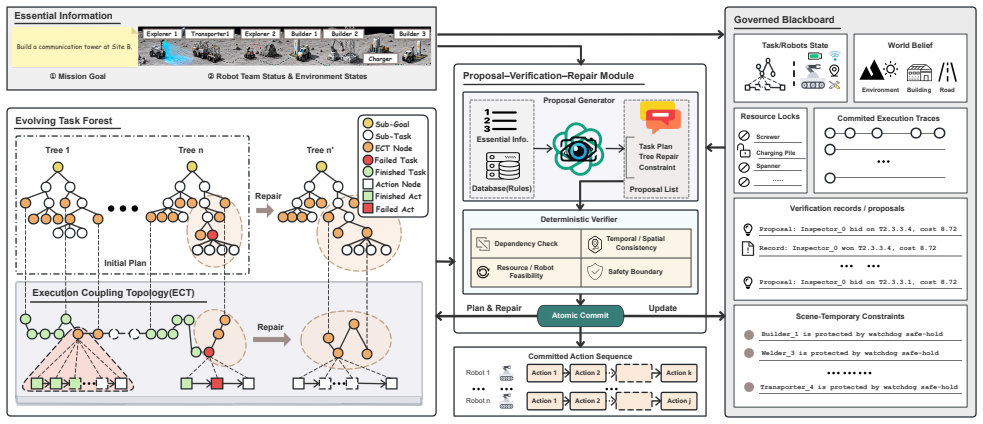
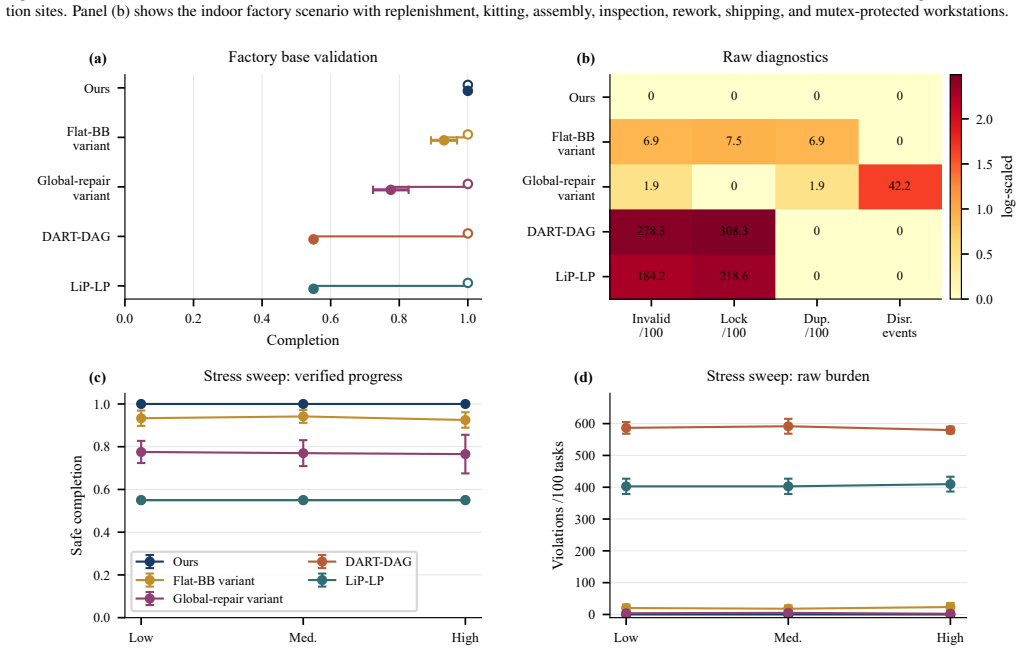
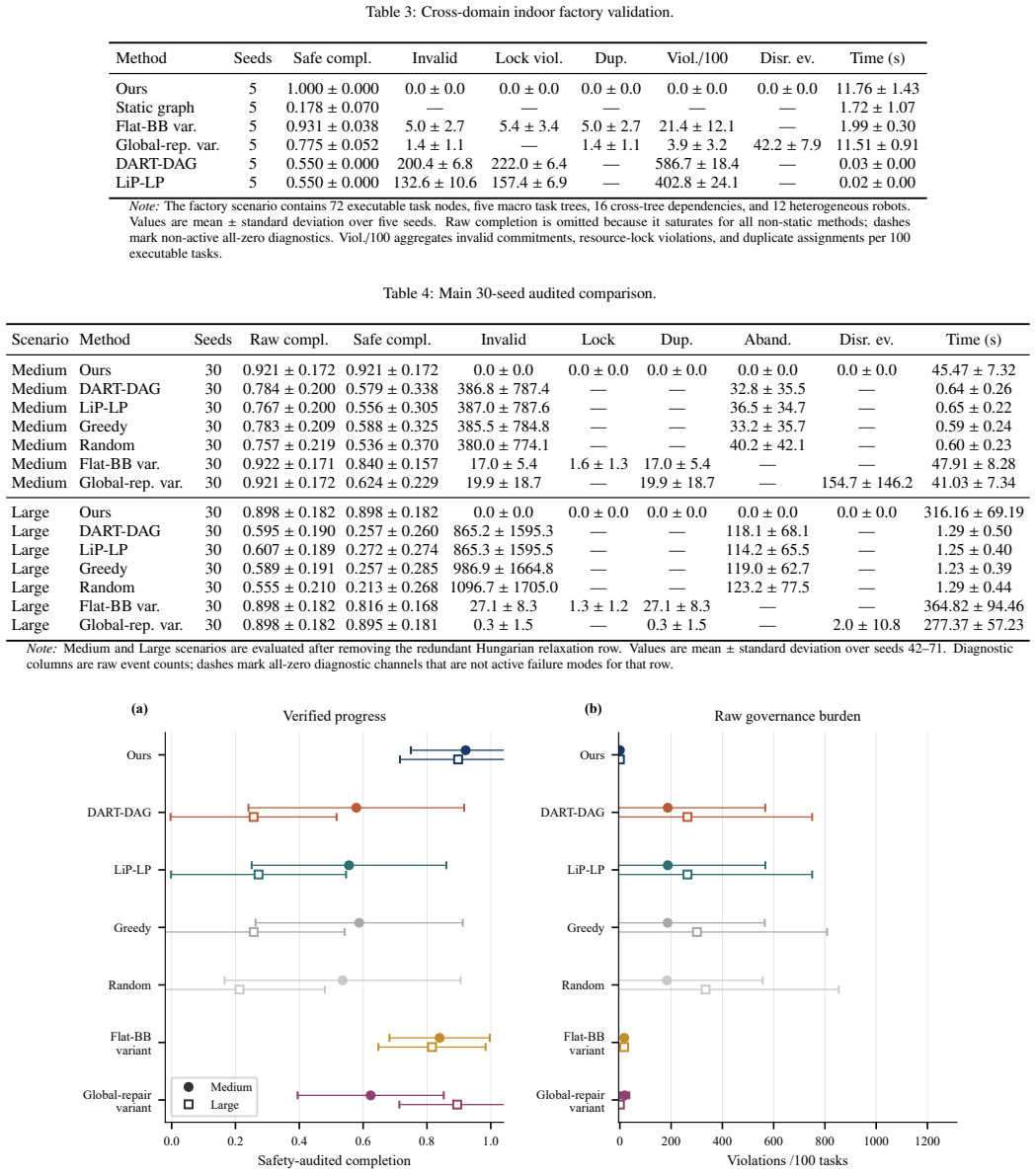
The framework maintains an evolving task forest and a governed blackboard; from each synchronized snapshot it derives an execution coupling topology that makes cross-branch dependencies explicit for verification, parallel-commit eligibility, and bounded repair. Candidate proposals generated by any heuristic, optimization, or agentic module may update the committed mission state only after passing deterministic verification and atomic commit. Evaluations in factory scenarios and stress benchmarks report higher verified progress and fewer invalid commitments, lock conflicts, and disruptive repairs under the modeled mission predicates.
What carries the argument
Execution coupling topology derived from each forest-blackboard snapshot, which exposes cross-branch dependencies for deterministic proposal verification before atomic commit.
If this is right
- Mission-state progress improves under verification gating because only checked proposals reach committed state.
- Invalid commitments, lock conflicts, duplicate assignments, and abandoned nodes decrease in evaluated industrial scenarios.
- Agentic modules remain proposal generators while verification supplies the inspectable execution authority.
Where Pith is reading between the lines
- The same forest-blackboard plus topology pattern could govern proposal streams in non-industrial multi-agent settings such as logistics fleets or swarm coordination.
- Adding probabilistic or learned predictors of topology completeness might reduce false negatives without altering the deterministic commit rule.
- Integration with existing robot middleware would require mapping the blackboard locks onto standard resource arbitration primitives.
Load-bearing premise
The derived execution coupling topology from each forest-blackboard snapshot exposes all relevant cross-branch dependencies without omissions or false negatives in dynamic environments.
What would settle it
A recorded case in which a proposal commits after verification yet produces a safety violation or dependency breach traceable to an undetected cross-branch interaction would falsify the framework's guarantee.
Figures
read the original abstract
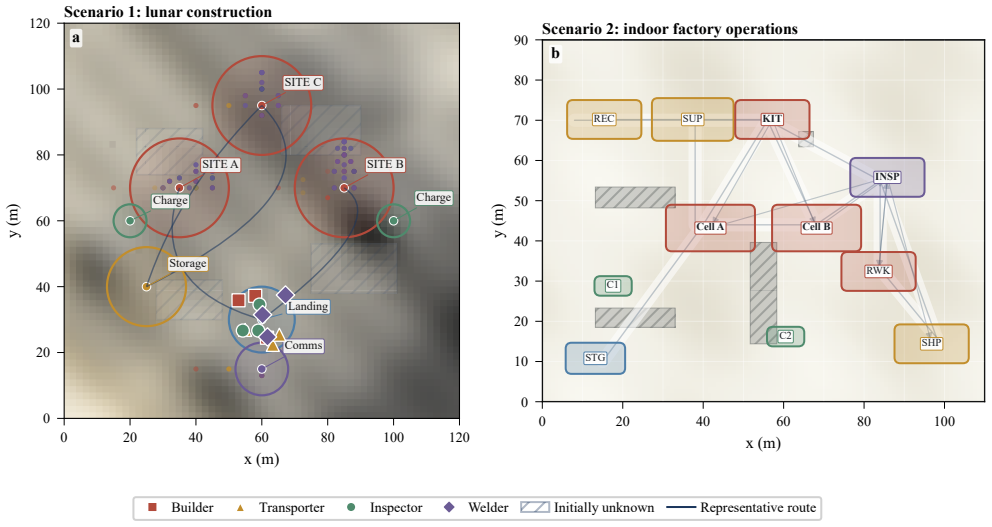
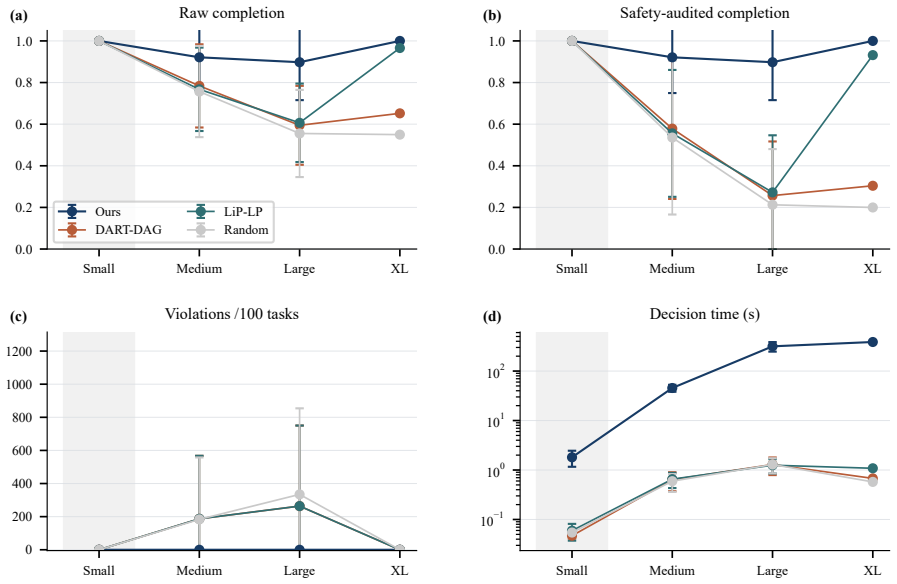
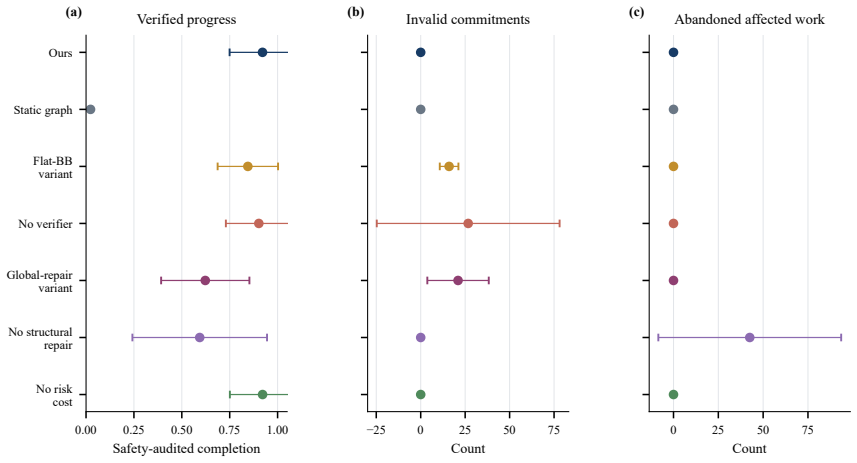
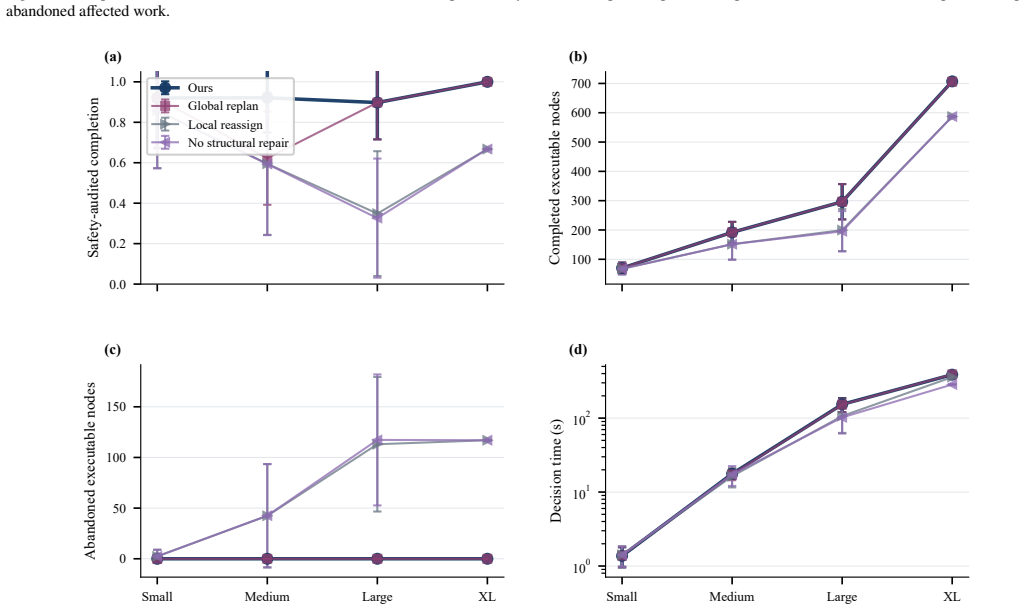
Agentic artificial intelligence is increasingly used to decompose industrial tasks, propose robot actions, and adapt execution plans in dynamic cyber-physical environments. However, autonomous proposal generation alone does not guarantee that multi-robot industrial systems preserve task dependencies, resource ownership, safety holds, or repair boundaries during long-horizon execution. This paper introduces a verification-gated agentic mission-state governance framework for intelligent industrial multi-robot systems. The framework maintains two synchronized state objects: an evolving task forest for persistent hierarchy, delayed grounding, and repairable substructures; and a governed blackboard for online execution state, robot traces, resource locks, world beliefs, proposals, verification records, and scene-temporary constraints. From each forest--blackboard snapshot, a derived execution coupling topology exposes cross-branch dependencies for proposal verification, parallel-commit eligibility, and bounded repair. Candidate assignments, repairs, deferrals, and constraint updates may be generated by heuristic, optimization, or agentic reasoning modules, but they can update the committed mission state only after deterministic verification and atomic commit. We evaluate the framework in an indoor factory multi-robot scenario, 30-seed remote-construction stress benchmarks, structural ablations, and scalability probes. The results show improved verified and safety-audited mission-state progress with fewer invalid commitments, lock conflicts, duplicate assignments, abandoned nodes, and disruptive repairs under modeled mission predicates. The study positions agentic AI as a proposal-generating layer governed by inspectable mission-state verification rather than as an unchecked execution authority.
Editorial analysis
A structured set of objections, weighed in public.
Referee Report
Summary. The paper introduces a verification-gated agentic mission-state governance framework for intelligent industrial multi-robot systems. It maintains two synchronized state objects—an evolving task forest for hierarchy, delayed grounding, and repairable substructures, and a governed blackboard for execution state, resource locks, proposals, and verification records—from which a derived execution coupling topology exposes cross-branch dependencies. Candidate proposals (assignments, repairs, etc.) generated by heuristic, optimization, or agentic modules may only update the committed state after deterministic verification and atomic commit. The framework is evaluated in an indoor factory scenario, 30-seed remote-construction benchmarks, ablations, and scalability probes, with claims of improved verified mission-state progress and fewer invalid commitments, lock conflicts, duplicate assignments, and disruptive repairs.
Significance. If the execution coupling topology derivation is shown to be complete and the verification gate sound under dynamic conditions, the framework would provide a concrete mechanism for safely layering agentic proposal generation atop inspectable, deterministic mission-state governance in cyber-physical systems. This separation of concerns could reduce risks in long-horizon multi-robot industrial tasks while preserving adaptability.
major comments (2)
- [Abstract] Abstract / framework description: the central safety claim rests on the assertion that each forest–blackboard snapshot yields an execution coupling topology that exposes all relevant cross-branch dependencies for proposal verification. No formal definition, algorithm, or completeness argument for this derivation is supplied, leaving open the possibility (raised in the stress-test note) that dependencies arising after the snapshot, across repair boundaries, or from delayed grounding are omitted. This is load-bearing for the verification gate's reliability.
- [Evaluation] Evaluation description: the manuscript asserts quantitative improvements in verified progress and reductions in conflicts, invalid commitments, and abandoned nodes under modeled predicates, yet supplies no specific metrics, tables, error bars, baseline comparisons, or statistical details. Without these, the empirical support for the framework's advantages cannot be assessed.
Simulated Author's Rebuttal
We thank the referee for the constructive feedback highlighting two key areas for strengthening the manuscript. We address each major comment below and commit to revisions that directly respond to the concerns raised.
read point-by-point responses
-
Referee: [Abstract] Abstract / framework description: the central safety claim rests on the assertion that each forest–blackboard snapshot yields an execution coupling topology that exposes all relevant cross-branch dependencies for proposal verification. No formal definition, algorithm, or completeness argument for this derivation is supplied, leaving open the possibility (raised in the stress-test note) that dependencies arising after the snapshot, across repair boundaries, or from delayed grounding are omitted. This is load-bearing for the verification gate's reliability.
Authors: We agree this is a substantive gap in the current presentation. While the full manuscript describes the derivation process in Section 4, it does not supply an explicit formal definition, pseudocode algorithm, or completeness argument addressing post-snapshot changes, repair boundaries, and delayed grounding. We will add a dedicated subsection in the methods with the formal definition of the execution coupling topology, the derivation algorithm, and a completeness argument under the modeled predicates. We will also incorporate a targeted stress-test analysis in the evaluation to demonstrate coverage of the noted edge cases. revision: yes
-
Referee: [Evaluation] Evaluation description: the manuscript asserts quantitative improvements in verified progress and reductions in conflicts, invalid commitments, and abandoned nodes under modeled predicates, yet supplies no specific metrics, tables, error bars, baseline comparisons, or statistical details. Without these, the empirical support for the framework's advantages cannot be assessed.
Authors: The comment is correct: the current evaluation section provides only high-level qualitative claims without the requested quantitative details. We will revise the evaluation section to include full tables reporting the specific metrics (verified progress, conflict counts, invalid commitments, etc.) from the 30-seed benchmarks and ablations, with error bars, baseline comparisons against non-gated agentic and heuristic approaches, and statistical significance tests. revision: yes
Circularity Check
No significant circularity; conceptual framework without self-referential reductions or fitted predictions
full rationale
The paper describes a verification-gated framework using a task forest and governed blackboard, from which an execution coupling topology is derived to expose cross-branch dependencies. No equations, parameter fits, predictions, or self-citations appear in the abstract or description that would reduce any claim to its inputs by construction. The topology is presented as a derived object for verification purposes, but without formal definitions, completeness proofs, or reductions shown that match any enumerated circularity pattern. The central safety claim rests on design choices for deterministic verification rather than on a derivation that loops back to fitted data or prior self-work. This aligns with the absence of visible math or load-bearing self-references, making the work self-contained as a proposed architecture.
Axiom & Free-Parameter Ledger
Reference graph
Works this paper leans on
-
[1]
B. P. Gerkey, M. J. Mataric, A formal analysis and taxon- omy of task allocation in multi-robot systems, The Inter- national Journal of Robotics Research 23 (9) (2004) 939– 954.doi:10.1177/0278364904045564
-
[2]
G. A. Korsah, A. Stentz, M. B. Dias, A comprehensive taxonomy for multi-robot task allocation, The Interna- tional Journal of Robotics Research 32 (12) (2013) 1495– 1512.doi:10.1177/0278364913496484
-
[3]
A. Calvo, J. Capitán, Heterogeneous multirobot task al- location for long-endurance missions in dynamic scenar- ios, IEEE Transactions on Robotics 41 (2025) 6494–6513. doi:10.1109/TRO.2025.3626651
-
[4]
M. Ahn, A. Brohan, N. Brown, Y . Chebotar, O. Cortes, B. David, C. Finn, C. Fu, K. Gopalakrishnan, K. Haus- man, A. Herzog, D. Ho, J. Hsu, J. Ibarz, B. Ichter, et al., Do as i can, not as i say: Grounding language in robotic affordances, in: Proceedings of the 6th Conference on Robot Learning, 2022.arXiv:2204.01691
work page internal anchor Pith review Pith/arXiv arXiv 2022
-
[5]
Huang, C
W. Huang, C. Wang, R. Zhang, Y . Li, J. Wu, L. Fei- Fei, V oxPoser: Composable 3d value maps for robotic manipulation with language models, in: Proceedings of The 7th Conference on Robot Learning, V ol. 229 of Proceedings of Machine Learning Research, PMLR, 2023, pp. 540–562. URLhttps://proceedings.mlr.press/v229/ huang23b.html 12
2023
-
[6]
K. Rana, J. Haviland, S. Garg, J. Abou-Chakra, I. Reid, N. Suenderhauf, SayPlan: Grounding large language models using 3d scene graphs for scalable task planning, in: 7th Annual Conference on Robot Learning, 2023. URLhttps://openreview.net/forum?id= wMpOMO0Ss7a
2023
-
[7]
S. Vemprala, R. Bonatti, A. Bucker, A. Kapoor, ChatGPT for robotics: Design principles and model abilities, IEEE Access 12 (2024) 55682–55696.doi:10.1109/ACCESS. 2024.3387941
-
[8]
S. S. Kannan, V . L. N. Venkatesh, B.-C. Min, SMART- LLM: Smart multi-agent robot task planning using large language models, in: Proceedings of the IEEE/RSJ In- ternational Conference on Intelligent Robots and Sys- tems (IROS), 2024.doi:10.1109/IROS58592.2024. 10802322
-
[9]
M. Lai, K. Go, Z. Li, T. Kroger, S. Schaal, K. Allen, J. Scholz, Roboballet: Planning for multirobot reaching with graph neural networks and reinforcement learning, Science Robotics (2025).doi:10.1126/scirobotics. ads1204
-
[10]
Z. Yang, C. R. Garrett, T. Lozano-Perez, L. P. Kaelbling, D. Fox, Sequence-based plan feasibility prediction for efficient task and motion planning, in: Proceedings of Robotics: Science and Systems, Daegu, Republic of Ko- rea, 2023.doi:10.15607/RSS.2023.XIX.061
-
[11]
M. Fox, D. Long, PDDL2.1: An extension to PDDL for expressing temporal planning domains, Journal of Ar- tificial Intelligence Research 20 (2003) 61–124.doi: 10.1613/jair.1129
-
[12]
J. Hoffmann, B. Nebel, The FF planning system: Fast plan generation through heuristic search, Journal of Ar- tificial Intelligence Research 14 (2001) 253–302.doi: 10.1613/jair.855
-
[13]
M. Helmert, The fast downward planning system, Jour- nal of Artificial Intelligence Research 26 (2006) 191–246. doi:10.1613/jair.1705
-
[14]
D. S. Nau, T.-C. Au, O. Ilghami, U. Kuter, J. W. Mur- dock, D. Wu, F. Yaman, SHOP2: An HTN planning sys- tem, Journal of Artificial Intelligence Research 20 (2003) 379–404.doi:10.1613/jair.1141
-
[15]
M. Cashmore, M. Fox, D. Long, D. Magazzeni, B. Rid- der, A. Carrera, N. Palomeras, N. Hurtos, M. Carreras, ROSPlan: Planning in the robot operating system, in: Pro- ceedings of the Twenty-Fifth International Conference on Automated Planning and Scheduling, V ol. 25, 2015, pp. 333–341.doi:10.1609/icaps.v25i1.13699
-
[16]
Driess, F
D. Driess, F. Xia, M. S. M. Sajjadi, C. Lynch, A. Chowd- hery, B. Ichter, A. Wahid, J. Tompson, Q. Vuong, T. Yu, W. Huang, Y . Chebotar, P. Sermanet, D. Duckworth, S. Levine, V . Vanhoucke, K. Hausman, M. Toussaint, K. Greff, A. Zeng, I. Mordatch, P. Florence, PaLM-E: An embodied multimodal language model, in: Proceedings of the 40th International Confere...
2023
-
[17]
Zitkovich, T
B. Zitkovich, T. Yu, S. Xu, P. Xu, T. Xiao, F. Xia, J. Wu, P. Wohlhart, S. Welker, A. Wahid, Q. Vuong, V . Vanhoucke, H. Tran, R. Soricut, A. Singh, J. Singh, P. Sermanet, P. R. Sanketi, G. Salazar, M. S. Ryoo, et al., RT-2: Vision-language-action models transfer web knowledge to robotic control, in: Proceedings of The 7th Conference on Robot Learning, V ...
2023
-
[18]
Y . Chen, M. Wei, X. Wang, Y . Liu, J. Wang, H. Song, L. Ma, D. Di, C. Sun, K. Liu, L. Qi, J. Yu, X. Tian, S. Liang, C. Duan, Z. Hong, W. Zhang, T. Liu, Em- bodied AI: A survey on the evolution from perceptive to behavioral intelligence, SmartBot 1 (3) (2025) e70003. doi:10.1002/smb2.70003
-
[19]
I. Singh, V . Blukis, A. Mousavian, A. Goyal, D. Xu, J. Tremblay, D. Fox, J. Thomason, A. Garg, ProgPrompt: Generating situated robot task plans using large lan- guage models, in: 2023 IEEE International Conference on Robotics and Automation (ICRA), 2023, pp. 11523– 11530.doi:10.1109/ICRA48891.2023.10161317
-
[20]
Y . Wang, R. Xiao, J. Y . L. Kasahara, R. Yajima, K. Nagatani, A. Yamashita, H. Asama, DART-LLM: Dependency-aware multi-robot task decomposition and execution using large language models (2024).arXiv: 2411.09022,doi:10.48550/arXiv.2411.09022
-
[21]
K. Liu, Z. Tang, D. Wang, Z. Wang, B. Zhao, X. Li, COHERENT: Collaboration of heterogeneous multi-robot system with large language models (2024).arXiv:2409. 15146
2024
- [22]
-
[23]
H. Zeng, M. Wang, P. Li, Emboteam: Grounding llm rea- soning into reactive behavior trees via pddl for embodied multi-robot collaboration (2026).arXiv:2601.11063, doi:10.48550/arXiv.2601.11063
-
[24]
Valmeekam, M
K. Valmeekam, M. Marquez, A. Olmo, S. Sreedharan, S. Kambhampati, PlanBench: An extensible benchmark for evaluating large language models on planning and rea- soning about change, in: Advances in Neural Information 13 Processing Systems, V ol. 36, 2023, datasets and Bench- marks Track
2023
-
[25]
P. Li, Z. An, S. Abrar, L. Zhou, Large language models for multi-robot systems: A survey (2025).arXiv:2502. 03814
2025
-
[26]
Hayes-Roth, A blackboard architecture for control, Artificial Intelligence 26 (3) (1985) 251–321.doi:10
B. Hayes-Roth, A blackboard architecture for control, Artificial Intelligence 26 (3) (1985) 251–321.doi:10. 1016/0004-3702(85)90063-3
1985
-
[27]
H. P. Nii, The blackboard model of problem solving and the evolution of blackboard architectures, AI Magazine 7 (2) (1986) 38–53.doi:10.1609/aimag.v7i2.537
-
[28]
P. J. Ramadge, W. M. Wonham, Supervisory control of a class of discrete event processes, SIAM Journal on Control and Optimization 25 (1) (1987) 206–230.doi: 10.1137/0325013
-
[29]
A. M. Madni, M. Sievers, Model-based systems engineer- ing: Motivation, current status, and research opportuni- ties, Systems Engineering 21 (3) (2018) 172–190.doi: 10.1002/sys.21438
-
[30]
Cofer, I
D. Cofer, I. Amundson, R. Sattigeri, A. Passi, C. Boggs, E. Smith, L. Gilham, T. Byun, S. Rayadurgam, Run-time assurance for learning-enabled systems, in: NASA For- mal Methods, V ol. 12229 of Lecture Notes in Computer Science, Springer, 2020, pp. 361–368.doi:10.1007/ 978-3-030-55754-6_21. 14
2020
discussion (0)
Sign in with ORCID, Apple, or X to comment. Anyone can read and Pith papers without signing in.