REVIEW 2 major objections 4 minor 18 references
The relative $\mathcal{L}$-invariant of a compact $4$-manifold
T0 review · 2 major / 4 minor · reviewed 2026-08-14 · deepseek-v4-flash
Pith's one-line read The paper introduces the relative $\mathcal{L}$-invariant $r\mathcal{L}(X)$ for compact 4-manifolds with boundary and proves that, for rational homology balls, $r\mathcal{L}(X)=0$ exactly when $X$ is diffeomorphic to the standard 4-ball…
desk verdict A valuable new relative invariant with genuinely new moves and an algorithm, but the proof of the main detection theorem has an unjustified ordering argument in Claim 4.7. read the letter →
The pith
A machine-rendered reading of the paper's core claim, the machinery that carries it, and where it could break.
The reading
What carries the argument
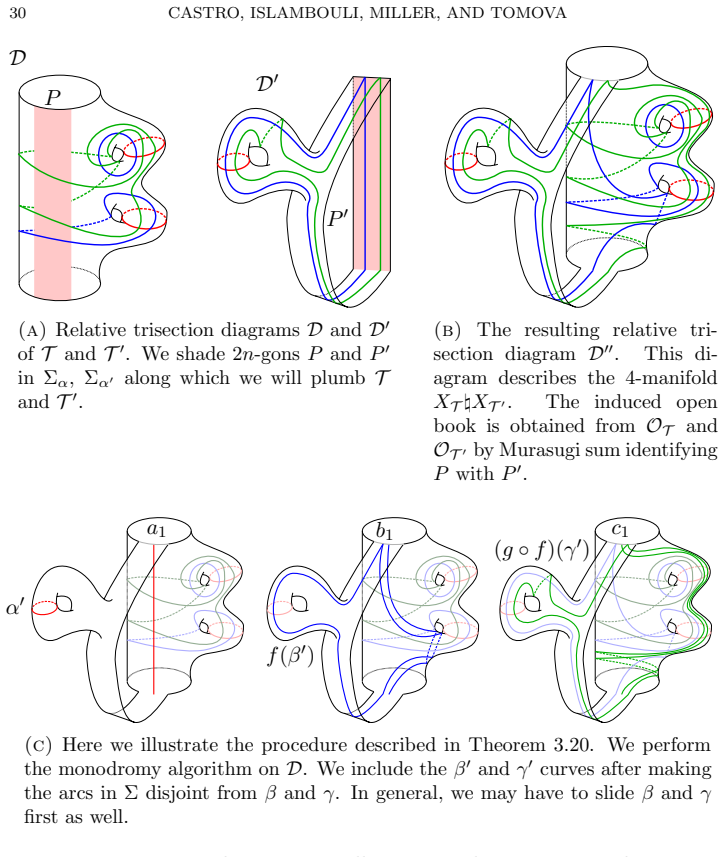
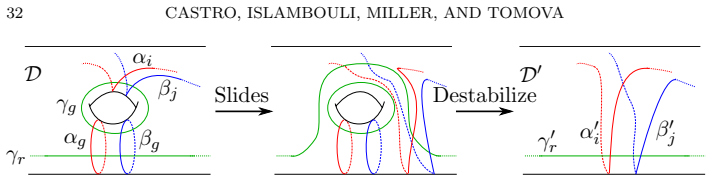
The central object is the relative $\mathcal{L}$-invariant $r\mathcal{L}(X)$, defined by minimizing, over relative trisection diagrams, the quantity $|\delta|-3(g+p+b-1)+(k_1+k_2+k_3)$, where $\delta$ is a valid path in the $p$-cut complex $\mathcal{H}\mathcal{T}_p(\Sigma)$ of the trisection surface $\Sigma$. In this complex, vertices are cut systems consisting of $g-p$ closed curves and $2p+b-1$ arcs; type-0 edges represent generalized handleslides, type-0$\partial$ edges represent slides of arcs with common endpoints, and type-1 edges represent replacing a curve by one that intersects it in a single point. A path is valid if it travels through the $\alpha$-, $\beta$-, and $\gamma$-components of the complex in order, with the minimal possible number of type-1 edges between good pairs (pairs of cut systems connected by exactly the algebraic minimum of type-1 edges). The other load-bearing construction is the relative double twist, a diagram-level move that realizes a $\partial U$ move on the boundary open book; together with relative stabilization it connects any two relative trisections of a fixed 4-manifold.
What would settle it
Take any known contractible 4-manifold that is not diffeomorphic to the 4-ball, compute $r\mathcal{L}$ from one of its relative trisection diagrams, and check whether the normalized minimum valid-path length is zero; a zero value for such a manifold would disprove the theorem. At the proof level, exhibit a valid path in which the curve $\beta_i$ must be replaced by $\gamma_j$ before $\beta_1$ is replaced by $\gamma_1$, contrary to the ordering used in Claim 4.7.
Extended reading notes
Core claim
The central discovery is that the relative $\mathcal{L}$-invariant $r\mathcal{L}(X)$ detects exactly the standard 4-ball among rational homology balls. Concretely, $r\mathcal{L}(X)=0$ for a rational homology ball $X$ if and only if $X\cong B^4$; the forward direction is Theorem 4.5, and the reverse direction follows from Remark 3.7, where the trivial $(0,0;0,1)$-trisection of $B^4$ has an empty valid path and hence $r\mathcal{L}(B^4)=0$. The invariant is defined as the minimum, over all relative trisections of $X$, of the normalized length of a valid path in the $p$-cut complex of the trisection surface; a zero value forces the minimizing path to consist entirely of type-1 edges connecting good pairs. The proof then reduces the diagram by destabilizing along a parallel pair of curves, inductively stripping away genus until the diagram must decompose as a connected sum of the trivial $B^4$ diagram and genus-1 $S^4$ trisections, which describes $B^4$.
Load-bearing premise
The load-bearing premise is that, after simplifying a minimal relative trisection diagram, the shortest path used to define the invariant survives the simplification without getting longer, and this survival depends on the order in which curves are exchanged along the path.
Editorial extensions
If this is right
- For rational homology balls, the relative $\mathcal{L}$-invariant is a complete detector of the 4-ball: $r\mathcal{L}(X)=0$ if and only if $X\cong B^4$.
- For a closed rational homology 4-sphere $\widehat{X}$, the closed $\mathcal{L}$-invariant vanishes if and only if $\widehat{X}\cong S^4$ (Corollary 4.8).
- Small boundary complexity forces the boundary to be a connected sum of $S^1\times S^2$'s: $r\mathcal{L}_\partial(T)\le 1$ implies $\partial X\cong \#_{2p+b-1}S^1\times S^2$, and below a related threshold $\partial X$ has an $S^1\times S^2$ summand.
- There are 4-manifolds with arbitrarily large relative $\mathcal{L}$-invariant, including families whose boundary homology stays bounded (Corollaries 4.4 and 5.8).
- Relative trisections of a fixed 4-manifold are unique up to interior stabilization, relative stabilization, and relative double twists, removing the previous need to fix the boundary open book or assume rational-homology-sphere boundary.
Reading between the lines
- Because $r\mathcal{L}(X)=0$ characterizes the 4-ball among rational homology balls, the invariant can serve as an obstruction: a rational homology ball that is known not to be $B^4$ would need to have $r\mathcal{L}(X)>0$, so computations on explicit trisection diagrams could certify nontriviality.
- The Murasugi-sum algorithm suggests testable subadditivity properties: one might ask whether $r\mathcal{L}(X\# Y)\le r\mathcal{L}(X)+r\mathcal{L}(Y)$ or whether $r\mathcal{L}$ respects Murasugi sums of the boundary open books; the paper does not address these inequalities.
- The relative double twist gives a trisection-level way to change the boundary open book by a $\partial U$ move, so one could use it to define distances between relative trisections with different boundary data, or to convert any relative trisection into one inducing a prescribed open book on the same boundary 3-manifold; this goes beyond the paper's uniqueness statement.
- A natural quantitative question the paper leaves open is whether $r\mathcal{L}(X)=r\mathcal{L}_\circ(X)+r\mathcal{L}_\partial(X)$ (Question 3.12); if true, the interior and boundary contributions to the invariant would each be separately computable and could give finer information about 4-manifolds with small invariant.
Signed reviews
Editorial analysis
A structured set of objections, weighed in public.
Referee Report
Summary. The paper introduces a relative L-invariant rL(X) for smooth, orientable, compact 4-manifolds with connected boundary, defined by measuring the lengths of certain paths in the p-cut complex HT_p(Σ) associated to a relative trisection surface. Two related invariants, rL∂(X) and rL◦(X), are also defined. The main theorem states that if X is a rational homology ball and rL(X)=0, then X is diffeomorphic to B^4, giving a trisection-theoretic analogue of the Kirby–Thompson result for closed 4-manifolds. The paper also proves a uniqueness theorem for relative trisections up to interior stabilization, relative stabilization, and a new relative double twist move, and gives an explicit algorithm for performing Murasugi sums of relatively trisected 4-manifolds.
Significance. If the main results are correct, this is a substantive contribution to trisection theory: it provides the first relative analogue of the L-invariant and shows that it detects the standard 4-ball among rational homology balls. The construction is self-contained, and the proofs are generally detailed. The Murasugi sum gluing algorithm and the strengthened uniqueness theorem for relative trisections are also valuable, as they address previously open structural questions. The paper also includes explicit computations and bounds relating rL∂ to the arc complex, which will be useful for future applications.
major comments (2)
- [Section 4, proof of Theorem 4.2] The case analysis in the proof of Theorem 4.2 is incomplete as written. The proof labels two different cases as "Case 3", and the second of these reads "a0 changes to arc c0 in Aγ (which is not also in Aγ)", which is self-contradictory. The intended case appears to be the one in which the arc changes once into the terminal Aα cut system, and the reduction to Case 2 by reversing the path is asserted without a precise formulation. Since Corollary 4.4 relies on Theorem 4.2 to produce lower bounds on rL, this proof must be completed before Theorem 4.2 can be considered established.
- [Section 4, Claim 4.7] The order-of-edges argument in Claim 4.7 is valid but too terse. The proof should explicitly state that every vertex of HT_p is a disjoint cut system and that a type 1 edge adds a curve which is disjoint from all curves in the cut system other than the one it replaces. With that convention, β_i ∩ γ_1 ≠ ∅ forces the edge E replacing β_i to precede the edge E_{β_1}, and γ_j ∩ β_1 ≠ ∅ forces E_{β_1} to precede E, giving the desired contradiction. No actual gap remains, but the exposition should be clarified so that future readers do not misread the argument as relying on an unjustified implication.
minor comments (4)
- [Section 4, proof of Theorem 4.5] The phrase "a path δ in HT0(Σ) from vα to vγ to vγ" should read "from vα to vβ to vγ", since the path is composed of the α-to-β and β-to-γ segments.
- [Section 3, Remark 3.15] The numerical claims rL(T') = 2 and rL(T'') = 4 are asserted without computation or reference to a proof, and the sentence contains an unmatched closing parenthesis. Please either add the missing justification or clearly mark these as examples awaiting later results.
- [Section 5, Corollary 5.6] The sentence "By combining Lemma 5.5 and Proposition 5" should refer to Proposition 5.3, not "Proposition 5".
- [Section 4, proof of Theorem 4.2] In addition to the duplicate Case 3 label, the first Case 3 ends with a conclusion about the monodromy fixing an essential arc, but the text does not fully justify why sliding over β curves, after the α and β curves are made standard, implies isotopy in the α-page. This is likely fixable by a short argument, but it should be spelled out.
Circularity Check
No significant circularity: the relative L-invariant is defined from scratch and its main theorems are proved from that definition plus external background results.
full rationale
The paper defines the relative L-invariant rL(X) directly in Section 3.1 from a new p-cut complex HTp(Sigma) and a new notion of valid path; no parameter is fitted to data and no 'prediction' is reused as an input. The if-and-only-if statement for rational homology balls is obtained in two independent directions: Remark 3.7 computes rL(B^4)=0 from the empty path, and Theorem 4.5 derives diffeomorphism to B^4 from rL(X)=0 via Lemma 4.1 and an induction on trisection genus. The paper cites earlier work by its own authors (e.g., [Cas16], [CGPC18a], [CGPC18b], [CO19]), but these are published results with independent proofs used as background ingredients, not restatements of the target theorem. The uniqueness result Theorem 2.17 relies on Piergallini-Zuddas [PZ18] and Gay-Kirby [GK16], and the Murasugi gluing Theorem 3.20 is an explicit construction rather than a renamed known result. I find no step where a claim reduces by definition to its input or where a fitted value is relabeled as a prediction.
Assumptions & free parameters
assumptions (7)
- standard math Laudenbach-Poenaru theorem (LP72): every self-diffeomorphism of the boundary of a 4-dimensional 1-handlebody extends over the handlebody.
- standard math Waldhausen's theorem (Wal68): Heegaard diagrams of #^k S^1 x S^2 have a standard form up to slides.
- domain assumption Gay-Kirby existence (GK16): every compact 4-manifold with boundary admits a relative trisection inducing any given open book decomposition on the boundary.
- domain assumption Castro-Gay-Pinzon-Caicedo (CGPC18a): every relative trisection is described by a relative trisection diagram and the monodromy algorithm computes the boundary open book.
- domain assumption Piergallini-Zuddas (PZ18, Theorem 2.13): any two open books on a 3-manifold are related by Hopf stabilizations and ∂U moves.
- domain assumption Etnyre-Li (EL15): if the displacement distance of the monodromy in the arc complex is zero or one, then the 3-manifold splits off S^1 x S^2 or the open book admits a Hopf destabilization.
- standard math Hatcher-Thurston (HT80): the cut complex of a surface is connected.
Cite this review
Pith. "Pith review of The relative $\mathcal{L}$-invariant of a compact $4$-manifold." pith.science (2026). https://pith.science/paper/NYL2Y7FF
@misc{pith2026190805371,
  author       = {Pith},
  title        = {Pith review of: The relative $\mathcalL$-invariant of a compact $4$-manifold},
  year         = {2026},
  howpublished = {\url{https://pith.science/paper/NYL2Y7FF}},
  note         = {Machine review of arXiv:1908.05371}
}
abstract
In this paper, we introduce the relative $\mathcal{L}$-invariant $r\mathcal{L}(X)$ of a smooth, orientable, compact 4-manifold $X$ with boundary. This invariant is defined by measuring the lengths of certain paths in the cut complex of a trisection surface for $X$. This is motivated by the definition of the $\mathcal{L}$-invariant for smooth, orientable, closed 4-manifolds by Kirby and Thompson. We show that if $X$ is a rational homology ball, then $r\mathcal{L}(X)=0$ if and only if $X\cong B^4$. In order to better understand relative trisections, we also produce an algorithm to glue two relatively trisected 4-manifold by any Murasugi sum or plumbing in the boundary, and also prove that any two relative trisections of a given 4-manifold $X$ are related by interior stabilization, relative stabilization, and the relative double twist, which we introduce in this paper as a trisection version of one of Piergallini and Zuddas's moves on open book decompositions. Previously, it was only known (by Gay and Kirby) that relative trisections inducing equivalent open books on $X$ are related by interior stabilizations.
Figures


Figures from the paper (11 more)



Reference graph
Works this paper leans on
-
[1]
Jos \'e Rom \'a n Aranda and Jesse Moeller . Diagrams of *-Trisections . arXiv e-prints , page arXiv:1911.06467, November 2019
arXiv 1911
-
[2]
Nickolas A. Castro. Relative trisections of smooth 4-manifolds with boundary . PhD thesis, University of Georgia, 2016. https://nickcastromath.files.wordpress.com/2015/11/thesis.pdf
work page 2016
-
[3]
Nickolas A. Castro, David T. Gay, and Juanita Pinz\' o n-Caicedo. Diagrams for relative trisections. Pacific J. Math. , 294(2):275--305, 2018
work page 2018
-
[4]
Nickolas A. Castro, David T. Gay, and Juanita Pinz\' o n-Caicedo. Trisections of 4-manifolds with boundary. Proc. Natl. Acad. Sci. USA , 115(43):10861--10868, 2018
work page 2018
-
[5]
Nickolas A. Castro and Burak Ozbagci . Trisections of 4-manifolds via Lefschetz fibrations . Math. Res. Lett. , 26(2):383--420, 2019
work page 2019
-
[6]
John Etnyre and Youlin Li. The arc complex and contact geometry: nondestabilizable planar open book decompositions of the tight contact 3-sphere. Int. Math. Res. Not. IMRN , 2015(5):1401--1420, 2015
work page 2015
-
[7]
Cusp geometry of fibered 3-manifolds
David Futer and Saul Schleimer. Cusp geometry of fibered 3-manifolds. Amer. J. Math. , 136(2):309--356, 2014
work page 2014
-
[8]
On the stable equivalence of open books in three-manifolds
Emmanuel Giroux and Noah Goodman. On the stable equivalence of open books in three-manifolds. Geom. Topol. , 10:97--114, 2006
work page 2006
Show all 18 references
-
[9]
Trisecting 4-manifolds
David Gay and Robion Kirby. Trisecting 4-manifolds. Geom. Topol. , 20(6):3097--3132, 2016
2016
-
[10]
Hatcher and W
A. Hatcher and W. Thurston. A presentation for the mapping class group of a closed orientable surface. Topology , 19(3):221--237, 1980
1980
-
[11]
Trisections of surface complements and the P rice twist
Seungwon Kim and Maggie Miller . Trisections of surface complements and the P rice twist . arXiv e-prints , page arXiv:1805.00429, May 2018. To appear in Algebr. Geom. Topol
2018 arXiv
-
[12]
A new invariant of 4-manifolds
Robion Kirby and Abigail Thompson. A new invariant of 4-manifolds. Proc. Natl. Acad. Sci. U.S.A. , 115(43):10857--10860, 2018
2018
-
[13]
A note on 4-dimensional handlebodies
Fran c ois Laudenbach and Valentin Po\' e naru. A note on 4-dimensional handlebodies. Bull. Soc. Math. France , 100:337--344, 1972
1972
-
[14]
Trisections of non-orientable 4-manifolds
Maggie Miller and Patrick Naylor . Trisections of non-orientable 4-manifolds . arXiv e-prints , page arXiv:2010.07433, October 2020
2010 arXiv
-
[15]
Stipsicz
Burak Ozbagci and Andr \'a s I. Stipsicz. Surgery on contact 3-manifolds and S tein surfaces , volume 13 of Bolyai Society Mathematical Studies . Springer-Verlag, Berlin; J\'anos Bolyai Mathematical Society, Budapest, 2004
2004
-
[16]
Special moves for open book decompositions of 3-manifolds
Riccardo Piergallini and Daniele Zuddas. Special moves for open book decompositions of 3-manifolds. J. Knot Theory Ramifications , 27(11):1843008, 16, 2018
2018
-
[17]
Fibrations of 3-manifolds and asymptotic translation length in the arc complex
Bal \'a zs Strenner . Fibrations of 3-manifolds and asymptotic translation length in the arc complex . arXiv e-prints , page arXiv:1810.07236, Oct 2018
2018 arXiv
-
[18]
Heegaard- Z erlegungen der 3 - S ph\"are
Friedhelm Waldhausen. Heegaard- Z erlegungen der 3 - S ph\"are. Topology , 7:195--203, 1968
1968
Reviewed August 14, 2026 · model on record in the stance chip above.
Discussion (0). Continue with ORCID to comment.