REVIEW 3 major objections 4 minor 62 references
Quasiclassical circuit-theory of contiguous disordered multiband superconductors
T0 review · 3 major / 4 minor · reviewed 2026-08-14 · deepseek-v4-flash
Pith's one-line read The paper claims that Josephson current in disordered multiband junctions with coexisting spin-density-wave order is fixed by bulk Green's functions and transmission eigenvalues alone, derived from the quasiclassical equations by Yip's…
desk verdict A useful and mostly sound extension of quasiclassical circuit theory to multiband SC+SDW junctions, but the central current formula deserves a fuller derivation before I would build on it. read the letter →
The pith
A machine-rendered reading of the paper's core claim, the machinery that carries it, and where it could break.
The reading
What carries the argument
The load-bearing device is Yip's auxiliary-solution construction: instead of solving the Eilenberger equation with the nonlinear Zaitsev boundary conditions directly, one solves two auxiliary (divergent) propagators on each side of the interface, combines them into the bounded physical solution via Eq. (A3), and finds that the interface matching conditions take the rational circuit-theory form of Eq. (A5). The essential objects are the bulk quasiclassical Green's functions ($g_z$, $f_z$, $s_z$, ...) and the transmission-eigenvalue distribution $\rho(D)$, with the transparency $D$ entering only through the denominators. This machinery converts the full boundary-value problem into a one-parameter average over transmissions and yields the central trace formula Eq. (27) and its compact current-phase consequences, Eqs. (43) and (45).
What would settle it
Numerically solve the full Eilenberger equations retaining the phase-gradient term $\partial\chi/\partial x$ for a junction whose electrodes carry a spatially varying phase and compare the resulting Josephson current with Eq. (27); a significant change would falsify the claim that the term can be ignored. A complementary experiment is to measure the current-phase relation of a disordered $s^{\pm}$-wave junction with strong spin-density-wave order and check whether the critical current follows $\Delta^2/(eR_N M)$ rather than the clean BCS scaling.
Extended reading notes
Core claim
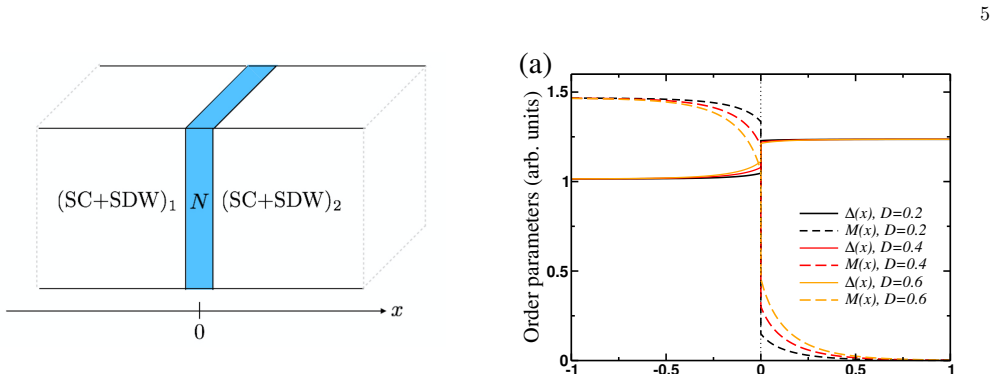
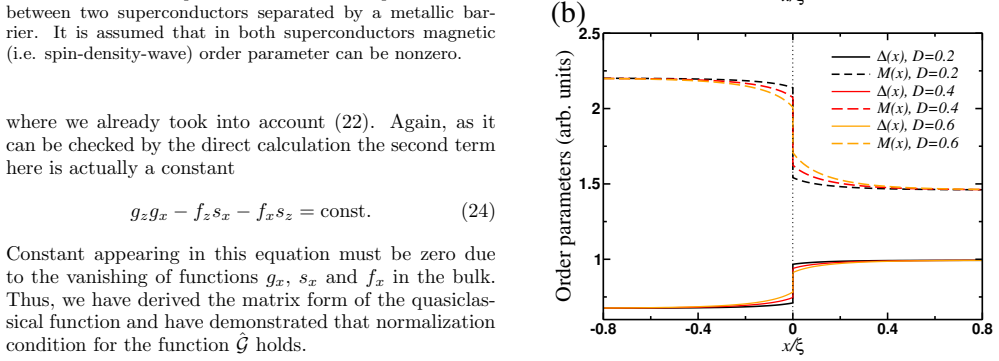
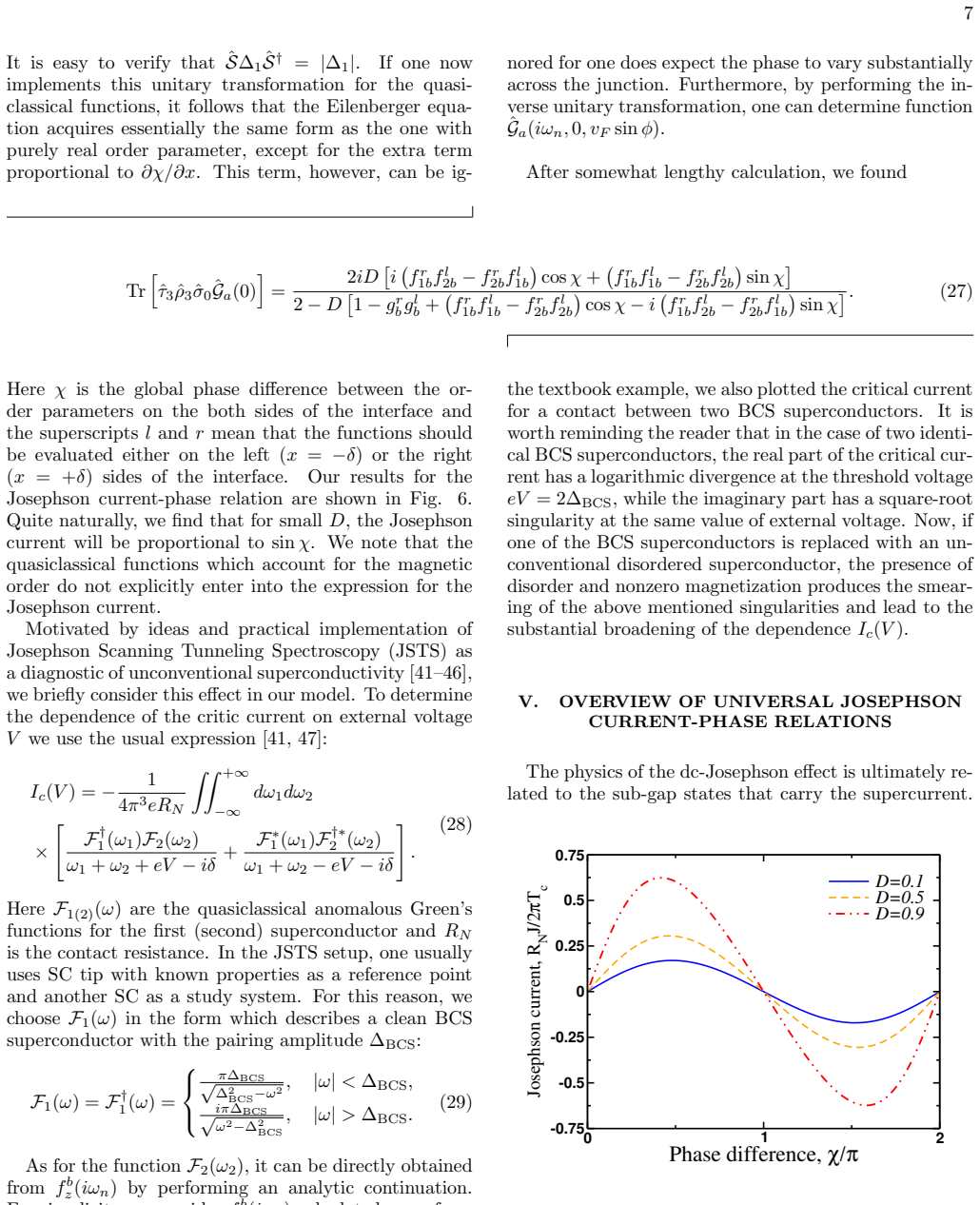
The central claim is that the auxiliary-solution construction converts a nonlinear boundary-value problem into circuit-theory form: the interface values of the quasiclassical propagators are rational functions of the bulk left and right propagators with the transparency $D$ as the only parameter, exactly as in Nazarov's boundary rules. In the coexistence model the Josephson current is therefore a transmission-eigenvalue average of bulk quasiclassical propagators, Eq. (43), which in the symmetric step-function limit reduces to $J(\chi) = c_p \frac{\Delta^2}{eR_N} \frac{\sin\chi}{\sqrt{M^2+\Delta^2\cos^2(\chi/2)}}$, Eq. (45). The paper further shows numerically that the superconducting order parameter varies only in a narrow neighbourhood of the interface while the spin-density-wave order varies on a longer scale, justifying the step-function approximation used to derive these universal current-phase relations. Disorder and magnetization enter through the anomalous Green's functions and smear the sharp features of the voltage-dependent critical current compared with a clean BCS contact.
Load-bearing premise
The whole calculation rests on assuming that the superconducting phase is essentially uniform inside each electrode so that the phase-gradient term generated by the unitary transformation can be dropped; if the phase actually varies across the junction, the central trace formula and every Josephson result built on it miss additional contributions.
Editorial extensions
If this is right
- For short junctions between arbitrary superconductors, the Josephson current is fixed by bulk quasiclassical Green's functions and the transmission distribution, with no additional interface fitting parameters.
- In the regime where spin-density-wave order dominates, $M \gg \Delta$, the critical current scales as $\Delta^2/(eR_N M)$; this suppression is a concrete, measurable signature inside the magnetic phase.
- The self-consistent profiles justify treating the order parameters as step functions, so current-phase relations computed from bulk values describe the full junction.
- Disorder-induced interband scattering broadens the singular features in $I_c(V)$, so junction spectroscopy of such materials cannot be interpreted with clean BCS formulas.
- The known universal Josephson results—Ambegaokar-Baratoff, Kulik-Omelyanchouk, Kupriyanov-Lukichev, and chaotic-cavity limits—all reappear as special cases of the same transmission averaging.
Reading between the lines
- A natural extension, not carried out in the paper, is to apply the same auxiliary-solution machinery to junctions with other coexisting orders (nematic, charge-density wave) and to three-band models where nematic order can appear.
- The phrase in the paper justifying the dropped phase-gradient term ('one does expect the phase to vary substantially') is likely a typo for 'does not expect'; explicitly retaining $\partial\chi/\partial x$ in a numerical solution would test whether the central trace formula survives when the phase varies inside the electrodes.
- The predicted $J_c \sim \Delta^2/(eR_N M)$ suppression offers a diagnostic: in a disordered iron-pnictide junction, the critical current should dip inside the SDW-dominated part of the phase diagram, tracking the magnetic order parameter.
Signed reviews
Editorial analysis
A structured set of objections, weighed in public.
Referee Report
Summary. The paper develops a quasiclassical Eilenberger theory for Josephson junctions between disordered multiband superconductors with coexisting s± superconducting and spin-density-wave order. The authors use the Yip auxiliary-solution method to satisfy the nonlinear Zaitsev boundary conditions, solve the Eilenberger equations self-consistently for the spatial profiles of the superconducting and magnetic order parameters, and compute the local density of states and the Josephson current as functions of phase and voltage. They then connect their trace formula to Nazarov circuit theory, give averaged expressions in terms of transmission-eigenvalue distributions, and present a compact current-phase relation for the SDW-coexisting case. The central claim is that the Josephson physics of such junctions is determined by bulk quasiclassical propagators plus the transmission distribution, with a universal suppression Jc ~ Δ²/(e RN M) when magnetic order dominates.
Significance. If the central trace formula and its circuit-theory interpretation are correct, this is a useful and fairly general result: it extends Nazarov's circuit theory beyond single-band systems to multiband superconductors with competing orders, and it provides a common framework that reproduces known limits such as Ambegaokar-Baratoff and Kulik-Omelyanchuk. The paper's strengths include a fully self-consistent numerical solution of the Eilenberger equations with nonlinear boundary conditions, explicit phase-diagram and density-of-states computations, and a clear demonstration of how transmission averaging reproduces several previously known current-phase relations. The main weakness is that the central trace formula is asserted rather than derived, and the approximation under which the spatial phase gradient is neglected is not quantified; these issues carry over into all Josephson-current results and the final averaged formulas.
major comments (3)
- [Section IV.B, Eq. (27)] The central current trace formula is introduced as the result of "somewhat lengthy calculation" but is not actually derived in the main text or in the appendices. Appendices A–D construct the auxiliary solutions and bulk propagators and state the matching coefficients, but they stop short of showing how these ingredients produce the trace formula Eq. (27). Because Eq. (27) is the starting point for all Josephson-current results in Figs. 6–7 and for Eqs. (42)–(45), the derivation must be supplied in a revised version, either in the main text or in a dedicated appendix with the key intermediate steps.
- [Section IV.B, Eqs. (25)–(27)] The unitary transformation Eq. (26) introduces a term proportional to ∂χ/∂x in the Eilenberger equation, and the paper drops this term with the sentence "This term, however, can be ignored for one does expect the phase to vary substantially across the junction." The sentence appears to contain a typo (presumably "does not expect"), but more importantly no estimate is given for the size of the neglected term. In a current-carrying Josephson junction the phase gradient in the electrodes is tied to the supercurrent and is not obviously negligible near a high-transparency interface; since Eq. (27) is obtained after this omission, this unquantified approximation is load-bearing. The authors should justify the short-junction limit explicitly, estimate (ℏvF/2)∂χ/∂x relative to Δ and M, or present a benchmark calculation that retains the phase-gradient term.
- [Section V, Eq. (45)] The compact current-phase relation Eq. (45) contains an unspecified prefactor cp described only as "of the order of one." Since Eq. (45) is presented as a closed-form result and is used for the scaling claim Jc ~ Δ²/(e RN M), leaving cp undetermined turns a supposedly quantitative formula into a parametric statement. The authors should evaluate cp explicitly from the transmission-average integral, or at least provide the integral representation from which cp follows, so that the result is reproducible and falsifiable.
minor comments (4)
- [Section IV.B, after Eq. (26)] The sentence "This term, however, can be ignored for one does expect the phase to vary substantially across the junction" appears to contain a typo; it should presumably read "does not expect." As written it asserts the opposite of the intended approximation.
- [Section IV.B, after Eq. (27)] The sentence "the quasiclassical functions which account for the magnetic order do not explicitly enter into the expression for the Josephson current" is misleading, because M enters explicitly in Eqs. (42)–(44) and also through the bulk propagators in Eq. (27). The intended statement should be rephrased, for example that M enters only through the bulk Green's functions and not through an additional interface-specific magnetic term.
- [Section V, Eq. (42)–(45)] The notation SSDWINISSDW is used without a definition or a diagram; a brief explanation of this junction type would help the reader, especially since it is the basis for Eq. (45).
- [Fig. 7] The two non-BCS curves in Fig. 7 are not accompanied by the disorder parameters Γ0 and Γπ used in the calculation; specifying these parameters would make the numerical results reproducible.
Circularity Check
No material circularity: the Josephson and circuit-theory results are derived from the stated quasiclassical equations and boundary conditions, with independent checks against Ambegaokar-Baratoff and Kulik-Omelyanchuk limits.
full rationale
The paper's central derivation is a forward calculation from the model Hamiltonian, the Eilenberger equations (12), the normalization condition (13), and the Zaitsev boundary conditions (14). The auxiliary-solution construction in Appendix A follows the external Yip method and is used to obtain the interface relations (A5), which are then identified with Nazarov circuit-theory boundary conditions. Equation (27) is presented as the result of a lengthy calculation from these ingredients, not as an assumed input, and the later compact formulas (42)-(45) follow by substituting bulk propagators and averaging over transmission distributions. The reproduction of known limits such as Ambegaokar-Baratoff (33) and Kulik-Omelyanchuk (37) provides an independent benchmark for the method. The self-citations to prior work by the same authors (Refs. 34, 36) concern the bulk two-band coexistence model and phase diagram, but the Josephson and circuit-theory results are not imported from those papers; the bulk equations are rederived in the manuscript. The most load-bearing approximation, the dropping of the ∂χ/∂x term after the unitary transformation (26), is unquantified and is justified with an apparent typo ('can be ignored for one does expect the phase to vary substantially across the junction' instead of 'does not expect'). This is a correctness and completeness concern rather than a circularity: it is not an equivalence-by-definition, a fitted parameter disguised as a prediction, or a self-citation chain, so it does not raise the circularity score.
Assumptions & free parameters
free parameters (1)
- cp in Eq. (45) =
unspecified, claimed O(1)
assumptions (6)
- domain assumption Zaitsev boundary conditions with a single transparency D and no trajectory interference are valid for the interfaces considered.
- domain assumption Self-consistent Born approximation for disorder is adequate in the coexisting SC+SDW state.
- domain assumption The six-component ansatz Eq. (16) closes the Eilenberger equations for the s± plus SDW model.
- domain assumption The Yip auxiliary-solution procedure requires that order parameters recover their bulk values away from the interface.
- domain assumption The spatial phase gradient term after the unitary transformation (26) can be neglected.
- domain assumption Padé analytic continuation reliably converts Matsubara results to real-frequency LDOS.
Cite this review
Pith. "Pith review of Quasiclassical circuit-theory of contiguous disordered multiband superconductors." pith.science (2026). https://pith.science/paper/NYWDTEBI
@misc{pith2026190807953,
  author       = {Pith},
  title        = {Pith review of: Quasiclassical circuit-theory of contiguous disordered multiband superconductors},
  year         = {2026},
  howpublished = {\url{https://pith.science/paper/NYWDTEBI}},
  note         = {Machine review of arXiv:1908.07953}
}
abstract
We consider a general problem of a Josephson contact between two multiband superconductors with coexisting superconducting and magnetic phases. As a particular example, we use the quasiclassical theory of superconductivity to study the properties of a Josephson contact between two disordered $s^{\pm}$-wave superconductors allowing for the coexistence between superconductivity and spin-density-wave orders. The intra- and inter-band scattering effects of disorder are treated within the self-consistent Born approximation. We calculate the spatial profile of the corresponding order parameters on both sides of the interface assuming that the interface has finite reflection coefficient and use our results to evaluate the local density of states at the interface as well as critical supercurrent through the junction as a function of phase or applied voltage. Our methods are particularly well suited for describing spatially inhomogeneous states of iron-based superconductors where controlled structural disorder can be created by an electron irradiation. We reveal the connection between our theory and the circuit-theory of Andreev reflection and extend it to superconducting junctions of arbitrary nature. Lastly, we outline directions for further developments in the context of proximity circuits of correlated electron systems.
Figures

Figures from the paper (4 more)



Reference graph
Works this paper leans on
-
[1]
This completes the proof of the method based on find- ing auxiliary solutions
Similarly, anticommutator in the numerator of the first equation in (D5), can be made diagonal by setting cl 1 = cl(Mr∆l−Ml∆r)λl n ωrn(∆2 l +M2 l )−ωln(∆r∆l +MrMl) (D7) and changing sign of cl in the second equation in (D5). This completes the proof of the method based on find- ing auxiliary solutions. The most interesting property of this method is that in...
-
[2]
A. A. Abrikosov, Fundamentals of the Theory of Metals (North-Holland, Elsevier Science Publishers, 1988)
work page 1988
-
[3]
A. N. Svidzinsky, Spatially inhomogeneous problems in the theory of superconductivity (Science, Moscow, 1982)
work page 1982
-
[4]
Blatter, M
G. Blatter, M. V. Feigel’man, V. B. Geshkenbein, A. I. Larkin, and V. M. Vinokur, Rev. Mod. Phys. 66, 1125 (1994)
1994
-
[5]
B. D. Josephson, Rev. Mod. Phys. 36, 216 (1964)
work page 1964
-
[6]
A. A. Golubov, M. Y. Kupriyanov, and E. Il’ichev, Rev. Mod. Phys. 76, 411 (2004)
2004
-
[7]
Eilenberger, Zeitschrift f¨ ur Physik214, 195 (1968)
G. Eilenberger, Zeitschrift f¨ ur Physik214, 195 (1968)
work page 1968
-
[8]
K. D. Usadel, Phys. Rev. Lett. 25, 507 (1970)
1970
Show all 62 references
-
[9]
C. W. J. Beenakker, Rev. Mod. Phys. 69, 731 (1997)
1997
-
[10]
Y. V. Nazarov, Phys. Rev. Lett. 73, 1420 (1994)
1994
-
[11]
Y. V. Nazarov, Superlattices and Microstructures 25, 1221 (1999)
1999
-
[12]
Argaman, Europhysics Letters (EPL) 38, 231 (1997)
N. Argaman, Europhysics Letters (EPL) 38, 231 (1997)
1997
-
[13]
Dorokhov, Solid State Communications 51, 381 (1984)
O. Dorokhov, Solid State Communications 51, 381 (1984)
1984
-
[14]
K. M. Schep and G. E. W. Bauer, Phys. Rev. Lett. 78, 3015 (1997)
1997
-
[15]
Shibauchi, A
T. Shibauchi, A. Carrington, and Y. Matsuda, Annual Review of Condensed Matter Physics 5, 113 (2014)
2014
-
[16]
Chubukov, Annual Review of Condensed Matter Physics 3, 57 (2012)
A. Chubukov, Annual Review of Condensed Matter Physics 3, 57 (2012)
2012
-
[17]
A. Moor, A. F. Volkov, and K. B. Efetov, Phys. Rev. B 83, 134524 (2011)
2011
-
[18]
Apostolov and A
S. Apostolov and A. Levchenko, Phys. Rev. B 86, 224501 (2012)
2012
-
[19]
Vakaryuk, V
V. Vakaryuk, V. Stanev, W.-C. Lee, and A. Levchenko, Phys. Rev. Lett. 109, 227003 (2012)
2012
-
[20]
Lin, Phys
S.-Z. Lin, Phys. Rev. B 86, 014510 (2012)
2012
-
[21]
V. G. Stanev and A. E. Koshelev, Phys. Rev. B 86, 174515 (2012)
2012
-
[22]
A. E. Koshelev and V. Stanev, EPL (Europhysics Let- ters) 96, 27014 (2011)
2011
-
[23]
A. A. Golubov and I. I. Mazin, Applied Physics Letters 102, 032601 (2013)
2013
-
[24]
E. Berg, N. H. Lindner, and T. Pereg-Barnea, Phys. Rev. Lett. 106, 147003 (2011)
2011
-
[25]
Y. S. Yerin and A. N. Omelyanchouk, Low Temperature Physics 36, 969 (2010)
2010
-
[26]
Y. Ota, M. Machida, T. Koyama, and H. Matsumoto, Phys. Rev. Lett. 102, 237003 (2009)
2009
-
[27]
Y. Ota, N. Nakai, H. Nakamura, M. Machida, D. Inotani, Y. Ohashi, T. Koyama, and H. Matsumoto, Phys. Rev. B 81, 214511 (2010)
2010
-
[28]
W.-Q. Chen, F. Ma, Z.-Y. Lu, and F.-C. Zhang, Phys. Rev. Lett. 103, 207001 (2009)
2009
-
[29]
Tsai, D.-X
W.-F. Tsai, D.-X. Yao, B. A. Bernevig, and J. Hu, Phys. Rev. B 80, 012511 (2009)
2009
-
[30]
Linder, I
J. Linder, I. B. Sperstad, and A. Sudbø, Phys. Rev. B 80, 020503 (2009)
2009
-
[31]
T. K. Ng and N. Nagaosa, EPL (Europhysics Letters) 87, 17003 (2009)
2009
-
[32]
Yip, Jour
S.-K. Yip, Jour. of Low Temp. Phys. 109, 547 (1997)
1997
-
[33]
A. V. Zaitsev, Sov. Phys. JETP 59, 1015 (1984)
1984
-
[34]
M. G. Vavilov and A. V. Chubukov, Phys. Rev. B 84, 214521 (2011)
2011
-
[35]
Dzero, M
M. Dzero, M. Khodas, A. D. Klironomos, M. G. Vavilov, and A. Levchenko, Phys. Rev. B 92, 144501 (2015)
2015
-
[36]
A. A. Kirmani, A. Levchenko, and M. Dzero, unpublished (2019)
2019
-
[37]
Dzero and A
M. Dzero and A. Levchenko, Phys. Rev. B 98, 054501 (2018)
2018
-
[38]
A. B. Vorontsov, M. G. Vavilov, and A. V. Chubukov, 14 Phys. Rev. B 81, 174538 (2010)
2010
-
[39]
R. M. Fernandes and J. Schmalian, Phys. Rev. B 82, 014521 (2010)
2010
-
[40]
Kieselmann, Phys
G. Kieselmann, Phys. Rev. B 35, 6762 (1987)
1987
-
[41]
Bruder, Phys
C. Bruder, Phys. Rev. B 41, 4017 (1990)
1990
-
[42]
ˇSmakov, I
J. ˇSmakov, I. Martin, and A. V. Balatsky, Phys. Rev. B 64, 212506 (2001)
2001
-
[43]
Naaman, W
O. Naaman, W. Teizer, and R. C. Dynes, Phys. Rev. Lett. 87, 097004 (2001)
2001
-
[44]
Suderlow, I
H. Suderlow, I. Guillamon, G. Rodrigo, J, and S. Vieira, Supercond. Sci. Technol. 27, 063001 (2014)
2014
-
[45]
M. H. Hamidian, S. D. Edkins, S. H. Joo, A. Kostin, H. Eisaki, S. Uchida, M. J. Lawler, E. A. Kim, A. P. Mackenzie, K. Fujita, et al., Nature 532, 343 EP (2016)
2016
-
[46]
M. T. Randeria, B. E. Feldman, I. K. Drozdov, and A. Yazdani, Phys. Rev. B 93, 161115 (2016)
2016
-
[47]
Graham and D
M. Graham and D. K. Morr, Phys. Rev. Lett. 123, 017001 (2019)
2019
-
[48]
I. O. Kulik and I. K. Yanson, The Josephson Effect in Su- perconducting Tunneling Structures (Israel Program for Scientific Translations, 1972)
1972
-
[49]
C. W. J. Beenakker, Transport Phenomena in Mesoscopic Systems, edited by H. Fukuyama and T. Ando (Springer, Berlin, 1992) [arXiv: cond-mat/0406127] (2004)
2004 arXiv
-
[50]
L. G. Aslamazov and A. I. Larkin, Sov. Phys. JETP 43, 698 (1976)
1976
-
[51]
Ambegaokar and A
V. Ambegaokar and A. Baratoff, Phys. Rev. Lett. 10, 486 (1963)
1963
-
[52]
I. O. Kulik and A. N. Omel’yanchuk, Sov. J. Low Temp. Phys. 4, 142 (1978)
1978
-
[53]
I. O. Kulik and A. N. Omel’yanchuk, JETP Lett. 21, 96 (1975)
1975
-
[54]
A. A. Golubov, M. Y. Kupriyanov, and V. F. Lukichev, Fizika Nizkikh Temperatur 10, 799 (1984)
1984
-
[55]
Brinkman and A
A. Brinkman and A. A. Golubov, Phys. Rev. B 61, 11297 (2000)
2000
-
[56]
P. W. Brouwer and C. W. J. Beenakker, Phys. Rev. B 51, 7739 (1995)
1995
-
[57]
C. M. Whisler, M. G. Vavilov, and A. Levchenko, Phys. Rev. B 97, 224515 (2018)
2018
-
[58]
Eschrig, Phys
M. Eschrig, Phys. Rev. B 61, 9061 (2000)
2000
-
[59]
Tanaka, Y
Y. Tanaka, Y. Tanuma, and A. A. Golubov, Phys. Rev. B 76, 054522 (2007)
2007
-
[60]
Tanaka, Y
Y. Tanaka, Y. Asano, and A. A. Golubov, Phys. Rev. B 77, 220504 (2008)
2008
-
[61]
B. Lu, P. Burset, Y. Tanuma, A. A. Golubov, Y. Asano, and Y. Tanaka, Phys. Rev. B 94, 014504 (2016)
2016
-
[62]
Burset, B
P. Burset, B. Lu, S. Tamura, and Y. Tanaka, Phys. Rev. B 95, 224502 (2017)
2017
Reviewed August 14, 2026 · model on record in the stance chip above.
Discussion (0). Continue with ORCID to comment.