REVIEW 3 major objections 4 minor 96 references
GMRT observations of a first sample of Extremely Inverted Spectrum Extragalactic Radio Sources (EISERS) candidates in the Northern sky
T0 review · 3 major / 4 minor · reviewed 2026-08-14 · deepseek-v4-flash
Pith's one-line read Quasi-simultaneous GMRT observations at 150 and 325 MHz claim two of fifteen candidate sources, J1326+5712 and J1658+4732, have spectral slopes +2.91 and +3.05, above the +2.5 SSA ceiling, confirming them as EISERS.
desk verdict Solid northern EISERS sample with one secure confirmation; the second object drops below threshold under the paper's own flux-scale correction. read the letter →
The pith
A machine-rendered reading of the paper's core claim, the machinery that carries it, and where it could break.
The reading
What carries the argument
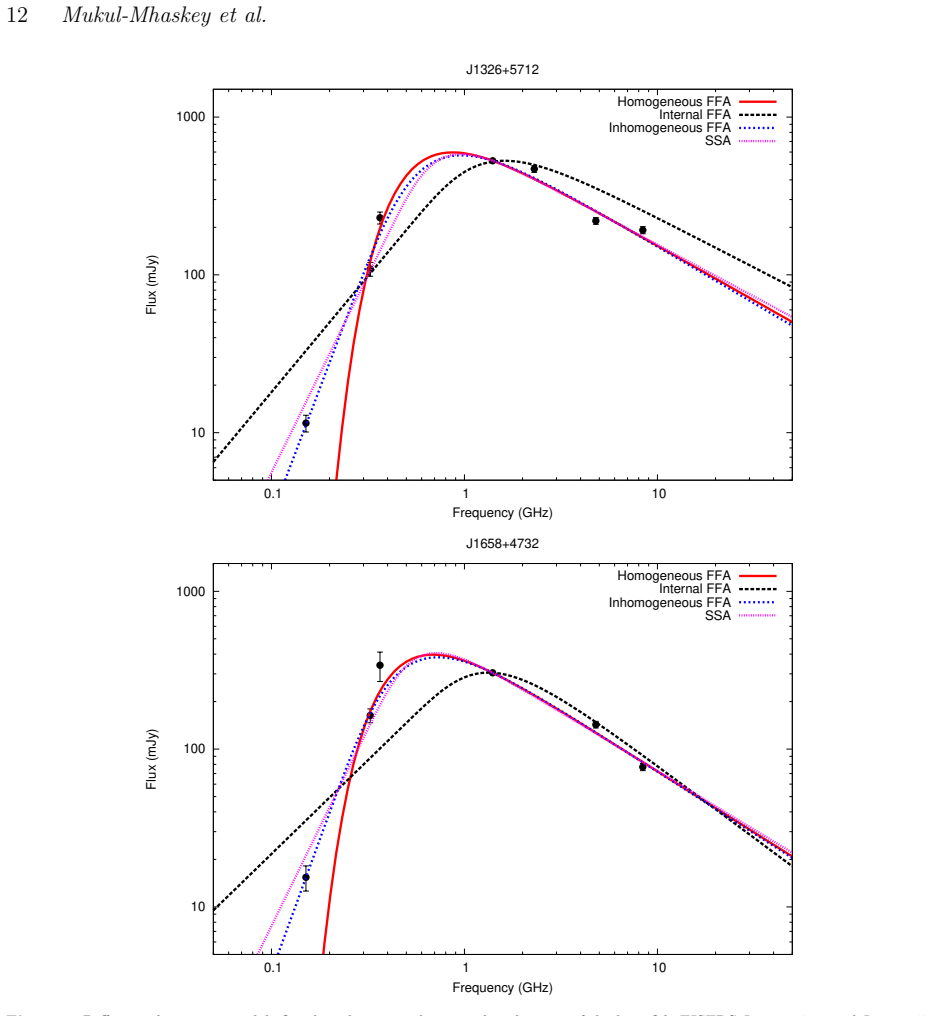
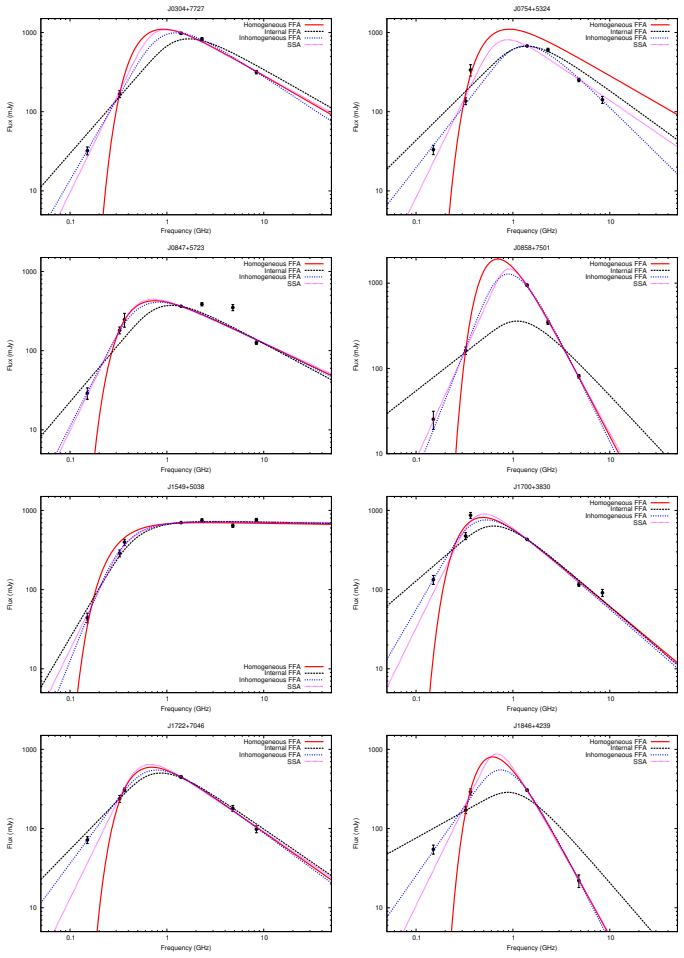
The load-bearing quantity is the two-point spectral index $\alpha$ computed between the uGMRT flux densities at 150 and 325 MHz, compared with the SSA critical value $\alpha_c = +2.5$, the optically thick slope $S_\nu \propto \nu^{5/2}$ that bounds a homogeneous incoherent synchrotron source with a power-law electron distribution. Because the underlying surveys were made a decade apart, the paper guards against calibration bias with field-based flux scaling factors (FSFs), ratios of bright in-field sources that rescale each 150 MHz uGMRT map to the TGSS-ADR1 flux scale. The interpretive machinery is the competition among four spectral models, SSA, homogeneous free-free absorption, internal free-free absorption, and the inhomogeneous free-free absorption of Bicknell et al., fitted to each source to decide which absorption process can produce the sharp turnover.
What would settle it
A single-epoch spectrum of J1658+4732 with narrowband coverage across 120-350 MHz on a flux scale tied directly to that source would settle it: if the 150-325 MHz slope stays above +2.5 with narrowband measurements, the FSF ambiguity becomes irrelevant; if it falls below +2.5, J1658+4732 loses its bona fide status.
Extended reading notes
Core claim
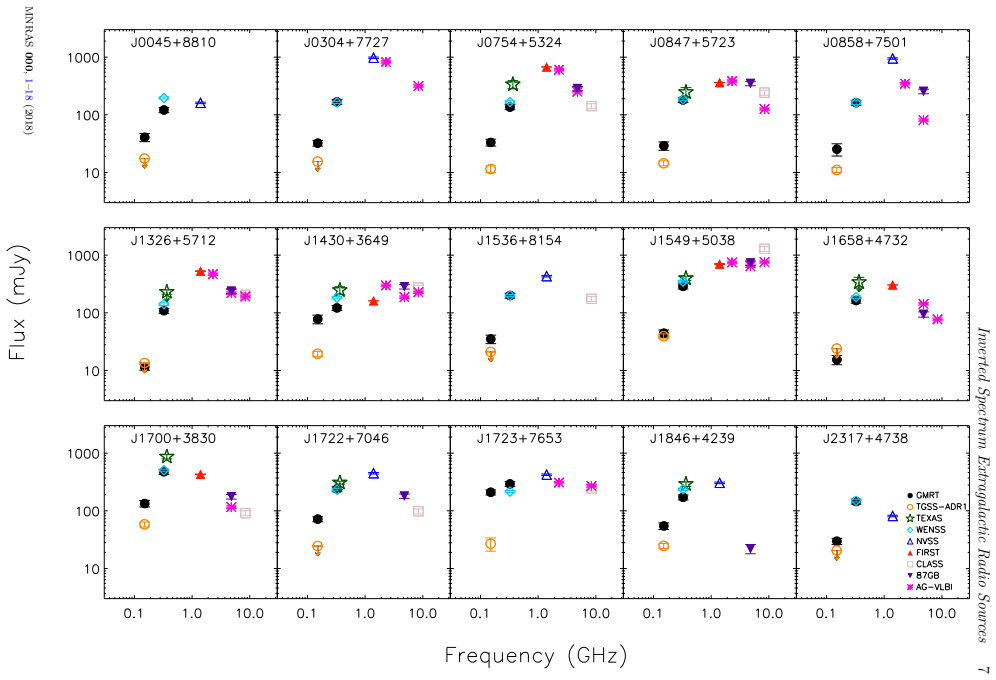
On its own measurements, the paper identifies J1326+5712 and J1658+4732 as confirmed EISERS. Their 150-325 MHz spectral indices, $\alpha = +2.91 \pm 0.20$ and $+3.05 \pm 0.27$, lie significantly above $\alpha_c = +2.5$, the hardness limit of the standard self-absorbed synchrotron spectrum $S_\nu \propto \nu^{5/2}$ for a homogeneous source. Both sources have GPS-like spectra peaking near 1 GHz, and their milliarcsecond structures are consistent with a compact symmetric object and a core-jet, respectively. Fitting four absorption models to the full spectra, the paper finds the inhomogeneous free-free absorption model of Bicknell et al. gives the best fit for both confirmed EISERS, with implied mean densities of the absorbing thermal gas of about 43 and 17 cm$^{-3}$ at the assumed velocity dispersion. Three more sources, J0847+5723, J0858+7501 and J1549+5038, are called possible EISERS because their slopes agree with $+2.5$ within 1$\sigma$.
Load-bearing premise
The claim that J1658+4732 is a bona fide EISERS assumes the field-based flux scaling factor that converts its uGMRT 150 MHz flux density to the TGSS-ADR1 scale is correct; with the paper's own FSF of 1.577 its spectral slope drops from +3.05 to +2.47, below the +2.5 threshold, and the FSF carries no quoted uncertainty.
Editorial extensions
If this is right
- EISERS are extremely rare: only two of fifteen carefully selected candidates survive quasi-simultaneous measurement as bona fide cases, and the total known population remains a handful.
- For both confirmed sources the inhomogeneous free-free absorption model is preferred, which would mean the ultra-sharp turnover comes from clumpy thermal gas surrounding the radio-emitting lobes rather than from the standard SSA mechanism.
- The three possible EISERS are concrete follow-up targets: deeper, simultaneous metre-wavelength spectra could promote or remove each one.
- Quasi-simultaneous observations are essential for this classification, since several candidates dropped out simply because their 150 MHz flux densities from decade-old surveys were unreliable, likely due to refractive interstellar scintillation.
- If free-free absorption is confirmed, these sources probe dense ionized gas around young, parsec-scale radio sources; if not, they flag non-standard electron acceleration.
Reading between the lines
- The status of J1658+4732 as bona fide EISERS is not settled on its own numbers: applying the paper's Table 4 flux scaling factor lowers its 150-325 MHz slope from $+3.05$ to $+2.47$, below the $+2.5$ threshold, and the FSF carries no quoted error.
- A two-point slope says nothing about curvature; a single-epoch, multi-narrowband spectrum between 120 and 350 MHz for both confirmed sources would cleanly separate a power-law inverted slope from the curved signature of free-free absorption.
- The candidate list was built from relatively bright sources in overlapping surveys, so the inferred rarity of EISERS is a lower limit; deeper overlapping surveys could reveal a fainter population with different physical conditions.
- Spatially resolving the absorbing gas, through high-resolution imaging of the 150 MHz absorption against the VLBI core-jet, would test whether the free-free screen is external or internal to the synchrotron source.
Signed reviews
Editorial analysis
A structured set of objections, weighed in public.
Referee Report
Summary. The paper reports quasi-simultaneous uGMRT 150 MHz and 325 MHz observations of 15 extremely inverted spectrum radio source candidates selected from the overlap of TGSS-ADR1 and WENSS. Using the two measured flux densities, the authors compute spectral indices in the optically thick part of the spectrum and identify two 'bona fide' EISERS (J1326+5712 and J1658+4732) with slopes of +2.91±0.20 and +3.05±0.27, above the SSA critical value +2.5; three further sources are close to the threshold and are called tentative. The paper also fits SSA and free-free absorption spectral models to the sources, derives physical parameters (absorbing gas densities, magnetic fields) for selected sources, and summarizes VLBI structural information. A flux scaling factor (FSF) calibration is applied to check the 150 MHz uGMRT flux scale against TGSS-ADR1; Table 4 lists FSF values and the resulting adjusted spectral indices.
Significance. If both headline objects are genuine, the sample would add to the very small list of known EISERS and would strengthen the case that some compact radio sources exhibit a turnover steeper than the canonical SSA limit, motivating non-standard electron energy distributions or widespread free-free absorption. The paper's strengths include the quasi-simultaneous two-frequency uGMRT observations, a well-documented survey-based selection procedure, comparison of SSA and FFA model families, and VLBI context for individual sources. The central classification is a threshold test, however, and its reliability depends on calibration systematics that are not fully quantified; the most serious issue is the effect of the FSF correction on J1658+4732, which, by the paper's own numbers, drops the central spectral index to 2.47, below the threshold.
major comments (3)
- [Section 6 and Table 4] The statement in Section 6 that 'the spectral indices of the two confirmed EISERS would remain above the SSA limit ... even if their present flux densities measured at 150 MHz with uGMRT are aligned with the flux scale of the TGSS-ADR1' is contradicted by the paper's own Table 4 for J1658+4732. Applying FSF = 1.577 to the uGMRT 150 MHz flux density of 15.4±2.8 mJy gives a rescaled 150 MHz flux density of about 24.3 mJy, and the quoted 325 MHz uGMRT flux density of 163.4±16.4 mJy yields alpha(150-325 MHz) = 2.47±0.32, which lies below alpha_c = +2.5. Only J1326+5712 remains above the threshold after the FSF correction (alpha = 3.24±0.20). The sentence in Section 6 is therefore internally inconsistent with Table 4, and the 'two bona fide EISERS' claim appears to be one object short unless J1658+4732 is re-evaluated with a full treatment of calibration uncertainty.
- [Section 3.2 and Table 4] The FSF values in Table 4 are quoted as single numbers without uncertainties, and this omission is load-bearing because the EISERS classification is a threshold test. For J1658+4732 the threshold alpha_c = +2.5 is crossed when FSF is about 1.535, only about 3% below the adopted 1.577, while the FSF values span 0.390-1.577 across the fifteen fields and are derived from only a few bright comparison sources per field. A calibration error of a few percent, much smaller than the 10% systematic error included in Eq. (1), would move J1658+4732 across the boundary. The authors should quote the FSF uncertainties (e.g., the RMS scatter about the mean ratio and the number of comparison sources used in each field) and propagate them into the threshold test before labeling J1658+4732 a bona fide EISERS.
- [Section 3.2 and Table 4] The FSF correction as implemented rescales only the 150 MHz uGMRT flux densities to the TGSS-ADR1 scale; the 325 MHz uGMRT flux densities are not independently tied to an absolute flux scale. This matters because Section 3 notes that WENSS deviates from the RCB/Baars flux scales by more than 10%, and Section 4 documents differences of roughly 20-25% between some uGMRT 325 MHz measurements and the WENSS values (e.g., J1326+5712 is about 75% of the WENSS value, and J1846+4239 differs substantially). A 10% scale error at 325 MHz changes alpha(150-325) by about 0.3 in this frequency ratio, which is comparable to the quoted 1-sigma uncertainties and to the margin separating J1658+4732 from alpha_c. The threshold test should include a corresponding check of the 325 MHz scale, for example against WENSS or a calibrator-based measurement, before the two-object conclusion is presented as secure.
minor comments (4)
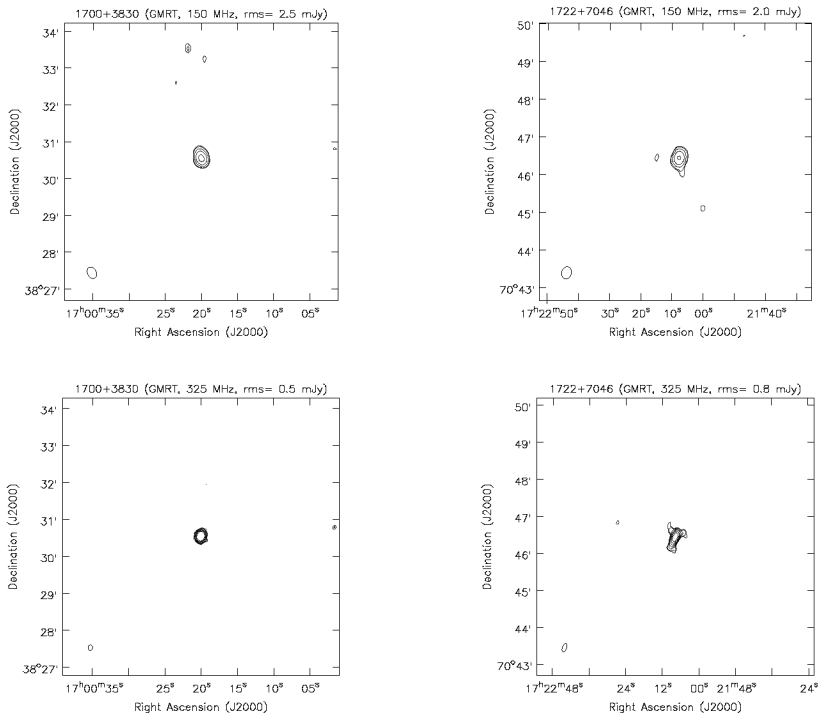
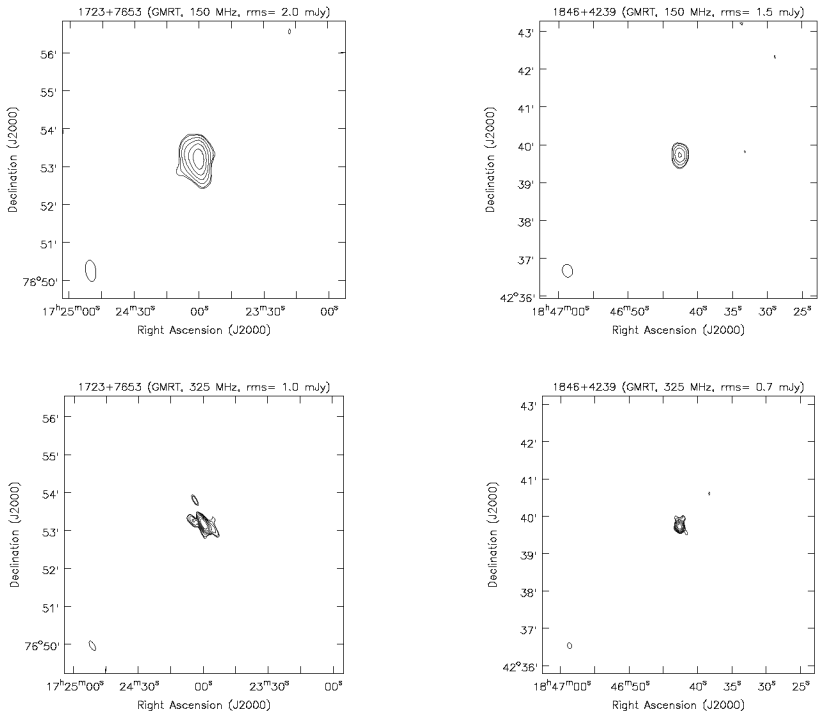
- [Section 3.1] The text refers to 'J1658+473' in the sentence about Figures 1 and 2; this should be 'J1658+4732'.
- [Section 5.4] The phrase 'For the confirmed EISERS where in-homogeneous FFA model ... namely, J0847+5723, J1326+5712 and J1658+4732' is inaccurate because J0847+5723 is classified as 'Tentative' rather than 'Bona fide' in Table 3; please rephrase to 'for the sources where the inhomogeneous FFA model provides the best fit'.
- [Section 6] In the discussion of the Callingham et al. (2017) sources, the same name 'J213024-434819' appears twice; the second instance should presumably be a different source name and should be corrected.
- [Section 6] The sentence 'The radio power at 5 GHz are presentented in Table 3' contains a typo: 'presentented' should be 'presented'.
Circularity Check
No circularity: EISERS confirmation uses new uGMRT flux densities against an externally established SSA limit; the Table 4/Section 6 FSF tension is a calibration robustness issue, not a circular derivation.
full rationale
The paper's central claim is a measured two-point spectral index from new uGMRT observations compared against the externally established SSA limit alpha_c = +2.5 (Slish 1963; Scheuer & Williams 1968; Rybicki & Lightman 1986), not against a quantity fitted from the same data. The candidate list was selected from TGSS/WENSS catalogue flux densities, while the confirmation uses independent quasi-simultaneous uGMRT flux densities, so the confirmation is not forced by the selection. The FSF rescaling in Section 3.2 is calibrated using unrelated bright sources within each field; it is not fitted to the target's 150-325 MHz slope, so the adjusted indices are a cautionary recalibration rather than a fitted prediction. Self-citations to Papers I and II establish the class name and earlier candidate lists, but the SSA limit itself is supported by independent classical references. There is a real internal tension: for J1658+4732, applying FSF = 1.577 gives alpha_TGSS = 2.47 +/- 0.32 (Table 4), below alpha_c = 2.5, while Section 6 asserts both confirmed EISERS 'would remain above the SSA limit' even after rescaling; the FSF values also carry no quoted uncertainties, and the paper explicitly notes the small number of fields 'does not allow us to make a general comment about the origin of the occasionally significant departures of FSF values from unity.' This is a calibration robustness/correctness problem, not circularity, because the classification rests on directly measured flux densities and an external threshold. No derivation step reduces to its own input or to an unverified self-citation, so the circularity score is 0.
Assumptions & free parameters
free parameters (4)
- Normalization amplitude a_i (SSA and FFA models) =
Not reported
- Turnover frequency nu_p =
Reported per source in Table 5 (e.g., 0.73 GHz for J1326+5712)
- Intrinsic spectral index alpha (FFA models) =
Not reported
- Inhomogeneity index p (Bicknell et al. 1997 model) =
Not reported
assumptions (5)
- domain assumption Standard SSA limit: a homogeneous, incoherent synchrotron source with a power-law electron energy distribution cannot produce a low-frequency spectral slope steeper than alpha_c = +2.5.
- domain assumption The two-point spectral index between 150 and 325 MHz measured from quasi-simultaneous uGMRT observations is a reliable estimate of the optically thick spectral slope, unaffected by variability or resolution effects.
- ad hoc to paper The flux-density scale of the uGMRT 150 MHz maps can be corrected to the TGSS-ADR1 scale using field-based FSF values computed from other bright sources.
- domain assumption For sources without redshifts, z=1 is assumed when computing 5 GHz radio powers.
- domain assumption The absorbing medium in the FFA interpretation is assumed to have a baryonic velocity dispersion of 250 km/s.
Cite this review
Pith. "Pith review of GMRT observations of a first sample of Extremely Inverted Spectrum Extragalactic Radio Sources (EISERS) candidates in the Northern sky." pith.science (2026). https://pith.science/paper/NZKPHF7G
@misc{pith2026190808883,
  author       = {Pith},
  title        = {Pith review of: GMRT observations of a first sample of Extremely Inverted Spectrum Extragalactic Radio Sources (EISERS) candidates in the Northern sky},
  year         = {2026},
  howpublished = {\url{https://pith.science/paper/NZKPHF7G}},
  note         = {Machine review of arXiv:1908.08883}
}
abstract
We present an extension of our search for Extremely Inverted Spectrum Extragalactic Radio Sources (EISERS) to the northern celestial hemisphere. With an inverted radio spectrum of slope $\alpha$ > +2.5, these rare sources would either require a non-standard particle acceleration mechanism (in the framework of synchrotron self-absorption hypothesis), or a severe free-free absorption which attenuates practically all of their synchrotron radiation at metre wavelengths. By applying a sequence of selection filters, a list of 15 EISERS candidates is extracted out by comparing two large-sky radio surveys, WENSS (325 MHz) and TGSS-ADR1 (150 MHz), which overlap across 1.03$\pi$ steradian of the sky. Here we report quasi-simultaneous GMRT observations of these 15 EISERS candidates at 150 MHz and 325 MHz, in an attempt to accurately define their spectra below the turnover frequency. Out of the 15 candidates observed, two are confirmed as EISERS, since the slope of the inverted spectrum between these two frequencies is found to be significantly larger than the critical value $\alpha_c$ = +2.5: the theoretical limit for the standard case of synchrotron self-absorption (SSA). For another 3 sources, the spectral slope is close to, or just above the critical value $\alpha_c$. Nine of the sources have GPS type radio spectra. The parsec-scale radio structural information available for the sample is also summarised.
Figures

Figures from the paper (8 more)



Reference graph
Works this paper leans on
-
[1]
Alam S., et al., 2015, @doi [ ] 10.1088/0067-0049/219/1/12 , http://adsabs.harvard.edu/abs/2015ApJS..219...12A 219, 12
-
[2]
An T., Baan W. A., 2012, @doi [ ] 10.1088/0004-637X/760/1/77 , http://adsabs.harvard.edu/abs/2012ApJ...760...77A 760, 77
-
[3]
Asano K., Takahara F., Kusunose M., Toma K., Kakuwa J., 2014, @doi [ ] 10.1088/0004-637X/780/1/64 , https://ui.adsabs.harvard.edu/abs/2014ApJ...780...64A 780, 64
-
[4]
Baars J. W. M., Genzel R., Pauliny-Toth I. I. K., Witzel A., 1977, , http://adsabs.harvard.edu/abs/1977A
1977
-
[5]
Baldi R. D., Capetti A., Giovannini G., 2015, @doi [ ] 10.1051/0004-6361/201425426 , http://adsabs.harvard.edu/abs/2015A
-
[6]
C., 1996, Baby Cygnus A's
Begelman M. C., 1996, Baby Cygnus A's . p. 209
1996
-
[7]
Bell M. E., et al., 2019, @doi [ ] 10.1093/mnras/sty2801 , http://adsabs.harvard.edu/abs/2019MNRAS.482.2484B 482, 2484
-
[8]
Best P. N., Kauffmann G., Heckman T. M., Ivezi \'c Z ., 2005, @doi [ ] 10.1111/j.1365-2966.2005.09283.x , http://adsabs.harvard.edu/abs/2005MNRAS.362....9B 362, 9
arXiv 2005
Show all 96 references
-
[9]
V., Dopita M
Bicknell G. V., Dopita M. A., O'Dea C. P. O., 1997, @doi [ ] 10.1086/304400 , http://adsabs.harvard.edu/abs/1997ApJ...485..112B 485, 112
1997 doi
-
[10]
V., Mukherjee D., Wagner A
Bicknell G. V., Mukherjee D., Wagner A. Y., Sutherland R. S., Nesvadba N. P. H., 2018, @doi [ ] 10.1093/mnras/sty070 , http://adsabs.harvard.edu/abs/2018MNRAS.475.3493B 475, 3493
2018 doi
-
[11]
R., et al., 2015, @doi [ ] 10.1088/0004-637X/809/2/168 , http://adsabs.harvard.edu/abs/2015ApJ...809..168C 809, 168
Callingham J. R., et al., 2015, @doi [ ] 10.1088/0004-637X/809/2/168 , http://adsabs.harvard.edu/abs/2015ApJ...809..168C 809, 168
2015 doi
-
[12]
R., et al., 2017, @doi [ ] 10.3847/1538-4357/836/2/174 , http://adsabs.harvard.edu/abs/2017ApJ...836..174C 836, 174
Callingham J. R., et al., 2017, @doi [ ] 10.3847/1538-4357/836/2/174 , http://adsabs.harvard.edu/abs/2017ApJ...836..174C 836, 174
2017 doi
-
[13]
Chandra P., Ray A., Bhatnagar S., 2004, @doi [ ] 10.1086/422675 , http://adsabs.harvard.edu/abs/2004ApJ...612..974C 612, 974
2004 doi
-
[14]
Cheung E., et al., 2013, @doi [ ] 10.1088/0004-637X/779/2/162 , http://adsabs.harvard.edu/abs/2013ApJ...779..162C 779, 162
2013 doi
-
[15]
J., Cotton W
Condon J. J., Cotton W. D., Greisen E. W., Yin Q. F., Perley R. A., Taylor G. B., Broderick J. J., 1998, @doi [ ] 10.1086/300337 , http://adsabs.harvard.edu/abs/1998AJ....115.1693C 115, 1693
1998 doi
-
[16]
E., Myers S
Conway J. E., Myers S. T., Pearson T. J., Readhead A. C. S., Unwin S. C., Xu W., 1994, @doi [ ] 10.1086/174006 , http://adsabs.harvard.edu/abs/1994ApJ...425..568C 425, 568
1994 doi
-
[17]
P., Ortega-Minakata R
Coziol R., Andernach H., Torres-Papaqui J. P., Ortega-Minakata R. A., Moreno del Rio F., 2017, @doi [ ] 10.1093/mnras/stw3164 , http://adsabs.harvard.edu/abs/2017MNRAS.466..921C 466, 921
2017 doi
-
[18]
Dabhade P., Gaikwad M., Bagchi J., Pandey-Pommier M., Sankhyayan S., Raychaudhury S., 2017, @doi [ ] 10.1093/mnras/stx860 , http://adsabs.harvard.edu/abs/2017MNRAS.469.2886D 469, 2886
2017 doi
-
[19]
Dallacasa D., Stanghellini C., Centonza M., Fanti R., 2000, , http://adsabs.harvard.edu/abs/2000A
2000
-
[20]
G., R \"o ttgering H., van Breugel W., 2002, @doi [ ] 10.1051/0004-6361:20021115 , http://adsabs.harvard.edu/abs/2002A
De Breuck C., Tang Y., de Bruyn A. G., R \"o ttgering H., van Breugel W., 2002, @doi [ ] 10.1051/0004-6361:20021115 , http://adsabs.harvard.edu/abs/2002A
2002 doi
-
[21]
N., Bash F
Douglas J. N., Bash F. N., Bozyan F. A., Torrence G. W., Wolfe C., 1996, @doi [ ] 10.1086/117932 , http://adsabs.harvard.edu/abs/1996AJ....111.1945D 111, 1945
1996 doi
-
[22]
L., Charlot P., 2000, @doi [ ] 10.1086/313382 , http://adsabs.harvard.edu/abs/2000ApJS..128...17F 128, 17
Fey A. L., Charlot P., 2000, @doi [ ] 10.1086/313382 , http://adsabs.harvard.edu/abs/2000ApJS..128...17F 128, 17
2000 doi
-
[23]
M., et al., 2009, @doi [ ] 10.1088/0004-637X/706/2/1364 , https://ui.adsabs.harvard.edu/abs/2009ApJ...706.1364F 706, 1364
F \"o rster Schreiber N. M., et al., 2009, @doi [ ] 10.1088/0004-637X/706/2/1364 , https://ui.adsabs.harvard.edu/abs/2009ApJ...706.1364F 706, 1364
2009 doi
-
[24]
Gopal-Krishna Spoelstra T. A. T., 1993, , http://adsabs.harvard.edu/abs/1993A
1993
-
[25]
J., 2000, , http://adsabs.harvard.edu/abs/2000A
Gopal-Krishna Wiita P. J., 2000, , http://adsabs.harvard.edu/abs/2000A
2000
-
[26]
R., Steppe H., 1983, , http://adsabs.harvard.edu/abs/1983A
Gopal-Krishna Patnaik A. R., Steppe H., 1983, , http://adsabs.harvard.edu/abs/1983A
1983
-
[27]
L., Gergely L
Gopal-Krishna Biermann P. L., Gergely L. \'A ., Wiita P. J., 2012, @doi [Research in Astronomy and Astrophysics] 10.1088/1674-4527/12/2/002 , http://adsabs.harvard.edu/abs/2012RAA....12..127G 12, 127
2012 doi
-
[28]
K., Mhaskey M., Ranadive P., Wiita P
Gopal-Krishna Sirothia S. K., Mhaskey M., Ranadive P., Wiita P. J., Goyal A., Kantharia N. G., Ishwara-Chandra C. H., 2014, @doi [ ] 10.1093/mnras/stu1364 , http://adsabs.harvard.edu/abs/2014MNRAS.443.2824K 443, 2824
2014 doi
-
[29]
C., Condon J
Gregory P. C., Condon J. J., 1991, @doi [ ] 10.1086/191559 , http://adsabs.harvard.edu/abs/1991ApJS...75.1011G 75, 1011
1991 doi
-
[30]
E., Taylor G
Gugliucci N. E., Taylor G. B., Peck A. B., Giroletti M., 2005, @doi [ ] 10.1086/427934 , http://adsabs.harvard.edu/abs/2005ApJ...622..136G 622, 136
2005 doi
-
[31]
Gupta Y., et al., 2017, Current Science, 113, 707
2017
-
[32]
Hales S. E. G., Mayer C. J., Warner P. J., Baldwin J. E., 1991, @doi [ ] 10.1093/mnras/251.1.46 , https://ui.adsabs.harvard.edu/abs/1991MNRAS.251...46H 251, 46
1991 doi
-
[33]
J., et al., 2016, @doi [ ] 10.1093/mnras/stw1763 , http://adsabs.harvard.edu/abs/2016MNRAS.462.1910H 462, 1910
Hardcastle M. J., et al., 2016, @doi [ ] 10.1093/mnras/stw1763 , http://adsabs.harvard.edu/abs/2016MNRAS.462.1910H 462, 1910
2016 doi
-
[34]
J., White R
Helfand D. J., White R. L., Becker R. H., 2015, @doi [ ] 10.1088/0004-637X/801/1/26 , http://adsabs.harvard.edu/abs/2015ApJ...801...26H 801, 26
2015 doi
-
[35]
F., et al., 2007, @doi [ ] 10.1086/511005 , http://adsabs.harvard.edu/abs/2007ApJ...658..203H 658, 203
Helmboldt J. F., et al., 2007, @doi [ ] 10.1086/511005 , http://adsabs.harvard.edu/abs/2007ApJ...658..203H 658, 203
2007 doi
-
[36]
Hurley-Walker N., et al., 2017, @doi [ ] 10.1093/mnras/stw2337 , http://adsabs.harvard.edu/abs/2017MNRAS.464.1146H 464, 1146
2017 doi
-
[37]
T., 2014, in Astronomical Society of India Conference Series
Intema H. T., 2014, in Astronomical Society of India Conference Series. ( @eprint arXiv 1402.4889 )
2014 arXiv
-
[38]
T., Jagannathan P., Mooley K
Intema H. T., Jagannathan P., Mooley K. P., Frail D. A., 2017, @doi [ ] 10.1051/0004-6361/201628536 , http://adsabs.harvard.edu/abs/2017A
2017 doi
-
[39]
Jauncey D., et al., 2016, @doi [Galaxies] 10.3390/galaxies4040062 , http://adsabs.harvard.edu/abs/2016Galax...4...62J 4, 62
2016 doi
-
[40]
L., et al., 1996, @doi [ ] 10.1086/310183 , http://adsabs.harvard.edu/abs/1996ApJ...466L..63J 466, L63
Jones D. L., et al., 1996, @doi [ ] 10.1086/310183 , http://adsabs.harvard.edu/abs/1996ApJ...466L..63J 466, L63
1996 doi
-
[41]
Kameno S., Horiuchi S., Shen Z.-Q., Inoue M., Kobayashi H., Hirabayashi H., Murata Y., 2000, @doi [ ] 10.1093/pasj/52.1.209 , http://adsabs.harvard.edu/abs/2000PASJ...52..209K 52, 209
2000 doi
-
[42]
D., et al., 2017, @doi [ ] 10.3847/1538-3881/aa90b7 , http://adsabs.harvard.edu/abs/2017AJ....154..253K 154, 253
Kapi \'n ska A. D., et al., 2017, @doi [ ] 10.3847/1538-3881/aa90b7 , http://adsabs.harvard.edu/abs/2017AJ....154..253K 154, 253
2017 doi
-
[43]
I., 1966, @doi [Australian Journal of Physics] 10.1071/PH660195 , http://adsabs.harvard.edu/abs/1966AuJPh..19..195K 19, 195
Kellermann K. I., 1966, @doi [Australian Journal of Physics] 10.1071/PH660195 , http://adsabs.harvard.edu/abs/1966AuJPh..19..195K 19, 195
1966 doi
-
[44]
I., Pauliny-Toth I
Kellermann K. I., Pauliny-Toth I. I. K., 1969, @doi [ ] 10.1086/180305 , http://adsabs.harvard.edu/abs/1969ApJ...155L..71K 155, L71
1969 doi
-
[45]
P., Alef W., Witzel A., Zensus J
Krichbaum T. P., Alef W., Witzel A., Zensus J. A., Booth R. S., Greve A., Rogers A. E. E., 1998, , http://adsabs.harvard.edu/abs/1998A
1998
-
[46]
V., Dopita M
Kuncic Z., Bicknell G. V., Dopita M. A., 1998, @doi [ ] 10.1086/311202 , http://adsabs.harvard.edu/abs/1998ApJ...495L..35K 495, L35
1998 doi
-
[47]
Ku \'z micz A., Jamrozy M., Kozie -Wierzbowska D., We \.z gowiec M., 2017, @doi [ ] 10.1093/mnras/stx1830 , http://adsabs.harvard.edu/abs/2017MNRAS.471.3806K 471, 3806
2017 doi
-
[48]
M., Cotton W
Lane W. M., Cotton W. D., van Velzen S., Clarke T. E., Kassim N. E., Helmboldt J. F., Lazio T. J. W., Cohen A. S., 2014, @doi [ ] 10.1093/mnras/stu256 , http://adsabs.harvard.edu/abs/2014MNRAS.440..327L 440, 327
2014 doi
-
[49]
Lazio T. J. W., Cordes J. M., de Bruyn A. G., Macquart J.-P., 2004, @doi [ ] 10.1016/j.newar.2004.09.039 , http://adsabs.harvard.edu/abs/2004NewAR..48.1439L 48, 1439
2004 doi
-
[50]
C., 1995, @doi [ ] 10.1086/175988 , http://adsabs.harvard.edu/abs/1995ApJ...448..589L 448, 589
Levinson A., Laor A., Vermeulen R. C., 1995, @doi [ ] 10.1086/175988 , http://adsabs.harvard.edu/abs/1995ApJ...448..589L 448, 589
1995 doi
-
[51]
R., Gawro \'n ski M
Lowe S. R., Gawro \'n ski M. P., Wilkinson P. N., Kus A. J., Browne I. W. A., Pazderski E., Feiler R., Kettle D., 2007, @doi [ ] 10.1051/0004-6361:20078034 , http://adsabs.harvard.edu/abs/2007A
2007 doi
-
[52]
I., Pauliny-Toth I
Matveenko L. I., Pauliny-Toth I. I. K., Sherwood W., 1990, Soviet Astronomy Letters, http://adsabs.harvard.edu/abs/1990SvAL...16..247M 16, 247
1990
-
[53]
K., 2019, @doi [ ] 10.1093/mnras/stz335 , http://adsabs.harvard.edu/abs/2019MNRAS.tmp..341M
Mhaskey M., Gopal-Krishna Pratik D., Paul S., Salunkhe S., Sirothia S. K., 2019, @doi [ ] 10.1093/mnras/stz335 , http://adsabs.harvard.edu/abs/2019MNRAS.tmp..341M
2019 doi
-
[54]
V., Sutherland R., Wagner A., 2016, @doi [ ] 10.1093/mnras/stw1368 , https://ui.adsabs.harvard.edu/abs/2016MNRAS.461..967M 461, 967
Mukherjee D., Bicknell G. V., Sutherland R., Wagner A., 2016, @doi [ ] 10.1093/mnras/stw1368 , https://ui.adsabs.harvard.edu/abs/2016MNRAS.461..967M 461, 967
2016 doi
-
[55]
T., et al., 2003, VizieR Online Data Catalog, http://adsabs.harvard.edu/abs/2003yCat.8072....0M 8072
Myers S. T., et al., 2003, VizieR Online Data Catalog, http://adsabs.harvard.edu/abs/2003yCat.8072....0M 8072
2003
-
[56]
P., 1998, @doi [ ] 10.1086/316162 , http://adsabs.harvard.edu/abs/1998PASP..110..493O 110, 493
O'Dea C. P., 1998, @doi [ ] 10.1086/316162 , http://adsabs.harvard.edu/abs/1998PASP..110..493O 110, 493
1998 doi
-
[57]
Orienti M., Dallacasa D., 2008, @doi [ ] 10.1051/0004-6361:20078098 , http://adsabs.harvard.edu/abs/2008A
2008 doi
-
[58]
Orienti M., Dallacasa D., Stanghellini C., 2007, @doi [ ] 10.1051/0004-6361:20078105 , https://ui.adsabs.harvard.edu/abs/2007A&A...475..813O 475, 813
2007 doi
-
[59]
G., 1970, Radio astrophysics
Pacholczyk A. G., 1970, Radio astrophysics. Nonthermal processes in galactic and extragalactic sources
1970
-
[60]
P \^a ris I., et al., 2017, @doi [ ] 10.1051/0004-6361/201527999 , http://adsabs.harvard.edu/abs/2017A
2017 doi
-
[61]
Pasetto A., Kraus A., Mack K.-H., Bruni G., Carrasco-Gonz \'a lez C., 2016, @doi [ ] 10.1051/0004-6361/201526963 , http://adsabs.harvard.edu/abs/2016A
2016 doi
-
[62]
B., Taylor G
Peck A. B., Taylor G. B., 2000, @doi [ ] 10.1086/308746 , http://adsabs.harvard.edu/abs/2000ApJ...534...90P 534, 90
2000 doi
-
[63]
B., Mutel R
Phillips R. B., Mutel R. L., 1982, , http://adsabs.harvard.edu/abs/1982A
1982
-
[64]
J., 1967, @doi [ ] 10.1093/mnras/136.3.279 , http://adsabs.harvard.edu/abs/1967MNRAS.136..279R 136, 279
Rees M. J., 1967, @doi [ ] 10.1093/mnras/136.3.279 , http://adsabs.harvard.edu/abs/1967MNRAS.136..279R 136, 279
1967 doi
-
[65]
B., Tang Y., de Bruyn A
Rengelink R. B., Tang Y., de Bruyn A. G., Miley G. K., Bremer M. N., Roettgering H. J. A., Bremer M. A. R., 1997, @doi [ ] 10.1051/aas:1997358 , http://adsabs.harvard.edu/abs/1997A
1997 doi
-
[66]
L., et al., 2011, @doi [ ] 10.1088/0067-0049/194/2/29 , http://adsabs.harvard.edu/abs/2011ApJS..194...29R 194, 29
Richards J. L., et al., 2011, @doi [ ] 10.1088/0067-0049/194/2/29 , http://adsabs.harvard.edu/abs/2011ApJS..194...29R 194, 29
2011 doi
-
[67]
L., Hovatta T., Max-Moerbeck W., Pavlidou V., Pearson T
Richards J. L., Hovatta T., Max-Moerbeck W., Pavlidou V., Pearson T. J., Readhead A. C. S., 2014, @doi [ ] 10.1093/mnras/stt2412 , http://adsabs.harvard.edu/abs/2014MNRAS.438.3058R 438, 3058
2014 doi
-
[68]
J., Coles W
Rickett B. J., Coles W. A., Bourgois G., 1984, , http://adsabs.harvard.edu/abs/1984A
1984
-
[69]
H., Saripalli L., Wang K
Roberts D. H., Saripalli L., Wang K. X., Sathyanarayana Rao M., Subrahmanyan R., KleinStern C. C., Morii-Sciolla C. Y., Simpson L., 2018, @doi [ ] 10.3847/1538-4357/aa9c49 , http://adsabs.harvard.edu/abs/2018ApJ...852...47R 852, 47
2018 doi
-
[70]
S., Costain C
Roger R. S., Costain C. H., Bridle A. H., 1973, @doi [ ] 10.1086/111506 , http://adsabs.harvard.edu/abs/1973AJ.....78.1030R 78, 1030
1973 doi
-
[71]
B., Lightman A
Rybicki G. B., Lightman A. P., 1986, Radiative Processes in Astrophysics
1986
-
[72]
Scheuer P. A. G., Williams P. J. S., 1968, @doi [ ] 10.1146/annurev.aa.06.090168.001541 , http://adsabs.harvard.edu/abs/1968ARA
1968
-
[73]
pp 355--360
Schlickeiser R., 1985, Particle acceleration in active galactic nuclei - coexistence of monoenergetic, power law and Maxwell-Boltzmann electron energy spectra. . pp 355--360
1985
-
[74]
Y., 1978, , http://adsabs.harvard.edu/abs/1978SvA....22..544S 22, 544
Shapirovskaya N. Y., 1978, , http://adsabs.harvard.edu/abs/1978SvA....22..544S 22, 544
1978
-
[75]
W., et al., 2017, @doi [ ] 10.1051/0004-6361/201629313 , http://adsabs.harvard.edu/abs/2017A
Shimwell T. W., et al., 2017, @doi [ ] 10.1051/0004-6361/201629313 , http://adsabs.harvard.edu/abs/2017A
2017 doi
-
[76]
W., et al., 2019, @doi [ ] 10.1051/0004-6361/201833559 , https://ui.adsabs.harvard.edu/abs/2019A&A...622A...1S 622, A1
Shimwell T. W., et al., 2019, @doi [ ] 10.1051/0004-6361/201833559 , https://ui.adsabs.harvard.edu/abs/2019A&A...622A...1S 622, A1
2019 doi
-
[77]
I., 1963, @doi [ ] 10.1038/199682a0 , http://adsabs.harvard.edu/abs/1963Natur.199..682S 199, 682
Slish V. I., 1963, @doi [ ] 10.1038/199682a0 , http://adsabs.harvard.edu/abs/1963Natur.199..682S 199, 682
1963 doi
-
[78]
V., Kovalev Y
Sokolovsky K. V., Kovalev Y. Y., Pushkarev A. B., Mimica P., Perucho M., 2011, @doi [ ] 10.1051/0004-6361/201015772 , http://adsabs.harvard.edu/abs/2011A
2011 doi
-
[79]
Spoelstra T. A. T., Patnaik A. R., Gopal-Krishna 1985, , http://adsabs.harvard.edu/abs/1985A
1985
-
[80]
P., Baum S
Stanghellini C., Dallacasa D., O'Dea C. P., Baum S. A., Fanti R., Fanti C., 2001, @doi [ ] 10.1051/0004-6361:20011101 , http://adsabs.harvard.edu/abs/2001A
2001 doi
-
[81]
C., Moderski R., Kataoka J., Wagner S., 2008, @doi [ ] 10.1086/587781 , http://adsabs.harvard.edu/abs/2008ApJ...680..911S 680, 911
Stawarz ., Ostorero L., Begelman M. C., Moderski R., Kataoka J., Wagner S., 2008, @doi [ ] 10.1086/587781 , http://adsabs.harvard.edu/abs/2008ApJ...680..911S 680, 911
2008 doi
-
[82]
K., Rao A
Swarup G., Ananthakrishnan S., Kapahi V. K., Rao A. P., Subrahmanya C. R., Kulkarni V. K., 1991, Current Science, Vol. 60, NO.2/JAN25, P. 95, 1991, http://adsabs.harvard.edu/abs/1991CuSc...60...95S 60, 95
1991
-
[83]
B., et al., 2005, @doi [ ] 10.1086/430255 , http://adsabs.harvard.edu/abs/2005ApJS..159...27T 159, 27
Taylor G. B., et al., 2005, @doi [ ] 10.1086/430255 , http://adsabs.harvard.edu/abs/2005ApJS..159...27T 159, 27
2005 doi
-
[84]
J., Murphy D
Tingay S. J., Murphy D. W., 2001, @doi [ ] 10.1086/318247 , http://adsabs.harvard.edu/abs/2001ApJ...546..210T 546, 210
2001 doi
-
[85]
J., de Kool M., 2003, @doi [ ] 10.1086/376600 , http://adsabs.harvard.edu/abs/2003AJ....126..723T 126, 723
Tingay S. J., de Kool M., 2003, @doi [ ] 10.1086/376600 , http://adsabs.harvard.edu/abs/2003AJ....126..723T 126, 723
2003 doi
-
[86]
C., Ros E., Kellermann K
Vermeulen R. C., Ros E., Kellermann K. I., Cohen M. H., Zensus J. A., van Langevelde H. J., 2003, @doi [ ] 10.1051/0004-6361:20021752 , http://adsabs.harvard.edu/abs/2003A
2003 doi
-
[87]
V \'e ron-Cetty M.-P., V \'e ron P., 2010, @doi [ ] 10.1051/0004-6361/201014188 , http://adsabs.harvard.edu/abs/2010A
2010 doi
-
[88]
C., Romney J
Walker R. C., Romney J. D., Benson J. M., 1994, in Zensus J. A., Kellermann K. I., eds, Compact Extragalactic Radio Sources. p. 121
1994
-
[89]
B., et al., 2015, @doi [ ] 10.1017/pasa.2015.26 , http://adsabs.harvard.edu/abs/2015PASA...32...25W 32, e025
Wayth R. B., et al., 2015, @doi [ ] 10.1017/pasa.2015.26 , http://adsabs.harvard.edu/abs/2015PASA...32...25W 32, e025
2015 doi
-
[90]
N., Polatidis A
Wilkinson P. N., Polatidis A. G., Readhead A. C. S., Xu W., Pearson T. J., 1994, @doi [ ] 10.1086/187518 , http://adsabs.harvard.edu/abs/1994ApJ...432L..87W 432, L87
1994 doi
-
[91]
Xu W., Readhead A. C. S., Pearson T. J., Polatidis A. G., Wilkinson P. N., 1995, @doi [ ] 10.1086/192189 , http://adsabs.harvard.edu/abs/1995ApJS...99..297X 99, 297
1995 doi
-
[92]
Zovaro H. R. M., Sharp R., Nesvadba N. P. H., Bicknell G. V., Mukherjee D., Wagner A. e. Y., Groves B., Krishna S., 2019, @doi [ ] 10.1093/mnras/stz233 , https://ui.adsabs.harvard.edu/abs/2019MNRAS.484.3393Z 484, 3393
2019 doi
-
[93]
de Bruyn G., et al., 2000, VizieR Online Data Catalog, http://adsabs.harvard.edu/abs/2000yCat.8062....0D 8062
2000
-
[94]
C., 1989, @doi [ ] 10.1038/338484a0 , http://adsabs.harvard.edu/abs/1989Natur.338..484D 338, 484
de Kool M., Begelman M. C., 1989, @doi [ ] 10.1038/338484a0 , http://adsabs.harvard.edu/abs/1989Natur.338..484D 338, 484
1989 doi
-
[95]
H., Barthel P
de Vries W. H., Barthel P. D., O'Dea C. P., 1997, , http://adsabs.harvard.edu/abs/1997A
1997
-
[96]
write newline
" write newline "" before.all 'output.state := FUNCTION fin.entry write newline FUNCTION new.block output.state before.all = 'skip after.block 'output.state := if FUNCTION new.sentence output.state after.block = 'skip output.state before.all = 'skip after.sentence 'output.stat...
Reviewed August 14, 2026 · model on record in the stance chip above.
Discussion (0). Continue with ORCID to comment.