Tur\'an numbers of 4-uniform tight even cycles minus one edge
Pith reviewed 2026-06-26 08:10 UTC · model grok-4.3
The pith
For large n the extremal 4-uniform hypergraphs avoiding a tight even cycle of length 4k+2 minus one edge are the complete odd-bipartite 4-graphs.
A machine-rendered reading of the paper's core claim, the machinery that carries it, and where it could break.
Core claim
For every integer k ≥ 1 and sufficiently large n, the extremal construction for the Turán number of the 4-uniform tight cycle of length 4k+2 minus one edge is a complete odd-bipartite 4-graph. In particular the Turán density of C_{4k+2}^4 is 1/2 for all k ≥ 2 together with the corresponding stability result.
What carries the argument
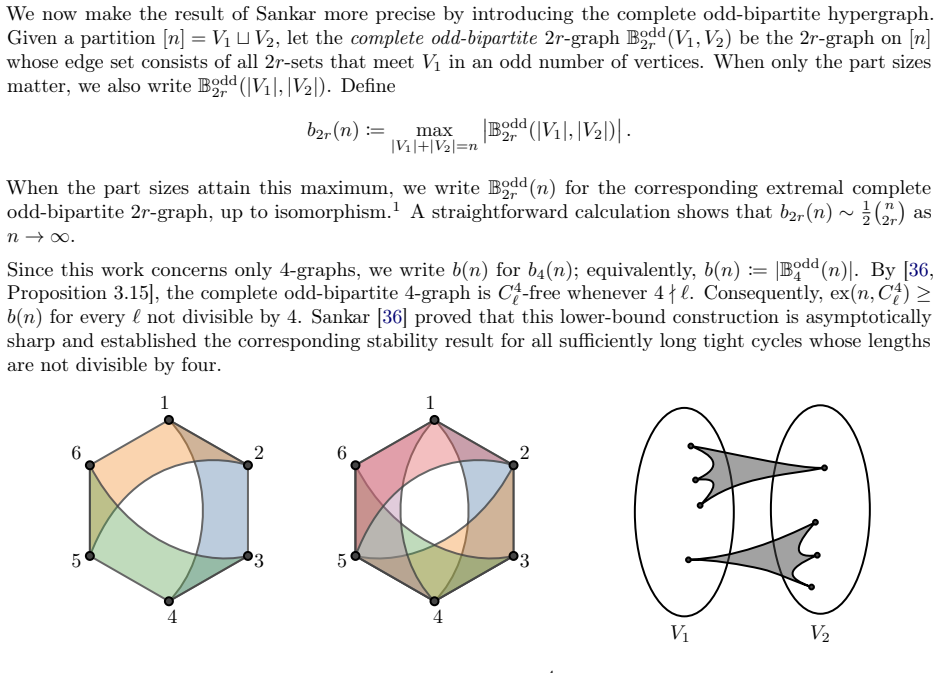
The complete odd-bipartite 4-graph, the unique maximum-edge construction shown to avoid every copy of C_{4k+2}^{4-} while attaining the stated density.
If this is right
- The Turán density of every C_{4k+2}^4 equals 1/2 for k ≥ 2.
- Any 4-uniform hypergraph with edge count within o(n^4) of the extremal number must be edit-close to a complete odd-bipartite 4-graph.
- The same extremal construction works for the expanded-triangle case, recovering and extending the Frankl–Keevash–Sudakov theorem.
- Stability transfers to the full cycle problem, so near-maximal hypergraphs without C_{4k+2}^4 are also close to odd-bipartite examples.
Where Pith is reading between the lines
- The stability result may be strong enough to determine the exact Turán number for every n once the threshold is made explicit.
- The same odd-bipartite construction could serve as the extremal example for other even-length tight cycles in higher uniformities.
- Removing one edge from the cycle appears to be the minimal change that makes the density drop from its conjectured value to exactly 1/2.
Load-bearing premise
That n is large enough for stability and supersaturation arguments to rule out all other constructions.
What would settle it
An explicit 4-uniform hypergraph on n vertices (n larger than the paper's implicit threshold for a given k) that contains more edges than any complete odd-bipartite 4-graph yet still contains no copy of C_{4k+2}^{4-}.
Figures
read the original abstract
For every integer $k \ge 1$ and sufficiently large $n$, we show that the extremal construction for the Tur\'{a}n number of the $4$-uniform tight cycle of length $4k+2$ minus one edge is a complete odd-bipartite $4$-graph. In particular, since $C_{6}^{4-}$ contains the $4$-uniform expanded triangle as a subgraph, our result extends that of Frankl and Keevash--Sudakov on the Tur\'an density and the Tur\'{a}n number of the $4$-uniform expanded triangle. We also show that the Tur\'{a}n density of $C_{4k+2}^{4}$ is $1/2$ for all integers $k \ge 2$, and establish the corresponding stability result. This strengthens the result of Sankar on the Tur\'{a}n density of $C_{4k+2}^{4}$ which holds only for all sufficiently large $k$.
Editorial analysis
A structured set of objections, weighed in public.
Referee Report
Summary. The paper proves that for every integer k ≥ 1 and all sufficiently large n, the unique extremal 4-uniform hypergraph on n vertices avoiding a tight 4-cycle of length 4k+2 minus one edge is the complete odd-bipartite 4-graph. As a consequence it obtains the Turán density π(C_{4k+2}^4) = 1/2 together with stability for every k ≥ 2, extending the Frankl–Keevash–Sudakov result on the expanded triangle and improving Sankar’s theorem (which required k sufficiently large).
Significance. If correct, the result supplies an exact extremal construction and density for an infinite family of 4-uniform even cycles (minus an edge) that was previously known only asymptotically in k. The stability statement is a standard strengthening in the area and the reduction to the odd-bipartite construction is the central new contribution.
major comments (2)
- [Introduction] Introduction, paragraph following the statement of the main theorem: the claim that the result strengthens Sankar by removing the “sufficiently large k” hypothesis rests on the existence of N(k) for every fixed k ≥ 2. The stability and supersaturation arguments invoked to obtain this N(k) necessarily pass through the hypergraph removal lemma (or an iterative supersaturation step) whose quantitative bounds depend on the length 4k+2; no explicit bound or growth rate for N(k) is supplied, leaving open whether the improvement over Sankar is uniform in the stated sense.
- [Main theorem statement] The proof that the complete odd-bipartite 4-graph is extremal for C_{4k+2}^{4-} (the minus-one-edge version) is used to deduce the density result for the full cycle C_{4k+2}^4. If the stability argument for the minus-one-edge problem contains a k-dependent error term that is not controlled uniformly, the deduction that π(C_{4k+2}^4) = 1/2 for every k ≥ 2 would require an additional limiting argument that is not indicated in the abstract.
minor comments (1)
- The abstract cites the Frankl–Keevash–Sudakov and Sankar results but does not give their precise statements or reference numbers; adding these in the introduction would clarify the exact strengthening.
Simulated Author's Rebuttal
We thank the referee for the careful reading and the detailed comments. We address the two major comments point by point below.
read point-by-point responses
-
Referee: [Introduction] Introduction, paragraph following the statement of the main theorem: the claim that the result strengthens Sankar by removing the “sufficiently large k” hypothesis rests on the existence of N(k) for every fixed k ≥ 2. The stability and supersaturation arguments invoked to obtain this N(k) necessarily pass through the hypergraph removal lemma (or an iterative supersaturation step) whose quantitative bounds depend on the length 4k+2; no explicit bound or growth rate for N(k) is supplied, leaving open whether the improvement over Sankar is uniform in the stated sense.
Authors: The main result is stated existentially: for every fixed integer k ≥ 1 there exists N = N(k) such that the unique extremal hypergraph on n > N vertices is the complete odd-bipartite 4-graph. This removes Sankar’s hypothesis that k itself must exceed some absolute constant, which is the strengthening claimed in the manuscript. The dependence of the quantitative bounds (via the removal lemma) on the cycle length 4k+2 is standard and does not invalidate the per-k existential statement. The manuscript makes no claim of a uniform N independent of k. revision: no
-
Referee: [Main theorem statement] The proof that the complete odd-bipartite 4-graph is extremal for C_{4k+2}^{4-} (the minus-one-edge version) is used to deduce the density result for the full cycle C_{4k+2}^4. If the stability argument for the minus-one-edge problem contains a k-dependent error term that is not controlled uniformly, the deduction that π(C_{4k+2}^4) = 1/2 for every k ≥ 2 would require an additional limiting argument that is not indicated in the abstract.
Authors: For each fixed k ≥ 2 the stability theorem for the minus-one-edge problem supplies an error term that may depend on k. The Turán density π(C_{4k+2}^4) is the limit of ex(n, C_{4k+2}^4)/binom(n,4) as n → ∞ with k held fixed; any k-dependent error therefore disappears in this limit. The deduction therefore requires no additional limiting process in which k tends to infinity, and the abstract statement for all k ≥ 2 is justified by fixing k first. revision: no
Circularity Check
No circularity; extends independent external theorems via standard stability
full rationale
The derivation invokes stability and supersaturation methods applied to the new forbidden subgraph C_{4k+2}^{4-}, extending results of Frankl-Keevash-Sudakov (on the expanded triangle) and Sankar (on large cycles) without any reduction of the central claim to a self-defined quantity, fitted parameter, or self-citation chain. No equations or steps in the provided abstract or description equate the extremal construction or density 1/2 to inputs by construction; the 'sufficiently large n' threshold is a standard non-quantified asymptotic hypothesis common to the field and does not create circularity. The result is self-contained against external benchmarks.
Axiom & Free-Parameter Ledger
axioms (1)
- standard math Standard definitions and basic properties of 4-uniform hypergraphs, tight cycles, and the Turán number ex(n, F).
Reference graph
Works this paper leans on
-
[1]
Avart, V
C. Avart, V. Rödl, and M. Schacht. Every monotone3-graph property is testable.SIAM J. Discrete Math., 21(1):73–92, 2007. 4
2007
-
[2]
Baber and J
R. Baber and J. Talbot. Hypergraphs do jump.Combin. Probab. Comput., 20(2):161–171, 2011. 1, 5
2011
-
[3]
Balogh and H
J. Balogh and H. Luo. Turán density of long tight cycle minus one hyperedge.Combinatorica, 44(5):949–976, 2024. 1
2024
- [4]
-
[5]
Chao and H.-H
T.-W. Chao and H.-H. H. Yu. When entropy meets Turán: new proofs and hypergraph Turán results. J. Lond. Math. Soc., 113(3):e70473, 2026. 1
2026
-
[6]
D. de Caen. Extension of a theorem of Moon and Moser on complete subgraphs.Ars Combin., 16:5–10,
-
[7]
D. de Caen. The current status of Turán’s problem on hypergraphs. InExtremal problems for finite sets (Visegrád, 1991), volume 3 ofBolyai Soc. Math. Stud., pages 187–197. János Bolyai Math. Soc., Budapest, 1994. 1
1991
-
[8]
P. Erdős. Some recent results on extremal problems in graph theory. Results. InTheory of Graphs (Internat. Sympos., Rome, 1966), pages 117–123 (English); pp. 124–130 (French). Gordon and Breach, New York, 1967. 1, 3, 13
1966
-
[9]
Erdős and M
P. Erdős and M. Simonovits. A limit theorem in graph theory.Studia Sci. Math. Hungar., 1:51–57,
-
[10]
Erdős and A
P. Erdős and A. H. Stone. On the structure of linear graphs.Bull. Amer. Math. Soc., 52:1087–1091,
-
[11]
P. Frankl. Asymptotic solution of a Turán-type problem.Graphs Combin., 6(3):223–227, 1990. 3
1990
-
[12]
Frankl and V
P. Frankl and V. Rödl. Lower bounds for Turán’s problem.Graphs Combin., 1(3):213–216, 1985. 1
1985
-
[13]
Z. Füredi. Turán type problems. InSurveys in combinatorics, 1991 (Guildford, 1991), volume 166 of London Math. Soc. Lecture Note Ser., pages 253–300. Cambridge Univ. Press, Cambridge, 1991. 1
1991
-
[14]
J. Hou, X. Liu, Y. Zhang, H. Zhao, and T. Zhu. Odd hypergraph Mantel theorems.arXiv preprint arXiv:2510.10590, 2025. 1
arXiv 2025
-
[15]
Kamčev, S
N. Kamčev, S. Letzter, and A. Pokrovskiy. The Turán density of tight cycles in three-uniform hypergraphs.Int. Math. Res. Not. IMRN, 2024(6):4804–4841, 2024. 1
2024
-
[16]
Katona, T
G. Katona, T. Nemetz, and M. Simonovits. On a problem of Turán in the theory of graphs.Mat. Lapok, 15:228–238, 1964. 1
1964
-
[17]
P. Keevash. The Turán problem for hypergraphs of fixed size.Electron. J. Combin., 12(1):Note 11, 6,
-
[18]
P. Keevash. Hypergraph Turán problems. InSurveys in combinatorics 2011, volume 392 ofLondon Math. Soc. Lecture Note Ser., pages 83–139. Cambridge Univ. Press, Cambridge, 2011. 1
2011
-
[19]
Keevash and B
P. Keevash and B. Sudakov. On a hypergraph Turán problem of Frankl.Combinatorica, 25(6):673–706,
-
[20]
B. Lidický, C. Mattes, and F. Pfender. The hypergraph Turán densities of tight cycles minus an edge. arXiv preprint arXiv:2409.14257, 2024. 1
arXiv 2024
-
[21]
X. Liu. On a hypergraph Mantel theorem.arXiv preprint arXiv:2501.19229, 2025. 1
arXiv 2025
-
[22]
Liu and O
X. Liu and O. Pikhurko. A note on the minimum size of Turán systems.Electron. J. Combin., 33(1):Paper No. 1.4, 2026. 1
2026
-
[23]
Lu and Y
L. Lu and Y. Zhao. An exact result for hypergraphs and upper bounds for the Turán density ofK r r+1. SIAM J. Discrete Math., 23(3):1324–1334, 2009. 1
2009
-
[24]
W. Mantel. Problem 28.Wiskundige Opgaven, 10:60–61, 1907. 1 21
1907
-
[25]
Markström
K. Markström. Extremal hypergraphs and bounds for the Turán density of the 4-uniformK5.Discrete Math., 309(16):5231–5234, 2009. 1
2009
-
[26]
D. Mubayi. A hypergraph extension of Turán’s theorem.J. Combin. Theory Ser. B, 96(1):122–134,
-
[27]
Mubayi, O
D. Mubayi, O. Pikhurko, and B. Sudakov. Hypergraph Turán problem: some open questions. InAIM workshop problem lists, page 166, 2011. 1
2011
-
[28]
Mubayi and V
D. Mubayi and V. Rödl. On the Turán number of triple systems.J. Combin. Theory Ser. A, 100(1):136–152, 2002. 1
2002
-
[29]
Mubayi and J
D. Mubayi and J. Verstraëte. A survey of Turán problems for expansions. InRecent trends in combinatorics, volume 159 ofIMA Vol. Math. Appl., pages 117–143. Springer, Cham, 2016. 1
2016
-
[30]
Pikhurko
O. Pikhurko. Exact computation of the hypergraph Turán function for expanded complete 2-graphs.J. Combin. Theory Ser. B, 103(2):220–225, 2013. 1
2013
-
[31]
Pikhurko
O. Pikhurko. Constructions of Turán systems that are tight up to a multiplicative constant.Adv. Math., 464:110148, 2025. 1
2025
-
[32]
Pikhurko, J
O. Pikhurko, J. Sliačan, and K. Tyros. Strong forms of stability from flag algebra calculations.J. Combin. Theory Ser. B, 135:129–178, 2019. 6
2019
-
[33]
A. A. Razborov. Flag algebras.J. Symbolic Logic, 72(4):1239–1282, 2007. 1, 5
2007
-
[34]
A. A. Razborov. On 3-hypergraphs with forbidden 4-vertex configurations.SIAM J. Discrete Math., 24(3):946–963, 2010. 1, 5
2010
-
[35]
Rödl and M
V. Rödl and M. Schacht. Generalizations of the removal lemma.Combinatorica, 29(4):467–501, 2009. 3, 4, 13
2009
-
[36]
M. Sankar. The Turán density of 4-uniform tight cycles.Adv. Comb., pages Paper No. 4, 57, 2026. 1, 2
2026
-
[37]
Sidorenko
A. Sidorenko. What we know and what we do not know about Turán numbers.Graphs Combin., 11(2):179–199, 1995. 1
1995
-
[38]
Sidorenko
A. Sidorenko. Upper bounds for Turán numbers.J. Combin. Theory Ser. A, 77(1):134–147, 1997. 1
1997
-
[39]
Sidorenko
A. Sidorenko. Turán numbers ofr-graphs on r + 1vertices.J. Combin. Theory Ser. B, 169:150–160,
-
[40]
A. F. Sidorenko. Extremal combinatorial problems in spaces with continuous measure.Issled. Operatsii ASU, 34:34–40, 1989. 1
1989
-
[41]
P. Turán. Eine Extremalaufgabe aus der Graphentheorie.Mat. Fiz. Lapok, 48:436–452, 1941. 1 Appendix A direct upper-bound proof forC 4− 6 This appendix gives a self-contained proof ofπ(C 4− 6 ) ≤ 1/2by writing out the first positive semidefinite block of the C 4− 6 certificate. Here we include a human-readable proof produced by AI by giving it the certific...
1941
discussion (0)
Sign in with ORCID, Apple, or X to comment. Anyone can read and Pith papers without signing in.