REVIEW 3 major objections 3 minor 23 references
Projective Naturality in Heegaard Floer Homology
T0 review · 3 major / 3 minor · reviewed 2026-08-14 · deepseek-v4-flash
Pith's one-line read Heegaard Floer invariants are natural over Z up to sign
desk verdict A credible candidate for integral projectivized naturality in Heegaard Floer homology, but the load-bearing beta-side triangle count is explicitly unproved, so it deserves refereeing rather than acceptance as is. read the letter →
The pith
A machine-rendered reading of the paper's core claim, the machinery that carries it, and where it could break.
The reading
What carries the argument
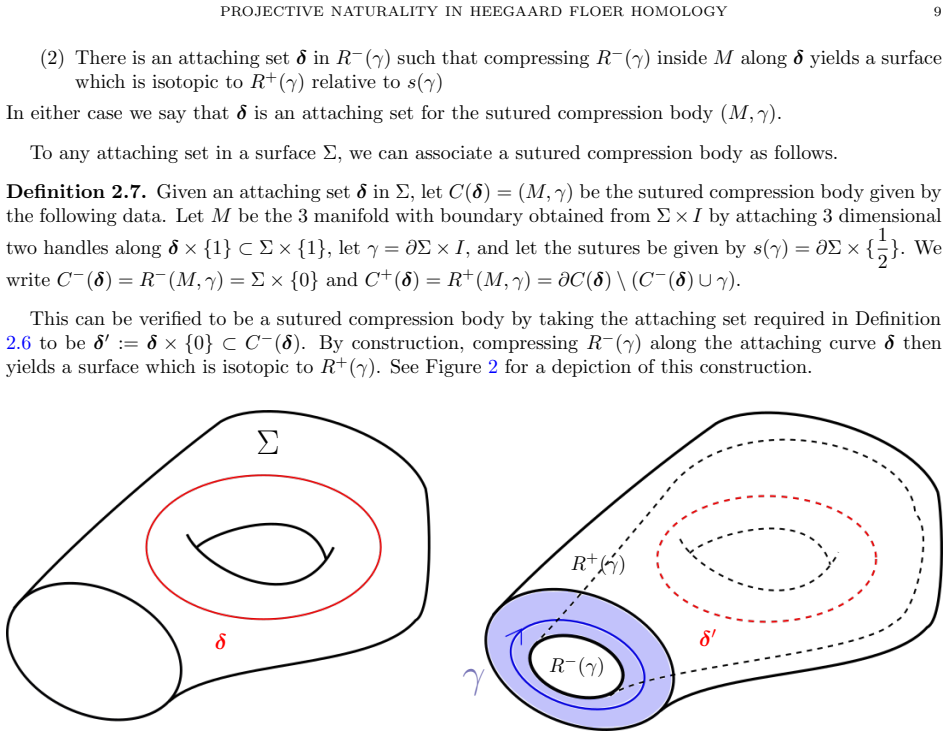
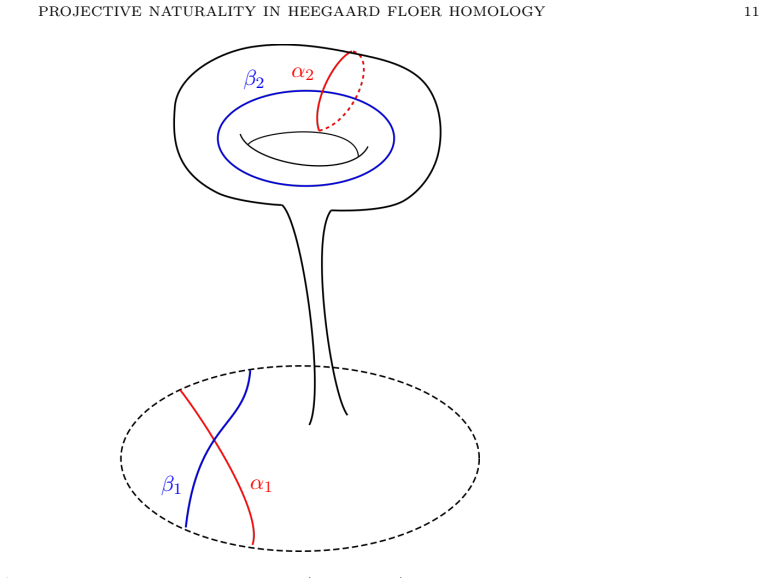
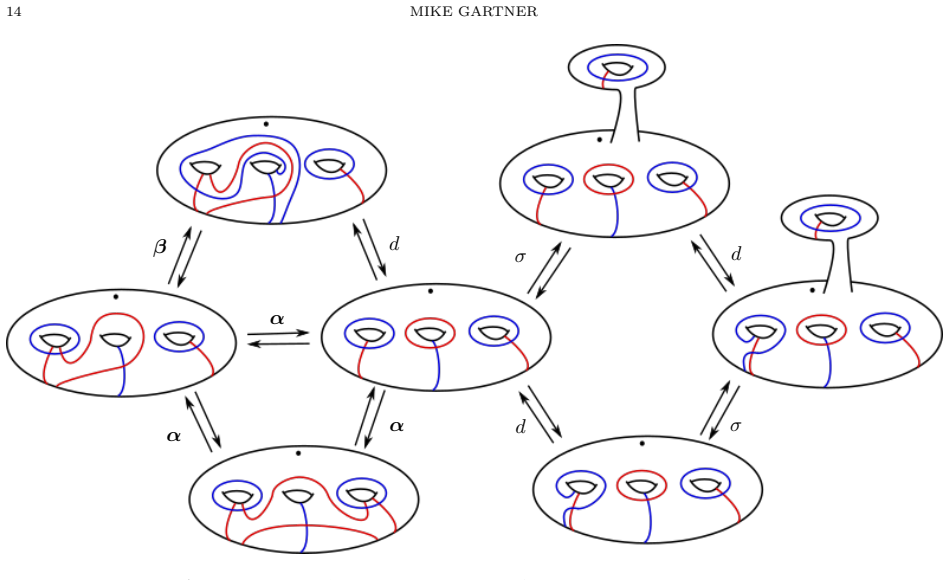
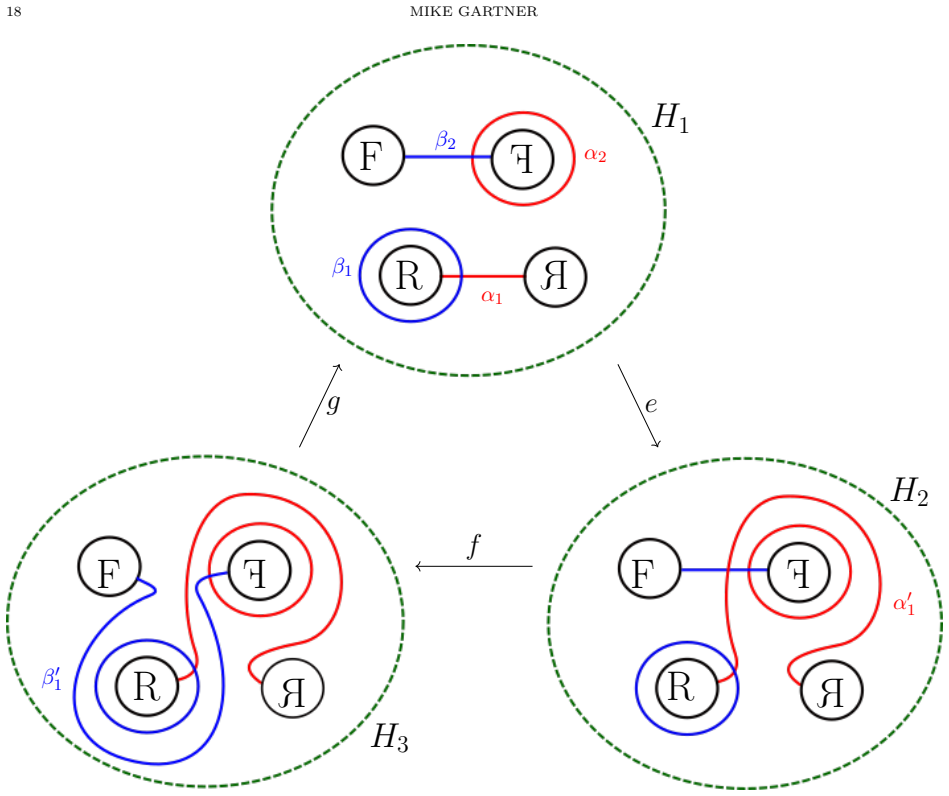
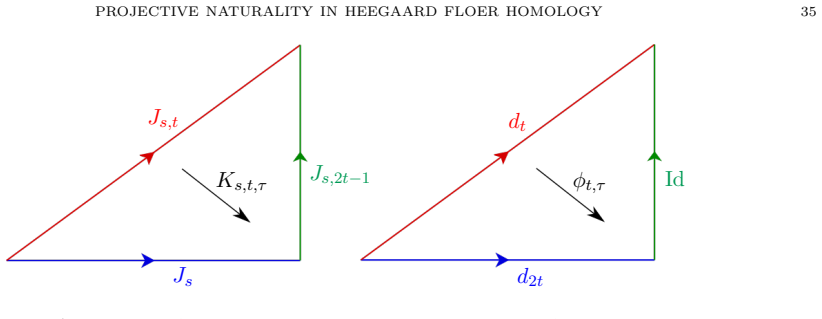
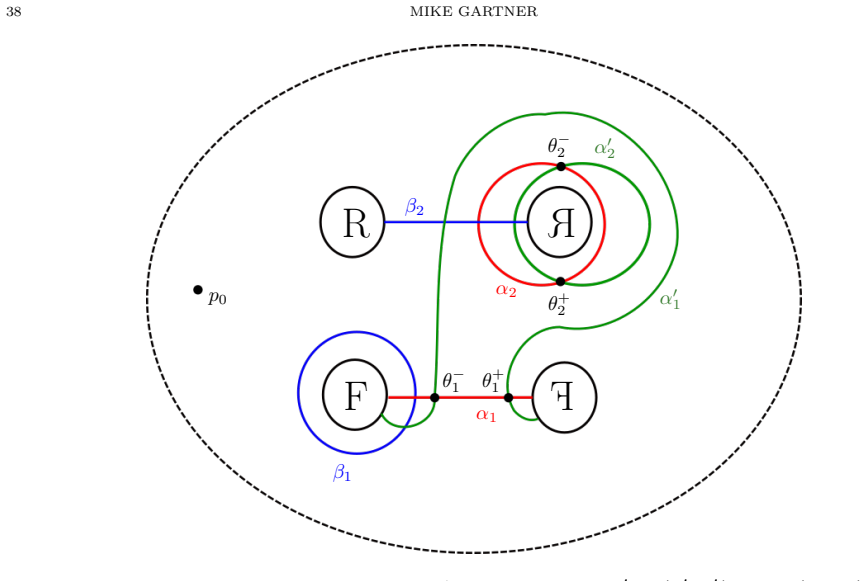
The projectivization $P(\mathcal{C})$ of an additive category $\mathcal{C}$ is the quotient that identifies every morphism $f$ with $-f$; the paper works with $P(\mathbb{Z}[U]\text{-Mod})$ and with the projectivized homotopy category of $\mathbb{Z}[U]$-module chain complexes. A transitive system is a directed-indexed family of objects and isomorphisms satisfying $f_{i,k}=f_{j,k}\circ f_{i,j}$, and $\mathrm{Trans}(\mathcal{C})$ is the resulting category. On the geometric side, the graph $G_{\mathrm{man}}$ has vertices given by pointed isotopy Heegaard diagrams and edges for strong $\alpha$-equivalences, strong $\beta$-equivalences, stabilizations, and diffeomorphisms. A strong Heegaard invariant is a weak one that also satisfies functoriality, commutativity for distinguished rectangles, continuity for isotopies, and simple handleswap invariance; the transitivity theorem for strong Heegaard invariants then turns such data into a genuine invariant. The load-bearing new check is the simple handleswap triangle count on the model diagram $T_0$, carried out through matched moduli spaces and coherent orientation systems, with the key identity being the signed count $\#\mathcal{M}_{\Theta,a,b}(d)=\pm 1$ independent of the divisor $d$.
What would settle it
On the model diagram $T_0$, choose a divisor $d\in \mathrm{Sym}^k(\Delta)$ away from the fat diagonal and compute the signed count $\#\mathcal{M}_{\Theta,a,b}(d)$ with the coherent orientation system constructed in Section 8.3. If the result is $0$ for any such $d$, the projective handleswap identity $g\circ f\circ e=\mathrm{Id}$ fails, disproving Theorem 7.2. Independently, writing out the omitted proof of Proposition 8.2 and checking that $F_{T'\#T'_0}((x\times b)\otimes(y\times \Theta'))=\pm F_{T'}(x\otimes y)\times c$ for all $x,y$ would settle the remaining sign question.
Extended reading notes
Core claim
The central assertion is that the four chain-complex invariants $\widehat{CF}$, $CF^-$, $CF^+$, and $CF^\infty$ are strong Heegaard invariants valued in transitive systems in the projectivized homotopy category $P(\mathrm{Kom}(\mathbb{Z}[U]\text{-Mod}))$. On homology this yields strong invariants into $P(\mathbb{Z}[U]\text{-Mod})$, and the abstract machinery of strong Heegaard invariants converts them into functors $\mathrm{Man}_* \to \mathrm{Trans}(P(\mathbb{Z}[U]\text{-Mod}))$ whose values on a based 3-manifold agree with the original modules up to isomorphism, with isotopic diffeomorphisms acting trivially. The main new work is the verification of the last required axiom, simple handleswap invariance, by counting holomorphic triangles on a fixed genus-two model diagram; the decisive signed count is $\pm 1$, which is all one needs after projectivization.
Load-bearing premise
The proof rests on two triangle counts on a small model diagram: one is stated without proof, and the other must come out exactly plus or minus one for every divisor; if either count ever came out zero, the handleswap relation would fail and the whole projectivized naturality would collapse.
Editorial extensions
If this is right
- Each flavor of Heegaard Floer homology becomes a well-defined functor on based 3-manifolds with values in $\mathrm{Trans}(P(\mathbb{Z}[U]\text{-Mod}))$, matching the classical invariants up to sign.
- Isotopic diffeomorphisms act as the identity, so mapping class group actions descend to the projectivized category without extra choices.
- The chain complexes themselves fit into transitive systems in the projectivized homotopy category, so different Heegaard diagrams for the same manifold are related by homotopy equivalences that are coherent up to sign.
- An integral version of involutive Heegaard Floer homology is obtained: the unordered pair of cone complexes $CFI^\pm$ is a diffeomorphism invariant of the based 3-manifold.
- The projectivized framework is positioned to upgrade naturality of cobordism maps and the mixed invariants of 4-manifolds from $\mathbb{F}_2$ coefficients to $\mathbb{Z}/\pm$ coefficients.
Reading between the lines
- The same projectivization device should apply to any Floer invariant whose only obstruction is handleswap-type monodromy and whose orientation systems are canonical up to sign, not just to Heegaard Floer homology.
- The unproved mirror-side triangle count (Proposition 8.2) is the most likely place for a hidden sign inconsistency; an independent proof would directly test the construction of the integral involutive invariant.
- If the transitive systems here are homotopy coherent, a homotopy colimit could replace the transitive-system packaging by one projectivized chain complex per 3-manifold, simplifying future computations.
- A concrete testable extension is to compute the pair $\{CFI^\pm\}$ for a lens space or small Seifert-fibered space and compare it with the known $\mathbb{F}_2$ involutive invariant, since torsion differences would show where the sign ambiguity matters.
Signed reviews
Editorial analysis
A structured set of objections, weighed in public.
Referee Report
Summary. The paper proves a projectivized (up-to-sign) naturality statement for the Heegaard Floer invariants of closed, connected, oriented, based 3-manifolds over Z[U]. It introduces the projectivized homotopy category P(Kom(Z[U]-Mod)) and the category Trans(P(Kom(Z[U]-Mod))) of transitive systems, and states that the morphisms \hat{CF}, CF^-, CF^+, CF^\infty : Gman -> Trans(P(Kom(Z[U]-Mod))) are strong Heegaard invariants (Theorem 1.3). From this it derives functors HF^\circ : Man_* -> Trans(P(Z[U]-Mod)) whose values are isomorphic to the Ozsvath-Szabo modules (Theorem 1.1). The proof follows the structure of JTZ12, concentrates on the new integral simple-handleswap computation, and includes an application to involutive Heegaard Floer homology over Z. The paper is honest about the fact that the beta-side triangle count (Proposition 8.2) is not proved, and that Lemma 8.21's sign count is only sketched.
Significance. If the central claim is correct, the paper fills a recognized gap: it provides naturality over Z up to sign for all Heegaard Floer variants, on the chain level, and establishes groundwork for integral cobordism naturality and mixed invariants over Z/±. The projectivized transitive-system formalism is a sensible and carefully described framework for the result, and the verification of axioms 1–3 in Section 7 is substantive. The alpha-side triangle count in Proposition 8.1 is proved in detail, and the dependence on coherent orientation systems is discussed explicitly. However, the main new ingredient—simple handleswap invariance—is not fully supported as written: Proposition 8.2 is stated without proof, and the crucial nonzero sign count in Lemma 8.21 rests on a sketch. Since the target category is projectivized, sign ambiguities are benign only if the relevant counts are ±1 rather than 0; exactly this is left unproved for the beta-side.
major comments (3)
- [Section 8, Proposition 8.2] Proposition 8.2 is load-bearing for Theorem 7.2 but its proof is omitted, with the sentence 'Since a nearly identical proof can be used to establish Proposition 8.2, we omit the proof of that result.' In the proof of Theorem 7.2, the beta-side computation of Φf uses Proposition 8.2 to replace F_{T'#T'_0}((x×b)⊗(y×Θ')) by ±F_{T'}(x⊗y)×c. If the beta-side count were 0 for some divisor rather than ±1, the composition g*∘Φf∘Φe would be 0, not Id, and Theorem 7.2 would fail. The 'nearly identical' claim is not a formal α↔β symmetry: the model diagrams T0 and T'0 (Figures 9 and 10) differ in the placement of the basepoint and in the arrangement of the special curve pair relative to the F/R regions, so the orientation-coherence arguments used on the alpha side—Lemmas 8.13, 8.19, 8.20, and Step 3 of Lemma 8.21—do not automatically transfer. The proof of Proposition 8.2, or at least a precise symmetry reduction to Proposition 8.1, must be supplied.
- [Section 8.3, Lemma 8.21] Lemma 8.21 is the quantitative heart of Proposition 8.1, but its proof is only a sketch. Step 2 asserts independence of the signed count from the divisor d using Lemma 8.13, and Step 3 finds one divisor with the desired count via a stabilization argument involving the twice-stabilized bigon and an appeal to [OS04b, Lemma 8.7] to extend the orientation system. The text does not give the sign bookkeeping for the extension, nor does it prove that the resulting coherent orientation system yields the same sign for all generic d and for the beta-side configuration needed in Proposition 8.2. Since Lemma 8.21 must produce #M_{(Θ,a,b)}(d) = ±1 for every generic d, and since a zero count would destroy the handleswap relation, this lemma needs a complete proof rather than a sketch. In particular, the orientation system on the matched moduli spaces and the sign in Step 3 must be made explicit and shown to be compatible with the path-independence argument in Step 2.
- [Section 6.5] In Section 6.5, after defining CF^-(H,s) for a fixed isotopy diagram H, the paper asserts that the coherent orientation system induced on a diagram H' is independent of the path γ chosen from H to H', citing [JTZ12, Proof of Theorem 2.38 and Remark 2.39] and a verification in the five types of distinguished rectangle and in a simple handleswap. The simple handleswap verification is precisely the content that is deferred to Section 8 and Theorem 7.2. As written, this makes the definition of CF^-(H') for vertices of Gman appear to presuppose the theorem it is meant to help prove. The author should either move the definition of CF^-(H') to after the handleswap proof, or state explicitly that the orientation-level independence is a weaker statement proved independently of the map-level handleswap invariance.
minor comments (3)
- [Section 8, before Proposition 8.2] The notation for T'_0 is inconsistent: the line 'β'_0={β_1,β_2} and β'_0={β'_1,β'_2}' should read 'β_0={β_1,β_2} and β'_0={β'_1,β'_2}'.
- [Throughout] There are several typos, including 'orienation' in Theorem 7.1 and 'stablization' in Section 6.6; these should be corrected.
- [Theorem 1.7] The proof of Theorem 1.7 is only a sketch and relies on a choice among 'at least one' of the two maps in {±ι'}; the text should clarify in what sense the resulting unordered pair is independent of that choice, since the application to involutive Heegaard Floer homology is a stated motivation.
Circularity Check
No significant circularity: the projective naturality claim rests on external benchmarks (OS04b, JTZ12, Lip06) and a new integral triangle count; the omitted proof of Proposition 8.2 is a completeness gap, not a circular reduction.
full rationale
I walked the derivation chain from Theorem 1.1 back through Theorem 1.3, Corollary 1.4, Theorem 7.2, Propositions 8.1 and 8.2, and Lemma 8.21. The logic is: (i) the weak Heegaard invariant property is imported from the external results of Ozsvath-Szabo and Juhasz-Thurston-Zemke; (ii) JTZ12's strong-invariant framework is imported as a theorem about any target category, not as an assumption of the conclusion; (iii) the genuinely new work is the integral, projectivized simple-handleswap count. Propositions 8.1 and 8.2 are stated as concrete triangle-count identities for the model diagrams T0 and T0', and Lemma 8.21 establishes the required signed count #M(Theta,a,b)(d) = +/-1 by showing independence of d and then computing one divisor via a stabilization argument. The target equality g* o Phi_f o Phi_e = Id is not used as an input; it is derived by multiplying the signs from those independent counts. The only load-bearing weakness I found is that Proposition 8.2's proof is omitted with the sentence 'Since a nearly identical proof can be used to establish Proposition 8.2, we omit the proof of that result.' That is a genuine completeness risk: if the beta-side count were 0 for some matched divisor, Theorem 7.2 could fail. But a missing or sketched proof is not circularity: no equation in the paper is shown to be equivalent to its own inputs, and the omitted result is not justified by citing the present paper or by assuming the theorem being proved. There is no fitted parameter renamed as a prediction, no self-citation chain carrying the argument, no uniqueness theorem imported from the authors' own prior work, and no ansatz smuggled in via citation. The projectivized category P(Z[U]-Mod) is a quotient by f ~ -f, used to absorb the signs arising in Theorem 7.1; it is not an entity constructed to force the result. The values of HF^o are compared against the previously published OS04b modules as an external benchmark. Accordingly, the derivation is self-contained against external standards, and the circularity score is 0.
Assumptions & free parameters
assumptions (4)
- domain assumption The Heegaard Floer chain complexes over Z[U] with signed counts are well defined for strongly admissible diagrams.
- domain assumption The JTZ12 framework of weak and strong Heegaard invariants, and the theorem that strong invariants form transitive systems, applies to the target categories used here.
- domain assumption Compactness, gluing, and index properties of holomorphic triangles in stretched neck regions (Propositions 8.6 and 8.17) hold for the matched moduli spaces.
- domain assumption The canonical coherent orientation systems of [OS04a] satisfy the coherence conditions needed for the connect-sum and handleswap arguments.
Cite this review
Pith. "Pith review of Projective Naturality in Heegaard Floer Homology." pith.science (2026). https://pith.science/paper/NZUCBYAY
@misc{pith2026190806237,
  author       = {Pith},
  title        = {Pith review of: Projective Naturality in Heegaard Floer Homology},
  year         = {2026},
  howpublished = {\url{https://pith.science/paper/NZUCBYAY}},
  note         = {Machine review of arXiv:1908.06237}
}
abstract
Let $\text{Man}_{*}$ denote the category of closed, connected, oriented and based $3$-manifolds, with basepoint preserving diffeomorphisms between them. Juh\'asz, Thurston and Zemke showed that the Heegaard Floer invariants are natural with respect to diffeomorphisms, in the sense that there are functors $HF^{\circ}: \text{Man}_{*} \rightarrow \mathbb{F}_{2}[U]\text{-}\text{Mod}$ whose values agree with the invariants defined by Ozsv\'ath and Szab\'o. The invariant associated to a based $3$-manifold comes from a transitive system in $\mathbb{F}_{2}[U]\text{-}\text{Mod}$ associated to a graph of embedded Heegaard diagrams representing the $3$-manifold. We show that the Heegaard Floer invariants yield functors $HF^{\circ}: \text{Man}_{*} \rightarrow \text{Trans}(P(\mathbb{Z}[U]\text{-}\text{Mod}))$ to the category of transitive systems in a projectivized category of $\mathbb{Z}[U]$-modules. In doing so, we will see that the transitive system of modules associated to a $3$-manifold actually comes from an underlying transitive system in the projectivized homotopy category of chain complexes over $\mathbb{Z}[U]\text{-}\text{Mod}$. We discuss an application to involutive Heegaard Floer homology, and potential generalizations of our results.
Figures

Figures from the paper (10 more)





Reference graph
Works this paper leans on
-
[1]
On the functoriality of the blow-up construction
Gregory Arone and Marja Kankaanrinta. On the functoriality of the blow-up construction. Bull. Belg. Math. Soc. Simon Stevin , 17(5):821--832, 2010
work page 2010
-
[2]
M. F. Atiyah. K -theory . Advanced Book Classics. Addison-Wesley Publishing Company, Advanced Book Program, Redwood City, CA, second edition, 1989. Notes by D. W. Anderson
work page 1989
-
[3]
Foliations and the topology of 3 -manifolds
David Gabai. Foliations and the topology of 3 -manifolds. J. Differential Geom. , 18(3):445--503, 1983
work page 1983
-
[4]
A flexible construction of equivariant F loer homology and applications
Kristen Hendricks, Robert Lipshitz, and Sucharit Sarkar. A flexible construction of equivariant F loer homology and applications. J. Topol. , 9(4):1153--1236, 2016
work page 2016
-
[5]
Involutive H eegaard F loer homology
Kristen Hendricks and Ciprian Manolescu. Involutive H eegaard F loer homology. Duke Math. J. , 166(7):1211--1299, 2017
work page 2017
-
[6]
Stanislav Jabuka and Thomas E. Mark. Product formulae for O zsv\' a th- S zab\' o 4-manifold invariants. Geom. Topol. , 12(3):1557--1651, 2008
work page 2008
-
[7]
Naturality and mapping class groups in Heegaard Floer homology
Andr \'a s Juh \'a sz , Dylan P. Thurston , and Ian Zemke . Naturality and mapping class groups in Heegaard Floer homology . arXiv e-prints , page arXiv:1210.4996, October 2012
work page Pith review arXiv 2012
-
[8]
A cylindrical reformulation of H eegaard F loer homology
Robert Lipshitz. A cylindrical reformulation of H eegaard F loer homology. Geom. Topol. , 10:955--1096, 2006. Paging previously given as 955--1097
work page 2006
Show all 23 references
-
[9]
Ozsvath, and Dylan P
Robert Lipshitz, Peter S. Ozsvath, and Dylan P. Thurston. Bordered H eegaard F loer homology. Mem. Amer. Math. Soc. , 254(1216):viii+279, 2018
2018
-
[10]
On spaces having the homotopy type of a CW -complex
John Milnor. On spaces having the homotopy type of a CW -complex. Trans. Amer. Math. Soc. , 90:272--280, 1959
1959
-
[11]
J -holomorphic curves and symplectic topology , volume 52 of American Mathematical Society Colloquium Publications
Dusa McDuff and Dietmar Salamon. J -holomorphic curves and symplectic topology , volume 52 of American Mathematical Society Colloquium Publications . American Mathematical Society, Providence, RI, second edition, 2012
2012
-
[12]
Micallef and Brian White
Mario J. Micallef and Brian White. The structure of branch points in minimal surfaces and in pseudoholomorphic curves. Ann. of Math. (2) , 141(1):35--85, 1995
1995
-
[13]
Holomorphic disks and three-manifold invariants: properties and applications
Peter Ozsv\' a th and Zolt\' a n Szab\' o . Holomorphic disks and three-manifold invariants: properties and applications. Ann. of Math. (2) , 159(3):1159--1245, 2004
2004
-
[14]
Holomorphic disks and topological invariants for closed three-manifolds
Peter Ozsv\' a th and Zolt\' a n Szab\' o . Holomorphic disks and topological invariants for closed three-manifolds. Ann. of Math. (2) , 159(3):1027--1158, 2004
2004
-
[15]
Holomorphic triangle invariants and the topology of symplectic four-manifolds
Peter Ozsv\' a th and Zolt\' a n Szab\' o . Holomorphic triangle invariants and the topology of symplectic four-manifolds. Duke Math. J. , 121(1):1--34, 2004
2004
-
[16]
Heegaard F loer homology and contact structures
Peter Ozsv\' a th and Zolt\' a n Szab\' o . Heegaard F loer homology and contact structures. Duke Math. J. , 129(1):39--61, 2005
2005
-
[17]
Holomorphic triangles and invariants for smooth four-manifolds
Peter Ozsv\' a th and Zolt\' a n Szab\' o . Holomorphic triangles and invariants for smooth four-manifolds. Adv. Math. , 202(2):326--400, 2006
2006
-
[18]
Holomorphic disks, link invariants and the multi-variable A lexander polynomial
Peter Ozsv\' a th and Zolt\' a n Szab\' o . Holomorphic disks, link invariants and the multi-variable A lexander polynomial. Algebr. Geom. Topol. , 8(2):615--692, 2008
2008
-
[19]
Lawrence P. Roberts. Rational blow-downs in H eegaard- F loer homology. Commun. Contemp. Math. , 10(4):491--522, 2008
2008
-
[20]
Maslov index formulas for W hitney n -gons
Sucharit Sarkar. Maslov index formulas for W hitney n -gons. J. Symplectic Geom. , 9(2):251--270, 2011
2011
-
[21]
Moving basepoints and the induced automorphisms of link F loer homology
Sucharit Sarkar. Moving basepoints and the induced automorphisms of link F loer homology. Algebr. Geom. Topol. , 15(5):2479--2515, 2015
2015
-
[22]
R. M. Vogt. Homotopy limits and colimits. Proceedings of the I nternational S ymposium on T opology and its A pplications ( B udva, 1972) , pages 235--241, 1973
1972
-
[23]
Graph cobordisms and Heegaard Floer homology
Ian Zemke . Graph cobordisms and Heegaard Floer homology . arXiv e-prints , page arXiv:1512.01184, Dec 2015
2015
Reviewed August 14, 2026 · model on record in the stance chip above.
Discussion (0). Continue with ORCID to comment.