Formation and dynamics of self-bound droplets in dipolar molecular condensate
Pith reviewed 2026-06-26 09:46 UTC · model grok-4.3
The pith
Self-bound quantum droplets in dipolar molecular condensates display nonmonotonous dependence on non-axisymmetric DDI strength and direction-dependent collision outcomes.
A machine-rendered reading of the paper's core claim, the machinery that carries it, and where it could break.
Core claim
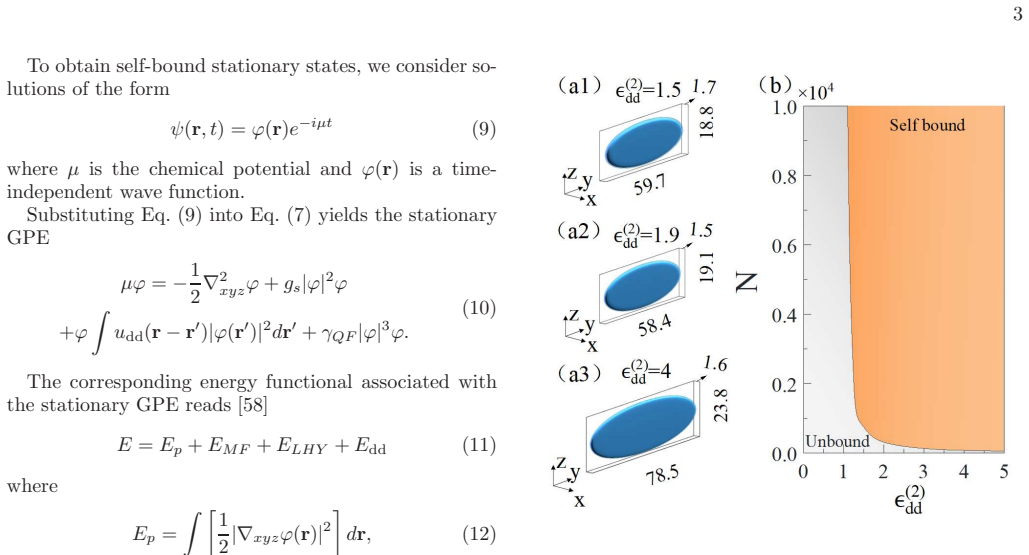
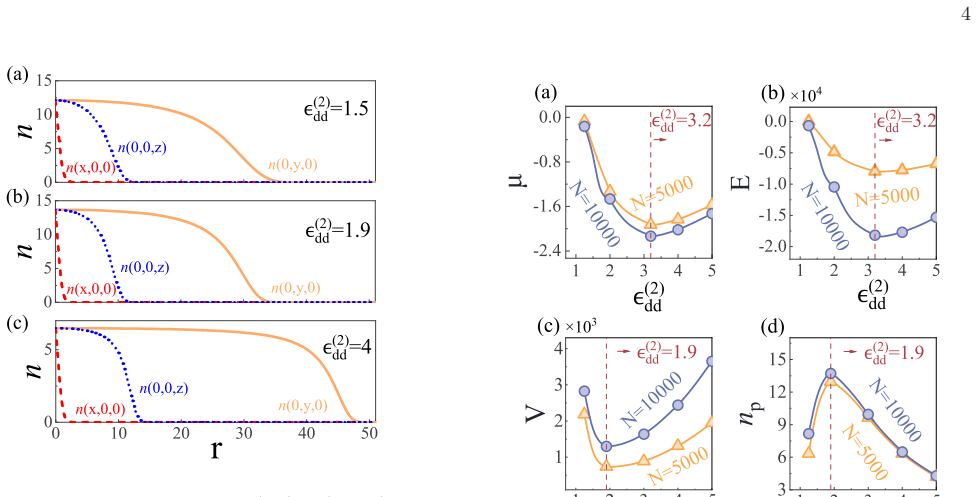
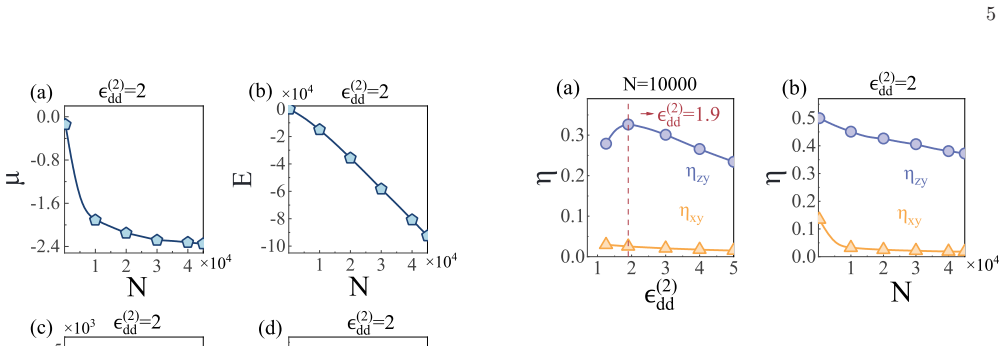
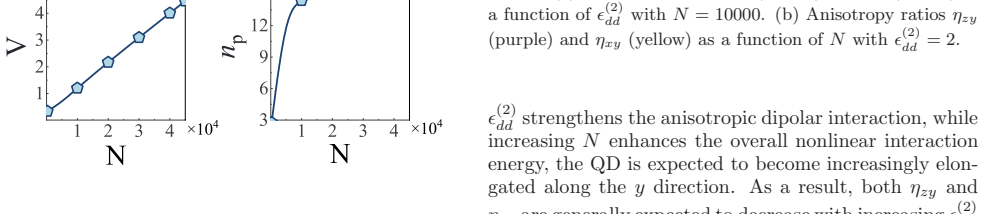
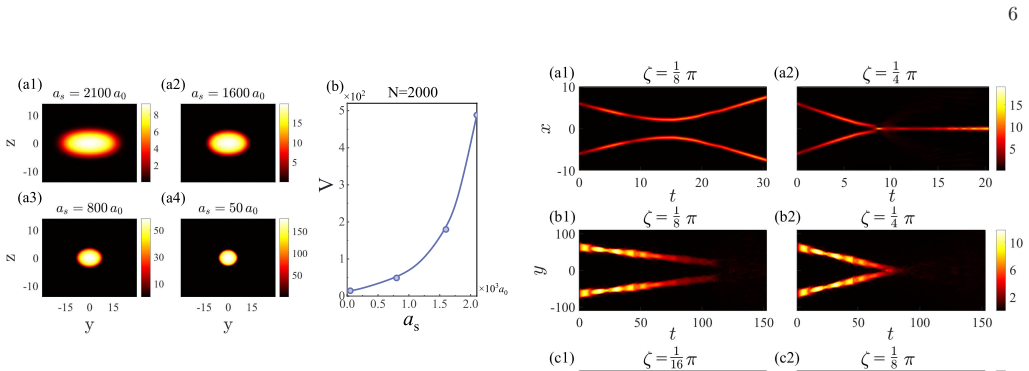
Within this framework, we identify the existence region of the self-bound QDs and characterize their chemical potential, total energy, effective volume, peak density, and geometric anisotropy. The results reveal a pronounced nonmonotonous dependence on the non-axisymmetric DDI strength, whereas the increase of the number of particles in the condensate leads to tighter bound and more anisotropic QDs. Furthermore, reducing the s-wave scattering length drives a transition from stable self-bound states to the collapse. Collisions between QDs moving along different directions reveal a strong directional dependence, with outcomes ranging from quasi-elastic rebound and merger to fragmentation.
What carries the argument
Extended Gross-Pitaevskii equation with Lee-Huang-Yang corrections, which governs the formation and dynamics in the non-axisymmetric DDI-dominated regime and enables direct computation of droplet observables.
If this is right
- Increasing particle number produces more tightly bound and geometrically anisotropic droplets.
- Lowering the s-wave scattering length induces a transition from stable droplets to collapse.
- Collisions between droplets exhibit quasi-elastic rebound, merger, or fragmentation according to their relative direction of motion.
Where Pith is reading between the lines
- Microwave dressing parameters could be used to select stable droplet sizes or shapes for targeted experiments.
- The directional collision rules may enable controlled merging or scattering protocols in droplet-based quantum simulators.
- The nonmonotonous response to DDI strength suggests an optimal interaction window that could be tested by scanning microwave field amplitudes.
Load-bearing premise
The extended Gross-Pitaevskii equation with the Lee-Huang-Yang corrections accurately describes the system in the regime dominated by non-axisymmetric DDIs.
What would settle it
Measurement of a nonmonotonous dependence of droplet peak density or anisotropy on the strength of the non-axisymmetric dipole-dipole interaction, or observation of direction-dependent outcomes in collisions between two moving droplets.
Figures
read the original abstract
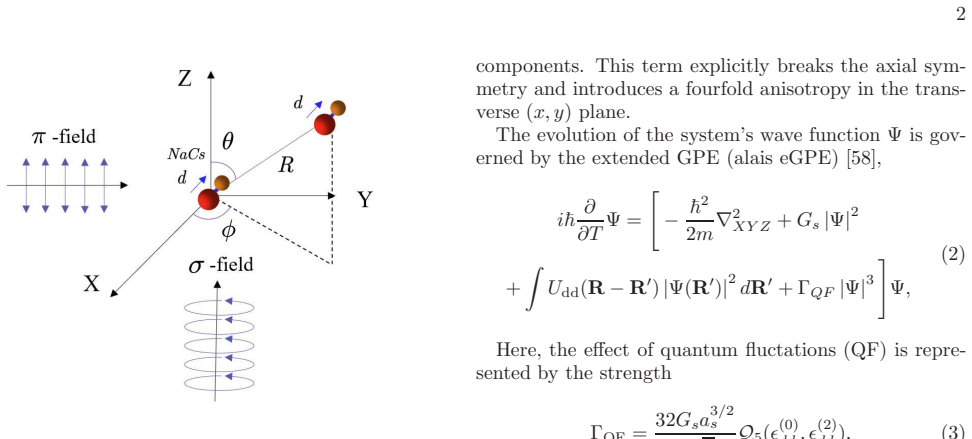
Recent advances in the work with ultracold condensates of polar molecules have enabled the realization of highly tunable self-bound quantum droplets (QDs), with the help of dual microwave fields dressig the dipole-dipole interactions (DDIs) It has been reported that symmetry properties and the equilibrium phase diagram of such QDs can be controlled by parameters of the two microwave fields. However, the effect of these fields on the formation and dynamics of the QD has not yet been systematically explored. Here we address self-bound QDs in a regime dominated by non-axisymmetric DDIs and governed by the extended Gross-Pitaevskii equation with the Lee-Huang-Yang corrections. Within this framework, we identify the existence region of the self-bound QDs and characterize their chemical potential, total energy, effective volume, peak density, and geometric anisotropy. The results reveal a pronounced nonmonotonous dependence on the non-axisymmetric DDI strength, whereas the increase of the number of particles in the condensate leads to tighter bound and more anisotropic QDs. Furthermore, reducing the s-wave scattering length drives a transition from stable self-bound states to the collapse. Collisions between QDs moving along different directions reveal a strong directional dependence, with outcomes ranging from quasi-elastic rebound and merger to fragmentation.
Editorial analysis
A structured set of objections, weighed in public.
Referee Report
Summary. The manuscript studies self-bound quantum droplets (QDs) in dipolar molecular condensates under dual-microwave dressing that produces non-axisymmetric dipole-dipole interactions (DDIs). Within the extended Gross-Pitaevskii equation supplemented by Lee-Huang-Yang (LHY) corrections, the authors map the existence region of stable QDs, report their chemical potential, total energy, effective volume, peak density and geometric anisotropy, and examine how these quantities vary with non-axisymmetric DDI strength, particle number and s-wave scattering length. They further simulate collisions between moving QDs and document direction-dependent outcomes ranging from rebound to merger or fragmentation.
Significance. If the underlying model remains quantitatively reliable, the work supplies concrete, tunable predictions for the stability and collisional behavior of self-bound states in a regime that is experimentally accessible with polar molecules. The reported non-monotonic dependence on DDI anisotropy and the directional sensitivity of collisions constitute falsifiable benchmarks that could be tested in current microwave-dressed setups.
major comments (3)
- [§2] §2 (extended GPE + LHY term): The functional form and prefactor of the LHY correction are taken from the standard axisymmetric or contact-interaction derivations without recomputation or cross-validation for the non-axisymmetric DDI regime that dominates the present study. Because every reported quantity (existence region, chemical potential, anisotropy, collision outcomes) rests on this term, the absence of a microscopic check or explicit justification constitutes a load-bearing uncertainty.
- [Numerical methods] Numerical methods paragraph (likely §3): No convergence tests, grid-size dependence, or error estimates are provided for the imaginary- or real-time propagation used to obtain stationary QDs and collision dynamics. Without these controls it is impossible to assess whether the reported non-monotonic trends and directional collision thresholds are numerically robust.
- [Figure 4] Figure 4 (or equivalent collision panel): The transition from quasi-elastic rebound to fragmentation is stated to depend strongly on impact direction, yet the manuscript supplies neither the precise initial velocities nor the quantitative thresholds (e.g., critical relative velocity or impact parameter) that separate the regimes. This weakens the claim of “strong directional dependence.”
minor comments (2)
- [Abstract] Abstract: “dressig” should read “dressing.”
- [§3] Notation: The definition of the effective volume and the precise normalization of the anisotropy parameter should be stated explicitly in the text rather than only in a figure caption.
Simulated Author's Rebuttal
We thank the referee for the careful reading and constructive comments on our manuscript. We address each major point below and outline the revisions we will make.
read point-by-point responses
-
Referee: [§2] §2 (extended GPE + LHY term): The functional form and prefactor of the LHY correction are taken from the standard axisymmetric or contact-interaction derivations without recomputation or cross-validation for the non-axisymmetric DDI regime that dominates the present study. Because every reported quantity (existence region, chemical potential, anisotropy, collision outcomes) rests on this term, the absence of a microscopic check or explicit justification constitutes a load-bearing uncertainty.
Authors: We agree that a dedicated microscopic recomputation of the LHY term for the specific non-axisymmetric DDI generated by dual microwave dressing is not performed in this work. The functional form employed follows the standard expression used in the literature for dipolar quantum droplets (both axisymmetric and anisotropic cases), as derived in prior works on beyond-mean-field corrections for dipolar gases. To address the concern, the revised manuscript will expand §2 with an explicit discussion of the approximation, including references to studies that have successfully applied the same LHY form to non-axisymmetric dipolar systems, and a statement on its expected range of validity. A full microscopic derivation lies outside the present scope but is noted as future work. revision: partial
-
Referee: [Numerical methods] Numerical methods paragraph (likely §3): No convergence tests, grid-size dependence, or error estimates are provided for the imaginary- or real-time propagation used to obtain stationary QDs and collision dynamics. Without these controls it is impossible to assess whether the reported non-monotonic trends and directional collision thresholds are numerically robust.
Authors: We acknowledge that explicit convergence tests and error estimates were omitted from the original manuscript. In the revised version we will add a dedicated paragraph (or short appendix) reporting the grid resolutions employed, the convergence criteria for imaginary-time propagation to stationary states, and checks on real-time collision dynamics with varied time steps and spatial discretizations. These additions will confirm that the non-monotonic dependencies and directional outcomes remain stable under refinement. revision: yes
-
Referee: [Figure 4] Figure 4 (or equivalent collision panel): The transition from quasi-elastic rebound to fragmentation is stated to depend strongly on impact direction, yet the manuscript supplies neither the precise initial velocities nor the quantitative thresholds (e.g., critical relative velocity or impact parameter) that separate the regimes. This weakens the claim of “strong directional dependence.”
Authors: We agree that the absence of specific numerical values for initial velocities and regime thresholds reduces the quantitative strength of the directional-dependence claim. The revised manuscript will update the relevant section and Figure 4 caption to include the exact initial velocities used in the simulations, the impact parameters explored, and the critical relative velocities (with uncertainties) that mark the boundaries between rebound, merger, and fragmentation for each collision direction. revision: yes
Circularity Check
No circularity: results from direct numerical integration of standard model
full rationale
The paper solves the extended Gross-Pitaevskii equation with Lee-Huang-Yang correction numerically to obtain existence regions, energies, densities, and collision outcomes for quantum droplets under non-axisymmetric DDIs. No step equates a fitted parameter to a reported prediction, renames a known result, or reduces the central claims to a self-citation chain. The LHY term is adopted from established literature as an input; its validity for the specific anisotropy is an external modeling assumption, not a definitional tautology within the derivation. All reported quantities are computed outputs, not re-expressions of the inputs.
Axiom & Free-Parameter Ledger
free parameters (2)
- dual microwave field parameters
- s-wave scattering length
axioms (1)
- domain assumption The extended Gross-Pitaevskii equation with Lee-Huang-Yang corrections is applicable to this dipolar molecular system.
Reference graph
Works this paper leans on
-
[1]
R. V. Krems, Cold controlled chemistry, Phys. Chem. Chem. Phys. 10, 4079 (2008)
2008
-
[2]
Baranov, Theoretical progress in many-body physics with ultracold dipolar gases, Phys
M. Baranov, Theoretical progress in many-body physics with ultracold dipolar gases, Phys. Rep. 464, 71 (2008)
2008
-
[3]
K.-K. Ni, S. Ospelkaus, M. H. G. De Miranda, A. Pe’er, B. Neyenhuis, J. J. Zirbel, S. Kotochigova, P. S. Julienne, D. S. Jin, and J. Ye, A High Phase-Space-Density Gas of Polar Molecules, Science 322, 231 (2008)
2008
-
[4]
S. A. Moses, J. P. Covey, M. T. Miecnikowski, D. S. Jin, and J. Ye, New frontiers with quantum gases of polar molecules, Nat. Phys. 13, 13 (2017)
2017
-
[5]
Lahaye, C
T. Lahaye, C. Menotti, L. Santos, M. Lewenstein, and T. Pfau, The physics of dipolar bosonic quantum gases, Rep. Prog. Phys. 72, 126401 (2009)
2009
-
[6]
M. A. Baranov, M. Dalmonte, G. Pupillo, and P. Zoller, Condensed matter theory of dipolar quantum gases, Chem. Rev. 112, 5012 (2012)
2012
-
[7]
Micheli, G
A. Micheli, G. K. Brennen, and P. Zoller, A toolbox for lattice spin models with polar molecules, Nat. Phys. 2, 341 (2006)
2006
-
[8]
L. D. Carr, D. DeMille, R. V. Krems, and J. Ye, Cold and ultracold molecules: science, technology, and appli- cations, New J. Phys. 11, 055049 (2009)
2009
-
[9]
Altman, K
E. Altman, K. R. Brown, G. Carleo, L. D. Carr, E. Demler, C. Chin, B. DeMarco, S. E. Economou, M. A. Eriksson, K.-M. C. Fu, et al., Quantum simulators: Ar- chitectures and opportunities, PRX Quantum 2, 017003 (2021)
2021
-
[10]
S. L. Cornish, M. R. Tarbutt, and K. R. A. Hazzard, Quantum computation and quantum simulation with ul- tracold molecules, Nat. Phys. 20, 731 (2024)
2024
-
[11]
DeMille, Quantum computation with trapped polar molecules, Phys
D. DeMille, Quantum computation with trapped polar molecules, Phys. Rev. Lett. 88, 067901 (2002)
2002
-
[12]
P. Rabl, D. DeMille, J. M. Doyle, M. D. Lukin, R. J. Schoelkopf, and P. Zoller, Hybrid quantum processors: molecular ensembles as quantum memory for solid state circuits, Phys. Rev. Lett. 97, 033003 (2006)
2006
-
[13]
K.-K. Ni, S. Ospelkaus, D. Wang, G. Qu´ em´ ener, B. Neyenhuis, M. H. G. De Miranda, J. L. Bohn, J. Ye, and D. S. Jin, Dipolar collisions of polar molecules in the quantum regime, Nature 464, 1324 (2010)
2010
-
[14]
Qu´ em´ ener and P
G. Qu´ em´ ener and P. S. Julienne, Ultracold molecules un- der control!, Chem. Rev. 112, 4949 (2012)
2012
-
[15]
J. L. Bohn, A. M. Rey, and J. Ye, Cold molecules: Progress in quantum engineering of chemistry and quan- tum matter, Science 357, 1002 (2017)
2017
-
[16]
X. Ye, M. Guo, M. L. Gonz´ alez-Mart ´ ınez, G. Qu´ em´ ener, and D. Wang, Collisions of ultracold 23Na87Rb molecules with controlled chemical reactivities, Sci. Adv. 4, eaaq0083 (2018)
2018
-
[17]
Bause, A
R. Bause, A. Christianen, A. Schindewolf, I. Bloch, and X.-Y. Luo, Ultracold sticky collisions: theoretical and experimental status, J. Phys. Chem. A 127, 729 (2023)
2023
-
[18]
Karman and J
T. Karman and J. M. Hutson, Microwave shielding of ultracold polar molecules, Phys. Rev. Lett. 121, 163401 (2018)
2018
-
[19]
Lassabli` ere and G
L. Lassabli` ere and G. Qu´ em´ ener, Controlling the sca t- tering length of ultracold dipolar molecules, Phys. Rev. Lett. 121, 163402 (2018)
2018
-
[20]
Anderegg, S
L. Anderegg, S. Burchesky, Y. Bao, S. S. Yu, T. Karman, E. Chae, K.-K. Ni, W. Ketterle, and J. M. Doyle, Ob- servation of microwave shielding of ultracold molecules, Science 373, 779 (2021)
2021
-
[21]
Schindewolf, R
A. Schindewolf, R. Bause, X.-Y. Chen, M. Duda, T. Kar- man, I. Bloch, and X.-Y. Luo, Evaporation of microwave- shielded polar molecules to quantum degeneracy, Nature 607, 677 (2022)
2022
-
[22]
X.-Y. Chen, A. Schindewolf, S. Eppelt, R. Bause, M. Duda, S. Biswas, T. Karman, T. Hilker, I. Bloch, and X.-Y. Luo, Field-linked resonances of polar molecules, Nature 614, 59 (2023)
2023
-
[23]
J. Lin, G. Chen, M. Jin, Z. Shi, F. Deng, W. Zhang, G. Qu´ em´ ener, T. Shi, S. Yi, and D. Wang, Microwave shielding of bosonic NaRb molecules, Phys. Rev. X 13, 031032 (2023)
2023
-
[24]
Bigagli, C
N. Bigagli, C. Warner, W. Yuan, S. Zhang, I. Steven- son, T. Karman, and S. Will, Collisionally stable gas of bosonic dipolar ground state molecules, Nat. Phys. 19, 1579 (2023)
2023
-
[25]
Deng, X.-Y
F. Deng, X.-Y. Chen, X.-Y. Luo, W. Zhang, S. Yi, and T. Shi, Effective potential and superfluidity of microwave- shielded polar molecules, Phys. Rev. Lett. 130, 183001 (2023)
2023
-
[26]
X.-Y. Chen, S. Biswas, S. Eppelt, A. Schindewolf, F. Deng, T. Shi, S. Yi, T. A. Hilker, I. Bloch, and X.-Y. Luo, Ultracold field-linked tetratomic molecules, Nature 626, 283 (2024)
2024
-
[27]
Dutta, Universality in the microwave shielding of ul tra- cold polar molecules, Phys
J. Dutta, Universality in the microwave shielding of ul tra- cold polar molecules, Phys. Rev. Res. 7, 023164 (2025)
2025
-
[28]
Karman, N
T. Karman, N. Bigagli, W. Yuan, S. Zhang, I. Stevenson, and S. Will, Double microwave shielding, PRX Quantum 6, 020358 (2025)
2025
-
[29]
Bigagli, W
N. Bigagli, W. Yuan, S. Zhang, B. Bulatovic, T. Kar- man, I. Stevenson, and S. Will, Observation of Bose- Einstein condensation of dipolar molecules, Nature 631, 289 (2024)
2024
- [30]
- [31]
- [32]
-
[33]
Ferrier-Barbut, H
I. Ferrier-Barbut, H. Kadau, M. Schmitt, M. Wenzel, and T. Pfau, Observation of quantum droplets in a strongly dipolar bose gas, Phys. Rev. Lett. 116, 215301 (2016)
2016
-
[34]
Schmitt, M
M. Schmitt, M. Wenzel, F. B¨ ottcher, I. Ferrier-Barbut , and T. Pfau, Self-bound droplets of a dilute magnetic quantum liquid, Nature 539, 259 (2016)
2016
-
[35]
Kadau, M
H. Kadau, M. Schmitt, M. Wenzel, C. Wink, T. Maier, I. Ferrier-Barbut, and T. Pfau, Observing the Rosensweig instability of a quantum ferrofluid, Nature 530, 194 (2016)
2016
-
[36]
Boudjemˆ aa, Fluctuations and quantum self-bound droplets in a dipolar bose-bose mixture, Phys
A. Boudjemˆ aa, Fluctuations and quantum self-bound droplets in a dipolar bose-bose mixture, Phys. Rev. A 98, 033612 (2018)
2018
-
[37]
Semeghini, G
G. Semeghini, G. Ferioli, L. Masi, C. Mazzinghi, L. Wol- swijk, F. Minardi, M. Modugno, G. Modugno, M. In- 9 guscio, and M. Fattori, Self-bound quantum droplets of atomic mixtures in free space, Phys. Rev. Lett. 120, 235301 (2018)
2018
-
[38]
C. R. Cabrera, L. Tanzi, J. Sanz, B. Naylor, P. Thomas, P. Cheiney, and L. Tarruell, Quantum liquid droplets in a mixture of Bose-Einstein condensates, Science 359, 301 (2018)
2018
-
[39]
Chomaz, I
L. Chomaz, I. Ferrier-Barbut, F. Ferlaino, B. Laburthe - Tolra, B. L. Lev, and T. Pfau, Dipolar physics: a review of experiments with magnetic quantum gases, Rep. Prog. Phys. 86, 026401 (2022)
2022
-
[40]
Pollet, J
L. Pollet, J. D. Picon, H. P. B¨ uchler, and M. Troyer, Supersolid phase of cold polar molecules on a triangular lattice, Phys. Rev. Lett. 104, 125301 (2010)
2010
-
[41]
Z.-K. Lu, Y. Li, D. Petrov, and G. Shlyapnikov, Sta- ble dilute supersolid of two-dimensional dipolar bosons, Phys. Rev. Lett. 115, 075303 (2015)
2015
-
[42]
Schmidt, L
M. Schmidt, L. Lassabli` ere, G. Qu´ em´ ener, and T. Langen, Self-bound dipolar droplets and supersolids in molecular bose-einstein condensates, Phys. Rev. Res. 4, 013235 (2022)
2022
-
[43]
Arnone Cardinale, T
T. Arnone Cardinale, T. Bland, and S. M. Reimann, Exploring supersolids of single-microwave shielded molecules via exact and mean-field theories, Commun. Phys. 9, 191 (2026)
2026
- [44]
-
[45]
A. V. Gorshkov, P. Rabl, G. Pupillo, A. Micheli, P. Zolle r, M. D. Lukin, and H. P. B¨ uchler, Suppression of inelastic collisions between polar molecules with a repulsive shield , Phys. Rev. Lett. 101, 073201 (2008)
2008
-
[46]
H. P. B¨ uchler, E. Demler, M. Lukin, A. Micheli, N. Prokof’ev, G. Pupillo, and P. Zoller, Strongly correlated 2D quantum phases with cold polar molecules: Control- ling the shape of the interaction potential, Phys. Rev. Lett. 98, 060404 (2007)
2007
-
[47]
Rabl and P
P. Rabl and P. Zoller, Molecular dipolar crystals as hig h- fidelity quantum memory for hybrid quantum computing, Phys. Rev. A 76, 042308 (2007)
2007
-
[48]
Goral, L
K. Goral, L. Santos, and M. Lewenstein, Quantum phases of dipolar bosons in optical lattices, Phys. Rev. Lett. 88, 170406 (2002)
2002
-
[49]
G. K. Brennen, A. Micheli, and P. Zoller, Designing spin - 1 lattice models using polar molecules, New J. Phys. 9, 138 (2007)
2007
-
[50]
B. Yan, S. A. Moses, B. Gadway, J. P. Covey, K. R. A. Hazzard, A. M. Rey, D. S. Jin, and J. Ye, Observation of dipolar spin-exchange interactions with lattice-confined polar molecules, Nature 501, 521 (2013)
2013
-
[51]
Gadway and B
B. Gadway and B. Yan, Strongly interacting ultracold polar molecules, J. Phys. B: At. Mol. Opt. Phys. 49, 152002 (2016)
2016
-
[52]
Zhang, W
S. Zhang, W. Yuan, N. Bigagli, H. Kwak, T. Karman, I. Stevenson, and S. Will, Observation of self-bound droplets of ultracold dipolar molecules, Nature 651, 601 (2026)
2026
-
[53]
D. S. Petrov, Quantum Mechanical Stabilization of a Col - lapsing Bose-Bose Mixture, Phys. Rev. Lett. 115, 155302 (2015)
2015
-
[54]
D. S. Petrov and G. E. Astrakharchik, Ultradilute Low- Dimensional Liquids, Phys. Rev. Lett. 117, 100401 (2016)
2016
-
[55]
R. N. Bisset, R. M. Wilson, D. Baillie, and P. B. Blakie, Ground-state phase diagram of a dipolar condensate with quantum fluctuations, Phys. Rev. A 94, 033619 (2016)
2016
-
[56]
A. R. P. Lima and A. Pelster, Quantum fluctuations in dipolar bose gases, Phys. Rev. A 84, 041604 (2011)
2011
-
[57]
Ferrier-Barbut, M
I. Ferrier-Barbut, M. Schmitt, M. Wenzel, H. Kadau, and T. Pfau, Liquid quantum droplets of ultracold magnetic atoms, J. Phys. B: At. Mol. Opt. Phys. 49, 214004 (2016)
2016
-
[58]
Baillie, Symmetry and self-bound droplets in dipola r molecular gases, Phys
D. Baillie, Symmetry and self-bound droplets in dipola r molecular gases, Phys. Rev. Res. 8, 023219 (2026)
2026
-
[59]
Yang, Nonlinear Waves in Integrable and Non- Integrable Systems (SIAM, Philadelphia, 2010)
J. Yang, Nonlinear Waves in Integrable and Non- Integrable Systems (SIAM, Philadelphia, 2010)
2010
-
[60]
N. G. Vakhitov and A. A. Kolokolov, Stationary solution s of the wave equation in a medium with nonlinearity sat- uration, Radiophys. Quantum Electron. 16, 783 (1973)
1973
-
[61]
W¨ achtler and L
F. W¨ achtler and L. Santos, Ground-state properties and elementary excitations of quantum droplets in dipo- lar bose-einstein condensates, Phys. Rev. A 94, 043618 (2016)
2016
-
[62]
Chomaz, R
L. Chomaz, R. M. W. Van Bijnen, D. Petter, G. Faraoni, S. Baier, J. H. Becher, M. J. Mark, F. W¨ achtler, L. San- tos, and F. Ferlaino, Observation of roton mode popula- tion in a dipolar quantum gas, Nat. Phys. 14, 442 (2018)
2018
-
[63]
Ferrier-Barbut, M
I. Ferrier-Barbut, M. Wenzel, F. B¨ ottcher, T. Langen, M. Isoard, S. Stringari, and T. Pfau, Scissors mode of dipolar quantum droplets of dysprosium atoms, Phys. Rev. Lett. 120, 160402 (2018)
2018
-
[64]
Baillie, R
D. Baillie, R. M. Wilson, R. N. Bisset, and P. B. Blakie, Self-bound dipolar droplet: a localized matter-wave in free space, Phys. Rev. A 94, 021602(R) (2016)
2016
-
[65]
Ferioli, G
G. Ferioli, G. Semeghini, L. Masi, G. Giusti, G. Mod- ugno, M. Inguscio, A. Gallem ´ ı, A. Recati, and M. Fat- tori, Collisions of Self-Bound Quantum Droplets, Phys. Rev. Lett. 122, 090401 (2019)
2019
-
[66]
S. K. Adhikari, Statics and dynamics of a self-bound matter-wave quantum ball, Phys. Rev. A 95, 023606 (2017)
2017
discussion (0)
Sign in with ORCID, Apple, or X to comment. Anyone can read and Pith papers without signing in.