REVIEW 3 major objections 6 minor 27 references
Influence of Load Models on Equilibria, Stability and Algebraic Manifolds of Power System Differential-Algebraic System
T0 review · 3 major / 6 minor · reviewed 2026-08-14 · deepseek-v4-flash
Pith's one-line read The paper claims that shifting loads from constant power to constant impedance sharply increases the number of equilibria and changes the topology of the algebraic manifold, while leaving the stable component mostly unchanged.
desk verdict Equilibrium and stability-region observations are useful numerics; the algebraic-manifold topology claims are pictures, not results. read the letter →
The pith
A machine-rendered reading of the paper's core claim, the machinery that carries it, and where it could break.
The reading
What carries the argument
The central object is the algebraic manifold of the DAE: the solution set of the algebraic constraints (voltage-magnitude equations at generator buses and real/reactive power balances at load buses) in the space of relative generator angles and bus voltages. The mechanism that drives the study is a linear interpolation parameter α, where the load at each bus is α times constant power plus (1−α) times equivalent constant impedance, so α=1 is pure constant power and α=0 is pure impedance. Equilibria are found by solving an equivalent power-flow problem in the COI frame, with each equilibrium typed by the eigenvalues of the reduced Jacobian; stability-region boundaries are identified numerically by a ray-search algorithm that distinguishes singular-surface crossings from crossings of stable manifolds of type-1 UEPs. The load-bearing computational tools are the multi-solution power-flow solver of [21] and [22] and the DAE stability-boundary theory of [24] and [25].
What would settle it
Compute the real algebraic variety of the 9-bus DAE constraints at 40%, 60%, and 93.1% impedance using certified real-root isolation or a cylindrical algebraic decomposition, and compare its Euler characteristic or homology to the claimed sphere, two glued tori, and quotient-space descriptions. A discrepancy would show the reported topological mutation is a plotting or sampling artifact.
Extended reading notes
Core claim
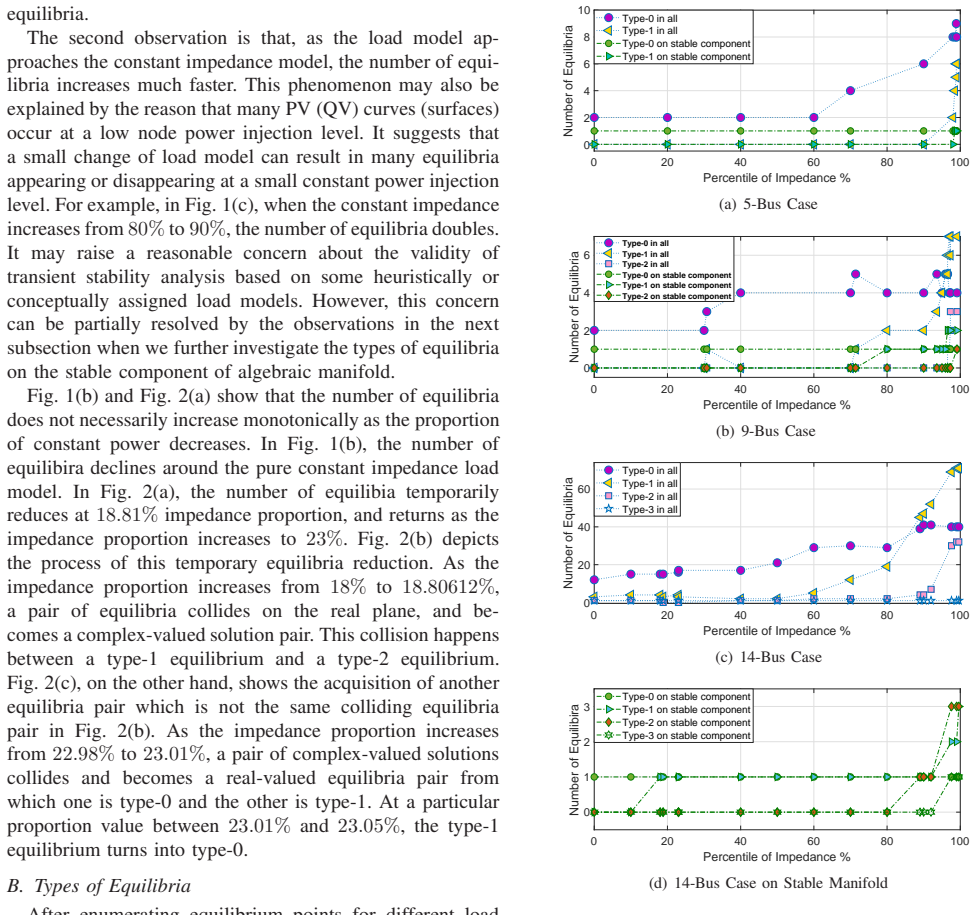
Using the IEEE 9-bus (and 5- and 14-bus) systems in a center-of-inertia classical DAE model, the paper claims that continuously replacing constant-power loads with equivalent constant-impedance loads produces a sequence of structural changes in the solution set. The number of power-flow-like equilibria increases by a large factor but not monotonically; equilibria of different types appear and collide, and pairs of real solutions vanish into the complex plane and later reappear. On the stable component of the algebraic manifold there remains exactly one stable equilibrium point (the high-voltage solution), and the number of equilibria there stays small. The stability boundary, initially the singular surface of the DAE, expands and is progressively taken over by the stable manifolds of type-1 unstable equilibria until, at pure impedance, the singular surface disappears. The algebraic manifold, plotted in the angle-angle-voltage slice, enlarges and connects to its modulo-2π replicas, and its topology is reported to mutate from sphere to glued tori to a quotient space; the authors emphasize this is counterintuitive because constant impedance is usually considered the simpler load model.
Load-bearing premise
The topological claims (sphere, glued tori, quotient space) rest on visual inspection of 3D plots of a single angle-angle-voltage slice, sampled numerically, without a formal proof that these plots correctly capture the global topology of the full algebraic variety.
Editorial extensions
If this is right
- The number of equilibrium solutions a power-flow-style solver must contend with grows sharply as impedance dominates, so contingency screening based on a single load model could miss many operating points.
- Stability regions under constant-power loads are bounded by the singularity surface; under pure impedance they are bounded by stable manifolds of type-1 UEPs, so the governing mechanism of transient stability changes with load composition.
- A low voltage at a single bus is not a reliable signature of a type-1 UEP on the stable component, and type-1 UEPs can show low voltages at several buses simultaneously.
- The algebraic manifold connects to its modulo-2π replicas under impedance-dominated loads, implying the DAE dynamics can pass through multiple 2π angular sweeps and still settle at an equilibrium.
- Because the added equilibria and topological changes sit on unstable components, stable-component behavior (and the uniqueness of the high-voltage SEP) may remain largely unaffected, though this is observed, not proven.
Reading between the lines
- If the topological mutation is real, the algebraic manifold of impedance-loaded systems is not simply connected; direct methods that rely on the stable component's basin structure may need to account for trajectories that wind around tunnels before converging.
- The non-monotone equilibria count suggests that homotopy-continuation or holomorphic-embedding solvers should expect saddle-node-style collisions of real solution pairs as load composition changes, providing a testable prediction for other bus systems.
- One could test whether the same complexity increase appears under ZIP loads with nonzero current terms; the paper deliberately omits constant-current components, so its conclusions may be a best-case for topology change.
- Practical load-model identification may benefit: if stable-component behavior is robust while unstable components proliferate, then matching measured transient behavior may not require exactly reproducing the full algebraic manifold.
Signed reviews
Editorial analysis
A structured set of objections, weighed in public.
Referee Report
Summary. This paper investigates how the composition of static load models—constant power versus constant impedance, parametrized by α in Eq. (9)—affects the equilibria, stability regions, and algebraic manifolds of power system differential-algebraic equation (DAE) models. Using modified 5-, 9-, and 14-bus test systems in the center-of-inertia frame, the authors report that as the load becomes impedance-dominated, the number of equilibria increases drastically but non-monotonically, the stability region expands and its boundary shifts from singular surfaces to stable manifolds of type-1 UEPs, and the algebraic manifold is claimed to undergo topological mutations from a sphere to glued tori and eventually a quotient space, with most changes occurring on unstable components. The high-voltage solution is held fixed by construction through the impedance normalization in Eq. (10). The paper is primarily an exploratory numerical study with several counter-intuitive observations.
Significance. If substantiated, the reported topological mutations of the algebraic manifold would be a novel and counter-intuitive contribution to the power systems DAE literature, with potential implications for direct stability analysis and load-model selection in transient stability studies. The paper also has notable strengths: a systematic continuous parameter sweep over load-model composition, explicit acknowledgment that the high-voltage solution is fixed by construction, use of multiple test systems, and an honest limitation statement that most changes occur on unstable components. However, the central topological discovery is currently presented as a visual interpretation of sampled renderings; the evidence does not yet support the strength of the claims made in the abstract and Section V.
major comments (3)
- [Section V, Figs. 5-6] The central claim that the algebraic manifold's topology mutates from a sphere to glued tori and eventually a quotient space is not supported by the evidence presented. The figures show two-dimensional surfaces rendered in the (δ21, δ31, V9) box, but the algebraic constraints (7c)-(7e) live in a higher-dimensional space; the manuscript never states whether the plotted object is the full algebraic manifold, a section, or a projection, nor does it give the sampling procedure. Furthermore, the angle coordinates are periodic, and the plots show one fundamental domain without specifying boundary identifications; a component that appears as a sphere inside one box can become a torus once 2π replicas are identified (as Fig. 5(f) itself invokes). To make the topology claim load-bearing, the authors need either a precise mathematical definition of the plotted set plus computational verification of the claimed homeomorphism types (e.g., via triangulation and homology computation with certified bounds), or a reformulation of the claim as a visual observation about a specific slice.
- [Section III, Figs. 1-2] The quantitative claims that the number of equilibria increases drastically and non-monotonically with impedance proportion rest on the assumption that the method of [21,22] computes all equilibria. No completeness certificate is provided for the 5-, 9-, and 14-bus systems studied; if the method occasionally misses solutions or produces spurious ones, the reported non-monotone dips (e.g., Fig. 2(a) around 18.81% impedance) and the doubling of solutions in Fig. 1(c) could be numerical artifacts. The authors should provide evidence of completeness, for instance by comparing the counts against known total-degree bounds for the equivalent power flow equations, or by validating the method on a system where the full solution set can be independently verified.
- [Section IV, Algorithm 1 and Fig. 4] The stability-region identification in Algorithm 1 traces each of M rays from the high-voltage SEP in the (δ21, δ31) plane and assumes that the intersection of the stability boundary with each ray is a single point (equivalently, that the stability region is star-shaped in this projection). This assumption is not justified and is generally false for power system stability regions, which can have complicated non-convex shapes. The claims that the stability region 'expands' and that its boundary transitions from the singularity boundary to the stable manifolds of type-1 UEPs are therefore only established for this ray-slicing approximation. Please either justify the star-shaped assumption for these cases or report the dependence of the conclusions on the choice of M and on the particular projection used.
minor comments (6)
- [Section II-B, Eq. (8)] In Eq. (8), the reactive current coefficient is written as 'Id,j' in (8b) but the text says 'Iq,j = 0'; the symbol should be corrected to 'Id,j'. Also, the phrase 'to acquire a uni-directional change of load model' should read 'to achieve a uni-directional change of the load model'.
- [Section III-B] The sentence 'neither a type-1 equilibrium point (on the stable component of the algebraic manifold) should admit one low bus voltage, nor a solution with only one low bus voltage should be type-1' is grammatically confusing and reads as a normative claim. Please state explicitly that this is an empirical observation from the tested cases and not a general theorem.
- [Sections III-B and V] The term 'stable component of the algebraic manifold' is used repeatedly but never formally defined. Please provide a definition (e.g., the connected component containing the high-voltage stable equilibrium) and clarify whether the classification of components as stable/unstable is independent of the load-model parameter.
- [Section V, Figs. 5-6 captions] The captions of Figs. 5 and 6 should state whether the plotted pink surface is a slice of the algebraic manifold or a projection, which variables are held fixed, and how the surface was sampled (grid resolution, solver used, treatment of multiple solution branches).
- [Throughout] There are several typos that should be corrected, including 'Appearently' (Section II-A), 'formualted' (Section II), 'equilibira' (Section III-A), and 'Eqt.' instead of 'Eq.'.
- [Section II-B, Eq. (10)] The normalization in Eq. (10) fixes the high-voltage solution by construction. Since several qualitative findings are drawn from sweeping α, a brief sensitivity study with respect to the base operating point, or an explicit scoping statement that results apply only under this normalization, would help the reader judge the generality of the conclusions.
Circularity Check
No circularity: alpha is swept, not fitted; the high-voltage normalization is explicit; self-citations are computational tools only.
full rationale
The paper's central observations do not reduce to its inputs. The load-mixing parameter alpha in Eq. (9) is varied continuously, not estimated from the outputs (equilibrium counts, stability boundaries, or manifold topology). Equation (10) fixes Zd,j from the high-voltage solution V0,j, and the paper explicitly states 'This setting ensures that the high voltage solution is unchanged during the change of load model'; this is a transparent normalization, not a hidden fit, and the claimed findings concern the other equilibria and global manifold geometry that are enumerated afterward. The equilibrium enumeration relies on the authors' own continuation methods [21], [22], but those are cited as computational tools for solving the algebraic equations (12); none of the paper's conclusions is an assumption smuggled in through those citations, and the counts/types are then read off the solved system. The topological statements ('sphere', 'two tori glued together', 'quotient space') are asserted from visual inspection of the plotted algebraic manifolds in Figs. 5-6; whether those inferences are fully justified is a verification/correctness question, not circularity, because the plots are outputs of the explicit DAE constraints (7c)-(7e) under a swept parameter. No equation is defined in terms of a target result, and no fitted quantity is renamed as a prediction. Hence no circular step can be exhibited, and the appropriate finding is no significant circularity.
Assumptions & free parameters
assumptions (4)
- domain assumption Generator damping coefficients are equal across all generators (Di = Dj for all i,j)
- domain assumption The numerical method of refs. [21] and [22] enumerates all (or a representative complete set of) equilibria of the equivalent power flow problem
- domain assumption The plotted 3D surfaces in Section V correctly represent the topology of the algebraic manifold of the DAE system
- domain assumption The classical generator model (constant voltage behind transient reactance) is adequate for the transient stability analysis
Cite this review
Pith. "Pith review of Influence of Load Models on Equilibria, Stability and Algebraic Manifolds of Power System Differential-Algebraic System." pith.science (2026). https://pith.science/paper/O2IJJYYE
@misc{pith2026190801111,
  author       = {Pith},
  title        = {Pith review of: Influence of Load Models on Equilibria, Stability and Algebraic Manifolds of Power System Differential-Algebraic System},
  year         = {2026},
  howpublished = {\url{https://pith.science/paper/O2IJJYYE}},
  note         = {Machine review of arXiv:1908.01111}
}
read the original abstract
Load models have a great impact on voltage behaviors as well as power system transient dynamics. Extensive work has been done on this topic, proposing appropriate load models and capturing better load behaviors during transient. This paper presents a comprehensive study to investigate the geometric and topological changes induced by different load models for the traditional power system differential-algebraic equations. Specifically, we attempt to reveal the deformation of equilibria, stability regions, and algebraic manifolds during a continuous evolution of load model. Several findings are presented in the paper, some of which countering traditional recognitions and intuitions. A major discovery is that the load model with a large proportion of constant impedance and a small proportion of constant power exhibits much more complex features than the load model with the reversed proportions of impedance and power. The increase of complexity is thoroughly recorded and investigated by the changes of geometric properties and mutations of topological invariants in the sense of equilibria, stability regions, and algebraic manifolds for the DAE system. However, most of the changes seem to occur on unstable components of algebraic manifolds or near the singular boundary surfaces, suggesting a limited variation of dynamical behaviors on the stable component.
Figures


Figures from the paper (3 more)


Reference graph
Works this paper leans on
-
[15]
Geometrical structure of constraint manifold in power system differential-algebra ic model,
H. Wu, R. Guo, Z. Han, and D. Gan, “Geometrical structure of constraint manifold in power system differential-algebra ic model,” in 2006 International Conference on Power System Technology , pp. 1–7, Oct 2006
work page 2006
-
[21]
Holomorphic embedding based continu ation method for identifying multiple power flow solutions,
D. Wu and B. Wang, “Holomorphic embedding based continu ation method for identifying multiple power flow solutions,” IEEE Access , 2019
work page 2019
-
[22]
An efficient method to locate all the load flow solutions-revisited,
B. Lesieutre and D. Wu, “An efficient method to locate all the load flow solutions-revisited,” in 2015 53rd Annual Allerton Conference on Communication, Control, and Computing (Allerton) , pp. 381–388, IEEE, 2015
work page 2015
-
[1]
Load model for stability studies,
W.-J. Lee, M.-S. Chen, and L. B. Williams, “Load model for stability studies,” IEEE Transactions on Industry Applications , vol. IA-23, no. 1, pp. 159–165, 1987
work page 1987
-
[2]
Load modeling in power system studies : Wecc progress update,
D. Kosterev, A. Meklin, J. Undrill, B. Lesieutre, W. Pric e, D. Chassin, R. Bravo, and S. Y ang, “Load modeling in power system studies : Wecc progress update,” in 2008 IEEE Power and Energy Society General Meeting - Conversion and Delivery of Electrical Energy in th e 21st Century, pp. 1–8, July 2008
work page 2008
-
[3]
D. Kosterev and J. Undrill, “Load modeling in wecc.” DOE- NERC FIDVR Workshop, 2009
work page 2009
-
[4]
CIGRE Task Force 38.02.05, “Load modeling and dynamics. ” Electra, 1990
work page 1990
-
[5]
Load representation for dynamic performance analysis,
IEEE Task Force on Load Representation for Dynamic Perfo rmance, “Load representation for dynamic performance analysis,” IEEE Trans. on Power Syst. , vol. 8, pp. 472–482, May 1993
work page 1993
Show all 27 references
-
[6]
Standard load models for power flow and dynamic performance simulation,
IEEE Task Force on Load Representation for Dynamic Perfo rmance, “Standard load models for power flow and dynamic performance simulation,” IEEE Trans. on Power Syst. , vol. 10, pp. 1302–1313, Aug 1995
1995
-
[7]
Load modelinga review,
A. Arif, Z. Wang, J. Wang, B. Mather, H. Bashualdo, and D. Z hao, “Load modelinga review,” IEEE Transactions on Smart Grid , vol. 9, pp. 5986–5999, Nov 2018
2018
-
[8]
A reference implementation of wecc composite load model in matlab and gridpack
Q. Huang, R. Huang, B. J. Palmer, Y . Liu, S. Jin, R. Diao, Y . Chen, and Y . Zhang, “A reference implementation of wecc composite load model in matlab and gridpack.” arXiv preprint 1708.00939
-
[9]
A transient energy function for power systems including the induction motor model,
Y . Min and L. Chen, “A transient energy function for power systems including the induction motor model,” Science in China Series E: Technological Sciences, vol. 50, no. 5, pp. 575–584, 2007
2007
-
[10]
K. R. Padiyar, Structure Preserving Energy Functions in Power Sys- tems: Theory and Applications . CRC Press, 2017
2017
-
[11]
M. A. Pai, Power System Stability: Analysis by the Direct Method of Lyapunov. North-Holland Publishing Company, 1981
1981
-
[12]
Chiang, Direct Methods for Stability Analysis of Electric Power Systems: Theoretical F oundation, BCU Methodologies, and A pplica- tions
H.-d. Chiang, Direct Methods for Stability Analysis of Electric Power Systems: Theoretical F oundation, BCU Methodologies, and A pplica- tions. John Wiley & Sons, 2011
2011
-
[13]
Lyapunov function analysi s of power systems with dynamic loads,
I. A. Hiskens and R. J. Davy, “Lyapunov function analysi s of power systems with dynamic loads,” in Proceedings of 35th IEEE Conference on Decision and Control , vol. 4, pp. 3870–3875 vol.4, Dec 1996
1996
-
[14]
Representative static load models for transient st ability anal- ysis: development and examination,
Y . Li, H. . Chiang, B. . Choi, Y . . Chen, D. . Huang, and M. G. Lauby, “Representative static load models for transient st ability anal- ysis: development and examination,” IET Generation, Transmission Distribution, vol. 1, pp. 422–431, May 2007
2007
-
[16]
P . W. Sauer, M. A. Pai, and J. H. Chow, Power System Dynamics and Stability: With Synchrophasor Measurement and Power Sy stem Toolbox. John Wiley & Sons, 2017
2017
-
[17]
Parallel processing for the load flow of power systems: the approach and applications,
F. Salam, L. Ni, S. Guo, and X. Sun, “Parallel processing for the load flow of power systems: the approach and applications,” in Decision and Control, 1989., Proceedings of the 28th IEEE Conference on, pp. 2173–2178, IEEE, 1989
1989
-
[18]
Parallel processing for the steady state solutions of large-scale non-linear models of power s ystems,
F. Salam, L. Ni, X. Sun, and S. Guo, “Parallel processing for the steady state solutions of large-scale non-linear models of power s ystems,” in Circuits and Systems, 1989., IEEE International Symposium on, pp. 1851–1854, IEEE, 1989
1989
-
[19]
Power systems test case archive
R. D. Christie, “Power systems test case archive.” Univ ersity of Washington, Seattle, 1999
1999
-
[20]
P . M. Anderson and A. A. Fouad, Power system control and stability . John Wiley & Sons, 2008
2008
-
[23]
On the existence and uniqu eness of load flow solution for radial distribution power networks ,
H.-D. Chiang and M. E. Baran, “On the existence and uniqu eness of load flow solution for radial distribution power networks ,” IEEE Transactions on Circuits and Systems , vol. 37, no. 3, pp. 410–416, 1990
1990
-
[24]
Stability regions for differential-algebraic systems,
V . V enkatasubramanian, H. Sch¨ attler, and J. Zaborszk y, “Stability regions for differential-algebraic systems,” in Systems, Models and Feedback: Theory and Applications , pp. 385–402, Springer, 1992
1992
-
[25]
Dynamics of large constrained nonlinear systems-a taxonomy theory [po wer system stability],
V . V enkatasubramanian, H. Schattler, and J. Zaborsky, “Dynamics of large constrained nonlinear systems-a taxonomy theory [po wer system stability],” Proceedings of the IEEE , vol. 83, no. 11, pp. 1530–1561, 1995
1995
-
[26]
Chinag and L
H.-D. Chinag and L. F. C. Alberto, Stability Regions of Nonlinear Dynamical Systems: Theory, Estimation, and Applications . Cambridge University Press, 2015
2015
-
[27]
Effect of gene rator models and load models on the results of the transient stability ana lysis of a power system,
E. Sorrentino, O. Salazar, and D. Chvez, “Effect of gene rator models and load models on the results of the transient stability ana lysis of a power system,” in 2009 44th International Universities Power Engineering Conference (UPEC) , pp. 1–5, Sep. 2009. APPENDIX A 9-B US SYS...
2009
Reviewed August 14, 2026 · model on record in the stance chip above.
Discussion (0). Continue with ORCID to comment.