REVIEW 4 major objections 6 minor 11 references
A Comparative Analyses Of Network Formation In Low-power Lossy Networks: ContikiMAC vs Orchestra-enabled TSCH
T0 review · 4 major / 6 minor · reviewed 2026-08-07 · deepseek-v4-flash
Pith's one-line read ContikiMAC forms low-power networks roughly 13 times faster than Orchestra-enabled TSCH in the paper's small office test, measured as the time for nodes to join and the topology to stabilize.
desk verdict The 13x claim is an artifact of comparing two different convergence metrics; the paper is a useful experimental write-up but not a reliable comparative benchmark. read the letter →
The pith
A machine-rendered reading of the paper's core claim, the machinery that carries it, and where it could break.
The reading
What carries the argument
The comparison runs on two timing operations: joining time, the interval from the first DIS/DIO exchange to the root's receipt of a node's first DAO message, and convergence time, the interval from that first DAO to the last topology-changing DAO followed by a roughly 120-second quiet period. ContikiMAC timestamps come from an over-the-air packet sniffer on the shared channel, while Orchestra/TSCH timestamps come from a serial/UART dump of RPL messages at the root node, with child messages expressed as elapsed time since the root's last DIO. The energy figures are produced by dual-mote hardware in which a paired monitor mote measures the voltage drop across a shunt resistor on the participating mote. These measurement choices are the machinery that carries the 13x comparison.
What would settle it
Run ContikiMAC and Orchestra-enabled TSCH on the same physical node positions with the same tracing method and an automated stability window, and compare total formation time; if ContikiMAC does not come out at least an order of magnitude faster, the 13x claim is not general.
Extended reading notes
Core claim
The paper's central discovery is that, in the tested close-range office environment, a ContikiMAC network reaches its formed state in roughly one-thirteenth of the time demanded by an Orchestra-scheduled TSCH network. Joining times for ContikiMAC leaf nodes ranged from 0.24 s to 3.99 s, while TSCH joining times ranged from 0 s to 11 s; convergence times were 0 s to 5.61 s for ContikiMAC but up to 83 s and 108 s for two TSCH leaf nodes. The paper interprets this as evidence that ContikiMAC's frequent, random wakeups and immediate clear-channel-assessment transmissions accelerate RPL tree formation, whereas Orchestra/TSCH pays for its collision-free, duty-cycled schedule with slow convergence during topological churning. The same data is used to estimate per-node average electrical consumption of 16.71 to 22.87 mA for the TSCH nodes during formation, with no comparable ContikiMAC figure because the monitoring link lost most samples.
Load-bearing premise
The two experiments are treated as measuring the same 'network formation' quantity even though they use different topologies, different timestamping paths (sniffer vs serial log), and a manually applied 120-second quiet-period convergence rule; if these setup differences inflate the TSCH times, the 13x factor is an artifact rather than a protocol property.
Editorial extensions
If this is right
- An LLN designer whose priority is fast deployment should choose ContikiMAC over Orchestra/TSCH in small, close-range networks.
- A 13x slower formation is the price TSCH pays for collision-free channel hopping and duty cycling; applications that need both fast joining and long lifetime must decouple join traffic from the steady-state schedule.
- TSCH convergence is dominated by RPL parent churn, so shortening the quiet-period stability window or enlarging the slotframe may shrink the gap without changing the MAC paradigm.
- The missing ContikiMAC energy data means the reported comparison is about formation time only; energy claims in the paper apply to the TSCH side.
- Under the paper's definitions, network formation is not a single event but joining plus convergence, and comparisons should state both numbers explicitly.
Reading between the lines
- Inference beyond the paper: because the two protocol runs used different topologies and different timestamping methods, the 13x factor cannot be read as a pure protocol property until a matched-topology, matched-instrumentation repeat is done.
- Inference beyond the paper: if TSCH's slow convergence is mostly RPL churn, then replaying the same experiment with Trickle timer parameters tuned for faster DIO emission could materially reduce TSCH formation time, a testable consequence the paper does not run.
- Inference beyond the paper: a fixed automated convergence criterion (no DAO for N seconds) would make the joining/convergence split reproducible across protocols and across labs.
- Inference beyond the paper: the paper's own claim that slotframe length reduces congestion suggests an extension where the TSCH slotframe length is swept and the 13x factor is plotted against it.
Editorial analysis
A structured set of objections, weighed in public.
Referee Report
Summary. The manuscript reports a small experimental comparison of two MAC-layer protocols for Low-power and Lossy Networks: ContikiMAC and Orchestra-enabled TSCH. Using custom 'Dual Motes' hardware and a Zolertia RE sniffer, the author measures per-leaf joining time, convergence time, and (for TSCH only) energy consumption in a four-leaf indoor deployment. The central claim, stated in the abstract and Section 5, is that ContikiMAC outperforms Orchestra-enabled TSCH by a factor of about 13 in network formation. The paper also discusses RPL message flows, the measurement setup, and the difficulties of sniffing TSCH traffic, and it includes explicit caveats about packet loss and differing topologies.
Significance. If the 13x claim were supported by a rigorous experimental design, it would be a practically relevant result: network formation speed is a first-order concern for LLN deployment, and an order-of-magnitude gap between ContikiMAC and Orchestra-enabled TSCH would be noteworthy. The paper also demonstrates the use of the Dual Motes hardware and an over-the-air sniffer for timing analysis, which is a sensible tool for this kind of study, and it is transparent about several limitations, including missing ContikiMAC energy data and the differing topologies. However, as it stands the central quantitative conclusion is not established: the comparison rests on a single run per protocol, four leaf nodes, asymmetric convergence definitions, and different observation methods. The paper is therefore best read as a preliminary case study, not as a controlled comparative benchmark.
major comments (4)
- [Abstract and Section 5, supported by Table 3] The headline 'factor of 13' is not supported by the data as analyzed. Table 3 shows joining times alone give roughly ContikiMAC 2.5/3.25/0.24/3.99 s versus TSCH 4/0/8/11 s, i.e., a ratio near 2.3x, not 13x. The 13x appears only after adding convergence times, and the TSCH convergence column is dominated by two entries (83 s and 108 s) that are measured with a different rule. ContikiMAC convergence is defined at the leaf as the time until no topology change is observed for about 120 s in over-the-air captures, while TSCH convergence is defined at the root from serial/UART timestamps relative to the last root DIO, with no equivalent quiet-period rule. Because the two TSCH rows with large convergence values drive the average, the 13x factor is an artifact of the asymmetric measurement definition rather than a demonstrated MAC-layer property.
- [Section 3 and Figure 9, together with Table 3] The two experiments are not comparable as controlled treatments. The ContikiMAC and TSCH runs use different node positions, different topologies, and different radio conditions, as the paper itself acknowledges in Section 3 and in the note to Table 3. In addition, each protocol is tested in a single run with one set of four leaves, so there are no error bars, no confidence intervals, and no repeated trials. Any observed difference could be due to topology, channel effects, or incidental interference rather than to the MAC protocol. The qualitative direction (ContikiMAC joins faster than TSCH in this particular setting) is plausible, but the quantitative 13x claim requires a matched or repeated experimental design.
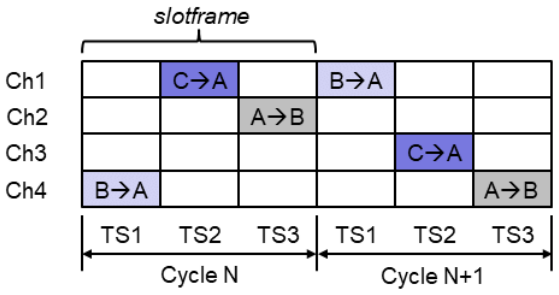
- [Section 3, TSCH configuration] The TSCH configuration is chosen without evidence that it is representative or neutral for network formation. The paper sets TSCH_HOPPING_SEQUENCE_4_16 and the default slotframe length of 7 (Section 3), but no sensitivity analysis or justification beyond an intuitive channel-offset argument is provided. Joining and convergence times in TSCH are known to depend on slotframe length, hopping sequence, and Orchestra's slot allocation. Without testing alternative configurations or citing prior evidence that this configuration is typical, the conclusion that 'ContikiMAC outperforms Orchestra-enabled TSCH' overgeneralizes from one particular TSCH setup.
- [Section 4.4 and Section 5, energy comparison] The energy-consumption comparison promised in the title and abstract is absent for ContikiMAC. Section 4.3 reports that only about four samples were received on the monitor-sink for ContikiMAC, and Section 5 explicitly states that the energy consumption 'could not be compared with ContikiMAC.' While this limitation is honestly disclosed, it means the paper does not deliver one of its stated comparative objectives. The TSCH energy numbers in Table 4 therefore stand alone, and the conclusion should not suggest an energy-related advantage of one protocol.
minor comments (6)
- [Section 3, paragraph on radio interfaces] The text repeatedly refers to a '2.5 GHz' radio, but the Zolertia Firely platform typically operates at 2.4 GHz; please correct the frequency or clarify the hardware variant.
- [Section 4.1.1] Table 1 is referenced as showing the recorded RPL messages for ContikiMAC, but the table body is missing in the manuscript; only the caption is present. Please include the actual data.
- [Section 1, structure paragraph] The manuscript contains an unresolved cross-reference: 'Sections ?? highlights the obtained results.' Please replace this with the correct section number.
- [Section 4.1, definition of joining time] The starting timestamp for joining time is defined ambiguously: 'the first DIS message of the leaf node or the first DIO message from the root node receipted by the leaf node.' These two reference points can differ, and the choice should be stated precisely and applied consistently in both experiments.
- [Throughout] There are numerous typographical and grammatical errors, e.g., 'approppriate,' 'inorder,' 'dissaper,' 'eluding,' and inconsistent capitalization of protocol names. A careful language edit is needed.
- [Section 2.1.2] The reference to '[section 1]' for radio duty cycling is unclear; this should be a specific section or reference citation.
Circularity Check
No significant circularity: the 13x claim is arithmetic on the paper's own timestamps, not a fitted or self-referential derivation.
full rationale
The paper does not derive its headline result from a model whose assumptions contain the conclusion. The 13x factor is arithmetic on the measured values in Table 3: summing the joining and convergence columns gives roughly 15.6 s for ContikiMAC versus 214 s for Orchestra-enabled TSCH, a ratio of about 13.7. Nothing is fitted to a subset of data and then renamed a prediction; no uniqueness theorem is imported; and no ansatz is smuggled in by citation. The only author-overlapping reference, [6], supplies the dual-mote hardware, but the joining and convergence timestamps were recorded in the present experiments rather than taken from that citation, so it is not load-bearing for the comparative claim. The convergence-time definitions and the differing observation points (over-the-air sniffer for ContikiMAC, root-side serial/UART for TSCH) are legitimate measurement-validity concerns that could affect whether the 13x factor reflects a protocol property, but they are methodological asymmetries, not circular reasoning in the derivation chain. Accordingly, no specific circular step can be quoted, and the circularity score is 0.
Assumptions & free parameters
assumptions (5)
- domain assumption A leaf node's joining time is the root's receipt of its first DAO; convergence is the last DAO before a ~120s quiet period.
- domain assumption The two packet-monitoring methods (over-the-air sniffer for ContikiMAC, serial UART at the root for TSCH) capture equivalent events with negligible added delay.
- domain assumption Dual Motes monitoring traffic on a separate sub-GHz radio does not perturb the 2.4 GHz RPL network being measured.
- ad hoc to paper The ContikiMAC and TSCH experiments are comparable despite different node positions and radio conditions.
- ad hoc to paper The chosen TSCH schedule (slotframe length 7, hopping sequence 4 of 16 channels) is a representative or neutral configuration for network formation.
Cite this review
Pith. "Pith review of A Comparative Analyses Of Network Formation In Low-power Lossy Networks: ContikiMAC vs Orchestra-enabled TSCH." pith.science (2026). https://pith.science/paper/O2V6SGEB
@misc{pith2026250606688,
  author       = {Pith},
  title        = {Pith review of: A Comparative Analyses Of Network Formation In Low-power Lossy Networks: ContikiMAC vs Orchestra-enabled TSCH},
  year         = {2026},
  howpublished = {\url{https://pith.science/paper/O2V6SGEB}},
  note         = {Machine review of arXiv:2506.06688}
}
read the original abstract
Medium Access Control (MAC) layer protocols are the underlying paradigms which dictate the transmission & reception of data in any network. Particularly for Low-powered Lossy Networks (LLNs), the design and selection of appropiate MAC-layer protocols is crucial inorder to satisfy several networking objectives such as joining time, network lifetime, energy consumption, end-to-end-delay, etc. In this report, we have presented a comparative analysis between Contiki-MAC and Orchestra-enabled TSCH protocol which provides insights towards the network joining & convergence time as well as an estimate of the energy consumption required of build such LLNs. Our results indicates that Contiki-MAC outperforms Orchestra-enabled TSCH by a factor of 13 times in network formation.
Figures


Figures from the paper (6 more)



Reference graph
Works this paper leans on
-
[1]
Roy, A., and N. Sarma. ”Energy saving in MAC layer of wireless sensor networks: a survey.” National Workshop in Design and Analysis of Algorithm (NWDAA), Tezpur University, India. Vol. 96. 2010
work page 2010
-
[2]
”An Architecture for IPv6 over the TSCH mode of IEEE 802.15
Thubert, Pascal, et al. ”An Architecture for IPv6 over the TSCH mode of IEEE 802.15. 4.” Working Draft, IETF Secretariat, Internet-Draft draft-ietf-6tisch-architecture-08 (2015)
work page 2015
-
[3]
Duquennoy, Simon, et al. ”Tsch and 6tisch for contiki: Challenges, design and evaluation.” 2017 13th International Conference on Distributed Computing in Sensor Systems (DCOSS). IEEE, 2017. 14
work page 2017
-
[4]
Implementing and evaluating dual-radios with TSCH MAC for Indus- trial Wireless Sensor Networks
Krogsethagen, Vegar. Implementing and evaluating dual-radios with TSCH MAC for Indus- trial Wireless Sensor Networks. MS thesis. 2018
work page 2018
-
[5]
Levis, Philip, et al. ”Trickle: A self-regulating algorithm for code propagation and main- tenance in wireless sensor networks.” Proc. of the 1st USENIX/ACM Symp. on Networked Systems Design and Implementation. Vol. 25. 2004
work page 2004
-
[6]
Van Glabbeek, Roald, et al. ”A Building Block for Internet of Things Prototyping.” IECON 2022–48th Annual Conference of the IEEE Industrial Electronics Society. IEEE, 2022
work page 2022
-
[7]
Dunkels, A. (2011). The ContikiMAC Radio Duty Cycling Protocol (SICS Technical Report T2011:13). Swedish Institute of Computer Science
work page 2011
-
[8]
Duquennoy, Simon, et al. ”Orchestra: Robust mesh networks through autonomously sched- uled TSCH.” Proceedings of the 13th ACM conference on embedded networked sensor sys- tems. 2015
work page 2015
Show all 11 references
-
[9]
Hassan, K. (2016). A Service Discovery Framework in IPv6 over Low-power Wireless Personal Area Network (Doctoral dissertation). doi:10.13140/RG.2.1.3425.9446
2016
-
[10]
Ergun, O. (2022). Unicast Multicast Broadcast Anycast and Incast Traffic Types. Retrieved December 25, 2022, from https://orhanergun.net/unicast-multicast-broadcast-anycast-and-incast-traffic- types#: :text=In%20a%20summary:%20Unicast%20is,Many%20to%20One%20communication%20model
2022
-
[11]
Tabari, M., & Mataji, Z. (2020). Detecting Sinkhole Attack in RPL-based Internet of Things Routing Protocol. doi:10.22044/JADM.2020.9253.2060 15
2020
Reviewed August 7, 2026 · model on record in the stance chip above.
Discussion (0). Continue with ORCID to comment.