Performance Evaluation of Selection Strategies for Inter-Satellite Paths in Walker-Delta Constellations
Pith reviewed 2026-06-26 06:28 UTC · model grok-4.3
The pith
Path selection strategies significantly affect latency and path churn in LEO satellite networks.
A machine-rendered reading of the paper's core claim, the machinery that carries it, and where it could break.
Core claim
In a single-shell Walker-Delta constellation with 1,156 satellites, the choice among three heuristic path-selection strategies produces measurable differences in path length, hop count, path-change rate, and rate of used links for traffic between user terminals and gateways.
What carries the argument
Three heuristic path selection strategies applied repeatedly to path candidates generated from the rotating constellation geometry.
If this is right
- Strategies that shorten average path length or hop count reduce expected communication latency.
- Strategies that lower path-change rate reduce the frequency of path reselection and associated signaling.
- Strategies that change the rate of used links alter the load on individual inter-satellite links and the complexity of resource allocation.
Where Pith is reading between the lines
- Network operators could tune path selection to meet specific latency or stability targets rather than using a single default rule.
- The relative ordering of the three heuristics might shift if traffic patterns or gateway placements differ from the evaluated scenarios.
- Extending the evaluation to dynamic user-terminal movement or multi-shell constellations would test whether the reported differences persist.
Load-bearing premise
The three heuristics and the single-shell 1,156-satellite Walker-Delta setup are representative enough that the observed metric differences will appear in operational LEO networks.
What would settle it
Repeating the metric comparison on a different constellation size, multi-shell configuration, or with measured traffic from an operational satellite network would show whether the impact size and direction remain the same.
Figures
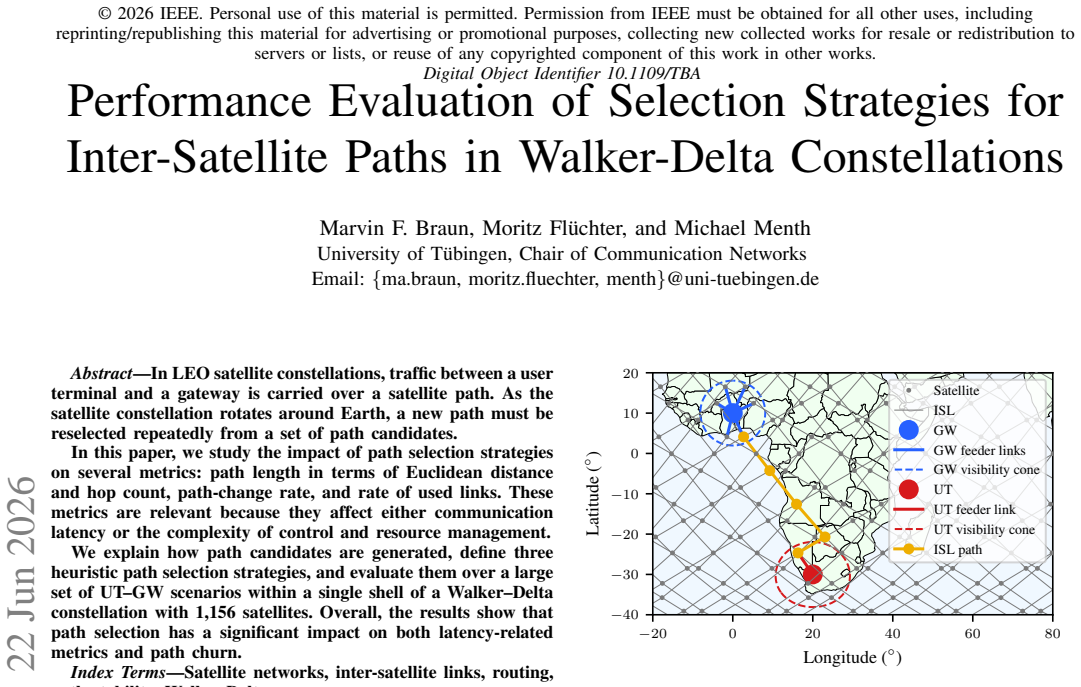
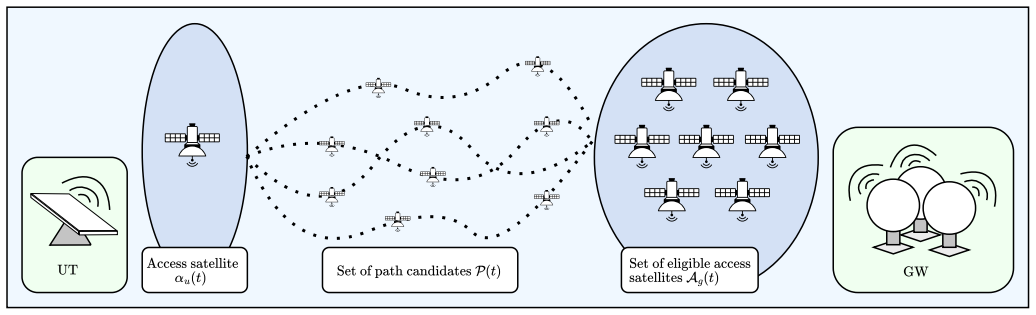
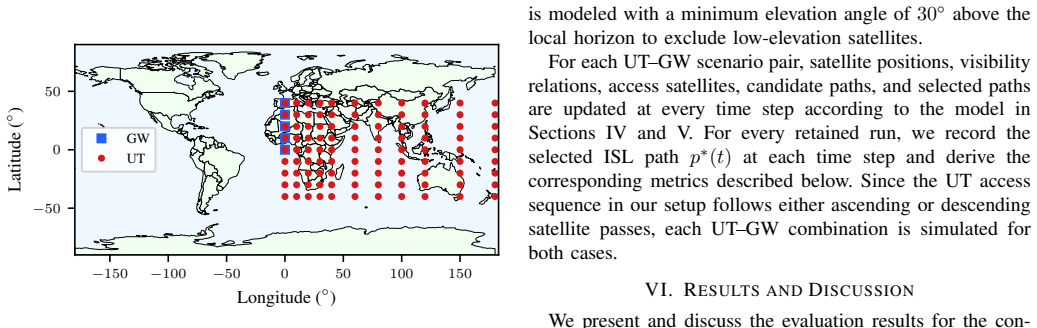
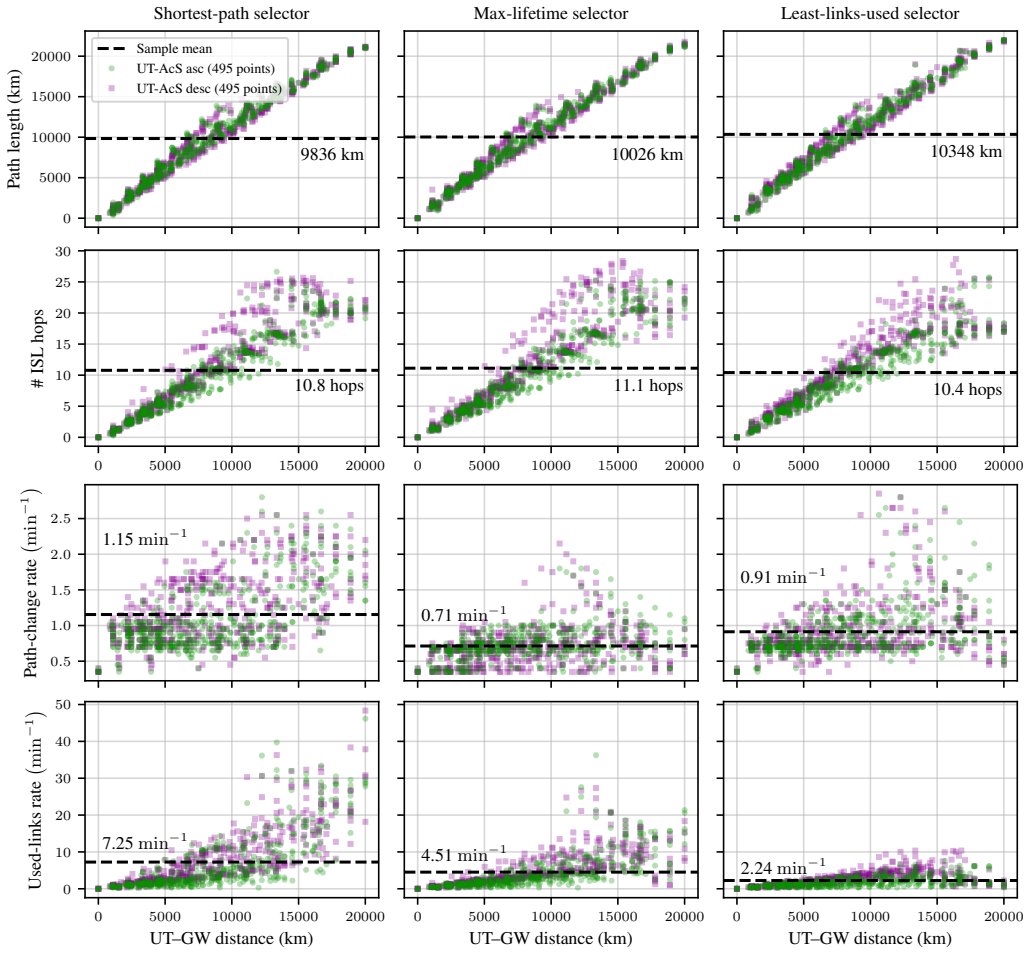
read the original abstract
In LEO satellite constellations, traffic between a user terminal and a gateway is carried over a satellite path. As the satellite constellation rotates around Earth, a new path must be reselected repeatedly from a set of path candidates. In this paper, we study the impact of path selection strategies on several metrics: path length in terms of Euclidean distance and hop count, path-change rate, and rate of used links. These metrics are relevant because they affect either communication latency or the complexity of control and resource management. We explain how path candidates are generated, define three heuristic path selection strategies, and evaluate them over a large set of UT-GW scenarios within a single shell of a Walker-Delta constellation with 1,156 satellites. Overall, the results show that path selection has a significant impact on both latency-related metrics and path churn.
Editorial analysis
A structured set of objections, weighed in public.
Referee Report
Summary. The paper claims that path selection strategies for inter-satellite paths in LEO Walker-Delta constellations significantly affect latency metrics (Euclidean distance and hop count) and churn metrics (path-change rate and used-link rate). It describes generation of path candidates, defines three heuristic selection strategies, and evaluates them across a large set of UT-GW scenarios in a single-shell 1156-satellite Walker-Delta constellation, concluding that selection choice has a significant impact on the metrics.
Significance. If the observed differences prove robust, the work would usefully illustrate how path selection influences latency and control-plane overhead in LEO networks. The scale of the simulated constellation and the focus on multiple relevant metrics are positive aspects of the empirical design.
major comments (2)
- [Abstract] Abstract: the assertion that 'the results show that path selection has a significant impact' supplies no quantitative values, confidence intervals, or statistical tests, so the magnitude and reliability of the claimed differences cannot be verified from the evidence presented.
- [Abstract] Abstract / Evaluation setup: the central claim that the observed differences generalize to operational LEO networks rests on a single fixed 1156-satellite Walker-Delta shell and three hand-crafted heuristics, with no sensitivity analysis on shell count, inclination, phasing, or traffic patterns; this untested extrapolation is load-bearing for the significance statement.
minor comments (1)
- [Abstract] Abstract: the number and distribution of the 'large set of UT-GW scenarios' are not stated; adding these details would improve reproducibility.
Simulated Author's Rebuttal
We thank the referee for the constructive comments. We address each major point below and indicate the revisions we will make to the manuscript.
read point-by-point responses
-
Referee: [Abstract] Abstract: the assertion that 'the results show that path selection has a significant impact' supplies no quantitative values, confidence intervals, or statistical tests, so the magnitude and reliability of the claimed differences cannot be verified from the evidence presented.
Authors: We agree that the abstract would be strengthened by including concrete quantitative support. In the revised version we will insert specific observed differences drawn from the simulation results (e.g., relative reductions in Euclidean distance and hop count, and ranges for path-change frequency and link utilization) together with a short statement on consistency across the evaluated UT-GW pairs. Because the underlying data already exist in the evaluation section, this change can be made without new experiments. revision: yes
-
Referee: [Abstract] Abstract / Evaluation setup: the central claim that the observed differences generalize to operational LEO networks rests on a single fixed 1156-satellite Walker-Delta shell and three hand-crafted heuristics, with no sensitivity analysis on shell count, inclination, phasing, or traffic patterns; this untested extrapolation is load-bearing for the significance statement.
Authors: The study is deliberately scoped to a single, representative 1156-satellite Walker-Delta shell; no sensitivity sweeps over shell size, inclination, or traffic patterns were performed. We will therefore revise the abstract and conclusion to qualify the claims explicitly as results for this configuration and will add a short limitations paragraph noting that extrapolation to other Walker-Delta parameters or to non-Walker-Delta constellations remains future work. This addresses the over-generalization concern without requiring additional simulation campaigns. revision: partial
Circularity Check
No circularity: empirical simulation study with no derivations or fitted predictions
full rationale
The paper is a pure empirical evaluation: it generates path candidates in a fixed 1156-satellite Walker-Delta shell, defines three hand-crafted heuristics, runs simulations over UT-GW scenarios, and reports observed differences in four metrics. No equations, parameter fitting, first-principles derivations, or predictions appear in the provided text. The central claim (path selection impacts latency and churn) rests directly on the simulation outputs rather than reducing to any self-referential construction, self-citation chain, or renamed input. This is the expected non-finding for a simulation-based comparison paper.
Axiom & Free-Parameter Ledger
Reference graph
Works this paper leans on
-
[1]
Distributed on-Demand Routing for LEO Mega-Constellations: A Starlink Case Study,
G. Stock, J. A. Fraire, and H. Hermanns, “Distributed on-Demand Routing for LEO Mega-Constellations: A Starlink Case Study,” inAd- vanced Satellite Multimedia Systems Conference and Signal Processing for Space Communications Workshop (ASMS/SPSC), 2022
2022
-
[2]
Shortest Path in LEO Satellite Constellation Networks: An Explicit Analytic Approach,
Q. Chen, L. Yang, Y . Zhao, Y . Wang, H. Zhou, and X. Chen, “Shortest Path in LEO Satellite Constellation Networks: An Explicit Analytic Approach,”IEEE Journal on Selected Areas in Communications, vol. 42, no. 5, pp. 1175–1187, 2024
2024
-
[3]
Analysis of Inter-Satellite Link Paths for LEO Mega-Constellation Networks,
Q. Chen, G. Giambene, L. Yang, C. Fan, and X. Chen, “Analysis of Inter-Satellite Link Paths for LEO Mega-Constellation Networks,”IEEE Transactions on Vehicular Technology, vol. 70, no. 3, pp. 2743–2755, 2021
2021
-
[4]
A Character- ization of Route Variability in LEO Satellite Networks,
V . Bhosale, A. Saeed, K. Bhardwaj, and A. Gavrilovska, “A Character- ization of Route Variability in LEO Satellite Networks,” inPassive and Active Measurements Conference (PAM), pp. 313–342, 2023
2023
-
[5]
Scalable Routing in Low-Earth Orbit Satellite Constellations: Architecture and Algorithms,
S. Zhang and K. L. Yeung, “Scalable Routing in Low-Earth Orbit Satellite Constellations: Architecture and Algorithms,”Computer Com- munications, vol. 188, pp. 26–38, 2022
2022
-
[6]
Time-Dependent Network Topology Optimization for Leo Satellite Constellations,
D. Ron, F. A. Yusufzai, S. Kwakye, S. Roy, N. Sastry, and V . K. Shah, “Time-Dependent Network Topology Optimization for Leo Satellite Constellations,” inIEEE Infocom, 2025
2025
-
[7]
A Novel Feeder Link Handover Strategy for Backhaul in LEO Satellite Networks,
Y . Zhou, J. Liu, R. Zhang, M. Ouyang, and T. Huang, “A Novel Feeder Link Handover Strategy for Backhaul in LEO Satellite Networks,” Sensors, vol. 23, no. 12, 2023
2023
-
[8]
Finding the K Shortest Loopless Paths in a Network,
J. Y . Yen, “Finding the K Shortest Loopless Paths in a Network,” Management Science, vol. 17, pp. 712–716, July 1971
1971
-
[9]
Exploring Network Structure, Dynamics, and Function Using NetworkX,
A. A. Hagberg, D. A. Schult, and P. J. Swart, “Exploring Network Structure, Dynamics, and Function Using NetworkX,” inPython in Science Conference (PS), pp. 11–15, 2008
2008
-
[10]
In the Matter of Kuiper Systems LLC: Request for Modification of the Authorization for the Kuiper NGSO Satellite System,
Federal Communications Commission, “In the Matter of Kuiper Systems LLC: Request for Modification of the Authorization for the Kuiper NGSO Satellite System,” Mar. 2024. DA 24-224
2024
-
[11]
Skyfield: High Precision Research-Grade Positions for Planets and Earth Satellites Generator
B. Rhodes, “Skyfield: High Precision Research-Grade Positions for Planets and Earth Satellites Generator.” Astrophysics Source Code Library, record ascl:1907.024, July 2019
1907
discussion (0)
Sign in with ORCID, Apple, or X to comment. Anyone can read and Pith papers without signing in.