The ultra-deep HI radial profiles of late-type galaxies from MHONGOOSE
Pith reviewed 2026-06-27 00:04 UTC · model grok-4.3
The pith
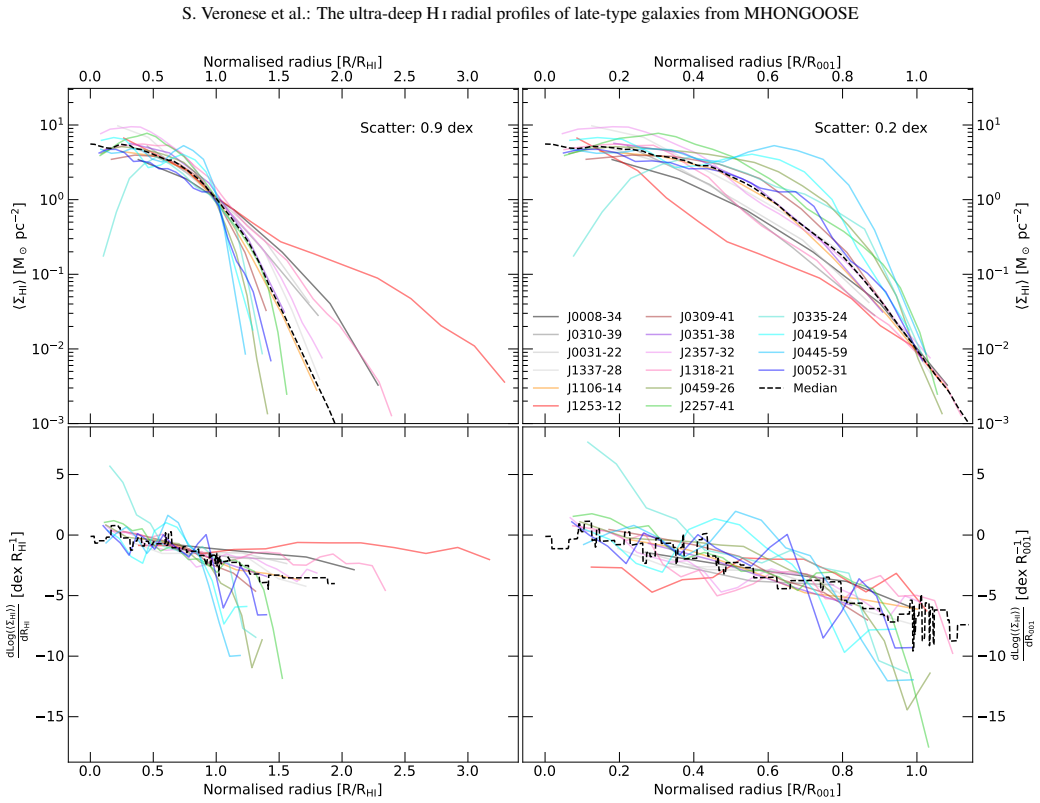
HI radial profiles of late-type galaxies become self-similar after scaling to the radius where surface density hits 0.01 solar masses per square parsec.
A machine-rendered reading of the paper's core claim, the machinery that carries it, and where it could break.
Core claim
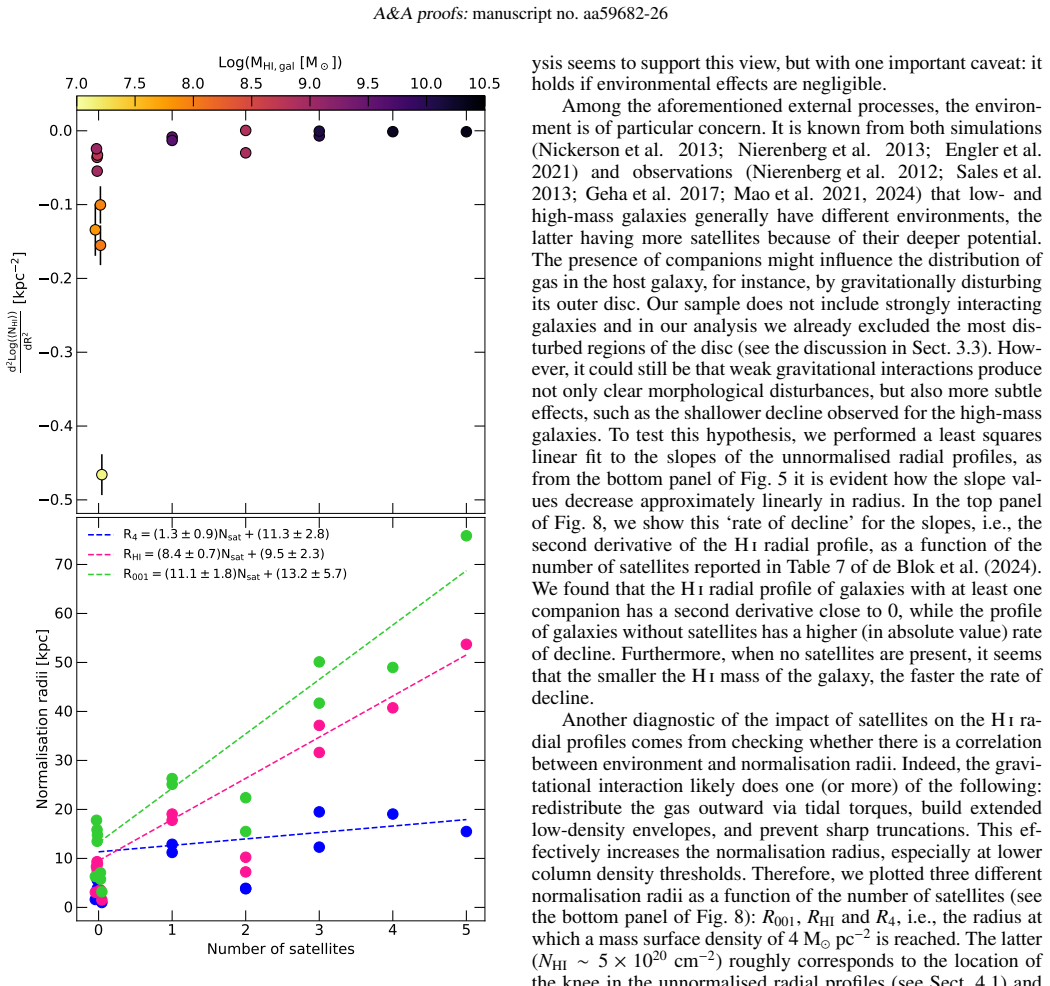
The HI radial profiles are self-similar when normalised to the radius at which a mass surface density of 0.01 M_⊙ pc^{-2} is reached. High-mass galaxies exhibit an inner plateau followed by a knee near 5 times 10^{20} cm^{-2}, while low-mass galaxies show steeper declines; no unambiguous edges appear in either case. The normalisation radius itself correlates with environment.
What carries the argument
Normalisation of each galaxy's HI profile to the radius where the azimuthally averaged surface density reaches 0.01 M_⊙ pc^{-2}, after spectral stacking reaches low column densities.
If this is right
- Diverse HI morphologies arise from a combination of internal and external processes that act differently across galaxy masses.
- No sharp truncation occurs at the classically debated column density of 10^{19} cm^{-2}.
- Environment may set the characteristic size of the HI disc in addition to internal galaxy properties.
Where Pith is reading between the lines
- If the self-similarity holds, it implies that the outer HI disc is shaped by a process whose efficiency scales with the total HI reservoir rather than with local star-formation rate.
- The suggested environmental correlation could be tested by comparing the same normalisation in isolated versus group galaxies matched in HI mass.
Load-bearing premise
Spectral stacking and inclination corrections recover the true low-column-density HI distribution without introducing biases that could create apparent self-similarity or mask real edges.
What would settle it
A larger sample in which the stacked profiles, after the same 0.01 M_⊙ pc^{-2} normalisation, fail to overlap at column densities below 10^{19} cm^{-2} would falsify the claimed self-similarity.
Figures
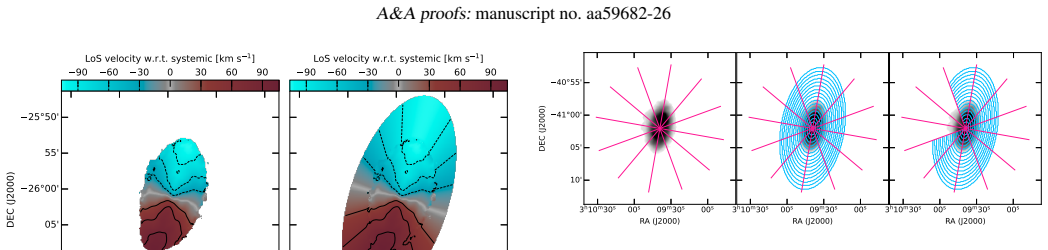
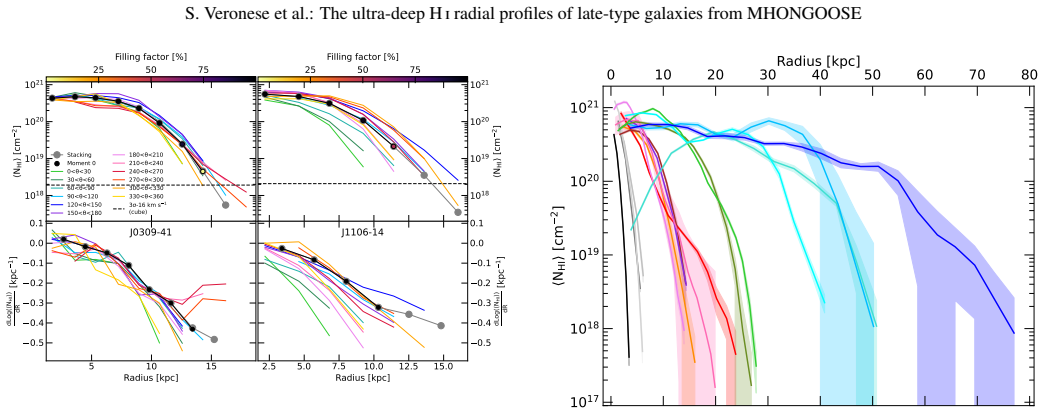
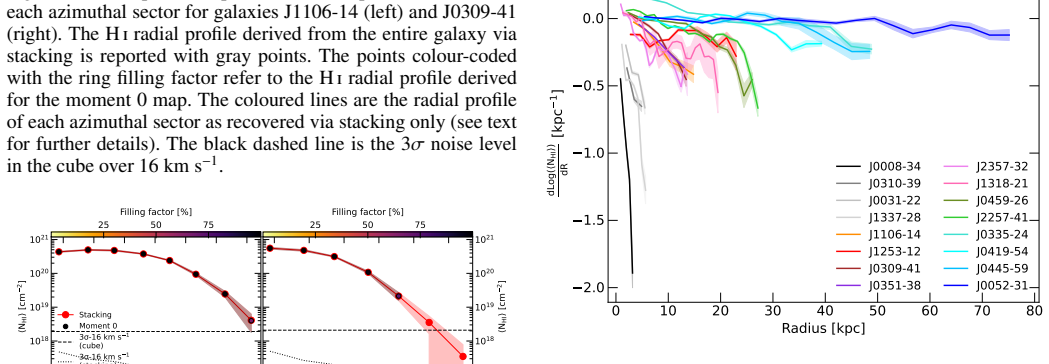

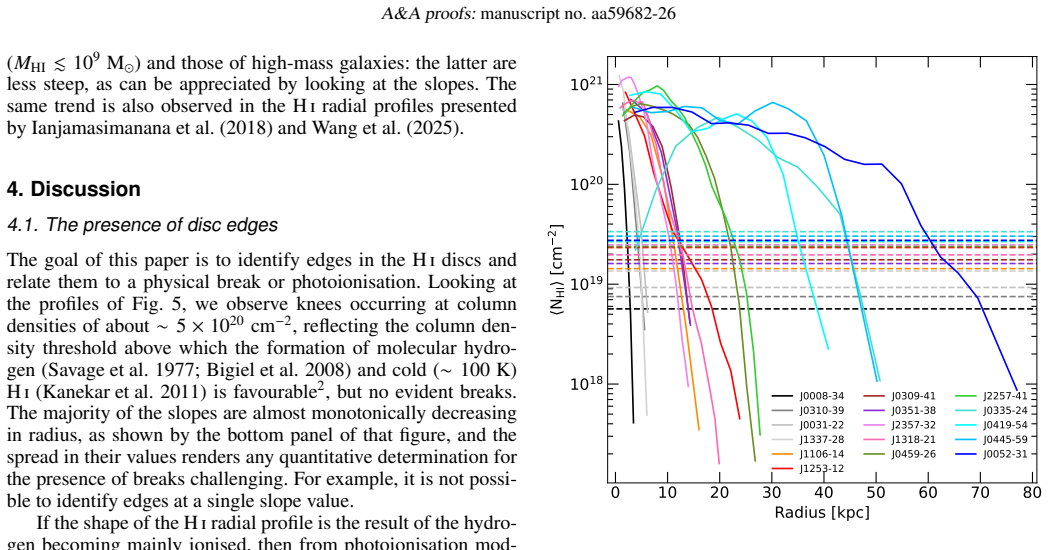
read the original abstract
Galaxy discs have a finite extent, yet how and where their neutral atomic hydrogen (HI) components end is not fully understood. The existence of a break in the HI disc at column densities of $\sim10^{19}$ cm$^{-2}$ has been debated since early 21-cm observations of the spiral galaxy NGC 3198. We present the HI radial profiles of 16 star-forming, late-type galaxies from the MeerKAT HI Observations of Nearby Galactic Objects: Observing Southern Emitters (MHONGOOSE) survey spanning a range of HI mass from $10^{7}$ M$_\odot$ to $10^{10}$ M$_\odot$. We probed via spectral stacking their HI discs down to inclination-corrected column densities of a few times $10^{17}$ cm$^{-2}$ at kpc resolution. The HI radial profiles of high-mass (M$_{\rm {HI}}>10^{9}$ M$_\odot$) galaxies are characterised by a inner plateau, followed by a knee at column densities of $\sim5\times10^{20}$ cm$^{-2}$, but no edges are unambiguously identified. The HI radial profiles of low-mass (M$_{\rm {HI}}>10^{9}$ M$_\odot$) galaxies shows a steeper decline and also no edges. We found that the profiles are self-similar when normalised to the radius at which a mass surface density of 0.01 M$_\odot$ pc$^{-2}$ is reached, in agreement with recent literature results, but we also found a possible correlation between the normalisation radius and the environment, suggesting that environment contributes to the shaping of the HI distribution in galaxies. The emerging picture is that the diverse morphology of the HI radial profiles is difficult to interpret, and future studies with a larger sample are necessary for quantifying the contribution of internal and external processes acting at different levels for different galaxies.
Editorial analysis
A structured set of objections, weighed in public.
Referee Report
Summary. The manuscript presents HI radial profiles for 16 late-type galaxies from the MHONGOOSE survey, derived via spectral stacking to reach inclination-corrected column densities of a few ×10^{17} cm^{-2} at kpc resolution. High-mass galaxies (M_HI > 10^9 M_⊙) exhibit an inner plateau and knee near 5×10^{20} cm^{-2} with no unambiguous edges; low-mass galaxies show steeper declines, also without edges. The profiles are reported to be self-similar when normalized to the radius at which the HI surface density reaches 0.01 M_⊙ pc^{-2}, consistent with recent literature, with an additional possible correlation between this normalization radius and galaxy environment.
Significance. If validated, the direct observational result would reinforce the self-similarity of HI profiles across galaxy masses when normalized at low column density and indicate a possible environmental role in shaping outer discs. The measurements are direct products with the normalization radius defined from the data itself rather than from a model, avoiding circularity.
major comments (1)
- [Abstract and Methods (spectral stacking)] Abstract and Methods (spectral stacking procedure): The self-similarity result and reported absence of edges depend on the stacked, inclination-corrected profiles faithfully recovering the true HI distribution at ~10^{17} cm^{-2}. No mock-data tests, residual maps, or comparisons to individual detections are described to quantify biases from velocity misalignment, weighting schemes, or noise thresholding that could systematically shift the normalization radius (defined at the 0.01 M_⊙ pc^{-2} contour) and thereby induce apparent self-similarity or the environment correlation.
minor comments (1)
- [Abstract] Abstract: The low-mass galaxy threshold is stated as M_HI > 10^9 M_⊙, identical to the high-mass threshold; this is evidently a typographical error (likely intended as <) that should be corrected for clarity.
Simulated Author's Rebuttal
We thank the referee for their careful and constructive review of our manuscript. We address the single major comment below and outline the revisions we will make.
read point-by-point responses
-
Referee: Abstract and Methods (spectral stacking procedure): The self-similarity result and reported absence of edges depend on the stacked, inclination-corrected profiles faithfully recovering the true HI distribution at ~10^{17} cm^{-2}. No mock-data tests, residual maps, or comparisons to individual detections are described to quantify biases from velocity misalignment, weighting schemes, or noise thresholding that could systematically shift the normalization radius (defined at the 0.01 M_⊙ pc^{-2} contour) and thereby induce apparent self-similarity or the environment correlation.
Authors: We agree that the manuscript does not describe mock-data tests, residual maps, or direct comparisons to individual detections for the spectral stacking procedure. While the stacking approach follows standard techniques applied in prior HI studies, we acknowledge that explicit validation is necessary to demonstrate that biases from velocity misalignment, weighting, or thresholding do not artificially produce the reported self-similarity or environment correlation. In the revised manuscript we will add a new subsection to the Methods section that presents mock-data simulations incorporating realistic velocity fields, noise characteristics, and weighting schemes. These tests will quantify any systematic shifts in the derived profiles at low column densities and in the normalization radius. We will also include comparisons of stacked profiles against individual detections in the brighter inner discs. These additions will directly strengthen the robustness of the self-similarity result and the suggested environmental dependence. revision: yes
Circularity Check
No significant circularity in observational derivation chain
full rationale
The paper reports direct measurements of HI radial profiles obtained via spectral stacking on MHONGOOSE data, with the normalization radius defined empirically as the observed radius where the surface density reaches 0.01 M⊙ pc^{-2}. Self-similarity is presented as an empirical finding after this data-driven rescaling, with no model equations, fitted parameters renamed as predictions, or load-bearing self-citations that reduce the central claim to its own inputs by construction. The derivation consists of observational processing steps that remain independent of the reported similarity result.
Axiom & Free-Parameter Ledger
free parameters (1)
- normalization surface density threshold
axioms (2)
- domain assumption Inclination corrections accurately convert observed column densities to face-on values without residual projection effects at large radii.
- domain assumption Spectral stacking recovers the azimuthally averaged radial profile without significant flux loss or bias from velocity gradients or noise properties.
Reference graph
Works this paper leans on
-
[1]
2023, , 947, 16
Amiri , M., Bandura , K., Chen , T., et al. 2023, , 947, 16
2023
-
[2]
2019, , 622, A64
Bacchini , C., Fraternali , F., Iorio , G., & Pezzulli , G. 2019, , 622, A64
2019
-
[3]
Begeman , K. G. 1987, PhD thesis, -
1987
-
[4]
N., & Bagla , J
Bera , A., Kanekar , N., Chengalur , J. N., & Bagla , J. S. 2023, , 950, L18
2023
-
[5]
2008, , 136, 2846
Bigiel , F., Leroy , A., Walter , F., et al. 2008, , 136, 2846
2008
-
[6]
R., Stephens , A., Zovaro , A., & Popping , A
Bland-Hawthorn , J., Maloney , P. R., Stephens , A., Zovaro , A., & Popping , A. 2017, , 849, 51
2017
-
[7]
& Thilker , D
Braun , R. & Thilker , D. A. 2004, , 417, 421
2004
-
[8]
Broeils , A. H. & Rhee , M. H. 1997, , 324, 877
1997
-
[9]
N., Braun , R., & Wieringa , M
Chengalur , J. N., Braun , R., & Wieringa , M. 2001, , 372, 768
2001
-
[10]
Chowdhury , A., Kanekar , N., & Chengalur , J. N. 2022, , 937, 103
2022
-
[11]
G., Salo , H., et al
Comer \'o n , S., Elmegreen , B. G., Salo , H., et al. 2012, , 759, 98
2012
-
[12]
& Bandiera , R
Corbelli , E. & Bandiera , R. 2002, , 567, 712
2002
-
[13]
de Blok , W. J. G., Healy , J., Maccagni , F. M., et al. 2024, , 688, A109
2024
-
[14]
de Blok , W. J. G., van der Hulst , J. M., & Bothun , G. D. 1995, , 274, 235
1995
-
[15]
& van der Kruit , P
de Grijs , R. & van der Kruit , P. C. 1996, , 117, 19
1996
-
[16]
de Jong , R. S. 1996, , 313, 45
1996
-
[17]
J., Staveley-Smith , L., & Boyle , B
Delhaize , J., Meyer , M. J., Staveley-Smith , L., & Boyle , B. J. 2013, , 433, 1398
2013
-
[18]
Di Teodoro , E. M. & Fraternali , F. 2015, , 451, 3021
2015
-
[19]
Di Teodoro , E. M. & Peek , J. E. G. 2021, , 923, 220
2021
-
[20]
Dove , J. B. & Shull , J. M. 1994, , 423, 196
1994
-
[21]
L., Fertig , D., Rosenberg , J
Ellison , S. L., Fertig , D., Rosenberg , J. L., et al. 2015, , 448, 221
2015
-
[22]
2021, , 507, 4211
Engler , C., Pillepich , A., Pasquali , A., et al. 2021, , 507, 4211
2021
-
[23]
English , J., Richardson , M. L. A., Ferrand , G., & Deg , N. 2024, CosmosCanvas: Useful color maps for different astrophysical properties , Astrophysics Source Code Library, record ascl:2401.005
2024
-
[24]
2011, , 411, 993
Fabello , S., Catinella , B., Giovanelli , R., et al. 2011, , 411, 993
2011
-
[25]
F., Kere s , D., et al
Faucher-Gigu \`e re , C.-A., Hopkins , P. F., Kere s , D., et al. 2015, , 449, 987
2015
-
[26]
2009, , 703, 1416
Faucher-Gigu \`e re , C.-A., Lidz , A., Zaldarriaga , M., & Hernquist , L. 2009, , 703, 1416
2009
-
[27]
& Oh , S
Faucher-Gigu \`e re , C.-A. & Oh , S. P. 2023, , 61, 131
2023
-
[28]
Freeman , K. C. 1970, , 160, 811
1970
-
[29]
2002, , 394, 769
Garc \' a-Ruiz , I., Sancisi , R., & Kuijken , K. 2002, , 394, 769
2002
-
[30]
H., Mao , Y.-Y., et al
Geha , M., Wechsler , R. H., Mao , Y.-Y., et al. 2017, , 847, 4
2017
-
[31]
Gentile , G., J \'o zsa , G. I. G., Serra , P., et al. 2013, , 554, A125
2013
-
[32]
& Madau , P
Haardt , F. & Madau , P. 2012, , 746, 125
2012
-
[33]
2011, , 526, A118
Heald , G., J \'o zsa , G., Serra , P., et al. 2011, , 526, A118
2011
-
[34]
L., Elson , E., et al
Healy , J., Blyth , S. L., Elson , E., et al. 2019, , 487, 4901
2019
-
[35]
L., Verheijen , M
Healy , J., Blyth , S. L., Verheijen , M. A. W., et al. 2021, , 650, A76
2021
-
[36]
Healy , J., de Blok , W. J. G., Maccagni , F. M., et al. 2024, , 687, A254
2024
-
[37]
Högbom , J. A. & Brouw , W. N. 1974, , 33, 289
1974
-
[38]
Ianjamasimanana , R., de Blok , W. J. G., Walter , F., & Heald , G. H. 2012, , 144, 96
2012
-
[39]
Ianjamasimanana , R., Walter , F., de Blok , W. J. G., Heald , G. H., & Brinks , E. 2018, , 155, 233
2018
-
[40]
Jewell , P. R. & Prestage , R. M. 2004, in Society of Photo-Optical Instrumentation Engineers (SPIE) Conference Series, Vol. 5489, Ground-based Telescopes, ed. J. M. Oschmann , Jr., 312--323
2004
-
[41]
2019, Science China Physics, Mechanics, and Astronomy, 62, 959502
Jiang , P., Yue , Y., Gan , H., et al. 2019, Science China Physics, Mechanics, and Astronomy, 62, 959502
2019
-
[42]
& MeerKAT Team
Jonas , J. & MeerKAT Team . 2016, in MeerKAT Science: On the Pathway to the SKA, 1
2016
-
[43]
J \'o zsa , G. I. G., White , S. V., Thorat , K., et al. 2020, CARACal: Containerized Automated Radio Astronomy Calibration pipeline , Astrophysics Source Code Library, record ascl:2006.014
2020
-
[44]
2011, , 737, L33
Kanekar , N., Braun , R., & Roy , N. 2011, , 737, L33
2011
-
[45]
Kanekar , N., Sethi , S., & Dwarakanath , K. S. 2016, , 818, L28
2016
-
[46]
K., Di Matteo , T., et al
Khandai , N., Sethi , S. K., Di Matteo , T., et al. 2011, , 415, 2580
2011
-
[47]
C., & de Grijs , R
Kregel , M., van der Kruit , P. C., & de Grijs , R. 2002, , 334, 646
2002
-
[48]
K., Walter , F., Brinks , E., et al
Leroy , A. K., Walter , F., Brinks , E., et al. 2008, , 136, 2782
2008
-
[49]
2025, , 982, 151
Lin , X., Wang , J., Staveley-Smith , L., et al. 2025, , 982, 151
2025
- [50]
-
[51]
& Haardt , F
Madau , P. & Haardt , F. 2015, , 813, L8
2015
-
[52]
M., Blyth , S
Maddox , N., Hess , K. M., Blyth , S. L., & Jarvis , M. J. 2013, , 433, 2613
2013
-
[53]
1993, , 414, 41
Maloney , P. 1993, , 414, 41
1993
-
[54]
E., Fraternali , F., Oman , K
Mancera Pi \ n a , P. E., Fraternali , F., Oman , K. A., et al. 2020, , 495, 3636
2020
-
[55]
E., Fraternali , F., Oosterloo , T., et al
Mancera Pi \ n a , P. E., Fraternali , F., Oosterloo , T., et al. 2022, , 512, 3230
2022
-
[56]
H., et al
Mao , Y.-Y., Geha , M., Wechsler , R. H., et al. 2024, , 976, 117
2024
-
[57]
H., et al
Mao , Y.-Y., Geha , M., Wechsler , R. H., et al. 2021, , 907, 85
2021
-
[58]
Marasco , A., de Blok , W. J. G., Maccagni , F. M., et al. 2025, , 697, A86
2025
-
[59]
Mart \' nez-Lombilla , C., Trujillo , I., & Knapen , J. H. 2019, , 483, 664
2019
-
[60]
K., Alonso-Garc \' a , J., Lucas , P
Minniti , D., Saito , R. K., Alonso-Garc \' a , J., Lucas , P. W., & Hempel , M. 2011, , 733, L43
2011
-
[61]
S., Bigiel , F., et al
Neumann , L., den Brok , J. S., Bigiel , F., et al. 2023, , 675, A104
2023
-
[62]
Nickerson , S., Stinson , G., Couchman , H. M. P., Bailin , J., & Wadsley , J. 2013, , 429, 452
2013
-
[63]
M., Auger , M
Nierenberg , A. M., Auger , M. W., Treu , T., et al. 2012, , 752, 99
2012
-
[64]
M., Treu , T., Menci , N., Lu , Y., & Wang , W
Nierenberg , A. M., Treu , T., Menci , N., Lu , Y., & Wang , W. 2013, , 772, 146
2013
-
[65]
R., McKinley , B., Hurley-Walker , N., et al
Offringa , A. R., McKinley , B., Hurley-Walker , N., et al. 2014, , 444, 606
2014
-
[66]
Offringa , A. R. & Smirnov , O. 2017, , 471, 301
2017
-
[67]
A., Brinks , E., et al
Oh , S.-H., Hunter , D. A., Brinks , E., et al. 2015, , 149, 180
2015
-
[68]
& Howk , J
P \'e roux , C. & Howk , J. C. 2020, , 58, 363
2020
-
[69]
Pisano , D. J. 2014, , 147, 48
2014
-
[70]
& Trujillo , I
Pohlen , M. & Trujillo , I. 2006, , 454, 759
2006
-
[71]
Popping , A., Dav \'e , R., Braun , R., & Oppenheimer , B. D. 2009, , 504, 15
2009
-
[72]
2021, , 647, A1
Predehl , P., Andritschke , R., Arefiev , V., et al. 2021, , 647, A1
2021
-
[73]
E., Peek , J
Putman , M. E., Peek , J. E. G., & Joung , M. R. 2012, , 50, 491
2012
-
[74]
H., Rai c evi \'c , M., & Schaye , J
Rahmati , A., Pawlik , A. H., Rai c evi \'c , M., & Schaye , J. 2013, , 430, 2427
2013
-
[75]
Rajohnson , S. H. A., Frank , B. S., Ponomareva , A. A., et al. 2022, , 512, 2697
2022
-
[76]
& Del Popolo , A
Saburova , A. & Del Popolo , A. 2014, , 445, 3512
2014
-
[77]
& Catinella , B
Saintonge , A. & Catinella , B. 2022, , 60, 319
2022
-
[78]
V., Wang , W., White , S
Sales , L. V., Wang , W., White , S. D. M., & Navarro , J. F. 2013, , 428, 573
2013
-
[79]
J., Pingel , N
Sardone , A., Pisano , D. J., Pingel , N. M., et al. 2021, , 910, 69
2021
-
[80]
D., Bohlin , R
Savage , B. D., Bohlin , R. C., Drake , J. F., & Budich , W. 1977, , 216, 291
1977
discussion (0)
Sign in with ORCID, Apple, or X to comment. Anyone can read and Pith papers without signing in.