REVIEW 3 major objections 6 minor 82 references
Semi-analytical Light Curve Model for Transients Preceding Binary Mergers. I: Supernova Precursor Emission from Compact Object Companions
T0 review · 3 major / 6 minor · reviewed 2026-08-01 · deepseek-v4-flash
Pith's one-line read A semi-analytical model reconstructs the mass-transfer history of merging binaries from years-long supernova precursor light curves and temperatures.
desk verdict A useful and honest semi-analytical framework for SN precursors, but the 'mass-transfer history inference' is really a fit to an assumed two-stage shape until synthetic-data validation shows otherwise. read the letter →
The pith
A machine-rendered reading of the paper's core claim, the machinery that carries it, and where it could break.
The reading
What carries the argument
The load-bearing object is the quasi-spherical optically thick wind. Two radii set the emission: the trapping radius, where the diffusion time equals expansion time and most luminosity escapes, and the thermalization radius, where radiation and gas decouple (found with a bound-free/free-free absorption opacity with a recombination cutoff); the observed temperature is the wind temperature at the larger radius. The mass-transfer history is prescribed as a constant rate followed by a power-law rise (t_m - t)^(-δ), with δ tied to the donor's envelope structure, and dust reddening is added through a sublimation radius. This maps observed luminosity and temperature to the binary's mass-transfer ra
What would settle it
The model predicts that a precursor's color temperature should fall as the wind becomes denser (constant or rising luminosity with falling temperature). A precursor whose multi-band photometry shows temperature rising alongside luminosity, or whose radio-inferred mass-loss rate differs from the model-reconstructed Mdot by much more than the factor of a few the paper already attributes to asymmetry in SN 2023fyq, would contradict the quasi-spherical, optically thick wind assumption.
Extended reading notes
Core claim
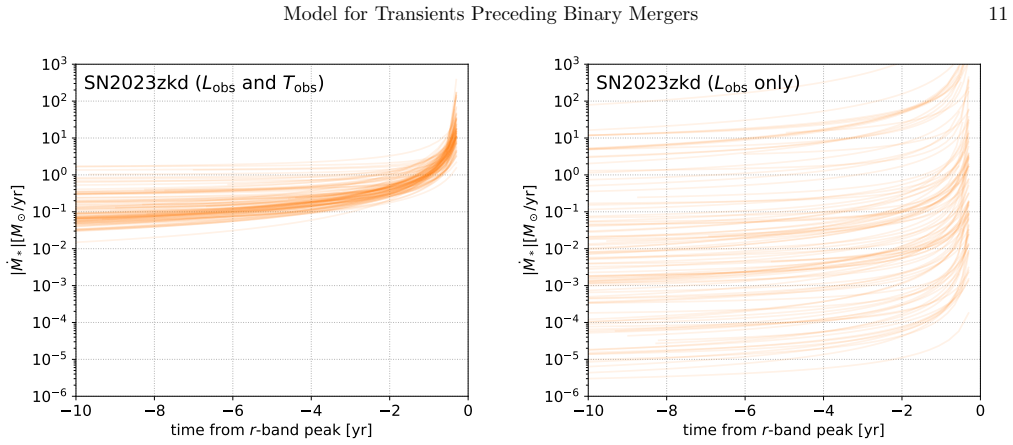
The paper's central claim is that years-long supernova precursors are powered by unstable mass transfer onto a compact object, and that the light curve is the emission of an optically thick wind reprocessing accretion power. Solving the wind shell by shell shows luminosity is set at the trapping radius; temperature is set at the thermalization radius. Because temperature traces mass-transfer rate divided by wind velocity while luminosity traces their product, the pair breaks the degeneracy between them. Applied to three real precursors, the model recovers mass-transfer histories that rise toward merger with total masses matching the inferred circumstellar material.
Load-bearing premise
The model assumes the erupted material forms a roughly spherical, opaque wind whose flow rate stays flat for years and then surges as a single steepening curve right up to the moment of merger; if the flow is lumpy, lopsided, or ramps up differently early on, every inferred mass-transfer history and donor property would be off.
Editorial extensions
If this is right
- Precursor light curves of interacting supernovae can be inverted to recover the mass-transfer history of the pre-merger binary, giving the mass-loss rate and total mass shed in the final years.
- Temperature information (multi-band photometry or spectroscopy) is what breaks the degeneracy between mass-transfer rate and accretion efficiency; bolometric-only fits leave the mass-loss history poorly constrained.
- The three fitted events favor evolved, giant-like donors with black hole companions for the Type IIn cases and a low-mass helium star with a neutron star for the Type Ibn case.
- The double-peaked morphology shared by these events is explained as a delay between the compact object's plunge-in and the final explosion, with a prediction of at most two well-separated peaks.
- The model applies directly to the large sample of precursors expected from next-generation sky surveys, where dimmer events with lower-mass donors or neutron star companions should be far more numerous.
Reading between the lines
- Editorial: if the assumed two-stage mass-transfer law is generic, the shape of the late rising light curve directly measures the donor envelope's polytropic index (δ = 1 + 2/(2n+1)), turning a survey of precursors into a population-level measurement of donor structure.
- Editorial: the model's dust treatment implies a sharp drop in optical dust optical depth as the precursor brightens near merger—an infrared signature that could be tested with targeted follow-up observations of future precursors.
- Editorial: the same wind-reprocessing framework could be adapted to other long-rising transients (e.g., luminous red novae), but for those the donor's own emission and gas pressure would need to be included, as the authors themselves note.
Editorial analysis
A structured set of objections, weighed in public.
Referee Report
Summary. This manuscript constructs a semi-analytical model for long-rising optical precursors of binary mergers with compact-object accretors. The model assumes a quasi-spherical, optically thick wind reprocessing accretion power; the mass-transfer history is parameterized as a constant plateau followed by a power-law divergence (Eq. 6). It includes dust extinction and computes luminosity and temperature, with eight free parameters. The model is fit via MCMC to three observed SN precursors (SN 2023zkd, 2023fyq, 2021qqp), yielding reconstructed mass-transfer histories and progenitor interpretations. The code is publicly available.
Significance. The paper addresses a timely problem: interpreting a growing sample of long-rising precursors of interacting SNe as unstable mass transfer onto compact objects. Its strengths include a transparent, semi-analytical formalism; a public implementation; joint use of luminosity and temperature to break the Mdot-epsilon degeneracy; and honest confrontation with external data (e.g., CSM mass for 2023zkd; radio mass-loss estimates for 2023fyq). If the inference is robust, this is a valuable framework for LSST-era events. The principal caveat is that the 'inferred mass-transfer history' is a projection onto the assumed functional form of Eq. (6), and no synthetic-data test demonstrates recovery of other shapes. This is addressable and does not invalidate the model as a forward model.
major comments (3)
- [§2.1, Eq. (6); §5] The central claim of the abstract and §5 — that the method infers the mass-transfer history — is conditioned on the assumed two-stage form of |Mdot(t)| in Eq. (6). The MCMC only explores the parameters of this prescribed curve, so the reconstructed Mdot(t) is not a free-form inference. This matters because §4.4 uses the reconstructed Mdot in Eq. (7) to derive donor properties (e.g., R*~100 Rsun, M*~10s Msun for the Type IIn events; He-star+NS for 2023fyq). No synthetic-data experiment is shown in which an Mdot(t) with a different early-time behavior is injected and recovered. I recommend either adding such a validation (e.g., injecting a two-plateau or exponential-rise history and checking posteriors) or explicitly limiting the claim in the abstract and §5 to 'constraining parameters within the assumed family.' This is the most load-bearing point.
- [§4.1, Table 2, Figure 5] For SN 2023zkd, the fit uses five blackbody epochs (Figure 5; ten scalar measurements) against eight free parameters (Table 2). The corner plot (Figure 10) shows weak constraints on tMT (-19.3 +7.6/-5.8 yr) and broad posteriors on several parameters. The reconstructed history in Figure 6 is therefore strongly influenced by the prior shape of Eq. (6). A cross-validation check, an information criterion, or a statement of effective degrees of freedom would make the 'capability' claim more convincing. This is related to Major Comment 1 and could be addressed in the same validation.
- [§2.3–2.4, §3.3] The luminosity-temperature mapping assumes a quasi-spherical wind, but §3.3 acknowledges that the L2 outflow may be equatorial and that the light curve could then be two-component. The current version does not quantify how much an asymmetric geometry biases the inferred Mdot(t) or the donor properties in §4.4. Because the abstract claims a general capability, the authors should either add a simple anisotropy study or qualify the claim in the abstract and §5 to the quasi-spherical case.
minor comments (6)
- [§4] Duplicate 'our' in 'our our light curve model'.
- [§5] Typo: 'currect model' should be 'current model'.
- [Table 2] The prior range for tMT appears as '[-104 days, first detection]'; should read '[-10^4 days, first detection]'.
- [Eq. (25)] Kramer's opacity' should be 'Kramers' opacity' for consistency with §2.6.
- [Figure 9] The g-band residuals near t≈-1.8 yr are attributed to weighting toward the many ramp-up points; showing the weights or residuals explicitly would improve transparency.
- [Eq. (33)] The inverse formula uses the positive branch of the square root; the authors should state the range of color over which this branch is valid.
Circularity Check
No significant circularity: the paper is a conditional inverse-modeling analysis, not a self-referential derivation.
full rationale
I checked the derivation chain. The mass-transfer history is introduced as an assumed parametric form in Eq. (6), |Mdot*(t)| = Mdot0[1 + ((tm-t0)/(tm-t))^delta], and the MCMC fits its parameters to external Lobs/Tobs data. The reconstructed histories in Figures 6, 8, and 9 are posterior draws from that same parametric family, so the inference is conditional on the model; but this is standard model-based inference and not a circular reduction, because the data genuinely constrain the parameters and the paper explicitly frames the work as an inverse problem (§5: 'our work has been limited to an inverse problem approach') with forward modeling deferred. The luminosity-temperature mapping (§2.3–2.4) follows the external framework of Piro & Lu (2020) with opacity and dust inputs; it is not derived from the assumed Mdot shape. External consistency checks are also made, e.g. the CSM mass for SN 2023zkd is 'not imposed in our model' (§4.1), and the radio-based mass-loss estimate for SN 2023fyq is compared and its discrepancy discussed (§4.2). Self-citations to Tsuna et al. (2024) motivate the scenario and expected parameter ranges (§3.1) but are not used as a uniqueness theorem, ansatz source, or load-bearing derivation step; the power-law mass-transfer divergence is cited to Webbink (1977) and Pejcha (2014). The lack of synthetic-data validation against alternative Mdot(t) shapes is a validation limitation, not circularity.
Assumptions & free parameters
free parameters (8)
- log10 Mdot0 (M_sun/yr) =
-1.29 / -1.57 / -1.59 (SN2023zkd/2023fyq/2021qqp)
- tMT (yr) =
-19.3 / -16.0 / -17.5
- t0 (yr) =
-6.36 / -0.17 / -4.11
- tm (day) =
-51.8 / -7.8 / -18.2
- delta =
1.50 / 1.51 / 1.45 (posterior medians)
- log10 rin (cm) =
12.67 / 12.86 / 12.69
- log10 eps_acc,0 =
-3.68 / -4.07 / -3.75
- n_acc =
-0.18 / -0.30 / -0.28
assumptions (5)
- domain assumption Mass-transfer rate follows Eq. (6): constant Mdot0 before t0, then ∝(t_m - t)^-delta
- domain assumption Outflow is quasi-spherical, optically thick wind launched at radius r_in with half the accretion power in internal energy
- ad hoc to paper Accretion efficiency follows eps_acc = eps_acc,0 (|Mdot|/Mdot0)^n_acc with constant n_acc
- ad hoc to paper Kramers opacity with sharp cutoff beta=15 at recombination temperature Tc
- domain assumption Dust sublimation and color-temperature conversion via Eq. (32) fitted to SNEC tables
Cite this review
Pith. "Pith review of Semi-analytical Light Curve Model for Transients Preceding Binary Mergers. I: Supernova Precursor Emission from Compact Object Companions." pith.science (2026). https://pith.science/paper/O4PQDUHR
@misc{pith2026260720599,
  author       = {Pith},
  title        = {Pith review of: Semi-analytical Light Curve Model for Transients Preceding Binary Mergers. I: Supernova Precursor Emission from Compact Object Companions},
  year         = {2026},
  howpublished = {\url{https://pith.science/paper/O4PQDUHR}},
  note         = {Machine review of arXiv:2607.20599}
}
read the original abstract
A binary undergoing dynamically unstable mass transfer could rapidly shrink its orbit and lead to a merger, with the whole process often observable in human timescales. We construct a semi-analytical light curve model of binary systems composed of a star and a compact object accretor, that would display long-rising accretion-powered emission prior to a final merger-driven explosion. We apply the model to the precursors of interacting supernovae (SNe) that display long-rising light curves of years, SN 2023zkd, 2023fyq and 2021qqp, demonstrating the model's capability of inferring the mass-transfer history and constraining the progenitor binary system. The model and the parameter inference framework, encapsulated in a publicly-released script, can be applied to existing long-rising precursors of SNe as well as many SN precursors to be discovered by surveys like those from the Vera C. Rubin Observatory.
Figures


Figures from the paper (9 more)




Reference graph
Works this paper leans on
-
[1]
Abbott, B. P., Abbott, R., Abbott, T. D., et al. 2018, Phys. Rev. Lett., 121, 161101, doi:10.1103/PhysRevLett.121.161101
-
[2]
Andrews, J. J., Bavera, S. S., Briel, M., et al. 2025, ApJS, 281, 3, doi:10.3847/1538-4365/adfb78
-
[3]
J., N., Jacobson-Gal´ an, W., et al
Baer-Way, R., A. J., N., Jacobson-Gal´ an, W., et al. 2025, ApJ, 995, L49, doi:10.3847/2041-8213/ae1cb8
-
[4]
Begelman, M. C. 1979, MNRAS, 187, 237, doi:10.1093/mnras/187.2.237
-
[5]
Belczynski, K., Bulik, T., Fryer, C. L., et al. 2010, ApJ, 714, 1217, doi:10.1088/0004-637X/714/2/1217
-
[6]
2017, ApJ, 834, 107, doi:10.3847/1538-4357/834/2/107
Blagorodnova, N., Kotak, R., Polshaw, J., et al. 2017, ApJ, 834, 107, doi:10.3847/1538-4357/834/2/107
-
[7]
Blandford, R. D., & Znajek, R. L. 1977, MNRAS, 179, 433, doi:10.1093/mnras/179.3.433
-
[8]
J., Sollerman, J., Irani, I., et al
Brennan, S. J., Sollerman, J., Irani, I., et al. 2024, A&A, 684, L18, doi:10.1051/0004-6361/202449350
Show all 82 references
-
[9]
2026, ApJ, 1004, L37, doi:10.3847/2041-8213/ae734e
Cai, Y.-Z., Pastorello, A., Chiba, R., et al. 2026, ApJ, 1004, L37, doi:10.3847/2041-8213/ae734e
2026 doi
-
[10]
Chevalier, R. A. 2012, ApJ, 752, L2, doi:10.1088/2041-8205/752/1/L2
2012 doi
-
[11]
S., Narayan, R., Su, K.-Y., & Natarajan, P
Cho, H., Prather, B. S., Narayan, R., Su, K.-Y., & Natarajan, P. 2025, ApJ, 995, 122, doi:10.3847/1538-4357/ae1fdb
2025 doi
-
[12]
S., Su, K.-Y., Narayan, R., & Natarajan, P
Cho, H., Prather, B. S., Su, K.-Y., Narayan, R., & Natarajan, P. 2024, ApJ, 977, 200, doi:10.3847/1538-4357/ad9561 De Marco, O., & Izzard, R. G. 2017, PASA, 34, e001, doi:10.1017/pasa.2016.52
2024 doi
-
[13]
J., & Kuncarayakti, H
Dessart, L., Hillier, D. J., & Kuncarayakti, H. 2022, A&A, 658, A130, doi:10.1051/0004-6361/202142436
2022 doi
-
[14]
2024, ApJ, 977, 254, doi:10.3847/1538-4357/ad8de6
Dong, Y., Tsuna, D., Valenti, S., et al. 2024, ApJ, 977, 254, doi:10.3847/1538-4357/ad8de6
2024 doi
-
[15]
A., et al
Dong, Y., de Soto, K., Villar, V. A., et al. 2025, ApJ, 994, L8, doi:10.3847/2041-8213/ae1837
2025 doi
-
[16]
Draine, B. T. 2011, Physics of the Interstellar and Intergalactic Medium Duchˆ ene, G., & Kraus, A. 2013, ARA&A, 51, 269, doi:10.1146/annurev-astro-081710-102602
2011 doi
-
[17]
2024, A&A, 685, A58, doi:10.1051/0004-6361/202347646 —
Ercolino, A., Jin, H., Langer, N., & Dessart, L. 2024, A&A, 685, A58, doi:10.1051/0004-6361/202347646 —. 2025, A&A, 696, A103, doi:10.1051/0004-6361/202453426
2024 doi
-
[18]
2019, ApJ, 879, 20, doi:10.3847/1538-4357/ab218a
Faran, T., Goldfriend, T., Nakar, E., & Sari, R. 2019, ApJ, 879, 20, doi:10.3847/1538-4357/ab218a
2019 doi
-
[19]
W., Lang, D., & Goodman, J
Foreman-Mackey, D., Hogg, D. W., Lang, D., & Goodman, J. 2013, PASP, 125, 306, doi:10.1086/670067
2013 doi
-
[20]
2022, MNRAS, 511, 3951, doi:10.1093/mnras/stac317
Fuller, J., & Lu, W. 2022, MNRAS, 511, 3951, doi:10.1093/mnras/stac317
2022 doi
-
[21]
2019, ApJ, 881, L1, doi:10.3847/2041-8213/ab339b
Fuller, J., & Ma, L. 2019, ApJ, 881, L1, doi:10.3847/2041-8213/ab339b
2019 doi
-
[22]
A., et al
Gagliano, A., Berger, E., Villar, V. A., et al. 2025a, ApJ, 978, 110, doi:10.3847/1538-4357/ad9748
-
[23]
A., Matsumoto, T., et al
Gagliano, A., Villar, V. A., Matsumoto, T., et al. 2025b, ApJ, 989, 182, doi:10.3847/1538-4357/adea38
-
[24]
F., Chen, X., & Han, Z
Ge, H., Webbink, R. F., Chen, X., & Han, Z. 2015, ApJ, 812, 40, doi:10.1088/0004-637X/812/1/40 G¨ otberg, Y., de Mink, S. E., & Groh, J. H. 2017, A&A, 608, A11, doi:10.1051/0004-6361/201730472
2015 doi
-
[25]
M., Quataert, E., & Kim, C.-G
Guo, M., Stone, J. M., Quataert, E., & Kim, C.-G. 2024, ApJ, 973, 141, doi:10.3847/1538-4357/ad5fe7
2024 doi
-
[26]
M., Quataert, E., & Springel, V
Guo, M., Stone, J. M., Quataert, E., & Springel, V. 2025, ApJ, 987, 202, doi:10.3847/1538-4357/add1da
2025 doi
-
[27]
Henneco, J., Schneider, F. R. N., & Laplace, E. 2024, A&A, 682, A169, doi:10.1051/0004-6361/202347893 16 Tsuna et al. log M0 [M /yr] = 1.29+0.60 0.56 25 20 15 10 5 tMT [yr] tMT [yr] = 19.28+7.58 5.76 24 18 12 6 t0 [yr] t0 [yr] = 6.36+4.43 8.42 120 90 60 30 tm [day] tm [day] = ...
2024 doi
-
[28]
2024, ApJ, 964, 181, doi:10.3847/1538-4357/ad2854
Hiramatsu, D., Matsumoto, T., Berger, E., et al. 2024, ApJ, 964, 181, doi:10.3847/1538-4357/ad2854
2024 doi
-
[29]
S., & Webbink, R
Hjellming, M. S., & Webbink, R. F. 1987, ApJ, 318, 794, doi:10.1086/165412
1987 doi
- [30]
-
[31]
K., Hashimoto, T., Chihara, H., & Koike, C
Inoue, A. K., Hashimoto, T., Chihara, H., & Koike, C. 2020, MNRAS, 495, 1577, doi:10.1093/mnras/staa1203
2020 doi
-
[32]
2013, A&A Rev., 21, 59, doi:10.1007/s00159-013-0059-2 Ivezi´ c,ˇZ., Kahn, S
Ivanova, N., Justham, S., Chen, X., et al. 2013, A&A Rev., 21, 59, doi:10.1007/s00159-013-0059-2 Ivezi´ c,ˇZ., Kahn, S. M., Tyson, J. A., et al. 2019, ApJ, 873, 111, doi:10.3847/1538-4357/ab042c
2013 doi
-
[33]
M., & Davis, S
Jiang, Y.-F., Stone, J. M., & Davis, S. W. 2014, ApJ, 796, 106, doi:10.1088/0004-637X/796/2/106
2014 doi
-
[34]
K., & Kasen, D
Khatami, D. K., & Kasen, D. N. 2024, ApJ, 972, 140, doi:10.3847/1538-4357/ad60c0
2024 doi
-
[35]
2025, MNRAS, 541, 3748, doi:10.1093/mnras/staf1241
Ko, T., Kinugawa, T., Tsuna, D., Hirai, R., & Takei, Y. 2025, MNRAS, 541, 3748, doi:10.1093/mnras/staf1241
2025 doi
-
[36]
Kochanek, C. S. 2011, ApJ, 743, 73, doi:10.1088/0004-637X/743/1/73
2011 doi
-
[37]
2017, Journal of Astrophysics and Astronomy, 38, 47, doi:10.1007/s12036-017-9467-4
Konar, S. 2017, Journal of Astrophysics and Astronomy, 38, 47, doi:10.1007/s12036-017-9467-4
2017 doi
-
[38]
E., Justham, S., & Farmer, R
Laplace, E., G¨ otberg, Y., de Mink, S. E., Justham, S., & Farmer, R. 2020, A&A, 637, A6, doi:10.1051/0004-6361/201937300
2020 doi
-
[39]
2003, ApJ, 591, 1220, doi:10.1086/375492
Lodders, K. 2003, ApJ, 591, 1220, doi:10.1086/375492
2003 doi
-
[40]
2024, ApJ, 960, 82, doi:10.3847/1538-4357/ad09af
Lowell, B., Jacquemin-Ide, J., Tchekhovskoy, A., & Duncan, A. 2024, ApJ, 960, 82, doi:10.3847/1538-4357/ad09af
2024 doi
-
[41]
2023, MNRAS, 519, 1409, doi:10.1093/mnras/stac3621
Lu, W., Fuller, J., Quataert, E., & Bonnerot, C. 2023, MNRAS, 519, 1409, doi:10.1093/mnras/stac3621
2023 doi
-
[42]
2020a, ApJ, 893, 106, doi:10.3847/1538-4357/ab822e —
MacLeod, M., & Loeb, A. 2020a, ApJ, 893, 106, doi:10.3847/1538-4357/ab822e —. 2020b, ApJ, 895, 29, doi:10.3847/1538-4357/ab89b6 Model for Transients Preceding Binary Mergers 17 log M0 [M /yr] = 1.57+0.05 0.05 25 20 15 10 5 tMT [yr] tMT [yr] = 16.03+7.27 7.62 0.40 0.32 0.24 0.1...
-
[43]
C., & Stone, J
MacLeod, M., Ostriker, E. C., & Stone, J. M. 2018, ApJ, 863, 5, doi:10.3847/1538-4357/aacf08
2018 doi
-
[44]
2026, PASJ, 78, L1, doi:10.1093/pasj/psaf140
Maeda, K., Kuncarayakti, H., Nagao, T., et al. 2026, PASJ, 78, L1, doi:10.1093/pasj/psaf140
2026 doi
-
[45]
2021, MNRAS, 502, 3385, doi:10.1093/mnras/stab240
Matsumoto, T., & Piran, T. 2021, MNRAS, 502, 3385, doi:10.1093/mnras/stab240
2021 doi
-
[46]
Metzger, B. D. 2022, ApJ, 932, 84, doi:10.3847/1538-4357/ac6d59
2022 doi
-
[47]
C., Lamb, F
Miller, M. C., Lamb, F. K., Dittmann, A. J., et al. 2021, ApJ, 918, L28, doi:10.3847/2041-8213/ac089b
2021 doi
-
[48]
L., Renzo, M., et al
Morozova, V., Piro, A. L., Renzo, M., et al. 2015, ApJ, 814, 63, doi:10.1088/0004-637X/814/1/63
2015 doi
-
[49]
A., & Ofek, E
Murase, K., Thompson, T. A., & Ofek, E. O. 2014, MNRAS, 440, 2528, doi:10.1093/mnras/stu384
2014 doi
-
[50]
2015, MNRAS, 454, 2539, doi:10.1093/mnras/stv2087
Poutanen, J. 2015, MNRAS, 454, 2539, doi:10.1093/mnras/stv2087
2015 doi
-
[51]
2017, A&A, 605, A6, doi:10.1051/0004-6361/201629906
Nyholm, A., Sollerman, J., Taddia, F., et al. 2017, A&A, 605, A6, doi:10.1051/0004-6361/201629906
2017 doi
-
[52]
2020, A&A, 637, A73, doi:10.1051/0004-6361/201936097
Nyholm, A., Sollerman, J., Tartaglia, L., et al. 2020, A&A, 637, A73, doi:10.1051/0004-6361/201936097
2020 doi
-
[53]
2005, ApJ, 628, 368, doi:10.1086/430728
Ohsuga, K., Mori, M., Nakamoto, T., & Mineshige, S. 2005, ApJ, 628, 368, doi:10.1086/430728
2005 doi
-
[54]
1976, in IAU Symposium, Vol
Paczynski, B. 1976, in IAU Symposium, Vol. 73, Structure and Evolution of Close Binary Systems, ed. P. Eggleton, S. Mitton, & J. Whelan, 75 Paczy´ nski, B., & Sienkiewicz, R. 1972, Acta Astron., 22, 73
1976
-
[55]
2023, A&A, 671, A158, doi:10.1051/0004-6361/202244684 18 Tsuna et al
Pastorello, A., Valerin, G., Fraser, M., et al. 2023, A&A, 671, A158, doi:10.1051/0004-6361/202244684 18 Tsuna et al. log M0 [M /yr] = 1.59+0.25 0.24 25 20 15 10 tMT [yr] tMT [yr] = 17.47+7.12 6.93 24 18 12 6 t0 [yr] t0 [yr] = 4.11+2.12 3.84 60 45 30 15 tm [day] tm [day] = 18....
2023 doi
-
[56]
2015, MNRAS, 449, 4415, doi:10.1093/mnras/stv619
Pavlovskii, K., & Ivanova, N. 2015, MNRAS, 449, 4415, doi:10.1093/mnras/stv619
2015 doi
-
[57]
2014, ApJ, 788, 22, doi:10.1088/0004-637X/788/1/22
Pejcha, O. 2014, ApJ, 788, 22, doi:10.1088/0004-637X/788/1/22
2014 doi
-
[58]
D., & Tomida, K
Pejcha, O., Metzger, B. D., & Tomida, K. 2016a, MNRAS, 461, 2527, doi:10.1093/mnras/stw1481 —. 2016b, MNRAS, 455, 4351, doi:10.1093/mnras/stv2592
-
[59]
D., Tyles, J
Pejcha, O., Metzger, B. D., Tyles, J. G., & Tomida, K. 2017, ApJ, 850, 59, doi:10.3847/1538-4357/aa95b9
2017 doi
- [60]
-
[61]
B., & Lightman, A
Rybicki, G. B., & Lightman, A. P. 1986, Radiative Processes in Astrophysics
1986
-
[62]
C., & Tchekhovskoy, A
Sadowski, A., Narayan, R., McKinney, J. C., & Tchekhovskoy, A. 2014, MNRAS, 439, 503, doi:10.1093/mnras/stt2479
2014 doi
-
[63]
E., de Koter, A., et al
Sana, H., de Mink, S. E., de Koter, A., et al. 2012, Science, 337, 444, doi:10.1126/science.1223344
2012 doi
-
[64]
2025, Nature Astronomy, 9, 1337, doi:10.1038/s41550-025-02610-x
Sana, H., Shenar, T., Bodensteiner, J., et al. 2025, Nature Astronomy, 9, 1337, doi:10.1038/s41550-025-02610-x
2025 doi
-
[65]
2025, ApJ, 990, 172, doi:10.3847/1538-4357/adf067 —
Scherbak, P., Lu, W., & Fuller, J. 2025, ApJ, 990, 172, doi:10.3847/1538-4357/adf067 —. 2026, PASP, 138, 034206, doi:10.1088/1538-3873/ae453c Schrøder, S. L., MacLeod, M., Loeb, A., Vigna-G´ omez, A., &
2025 doi
-
[66]
2020, ApJ, 892, 13, doi:10.3847/1538-4357/ab7014
Mandel, I. 2020, ApJ, 892, 13, doi:10.3847/1538-4357/ab7014
2020 doi
-
[67]
I., & Sunyaev, R
Shakura, N. I., & Sunyaev, R. A. 1973, A&A, 24, 337
1973
- [68]
-
[69]
2019, MNRAS, 484, 4972, doi:10.1093/mnras/stz364
Soker, N., Grichener, A., & Gilkis, A. 2019, MNRAS, 484, 4972, doi:10.1093/mnras/stz364
2019 doi
-
[70]
L., Ofek, E
Strotjohann, N. L., Ofek, E. O., Gal-Yam, A., et al. 2024, ApJ, 960, 72, doi:10.3847/1538-4357/ad06b6 Model for Transients Preceding Binary Mergers 19
2024 doi
-
[71]
2020, MNRAS, 491, 6000, doi:10.1093/mnras/stz3431
Podsiadlowski, P. 2020, MNRAS, 491, 6000, doi:10.1093/mnras/stz3431
2020 doi
-
[72]
2024, Dust to Dust: Probing the Survival of Cold Dust, New Hot Dust Formation, and Mass-Loss History of the Nearest Type Ibn Supernova, JWST Proposal
Taggart, K., Auchettl, K., Davis, K., et al. 2024, Dust to Dust: Probing the Survival of Cold Dust, New Hot Dust Formation, and Mass-Loss History of the Nearest Type Ibn Supernova, JWST Proposal. Cycle 2, ID. #6659
2024
-
[73]
D., Pols, O
Temmink, K. D., Pols, O. R., Justham, S., & Blagorodnova, N. 2025, A&A, 703, A121, doi:10.1051/0004-6361/202556333
2025 doi
-
[74]
2025, ApJ, 986, 84, doi:10.3847/1538-4357/add158
Tsuna, D., & Lu, W. 2025, ApJ, 986, 84, doi:10.3847/1538-4357/add158
2025 doi
-
[75]
C., Fuller, J., Dong, Y., & Piro, A
Tsuna, D., Wu, S. C., Fuller, J., Dong, Y., & Piro, A. L. 2024, The Open Journal of Astrophysics, 7, 82, doi:10.33232/001c.123897
2024 doi
-
[76]
2011, A&A, 528, A114, doi:10.1051/0004-6361/201016221
Tylenda, R., Hajduk, M., Kami´ nski, T., et al. 2011, A&A, 528, A114, doi:10.1051/0004-6361/201016221
2011 doi
-
[77]
2024, MNRAS, 530, 3906, doi:10.1093/mnras/stae1038
Wang, Q., Goel, A., Dessart, L., et al. 2024, MNRAS, 530, 3906, doi:10.1093/mnras/stae1038
2024 doi
-
[78]
Waxman, E., & Draine, B. T. 2000, ApJ, 537, 796, doi:10.1086/309053
2000 doi
-
[79]
Webbink, R. F. 1977, ApJ, 211, 881, doi:10.1086/154998
1977 doi
-
[80]
Woosley, S. E. 2019, ApJ, 878, 49, doi:10.3847/1538-4357/ab1b41
2019 doi
- [81]
-
[82]
Zhang, W., & Fryer, C. L. 2001, ApJ, 550, 357, doi:10.1086/319734 This paper was built using the Open Journal of As- trophysics LATEX template. The OJA is a journal which provides fast and easy peer review for new papers in the astro-phsection of the arXiv, making the reviewin...
2001 doi
Reviewed August 1, 2026 · model on record in the stance chip above.
Discussion (0). Continue with ORCID to comment.