REVIEW 2 major objections 2 minor 44 references
Flexibility of Lyapunov exponents
T0 review · 2 major / 2 minor · reviewed 2026-08-14 · deepseek-v4-flash
Pith's one-line read Strict majorization is the only obstruction to prescribing Lyapunov spectra of Anosov maps.
desk verdict Strong new flexibility theorem for Lyapunov exponents of Anosov diffeomorphisms; the main proof has a small but real gap in Lemma 6.1 that is easy to patch. read the letter →
The pith
A machine-rendered reading of the paper's core claim, the machinery that carries it, and where it could break.
The reading
What carries the argument
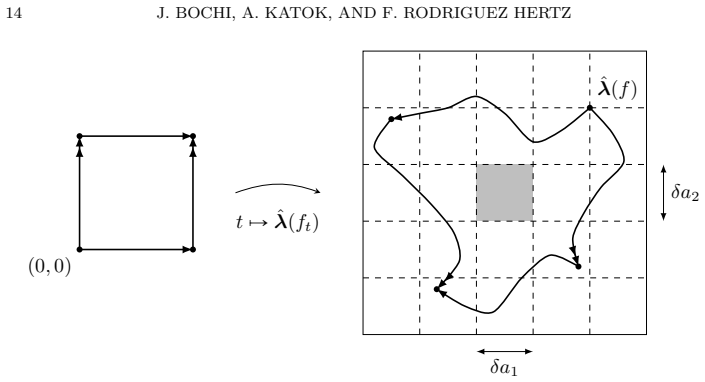
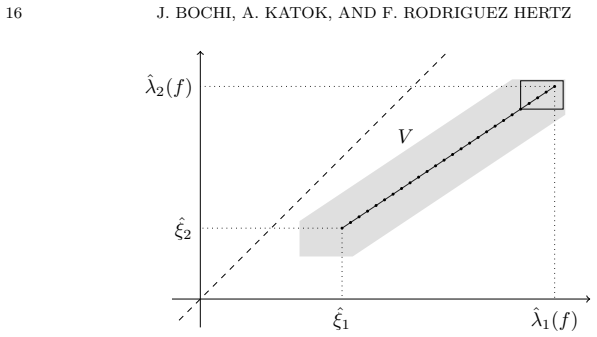
The load-bearing object is the pair formed by a simple dominated splitting, a continuous, uniformly contracted and expanded decomposition of the tangent bundle into $d$ one-dimensional subbundles, and the Lyapunov metrics built in Proposition 3.1 by geometric averaging of $N$-step expansion rates; these make each Lyapunov exponent equal to the integral of a single pointwise expansion function that is $L^1$-close to a constant. On top of these metrics, the paper constructs damping perturbations whose support is a tower of small Lyapunov balls with long first return time, and model deformations on the unit ball given by composing rotations of coordinate planes with angle modulated by a bump function. Lemma 5.1, the computational heart, shows that the $j$-th principal minor of the deformation's derivative factors through a single coordinate rotation, so its averaged logarithm is exactly $-Q(t_j)$, a function of the $j$-th parameter alone; formulas (5.9) and (6.16) then transcribe this into an independent, controlled drop of each summed exponent. The proof closes with a topological cube argument (Lemma 2.3) ensuring that the image of the parameter cube covers a whole small box of spectra, which allows the iterative stepping from $\lambda(f)$ to $\xi$.
What would settle it
In $\mathbb{T}^3$, take any hyperbolic matrix $L \in GL(3,\mathbb{Z})$ with three distinct real eigenvalues and search numerically (for instance by high-precision integration of the derivative cocycle over $C^2$ perturbations of $F_L$) for a conservative Anosov diffeomorphism homotopic to $F_L$ whose top Lyapunov exponent strictly exceeds $\lambda_1(L)$; Theorem 1.7 says no such map with simple dominated splitting exists, so finding one, or finding any spectrum not majorized by $\lambda(L)$, would falsify the necessity part.
Extended reading notes
Core claim
The paper proves that for a conservative (volume-preserving) Anosov diffeomorphism whose derivative splits into one-dimensional invariant bundles with uniform domination, the Lyapunov spectrum is flexible exactly in the region allowed by the majorization partial order: any strictly ordered list of numbers with the same sign pattern (unstable index) and strictly majorized by the current spectrum can be reached along a continuous path of conservative Anosov diffeomorphisms with simple dominated splitting (Theorem 1.5). On the torus $\mathbb{T}^d$ this yields the clean statement (Corollary 1.6) that every vector of strictly ordered nonzero numbers summing to zero is the simple Lyapunov spectrum of some $C^8$ conservative Anosov diffeomorphism. For $\mathbb{T}^3$ with a fixed homotopy class of a linear Anosov automorphism with simple spectrum, the converse also holds: the spectra realizable by diffeomorphisms with simple dominated splitting are exactly those majorized by the linear automorphism's spectrum (Theorem 1.7). Thus majorization, the condition that the target spectrum is obtained from the initial one by a mixing process, is shown to be the precise obstruction in the one-dimensional-splitting setting.
Load-bearing premise
The proof rests on the Anosov map having a simple dominated splitting, meaning the tangent bundle splits into one-dimensional invariant directions with uniformly separated expansion rates, and this assumption fails as soon as any of the invariant directions has dimension two or more.
Editorial extensions
If this is right
- Every strictly ordered list of nonzero numbers summing to zero is realized on $\mathbb{T}^d$ by a $C^8$ conservative Anosov diffeomorphism (Corollary 1.6).
- On tori, weak flexibility holds for simple spectra: if the target list contains zero, one takes the product of a realized Anosov map on $\mathbb{T}^{d-1}$ with an irrational rotation, obtaining ergodicity from mixing.
- In the homotopy class of a fully hyperbolic linear automorphism of $\mathbb{T}^3$, majorization by the linear spectrum is both necessary and sufficient for realization with simple dominated splitting (Theorem 1.7).
- The path of diffeomorphisms can be chosen continuous with spectra following any monotone-in-majorization path from $\lambda(f)$ to $\xi$ (Remark 2.4).
- Crossing a boundary component where the smallest unstable or largest stable exponent vanishes leads out of Anosov into partially hyperbolic maps, so the flexible region naturally borders on partially hyperbolic dynamics (Section 1.7.1).
Reading between the lines
- Inference: Because the perturbation effect depends only on the minimal gap $\sigma$ and not on the map $f$, the same scheme should yield uniform flexibility for open sets of conservative Anosov diffeomorphisms with uniformly bounded gap, a useful ingredient for attacking the general weak flexibility conjecture.
- Inference: Realizing repeated Lyapunov exponents would require leaving the simple-dominated class, since the construction's independence of parameters relies on one-dimensional bundles; averaging over symmetric spaces instead of norms would move whole blocks of exponents, suggesting a blockwise majorization theory for non-simple spectra.
- Inference: In higher-dimensional tori the necessity argument would need a higher-rank analogue of quasi-isometric strong unstable foliations; absent such a tool, Theorem 1.7's characterization suggests that majorization by the linear model is the right conjecture for all homotopy classes.
- Inference: A numerical search in $\mathbb{T}^3$ for conservative Anosov maps homotopic to a linear automorphism $F_L$ whose top exponent exceeds $\lambda_1(L)$ would either confirm the majorization barrier or reveal a genuinely new phenomenon of non-simple-dominated Anosov diffeomorphisms.
Signed reviews
Editorial analysis
A structured set of objections, weighed in public.
Referee Report
Summary. The paper proves flexibility results for Lyapunov spectra of conservative Anosov diffeomorphisms admitting simple dominated splittings. Theorem 1.5 states that any vector ξ strictly majorized by the Lyapunov spectrum of such an f, and satisfying the sign and strict-gap conditions (a), can be realized as the Lyapunov spectrum of f1 at the end of a continuous path in Di^r_m(M) of conservative Anosov diffeomorphisms with simple dominated splitting. Corollary 1.6 shows that every strictly ordered hyperbolic list of nonzero numbers summing to zero is realized on T^d, and Theorem 1.7 provides a full majorization characterization on T^3. The proofs introduce several new tools: Lyapunov metrics with L1 estimates, Lyapunov charts, damping perturbations, and a multiparameter model deformation, combined with a tower construction and a topological intermediate-value argument.
Significance. Assuming the results are correct, the paper is an important contribution to the flexibility program in smooth dynamics. It resolves the flexibility question for a natural class of hyperbolic systems and identifies majorization as the exact obstruction, complementing known rigidity results. The proof of Theorem 1.5 is constructive and largely self-contained, with explicit quantitative control on the perturbations; the paper also makes a convincing case that the method may extend to broader settings. The exposition is clear and includes useful discussion of the history and open problems.
major comments (2)
- [Section 6, Lemma 6.1] The verification of condition (iv) in the definition of damping perturbations (Section 4.1) is incomplete. For x in Z4 ⊂ U, the definition of U gives |χ_j(f^n x) − λ_j(f)| < σ/2 for every j and every n in the relevant range, but this only implies that the averaged vector \barχ = (1/(N−1))∑_{n=1}^{N−1} χ(f^n x) satisfies \barχ_j − \barχ_{j+1} > (λ_j(f) − λ_{j+1}(f)) − σ. Since the hypothesis g_u(λ(f)) ≥ σ only gives λ_j(f) − λ_{j+1}(f) ≥ σ, the lower bound is 0, not σ/2 as required by condition (iv). For example, with d=3, u=1, λ(f) = (σ,−σ,−2σ) and pointwise values χ_2 = −1.49σ, χ_3 = −1.51σ on the orbit segment (each within σ/2 of the corresponding λ_j), the averaged gap is 0.02σ < σ/2. Thus condition (iv) can fail, and since this condition is used in the proof of Lemma 4.3 and Proposition 4.2, the conclusion that each f_t is Anosov with simple dominated splitting is not established. The gap is fixable by changing the threshold σ/2 to σ/4 in the definition of R_j (or assuming g_u(λ(f)) ≥ 2σ), but as written the proof is incomplete.
- [Section 7.2, Proposition 7.4] The proof of Proposition 7.4 is only a sketch, stated as 'we mimic the proof of Proposition 2.1 (but with a2 = 0)'. Since Proposition 7.4 is a load-bearing component of the 'if' direction of Theorem 1.7, the authors should provide a full proof. In particular, the degenerate case a2 = 0 requires showing that \hatλ_2(f_t) remains exactly equal to \hatλ_2(f) despite the error terms in (6.16); the intended argument presumably uses the preservation of the foliation F^12, but this is not carried out. The verification of the damping-perturbation conditions for the foliated charts also needs to be written in detail.
minor comments (2)
- [Section 4.2 (proof of Lemma 4.3)] The set denoted \bar Z in the proof of Lemma 4.3 is not defined; it presumably denotes the closure of the support Z, and this should be stated explicitly.
- [Section 5] In the paragraph introducing the wedge product, 'mutilinear' should be 'multilinear'.
Circularity Check
No circularity: the main theorem is proved by an explicit construction, and self-citations are background only.
full rationale
The central theorem (Theorem 1.5) is derived by a constructive iterative argument: Proposition 2.1 is a local multiparameter perturbation statement, and its proof in Section 6 builds the maps f_t explicitly as f∘g_t using Lyapunov charts (Section 3), the model deformation h_t defined in (5.3), and a Rokhlin-tower selection. The change in summed Lyapunov exponents is computed from the explicit formula (5.9), obtained from Lemma 5.1, together with the estimate (6.16); no fitted parameter is later renamed as a prediction. The Lyapunov metric in Proposition 3.1 is constructed directly by the averaging formula (3.6), not assumed as an input. Self-citations such as [10], [13], and [28] are used only for standard textbook facts, general background, or remarks about the style of tower constructions; none of them supplies the load-bearing content of the main theorem. The 'only if' direction of Theorem 1.7 relies on the external quasi-isometric foliation result [15] and the absolute continuity result [36], not on a self-citation. The alleged numerical gap in the proof of Lemma 6.1, whether or not it is valid, is a possible correctness issue in the verification of condition (iv) of damping perturbations; it is not a circularity, because the conclusion of Theorem 1.5 is not equivalent by construction to any assumed input.
Assumptions & free parameters
assumptions (6)
- standard math Oseledets multiplicative ergodic theorem and Pesin entropy formula
- domain assumption Anosov-Sinai ergodicity of volume for C^2 conservative Anosov diffeomorphisms
- domain assumption Quasi-isometric property of strong unstable foliation on T^3 (Brin-Burago-Ivanov)
- domain assumption Absolute continuity of strong unstable foliation (Pesin-Sinai)
- standard math Existence of conservative atlas
- standard math Rokhlin tower lemma
Cite this review
Pith. "Pith review of Flexibility of Lyapunov exponents." pith.science (2026). https://pith.science/paper/O5RWL4XD
@misc{pith2026190807891,
  author       = {Pith},
  title        = {Pith review of: Flexibility of Lyapunov exponents},
  year         = {2026},
  howpublished = {\url{https://pith.science/paper/O5RWL4XD}},
  note         = {Machine review of arXiv:1908.07891}
}
read the original abstract
We outline the flexibility program in smooth dynamics, focusing on flexibility of Lyapunov exponents for volume-preserving diffeomorphisms. We prove flexibility results for Anosov diffeomorphisms admitting dominated splittings into one-dimensional bundles.
Figures
Figures from the paper (1 more)

Reference graph
Works this paper leans on
-
[1]
– Existence of smooth ergodic flows on smooth manifolds
Anosov, D.V. – Existence of smooth ergodic flows on smooth manifolds. Izv. Akad. Nauk SSSR Ser. Mat. 38 (1974), 518–545 (Russian). Math. USSR-Izv. 8 (1974), no. 3, 525–552. (English translation). (Cited on page 3.)
work page 1974
-
[2]
– New examples in smooth ergodic theory
Anosov, D.V.; Katok, A.B. – New examples in smooth ergodic theory. Ergodic dif- feomorphisms. Trudy Moskov. Mat. Obˇ sˇ c.23 (1970), 3–36 (Russian). Trans. Moscow Math. Soc. 23 (1970), 1–35 (English translation). (Cited on page 3.) FLEXIBILITY OF LYAPUNOV EXPONENTS 39
work page 1970
-
[3]
Arnold, L. – Random dynamical systems. Springer-Verlag, Berlin, 1998. (Cited on pages 2 and 31.)
work page 1998
-
[4]
– On the regularization of conservative maps
A vila, A. – On the regularization of conservative maps. Acta Math. 205 (2010), no. 1, 5–18. (Cited on page 4.)
work page 2010
-
[5]
– Diffeomorphisms with positive metric entropy
A vila, A.; Crovisier, S.; Wilkinson, A. – Diffeomorphisms with positive metric entropy. Publ. Math. IHES 124 (2016), 319–347. (Cited on pages 8 and 24.)
work page 2016
-
[6]
– Removing zero Lyapunov exponents
Baraviera, A.T.; Bonatti, C. – Removing zero Lyapunov exponents. Ergodic The- ory Dynam. Systems 23 (2003), no. 6, 1655–1670. (Cited on pages 7, 8, 9, 19, and 26.)
work page 2003
-
[7]
Barreira, L.; Pesin, Ya. – Nonuniform hyperbolicity. Dynamics of systems with nonzero Lyapunov exponents. Encyclopedia of Mathematics and its Applications, 115. Cambridge University Press, Cambridge, 2007. (Cited on pages 1, 2, and 16.)
work page 2007
-
[8]
– Flexibility of geometrical and dynamical data in fixed conformal classes
Barthelm´e, T.; Erchenko, A. – Flexibility of geometrical and dynamical data in fixed conformal classes. Indiana Univ. Math. J. 69 (2020), no. 2, 517–544. (Cited on pages 2 and 11.)
work page 2020
Show all 44 references
-
[9]
– Geometry and entropies in a fixed conformal class on surfaces
Barthelm´e, T.; Erchenko, A. – Geometry and entropies in a fixed conformal class on surfaces. Preprint arXiv:1902.02896. Ann. Inst. Fourier , to appear. (Cited on pages 2 and 11.)
1902 arXiv
-
[10]
– Genericity of zero Lyapunov exponents
Bochi, J. – Genericity of zero Lyapunov exponents. Ergodic Theory Dynam. Systems 22 (2002), no. 6, 1667–1696. (Cited on pages 5 and 8.)
2002
-
[11]
– Ergodic optimization of Birkhoff averages and Lyapunov exp onents
Bochi, J. – Ergodic optimization of Birkhoff averages and Lyapunov exp onents. Proc. Int. Cong. of Math. – 2018 Rio de Janeiro , Vol. 2, 1821–1842. (Cited on page 18.)
2018
-
[12]
– Perturbation of the Lyapunov spectra of periodic orbits
Bochi, J.; Bonatti, C. – Perturbation of the Lyapunov spectra of periodic orbits. Proc. Lond. Math. Soc. 105 (2012), no. 1, 1–48. (Cited on page 6.)
2012
-
[13]
– The Lyapunov exponents of generic volume-preserving and symplectic maps
Bochi, J.; Viana, M. – The Lyapunov exponents of generic volume-preserving and symplectic maps. Ann. of Math. 161 (2005), no. 3, 1423–1485. (Cited on pages 5 and 8.)
2005
-
[14]
– Dynamics beyond uniform hyperbolicity
Bonatti, C.; D ´ıaz, L.J.; Viana, M. – Dynamics beyond uniform hyperbolicity. A global geometric and probabilistic perspective. Encyclopaedia of Mathematical Sci- ences, 102. Mathematical Physics, III. Springer-Verlag, B erlin, 2005. (Cited on page 5.)
2005
-
[15]
, – Dynamical coherence of partially hyperbolic diffeomorphisms of the 3-torus
Brin, M.; Burago, D.; Ivanov, S. , – Dynamical coherence of partially hyperbolic diffeomorphisms of the 3-torus. J. Mod. Dyn. 3 (2009), no. 1, 1–11. (Cited on pages 9 and 35.)
2009
-
[16]
– Rigidity of equality of Lyapunov exponents for geodesic flo ws
Butler, C. – Rigidity of equality of Lyapunov exponents for geodesic flo ws. J. Dif- ferential Geom. 109 (2018), no. 1, 39–79. (Cited on page 11.)
2018
-
[17]
– Characterizing symmetric spaces by their Lyapunov spectr a
Butler, C. – Characterizing symmetric spaces by their Lyapunov spectr a. Preprint arXiv:1709.08066 (Cited on page 11.)
-
[18]
– Every compact manifold carries a completely hyper- bolic diffeomorphism
Dolgopyat, D.; Pesin, Ya. – Every compact manifold carries a completely hyper- bolic diffeomorphism. Ergodic Theory Dynam. Systems 22 (2002), no. 2, 409–435. (Cited on pages 3 and 9.)
2002
-
[19]
– Flexibility of Lyapunov exponents for expanding circle ma ps
Erchenko, A. – Flexibility of Lyapunov exponents for expanding circle ma ps. Dis- crete Contin. Dynam. Systems 39 (2019), no. 5, 2325–2342. (Cited on pages 2 and 10.)
2019
-
[20]
– Flexibility of entropies for surfaces of negative curva- ture
Erchenko, A.; Katok, A. – Flexibility of entropies for surfaces of negative curva- ture. Israel J. Math. 232 (2019), no. 2, 631–676. (Cited on pages 2 and 11.)
2019
-
[21]
T.; Gogolev, A
F arrell, F. T.; Gogolev, A. – The space of Anosov diffeomorphisms. J. Lond. Math. Soc. 89 (2014), no. 2, 383–396. (Cited on page 4.)
2014
-
[22]
– Local rigidity of Lyapunov spec- trum for toral automorphisms
Gogolev, A.; Kalinin, B.; Sadovskaya, V. – Local rigidity of Lyapunov spec- trum for toral automorphisms. Israel J. Math. 238 (2020), no. 1, 389–403. (Cited on page 11.)
2020
-
[23]
– Adapted metrics for dominated splittings
Gourmelon, N. – Adapted metrics for dominated splittings. Ergodic Theory Dynam. Systems 27 (2007), no. 6, 1839–1849. (Cited on pages 5, 8, and 16.) 40 J. BOCHI, A. KATOK, AND F. RODRIGUEZ HERTZ [ 24] Hu, H.; Jiang, M.; Jiang, Y. – Infimum of the metric entropy of hyperbolic at-...
2007
-
[25]
– Infimum of the metric entropy of volume preserving Anosov systems
Hu, H.; Jiang, M.; Jiang, Y. – Infimum of the metric entropy of volume preserving Anosov systems. Discrete Contin. Dyn. Syst. 37 (2017), no. 9, 4767–4783. (Cited on pages 2 and 7.)
2017
-
[26]
– Bernoulli diffeomorphisms on surfaces
Katok, A. – Bernoulli diffeomorphisms on surfaces. Ann. of Math. 110 (1979), no. 3, 529–547. (Cited on pages 3 and 9.)
1979
-
[27]
– Entropy and closed geodesics
Katok, A. – Entropy and closed geodesics. Ergodic Theory Dynam. Systems 2 (1982), no. 3–4, 339–365. (Cited on pages 2 and 11.)
1982
-
[28]
– Introduction to the modern theory of dynamical sys- tems
Katok, A.; Hasselblatt, B. – Introduction to the modern theory of dynamical sys- tems. With a supplementary chapter by Katok and Leonardo Mendoza. Encyclopedia of Mathematics and its Applications, 54. Cambridge Univers ity Press, Cambridge,
-
[29]
– Arithmeticity and topology of smooth actions of higher rank abelian groups
Katok, A.; Rodriguez Hertz, F. – Arithmeticity and topology of smooth actions of higher rank abelian groups. J. Mod. Dyn. 10 (2016), 135–172. (Cited on page 2.)
2016
-
[30]
– Transformation groups in differential geometry
Kobayashi, S. – Transformation groups in differential geometry. Reprint of the 1972 edition. Classics in Mathematics. Springer-Verlag, Berli n, 1995. (Cited on page 18.)
1972
-
[31]
– C 1-openness of non-uniform hyperbolic diffeo- morphisms with bounded C 2-norm
Liang, C; Marin, K.; Yang, J. – C 1-openness of non-uniform hyperbolic diffeo- morphisms with bounded C 2-norm. Ergodic Theory Dynam. Systems 40 (2020), no. 11, 3078–3104. (Cited on page 5.)
2020
-
[32]
– Inequalities: theory of majorization and its applications
Marshall, A.W.; Olkin, I.; Arnold, B.C. – Inequalities: theory of majorization and its applications. 2nd ed. Springer Series in Statistics. Springer, New York, 2 011. (Cited on page 6.)
-
[33]
– A note on rigidity of Anosov diffeomorphisms of the three torus
Micena, F.; Tahzibi, A. – A note on rigidity of Anosov diffeomorphisms of the three torus. Proc. Amer. Math. Soc. 147 (2019), 2453–2463. (Cited on page 11.)
2019
-
[34]
– On the volume elements on a manifold
Moser, J. – On the volume elements on a manifold. Trans. Amer. Math. Soc. 120 (1965), 286–294. (Cited on page 3.)
1965
-
[35]
– Continuity properties of entropy
Newhouse, S.E. – Continuity properties of entropy. Ann. of Math. 129 (1989), no. 2, 215–235. (Cited on page 1.)
1989
-
[36]
B.; Sinai, Ya
Pesin, Ya. B.; Sinai, Ya. G. – Gibbs measures for partially hyperbolic attractors. Ergodic Theory Dynam. Systems 2 (1982), no. 3-4, 417–438 (1983). (Cited on page 36.)
1982
-
[37]
– Central Lyapunov exponent of partially hyperbolic diffeo- morphisms of T3
Ponce, G.; Tahzibi, A. – Central Lyapunov exponent of partially hyperbolic diffeo- morphisms of T3. Proc. Amer. Math. Soc. 142 (2014), no. 9, 3193–3205. (Cited on page 9.)
2014
-
[38]
– Partial hyperbolicity and foliations in T3
Potrie, R. – Partial hyperbolicity and foliations in T3. J. Mod. Dyn. 9 (2015), 81–121. (Cited on page 35.)
2015
-
[39]
– Geometric expansion, Lyapunov exponents and foliations
Saghin, R.; Xia, Z. – Geometric expansion, Lyapunov exponents and foliations. Ann. Inst. H. Poincar´ e Anal. Non Lin´ eaire 26 (2009), no. 2, 689–704. (Cited on page 36.)
2009
-
[40]
– Lyapunov exponents and rigidity of Anosov automorphisms and skew products
Saghin, R.; Yang, J. – Lyapunov exponents and rigidity of Anosov automorphisms and skew products. Adv. Math. 355 (2019), 106764, 45 pp. (Cited on page 11.)
2019
-
[41]
– A (short) survey on dominated splittings
Sambarino, M. – A (short) survey on dominated splittings. Mathematical Congress of the Americas , 149–183, Contemp. Math., 656, Amer. Math. Soc., Providenc e, RI,
-
[42]
– Pathological foliations and removable zero exponents
Shub, M.; Wilkinson, A. – Pathological foliations and removable zero exponents. Invent. Math. 139 (2000), no. 3, 495–508. (Cited on page 7.)
2000
-
[43]
– On the fractional parts of the powers of a number
Vijayaraghavan, T. – On the fractional parts of the powers of a number. II. Proc. Cambridge Philos. Soc. 37 (1941), 349–357. (Cited on page 34.)
1941
-
[44]
– Volume growth and entropy
Yomdin, Y. – Volume growth and entropy. Israel J. Math. 57 (1987), no. 3, 285–300. (Cited on page 1.) Email address : jairo.bochi@mat.uc.cl FLEXIBILITY OF LYAPUNOV EXPONENTS 41 F acultad de Matem´aticas, Pontificia Universidad Cat ´olica de Chile, A venida Vicu˜na Mackenna 486...
1987
-
[1995]
(Cited on pages 1, 2, 3, 4, and 16.)
Reviewed August 14, 2026 · model on record in the stance chip above.
Discussion (0). Continue with ORCID to comment.