REVIEW 2 major objections 5 minor 31 references
Synthetic gauge field in a single optomechanical resonator
T0 review · 2 major / 5 minor · reviewed 2026-08-14 · deepseek-v4-flash
Pith's one-line read The paper reports that a single optomechanical microresonator can host a synthetic gauge field, with the effective magnetic flux set by the phase difference of two counter-propagating drive lasers, producing non-reciprocal conversion…
desk verdict First synthetic gauge field in a single optomechanical resonator, with clear phase control but non-reciprocity inferred from symmetry rather than measured both ways. read the letter →
The pith
A machine-rendered reading of the paper's core claim, the machinery that carries it, and where it could break.
The reading
What carries the argument
The load-bearing object is the triangle-plaquette Hamiltonian $H = J a_{\mathrm{cw}} a_{\mathrm{ccw}}^\dagger + G_{\mathrm{cw}} e^{i\theta} m^\dagger a_{\mathrm{cw}} + G_{\mathrm{ccw}} m^\dagger a_{\mathrm{ccw}} + \mathrm{H.c.}$, in which backscattering couples the two optical modes with strength $J$ and red-detuned drives create optomechanical hopping $G_{\mathrm{cw}}, G_{\mathrm{ccw}}$ to the mechanical mode. The phase $\theta$ appears only in the CW-photon–phonon hopping term, so a boson circumnavigating the loop gains $e^{i\theta}$ in one direction and $e^{-i\theta}$ in the other; that path-dependent phase is the synthetic flux. It is what makes the forward and reverse conversions differ, and it can be tuned simply by changing the relative RF phase of the two drive modulators.
What would settle it
Send the probe laser into the counter-clockwise mode with the drive phase fixed at $\theta$, and compare the counter-clockwise-to-clockwise transmission with the clockwise-probe measurement at $-\theta$; if the two do not match, the symmetry shortcut used to infer non-reciprocity fails and the directional contrast would need to be re-measured directly.
Extended reading notes
Core claim
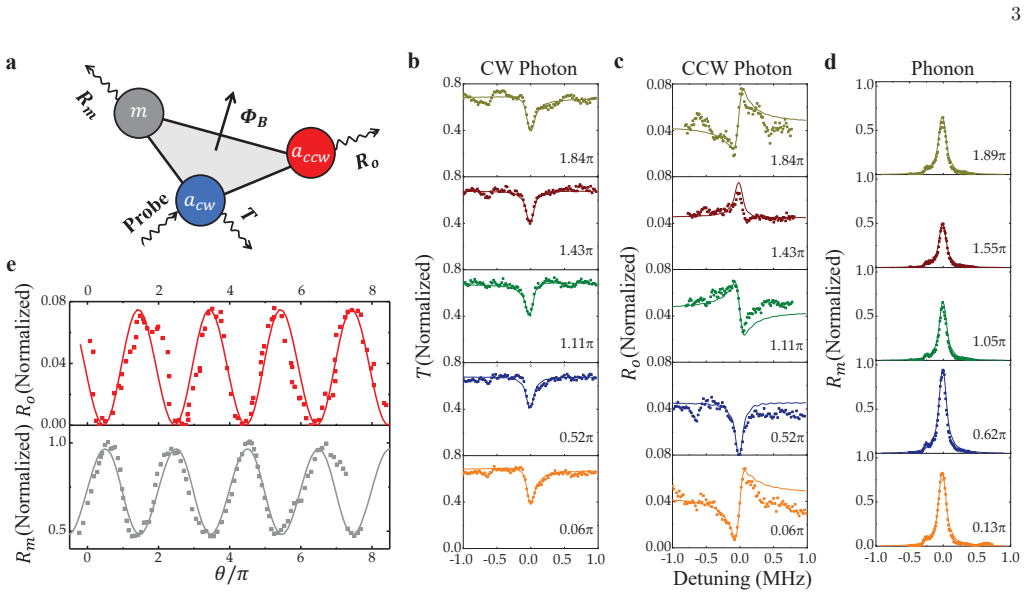
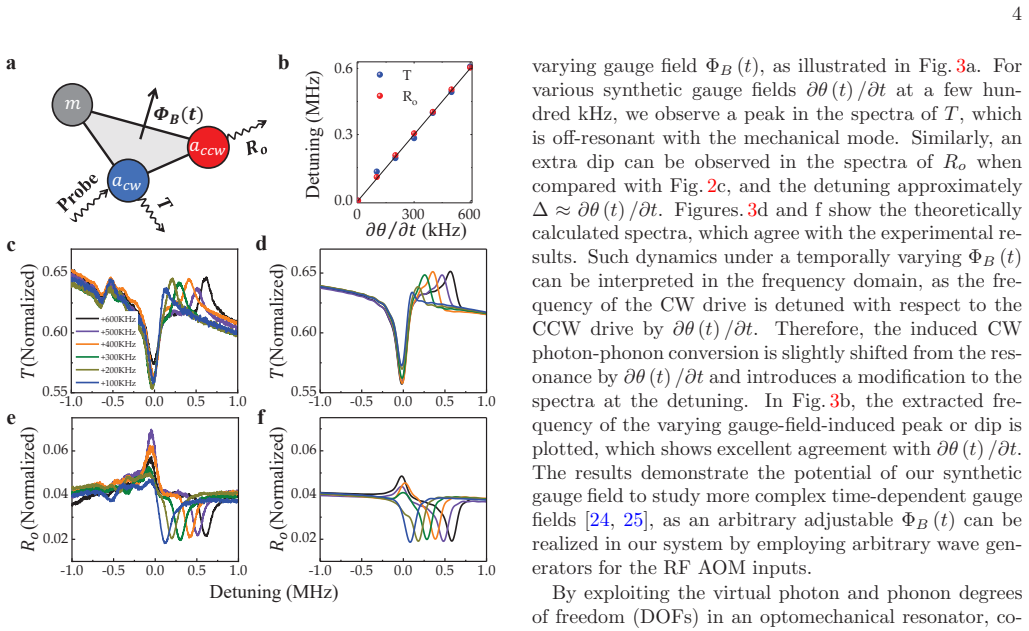
The central claim is that a bosonic excitation moving around the loop CW photon → phonon → CCW photon → CW photon acquires an Aharonov-Bohm-type phase equal to the relative drive phase $\theta$, so the three-mode triangle behaves as if pierced by a controllable magnetic flux. The authors observe $2\pi$-periodic oscillations in the mode populations as $\theta$ is scanned over $7\pi$, and they show that the photon and phonon conversion efficiencies are complementary: one is near maximum where the other is near minimum. For a fixed non-zero $\theta$, the response is not invariant under reversing the probe direction (equivalently, flipping $\theta$ to $-\theta$), which is the signature of broken time-reversal symmetry and non-reciprocal conversion. They also sweep the phase linearly in time and find spectral peaks and dips shifted by $\partial\theta/\partial t$, demonstrating a fast-varying synthetic gauge field.
Load-bearing premise
The proof of non-reciprocity assumes that probing from the opposite direction behaves exactly like reversing the sign of the drive phase, so any hidden asymmetry between clockwise and counter-clockwise light paths could make the reported directional contrast look larger than it really is.
Editorial extensions
If this is right
- Synthetic gauge fields and non-reciprocal transport can be implemented in a single microresonator, replacing coupled arrays of many fabricated sites.
- The synthetic flux can be swept at rates of hundreds of kilohertz with a large dynamic range, making time-dependent and rapidly switched gauge fields experimentally accessible.
- The same phase-control mechanism can be extended to additional optical and mechanical modes, via effects like four-wave mixing and Brillouin scattering, to build higher-dimensional synthetic lattices in one device.
- Non-reciprocal conversion between optical and mechanical modes in one resonator could serve as a building block for on-demand optical isolation and frequency conversion.
Reading between the lines
- A direct reverse-direction measurement, probing from the counter-clockwise port at the same $\theta$ and comparing with the clockwise-port result at $-\theta$, would test the parity-time symmetry assumption on which the non-reciprocity inference rests.
- Because a time-dependent flux induces an effective electromotive force around a loop, sweeping $\theta(t)$ faster than the mechanical linewidth could emulate synthetic electric fields or Floquet topological phases—an extension the paper only gestures toward.
- If additional mechanical modes are included, the single triangle becomes a ladder or higher-dimensional lattice whose hopping phases are all laser-controlled, allowing band-structure and topological-edge probes without nanofabrication.
Signed reviews
Editorial analysis
A structured set of objections, weighed in public.
Referee Report
Summary. The paper reports an experiment in a single silica microsphere optomechanical resonator, using degenerate clockwise (CW) and counter-clockwise (CCW) optical modes coupled by backscattering and a mechanical mode to form a three-site closed loop. Two red-detuned drives with a relative phase θ create a synthetic magnetic flux. The authors measure the response of the system to a CW probe for various θ, observing phase-dependent conversion spectra, a 2π periodicity in the mode populations, and differences between θ and 2π−θ that they interpret as broken time-reversal symmetry. They infer non-reciprocal conversion among the CW, CCW, and mechanical modes by invoking the combined symmetry θ→−θ and CW↔CCW, rather than by direct reverse-direction measurement. They also demonstrate a time-varying synthetic gauge field by linearly sweeping θ and observe a spectral feature whose detuning matches ∂θ/∂t. The central claim is that this constitutes the first experimental demonstration of a synthetic gauge field in the virtual dimension of bosonic modes in a single optomechanical resonator.
Significance. If the results hold, this is a significant proof-of-principle: a single resonator can implement a controllable synthetic gauge field, enabling time-dependent flux and potential applications in non-reciprocal devices and topological photonics. The experimental data are clearly presented, and the main phase-dependent features are consistent with a standard three-mode optomechanical model. The dynamic tuning demonstration is particularly appealing because it shows fast, arbitrary control of the effective flux. However, the non-reciprocity claim, which is a central advertised result, rests on a model-symmetry assumption rather than a direct measurement of the reverse transmission, so the significance is somewhat reduced until that assumption is experimentally validated. The manuscript would be a valuable contribution if the non-reciprocity claim is properly supported.
major comments (2)
- [To verify the synthetic gauge field... (paragraph after Fig. 1) and Fig. 2 caption] The claimed non-reciprocal conversion is not directly measured. In the paragraph beginning 'To verify the synthetic gauge field...', the authors state that the CCW-probe case is equivalent to the CW-probe case with θ→−θ and CW↔CCW, and therefore 'we can prove non-reciprocal transmission by studying the probe field from the CW port with various θ.' This equivalence is an assumption about the device's directional symmetry, not an established property of the fabricated microsphere. The experiments use different drive powers in the two directions (3.7 mW vs 1.6 mW in Fig. 2b) and yield different fitted couplings (Gcw/2π=0.6 MHz vs Gccw/2π=0.4 MHz), and no independent characterization of direction-dependent backscattering phases, unequal optical losses, or readout calibration asymmetries is reported. Under these conditions, the observed T(θ) versus T(2π−θ) differences in Figs. 2c and 2e could in principle arise from a reciprocal but asymmetric device, not from non-reciprocity. To support the load-bearing claim of non-reciprocal conversion, the authors should either measure the reverse (CCW-probe) transmission directly, or provide a quantitative calibration demonstrating that the only directional asymmetry is the drive phase θ.
- [Fig. 2 caption and Fig. 3 caption] The quantitative agreement between theory and experiment relies on fitted parameters whose values change between datasets. In Fig. 2b-c, the model uses Gcw/2π=0.6 MHz and Gccw/2π=0.4 MHz; in Fig. 2d, Gcw/2π=0.53 MHz and Gccw/2π=0.38 MHz; in Fig. 3, Gcw/2π=0.69 MHz and Gccw/2π=0.31 MHz. The manuscript does not state which parameters are fixed a priori, which are adjusted to each dataset, or the uncertainties on the fitted values. The good agreement of the solid curves is therefore a multi-parameter fit rather than a parameter-free prediction. The authors should report the fitting procedure, the error bars on the extracted parameters, and the reason for the variation across datasets (e.g., different drive powers or thermal drift). This is important for assessing the strength of the evidence for the model.
minor comments (5)
- [Abstract] The sentence 'For example, an ultracold atom experiences a light-induced effective magnetic field when tunnelling in an optical lattice, and offering a platform...' contains a grammatical error; 'and offering' should be 'offering' or 'and offers'.
- [Fig. 2 caption] The normalization of the spectral powers in Figs. 2b-e is not defined in the caption or main text; please specify what 'Normalized' means.
- [Equation (1)] Equation (1) uses the notation 'H. c.'; the standard abbreviation is 'H.c.' with a period.
- [Fig. 3b] In Fig. 3b, the axes are not labeled with physical quantities and units in the provided version; please ensure all axes are clearly labeled.
- [Main text, paragraph after Eq. (1)] The phrase 'The remaining phase θ is gauge-independent and actually represents the phase gain by the bosonic excitations when circulating the plaquette' is terse; a short clarification of the loop phase would help readers not familiar with the synthetic gauge field formalism.
Circularity Check
No significant circularity: the phase-dependent conversion is independently measured against a standard model; the non-reciprocity inference is a symmetry-based limitation, not a circular reduction.
full rationale
The paper's derivation chain is self-contained against an external standard model. The Hamiltonian in Eq. (1) is a standard optomechanical three-mode Hamiltonian with drive-induced couplings, and the phase theta enters as the relative drive phase. The experiment measures CW/CCW photon and phonon populations as a function of probe detuning for different theta and compares them with numerical solutions of this model. Although the couplings Gcw and Gccw are obtained by fitting the same spectra, the paper does not present these as parameter-free predictions; the central claim is the observation of phase-dependent conversion, and the fitted model is used for quantitative comparison. The non-reciprocity statement is inferred from the model's symmetry theta -> -theta combined with CW <-> CCW rather than from a direct reverse-direction measurement; this is an experimental limitation or correctness risk, not a circular reduction, because the inference is an independent symmetry property of the assumed Hamiltonian rather than a definition of the observable. Self-citations (e.g., [20,23,27]) provide background and prior experimental support and are not load-bearing uniqueness theorems. No step reduces by construction to its inputs.
Assumptions & free parameters
free parameters (2)
- Gcw (CW optomechanical coupling) =
0.6, 0.53, 0.69 MHz (per data set)
- Gccw (CCW optomechanical coupling) =
0.4, 0.38, 0.31 MHz (per data set)
assumptions (4)
- domain assumption The linearized optomechanical Hamiltonian with coherent couplings among CW, CCW, and mechanical modes (Eq. 1).
- domain assumption Degeneracy of the CW and CCW optical modes in the microsphere.
- domain assumption Momentum conservation restricts each drive to couple only to the corresponding optical direction.
- domain assumption The system obeys the symmetry θ→−θ combined with CW↔CCW exchange.
Cite this review
Pith. "Pith review of Synthetic gauge field in a single optomechanical resonator." pith.science (2026). https://pith.science/paper/O63GMLJT
@misc{pith2026190804456,
  author       = {Pith},
  title        = {Pith review of: Synthetic gauge field in a single optomechanical resonator},
  year         = {2026},
  howpublished = {\url{https://pith.science/paper/O63GMLJT}},
  note         = {Machine review of arXiv:1908.04456}
}
read the original abstract
Synthetic gauge fields have recently emerged, arising in the context of quantum simulations, topological matter, and the protected transportation of excitations against defects. For example, an ultracold atom experiences a light-induced effective magnetic field when tunnelling in an optical lattice, and offering a platform to simulate the quantum Hall effect and topological insulators. Similarly, the magnetic field associated with photon transport between sites has been demonstrated in a coupled resonator array. Here, we report the first experimental demonstration of a synthetic gauge field in the virtual dimension of bosonic modes in a single optomechanical resonator. By employing degenerate clockwise (CW) and counter-clockwise (CCW) optical modes and a mechanical mode, a controllable synthetic gauge field is realized by tuning the phase of the driving lasers. The non-reciprocal conversion between the three modes is realized for different synthetic magnetic fluxes. As a proof-of-principle demonstration, we also show the dynamics of the system under a fast-varying synthetic gauge field. Our demonstration not only provides a versatile and controllable platform for studying synthetic gauge fields in high dimensions but also enables an exploration of ultra-fast gauge field tuning with a large dynamic range, which is restricted for a magnetic field.
Figures

Reference graph
Works this paper leans on
-
[1]
Ar- tificial gauge fields in materials and engineered systems,
M. Aidelsburger, S. Nascimbene, and N. Goldman, “Ar- tificial gauge fields in materials and engineered systems,” Comptes Rendus Physique 19, 394 (2018)
work page 2018
-
[2]
Advances in synthetic gauge fields for light through dynamic modulation,
D. Hey and E. Li, “Advances in synthetic gauge fields for light through dynamic modulation,” Royal Society Open Science 5, 172447 (2018)
work page 2018
-
[3]
Light-induced gauge fields for ultracold atoms,
N. Goldman, G. Juzeli¯ unas, P. ?hberg, and I. B. Spiel- man, “Light-induced gauge fields for ultracold atoms,” Reports on Progress in Physics 77, 126401 (2014)
work page 2014
-
[4]
Topological quantum matter with ultracold gases in optical lattices,
N. Goldman, J. C. Budich, and P. Zoller, “Topological quantum matter with ultracold gases in optical lattices,” Nature Physics 12, 639 (2016)
work page 2016
-
[5]
In the same resonator, the radial breathing mechanical mode has a frequency of ω m/ 2π = 98
3 MHz). In the same resonator, the radial breathing mechanical mode has a frequency of ω m/ 2π = 98. 72 MHz and an optomechanical mode linewidth of γm/ 2π = 92 kHz. In the experiments, both drives are generated from a laser passing through acoustic-optic modulators (AOMs), and the probe photons are generated by an electro-optic modulator (EOM). The phase ...
-
[6]
Imaging topological edge states in silicon pho- tonics,
M. Hafezi, S. Mittal, J. Fan, A. Migdall, and J. M. Taylor, “Imaging topological edge states in silicon pho- tonics,” Nature Photonics 7, 1001 (2013)
work page 2013
-
[7]
A topolog- ical source of quantum light,
S. Mittal, E. A. Goldschmidt, and M. Hafezi, “A topolog- ical source of quantum light,” Nature 561, 502 (2018)
work page 2018
-
[8]
Quantal phase fac- tors accompanying adiabatic changes,
M. V. Berry, “Quantal phase fac- tors accompanying adiabatic changes,” Proceedings of the Royal Society A: Mathematical, Physical and Engineering Sciences 392, 45 (1984)
work page 1984
Show all 31 references
-
[9]
Topological photonics,
T. Ozawa, H. M. Price, A. Amo, N. Goldman, M. Hafezi, L. Lu, M. C. Rechtsman, D. Schuster, J. Simon, O. Zil- berberg, and I. Carusotto, “Topological photonics,” Reviews of Modern Physics 91 (2019), 10.1103/revmodphys.91.015006
2019 doi
-
[10]
Topolog- ical phases in acoustic and mechanical systems,
G. Ma, M. Xiao, and C. T. Chan, “Topolog- ical phases in acoustic and mechanical systems,” Nature Reviews Physics 1, 281 (2019)
2019
-
[11]
Engineering topological many-body materials in microwave cavity arrays,
B. M. Anderson, R. Ma, C. Owens, D. I. Schus- ter, and J. Simon, “Engineering topological many-body materials in microwave cavity arrays,” Physical Review X 6, 041043 (2016)
2016
-
[12]
Chiral ground-state currents of interacting photons in a synthetic magnetic field,
P. Roushan, C. Neill, A. Megrant, Y. Chen, R. Bab- bush, R. Barends, B. Campbell, Z. Chen, B. Chiaro, A. Dunsworth, A. Fowler, E. Jeffrey, J. Kelly, E. Lucero, J. Mutus, P. J. J. O’Malley, M. Neeley, C. Quintana, D. Sank, A. Vainsencher, J. Wenner, T. White, E. Kapit, H. Neven,...
2017
-
[13]
Magnetic-free non-reciprocity and isolation based on parametrically modulated coupled-resonator loops,
N. A. Estep, D. L. Sounas, J. Soric, and A. Al` u, “Magnetic-free non-reciprocity and isolation based on parametrically modulated coupled-resonator loops,” Nature Physics 10, 923 (2014)
2014
-
[14]
Optomechanical creation of magnetic fields for photons on a lattice,
M. Schmidt, S. Kessler, V. Peano, O. Painter, and F. Marquardt, “Optomechanical creation of magnetic fields for photons on a lattice,” Optica 2, 635 (2015)
2015
-
[15]
Gen- eralized non-reciprocity in an optomechanical circuit via synthetic magnetism and reservoir engineering,
K. Fang, J. Luo, A. Metelmann, M. H. Matheny, F. Marquardt, A. A. Clerk, and O. Painter, “Gen- eralized non-reciprocity in an optomechanical circuit via synthetic magnetism and reservoir engineering,” Nature Physics 13, 465 (2017)
2017
-
[16]
Nonreciprocal reconfigurable microwave optomechanical circuit,
N. R. Bernier, L. D. T´ oth, A. Koottandavida, M. A. Ioannou, D. Malz, A. Nunnenkamp, A. K. Feofanov, and T. J. Kippenberg, “Nonreciprocal reconfigurable microwave optomechanical circuit,” Nature Communications 8 (2017), 10.1038/s41467-017-00447-1
2017 doi
-
[17]
Cavity opto- mechanics,
T. J. Kippenberg and K. J. Vahala, “Cavity opto- mechanics,” Optics Express 15, 17172 (2007)
2007
-
[18]
Resolved-sideband and cryogenic cooling of an optomechanical resonator,
Y.-S. Park and H. Wang, “Resolved-sideband and cryogenic cooling of an optomechanical resonator,” Nature Physics 5, 489 (2009)
2009
-
[19]
Optomechanically induced transparency,
S. Weis, R. Rivi` ere, S. Del´ eglise, E. Gavartin, O. Arcizet, A. Schliesser, and T. J. Kippenberg, “Optomechanically induced transparency,” Science 330, 1520 (2010)
2010
-
[20]
Electromagnetically in- duced transparency and slow light with optomechanics,
A. H. Safavi-Naeini, T. P. M. Alegre, J. Chan, M. Eichenfield, M. Winger, Q. Lin, J. T. Hill, D. E. Chang, and O. Painter, “Electromagnetically in- duced transparency and slow light with optomechanics,” Nature 472, 69 (2011)
2011
-
[21]
Optomechanical dark mode
C. Dong, V. Fiore, M. C. Kuzyk, and H. Wang, “Optomechanical dark mode.” Science (New York, N.Y.) 338, 1609 (2012)
2012
-
[22]
Optomechanical devices based on traveling-wave microresonators,
Y.-L. Zhang, C.-H. Dong, C.-L. Zou, X.-B. Zou, Y.-D. Wang, and G.-C. Guo, “Optomechanical devices based on traveling-wave microresonators,” Physical Review A 95 (2017), 10.1103/physreva.95.043815
2017 doi
-
[23]
Modal coupling in traveling-wave resonators,
T. J. Kippenberg, S. M. Spillane, and K. J. Va- hala, “Modal coupling in traveling-wave resonators,” Optics Letters 27, 1669 (2002)
2002
-
[24]
Ex- perimental realization of optomechanically induced non- reciprocity,
Z. Shen, Y.-L. Zhang, Y. Chen, C.-L. Zou, Y.-F. Xiao, X.-B. Zou, F.-W. Sun, G.-C. Guo, and C.-H. Dong, “Ex- perimental realization of optomechanically induced non- reciprocity,” Nature Photonics 10, 657 (2016)
2016
-
[25]
The covari- ant, time-dependent aharonov–bohm effect,
D. Singleton and E. C. Vagenas, “The covari- ant, time-dependent aharonov–bohm effect,” Physics Letters B 723, 241 (2013)
2013
-
[26]
On the time-dependent aharonov–bohm effect,
J. Jing, Y.-F. Zhang, K. Wang, Z.-W. Long, and S.-H. Dong, “On the time-dependent aharonov–bohm effect,” Physics Letters B 774, 87 (2017)
2017
-
[27]
Photonic-chip-based frequency combs,
A. L. Gaeta, M. Lipson, and T. J. Kippen- berg, “Photonic-chip-based frequency combs,” Nature Photonics 13, 158 (2019)
2019
-
[28]
Brillouin-scattering- induced transparency and non-reciprocal light storage,
C.-H. Dong, Z. Shen, C.-L. Zou, Y.-L. Zhang, W. Fu, and G.-C. Guo, “Brillouin-scattering- induced transparency and non-reciprocal light storage,” Nature Communications 6, 6193 (2015)
2015
-
[29]
Topological quantum fluctuations and traveling wave amplifiers,
V. Peano, M. Houde, F. Marquardt, and A. A. Clerk, “Topological quantum fluctuations and traveling wave amplifiers,” Phys. Rev. X 6, 041026 (2016)
2016
-
[30]
Topological protection of biphoton 6 states,
A. Blanco-Redondo, B. Bell, D. Oren, B. J. Eggle- ton, and M. Segev, “Topological protection of biphoton 6 states,” Science 362, 568 (2018)
2018
-
[31]
Quantum steer- ing: a review with focus on semidefinite programming,
D. Cavalcanti and P. Skrzypczyk, “Quantum steer- ing: a review with focus on semidefinite programming,” Reports on Progress in Physics 80, 024001 (2017)
2017
Reviewed August 14, 2026 · model on record in the stance chip above.
Discussion (0). Continue with ORCID to comment.