REVIEW 2 major objections 6 minor 2 cited by
Sensitivity of the Hyper-Kamiokande experiment to neutrino oscillation parameters using acceleration neutrinos
T0 review · 2 major / 6 minor · reviewed 2026-08-07 · deepseek-v4-flash
Pith's one-line read Hyper-Kamiokande projects that it can discover neutrino CP violation at 5-sigma in under three years if the CP-violating phase is maximal and the mass ordering is known, and in about six years even if the ordering is unknown.
desk verdict A careful, useful sensitivity projection whose headline discovery-time claim borrows 10-year systematics for the early years; the 10-year numbers hold up. read the letter →
The pith
A machine-rendered reading of the paper's core claim, the machinery that carries it, and where it could break.
The reading
What carries the argument
The load-bearing object is the CP asymmetry between neutrino and antineutrino appearance, encoded in the $\sin\delta_{CP}$ term of the electron (anti)neutrino appearance probability $P(\nu_\mu\to\nu_e)$ and $P(\bar\nu_\mu\to\bar\nu_e)$ in the PMNS framework. The measurement is carried by binned maximum-likelihood fits to four event samples (muon-like and electron-like, in forward and reverse horn current running), with nuisance parameters profiling flux, cross-section, and detector uncertainties. The tuning machinery is the T2K analysis framework, reweighted for Hyper-Kamiokande's larger far detector, higher beam power, and the upgraded near detector ND280 plus the planned Intermediate Water Cherenkov Detector (IWCD), a movable 300-tonne water detector that samples different off-axis angles; systematic uncertainties are modelled with a covariance matrix and scaled down according to assumed increases in statistics and detector capability.
What would settle it
If the first year of real Hyper-Kamiokande data (about $2.7\times10^{21}$ protons on target) with known normal ordering and a true $\delta_{CP}$ near $-\pi/2$ shows a CP-conservation exclusion below 5-$\sigma$ under the improved systematic model, or if near-detector data yield a $\sigma(\nu_e)/\sigma(\bar\nu_e)$ uncertainty above the assumed 2.7%, the three-year discovery projection is falsified.
Extended reading notes
Core claim
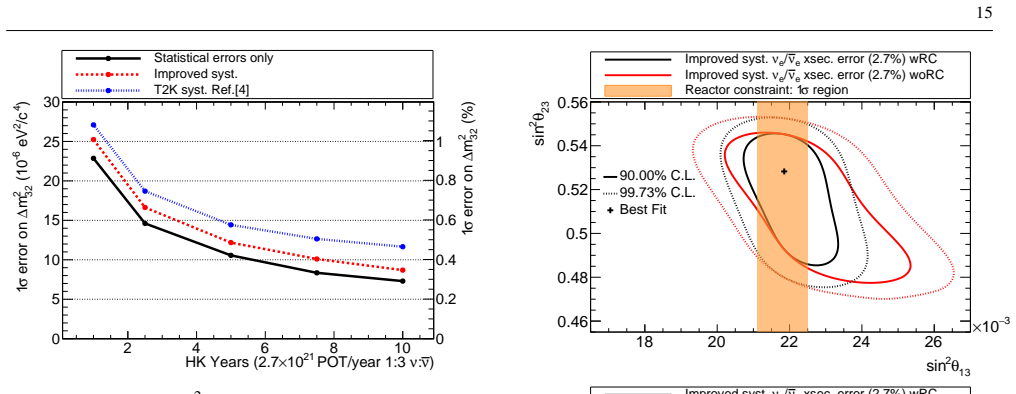
The paper projects that the Hyper-Kamiokande long-baseline program will establish CP violation in neutrino oscillations at the 5-$\sigma$ level in less than three years when $\delta_{CP}$ is near its maximally violating value ($-\pi/2$) and the neutrino mass ordering is known to be normal; without an external mass-ordering constraint and using only Hyper-Kamiokande's own atmospheric-neutrino ordering sensitivity, the same discovery takes about six years. After the nominal ten-year exposure of $27\times10^{21}$ protons on target, run one-quarter in neutrino mode and three-quarters in antineutrino mode, the appearance samples of roughly 2000 electron neutrinos and 800 electron antineutrinos (plus a similar number from intrinsic beam contamination) let Hyper-Kamiokande exclude CP conservation at 5 $\sigma$ for more than 60% of possible true $\delta_{CP}$ values. The same fit yields a 1-$\sigma$ resolution of about 6 degrees on $\delta_{CP}$ if CP is conserved and about 20 degrees if CP violation is maximal, better than 0.5% on $|\Delta m^2_{32}|$, and 0.5% to 3% on $\sin^2\theta_{23}$ depending on its true value.
Load-bearing premise
The projection rests on the assumption that future systematic uncertainties on the near and far detector event rates shrink as the square root of the increased statistics and as projected by the upgraded near detectors, a far-detector scaling the paper itself calls 'somewhat arbitrary', so that the systematic error model does not remain at today's T2K level.
Editorial extensions
If this is right
- If the assumptions hold, Hyper-Kamiokande becomes the first experiment to establish CP violation in the lepton sector, with a 5-sigma exclusion of CP conservation for over 60% of possible $\delta_{CP}$ values within 10 years.
- The measurement of $\delta_{CP}$ will reach about 6 degrees of precision if CP is conserved and about 20 degrees if CP violation is maximal.
- The atmospheric mixing parameters will be measured at sub-percent precision: better than 0.5% on $|\Delta m^2_{32}|$ and between 0.5% and 3% on $\sin^2\theta_{23}$ depending on the true value.
- The wrong octant of $\theta_{23}$ can be excluded at more than 5 sigma for $\sin^2\theta_{23}$ outside roughly 0.45 to 0.57.
- The reactor measurement of $\sin^2\theta_{13}$ is needed to break the $\sin^2\theta_{13}$-$\sin^2\theta_{23}$ degeneracy, but the ultimate $\delta_{CP}$ sensitivity is nearly independent of it.
Reading between the lines
- Editorial extension: the gap between the under-three-years and about-six-years scenarios shows that an independent, high-precision determination of the mass ordering would be the single most effective external boost to Hyper-Kamiokande's CPV timeline; the paper explicitly sets such external constraints aside.
- Editorial extension: the paper's precision on $\delta_{CP}$ near maximal CPV is dominated by energy-scale and spectrum-shape systematics rather than the electron cross-section ratio, which suggests that far-detector energy calibration is the highest-leverage internal investment for that measurement.
- Editorial extension: because the near-detector systematic scaling is the fragile link, a staged analysis that re-derives the CPV sensitivity after each year of data with measured rather than assumed systematic uncertainties would test the projection before the decade is up.
Editorial analysis
A structured set of objections, weighed in public.
Referee Report
Summary. This paper presents Monte Carlo sensitivity projections for the Hyper-Kamiokande long-baseline accelerator neutrino program. The analysis adapts the T2K simulation, event selection, and fitting framework to the Hyper-Kamiokande detector, beam, and near-detector configuration, assuming 27e21 protons on target over 10 years with a 1:3 neutrino-to-antineutrino running ratio. Sensitivities are reported under three systematic scenarios: statistical errors only, T2K-level systematics, and an 'improved' model with reduced near- and far-detector uncertainties. The main results are the CP-violation discovery significance as a function of time, the fraction of true delta_CP values for which CP conservation can be excluded, the expected precision on delta_CP, sin^2(theta_23), Delta m^2_32, and sin^2(theta_13), and the sensitivity to the theta_23 octant. The headline claims are a 5-sigma CPV discovery in less than three years for maximal CPV with known mass ordering, 5-sigma exclusion of CP conservation for over 60% of true delta_CP values after 10 years, and delta_CP precision from about 6 degrees (CP-conserving) to about 20 degrees (maximal CPV).
Significance. If the 10-year sensitivity projections are correct, this is an important and useful quantification of the Hyper-Kamiokande physics reach, consistent with the experiment's stated primary goal of establishing leptonic CP violation. The paper has clear strengths: the inputs and assumptions are stated explicitly, the fit machinery is inherited from a peer-reviewed T2K analysis, and the comparison across statistical-only, T2K-systematics, and improved-systematics scenarios provides a useful bracketing of the results. The T2K-systematics curve acts as a conservative lower bound, and the paper is transparent about several ad hoc assumptions, even labeling one far-detector scaling as 'somewhat arbitrary.' However, the headline discovery-time claim is weakened by a time-horizon inconsistency in the systematic model, as detailed below; the 10-year coverage and precision results are less affected by this issue.
major comments (2)
- [Section 3.2 and Fig. 4] The 'improved systematics' model is explicitly built from the expected statistical power after 10 years of Hyper-Kamiokande operation: near-detector-constrained uncertainties are scaled by sqrt(1/N) with N = 27e21/3.6e21 ~ 7.5, and far-detector systematics are scaled by sqrt(7.5). This fixed model is then applied to the time-dependent CPV discovery curves in Fig. 4, and it underlies the abstract's claim of a 5-sigma discovery in less than three years. At three years the accumulated POT is about 8.1e21, a factor of about 2.25 above the T2K exposure, so a consistent time-dependent scaling would give sqrt(1/2.25) ~ 0.67 for near-detector terms and sqrt(2.25) for far-detector terms, not the 10-year values. Since the T2K-systematics curve in Fig. 4 reaches 5 sigma only near six years, a consistent time-dependent treatment would move the crossing beyond three years. The 10-year results are not invalidated, but the headline '5-sigma in less than three years' is not a valid projection of the assumed running plan as currently presented; it should either be recomputed with time-dependent systematics or explicitly qualified as assuming the 10-year systematic model from the start.
- [Section 3.2 and Table 3] The central 10-year CPV coverage and precision claims are obtained with the 'improved' model, whose key inputs are assumed reductions rather than demonstrated results: a factor of 3 for neutrino non-quasi-elastic uncertainties, a factor of 2.5 for quasi-elastic uncertainties, a factor of 2 for antineutrino uncertainties, reduction of neutral-current uncertainties to about 10%, and a 'somewhat arbitrary' sqrt(7.5) scaling of far-detector systematics. The abstract presents the resulting 'over 60% of true delta_CP values' coverage without indicating which systematic scenario it relies on. Since these assumptions are load-bearing for the headline numbers, the paper should state explicitly which scenario underlies each abstract claim and should ideally quantify how the coverage degrades under partial achievement of the assumed improvements, for example by also showing the result with only the statistically motivated scaling or with intermediate reduction factors.
minor comments (6)
- [Abstract] The abstract contains a typo: 'These larges event samples' should be 'These large event samples.'
- [Eq. (1)] In Eq. (1), 'Delta m32' should be written as Delta m^2_32, and the units should be eV^2; as printed, the expression is dimensionally inconsistent.
- [Section 3.2] The notation for the cross-section ratio uncertainty is inconsistent: the text first refers to the errors on sigma(nu_e)/sigma(nu_mu) and sigma(nu_bar_e)/sigma(nu_bar_mu), but later refers to 'the uncertainty on sigma(nu_e)/sigma(nu_bar_e)'. Please clarify which ratio carries the 2.7% error and what the -0.33 correlation applies to.
- [Fig. 5] The caption and legend for the right panel of Fig. 5 appear to list the 'Improved syst.' entry twice, with one line labeled 4.9% and another labeled 2.7%; please check that the legend matches the curves actually plotted.
- [Abstract and Table 2] The abstract states that about 10000 muon neutrino events and a similar number of muon antineutrino events are expected, but Table 2 reports 8845 events in the neutrino-mode muon-like sample and 12027 in the antineutrino-mode muon-like sample; please reconcile these numbers or clarify the selection being quoted.
- [Fig. 4] Please define precisely how the 'percentage of delta_CP values' is computed in the right panel of Fig. 4, including whether this is a median coverage fraction and how the shaded band over systematic assumptions is generated.
Circularity Check
No significant circularity: the sensitivity projections are self-contained forward simulations whose inputs are external oscillation parameters and T2K benchmark models.
full rationale
The derivation chain is a forward Monte Carlo sensitivity study: fixed PMNS inputs (Table 1, with theta13 optionally constrained by external reactor measurements and theta12 and Delta m2_21 held fixed from solar/KamLAND), T2K flux and cross-section models, and a binned profile-likelihood fit (Eqs. 3-4). No fitted parameter is fed back as a prediction, and no claim is equivalent to its input by construction. The main caveat is that the 'Improved syst.' model is explicitly built 'considering the expected statistical power after 10 years of HK operation' and then used for the time-dependent CPV curves in Fig. 4; this may make the '5 sigma in less than three years' headline optimistic, but it is a stated modeling assumption rather than a circular step, and the paper also shows T2K-level systematics reaching 5 sigma in under six years. Reuse of the T2K analysis [4] and the HK design report [12] is self-referential, but [4] is an external data-driven model and [12] is a separate atmospheric-MO projection, not the claimed result; the central known-MO CPV discovery sensitivity is computed in this paper from simulated HK samples. No uniqueness theorem or hidden ansatz is imported, and the external benchmarks are used as inputs, not as outputs.
Assumptions & free parameters
free parameters (4)
- Far detector systematics scaling factor =
sqrt(7.5)
- sigma(nu_e)/sigma(nu_bar_e) cross-section ratio uncertainty =
2.7% with correlation -0.33
- Reduction factors for charged-current interaction uncertainties =
non-QE x3, QE x2.5, antineutrino x2, NC to ~10%
- Statistical scaling of ND280 constraints =
sqrt(N) with 7.5x POT
assumptions (5)
- domain assumption Standard three-flavor PMNS oscillation framework with matter effects
- domain assumption T2K flux and neutrino-nucleus interaction models apply to Hyper-Kamiokande
- ad hoc to paper Upgraded ND280 and IWCD will achieve the assumed systematic improvements
- domain assumption Mass ordering is known and normal for the primary projection
- domain assumption Detector response can be modeled by scaling Super-Kamiokande simulation with ToWall-dependent volume/surface scaling
Cite this review
Pith. "Pith review of Sensitivity of the Hyper-Kamiokande experiment to neutrino oscillation parameters using acceleration neutrinos." pith.science (2026). https://pith.science/paper/O65E2YBG
@misc{pith2026250515019,
  author       = {Pith},
  title        = {Pith review of: Sensitivity of the Hyper-Kamiokande experiment to neutrino oscillation parameters using acceleration neutrinos},
  year         = {2026},
  howpublished = {\url{https://pith.science/paper/O65E2YBG}},
  note         = {Machine review of arXiv:2505.15019}
}
abstract
This paper describes the analysis to estimate the sensitivity of the Hyper-Kamiokande experiment to long-baseline neutrino oscillation parameters using accelerator (anti)neutrinos. Results are presented for the CPV discovery sensitivity and precision measurements of the oscillation parameters $\delta_{CP}$, $\sin^2\theta_{23}$, $\Delta m^2_{32}$ and $\sin^2\theta_{13}$. With the assumed Hyper-Kamiokande running plan, a $5\sigma$ CPV discovery is possible in less than three years in the case of maximal CPV and known MO.In the absence of external constraints on the MO, considering the MO sensitivity of the Hyper-Kamiokande measurement using atmospheric neutrinos, the time for a CPV discovery could be estimated to be around six years. Using the nominal final exposure of $27 \times 10^{21}$ protons on target, corresponding to 10 years, with a ratio of 1:3 in neutrino to antineutrino beam mode, we expect to select approximately 10000 charged current, quasi-elastic-like, muon neutrino events, and a similar number of muon anti-neutrino events. In the electron (anti)neutrino appearance channels, we expect approximately 2000 charged current, quasi-elastic-like electron neutrino events and 800 electron antineutrino events. These larges event samples will allow Hyper-Kamiokande to exclude CP conservation at the $5\sigma$significance level for over 60% of the possible true values of $\delta_{CP}$.
Figures


Figures from the paper (6 more)



Forward citations
Cited by 2 Pith papers
-
CHIC: Caley-Hamilton, Invariants and Constants for Neutrino Oscillation Probabilities and Gradients
The paper derives Cayley-Hamilton-based analytic expressions and a C++ library (CHIC) for fast computation of neutrino oscillation probabilities and gradients in constant-density matter.
-
Can We Tell if ChatGPT is a Parasite? Studying Human-AI Symbiosis with Game Theory
A stochastic-game model of a human, a chatbot, and the environment is claimed to show the human-AI pair can form one 'aggregate individual' (Krakauer et al. 2020) and to make chatbot parasitism analyzable.
Reference graph
Works this paper leans on
-
[1]
Pontecorvo, Zh
B. Pontecorvo, Zh. Eksp. Teor. Fiz. 53, 1717 (1967)
1967
-
[2]
Z. Maki, M. Nakagawa, S. Sakata, Prog. Theor. Phys. 28, 870 (1962). DOI 10.1143/PTP.28.870
-
[3]
S. Navas, et al., Phys. Rev. D 110(3), 030001 (2024). DOI 10. 1103/PhysRevD.110.030001
work page 2024
-
[4]
K. Abe, et al., Eur. Phys. J. C 83(9), 782 (2023). DOI 10.1140/ epjc/s10052-023-11819-x
work page 2023
-
[5]
M.A. Acero, et al., Phys. Rev. D 110(1), 012005 (2024). DOI 10.1103/PhysRevD.110.012005
-
[6]
M. Fukugita, T. Yanagida, Phys. Lett. B 174, 45 (1986). DOI 10.1016/0370-2693(86)91126-3
-
[7]
A. Granelli, S. Pascoli, S.T. Petcov, Phys. Rev. D 108(10), L101302 (2023). DOI 10.1103/PhysRevD.108.L101302
-
[8]
T. Wester, et al., Phys. Rev. D 109(7), 072014 (2024). DOI 10. 1103/PhysRevD.109.072014
work page 2024
Show all 47 references
-
[9]
Abud Abed, et al., Phys
A. Abud Abed, et al., Phys. Rev. D 105(7), 072006 (2022). DOI 10.1103/PhysRevD.105.072006
2022 doi
- [10]
-
[11]
Abe, et al., PTEP 2015, 053C02 (2015)
K. Abe, et al., PTEP 2015, 053C02 (2015). DOI 10.1093/ptep/ ptv061
2015 doi
- [12]
-
[13]
Hirata, et al., Phys
K. Hirata, et al., Phys. Rev. Lett. 58, 1490 (1987). DOI 10.1103/ PhysRevLett.58.1490
1987
-
[14]
Fukuda, et al., Nucl
Y . Fukuda, et al., Nucl. Instrum. Meth. A 501, 418 (2003). DOI 10.1016/S0168-9002(03)00425-X
2003 doi
-
[15]
Ahn, et al., Phys
M.H. Ahn, et al., Phys. Rev. D 74, 072003 (2006). DOI 10.1103/ PhysRevD.74.072003
2006
-
[16]
Abe, et al., Nucl
K. Abe, et al., Nucl. Instrum. Meth. A 659, 106 (2011). DOI 10.1016/j.nima.2011.06.067
2011 doi
-
[17]
Abe, et al., arXiv 1908.05141 (2019)
K. Abe, et al., arXiv 1908.05141 (2019)
2019
-
[18]
Abe, et al., Nucl
K. Abe, et al., Nucl. Instrum. Meth. A 694, 211 (2012). DOI 10.1016/j.nima.2012.03.023
2012 doi
-
[19]
Abe, et al., arXiv 1901.03750 (2019)
K. Abe, et al., arXiv 1901.03750 (2019)
2019
- [20]
-
[21]
Argüelles, et al., Eur
C.A. Argüelles, et al., Eur. Phys. J. C 83(1), 15 (2023). DOI 10.1140/epjc/s10052-022-11049-7
2023 doi
-
[22]
Davis, Jr., D.S
R. Davis, Jr., D.S. Harmer, K.C. Hoffman, Phys. Rev. Lett. 20, 1205 (1968). DOI 10.1103/PhysRevLett.20.1205
1968 doi
-
[23]
Altmann, et al., Phys
M. Altmann, et al., Phys. Lett. B 616, 174 (2005). DOI 10.1016/j. physletb.2005.04.068
2005 doi
-
[24]
Abdurashitov, et al., Phys
J.N. Abdurashitov, et al., Phys. Rev. C 80, 015807 (2009). DOI 10.1103/PhysRevC.80.015807
2009 doi
-
[25]
Bellini, et al., Phys
G. Bellini, et al., Phys. Rev. Lett. 107, 141302 (2011). DOI 10. 1103/PhysRevLett.107.141302
2011
-
[26]
Aharmim, et al., Phys
B. Aharmim, et al., Phys. Rev. C 88, 025501 (2013). DOI 10. 1103/PhysRevC.88.025501
2013
-
[27]
Abe, et al., Phys
K. Abe, et al., Phys. Rev. D 94(5), 052010 (2016). DOI 10.1103/ PhysRevD.94.052010
2016
-
[28]
Gando, et al., Phys
A. Gando, et al., Phys. Rev. D 88(3), 033001 (2013). DOI 10. 1103/PhysRevD.88.033001
2013
-
[29]
Adey, et al., Phys
D. Adey, et al., Phys. Rev. Lett. 121(24), 241805 (2018). DOI 10.1103/PhysRevLett.121.241805
2018 doi
-
[30]
Shin, et al., JHEP 04, 029 (2020)
C.D. Shin, et al., JHEP 04, 029 (2020). DOI 10.1007/ JHEP04(2020)029
2020
-
[31]
de Kerret, et al., Nature Phys
H. de Kerret, et al., Nature Phys. 16(5), 558 (2020). DOI 10.1038/ s41567-020-0831-y
2020
-
[32]
Barger, K
V .D. Barger, K. Whisnant, S. Pakvasa, R.J.N. Phillips, Phys. Rev. D 22, 2718 (1980). DOI 10.1103/PhysRevD.22.2718
1980 doi
-
[33]
R. Wendell. Prob3++. https://github.com/rogerwendell/ Prob3plusplus (2018). Consulted on 2024
2018
-
[34]
Abusleme, et al., arXiv 2405.18008 (2024)
A. Abusleme, et al., arXiv 2405.18008 (2024)
2024
-
[35]
Aiello, et al., Eur
S. Aiello, et al., Eur. Phys. J. C 82(1), 26 (2022). DOI 10.1140/ epjc/s10052-021-09893-0
2022
-
[36]
Eller, et al., PoS ICRC2023, 1036 (2023)
P. Eller, et al., PoS ICRC2023, 1036 (2023). DOI 10.22323/1. 444.1036
2023 doi
-
[37]
Abe, et al., Phys
K. Abe, et al., Phys. Rev. D 87(1), 012001 (2013). DOI 10. 1103/PhysRevD.87.012001. [Addendum: Phys.Rev.D 87, 019902 (2013)]
2013
-
[38]
Abgrall, et al., Eur
N. Abgrall, et al., Eur. Phys. J. C 76(11), 617 (2016). DOI 10. 1140/epjc/s10052-016-4440-y
2016
-
[39]
Abe, et al., Phys
K. Abe, et al., Phys. Rev. D 103(11), 112008 (2021). DOI 10. 1103/PhysRevD.103.112008
2021
-
[40]
Dolan, et al., Phys
S. Dolan, et al., Phys. Rev. D 105(3), 032010 (2022). DOI 10. 1103/PhysRevD.105.032010
2022
-
[41]
Munteanu, S
L. Munteanu, S. Suvorov, S. Dolan, D. Sgalaberna, S. Bolog- nesi, S. Manly, G. Yang, C. Giganti, K. Iwamoto, C. Jesús-Valls, Phys. Rev. D 101(9), 092003 (2020). DOI 10.1103/PhysRevD. 101.092003
2020 doi
-
[42]
Abe, et al., Phys
K. Abe, et al., Phys. Rev. D 96(9), 092006 (2017). DOI 10.1103/ PhysRevD.96.092006. [Erratum: Phys.Rev.D 98, 019902 (2018)]
2017
-
[43]
Dieminger, S
T. Dieminger, S. Dolan, D. Sgalaberna, A. Nikolakopoulos, T. Dealtry, S. Bolognesi, L. Pickering, A. Rubbia, Phys. Rev. D 108, L031301 (2023). DOI 10.1103/PhysRevD.108.L031301
2023 doi
-
[44]
Tomalak, Q
O. Tomalak, Q. Chen, R.J. Hill, K.S. McFarland, Nature Commun. 13(1), 5286 (2022). DOI 10.1038/s41467-022-32974-x
2022 doi
-
[45]
Abe, et al., arXiv 2405.12488 (2024)
K. Abe, et al., arXiv 2405.12488 (2024)
2024
-
[46]
Nunokawa, S.J
H. Nunokawa, S.J. Parke, R. Zukanovich Funchal, Phys. Rev. D 72, 013009 (2005). DOI 10.1103/PhysRevD.72.013009
2005 doi
- [47]
Reviewed August 7, 2026 · model on record in the stance chip above.
Discussion (0). Continue with ORCID to comment.