REVIEW 4 major objections 6 minor 86 references
"I thought it was my mistake, but it's really the design'': A Critical Examination of the Accessibility of User-Enacted Moderation Tools on Facebook and X
T0 review · 4 major / 6 minor · reviewed 2026-08-04 · deepseek-v4-flash
Pith's one-line read Facebook and X's safety tools impose a systematic, cascading burden on blind and low-vision users, who face learning, compliance, and psychological costs at every step.
desk verdict A solid, well-written qualitative study that delivers a genuinely useful cross-platform catalog of accessibility breakdowns in moderation tools; the missing comparison group is a real limitation but does not sink the core claim. read the letter →
The pith
A machine-rendered reading of the paper's core claim, the machinery that carries it, and where it could break.
The reading
What carries the argument
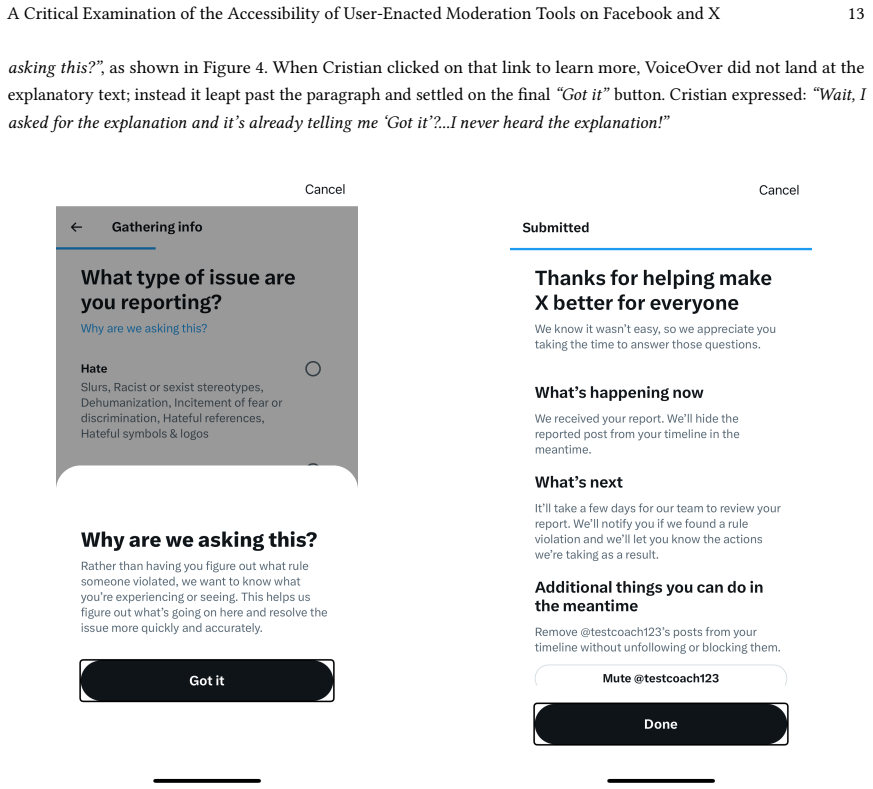
The analytic engine is the administrative burden lens, imported from public administration and applied to platform safety tasks. It splits burden into learning costs (figuring out what a control does and where it lives), compliance costs (executing multi-step procedures under a screen reader or low vision), and psychological costs (doubt, stress, loss of agency). The empirical machinery is a task-based walkthrough: 15 blind or low-vision participants, all VoiceOver users on their own iPhones, attempted six moderation tasks on controlled accounts while thinking aloud; researchers then coded transcripts into themes like discoverability, navigability, and expectation mismatches.
What would settle it
A controlled study in which sighted first-time users attempt the same six tasks on the same controlled accounts, under comparable conditions, would settle specificity: if sighted novices fail at similar rates and with similar disorientation, the core claim of an accessibility-specific burden would be falsified, while a large gap would corroborate it. A second falsifier: if either platform shipped fixes for the documented focus-order, labeling, and progress issues and a replication study found VoiceOver users completing tasks without restarts or workarounds, the 'pervasive accumulated design sh
Extended reading notes
Core claim
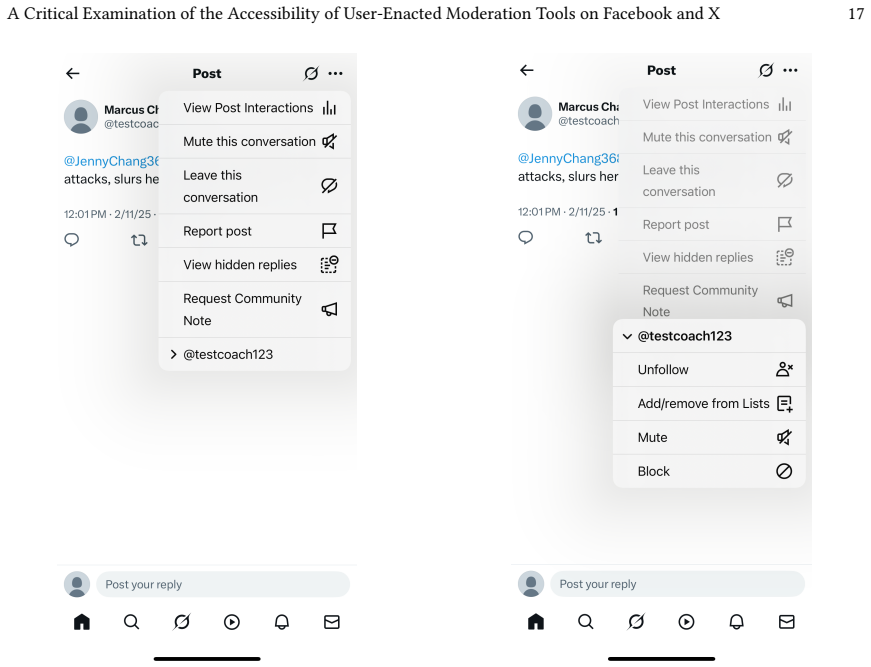
The central discovery is that the barriers are not one-off bugs but accumulated design shortcomings that cascade. Concrete patterns: screen reader focus order skips or reverses expected navigation; pop-up panels don't receive focus, leaving users on an unlabeled 'dim background'; identical menu icons get different labels; progress and confirmation are missing or ambiguous; and outcomes like report status or blocked-user lists are effectively hidden. Eight of nine Facebook VoiceOver users hit the focus-transfer failure at least once; eleven of fifteen looked for the block control on the post itself and nine of fifteen failed to locate platform-wide settings. The costs are distributed unequall
Load-bearing premise
The load-bearing premise is that the difficulties observed in the walkthroughs are primarily caused by platform accessibility barriers rather than by participants' general unfamiliarity with moderation tools; only two of fifteen had used reporting or blocking before, and the study did not include a sighted or experienced-user comparison group.
Editorial extensions
If this is right
- If platforms rely on user reports for safety, they must ensure reporting flows are completable non-visually; currently first-time users drop off or restart.
- Redesigns should use consistent labels, visible progress indicators (e.g., 'step 2 of 4'), screen-reader-exposed previews before commitment, and immediate confirmations after.
- Reaching a single control can take dozens of gestures; surfacing moderation options directly on posts would reduce that labor substantially.
- A reachable outcomes hub—making Facebook's Support Inbox findable and giving X a similar tracker—would reduce uncertainty and repeat submissions.
- The burden is inequitable: it turns safety maintenance into unpaid labor that falls hardest on marginalized users, reinforcing the case for participatory, ability-centered design.
- These findings imply that accessibility must be a measured dimension of moderation fairness, not an afterthought.
Reading between the lines
- A controlled study comparing sighted first-time users on the same tasks would isolate whether the failures are accessibility-specific or general first-time usability; either way the fixes matter, but the disability-specific claim would need reframing if sighted novices fail at similar rates.
- The same lens likely applies to other safety-critical flows beyond moderation—account recovery, privacy settings, data-download requests—where hidden menus and missing focus create unequal burden.
- The observed 'intent-blind search' failures suggest platform search should be evaluated as an accessibility surface, not just a content-discovery surface.
- Given European accessibility legislation, these findings may translate into concrete compliance obligations for major platforms, making the case actionable beyond design good will.
Editorial analysis
A structured set of objections, weighed in public.
Referee Report
Summary. This paper reports a qualitative, task-based study of the accessibility of user-enacted moderation tools (report, block, unblock, audience controls, sensitive-content filters) on Facebook and X. Fifteen blind or low-vision participants, all iPhone/VoiceOver users, performed six standardized tasks on their own devices using dummy accounts, with think-aloud protocol and retrospective interviews. The authors analyze the data through the lens of 'administrative burden of safety work,' identifying learning, compliance, and psychological costs, and produce a cross-platform catalog of accessibility breakdowns (discoverability, focus order, labeling, progress feedback, outcome opacity) plus design recommendations. The paper also includes a small technical contrast analysis of menu icons against WCAG thresholds. The contribution is framed as bridging content moderation and accessibility research, with implications for equitable safety tool design.
Significance. If the findings hold, the paper addresses an important and under-examined gap: the accessibility of safety-critical moderation workflows, not just routine social media use, for blind and low-vision users. The study's strengths are its empirical richness—verbatim quotes, detailed interaction traces, and documentation of specific failures such as VoiceOver focus-transfer problems, unlabeled controls, and contrast failures—and its transparent methodological reporting, including task design, recruitment, researcher positionality, and links to supporting screenshots. The adaptation of the administrative-burden framework to platform safety work is a useful conceptual contribution. The design recommendations (e.g., consistent labels, intent-aware search, progress indicators, accessible status trackers) are concrete and actionable. The paper is clearly within the scope of CSCW/HCI and would be of interest to researchers and practitioners working on accessible moderation and inclusive platform governance. The central claims are plausible but, as detailed below, require some tempering and clarification to match the evidence base.
major comments (4)
- [Section 4, first paragraph; Section 3.1] The central claim—that Facebook and X's moderation interfaces are 'systematically inaccessible' to BLV users—is underdetermined by the design because all participants were novice users of these tools (only two of fifteen had ever used reporting or blocking) and there was no sighted comparison or experienced-user comparison group. The observed breakdowns may reflect first-time-user difficulty with complex workflows rather than vision-specific accessibility barriers. This is not merely a framing issue: the paper's design recommendations target WCAG/accessibility fixes, and the stated contribution is accessibility. Please either (a) add a comparison condition with sighted first-time users or experienced BLV users, or (b) reframe the contribution more narrowly as an account of first-time BLV users' experiences and temper language such as 'pervasive pattern' and 'systematic barriers.' The pap
- [Section 4.1.2, 'Of nine Facebook participants...'] The quasi-quantitative claims (e.g., 'eight of nine Facebook VoiceOver users encountered this problem at least once,' 'eleven of fifteen' looked for Block on the post, 'nine of fifteen' failed to locate settings) rest on a small, non-random, self-selected sample. These counts are reported without uncertainty or qualification, which risks overstating generalizability. Please report these as descriptive observations within a qualitative study, clearly noting the sample size and non-random recruitment, and avoid presenting them as prevalence estimates. This is especially important because the sample is homogeneous (all iPhone/VoiceOver users from New Jersey).
- [Section 3.1 and Section 5.3] The sample is limited to 15 participants who all used iPhones with VoiceOver (with one low-vision participant also using a magnifier). The paper claims to examine 'the accessibility of user-enacted moderation tools on Facebook and X' but does not include Android/TalkBack users, web interfaces, or non-iOS low-vision configurations (e.g., screen magnification, high-contrast modes). Section 5.3's limitations mention platform dynamism and task artificiality but do not explicitly acknowledge this device/OS scope. Please add an explicit limitation and adjust the level of generality in the abstract and conclusion (e.g., 'on iOS' where appropriate).
- [Section 5.3] The limitations section states that 'specific challenges were not uniformly replicable across researchers’ own devices or every participant’s encounter.' This acknowledgement sits uneasily with the paper's stronger conclusions about 'systemic' barriers. Please specify which findings were consistently observed and which varied, and discuss the implications for the claim that the identified problems are stable features of the platforms rather than transient or device-specific issues. This would strengthen the credibility of the cross-platform catalog.
minor comments (6)
- [Section 4.1.1, Figure 1] The figure captions reference sub-figures (a) and (b), but the in-text discussion could more explicitly point to the specific visual elements being described. Consider annotating the screenshots with arrows or labels to make the focus-order issue easier for sighted readers to follow.
- [Section 2.2, reference [48]] The sentence 'interactive elements like buttons and menus often lack proper semantic labels' is supported by the citation, but the reference list entry for [48] appears to be incomplete (no page range). Please check.
- [Section 5.2] There is a typo: 'everday burden' should be 'everyday burden.'
- [Section 4.3.2] The estimate of 'thirty or more discrete actions' to reach a deeply nested option would benefit from a concrete example or trace (e.g., for the unblocking task on Facebook). As written, it is a vague quantitative claim that is not verifiable from the reported data.
- [Section 5.3] The sentence beginning 'However, we note that the ready usability of such tools becomes critical amid safety concerns...' is a useful defensive point, but it appears in the limitations section; consider moving it earlier (e.g., to the Findings introduction) to contextualize the novice-user sample.
- [Section 3.2.1] The description of the dummy-account setup is clear, but the use of placeholders like '[placeholder for hateful slur]' may reduce the ecological validity of the reporting task. Please discuss briefly how this trade-off was weighed.
Circularity Check
No circularity: the paper's claims are grounded in new qualitative task-based data, not in a derivation chain that reduces to its own inputs or to load-bearing self-citations.
full rationale
This is an interpretive qualitative study with no numerical derivation, fitted parameters, or formal model whose outputs could coincide with its inputs by construction. The central claim—that Facebook and X moderation tools impose significant accessibility burdens on blind and low-vision users—is supported by the authors' own task-based walkthroughs, think-aloud protocols, and thematic coding of 15 participants, not by a self-referential argument. The administrative burden lens is imported from an external public-administration source (Moynihan et al. 2015) and applied as an interpretive frame; the three cost categories are analytic vocabulary, not quantities derived from the data. Several self-citations appear (e.g., Lyu et al. 2024; Jhaver et al. 2018, 2025; Zhang et al. 2023), but they are used as background and motivation, not as load-bearing evidence for the study's findings. No uniqueness theorem, ansatz, or fitted input is invoked. The absence of a sighted comparison group is a genuine evidentiary limitation regarding how much of the observed difficulty is accessibility-specific versus first-time-user unfamiliarity, but underdetermination of an empirical claim is not circularity. Accordingly, no circular steps are present.
Assumptions & free parameters
assumptions (2)
- domain assumption Task performance in controlled walkthroughs with dummy accounts reflects real-world moderation use.
- domain assumption The administrative burden typology (learning, compliance, psychological costs) is a valid lens for interpreting accessibility barriers in platform safety tools.
Cite this review
Pith. "Pith review of "I thought it was my mistake, but it's really the design'': A Critical Examination of the Accessibility of User-Enacted Moderation Tools on Facebook and X." pith.science (2026). https://pith.science/paper/O6NNCSFE
@misc{pith2026250910789,
  author       = {Pith},
  title        = {Pith review of: "I thought it was my mistake, but it's really the design'': A Critical Examination of the Accessibility of User-Enacted Moderation Tools on Facebook and X},
  year         = {2026},
  howpublished = {\url{https://pith.science/paper/O6NNCSFE}},
  note         = {Machine review of arXiv:2509.10789}
}
read the original abstract
As social media platforms increasingly promote the use of user-enacted moderation tools (e.g., reporting, blocking, content filters) to address online harms, it becomes crucially important that such controls are usable for everyone. We evaluate the accessibility of these moderation tools on two mainstream platforms -- Facebook and X -- through interviews and task-based walkthroughs with 15 individuals with vision impairments. Adapting the lens of \emph{administrative burden of safety work}, we identify three interleaved costs that users with vision loss incur while interacting with moderation tools: \emph{learning costs} (understanding what controls do and where they live), \emph{compliance costs} (executing multi-step procedures under screen reader and low-vision conditions), and \emph{psychological costs} (experiencing uncertainty, stress, and diminished agency). Our analysis bridges the fields of content moderation and accessibility in HCI research and contributes (1) a cross-platform catalog of accessibility and usability breakdowns affecting safety tools; and (2) design recommendations for reducing this burden.
Figures


Figures from the paper (3 more)

Reference graph
Works this paper leans on
-
[1]
Technical Report SWD(2022) 410 final
2022.Report on the implementation of the Web Accessibility Directive. Technical Report SWD(2022) 410 final. European Commission. https://eur- lex.europa.eu/legal-content/EN/TXT/PDF/?uri=CELEX:52022SC0410 Explains EN 301 549 is based on WCAG 2.1 and notes revision to reflect EAA requirements
2022
-
[2]
World Wide Web Consortium (W3C)
World Wide Web Consortium (W3C) 2025.Web Content Accessibility Guidelines (WCAG) 2.1. World Wide Web Consortium (W3C). https: //www.w3.org/TR/WCAG21/
2025
-
[3]
Cynthia L. Bennett, Jane E, Martez E. Mott, Edward Cutrell, and Meredith Ringel Morris. 2018. How Teens with Visual Impairments Take, Edit, and Share Photos on Social Media. InProceedings of the 2018 CHI Conference on Human Factors in Computing Systems(Montreal QC, Canada)(CHI ’18). Association for Computing Machinery, New York, NY, USA, 1–12. https://doi...
arXiv 2018
-
[4]
Stacy M. Branham and Shaun K. Kane. 2015. The Invisible Work of Accessibility: How Blind Employees Manage Accessibility in Mixed-Ability Workplaces. InProceedings of the 17th International ACM SIGACCESS Conference on Computers & Accessibility(Lisbon, Portugal)(ASSETS ’15). Association for Computing Machinery, New York, NY, USA, 163–171. https://doi.org/10...
arXiv 2015
-
[5]
Virginia Braun and Victoria Clarke. 2006. Using Thematic Analysis in Psychology.Qualitative Research in Psychology3, 2 (2006), 77–101. https://doi.org/10.1191/1478088706qp063oa
-
[6]
2024.Memory Recognition and Recall in User Interfaces
Raluca Budiu. 2024.Memory Recognition and Recall in User Interfaces. https://www.nngroup.com/articles/recognition-and-recall/ Nielsen Norman Group. Accessed: 2025-08-22
2024
-
[7]
Eshwar Chandrasekharan, Chaitrali Gandhi, Matthew Wortley Mustelier, and Eric Gilbert. 2019. Crossmod: A cross-community learning-based system to assist reddit moderators.Proceedings of the ACM on human-computer interaction3, CSCW (2019), 1–30
2019
-
[8]
James I. Charlton. 1998.Nothing About Us Without Us. University of California Press, Berkeley. http://www.jstor.org/stable/10.1525/j.ctt1pnqn9
Show all 86 references
-
[9]
Bobby Chesney and Danielle Keats Citron. 2019. Deep Fakes: A Looming Challenge for Privacy, Democracy, and National Security.California Law Review107, 6 (2019), 1753–1819. https://www.californialawreview.org/print/deep-fakes-a-looming-challenge-for-privacy-democracy-and- natio...
2019
-
[10]
Corbin and Anselm L
Juliet M. Corbin and Anselm L. Strauss. 2015.Basics of Qualitative Research: Techniques and Procedures for Developing Grounded Theory(4 ed.). SAGE Publications, Thousand Oaks, CA. Chapter 8 provides a step-by-step guide to open coding
2015
-
[11]
2020.Design Justice: Community-Led Practices to Build the Worlds We Need
Sasha Costanza-Chock. 2020.Design Justice: Community-Led Practices to Build the Worlds We Need. MIT Press. https://doi.org/10.7551/mitpress/ 12255.001.0001 Open access edition
2020 doi
-
[12]
Kate Crawford and Tarleton Gillespie. 2016. What Is a Flag For? Social Media Reporting Tools and the Vocabulary of Complaint.New Media & Society18, 3 (2016), 410–428. https://doi.org/10.1177/1461444814543163
2016 doi
-
[13]
2021.EN 301 549 V3.2.1: Accessibility Requirements for ICT Products and Services
European Telecommunications Standards Institute. 2021.EN 301 549 V3.2.1: Accessibility Requirements for ICT Products and Services. https: //www.etsi.org/deliver/etsi_en/301500_301599/301549/03.02.01_60/en_301549v030201p.pdf
2021
-
[14]
2025.Consumer Sentinel Network Data Book 2024
Federal Trade Commission. 2025.Consumer Sentinel Network Data Book 2024. Technical Report. https://www.ftc.gov/system/files/ftc_gov/pdf/csn- annual-data-book-2024.pdf Reports over $12B in consumer fraud losses in 2024
2025
-
[15]
G. W. Furnas, T. K. Landauer, L. M. Gomez, and S. T. Dumais. 1987. The vocabulary problem in human-system communication.Commun. ACM30, 11 (Nov. 1987), 964–971. https://doi.org/10.1145/32206.32212
1987
-
[16]
GBD 2019 Blindness and Vision Impairment Collaborators and Vision Loss Expert Group of the Global Burden of Disease Study. 2021. Trends in prevalence of blindness and distance and near vision impairment over 30 years: an analysis for the Global Burden of Disease Study.The Lanc...
2019 doi
-
[17]
R Stuart Geiger. 2016. Bot-based collective blocklists in Twitter: the counterpublic moderation of harassment in a networked public space.Information, Communication & Society19, 6 (2016), 787–803
2016
-
[18]
2018.Custodians of the Internet: Platforms, Content Moderation, and the Hidden Decisions that Shape Social Media
Tarleton Gillespie. 2018.Custodians of the Internet: Platforms, Content Moderation, and the Hidden Decisions that Shape Social Media. Yale University Press, New Haven, CT
2018
-
[19]
Katerina Gkatzola and Konstantinos Papadopoulos. 2024. Social media actually used by people with visual impairment: A scoping review.British Journal of Visual Impairment42, 3 (2024), 832–848. https://doi.org/10.1177/02646196231189393 arXiv:https://doi.org/10.1177/02646196231189393
2024 doi
-
[20]
Chilton, Benjamin M
Cole Gleason, Patrick Carrington, Lydia B. Chilton, Benjamin M. Gorman, Hernisa Kacorri, Andrés Monroy-Hernández, Meredith Ringel Morris, Garreth W. Tigwell, and Shaomei Wu. 2019. Addressing the Accessibility of Social Media. InConference Companion Publication of the 2019 on C...
2019
-
[21]
Chilton, and Jeffrey P
Cole Gleason, Amy Pavel, Xingyu Liu, Patrick Carrington, Lydia B. Chilton, and Jeffrey P. Bigham. 2019. Making Memes Accessible. InProceedings of the 21st International ACM SIGACCESS Conference on Computers and Accessibility(Pittsburgh, PA, USA)(ASSETS ’19). Association for Co...
2019
-
[22]
Kitani, and Jeffrey P
Cole Gleason, Amy Pavel, Emma McCamey, Christina Low, Patrick Carrington, Kris M. Kitani, and Jeffrey P. Bigham. 2020. Twitter A11y: A Browser Extension to Make Twitter Images Accessible. InProceedings of the 2020 CHI Conference on Human Factors in Computing Systems. ACM, Hono...
2020
-
[23]
Aurora Harley. 2018. Visibility of System Status (Usability Heuristic No. 1).Nielsen Norman Group(3 June 2018). https://www.nngroup.com/ articles/visibility-system-status/
2018
-
[24]
2008.Web accessibility: a foundation for research
Simon Harper and Yeliz Yesilada. 2008.Web accessibility: a foundation for research. Springer Science & Business Media
2008
-
[25]
Natali Helberger, Jo Pierson, and Thomas Poell. 2018. Governing online platforms: From contested to cooperative responsibility.The information society34, 1 (2018), 1–14
2018
-
[26]
Nicola Henry and Anastasia Powell. 2018. Technology-Facilitated Sexual Violence: A Literature Review of Empirical Research.Trauma, Violence, & Abuse19, 2 (2018), 195–208. https://doi.org/10.1177/1524838016650189
2018 doi
-
[27]
Vulnerable, Victimized, and Objectified
Sharon Heung, Lucy Jiang, Shiri Azenkot, and Aditya Vashistha. 2024. “Vulnerable, Victimized, and Objectified”: Understanding Ableist Hate and Harassment Experienced by Disabled Content Creators on Social Media. InProceedings of the 2024 CHI Conference on Human Factors in Comp...
2024
-
[28]
Ignorance is not Bliss
Sharon Heung, Lucy Jiang, Shiri Azenkot, and Aditya Vashistha. 2025. "Ignorance is not Bliss": Designing Personalized Moderation to Address Ableist Hate on Social Media. InProceedings of the 2025 CHI Conference on Human Factors in Computing Systems (CHI ’25). Association for C...
2025
-
[29]
Sharon Heung, Mahika Phutane, Shiri Azenkot, Megh Marathe, and Aditya Vashistha. 2022. Nothing Micro About It: Examining Ableist Microag- gressions on Social Media. InProceedings of the 24th International ACM SIGACCESS Conference on Computers and Accessibility(Athens, Greece) ...
2022
-
[30]
Froehlich, Nicolas Ruffieux, and Denis Lalanne
Maximiliano Jeanneret Medina, Yong-Joon Thoo, Cédric Baudet, Jon E. Froehlich, Nicolas Ruffieux, and Denis Lalanne. 2025. Understanding Research Themes and Interactions at Scale within Blind and Low-vision Research in ACM and IEEE.ACM Trans. Access. Comput.18, 2, Article 7 (Ap...
2025 doi
-
[31]
Did You Suspect the Post Would be Removed?
Shagun Jhaver, Darren Scott Appling, Eric Gilbert, and Amy Bruckman. 2019. “Did You Suspect the Post Would be Removed?”: Understanding User Reactions to Content Removals on Reddit.Proceedings of the ACM on Human-Computer Interaction3, CSCW, Article 192 (2019), 192:1–192:33 pag...
2019 doi
-
[32]
Shagun Jhaver, Iris Birman, Eric Gilbert, and Amy Bruckman. 2019. Human-Machine Collaboration for Content Regulation: The Case of Reddit Automoderator.ACM Trans. Comput.-Hum. Interact.26, 5, Article 31 (July 2019), 35 pages. https://doi.org/10.1145/3338243
2019 doi
-
[33]
Shagun Jhaver, Quan Ze Chen, Detlef Knauss, and Amy X. Zhang. 2022. Designing Word Filter Tools for Creator-Led Comment Moderation. In Proceedings of the 2022 CHI Conference on Human Factors in Computing Systems(New Orleans, LA, USA)(CHI ’22). Association for Computing Machine...
2022
-
[34]
Shagun Jhaver, Sucheta Ghoshal, Amy Bruckman, and Eric Gilbert. 2018. Online Harassment and Content Moderation: The Case of Blocklists.ACM Transactions on Computer-Human Interaction25, 2 (2018), 12:1–12:33. https://doi.org/10.1145/3185593
2018 doi
-
[35]
Shagun Jhaver and Amy X. Zhang. 2025. Do Users Want Platform Moderation or Individual Control? Examining the Role of Third-Person Effects and Free Speech Support in Shaping Moderation Preferences.New Media & Society27, 5 (2025), 2930–2950. https://doi.org/10.1177/1461444823121...
2025 doi
-
[36]
Bern Jordan, Victoria Van Hyning, Mason A
J. Bern Jordan, Victoria Van Hyning, Mason A. Jones, Rachael Bradley Montgomery, Elizabeth Bottner, and Evan Tansil. 2024. Information Wayfinding of Screen Reader Users: Five Personas to Expand Conceptualizations of User Experiences. InProceedings of the 26th International ACM...
2024
-
[37]
Sara Kiesler, Robert Kraut, Paul Resnick, and Aniket Kittur. 2012. Regulating behavior in online communities.Building successful online communities: Evidence-based social design1 (2012), 4–2
2012
-
[38]
Dialing it Back:
Sena A Kojah, Ben Zefeng Zhang, Carolina Are, Daniel Delmonaco, and Oliver L Haimson. 2025. " Dialing it Back:" Shadowbanning, Invisible Digital Labor, and how Marginalized Content Creators Attempt to Mitigate the Impacts of Opaque Platform Governance.Proceedings of the ACM on...
2025
-
[39]
Bigham, and Amy Pavel
Christina Low, Emma McCamey, Cole Gleason, Patrick Carrington, Jeffrey P. Bigham, and Amy Pavel. 2019. Twitter A11y: A Browser Extension to Describe Images. InThe 21st International ACM SIGACCESS Conference on Computers and Accessibility. ACM, Pittsburgh PA USA, 551–553. https...
2019
-
[40]
I Got Flagged for Supposed Bullying, Even Though It Was in Response to Someone Harassing Me About My Disability
Yao Lyu, Jie Cai, Anisa Callis, Kelley Cotter, and John M. Carroll. 2024. "I Got Flagged for Supposed Bullying, Even Though It Was in Response to Someone Harassing Me About My Disability. ": A Study of Blind TikTokers’ Content Moderation Experiences. InProceedings of the 2024 ...
2024
-
[41]
I Upload...All Types of Different Things to Say, the World of Blindness Is More Than What They Think It Is
Yao Lyu, Jie Cai, Bryan Dosono, Davis Yadav, and John M. Carroll. 2024. "I Upload...All Types of Different Things to Say, the World of Blindness Is More Than What They Think It Is": A Study of Blind TikTokers’ Identity Work from a Flourishing Perspective.The ACM Conference on ...
2024 arXiv
-
[42]
Because Some Sighted People, They Don’t Know What the Heck You’re Talking About:
Yao Lyu and John M. Carroll. 2024. "Because Some Sighted People, They Don’t Know What the Heck You’re Talking About:" A Study of Blind TikTokers’ Infrastructuring Work to Build Independence.Proceedings of the ACM on Human-Computer Interaction8, CSCW (2024). https: //doi.org/10...
2024 doi
-
[43]
I’m not sure what difference is between their content and mine, other than the person itself
Renkai Ma and Yubo Kou. 2022. " I’m not sure what difference is between their content and mine, other than the person itself" A Study of Fairness Perception of Content Moderation on YouTube.Proceedings of the ACM on Human-Computer Interaction6, CSCW2 (2022), 1–28
2022
-
[44]
Nathan Matias
J. Nathan Matias. 2019. The Civic Labor of Volunteer Moderators Online.Social Media + Society5, 2 (2019), 1–14. https://doi.org/10.1177/ 2056305119836778
2019
-
[45]
Samuel Mayworm, Michael Ann DeVito, Daniel Delmonaco, Hibby Thach, and Oliver L Haimson. 2024. Content moderation folk theories and perceptions of platform spirit among marginalized social media users.ACM Transactions on Social Computing7, 1-4 (2024), 1–27
2024
-
[46]
Samuel Mayworm, Shannon Li, Hibby Thach, Daniel Delmonaco, Christian Paneda, Andrea Wegner, and Oliver L Haimson. 2024. The Online Identity Help Center: Designing and developing a content moderation policy resource for marginalized social media users.Proceedings of the ACM on ...
2024
-
[47]
Aiden McGillicuddy, Jean Grégoire Bernard, and Jocelyn Cranefield. 2016. Controlling bad behavior in online communities: An examination of moderation work.2016 International Conference on Information Systems, ICIS 2016(2016), 1–11
2016
-
[48]
With most of it being pictures now, I rarely use it
Meredith Ringel Morris, Annuska Zolyomi, Catherine Yao, Sina Bahram, Jeffrey P. Bigham, and Shaun K. Kane. 2016. "With most of it being pictures now, I rarely use it": Understanding Twitter’s Evolving Accessibility to Blind Users. InProceedings of the 2016 CHI Conference on Hu...
2016
-
[49]
Donald Moynihan, Pamela Herd, and Hope Harvey. 2015. Administrative burden: Learning, psychological, and compliance costs in citizen-state interactions.Journal of Public Administration Research and Theory25, 1 (2015), 43–69. A Critical Examination of the Accessibility of User-...
2015
-
[50]
Philip M. Napoli. 2019.Social Media and the Public Interest: Media Regulation in the Disinformation Age. Columbia University Press, New York. https://doi.org/10.7312/napo18454
2019 doi
-
[51]
Jakob Nielsen and Robert L. Mack. 1994.Usability Inspection Methods. John Wiley & Sons, New York, NY
1994
-
[52]
Donald A. Norman. 2013.The Design of Everyday Things. Basic Books, New York
2013
-
[53]
2015.The Black Box Society: The Secret Algorithms That Control Money and Information
Frank Pasquale. 2015.The Black Box Society: The Secret Algorithms That Control Money and Information. Harvard University Press. https: //www.hup.harvard.edu/books/9780674970847
2015
-
[54]
Martin J Riedl, Teresa K Naab, Gina M Masullo, Pablo Jost, and Marc Ziegele. 2021. Who is responsible for interventions against problematic comments? Comparing user attitudes in Germany and the United States.Policy & Internet13, 3 (2021), 433–451
2021
-
[55]
Afsaneh Rigot. 2022. Design From the Margins. Lecture at the Berkman Klein Center for Internet & Society at Harvard University. Available online at https://www.belfercenter.org/publication/design-margins
2022
-
[56]
Sarah T. Roberts. 2019.Behind the Screen: Content Moderation in the Shadows of Social Media. Yale University Press, New Haven, CT
2019
-
[57]
Wobbrock
Anne Spencer Ross, Xiaoyi Zhang, James Fogarty, and Jacob O. Wobbrock. 2018. Examining Image-Based Button Labeling for Accessibility in Android Apps through Large-Scale Analysis. InProceedings of the 20th International ACM SIGACCESS Conference on Computers and Accessibility (G...
2018
-
[58]
Andreas Savva, Helen Petrie, and Christopher Douglas Power. 2015. Comparing Concurrent and Retrospective Verbal Protocols for Blind and Sighted Users. InHuman-Computer Interaction – INTERACT 2015, Part I (Lecture Notes in Computer Science, Vol. 9296), Julio Abascal, Simone Bar...
2015 doi
-
[59]
Morgan Klaus Scheuerman, Stacy M Branham, and Foad Hamidi. 2018. Safe spaces and safe places: Unpacking technology-mediated experiences of safety and harm with transgender people.Proceedings of the ACM on Human-computer Interaction2, CSCW (2018), 1–27
2018
-
[60]
Morgan Klaus Scheuerman, Jialun Aaron Jiang, Casey Fiesler, and Jed R Brubaker. 2021. A framework of severity for harmful content online. Proceedings of the ACM on Human-Computer Interaction5, CSCW2 (2021), 1–33
2021
-
[61]
Joseph Seering. 2020. Reconsidering Self-Moderation: the Role of Research in Supporting Community-Based Models for Online Content Moderation. Proc. ACM Hum.-Comput. Interact.4, CSCW2, Article 107 (Oct. 2020), 28 pages. https://doi.org/10.1145/3415178
2020 doi
-
[62]
I Just Didn’t Notice It:
Filipo Sharevski and Aziz N Zeidieh. 2023. “I Just Didn’t Notice It:” Experiences with Misinformation Warnings on Social Media amongst Users Who Are Low Vision or Blind. InProceedings of the 2023 New Security Paradigms Workshop(Segovia, Spain)(NSPW ’23). Association for Comput...
2023
-
[63]
Yunhee Shim and Shagun Jhaver. 2024. Incorporating Procedural Fairness in Flag Submissions on Social Media Platforms.arXiv preprint arXiv:2409.08498(2024)
2024 arXiv
-
[64]
Jacobs, Niklas Elmqvist, and Nicholas Diakopoulos
Ben Shneiderman, Catherine Plaisant, Maxine Cohen, Steven M. Jacobs, Niklas Elmqvist, and Nicholas Diakopoulos. 2017.Designing the User Interface: Strategies for Effective Human–Computer Interaction(6 ed.). Pearson, Boston. 624 pages
2017
-
[65]
Gerling, Cynthia L
Katta Spiel, K. Gerling, Cynthia L. Bennett, Émeline Brulé, R. Williams, J. Rode, and Jennifer Mankoff. 2020. Nothing About Us Without Us: Investigating the Role of Critical Disability Studies in HCI.Extended Abstracts of the 2020 CHI Conference on Human Factors in Computing S...
2020
-
[66]
Person, Shoes, Tree. Is the Person Naked?
Abigale Stangl, Meredith Ringel Morris, and Danna Gurari. 2020. "Person, Shoes, Tree. Is the Person Naked?" What People with Vision Impairments Want in Image Descriptions. InProceedings of the 2020 CHI Conference on Human Factors in Computing Systems(Honolulu, HI, USA)(CHI ’20...
2020
-
[67]
Riedl, and Matthew Lease
Miriah Steiger, Timir J Bharucha, Sukrit Venkatagiri, Martin J. Riedl, and Matthew Lease. 2021. The Psychological Well-Being of Content Moderators: The Emotional Labor of Commercial Moderation and Avenues for Improving Support. InProceedings of the 2021 CHI Conference on Human...
2021
-
[68]
Sum, Rahaf Alharbi, F
C. Sum, Rahaf Alharbi, F. Spektor, Cynthia L. Bennett, Christina N. Harrington, Katta Spiel, and R. Williams. 2022. Dreaming Disability Justice in HCI.CHI Conference on Human Factors in Computing Systems Extended Abstracts(2022). https://doi.org/10.1145/3491101.3503731
2022
-
[69]
Sarit Felicia Anais Szpiro, Shafeka Hashash, Yuhang Zhao, and Shiri Azenkot. 2016. How People with Low Vision Access Computing Devices: Understanding Challenges and Opportunities. InProceedings of the 18th International ACM SIGACCESS Conference on Computers and Accessibility (...
2016
-
[70]
Meini Tang, Roberto Manduchi, Susana Chung, and Raquel Prado. 2023. Screen Magnification for Readers with Low Vision: A Study on Usability and Performance. InProceedings of the 25th International ACM SIGACCESS Conference on Computers and Accessibility(New York, NY, USA)(ASSETS...
2023
-
[71]
Ackerman, and David R
Jaime Teevan, Christine Alvarado, Mark S. Ackerman, and David R. Karger. 2004. The perfect search engine is not enough: a study of orienteering behavior in directed search. InProceedings of the SIGCHI Conference on Human Factors in Computing Systems(Vienna, Austria)(CHI ’04). ...
2004
-
[72]
Tiziana Terranova. 2000. Free Labor: Producing Culture for the Digital Economy.Social Text18, 2 (63) (2000), 33–58. https://doi.org/10.1215/01642472- 18-2_63-33
2000 doi
-
[73]
2022.Accessibility for Trust and Safety Flows
David Thiel and Samantha Bradshaw. 2022.Accessibility for Trust and Safety Flows. Stanford Cyber Policy Center. https://cyber.fsi.stanford.edu/io/ news/accessibility-trust-and-safety-flows Accessed 2025-05-02. 28 Hosamane, Walters, Lyu and Jhaver
2022
-
[74]
Amos Tversky and Daniel Kahneman. 1974. Judgment under Uncertainty: Heuristics and Biases: Biases in judgments reveal some heuristics of thinking under uncertainty.science185, 4157 (1974), 1124–1131
1974
-
[75]
At the End of the Day Facebook Does What ItWants
Kristen Vaccaro, Christian Sandvig, and Karrie Karahalios. 2020. " At the End of the Day Facebook Does What ItWants" How Users Experience Contesting Algorithmic Content Moderation.Proceedings of the ACM on human-computer interaction4, CSCW2 (2020), 1–22
2020
-
[76]
Emily A. Vogels. 2021. The State of Online Harassment. Pew Research Center. https://www.pewresearch.org/internet/2021/01/13/the-state-of- online-harassment/
2021
-
[77]
Soroush Vosoughi, Deb Roy, and Sinan Aral. 2018. The spread of true and false news online.Science359, 6380 (2018), 1146–1151. https: //doi.org/10.1126/science.aap9559
2018 doi
-
[78]
Violeta Voykinska, Shiri Azenkot, Shaomei Wu, and Gilly Leshed. 2016. How Blind People Interact with Visual Content on Social Networking Services. InProceedings of the 19th ACM Conference on Computer-Supported Cooperative Work & Social Computing(San Francisco, California, USA)...
2016
-
[79]
2023.Designing for Web Accessibility – Tips for Getting Started
W3C Web Accessibility Initiative (WAI). 2023.Designing for Web Accessibility – Tips for Getting Started. https://www.w3.org/WAI/design- develop/design-for-all/ Accessed 8 May 2025
2023
-
[80]
2025.Understanding Success Criterion 3.2.4: Consistent Identification
W3C Web Accessibility Initiative (WAI). 2025.Understanding Success Criterion 3.2.4: Consistent Identification. World Wide Web Consortium (W3C). https://www.w3.org/WAI/WCAG21/Understanding/consistent-identification.html Developed by the Accessibility Guidelines Working Group (AG WG)
2025
-
[82]
There’s so much responsibility on users right now:
Miranda Wei, Sunny Consolvo, Patrick Gage Kelley, Tadayoshi Kohno, Franziska Roesner, and Kurt Thomas. 2023. “There’s so much responsibility on users right now:” Expert Advice for Staying Safer From Hate and Harassment. InProceedings of the 2023 CHI Conference on Human Factors...
2023
-
[83]
Wobbrock, Shaun K
Jacob O. Wobbrock, Shaun K. Kane, Krzysztof Z. Gajos, Susumu Harada, and Jon Froehlich. 2011. Ability-Based Design: Concept, Principles and Examples.ACM Trans. Access. Comput.3, 3, Article 9 (April 2011), 27 pages. https://doi.org/10.1145/1952383.1952384
2011
-
[84]
Donghee Yvette Wohn. 2019. Volunteer Moderators in Twitch Micro Communities: How They Get Involved, the Roles They Play, and the Emotional Labor They Experience. InProceedings of the 2019 CHI Conference on Human Factors in Computing Systems(Glasgow, Scotland Uk)(CHI ’19). Asso...
2019
-
[85]
2019.World report on vision
World Health Organization. 2019.World report on vision. World Health Organization, Geneva. https://www.who.int/publications-detail/world- report-on-vision
2019
-
[86]
Shaomei Wu and Lada A. Adamic. 2014. Visually impaired users on an online social network. InProceedings of the SIGCHI Conference on Human Factors in Computing Systems(Toronto, Ontario, Canada)(CHI ’14). Association for Computing Machinery, New York, NY, USA, 3133–3142. https:/...
2014
-
[87]
Alice Qian Zhang, Kaitlin Montague, and Shagun Jhaver. 2023. Cleaning up the streets: Understanding motivations, mental models, and concerns of users flagging social media posts.arXiv preprint arXiv:2309.06688(2023)
2023 arXiv
Reviewed August 4, 2026 · model on record in the stance chip above.
Discussion (0). Continue with ORCID to comment.