REVIEW 4 major objections 6 minor 67 references
Gain More for Less: The Surprising Benefits of QoS Management in Constrained NDN Networks
T0 review · 4 major / 6 minor · reviewed 2026-08-14 · deepseek-v4-flash
Pith's one-line read Coordinated QoS in NDN improves prioritized and regular traffic at once.
desk verdict Solid testbed measurement of coordinated NDN QoS; the headline super-additivity claim outruns the experimental design. read the letter →
The pith
A machine-rendered reading of the paper's core claim, the machinery that carries it, and where it could break.
The reading
What carries the argument
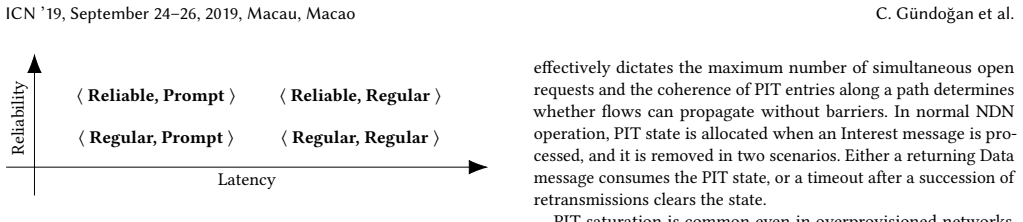
The load-bearing mechanism is prefix-based flow classification into two service dimensions—prompt (latency) and reliable (loss)—applied to both Interests and Data. Each node holds a small list of name prefixes marked with a traffic class and maps incoming packets by longest prefix match, so no extra signaling or header overhead is needed. The paper then couples this classification to three resources: forwarding queues (prompt before regular), the Pending Interest Table (eviction order regular, then reliable, then prompt; prioritized Interests enter first), and the Content Store (reliable data is cached even without a matching PIT entry; regular data follows the usual decision strategy; cache replacement never evicts a higher class unless no other option). Critically, the same rules are applied uniformly at every node, which the paper argues preserves PIT coherence along paths and creates cache diversity through class-weighted probabilistic caching. The name for the central danger this addresses is PIT decorrelation: when neighboring PITs diverge, data flows terminate and forwarding resources are wasted. Coordinated eviction keeps the state coherent, and that coordination is what carries the reported gains.
What would settle it
Measure time and memory of longest-prefix-match classification per packet on an ARM Cortex-M3-class node while forwarding at link rate, or run the same 31-node scenarios with classification cost artificially added; if per-packet overhead consumes a meaningful share of CPU or RAM, the net benefit of the QoS scheme would be lower. Alternatively, run the identical scenarios with all nodes using the same PIT/cache policies but with random (non-prefix) traffic marking; if gains persist, the mechanism is not the claimed prefix-based coordination.
Extended reading notes
Core claim
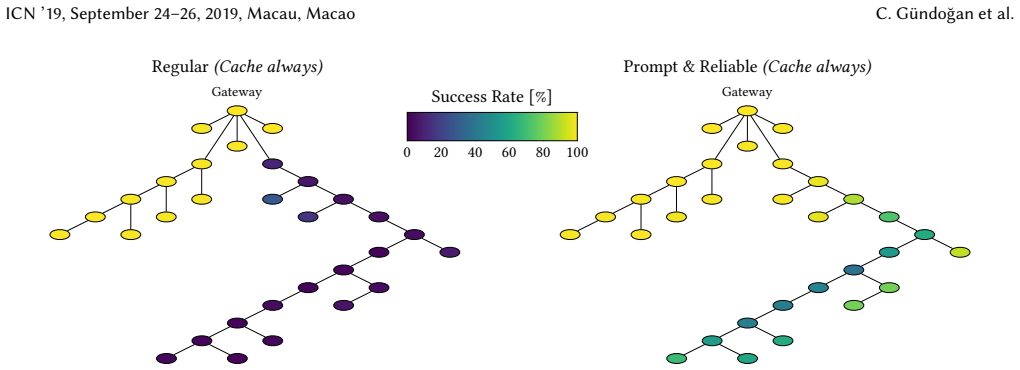
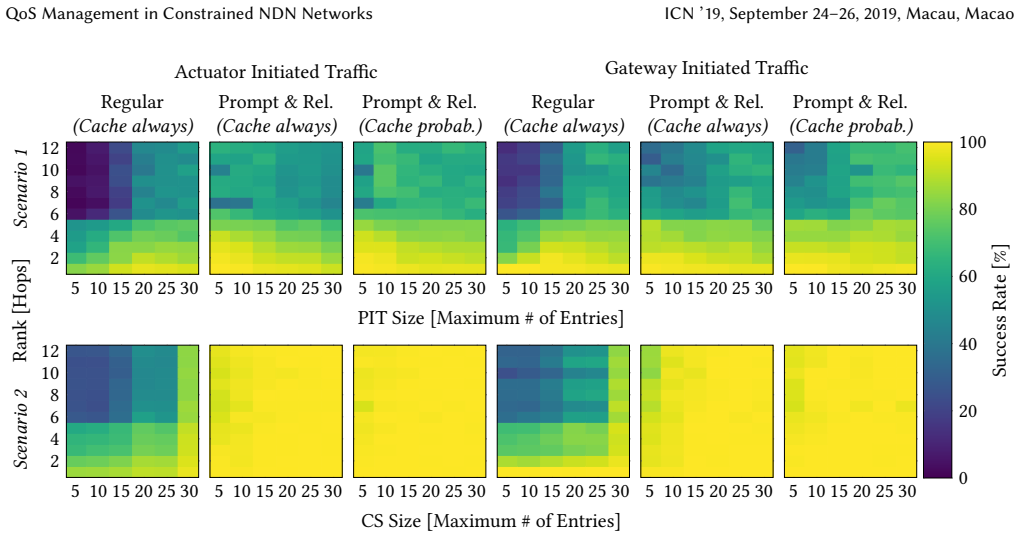
The paper's central claim is that a simple, coordinated QoS scheme for constrained NDN networks yields a global performance enhancement rather than a redistribution of service. Classifying Interest and Data traffic by longest-prefix match against per-node lists of QoS prefixes, the scheme maps flows to prompt and/or reliable service levels. These levels drive three coupled decisions: prioritized forwarding, PIT eviction order (regular before reliable before prompt), and cache admission/replacement that favors reliable content, optionally with class-dependent probabilistic caching ($p_{\text{rel}}=0.7$ vs. $p_{\text{reg}}=0.3$). In a 31-node wireless multi-hop testbed with limited PIT and cache sizes (5–30 entries), the authors report that this coordination raises success rates from below 10% in stressed parts of the network to 40–100%, roughly doubles success rates (40% to 80%) in one configuration, and cuts completion times for distant nodes by about 100 ms. Regular traffic does not lose out; the reduction in retransmissions and better cache diversity helps it too. This is the sense in which ICN QoS exceeds IP QoS: IP manages link and buffer resources, whereas NDN also manages forwarding state and cached content, and the interactions between these dimensions are where the gain comes from.
Load-bearing premise
The load-bearing premise is that sorting packets into service classes by looking up their name prefixes costs almost no memory or processing time on the tiny devices; the paper states this as a design goal but does not measure it.
Editorial extensions
If this is right
- Prioritizing Interest messages as well as Data is essential; treating only Data misses the coordination that keeps PITs coherent.
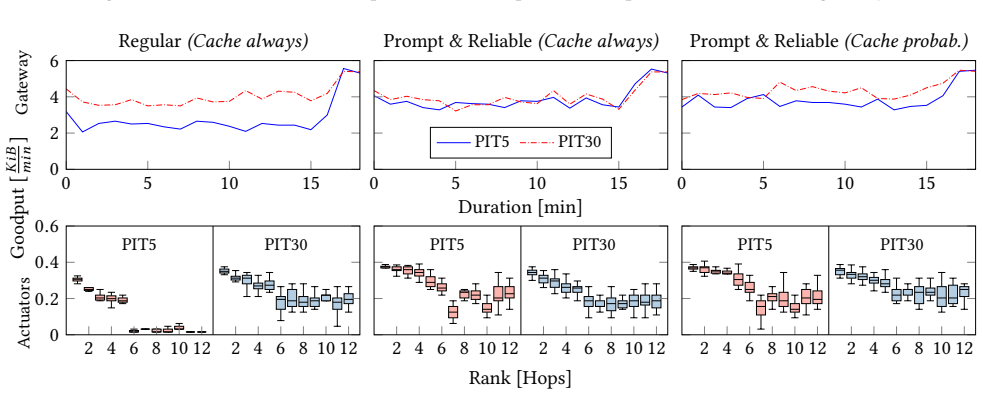
- Small PIT and cache sizes under QoS can reach the goodput and success rates that only much larger tables reach in regular NDN operation.
- In traffic patterns with cacheable group commands, QoS-enabled NDN approaches 100% delivery with as few as 10 cache entries, where regular NDN still fails 30–40% of requests at far ranks.
- Because prioritized delivery reduces retransmissions, total network load drops and the gateway sees fewer duplicate requests alongside higher response rates.
- Best-effort flows keep or improve their performance: the scheme does not trade regular traffic away.
Reading between the lines
- A natural next test is to make QoS prefix distribution dynamic: the paper assumes pre-deployed prefix lists, but the same longest-prefix mechanism could be updated at runtime; whether that preserves PIT coherence is an open question.
- The class-weighted probabilistic caching idea suggests a general principle for constrained networks: unequal per-class cache probabilities can act as distributed coordination without any explicit signaling between nodes.
- The paper notes that high-priority flows did not dominate its scenarios; in an overbooked network where most traffic is prompt, starvation of regular traffic could appear, and the proposed scheme would need a fairness guard.
- Because the scheme only touches local classification and resource decisions, it should transfer to other ICN flavors and to networks with different radio technologies whenever Interest/Data semantics exist.
Signed reviews
Editorial analysis
A structured set of objections, weighed in public.
Referee Report
Summary. The paper proposes a QoS management framework for NDN in constrained IoT networks, built on name-prefix classification into prompt and reliable service classes. The framework correlates resource management across forwarding queues, the Pending Interest Table (PIT), and the Content Store (CS), including probabilistic caching with class-dependent probabilities, and coordinates these mechanisms locally and across nodes. The authors implement the scheme in RIOT OS/CCN-lite and evaluate it on the FIT IoT-Lab testbed with 31 M3 devices in two scenarios (mixed sensors/actuators and sensing/lighting control), varying PIT and CS sizes. They report that the full QoS bundle improves success rates, goodput, and time-to-completion relative to regular NDN, and that best-effort traffic is not degraded. The abstract and conclusions further claim that coordinated QoS is 'more than the sum of its parts' and exceeds the impact of QoS in the IP world.
Significance. If the weaker, experimentally supported claim is adopted, this is a valuable first measurement study of QoS management in constrained NDN: it uses real hardware on an open testbed, covers two realistic IoT traffic patterns, and sweeps PIT and CS capacities. The open-source implementation and reproducibility note are strengths. However, the headline super-additivity and cross-technology claims are not supported by the experimental design, so the paper's significance currently rests on the bundled-treatment comparison, which is still useful but more modest than advertised.
major comments (4)
- [Abstract & §5] The abstract claims that 'coordinated QoS management in ICN is more than the sum of its parts and exceeds the impact QoS can have in the IP world,' and Section 5 repeats that coordinated QoS 'can lead to a global enhancement of network performance.' The experimental design in §4 compares only regular NDN against the full QoS bundle (classification, prioritized forwarding, PIT discipline, cache decision/replacement, and probabilistic caching). No component ablation is reported (e.g., PIT-only, CS-only, or queue-only), so the super-additivity claim is not testable from the data. Likewise, no IP/DiffServ-like queue-priority baseline is measured, so the comparison to IP QoS is unsupported. I recommend either adding factorial or partial-pair experiments and an IP baseline, or revising the abstract and conclusions to the supported statement that the coordinated bundle improves performance in constrained NDN.
- [§4.2 and §5] The claim that QoS does not sacrifice best-effort traffic is only tested in a regime where prioritized traffic does not dominate, as the paper itself acknowledges in §5: 'Since in our experiment setups the high priority flows did not dominate the network, we plan to investigate the effects of our proposed QoS mechanisms in overbooked network settings.' The experiments do show that regular sensor traffic improves under QoS in Scenario 1, but this is a single load regime. The text should be reworded to present the 'best-effort is not sacrificed' finding as a preliminary result for the tested conditions, not as a general property.
- [§4.2, Figures 5–10] The quantitative conclusions, such as 'doubled success rates from 40% to 80%' (discussion of Figure 8) and the improvements in time-to-completion, are presented as point estimates or CDFs without confidence intervals, error bars, or significance tests, despite the expected variability of a wireless testbed. For a measurement study, the paper should report the number of independent runs aggregated in each figure and provide error bars or statistical tests for the key metrics, at least for the headline comparisons, to establish robustness of the observed differences.
- [§4.1.4 and §3.3.3] The probabilistic caching parameters p_reg = 0.3 and p_rel = 0.7 are fixed without justification or sensitivity analysis. Section 3.3.3 presents coordinated 'equal cache weights' as a central mechanism for achieving CS diversity, but the experiments do not explore how sensitive the results are to these specific values, and no rationale is given for the 0.3/0.7 split. The authors should either justify these choices from prior work or add a sensitivity discussion, since the probabilistic variant is part of the recommended coordinated scheme.
minor comments (6)
- [§2.1] The word 'reponses' should be 'responses' in the sentence 'This complicates reliable resource predictions for reponses in NDN.'
- [§4.1.3] The text contains a typo: 'дroup id' uses a Cyrillic character and should read 'group id'.
- [§4.1.2] The sentence 'The topology is visualized in Figure 4' appears to be incorrect: Figure 4 shows nodal success rates, not the topology, and no separate topology figure is provided. Please either add a topology figure or correct the reference.
- [§3.2.3] The symbols 'pr eд' and 'pr el' render as garbled typesetting; please define the probabilities consistently as, for example, p_reg and p_rel, and use those symbols throughout.
- [§3.1] The claim that the classification scheme is 'computationally simple' and 'does not require an additional overhead in message headers' is not quantified. Since the paper targets constrained IoT devices, a short measurement of CPU and memory cost of the longest-prefix classification on the M3 would strengthen the motivation; the experimental results implicitly include this overhead, but an explicit measurement would be more convincing.
- [Header/ACM Reference Format] The ACM reference line contains a typo: 'Gain More for Less: The Surprising Benefits of, QoS Management' has an extra comma after 'of'.
Circularity Check
No significant circularity: the paper is an empirical measurement study with hand-set QoS parameters and direct comparisons against a regular NDN baseline; cited prior work is background, not a load-bearing derivation.
full rationale
This paper does not claim a first-principles derivation; it reports testbed measurements. The QoS parameters (preq=30%, prel=70%, four retransmissions, two-second retransmission interval) are stated as configuration choices, not fitted to the measured success rates, goodputs, or completion times, so no result reduces to a fitted quantity. The comparisons are direct empirical contrasts between regular NDN operation and the complete QoS bundle under two scenarios, and the improvements are presented as observed outcomes rather than as consequences of an equation. The self-citations ([22], [21], [54]) are used for provenance of the PIT-decorrelation problem, prior IoT measurement configuration, and an IRTF draft of the same scheme; none of them is invoked as an unverified premise that forces the experimental results. The paper's stronger interpretive claims ("more than the sum of its parts", "exceeds the impact QoS can have in the IP world") are not directly established by the bundled treatment and the absence of an IP-style baseline, but that is an evidentiary gap in the experimental design, not a circularity of the kind where a prediction is equivalent to its inputs by construction. The authors also state in Section 5 that high-priority flows did not dominate their experiment setups, which is a limitation on generality rather than a circular step.
Assumptions & free parameters
free parameters (2)
- p_reg =
0.30
- p_rel =
0.70
assumptions (3)
- domain assumption QoS classification via longest-prefix-match incurs negligible CPU and memory overhead on constrained devices.
- domain assumption Static QoS prefix lists are deployed at all nodes within the network domain.
- domain assumption The FIT IoT-Lab Grenoble wireless topology and DODAG convergecast pattern are representative of constrained NDN IoT networks.
Cite this review
Pith. "Pith review of Gain More for Less: The Surprising Benefits of QoS Management in Constrained NDN Networks." pith.science (2026). https://pith.science/paper/O7JNMKKM
@misc{pith2026190807592,
  author       = {Pith},
  title        = {Pith review of: Gain More for Less: The Surprising Benefits of QoS Management in Constrained NDN Networks},
  year         = {2026},
  howpublished = {\url{https://pith.science/paper/O7JNMKKM}},
  note         = {Machine review of arXiv:1908.07592}
}
read the original abstract
Quality of Service (QoS) in the IP world mainly manages forwarding resources, i.e., link capacities and buffer spaces. In addition, Information Centric Networking (ICN) offers resource dimensions such as in-network caches and forwarding state. In constrained wireless networks, these resources are scarce with a potentially high impact due to lossy radio transmission. In this paper, we explore the two basic service qualities (i) prompt and (ii) reliable traffic forwarding for the case of NDN. The resources we take into account are forwarding and queuing priorities, as well as the utilization of caches and of forwarding state space. We treat QoS resources not only in isolation, but correlate their use on local nodes and between network members. Network-wide coordination is based on simple, predefined QoS code points. Our findings indicate that coordinated QoS management in ICN is more than the sum of its parts and exceeds the impact QoS can have in the IP world.
Figures

Figures from the paper (7 more)



Reference graph
Works this paper leans on
-
[1]
3GPP. 2016. Evolved Universal Terrestrial Radio Access (E-UTRA) and Evolved Universal Terrestrial Radio Access Network (E-UTRAN); Overall description; Stage
work page 2016
-
[2]
Technical Report TS 36.300 13.4.0. 3GPP
-
[3]
ACM. Jan., 2017. Result and Artifact Review and Badging. http://acm.org/ publications/policies/artifact-review-badging
work page 2017
-
[4]
Bengt Ahlgren, Christian Dannewitz, Claudio Imbrenda, Dirk Kutscher, and Börje Ohlman. 2012. A Survey of Information-Centric Networking. IEEE Communica- tions Magazine 50, 7 (July 2012), 26–36
work page 2012
-
[5]
Al-Naday, Andreas Bontozoglou, Vassilios G
Mays F. Al-Naday, Andreas Bontozoglou, Vassilios G. Vassilakis, and Martin J. Reed. 2014. Quality of Service in an Information-Centric Network. In Proceedings of Globecom 2014. 1861–1866
work page 2014
-
[6]
M. Amadeo, C. Campolo, A. Iera, and A. Molinaro. 2015. Information Centric Net- working in IoT scenarios: The case of a smart home. InProc. of IEEE International Conference on Communications (ICC) . IEEE, Piscataway, NJ, USA, 648–653. QoS Management in Constrained NDN Networks ICN ’19, September 24–26, 2019, Macau, Macao
work page 2015
-
[7]
Sobia Arshad, Muhammad Awais Azam, Mubashir Husain Rehmani, and Jonathan Loo. 2017. Information-Centric Networking Based Caching and Naming Schemes for Internet of Things: A Survey and Future Research Directions. arXiv preprint arXiv:1710.03473 (2017)
work page Pith review arXiv 2017
-
[8]
Onur Ascigil, Sergi Reñé, George Xylomenos, Ioannis Psaras, and George Pavlou
Show all 67 references
-
[9]
Schmidt, and Matthias Wählisch
Emmanuel Baccelli, Cenk Gündogan, Oliver Hahm, Peter Kietzmann, Martine Lenders, Hauke Petersen, Kaspar Schleiser, Thomas C. Schmidt, and Matthias Wählisch. 2018. RIOT: an Open Source Operating System for Low-end Embedded Devices in the IoT. IEEE Internet of Things Journal 5, ...
2018
-
[10]
Atmel. 2009. Low Power 2.4 GHz Transceiver for ZigBee, IEEE 802.15.4, 6LoWPAN, RF4CE, SP100, WirelessHART, and ISM Applications . Atmel Corporation. http: //www.atmel.com/images/doc8111.pdf
2009
-
[11]
Schmidt, and Matthias Wählisch
Emmanuel Baccelli, Christian Mehlis, Oliver Hahm, Thomas C. Schmidt, and Matthias Wählisch. 2014. Information Centric Networking in the IoT: Experi- ments with NDN in the Wild. InProc. of 1st ACM Conf. on Information-Centric Net- working (ICN-2014). ACM, New York, 77–86. http:...
2014 doi
-
[12]
Blake, D
S. Blake, D. Black, M. Carlson, E. Davies, Z. Wang, and W. Weiss. 1998. An Architecture for Differentiated Services. RFC 2475. IETF
1998
-
[13]
Emmanuel Baccelli, Oliver Hahm, Mesut Günes, Matthias Wählisch, and Thomas C. Schmidt. 2013. RIOT OS: Towards an OS for the Internet of Things. In Proc. of the 32nd IEEE INFOCOM. Poster . IEEE Press, Piscataway, NJ, USA, 79–80
2013
-
[14]
Braden, D
R. Braden, D. Clark, and S. Shenker. 1994. Integrated Services in the Internet Architecture: an Overview. RFC 1633. IETF
1994
-
[15]
Braden, L
R. Braden, L. Zhang, S. Berson, S. Herzog, and S. Jamin. 1997.Resource ReSerVation Protocol (RSVP) – Version 1 Functional Specification . RFC 2205. IETF
1997
-
[16]
Bormann, M
C. Bormann, M. Ersue, and A. Keranen. 2014. Terminology for Constrained-Node Networks. RFC 7228. IETF
2014
-
[17]
Asit Chakraborti, Syed Obaid Amin, Aytac Azgin, Satyajayant Misra, and Rav- ishankar Ravindran. 2018. Using ICN Slicing Framework to Build an IoT Edge Network. In Proceedings of the 5th ACM Conference on Information-Centric Net- working (ICN ’18) . ACM, New York, NY, USA, 214–215
2018
-
[18]
Bo Chen, Liang Liu, Zhao Zhang, Wenbo Yang, and Huadong Ma. 2016. BRR- CVR: A Collaborative Caching Strategy for Information-Centric Wireless Sensor Networks. In 12th International Conference on Mobile Ad-Hoc and Sensor Networks (MSN). IEEE, 31–38
2016
-
[19]
Less for More
Wei Koong Chai, Diliang He, Ioannis Psaras, and George Pavlou. 2013. Cache “Less for More” in Information-Centric Networks (Extended Version). Computer Communications 36, 7 (2013), 758–770
2013
-
[20]
Dukkipati
N. Dukkipati. 2008. Rate control protocol (rcp): Congestion control to make flows complete quickly. Ph.D. Dissertation. Stanford, CA, USA
2008
-
[21]
Schmidt, and Matthias Wählisch
Cenk Gündogan, Peter Kietzmann, Martine Lenders, Hauke Petersen, Thomas C. Schmidt, and Matthias Wählisch. 2018. NDN, CoAP, and MQTT: A Com- parative Measurement Study in the IoT. In Proc. of 5th ACM Conference on Information-Centric Networking (ICN) . ACM, New York, NY, USA, ...
2018
-
[22]
Dong Doan Van and Qingsong Ai. 2018. An Efficient in-Network Caching Deci- sion Algorithm for Internet of Things. International Journal of Communication Systems 31, 8 (2018), e3521
2018
-
[23]
Schmidt, Matthias Wählisch, Cedric Adjih, and Laurent Massoulié
Oliver Hahm, Emmanuel Baccelli, Thomas C. Schmidt, Matthias Wählisch, Cedric Adjih, and Laurent Massoulié. 2017. Low-power Internet of Things with NDN and Cooperative Caching. In Proc. of 4th ACM Conference on Information-Centric Networking (ICN). ACM, New York, NY, USA, 98–108
2017
-
[24]
Mohamed Ahmed Hail, Marica Amadeo, Antonella Molinaro, and Stefan Fischer
-
[25]
Schmidt, Matthias Wählisch, Michael Frey, Felix Shzu-Juraschek, and Jakob Pfender
Cenk Gündogan, Thomas C. Schmidt, Matthias Wählisch, Michael Frey, Felix Shzu-Juraschek, and Jakob Pfender. 2019. Quality of Service for ICN in the IoT . IRTF Internet Draft – work in progress 01. IRTF. http://tools.ietf.org/html/ draft-gundogan-icnrg-iotqos
2019
-
[26]
IEEE. 2018. IEEE Standard for Local and Metropolitan Area Network–Bridges and Bridged Networks. Technical Report. 1–1993 pages. https://doi.org/10.1109/ IEEESTD.2018.8403927
2018
-
[27]
Stratis Ioannidis and Edmund Yeh. 2017. Jointly Optimal Routing and Caching for Arbitrary Network Topologies. In 4th ACM Conference on Information-Centric Networking (ACM-ICN ’17). ACM, New York, NY, USA, 77–87
2017
-
[28]
Smetters, James D
Van Jacobson, Diana K. Smetters, James D. Thornton, and Michael F. Plass. 2009. Networking Named Content. In5th Int. Conf. on emerging Networking Experiments and Technologies (ACM CoNEXT’09). ACM, New York, NY, USA, 1–12
2009
-
[29]
Hail, Marica Amadeo, Antonella Molinaro, and Stefan Fischer
Mohamed Ahmed M. Hail, Marica Amadeo, Antonella Molinaro, and Stefan Fischer. 2015. On the Performance of Caching and Forwarding in Information- Centric Networking for the IoT. In Proceedings of the International Conference on Wired/Wireless Internet Communication (WWIC) . Spr...
2015
-
[30]
Kutscher, S
D. Kutscher, S. Eum, K. Pentikousis, I. Psaras, D. Corujo, D. Saucez, T. Schmidt, and M. Waehlisch. 2016. Information-Centric Networking (ICN) Research Challenges . RFC 7927. IETF
2016
-
[31]
Schmidt, and Matthias Wäh- lisch
Martine Lenders, Peter Kietzmann, Oliver Hahm, Hauke Petersen, Cenk Gündo- gan, Emmanuel Baccelli, Kaspar Schleiser, Thomas C. Schmidt, and Matthias Wäh- lisch. 2018. Connecting the World of Embedded Mobiles: The RIOT Approach to Ubiq- uitous Networking for the Internet of Thi...
2018 arXiv
-
[32]
Zhe Li and Gwendal Simon. 2011. Time-Shifted TV in Content Centric Net- works: The Case for Cooperative In-Network Caching. In Proceedings of the IEEE International Conference on Communications (ICC) . Kyoto, Japan, 1–6
2011
-
[33]
Anil Jangam, Prakash suthar, and Milan Stolic. 2019. QoS Treatments in ICN using Disaggregated Name Components. Internet-Draft – work in progress 00. IETF
2019
-
[34]
LoRa Alliance. 2015. A Technical Overview of LoRa and LoRaWan . Technical Report. https://lora-alliance.org/sites/default/files/2018-04/what-is-lorawan.pdf
2015
-
[35]
Milad Mahdian, Somaya Arianfar, Jim Gibson, and Dave Oran. 2016. MIRCC: Multipath-aware ICN Rate-based Congestion Control. In Proceedings of the 3rd ACM Conference on Information-Centric Networking (ACM-ICN ’16) . ACM, New York, NY, USA, 1–10
2016
-
[36]
Markkanen and D
A. Markkanen and D. Shey. 2015. Edge Analytics in IoT. Technical Report. ABI Research
2015
-
[37]
Yinlong Liu, Dali Zhu, and Wei Ma. 2016. A Novel Cooperative Caching Scheme for Content Centric Mobile Ad Hoc Networks. In IEEE Symposium on Computers and Communication (ISCC). IEEE, 824–829
2016
-
[38]
Ilya Moiseenko and David Oran. 2019. Flow Classification in Information Centric Networking. Internet-Draft – work in progress 04. IETF
2019
-
[39]
Sheneela Naz, Rao Naveed Bin Rais, Peer Azmat Shah, Sadaf Yasmin, Amir Qayyum, Seungmin Rho, and Yunyoung Nam. 2018. A Dynamic Caching Strategy for CCN-Based MANETs. Computer Networks (2018)
2018
-
[40]
Nichols, S
K. Nichols, S. Blake, F. Baker, and D. Black. 1998. Definition of the Differentiated Services Field (DS Field) in the IPv4 and IPv6 Headers . RFC 2474. IETF
1998
-
[41]
Philipp Meyer, Till Steinbach, Franz Korf, and Thomas C. Schmidt. 2013. Extend- ing IEEE 802.1 AVB with Time-triggered Scheduling: A Simulation Study of the Coexistence of Synchronous and Asynchronous Traffic. In 2013 IEEE Vehicular Networking Conference (VNC). IEEE Press, Pis...
2013
-
[42]
David Oran. 2019. Maintaining CCNx or NDN flow balance with highly variable data object sizes. Internet-Draft – work in progress 01. IETF
2019
-
[43]
Jakob Pfender, Alvin Valera, and Winston K. G. Seah. 2018. Performance Com- parison of Caching Strategies for Information-Centric IoT. In Proceedings of the 5th ACM Conference on Information-Centric Networking (ICN ’18) . ACM, New York, NY, USA, 43–53
2018
-
[44]
Jakob Pfender, Alvin Valera, and Winston K. G. Seah. 2019. Content Delivery Latency of Caching Strategies for Information-Centric IoT. arXiv:1905.01011 [cs] (May 2019). http://arxiv.org/abs/1905.01011 arXiv: 1905.01011
2019 arXiv
-
[45]
David Oran. 2019. Considerations in the development of a QoS Architecture for CCNx-like ICN protocols. Internet-Draft – work in progress 00. IETF
2019
-
[46]
Ioannis Psaras, Wei Koong Chai, and George Pavlou. 2012. Probabilistic In- Network Caching for Information-Centric Networks. In Proceedings of the Second Edition of the ICN Workshop on Information-Centric Networking. Helsinki, Finland, 55–60
2012
-
[47]
Schmidt, and Georg Carle
Quirin Scheitle, Matthias Wählisch, Oliver Gasser, Thomas C. Schmidt, and Georg Carle. 2017. Towards an Ecosystem for Reproducible Research in Computer Networking. In Proc. of ACM SIGCOMM Reproducibility Workshop . ACM, New York, NY, USA, 5–8
2017
-
[48]
E. M. Schooler, D. Zage, J. Sedayao, H. Moustafa, A. Brown, and M. Ambrosin
-
[49]
Polyzos and Nikos Fotiou
George C. Polyzos and Nikos Fotiou. 2015. Building a reliable Internet of Things using Information-Centric Networking. Journal of Reliable Intelligent Environ- ments 1, 1 (2015), 47–58
2015
-
[50]
Yong Sun, Tiankui Zhang, Ruoqi Wang, Weidong Feng, and Pu Chen. 2016. Topology Potential Based Probability Caching Strategy for Content Centric Ad Hoc Networks. Journal of Residuals Science & Technology 13, 6 (2016)
2016
-
[51]
Saran Tarnoi, Kalika Suksomboon, Wuttipong Kumwilaisak, and Yusheng Ji
-
[52]
Christian Tschudin, Christopher Scherb, et al . 2018. CCN Lite: Lightweight implementation of the Content Centric Networking protocol. http://ccn-lite.net
2018
-
[53]
In IEEE 37th Intern
An Architectural Vision for a Data-Centric IoT: Rethinking Things, Trust and Clouds. In IEEE 37th Intern. Conference on Distributed Computing Systems (ICDCS). IEEE, Piscataway, NJ, USA, 1717–1728
-
[54]
Wentao Shang, Adeola Bannis, Teng Liang, Zhehao Wang, Yingdi Yu, Alexander Afanasyev, Jeff Thompson, Jeff Burke, Beichuan Zhang, and Lixia Zhang. 2016. Named Data Networking of Things (Invited Paper). In Proc. of IEEE International Conf. on Internet-of-Things Design and Implem...
2016
-
[55]
Michael Welzl. 2005. Network Congestion Control - Managing Internet Traffic . Wiley, Hoboken, NJ,USA
2005
-
[56]
Ververidis, Vasilios A
George Xylomenos, Christopher N. Ververidis, Vasilios A. Siris, Nikos Fotiou, Christos Tsilopoulos, Xenofon Vasilakos, Konstantinos V. Katsaros, and George C. Polyzos. 2014. A Survey of Information-Centric Networking Research. IEEE Communications Surveys and Tutorials 16, 2 (2...
2014
-
[57]
Yuguang Zeng and Xiaoyan Hong. 2011. A Caching Strategy in Mobile Ad Hoc Named Data Network. In 6th International ICST Conference on Communications and Networking in China (CHINACOM) . IEEE, 805–809
2011
-
[58]
Lixia Zhang, Alexander Afanasyev, Jeffrey Burke, Van Jacobson, kc claffy, Patrick Crowley, Christos Papadopoulos, Lan Wang, and Beichuan Zhang. 2014. Named Data Networking. SIGCOMM Comput. Commun. Rev. 44, 3 (2014), 66–73
2014
-
[59]
Christos Tsilopoulos and George Xylomenos. 2011. Supporting Diverse Traffic Types in Information Centric Networks. In Proceedings of the ACM SIGCOMM Workshop on Information-Centric Networking (ICN ’11) . ACM, New York, NY, ICN ’19, September 24–26, 2019, Macau, Macao C. Gündoğ...
2011
-
[60]
Schmidt, and Markus Vahlenkamp
Matthias Wählisch, Thomas C. Schmidt, and Markus Vahlenkamp. 2013. Backscat- ter from the Data Plane – Threats to Stability and Security in Information-Centric Network Infrastructure. Computer Networks 57, 16 (Nov. 2013), 3192–3206. http://dx.doi.org/10.1016/j.comnet.2013.07.009
2013 doi
-
[61]
Le Zhou, Tiankui Zhang, Xiaogeng Xu, Zhimin Zeng, and Yinlong Liu. 2015. Broadcasting Based Neighborhood Cooperative Caching for Content Centric Ad Hoc Networks. In IEEE/CIC International Conference on Communications in China (ICCC). IEEE, 1–5
2015
-
[65]
Li Zhang, Jiayan Zhao, and Zhenlian Shi. 2015. LF: A Caching Strategy for Named Data Mobile Ad Hoc Networks. In Proceedings of the 4th International Conference on Computer Engineering and Networks . Springer, 279–290
2015
-
[66]
Meng Zhang, Hongbin Luo, and Hongke Zhang. 2015. A Survey of Caching Mechanisms in Information-Centric Networking. IEEE Communications Surveys & Tutorials 17, 3 (2015), 1473–1499
2015
-
[2014]
In Proceedings of the IEEE 39th Conference on Local Computer Networks (LCN)
Performance of Probabilistic Caching and Cache Replacement Policies for Content-Centric Networks. In Proceedings of the IEEE 39th Conference on Local Computer Networks (LCN). Edmonton, AB, Canada, 99–106
-
[2015]
In International Conference on Recent Advances in Internet of Things (RIoT)
Caching in Named Data Networking for the Wireless Internet of Things. In International Conference on Recent Advances in Internet of Things (RIoT) . IEEE, 1–6
-
[2017]
A Keyword-based ICN-IoT Platform. In Proc. of 4th ACM Conference on Information-Centric Networking (ICN). ACM, New York, NY, USA, 22–28
-
[4440]
http://dx.doi.org/10.1109/JIOT.2018.2815038
2018
Reviewed August 14, 2026 · model on record in the stance chip above.
Discussion (0). Continue with ORCID to comment.