REVIEW 4 major objections 6 minor 34 references
DocReRank: Single-Page Hard Negative Query Generation for Training Multi-Modal RAG Rerankers
T0 review · 4 major / 6 minor · reviewed 2026-08-07 · deepseek-v4-flash
Pith's one-line read Training rerankers on generated unanswerable queries—rather than mined hard negative pages—yields consistent gains across multimodal retrieval benchmarks.
desk verdict Novel inversion of hard negative mining, but the key ablation never isolates generated query negatives from mined document negatives. read the letter →
The pith
A machine-rendered reading of the paper's core claim, the machinery that carries it, and where it could break.
The reading
What carries the argument
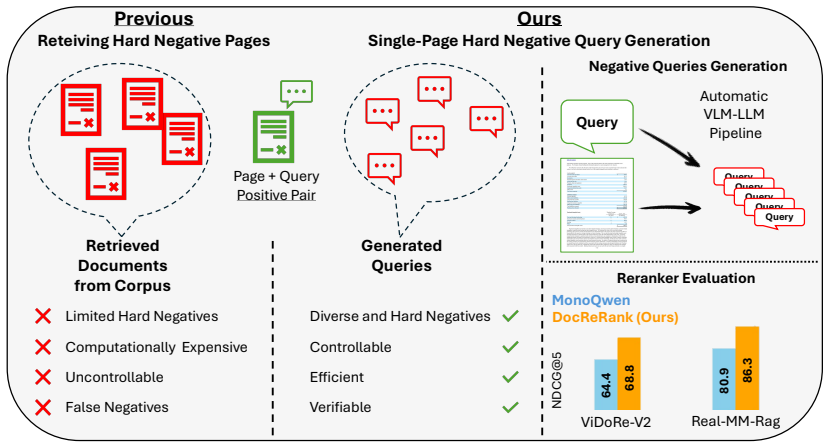
The central object is the hard negative query: a written question that closely mirrors the positive query's wording, topic, and format while being unanswerable from the page image. The machinery is a four-stage LLM-VLM pipeline—Pixtral-12B generates positive queries, Qwen2.5-VL-7B verifies answerability, Qwen2.5-7B LLM rephrases each positive into twelve negative variants, and the same VLM with two different prompts filters out any variant either prompt deems answerable. Decoupling linguistic rephrasing (LLM) from visual grounding (VLM) is what makes the negatives both plausible and verifiable.
What would settle it
Take a random sample of the generated 'hard negative' queries from Col-HNQue or Fin-HNQue, have human annotators (or a much stronger VLM) answer them from the page, and measure the true unanswerability rate; if a substantial fraction of negatives are in fact answerable, the training gain over document-mined negatives should shrink or vanish in a re-run of the main comparison with corrected labels.
Extended reading notes
Core claim
Rerankers trained with our Single-Page Hard Negative Query Generation approach significantly outperform models trained with document-based hard negatives alone. Instead of retrieving negative pages per query, we generate negative queries per page: an LLM rephrases the positive query into variants that are similar in topic and form but seek different information, and a VLM verifies that each variant is unanswerable from the page. Because the negatives are tied to a single page, unanswerability can be verified efficiently and false negatives filtered out. The resulting DocReRank models beat MonoQwen—trained on the same base model and objective but document negatives only—by +2.8 NDCG@5 on ViDoReV2 and +4.7 on Real-MM-RAG with ColQwen retrieval, and further targeted finance-specific negatives plus rephrased positives add more gains.
Load-bearing premise
The VLM used to check answerability must be right: if it systematically lets answerable queries through as negatives, or rejects good ones, the training signal is corrupted. The paper itself concedes false negatives and positives can occur despite double verification.
Editorial extensions
If this is right
- Training a reranker on generated query-level negatives alone (or mixed with mined negatives) outperforms training on mined document negatives at matched dataset size.
- Generation avoids embedding and searching the whole corpus per query, reducing the computational cost of hard-negative construction.
- The approach is controllable: targeted prompts can engineer negatives that fix specific observed weaknesses, such as confusing years, values, or entity names in financial documents.
- Rephrasing positive queries during training improves robustness on paraphrase variants of the benchmark (Rephrased Real-MM-RAG).
- The same single-page pipeline can be applied to any document collection, including manuals or reports, to generate application-specific negatives without a retrieval index.
Reading between the lines
- Editorial inference: because the negatives live on the query side, the reranker learns to reject plausible-sounding but wrong questions rather than only to rank pages; this may transfer to settings where users pose ambiguous or misleading queries beyond the benchmark distribution.
- Editorial inference: the verification-step reliance on Qwen2.5-VL means the method's ceiling depends on that model's grounding ability; using a different or stronger VLM for verification is a direct test of how much of the gain is due to generation vs filtering.
- Editorial inference: a human audit of false-negative rates (not just model verification) would separate the generation contribution from the verification contribution, and could be reported as a dataset statistic alongside the benchmark numbers.
Editorial analysis
A structured set of objections, weighed in public.
Referee Report
Summary. The paper proposes Single-Page Hard Negative Query Generation, a pipeline that generates hard negative queries per document page using an LLM (Qwen2.5-7B-Instruct) and verifies them with a VLM (Qwen2.5-VL-7B-Instruct), instead of mining hard negative documents from a corpus. The authors construct two new datasets, Col-HNQue and Fin-HNQue, and train a multimodal reranker, DocReRank, on combinations of these generated query negatives and traditional document-level hard negatives, optionally with rephrased positive queries. They evaluate on the ViDoReV2 and Real-MM-RAG benchmarks, reporting NDCG@5 improvements over MonoQwen and over a model trained only on document-level hard negatives (FT on Col-HNDoc).
Significance. The paper addresses a real and timely problem in multimodal RAG reranking, and the proposed pipeline is clearly described and has an appealing property: it flips hard-negative construction from document retrieval to query generation, enabling controllability and false-negative verification. The contribution includes new datasets (Col-HNQue, Fin-HNQue) and a reproducible training recipe. The controlled comparison between FT on Col-HNDoc and DocReRank-Base, both using the same document-negative source, is a useful step and shows consistent gains. However, the central claim that generated query negatives are superior to document-level mined negatives in isolation is not directly tested, and no significance testing is reported. The results are promising but the evidence is incomplete.
major comments (4)
- [§5.3, Table 4, §A.2] The central claim that generated query-level hard negatives are superior to document-level mined negatives is not tested in isolation. DocReRank-Base is trained on 60k positives from Col-HNDoc and 60k from Col-HNQue (A.2), so it mixes negative types, whereas FT on Col-HNDoc uses 120k positives with document negatives only. The observed +2.8/+4.7 NDCG@5 gains could be due to negative-type diversity, the specific positive-pair split, or the generation mechanism itself. Please train a model on Col-HNQue alone (120k positives, generated query negatives only) and compare against FT on Col-HNDoc under identical positive-pair assignment, or otherwise design an ablation that isolates the negative-generation method.
- [§5.3, Table 4] No error bars, multiple seeds, or significance tests are reported for any of the main results. Given the per-dataset variation in Table 4 (e.g., Axa +4.1, Economics-ML -2.0), the headline average gains are not established as statistically reliable. Please report mean and standard deviation over at least three runs or a significance test (e.g., paired bootstrap over queries).
- [§4.1, §5.2] The comparison to MonoQwen is not fully controlled. Because MonoQwen's original hard-negative mining is unavailable (Section 4.1), the paper uses Nomic-AI negatives for the FT on Col-HNDoc baseline, which is not identical to MonoQwen's training data. The statement in Section 5.2 that DocReRank-Base 'differs only on the training data' is therefore an assumption, not an established fact. Please temper this claim or provide a comparison using the exact MonoQwen training recipe if it becomes available.
- [§3.1, §7] The VLM verification step is the only safeguard against answerable generated negatives, and Section 7 concedes that false negatives and positives can occur. Since the central benefit of the method is the quality of the generated negatives, the paper would be strengthened by a small human-annotated evaluation of verification accuracy (e.g., on a sample of 100–200 filtered queries) to rule out systematic verifier bias. Without such a check, it is difficult to know whether the observed gains reflect negative quality or noise in the filtering process.
minor comments (6)
- [§2.2] The sentence 'A Reranker's tasks is to get the top-K candidate documents retrieved in the first stage' should read 'A reranker's task is to take the top-K candidate documents retrieved in the first stage.'
- [§2.2] The phrase 'with with one prominent model' contains a duplicated 'with'.
- [§5.2] The phrase 'requiring model sematic understanding' should be 'requiring model semantic understanding.'
- [Table 4] The label 'DocReRank-Bw Fin' is inconsistent with 'DocReRank-B w/ Fin' used in the text and Appendix; please unify the notation.
- [§A.2] The list of training datasets uses mixed numbering ('(i)... (v)') and later the model names are written inconsistently (e.g., 'DocReRank-B w/ Fin' vs. 'DocReRank-Bw Fin'). Please make the notation consistent throughout.
- [§4.2] In the batch description, please make explicit that for Col-HNDoc the negatives are other document pages, whereas for the generated datasets the negatives are hard negative queries for the same page; the current wording is easy to misread.
Circularity Check
No significant circularity: the main reranker improvement is tested on held-out benchmarks with a controlled ablation; the generated-only comparison is missing but that is an experimental gap, not a circular reduction.
full rationale
The paper's central claim is empirical rather than derivational: rerankers trained with generated query-level hard negatives (combined with document negatives in DocReRank-Base) outperform document-negative-only training on held-out ViDoReV2 and Real-MM-RAG. The main ablation in Table 4 (FT on Col-HNDoc vs DocReRank-Base) holds the total number of positives/examples constant and varies only whether half the negatives are generated query negatives, so the comparison is controlled rather than a restatement of the input. There is no equation in which an output is defined from an input, and no parameter is fitted to the evaluation labels and then reported as a prediction. The paper explicitly acknowledges in Section 7 that VLM verification can produce false negatives and positives; that is a data-quality limitation, not a circular step. The secondary uses of the authors' own Real-MM-RAG benchmark and of the rephrased variant are self-referential in provenance, and the Fin-HNQue prompt design is informed by error analysis on Real-MM-RAG, but the Fin-HNQue benefit is also demonstrated on the external ViDoReV2 benchmark, and no central conclusion reduces to a self-citation. The strongest reading of the abstract—that generated negatives alone beat mined negatives alone—is not directly tested because no model is trained on Col-HNQue only; this is a missing-control/overclaim issue, not a circular derivation. Therefore no circular step is exhibited.
Assumptions & free parameters
free parameters (4)
- Negative query variants per positive query =
12 generated, 3 kept
- Number of negatives per positive in training batches =
3
- Rephrasing fraction in rephrased datasets =
50%
- Finance prompt property set =
year, company name, numerical value, financial metric, subject metric, business segment
assumptions (4)
- domain assumption The LLM (Qwen2.5-7B-Instruct) can produce query variants that are structurally similar to the positive query but seek different information.
- domain assumption The VLM (Qwen2.5-VL-7B-Instruct) answerability verification with two prompts is sufficiently reliable to label queries as answerable or unanswerable.
- domain assumption The ColPali training set with Nomic-AI hard negatives is a representative and suitable base for document-level reranker training.
- domain assumption NDCG@5 on ViDoReV2 and Real-MM-RAG measures reranking quality that matters for real-world RAG.
Cite this review
Pith. "Pith review of DocReRank: Single-Page Hard Negative Query Generation for Training Multi-Modal RAG Rerankers." pith.science (2026). https://pith.science/paper/O7SZW4MT
@misc{pith2026250522584,
  author       = {Pith},
  title        = {Pith review of: DocReRank: Single-Page Hard Negative Query Generation for Training Multi-Modal RAG Rerankers},
  year         = {2026},
  howpublished = {\url{https://pith.science/paper/O7SZW4MT}},
  note         = {Machine review of arXiv:2505.22584}
}
read the original abstract
Rerankers play a critical role in multimodal Retrieval-Augmented Generation (RAG) by refining ranking of an initial set of retrieved documents. Rerankers are typically trained using hard negative mining, whose goal is to select pages for each query which rank high, but are actually irrelevant. However, this selection process is typically passive and restricted to what the retriever can find in the available corpus, leading to several inherent limitations. These include: limited diversity, negative examples which are often not hard enough, low controllability, and frequent false negatives which harm training. Our paper proposes an alternative approach: Single-Page Hard Negative Query Generation, which goes the other way around. Instead of retrieving negative pages per query, we generate hard negative queries per page. Using an automated LLM-VLM pipeline, and given a page and its positive query, we create hard negatives by rephrasing the query to be as similar as possible in form and context, yet not answerable from the page. This paradigm enables fine-grained control over the generated queries, resulting in diverse, hard, and targeted negatives. It also supports efficient false negative verification. Our experiments show that rerankers trained with data generated using our approach outperform existing models and significantly improve retrieval performance.
Figures


Figures from the paper (1 more)

Reference graph
Works this paper leans on
-
[1]
online" 'onlinestring :=
ENTRY address archivePrefix author booktitle chapter edition editor eid eprint eprinttype howpublished institution journal key month note number organization pages publisher school series title type volume year doi pubmed url lastchecked label extra.label sort.label short.list INTEGERS output.state before.all mid.sentence after.sentence after.block STRING...
-
[2]
write newline
" write newline "" before.all 'output.state := FUNCTION n.dashify 't := "" t empty not t #1 #1 substring "-" = t #1 #2 substring "--" = not "--" * t #2 global.max substring 't := t #1 #1 substring "-" = "-" * t #2 global.max substring 't := while if t #1 #1 substring * t #2 global.max substring 't := if while FUNCTION word.in bbl.in capitalize " " * FUNCT...
-
[3]
Pravesh Agrawal, Szymon Antoniak, Emma Bou Hanna, Baptiste Bout, Devendra Chaplot, Jessica Chudnovsky, Diogo Costa, Baudouin De Monicault, Saurabh Garg, Theophile Gervet, et al. 2024. Pixtral 12b. arXiv preprint arXiv:2410.07073
arXiv 2024
-
[4]
Lucas Beyer, Andreas Steiner, Andr \'e Susano Pinto, Alexander Kolesnikov, Xiao Wang, Daniel Salz, Maxim Neumann, Ibrahim Alabdulmohsin, Michael Tschannen, Emanuele Bugliarello, et al. 2024. Paligemma: A versatile 3b vlm for transfer. arXiv preprint arXiv:2407.07726
arXiv 2024
-
[5]
Antoine Chaffin and Aurélien Lac. 2024. https://huggingface.co/lightonai/MonoQwen2-VL-v0.1 Monoqwen: Visual document reranking
work page 2024
-
[6]
Jacob Devlin, Ming-Wei Chang, Kenton Lee, and Kristina Toutanova. 2019. Bert: Pre-training of deep bidirectional transformers for language understanding. In Proceedings of the 2019 conference of the North American chapter of the association for computational linguistics: human language technologies, volume 1 (long and short papers), pages 4171--4186
2019
-
[7]
Manuel Faysse, Hugues Sibille, Tony Wu, Bilel Omrani, Gautier Viaud, C \'e line Hudelot, and Pierre Colombo. 2024. Colpali: Efficient document retrieval with vision language models. arXiv preprint arXiv:2407.01449
arXiv 2024
-
[8]
Edward J Hu, Yelong Shen, Phillip Wallis, Zeyuan Allen-Zhu, Yuanzhi Li, Shean Wang, Lu Wang, Weizhu Chen, et al. 2022. Lora: Low-rank adaptation of large language models. ICLR, 1(2):3
2022
Show all 34 references
-
[9]
Illuin Technology . 2025. https://huggingface.co/collections/vidore/vidore-benchmark-v2-67ae03e3924e85b36e7f53b0 Vidore benchmark v2: Visual document retrieval benchmark
2025
-
[10]
Vladimir Karpukhin, Barlas O g uz, Sewon Min, Patrick Lewis, Ledell Wu, Sergey Edunov, Danqi Chen, and Wen-tau Yih. 2020. Dense passage retrieval for open-domain question answering. arXiv preprint arXiv:2004.04906
2020 arXiv
-
[11]
Omar Khattab and Matei Zaharia. 2020. Colbert: Efficient and effective passage search via contextualized late interaction over bert. In Proceedings of the 43rd International ACM SIGIR conference on research and development in Information Retrieval, pages 39--48
2020
-
[12]
u ttler, Mike Lewis, Wen-tau Yih, Tim Rockt \
Patrick Lewis, Ethan Perez, Aleksandra Piktus, Fabio Petroni, Vladimir Karpukhin, Naman Goyal, Heinrich K \"u ttler, Mike Lewis, Wen-tau Yih, Tim Rockt \"a schel, et al. 2020. Retrieval-augmented generation for knowledge-intensive nlp tasks. Advances in Neural Information Proc...
2020
-
[13]
Qi Liu, Bo Wang, Nan Wang, and Jiaxin Mao. 2025. Leveraging passage embeddings for efficient listwise reranking with large language models. In Proceedings of the ACM on Web Conference 2025, pages 4274--4283
2025
-
[14]
Xueguang Ma, Sheng-Chieh Lin, Minghan Li, Wenhu Chen, and Jimmy Lin. 2024. Unifying multimodal retrieval via document screenshot embedding. arXiv preprint arXiv:2406.11251
2024 arXiv
-
[15]
Sean MacAvaney, Andrew Yates, Arman Cohan, and Nazli Goharian. 2019. Cedr: Contextualized embeddings for document ranking. In Proceedings of the 42nd international ACM SIGIR conference on research and development in information retrieval, pages 1101--1104
2019
-
[16]
Gabriel de Souza P Moreira, Radek Osmulski, Mengyao Xu, Ronay Ak, Benedikt Schifferer, and Even Oldridge. 2024. Nv-retriever: Improving text embedding models with effective hard-negative mining. arXiv preprint arXiv:2407.15831
2024 arXiv
-
[17]
Rodrigo Nogueira and Kyunghyun Cho. 2019. Passage re-ranking with bert. arXiv preprint arXiv:1901.04085
2019 arXiv
-
[18]
Rodrigo Nogueira, Zhiying Jiang, and Jimmy Lin. 2020. Document ranking with a pretrained sequence-to-sequence model. arXiv preprint arXiv:2003.06713
2020 arXiv
-
[19]
Rodrigo Nogueira, Wei Yang, Kyunghyun Cho, and Jimmy Lin. 2019. Multi-stage document ranking with bert. arXiv preprint arXiv:1910.14424
2019 arXiv
-
[20]
Nomic AI . 2025. https://huggingface.co/datasets/nomic-ai/colpali-queries-mined-20250321-by-source Colpali queries mined 2025-03-21 by source
2025
-
[21]
Ronak Pradeep, Rodrigo Nogueira, and Jimmy Lin. 2021. The expando-mono-duo design pattern for text ranking with pretrained sequence-to-sequence models. arXiv preprint arXiv:2101.05667
2021 arXiv
-
[22]
Alec Radford, Jong Wook Kim, Chris Hallacy, Aditya Ramesh, Gabriel Goh, Sandhini Agarwal, Girish Sastry, Amanda Askell, Pamela Mishkin, Jack Clark, et al. 2021. Learning transferable visual models from natural language supervision. In International conference on machine learni...
2021
-
[23]
Colin Raffel, Noam Shazeer, Adam Roberts, Katherine Lee, Sharan Narang, Michael Matena, Yanqi Zhou, Wei Li, and Peter J Liu. 2020. Exploring the limits of transfer learning with a unified text-to-text transformer. Journal of machine learning research, 21(140):1--67
2020
-
[24]
Rita Ramos, Desmond Elliott, and Bruno Martins. 2023. Retrieval-augmented image captioning. arXiv preprint arXiv:2302.08268
2023 arXiv
-
[25]
S Robertson, Steve Walker, Susan Jones, and MHB GATFORD. 1994. Okapi at 3. In Proceedings of the 3rd Text REtrieval Conference (-3), pages 109--126
1994
-
[26]
Karen Sparck Jones. 1972. A statistical interpretation of term specificity and its application in retrieval. Journal of documentation, 28(1):11--21
1972
-
[27]
Weiwei Sun, Lingyong Yan, Xinyu Ma, Shuaiqiang Wang, Pengjie Ren, Zhumin Chen, Dawei Yin, and Zhaochun Ren. 2023. Is chatgpt good at search? investigating large language models as re-ranking agents. arXiv preprint arXiv:2304.09542
2023 arXiv
-
[28]
Peng Wang, Shuai Bai, Sinan Tan, Shijie Wang, Zhihao Fan, Jinze Bai, Keqin Chen, Xuejing Liu, Jialin Wang, Wenbin Ge, Yang Fan, Kai Dang, Mengfei Du, Xuancheng Ren, Rui Men, Dayiheng Liu, Chang Zhou, Jingren Zhou, and Junyang Lin. 2024. Qwen2-vl: Enhancing vision-language mode...
2024 arXiv
-
[29]
Navve Wasserman, Roi Pony, Oshri Naparstek, Adi Raz Goldfarb, Eli Schwartz, Udi Barzelay, and Leonid Karlinsky. 2025. Real-mm-rag: A real-world multi-modal retrieval benchmark. arXiv preprint arXiv:2502.12342
2025 arXiv
-
[30]
Lee Xiong, Chenyan Xiong, Ye Li, Kwok-Fung Tang, Jialin Liu, Paul Bennett, Junaid Ahmed, and Arnold Overwijk. 2020. Approximate nearest neighbor negative contrastive learning for dense text retrieval. arXiv preprint arXiv:2007.00808
2020 arXiv
-
[31]
Shi Yu, Chaoyue Tang, Bokai Xu, Junbo Cui, Junhao Ran, Yukun Yan, Zhenghao Liu, Shuo Wang, Xu Han, Zhiyuan Liu, et al. 2024. Visrag: Vision-based retrieval-augmented generation on multi-modality documents. arXiv preprint arXiv:2410.10594
2024 arXiv
-
[32]
Xiaohua Zhai, Basil Mustafa, Alexander Kolesnikov, and Lucas Beyer. 2023. Sigmoid loss for language image pre-training. In Proceedings of the IEEE/CVF international conference on computer vision, pages 11975--11986
2023
-
[33]
Xinyi Zheng, Doug Burdick, Lucian Popa, Peter Zhong, and Nancy Xin Ru Wang. 2021. Global table extractor (gte): A framework for joint table identification and cell structure recognition using visual context. Winter Conference for Applications in Computer Vision (WACV)
2021
-
[34]
Yucheng Zhou, Tao Shen, Xiubo Geng, Chongyang Tao, Can Xu, Guodong Long, Binxing Jiao, and Daxin Jiang. 2022. Towards robust ranker for text retrieval. arXiv preprint arXiv:2206.08063
2022 arXiv
Reviewed August 7, 2026 · model on record in the stance chip above.
Discussion (0). Sign in to comment.