A Dynamical Low-rank Multilevel Monte Carlo Estimator for High-Dimensional Kinetic Equations
Pith reviewed 2026-06-29 03:38 UTC · model grok-4.3
The pith
Combining dynamical low-rank approximation with multilevel Monte Carlo enables efficient simulation of high-dimensional kinetic equations.
A machine-rendered reading of the paper's core claim, the machinery that carries it, and where it could break.
Core claim
The paper establishes a low-rank multilevel Monte Carlo estimator for kinetic equations based on a probabilistic rank-adaptive DLRA time integrator. The level hierarchy is constructed through spatial refinement with the condition that the low-rank error remains below the spatial discretization error at each level. This combination allows for reduced computational and memory requirements while maintaining accuracy in high-dimensional settings.
What carries the argument
The probabilistic rank-adaptive DLRA time integrator, which dynamically adjusts the rank to keep low-rank approximation error below spatial discretization error.
If this is right
- The estimator achieves the variance reduction rates typical of multilevel Monte Carlo methods.
- It applies successfully to radiation transport and radiation therapy problems.
- Shallow water flow models can be simulated with this approach.
- Memory and computational costs are significantly reduced compared to full-rank methods.
Where Pith is reading between the lines
- This technique could be extended to other high-dimensional time-dependent PDEs beyond kinetic equations.
- Further integration with parallel computing might scale the method to even larger problems.
- The error control strategy may inspire similar hierarchies in other approximation methods.
Load-bearing premise
It is always possible to select ranks using the probabilistic rank-adaptive DLRA integrator so that the low-rank error stays strictly below the spatial discretization error on every level of the hierarchy.
What would settle it
A numerical test in which the rank-adaptive integrator is applied yet the low-rank error exceeds the spatial discretization error at one or more levels, causing the multilevel variance reduction to degrade below the expected rate.
Figures
read the original abstract
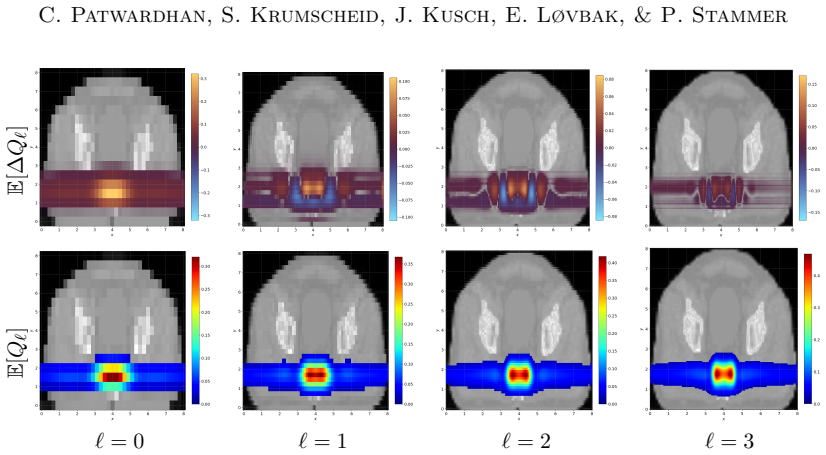
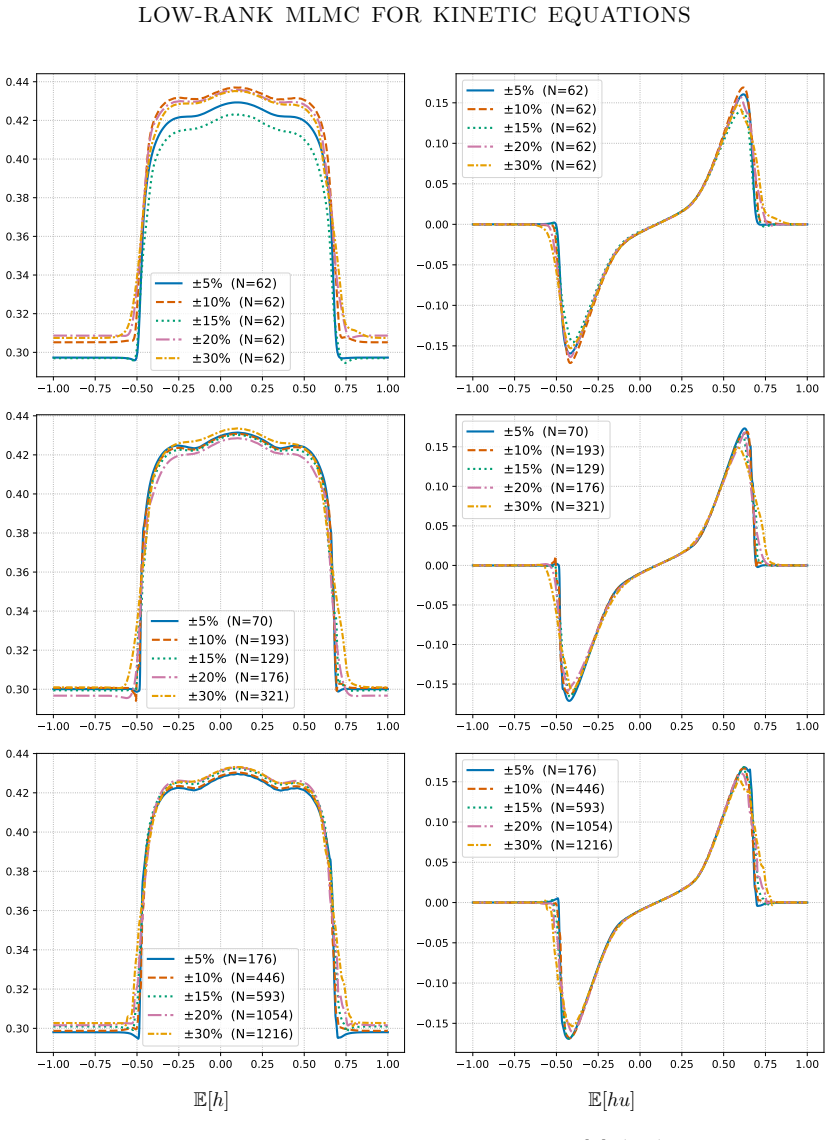
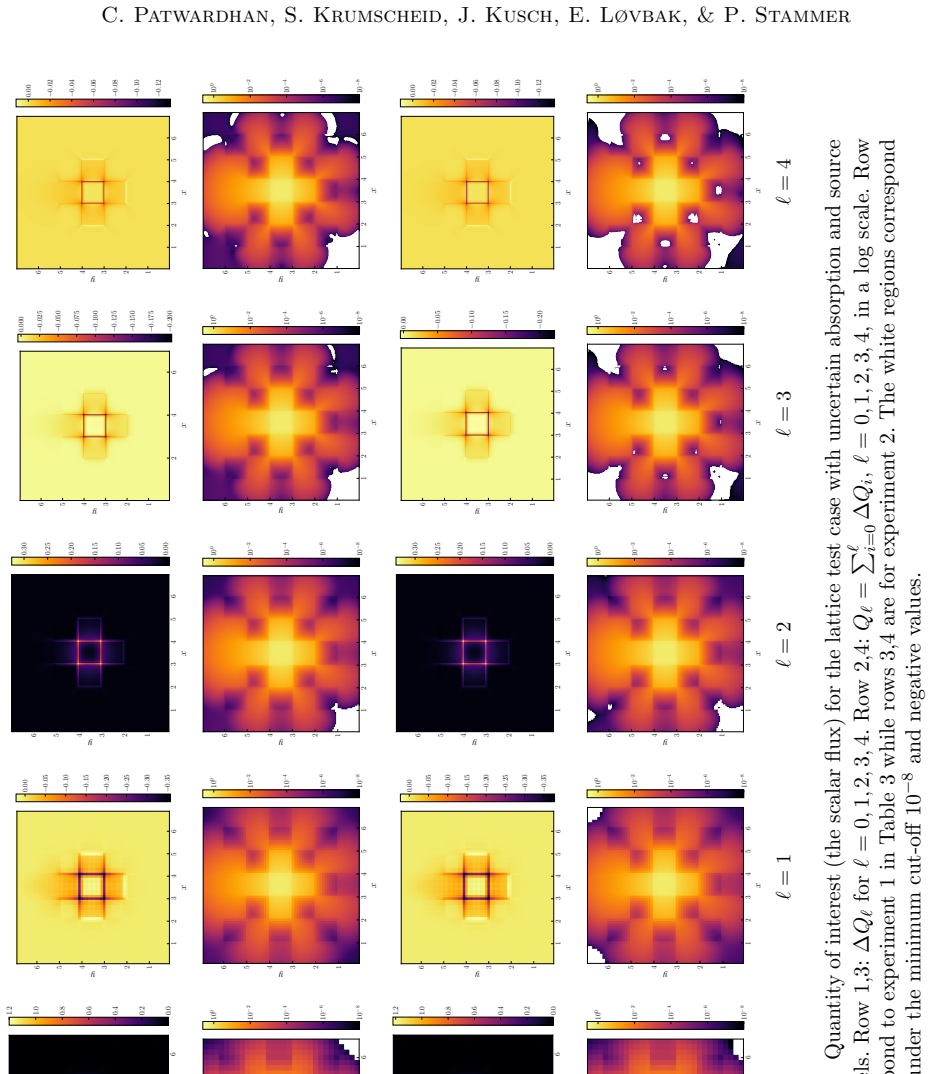
Kinetic equations are used to model a wide range of phenomena important for real-world applications. Their applications span astrophysics, nuclear physics, engineering, and social sciences. Due to their high-dimensional phase space, modelling and quantifying uncertainties, relevant for applications, poses a significant challenge even for modern computing infrastructure. In recent years, dynamical low-rank approximation (DLRA) has gained popularity for making fine grid simulations of high-dimensional problems feasible by evolving the solution of a time-dependent PDE as a low-rank factorization. This reduces the computational and memory requirements significantly. In this work, we propose a low-rank multilevel Monte Carlo estimator for kinetic equations based on a probabilistic rank-adaptive DLRA time integrator. The level hierarchy of the low-rank multilevel estimator is constructed through spatial refinement and by ensuring that the low-rank error remains below the spatial discretization error. We demonstrate the efficacy of the estimator through several numerical experiments from radiation transport, radiation therapy, and shallow water flow.
Editorial analysis
A structured set of objections, weighed in public.
Referee Report
Summary. The paper proposes a dynamical low-rank multilevel Monte Carlo (DLR-MLMC) estimator for high-dimensional kinetic equations. It combines a probabilistic rank-adaptive dynamical low-rank approximation (DLRA) time integrator with a multilevel Monte Carlo hierarchy whose levels are defined by successive spatial refinements, with the explicit rule that the low-rank approximation error must remain strictly below the spatial discretization error at each level. The central claim is that this construction preserves the bias-variance balance of the underlying spatial discretization while reducing computational cost; efficacy is asserted via numerical experiments on radiation transport, radiation therapy, and shallow water equations.
Significance. If the key construction rule can be shown to hold with controlled rank growth, the method would combine the dimensionality reduction of DLRA with the complexity gains of MLMC, offering a practical route to uncertainty quantification for kinetic problems whose phase-space dimension precludes standard Monte Carlo. The multi-application experiments provide empirical support for feasibility, but the absence of any a-priori rank bound or overall error analysis limits the result to a promising algorithmic template rather than a fully characterized estimator.
major comments (3)
- [Abstract / level construction paragraph] Abstract and the paragraph on level-hierarchy construction: the central design rule requires that the low-rank error (controlled by the probabilistic rank-adaptive DLRA integrator) stays strictly below the spatial discretization error at every level, yet no derivation, a-priori bound, or proof is supplied that the minimal rank satisfying this inequality remains independent of the finest spatial mesh; without such control the per-sample cost ceases to be level-independent and the MLMC complexity benefit is lost.
- [Numerical experiments] Numerical experiments section: the manuscript supplies no quantitative tables or plots that report the realized low-rank error versus spatial discretization error across successive refinement levels, nor any description of the concrete implementation of the probabilistic rank-adaptation rule (acceptance probability, tolerance schedule, or rank-update mechanism), leaving the verification of the load-bearing assumption unsupported by data.
- [Theory / analysis sections] No section derives an overall error bound or complexity estimate for the combined DLR-MLMC estimator; standard MLMC analyses require such a bound to confirm that the telescoping sum inherits the correct convergence rate, and its absence makes the claimed performance rest entirely on the unproven hierarchy construction.
minor comments (1)
- [Notation / §2] Notation for the probabilistic rank-adaptation parameters is introduced without a dedicated table or explicit list of symbols, making it difficult to trace how the adaptation is tuned in the reported runs.
Simulated Author's Rebuttal
We thank the referee for the careful reading and constructive feedback on our manuscript. We address each major comment below, indicating planned revisions where feasible. We focus on clarifying the algorithmic construction and strengthening the numerical evidence while acknowledging limitations in the theoretical analysis.
read point-by-point responses
-
Referee: Abstract and the paragraph on level-hierarchy construction: the central design rule requires that the low-rank error (controlled by the probabilistic rank-adaptive DLRA integrator) stays strictly below the spatial discretization error at every level, yet no derivation, a-priori bound, or proof is supplied that the minimal rank satisfying this inequality remains independent of the finest spatial mesh; without such control the per-sample cost ceases to be level-independent and the MLMC complexity benefit is lost.
Authors: We acknowledge that the manuscript does not supply a derivation or a-priori bound guaranteeing that the minimal rank needed to keep the low-rank error below the spatial discretization error remains independent of the finest mesh. The hierarchy is constructed by adapting the rank at each level to enforce the error condition, but proving mesh-independent rank growth would require additional analysis of the underlying kinetic equation and the probabilistic adaptation mechanism. In the revision we will add an explicit remark in the level-construction paragraph noting this limitation and its implications for the complexity analysis. We will also include numerical evidence from the existing experiments showing that observed ranks remain moderate across the tested refinements. revision: partial
-
Referee: Numerical experiments section: the manuscript supplies no quantitative tables or plots that report the realized low-rank error versus spatial discretization error across successive refinement levels, nor any description of the concrete implementation of the probabilistic rank-adaptation rule (acceptance probability, tolerance schedule, or rank-update mechanism), leaving the verification of the load-bearing assumption unsupported by data.
Authors: We agree that the numerical section lacks the requested quantitative verification and implementation details. In the revised manuscript we will add tables and plots that explicitly compare the realized low-rank approximation error against the spatial discretization error at each level of the hierarchy. We will also expand the description of the probabilistic rank-adaptive DLRA integrator to specify the acceptance probability, tolerance schedule, and rank-update mechanism employed in the experiments. revision: yes
-
Referee: No section derives an overall error bound or complexity estimate for the combined DLR-MLMC estimator; standard MLMC analyses require such a bound to confirm that the telescoping sum inherits the correct convergence rate, and its absence makes the claimed performance rest entirely on the unproven hierarchy construction.
Authors: The manuscript presents an algorithmic construction together with empirical validation rather than a complete theoretical analysis. Deriving a rigorous overall error bound and complexity estimate would require additional assumptions on solution regularity and controlled rank growth that are not established in the current work. In the revision we will insert a short discussion section that outlines the conditions under which the standard MLMC complexity gains would be inherited, based on the observed numerical behavior, while clearly stating that a full a-priori analysis is left for future research. revision: partial
- A rigorous a-priori proof that the minimal rank satisfying the low-rank error condition remains independent of the spatial mesh size.
Circularity Check
No significant circularity; derivation assembles independent components with explicit new rule
full rationale
The paper's central construction combines the existing probabilistic rank-adaptive DLRA integrator with standard MLMC telescoping via a new level-selection rule (spatial refinement while keeping low-rank error below spatial discretization error). No equation or claim reduces the claimed complexity benefit to a fitted constant, self-referential definition, or self-citation chain. The hierarchy rule is stated as an assumption that is then verified numerically; the derivation chain remains self-contained against external benchmarks and does not invoke load-bearing self-citations or uniqueness theorems from the same authors.
Axiom & Free-Parameter Ledger
Reference graph
Works this paper leans on
-
[1]
Armbruster, D
D. Armbruster, D. Marthaler, and C. Ringhofer. Kinetic and Fluid Model Hier- archies for Supply Chains.Multiscale Modeling & Simulation, 2(1):43–61, January 2003
2003
-
[2]
Multilevel Monte Carlo method for parabolic stochastic partial differential equations.BIT Numerical Mathematics, 53(1):3–27, March 2013
Andrea Barth, Annika Lang, and Christoph Schwab. Multilevel Monte Carlo method for parabolic stochastic partial differential equations.BIT Numerical Mathematics, 53(1):3–27, March 2013
2013
-
[3]
Bennett and R
W. Bennett and R. G. McClarren. Uncertainty Benchmarks for Time-Dependent Transport Problems.Nuclear Science and Engineering, 199(sup1):53, April 2025
2025
-
[4]
McClarren
William Bennett and Ryan G. McClarren. Benchmarks for Infinite Medium, Time Dependent Transport Problems with Isotropic Scattering.Journal of Computational and Theoretical Transport, 51(4):205–221, June 2022
2022
-
[5]
Im- proved beam angle arrangement in intensity modulated proton therapy treatment planning for localized prostate cancer.Cancers, 7(2):574–584, 2015
Wenhua Cao, Gino J Lim, Yupeng Li, X Ronald Zhu, and Xiaodong Zhang. Im- proved beam angle arrangement in intensity modulated proton therapy treatment planning for localized prostate cancer.Cancers, 7(2):574–584, 2015
2015
-
[6]
Case and Paul Frederick Zweifel.Linear Transport Theory
Kenneth M. Case and Paul Frederick Zweifel.Linear Transport Theory. Addison- Wesley Publishing Company, 1967. 25 C. Patwardhan, S. Krumscheid, J. Kusch, E. Løvbak, & P. Stammer
1967
-
[7]
A robust second-order low-rank BUG integrator based on the midpoint rule.BIT Numerical Mathematics, 64(3):30, 2024
Gianluca Ceruti, Lukas Einkemmer, Jonas Kusch, and Christian Lubich. A robust second-order low-rank BUG integrator based on the midpoint rule.BIT Numerical Mathematics, 64(3):30, 2024
2024
-
[8]
A rank-adaptive robust integrator for dynamical low-rank approximation.BIT Numerical Mathematics, 62(4):1149–1174, December 2022
Gianluca Ceruti, Jonas Kusch, and Christian Lubich. A rank-adaptive robust integrator for dynamical low-rank approximation.BIT Numerical Mathematics, 62(4):1149–1174, December 2022
2022
-
[9]
A Parallel Rank-Adaptive Integrator for Dynamical Low-Rank Approximation.SIAM Journal on Scientific Computing, 46(3):B205–B228, June 2024
Gianluca Ceruti, Jonas Kusch, and Christian Lubich. A Parallel Rank-Adaptive Integrator for Dynamical Low-Rank Approximation.SIAM Journal on Scientific Computing, 46(3):B205–B228, June 2024
2024
-
[10]
An unconventional robust integrator for dy- namical low-rank approximation.BIT Numerical Mathematics, 62(1):23–44, March 2022
Gianluca Ceruti and Christian Lubich. An unconventional robust integrator for dy- namical low-rank approximation.BIT Numerical Mathematics, 62(1):23–44, March 2022
2022
-
[11]
Wei Chen, Giacomo Dimarco, and Lorenzo Pareschi. Structure and asymptotic pre- serving deep neural surrogates for uncertainty quantification in multiscale kinetic equations, June 2025. arXiv:2506.10636
-
[12]
Multilevel Monte Carlo methods and applications to elliptic PDEs with random coefficients.Computing and Visualization in Science, 14(1):3–15, August 2011
K A Cliffe, M B Giles, R Scheichl, and A L Teckentrup. Multilevel Monte Carlo methods and applications to elliptic PDEs with random coefficients.Computing and Visualization in Science, 14(1):3–15, August 2011
2011
-
[13]
A continuation multilevel Monte Carlo algorithm.BIT Numerical Math- ematics, 55(2):399–432, June 2015
Nathan Collier, Abdul-Lateef Haji-Ali, Fabio Nobile, Erik Von Schwerin, and Ra´ ul Tempone. A continuation multilevel Monte Carlo algorithm.BIT Numerical Math- ematics, 55(2):399–432, June 2015
2015
-
[14]
Shared data for intensity modulated radiation therapy (imrt) optimization research: the cort dataset.GigaScience, 3(1):2047–217X, 2014
David Craft, Mark Bangert, Troy Long, D´ avid Papp, and Jan Unkelbach. Shared data for intensity modulated radiation therapy (imrt) optimization research: the cort dataset.GigaScience, 3(1):2047–217X, 2014
2047
-
[15]
Asymptotic-preserving and energy stable dynamical low-rank approximation.SIAM Journal on Numerical Analysis, 62(1):73–92, 2024
Lukas Einkemmer, Jingwei Hu, and Jonas Kusch. Asymptotic-preserving and energy stable dynamical low-rank approximation.SIAM Journal on Numerical Analysis, 62(1):73–92, 2024
2024
-
[16]
McClarren, and Jing-Mei Qiu
Lukas Einkemmer, Katharina Kormann, Jonas Kusch, Ryan G. McClarren, and Jing-Mei Qiu. A review of low-rank methods for time-dependent kinetic simulations. Journal of Computational Physics, 538:114191, October 2025
2025
-
[17]
A Low-Rank Projector-Splitting Inte- grator for the Vlasov–Poisson Equation.SIAM Journal on Scientific Computing, 40(5):B1330–B1360, January 2018
Lukas Einkemmer and Christian Lubich. A Low-Rank Projector-Splitting Inte- grator for the Vlasov–Poisson Equation.SIAM Journal on Scientific Computing, 40(5):B1330–B1360, January 2018
2018
-
[18]
Fairbanks, Alireza Doostan, Christian Ketelsen, and Gianluca Iaccarino
Hillary R. Fairbanks, Alireza Doostan, Christian Ketelsen, and Gianluca Iaccarino. A low-rank control variate for multilevel Monte Carlo simulation of high-dimensional uncertain systems.Journal of Computational Physics, 341:121–139, July 2017. 26 LOW-RANK MLMC FOR KINETIC EQUATIONS
2017
-
[19]
Distributed and scalable op- timization for robust proton treatment planning.Medical physics, 50(1):633–642, 2023
Anqi Fu, Vicki T Taasti, and Masoud Zarepisheh. Distributed and scalable op- timization for robust proton treatment planning.Medical physics, 50(1):633–642, 2023
2023
-
[20]
Ganapol and OECD Nuclear Energy Agency.Analytical benchmarks for nu- clear engineering applications: case studies in neutron transport theory
B D. Ganapol and OECD Nuclear Energy Agency.Analytical benchmarks for nu- clear engineering applications: case studies in neutron transport theory. Data bank. Nuclear Energy Agency, France, 2008. OCLC: 430990895
2008
-
[21]
Michael B. Giles. Multilevel Monte Carlo Path Simulation.Operations Research, 56(3):607–617, June 2008
2008
-
[22]
Michael B. Giles. Multilevel Monte Carlo methods.Acta Numerica, 24:259–328, May 2015
2015
-
[23]
Grote, Simon Michel, and Fabio Nobile
Marcus J. Grote, Simon Michel, and Fabio Nobile. Uncertainty Quantification by Multilevel Monte Carlo and Local Time-Stepping for Wave Propagation. SIAM/ASA Journal on Uncertainty Quantification, 10(4):1601–1628, December 2022
2022
-
[24]
Op- timization of mesh hierarchies in multilevel Monte Carlo samplers.Stochastics and Partial Differential Equations Analysis and Computations, 4(1):76–112, March 2016
Abdul-Lateef Haji-Ali, Fabio Nobile, Erik von Schwerin, and Ra´ ul Tempone. Op- timization of mesh hierarchies in multilevel Monte Carlo samplers.Stochastics and Partial Differential Equations Analysis and Computations, 4(1):76–112, March 2016
2016
-
[25]
Asymptotic-Preserving Neural Networks for Mul- tiscale Kinetic Equations.Communications in Computational Physics, 35(3):693– 723, January 2024
Shi Jin, Zheng Ma, and Keke Wu. Asymptotic-Preserving Neural Networks for Mul- tiscale Kinetic Equations.Communications in Computational Physics, 35(3):693– 723, January 2024
2024
-
[26]
Discretized Dynamical Low-Rank Approximation in the Presence of Small Singular Values.SIAM Journal on Numer- ical Analysis, 54(2):1020–1038, January 2016
Emil Kieri, Christian Lubich, and Hanna Walach. Discretized Dynamical Low-Rank Approximation in the Presence of Small Singular Values.SIAM Journal on Numer- ical Analysis, 54(2):1020–1038, January 2016
2016
-
[27]
Dynamical Low-Rank Approximation.SIAM Journal on Matrix Analysis and Applications, 29(2):434–454, January 2007
Othmar Koch and Christian Lubich. Dynamical Low-Rank Approximation.SIAM Journal on Matrix Analysis and Applications, 29(2):434–454, January 2007
2007
-
[28]
Julian Koellermeier, Philipp Krah, and Jonas Kusch. Macro-micro decomposition for consistent and conservative model order reduction of hyperbolic shallow water moment equations: a study using POD-Galerkin and dynamical low-rank approxi- mation.Advances in Computational Mathematics, 50(4):76, August 2024
2024
-
[29]
Analysis and numerical simulation of hyperbolic shallow water moment equations.Communications in Computational Physics, 28(3):1038–1084, 2020
Julian Koellermeier and Marvin Rominger. Analysis and numerical simulation of hyperbolic shallow water moment equations.Communications in Computational Physics, 28(3):1038–1084, 2020
2020
-
[30]
Moment Approximations and Model Cas- cades for Shallow Flow.Communications in Computational Physics, 25(3):669–702, January 2019
Julia Kowalski and Manuel Torrilhon. Moment Approximations and Model Cas- cades for Shallow Flow.Communications in Computational Physics, 25(3):669–702, January 2019. 27 C. Patwardhan, S. Krumscheid, J. Kusch, E. Løvbak, & P. Stammer
2019
-
[31]
Second-order robust parallel integrators for dynamical low-rank ap- proximation.BIT Numerical Mathematics, 65(3):31, September 2025
Jonas Kusch. Second-order robust parallel integrators for dynamical low-rank ap- proximation.BIT Numerical Mathematics, 65(3):31, September 2025
2025
-
[32]
Dynamical Low-Rank Approximation for Burgers’ Equation with Uncertainty.International Journal for Uncertainty Quantification, 12(5):1–21, 2022
Jonas Kusch, Gianluca Ceruti, Lukas Einkemmer, and Martin Frank. Dynamical Low-Rank Approximation for Burgers’ Equation with Uncertainty.International Journal for Uncertainty Quantification, 12(5):1–21, 2022
2022
-
[33]
On the Stability of Robust Dynamical Low-Rank Approximations for Hyperbolic Problems.SIAM Journal on Scientific Computing, 45(1):A1–A24, February 2023
Jonas Kusch, Lukas Einkemmer, and Gianluca Ceruti. On the Stability of Robust Dynamical Low-Rank Approximations for Hyperbolic Problems.SIAM Journal on Scientific Computing, 45(1):A1–A24, February 2023
2023
-
[34]
KiT-RT: An Extendable Framework for Radiative Transfer and Therapy.ACM Trans
Jonas Kusch, Steffen Schotth¨ ofer, Pia Stammer, Jannick Wolters, and Tianbai Xiao. KiT-RT: An Extendable Framework for Radiative Transfer and Therapy.ACM Trans. Math. Softw., 49(4):38:1–38:24, December 2023
2023
-
[35]
Jonas Kusch and Pia Stammer. A robust collision source method for rank adap- tive dynamical low-rank approximation in radiation therapy.ESAIM: Mathematical Modelling and Numerical Analysis, 57(2):865–891, March 2023
2023
-
[36]
LeVeque.Finite Volume Methods for Hyperbolic Problems
Randall J. LeVeque.Finite Volume Methods for Hyperbolic Problems. Cambridge University Press, 1 edition, August 2002
2002
-
[37]
United States: John Wiley and Sons, Inc., 1984
Elmer Eugene Lewis and Warren F Miller.Computational methods of neutron trans- port. United States: John Wiley and Sons, Inc., 1984
1984
-
[38]
A bi-fidelity method for the multiscale Boltzmann equation with random parameters.Journal of Computational Physics, 402:108914, February 2020
Liu Liu and Xueyu Zhu. A bi-fidelity method for the multiscale Boltzmann equation with random parameters.Journal of Computational Physics, 402:108914, February 2020
2020
-
[39]
AJ Lomax. Intensity modulated proton therapy and its sensitivity to treatment un- certainties 1: the potential effects of calculational uncertainties.Physics in Medicine & Biology, 53(4):1027–1042, 2008
2008
-
[40]
AJ Lomax. Intensity modulated proton therapy and its sensitivity to treatment uncertainties 2: the potential effects of inter-fraction and inter-field motions.Physics in Medicine & Biology, 53(4):1043–1056, 2008
2008
-
[41]
Oseledets
Christian Lubich and Ivan V. Oseledets. A projector-splitting integrator for dynam- ical low-rank approximation.BIT Numerical Mathematics, 54(1):171–188, March 2014
2014
-
[42]
A Multilevel Monte Carlo Ensemble Scheme for Ran- dom Parabolic PDEs.SIAM Journal on Scientific Computing, 41(1):A622–A642, January 2019
Yan Luo and Zhu Wang. A Multilevel Monte Carlo Ensemble Scheme for Ran- dom Parabolic PDEs.SIAM Journal on Scientific Computing, 41(1):A622–A642, January 2019
2019
-
[43]
Mishra and Ch
S. Mishra and Ch. Schwab. Sparse tensor multi-level Monte Carlo finite volume methods for hyperbolic conservation laws with random initial data.Mathematics of Computation, 81(280):1979–2018, April 2012. 28 LOW-RANK MLMC FOR KINETIC EQUATIONS
1979
-
[44]
Mishra, Ch
S. Mishra, Ch. Schwab, and J. ˇSukys. Multi-level Monte Carlo finite volume methods for nonlinear systems of conservation laws in multi-dimensions.Journal of Compu- tational Physics, 231(8):3365–3388, April 2012
2012
-
[45]
Dual Dynamically Orthogonal approxima- tion of incompressible Navier Stokes equations with random boundary conditions
Eleonora Musharbash and Fabio Nobile. Dual Dynamically Orthogonal approxima- tion of incompressible Navier Stokes equations with random boundary conditions. Journal of Computational Physics, 354:135–162, February 2018
2018
-
[46]
Symplectic dynamical low rank approximation of wave equations with random parameters.BIT Numerical Mathematics, 60(4):1153–1201, 2020
Eleonora Musharbash, Fabio Nobile, and Eva Vidliˇ ckov´ a. Symplectic dynamical low rank approximation of wave equations with random parameters.BIT Numerical Mathematics, 60(4):1153–1201, 2020
2020
-
[47]
High-Order BUG Dynamical Low-Rank Inte- grators Based on Explicit Runge–Kutta Methods.Journal of Scientific Computing, 107(3):102, June 2026
Fabio Nobile and S´ ebastien Riffaud. High-Order BUG Dynamical Low-Rank Inte- grators Based on Explicit Runge–Kutta Methods.Journal of Scientific Computing, 107(3):102, June 2026
2026
-
[48]
An Introduction to Uncertainty Quantification for Kinetic Equa- tions and Related Problems
Lorenzo Pareschi. An Introduction to Uncertainty Quantification for Kinetic Equa- tions and Related Problems. In Giacomo Albi, Sara Merino-Aceituno, Alessia Nota, and Mattia Zanella, editors,Trails in Kinetic Theory: Foundational Aspects and Numerical Methods, pages 141–181. Springer International Publishing, Cham, 2021
2021
-
[49]
Chinmay Patwardhan and Jonas Kusch. A Parallel, Energy-Stable Low-Rank Inte- grator for Nonlinear Multi-Scale Thermal Radiative Transfer.Journal of Computa- tional and Theoretical Transport, 55(2):145–189, February 2026
2026
-
[50]
Low-Rank Variance Reduction for Uncertain Radiative Transfer with Control Variates
Chinmay Patwardhan, Pia Stammer, Emil Løvbak, Jonas Kusch, and Sebastian Krumscheid. Low-Rank Variance Reduction for Uncertain Radiative Transfer with Control Variates. In Christiane Lemieux and Ben Feng, editors,Monte Carlo and Quasi-Monte Carlo 2024, volume 522, pages 357–375. Springer Nature Switzerland, Cham, 2026. Series Title: Springer Proceedings i...
2024
-
[51]
Fast and accurate sensitiv- ity analysis of impt treatment plans using polynomial chaos expansion.Physics in Medicine & Biology, 61(12):4646–4664, 2016
Zolt´ an Perk´ o, Sebastian R Van Der Voort, Steven Van De Water, Charlotte MH Hartman, Mischa Hoogeman, and Danny Lathouwers. Fast and accurate sensitiv- ity analysis of impt treatment plans using polynomial chaos expansion.Physics in Medicine & Biology, 61(12):4646–4664, 2016
2016
-
[52]
Martina Prugger, Lukas Einkemmer, and Carlos F. Lopez. A dynamical low-rank approach to solve the chemical master equation for biological reaction networks. Journal of Computational Physics, 489:112250, September 2023
2023
-
[53]
Dynamically orthogonal field equations for continuous stochastic dynamical systems.Physica D: Nonlinear Phe- nomena, 238(23-24):2347–2360, 2009
Themistoklis P Sapsis and Pierre FJ Lermusiaux. Dynamically orthogonal field equations for continuous stochastic dynamical systems.Physica D: Nonlinear Phe- nomena, 238(23-24):2347–2360, 2009
2009
-
[54]
Reference solutions for linear radiation trans- port: the Hohlraum and Lattice benchmarks, May 2025
Steffen Schotth¨ ofer and Cory Hauck. Reference solutions for linear radiation trans- port: the Hohlraum and Lattice benchmarks, May 2025. 29 C. Patwardhan, S. Krumscheid, J. Kusch, E. Løvbak, & P. Stammer
2025
-
[55]
A high-order deterministic dynamical low-rank method for proton transport in heterogeneous media.Journal of Computational Physics, page 114879, 2026
Pia Stammer, Niklas Wahl, Jonas Kusch, and Danny Lathouwers. A high-order deterministic dynamical low-rank method for proton transport in heterogeneous media.Journal of Computational Physics, page 114879, 2026
2026
-
[56]
Ueckermann, P.F.J
M.P. Ueckermann, P.F.J. Lermusiaux, and T.P. Sapsis. Numerical schemes for dy- namically orthogonal equations of stochastic fluid and ocean flows.Journal of Com- putational Physics, 233:272–294, 2013
2013
-
[57]
B. P. Welford. Note on a Method for Calculating Corrected Sums of Squares and Products.Technometrics, 4(3):419–420, August 1962. 30
1962
discussion (0)
Sign in with ORCID, Apple, or X to comment. Anyone can read and Pith papers without signing in.