REVIEW 4 major objections 5 minor 26 references
Unveiling Arithmetic Statistics of Congruent Number Elliptic Curves via Data Science and Machine Learning
T0 review · 4 major / 5 minor · reviewed 2026-08-05 · deepseek-v4-flash
Pith's one-line read A 3-million-integer census of congruent number curves tests Goldfeld's 50/50 split against data—and finds the asymptotic regime has not arrived.
desk verdict Useful 2-Selmer dataset and an honest body, but the abstract's Goldfeld 'verification' is contradicted by the paper's own data and needs to be fixed. read the letter →
The pith
A machine-rendered reading of the paper's core claim, the machinery that carries it, and where it could break.
The reading
What carries the argument
The load-bearing object is the family E_D: y^2 = x^3 - D^2x, quadratic twists of E_1: y^2 = x^3 - x, and its 2-Selmer rank s(D), defined as the F_2-dimension of the 2-Selmer group minus 2 to strip off the constant rational 2-torsion. Because the Mordell-Weil rank r(D) is hard to compute directly, s(D) serves as a computable upper bound and, through the parity conjecture, as a parity oracle: s(D) is even exactly for D ≡ 1,2,3 (mod 8) and odd for D ≡ 5,6,7 (mod 8). The dataset construction—2-Selmer ranks for all D up to 3 million, descent bounds with parity and analytic-rank fallbacks for Mordell-Weil ranks beyond 1 million, analytic ranks cross-checked across algorithms, and GRH-conditional 3
What would settle it
Take a random sample of 1,000 square-free D < 3,000,000 that the external list declares non-congruent, compute their 2-Selmer ranks and, where possible, unconditional descent bounds on the Mordell-Weil rank without consulting the list; if any has positive rank, or if the rank proportions change materially, the dataset's labels—and with them the Heath-Brown, Goldfeld, and ML conclusions—are corrupted. Separately, recompute the analytic ranks of the 98,400 curves using code that does not share the same rank routines; if the 44/56 split moves toward 50/50, the claimed verification is an algorithm
Extended reading notes
Core claim
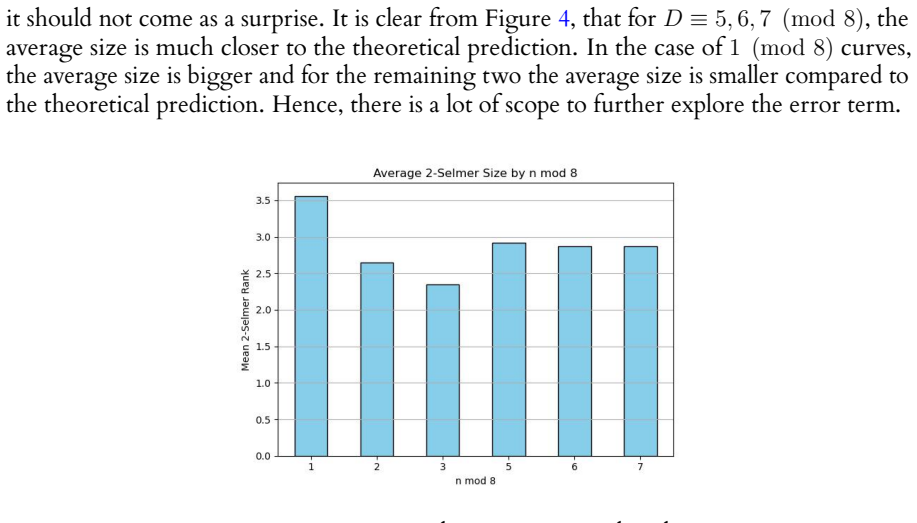
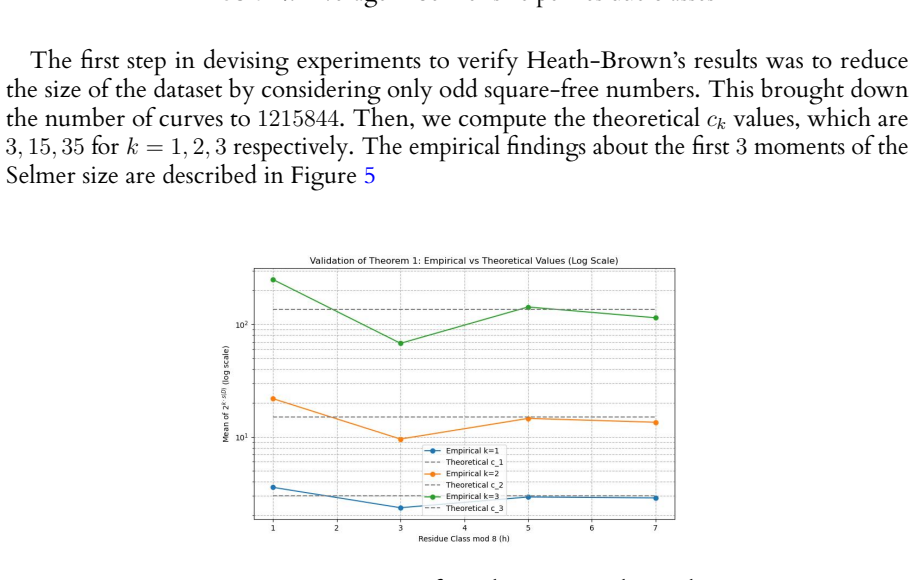
On its own terms, the central discovery is that the 2-Selmer ranks of the congruent-number family are now computed for all 1,823,773 square-free D ≤ 3,000,000, and these unconditional data reproduce the mod-8 parity dichotomy: s(D) is even for D ≡ 1,2,3 (mod 8) and odd for D ≡ 5,6,7 (mod 8). The empirical distribution is concentrated at s = 0 and s = 2 in the even classes and at s = 1 and s = 3 in the odd classes, with Heath-Brown's moment constants 3, 15, 35 matched for D ≡ 5,7 (mod 8) but not for D ≡ 1,3 (mod 8). For analytic ranks, the paper does not find Goldfeld's limit: among 98,400 curves, 43,529 have rank 0, 48,917 have rank 1, and 5,954 have rank ≥ 2, and the authors call this the f
Load-bearing premise
The entire rank and congruence label set rests on trusting an externally maintained list of which numbers up to 10 million are congruent, and on assuming the standard conjectures that equate 2-Selmer bounds with true ranks; if either is wrong for even a small fraction of numbers below 3 million, every statistic in the paper inherits that error.
Editorial extensions
If this is right
- If Heath-Brown's moment predictions are correct, the residue-class-dependent deviations for D ≡ 1,3 (mod 8) must eventually decay; the paper's normalized-error plots make the rate of that decay a quantitative target for improved error terms.
- If Goldfeld's conjecture is true, the 44/56 finite-sample split fixes a lower bound on how many twists are needed before asymptotic behavior appears; extending the analytic-rank computation beyond D ≈ 10^5 is a direct way to test convergence.
- Because average Frobenius traces vanish for every fixed prime, the congruent-number family shows no aggregate murmuration; any signal would have to come from finer stratification, such as by rank or residue class, where the paper's smoothed plots hint at structure.
- If the BSD-parameter machine-learning result generalizes, quantities like the regulator and special value encode congruent status so directly that near-perfect classification is expected; that makes feature-attribution analysis a natural next step.
- The 3-Selmer parity and average-size findings suggest a Heath-Brown-style limit theorem for 3-Selmer ranks in this family is plausible; a larger 3-Selmer dataset would make the comparison quantitative.
Reading between the lines
- The paper's own data support reading the Goldfeld section as a finite-sample diagnostic rather than a completed verification; the constructive next step is to model the observed rank proportions as a function of X and estimate the exponent at which they approach 1/2.
- The pipeline's reliance on an externally maintained congruent-number list for D below 3 million is the single most fragile link; an independent sample-based check of that list would harden every downstream statistic, including the machine-learning labels.
- The near-100% ML accuracy on BSD parameters likely measures how directly regulator and special value encode rank, not a new number-theoretic signal; a fairer test would withhold all quantities that are conjecturally determined by the L-function and train only on congruence-visible features such as D mod 8, prime factors, and Legendre symbols.
- The absence of murmurations in the aggregate Frobenius averages is consistent with the theorem, but the residue-class smoothed plots show oscillations with p-dependent amplitude; averaging (D/p)a_p(E_1) separately by Mordell-Weil or Selmer rank may reveal structure that the overall mean cancels.
Editorial analysis
A structured set of objections, weighed in public.
Referee Report
Summary. The paper compiles a large dataset for the congruent-number elliptic curves E_D: y^2 = x^3 - D^2x with square-free D: 2-Selmer ranks for D up to 3,000,000, Mordell-Weil ranks for about 1.73 million numbers, analytic ranks for 98,400 curves, 3-Selmer ranks for roughly 59,000-80,000 curves, BSD invariants, and Frobenius traces. It compares the observed distributions with the theorems of Heath-Brown, with Poonen-Rains and Delaunay heuristics, with Goldfeld's conjecture, and with Smith's results on congruent numbers and BSD. It also trains ML models to classify congruent numbers and proposes a new theorem and conjecture about averaged Frobenius traces in twist families.
Significance. The assembled dataset is a potentially useful resource: the 2-Selmer computations are unconditional, and the scripts and data are publicly available on GitHub/Zenodo. Several empirical comparisons, especially the residue-class dependence of 2-Selmer statistics and 3-Selmer moments, are suggestive and could inform future work. However, the headline claim of a rigorous verification of Goldfeld's conjecture is not supported by the paper's own Table 6, the MW-rank dataset depends on conditional assumptions and an unverified external list, and the proof of the new Theorem 5.3 has a gap. The paper is best viewed as an exploratory data-science contribution; its central assertions need substantial revision.
major comments (4)
- [Abstract and §4.1, Table 6] The abstract's claim of a 'rigorous verification' of Goldfeld's 50/50 split is contradicted by the paper's own data. Table 6 gives rank-0/rank-1 counts 4280/5720 at N=10000 through 21932/28068 at N=50000 with p-values 0; §4.1 reports totals 43,529 vs 48,917 among 98,400 curves, which is 47.1% vs 52.9% when restricted to ranks 0 and 1. The text itself says 'we are still in the finite-sample regime'. No convergence rate, error estimate, or statistical argument is supplied to justify the word 'rigorous'; the Bernoulli sampling in §7.2 concerns MW ranks and centers near 0.49, not 0.50. The abstract and Section 4 should be reworded to describe a finite-sample test that currently does not observe the predicted split.
- [§2.3] The MW-rank dataset, which underlies the Goldfeld/MW statistics and the ML labels, is built on several assumptions. For D absent from an externally maintained congruent-number list up to 10^7, the MW rank is set to 0; for 2-Selmer rank 1, the MW rank is set to 1 conditional on BSD; unresolved ranks are stored as -1. If that external list is incomplete for D < 3*10^6, or if the parity/BSD assumptions fail for individual curves, Table 8, Figure 28, and the ML labels inherit systematic errors. The paper should quantify how many rows have unresolved rank -1, state which rows are used in each statistic, and independently spot-check the external list.
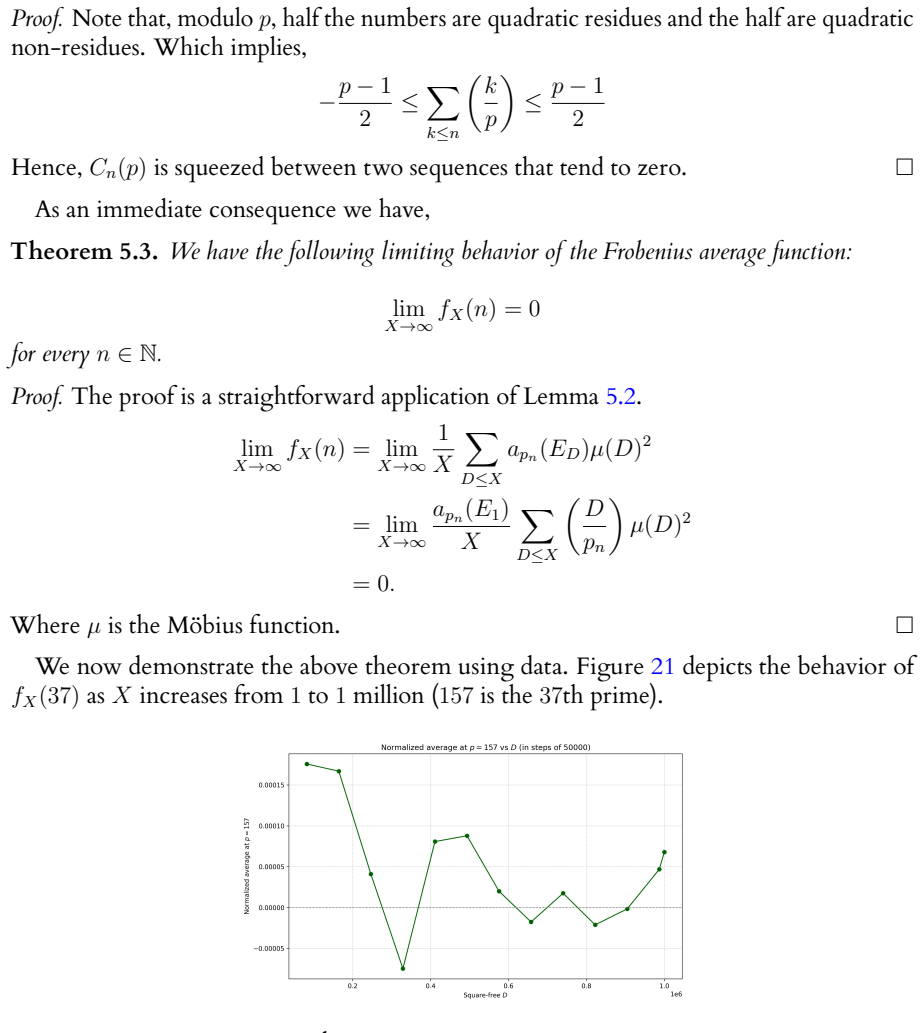
- [§5, Theorem 5.3] The proof of Theorem 5.3 is incomplete. Lemma 5.2 controls averages over consecutive integers, while f_X(n) averages over square-free D; the proof passes to the sum over D with the factor mu(D)^2 and asserts that (1/X)*sum_{D<=X} chi(D) mu(D)^2 tends to 0 without invoking a square-free sieve or an equivalent argument. The normalization also changes from 1/#SF(X) to 1/X. The theorem may be true, but the proof as written does not establish it.
- [§4.2, Theorem 4.4 verification] The verification of Smith's Theorem 4.4 appears to use the wrong Selmer condition. Under the paper's convention #S2(D) = 2^{2+s(D)}, the assertion that Sel2 is generated by the rational 2-torsion subgroup is equivalent to s(D)=0 (dimension 2), not to '2-Selmer rank is 2'. The subsequent count of curves with even Selmer rank that are of rank 2 (48,305 of 97,893) therefore does not test the condition in Theorem 4.4 as stated. The authors should clarify the terminology and re-run the check with s(D)=0.
minor comments (5)
- [§3.1, after Theorem 3.4] The empirical constants '3, 15, 35' do not match the displayed product formula: if the product is (1+2^j), the third value is 135; if it is (1+2j), the third value is 105. Correct the formula or the numerical values.
- [§4.1] The paper does not explain how the 98,400 curves with analytic ranks were selected from the larger dataset, nor which subset had all four rank algorithms agree. Add a precise description of this subset and the selection criteria.
- [§6.2] The 100% accuracy obtained using regulator, special value, real period, and Tamagawa product is largely a restatement of BSD, since these invariants encode whether L(E,1)=0. This should be presented as a consistency check rather than as a new ML discovery.
- [Conjecture 5.4] The phrase 'the normalized trace a_p(E) is seen as a discrete random variable on {-1,0,+1}' is undefined; specify the normalization and the probability space.
- [Table 6] The p-values are reported as '0'; actual values should be given. The subsamples are nested prefixes, so the chi-square and Fisher tests are not independent across rows; this should be noted.
Circularity Check
One secondary self-definitional step in MW-rank dataset construction; core external benchmarks are independent.
-
self definitional
[Section 2.3 (Generation of the datasets) and Section 7.2 (The behavior of the MW rank)]
"To speed up the calculation Magma recommends assuming GRH. Hence, we also consult 2-Selmer rank: if it is 0 then the MW rank is also zero. On the other hand, if it is 1 then the MW rank is also 1; this is conditional on BSD which implies that the dimension of Sha 2-torsion is even. We also consult the list of congruent numbers up to 10^7 ...; the numbers that do not appear in that list are not congruent and the MW rank of the corresponding curves is set to 0."
The MW-rank labels for curves not resolved by RankBounds are assigned by the quoted rules: s(D)=0 -> MW 0; s(D)=1 -> MW 1 (conditional on BSD); absent from the external congruent-number list -> MW 0. Section 7.2 then reports as empirical findings that 'the parities of the Selmer rank and the MW rank match' and that residue classes 5,6,7 are essentially all rank 1; Section 4.2 reports 'our database shows that 100% of these numbers are congruent'. These observations are restatements of the dataset-construction rules, not independent checks. This is peripheral: the central Selmer-rank, analytic-rank, Frobenius-trace, and ML comparisons use externally computed data and held-out tests, so the overall derivation is not circular.
full rationale
The paper's principal comparisons are to external theorems and conjectures (Heath-Brown, Poonen-Rains, Delaunay, Goldfeld, Smith). The 2-Selmer ranks are computed unconditionally with Sage's selmer_rank(); analytic ranks are computed by multiple independent algorithms; ML experiments use disjoint train/test splits; the Frobenius-average theorem is proved from the definition of the Legendre symbol. No load-bearing self-citations appear (the reference list contains no author self-citations). The abstract's phrase 'rigorous verification' of Goldfeld is contradicted by the paper's own Table 6 (p-values 0 and ~44/50 split) and Section 4.1's admission of the finite-sample regime, but that is a correctness/consistency problem, not circularity. The only circular element is secondary: unresolved MW ranks were filled using Selmer-rank parity, BSD, and the external congruent-number list, and later sections report parity-matching and 100% congruent rates among 5,6,7 (mod 8) as empirical observations, which are restatements of those same filling rules.
Assumptions & free parameters
assumptions (5)
- domain assumption Birch and Swinnerton-Dyer conjecture (rank equality and parity of Sha) is assumed when using MW rank to infer analytic rank and when setting MW rank from 2-Selmer rank 1.
- domain assumption Parity conjecture (root number determines parity of rank) is assumed to resolve MW ranks when RankBounds do not match.
- domain assumption Generalized Riemann Hypothesis is assumed in Magma's RankBounds and analytic_rank_upper_bound and in 3-Selmer computations via SetClassGroupBounds('GRH').
- domain assumption Externally maintained list of congruent numbers up to 10^7 is complete for D < 3×10^6, so absence from the list implies non-congruence.
- standard math Standard properties of elliptic curves (torsion structure Z/2 x Z/2, Frobenius trace formulas, root number by Birch-Stephens) are used.
Cite this review
Pith. "Pith review of Unveiling Arithmetic Statistics of Congruent Number Elliptic Curves via Data Science and Machine Learning." pith.science (2026). https://pith.science/paper/OAZ7J3GN
@misc{pith2026250903129,
  author       = {Pith},
  title        = {Pith review of: Unveiling Arithmetic Statistics of Congruent Number Elliptic Curves via Data Science and Machine Learning},
  year         = {2026},
  howpublished = {\url{https://pith.science/paper/OAZ7J3GN}},
  note         = {Machine review of arXiv:2509.03129}
}
abstract
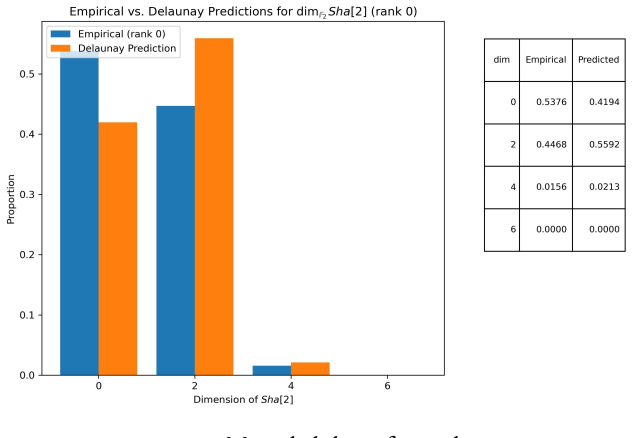
This article presents a comprehensive data-scientific investigation into the arithmetic statistics of congruent number elliptic curves, leveraging a dataset of square-free integers up to $3$ million. We analyze the Mordell-Weil ranks, 2-Selmer ranks, and 3-Selmer ranks of the corresponding elliptic curves $E_D: y^2 = x^3 - D^2x$, where $D$ is a square-free number. Our study empirically examines the Heath-Brown heuristics, which predict the distribution of $2$-Selmer ranks as well as congruent numbers based on their residue modulo $8$. In particular, offering statistical insights into the proportion of numbers whose associated elliptic curves have positive rank. We provide a rigorous verification of Goldfeld's Conjecture in this context, analyzing the distribution of analytic ranks and demonstrating their alignment with the conjectured $50/50$ split for ranks $0$ and $1$. Furthermore, we explore the conjectural asymptotic distribution of $2-$ and $3$-torsion part of the Tate-Shafarevich group of these curves. Based on empirical evidence, we also suggest potential statistical distribution of $3$-Selmer and Mordell-Weil ranks. We also examine the averages of Frobenius traces and observe that they tend to zero without exhibiting any murmuration-like patterns. In addition to these number-theoretic analyses, we apply machine learning techniques to classify and predict congruent numbers, exploring the efficacy of computational methods in distinguishing congruent from non-congruent numbers based on the arithmetic properties of elliptic curves. This interdisciplinary approach blends advanced number theory with modern data science, providing empirical support for conjectures as well as discovery of new patterns.
Figures


Figures from the paper (29 more)






Reference graph
Works this paper leans on
- [1]
-
[2]
J. Balakrishnan, W. Ho, N. Kaplan, S. Spicer, W. Stein, and J. Weigandt. Databases of elliptic curves ordered by height and distributions of Selmer groups and ranks.LMS J. Comput. and Math., 19(A):351–370, 2016
work page 2016
-
[3]
M. Bhargava and A. Shankar. Binary quartic forms having bounded invariants, and the boundedness of the average rank of elliptic curves. Ann. Math., 181(1):191–242, 2015
work page 2015
-
[4]
B. J. Birch and N. M. Stephens. The parity of the rank of Mordell-Weil group. Topology, 5:295–299, 1966
work page 1966
-
[5]
Bosma, J
W. Bosma, J. Cannon, and C. Playoust. The Magma algebra system. I. The user language.J. Symbolic Comput., 24(3-4):235–265, 1997. Computational algebra and number theory (London, 1993)
1997
- [6]
- [7]
- [8]
Show all 26 references
-
[9]
R Douglas and K
M. R Douglas and K. Lee. Mathematical data science. arXiv preprint arXiv:2502.08620, 2025
2025 arXiv
-
[10]
Goldfeld
D. Goldfeld. Conjectures on elliptic curves over quadratic fields.Number theory, Carbondale 1979 (Proc. Southern Illinois Conf.), Lecture Notes in Math., 751:108–118, 1979
1979
-
[11]
Hastie, R
T. Hastie, R. Tibshirani, and J. Friedman. The Elements of Statistical Learning: Data Mining, Inference, and Prediction. Springer, 2nd edition, 2009
2009
-
[12]
Y. He, K. Lee, T. Oliver, and A. Pozdnyakov. Murmurations of elliptic curves.Experimental Mathematics, 0(0):1–13, 2024
2024
-
[13]
D. R. Heath-Brown. The average analytic rank of elliptic curves. Duke Math. J., 122(3):591–623, 2004
2004
-
[14]
Heath-Brown
D.R. Heath-Brown. The size of Selmer groups for the congruent number problem. Invent. Math., 111:171–195, 1993
1993
-
[15]
Heath-Brown
D.R. Heath-Brown. The size of Selmer groups for the congruent number problem. II (with an appendix by P. Monsky). Invent. Math., 118(2):331–370, 1994
1994
-
[16]
James, D
G. James, D. Witten, T. Hastie, and R. Tibshirani. An Introduction to Statistical Learning: with Applications in R. Springer, 2nd edition, 2021
2021
-
[17]
The L-functions and modular forms database
The LMFDB Collaboration. The L-functions and modular forms database. https://www.lmfdb.org,
-
[18]
Poonen and E
B. Poonen and E. Rains. Random maximal isotropic subspaces and Selmer groups. J. Amer. Math. Soc., 25(1):245–269, 2012
2012
-
[19]
J. H. Silverman. The arithmetic of elliptic curves. Springer Verlag, 1992
1992
-
[20]
A. Smith. The congruent numbers have positive natural density. arXiv:1603.08479, 2016
2016 arXiv
-
[21]
A. Smith. 2∞-Selmer groups, 2∞-class groups and Goldfeld’s conjecture. arXiv:1702.02325v2, 2017
2017 arXiv
-
[22]
Sagemath, the Sage Mathematics Software System (Version 10.6)
The Sage Developers. Sagemath, the Sage Mathematics Software System (Version 10.6). https://www. sagemath.org, 2025
2025
-
[23]
Y. Tian, X. Yuan, and S. Zhang. Genus periods, genus points and congruent number problem.arXiv preprints arXiv: 1411.4728, 2014
2014 arXiv
-
[24]
J. B. Tunnell. A classical Diophantine problem and modular forms of weight3/2. Invent. Math., 72:323–334, 1983
1983
-
[25]
H. J. Van Veen, N. Saul, D. Eargle, and S. W Mangham. Kepler mapper: A flexible python implementation of the mapper algorithm. Journal of Open Source Software, 4(42):1315, 2019. 34 CHENNAI MATHEMATICAL INSTITUTE, INDIA. Email address: pdeshpande@cmi.ac.in CHENNAI MATHEMATICAL ...
2019
-
[2025]
[Online; accessed 12 July 2025]
2025
Reviewed August 5, 2026 · model on record in the stance chip above.
Discussion (0). Sign in to comment.