REVIEW 4 major objections 5 minor 18 references
Machine-learning surrogate models for nonlinear energetic-particle transport predictions in ITER
T0 review · 4 major / 5 minor · reviewed 2026-08-12 · deepseek-v4-flash
Pith's one-line read Trained on nonlinear FAR3d gyrofluid simulations of an ITER steady-state scenario, Gaussian-process and hierarchical neural-network surrogates predict energetic beam and alpha-particle transport fluxes with test $R^2$ around 0.98 while…
desk verdict First ML surrogate for AE-driven EP transport in ITER; solid proof-of-concept with a weak cross-scenario test. read the letter →
The pith
A machine-rendered reading of the paper's core claim, the machinery that carries it, and where it could break.
The reading
What carries the argument
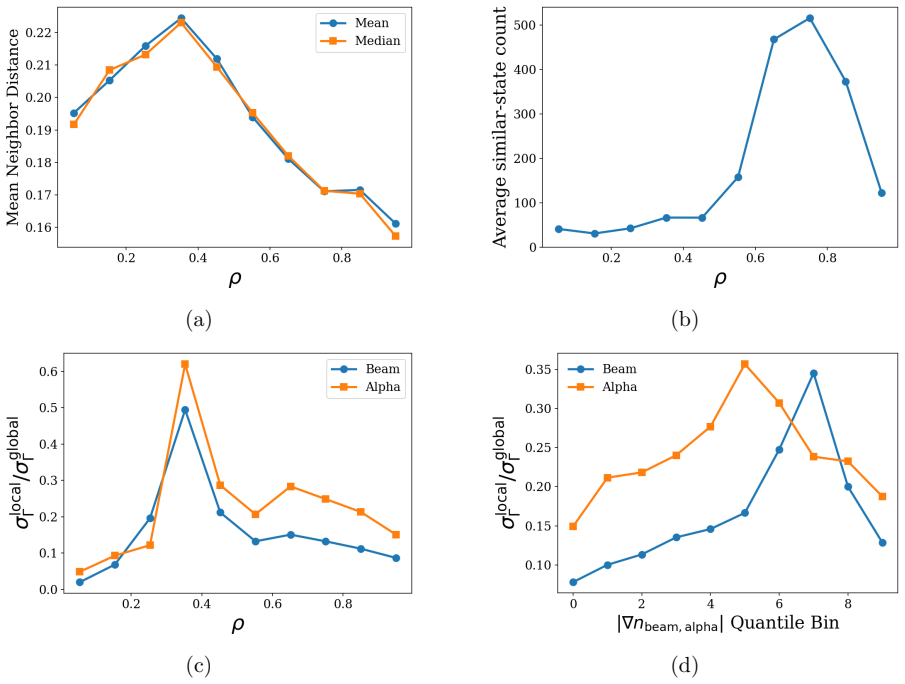
The load-bearing object is the surrogate mapping $(\Gamma_{\rm beam}, \Gamma_\alpha) = F(\rho, q, \hat{s}, n_{\rm beam}, n_\alpha, \nabla n_{\rm beam}, \nabla n_\alpha)$, which states that an instantaneous local plasma state uniquely determines the transport flux. Two complementary learners realize this mapping: a multitask Gaussian process with a Matérn 3/2 ARD kernel that also receives profile-averaged beam and $\alpha$ densities as global context, and a hierarchical neural network split at $\rho = 0.5$, where a low-$\rho$ network's predicted fluxes are fed as extra inputs to a high-$\rho$ network. Uncertainty is carried by the GP posterior variance and by Monte-Carlo dropout in the NN. A flux-variability analysis, which compares fluxes among neighboring states within a Euclidean distance of 0.3 in the normalized feature space, tests whether the mapping is unique enough for the surrogate formulation to be valid.
What would settle it
Run the trained GP and NN surrogates on new nonlinear FAR3d simulations of an ITER regime not represented in training data, such as a strongly bursting or large-scale relaxation case, and check whether test $R^2$ collapses or median relative $L^2$ error grows well beyond the 7–9% range; alternatively, repeat the flux-variability analysis with time-lagged features (e.g., the flux at the previous dump) and see whether the 10–17% of high-variability states near $\rho \sim 0.35$ become uniquely determined.
Extended reading notes
Core claim
The central discovery is that the saturated-phase transport flux of energetic particles can, to a good approximation, be treated as a function of the local plasma state $(\rho, q, \hat{s}, n_{\rm beam}, n_\alpha, \nabla n_{\rm beam}, \nabla n_\alpha)$, and that both a multitask Gaussian process and a hierarchical neural network trained on these features from nonlinear FAR3d simulations predict beam and $\alpha$ fluxes on test profiles with $R^2$ values of 0.979 and 0.974 (GP) and 0.982 and 0.975 (NN), respectively. The models reconstruct radial flux profiles with median relative $L^2$ errors of approximately 7–9% on unseen data and reduce the cost of evaluating a full set of transport profiles from 158 wall-clock hours to a few seconds. The authors demonstrate this for an ITER steady-state scenario covering both reversed-shear and monotonic-$q$ profiles, restricting training to the statistically stationary nonlinear saturated phase of the simulations where appreciable transport occurs.
Load-bearing premise
The load-bearing premise is that similar values of the seven plasma-state variables always produce similar transport fluxes, with no dependence on history or on unmeasured quantities; if that fails, the surrogate's accuracy will not generalize beyond its training set.
Editorial extensions
If this is right
- Integrated modeling workflows could evaluate AE-driven energetic-particle transport repeatedly in seconds rather than hundreds of wall-clock hours, enabling design scans and uncertainty quantification for ITER and future burning-plasma devices.
- The GP surrogate offers consistent global uncertainty estimates and slightly better reconstruction near the transport peak, while the NN surrogate's MC-dropout uncertainty distinguishes early- from late-saturation regimes, so the two models can serve complementary roles.
- Because the surrogates learn the transport response directly from nonlinear simulation data, the approach transfers to other simulation codes and other devices as a proof of concept for reduced transport modeling.
- The predictive uncertainty estimates provide a confidence measure when the surrogates are queried in plasma regimes sparsely represented in the training data.
- The demonstrated accuracy supports extending the methodology to time-dependent transport prediction, with the long-term goal of accelerating nonlinear simulations themselves.
Reading between the lines
- The authors do not test whether the 10–17% of high-variability states near $\rho \sim 0.35$ become uniquely determined when time-lagged features are added; a direct test would show whether the current seven-variable representation is missing memory effects.
- Because the flux-variability analysis flags the strongest transport and gradient regimes as least unique, integrated modeling should treat surrogate outputs there with wider uncertainty margins or resample with additional features.
- Disagreement between GP posterior variance and MC-dropout uncertainty could serve as an out-of-distribution detector: when the two uncertainty estimates diverge sharply, a plasma state is likely beyond the training manifold.
- The five-to-six-orders-of-magnitude speedup applies only to saturated-phase transport evaluation; using the surrogate to follow linear growth or bursting relaxation would place it outside its training regime.
Signed reviews
Editorial analysis
A structured set of objections, weighed in public.
Referee Report
Summary. The paper develops Gaussian process and hierarchical neural-network surrogate models that predict beam-ion and alpha-particle transport fluxes from nonlinear FAR3d gyrofluid simulations of an ITER steady-state scenario. The models use a seven-dimensional local plasma-state representation (radius, safety factor, magnetic shear, EP densities, and EP density gradients) to map to the two transport fluxes. A flux-variability analysis is used to argue that this local representation is sufficiently unique over most of the sampled feature space. The surrogates are trained on a dataset of about 9180 spatial samples derived from 20 radial profiles from two FAR3d simulations, with 16 profiles for training and 4 for testing. The reported test-set R² values are 0.9791/0.9737 (GP) and 0.9823/0.9752 (NN) for beam/alpha fluxes, and the evaluation time is reduced by five to six orders of magnitude relative to a full nonlinear simulation. The paper frames the result as a proof of concept for replacing repeated transport evaluations in integrated modeling workflows.
Significance. If the central claims hold, this would be a useful and novel proof of concept: the first ML surrogate for AE-driven energetic-particle transport, with explicit uncertainty quantification and a substantial speedup. The comparative study of GP and hierarchical NN uncertainty behavior is also informative. However, the significance is tempered by the narrow data basis: the surrogates are trained and tested on two simulations of one ITER steady-state scenario, and the test set consists of only four profiles drawn from those same two runs. The claimed predictive accuracy is therefore an interpolation result within the training manifold rather than demonstrated generalization to new equilibria, perturbations, or operating scenarios. The paper is appropriately cautious in its conclusions, but the abstract's statement that the surrogate is 'sufficiently accurate and computationally efficient to be incorporated into future integrated modeling workflows' goes beyond what the current evidence strictly supports.
major comments (4)
- [§2 and §5.1 (Table 3)] The test set consists of four profiles taken from the same two FAR3d runs used for training, with output dumps separated by about 14,000 timesteps within the nonlinear saturated phase. Consequently, the test profiles lie on the same temporal trajectories as the training profiles, and the reported test R² values of 0.979–0.982 demonstrate interpolation along known simulation trajectories rather than predictive skill for a new plasma state. For the GP, the additional profile-averaged densities ⟨n_beam⟩ and ⟨n_alpha⟩ are dump-level global inputs, which further tie test predictions to the specific source run. The paper should either add a hold-out scenario evaluation (e.g., train on one q-profile and test on the other, or leave out a full simulation) or explicitly restrict the central claim to interpolation within the sampled manifold. As written, the evidence does not support the abstract's implication that the surrogates are ready for deployment in integrated modeling of unseen ITER states.
- [§3 (Fig. 3 and surrounding text)] The flux-variability analysis is load-bearing for the uniqueness of the mapping in Eq. (3), but it leaves a non-negligible fraction of the data unexplained: approximately 10% of beam states and 17% of alpha states have local-to-global flux variability above the 0.3 threshold, concentrated near the peak transport region (ρ ≈ 0.35) and at intermediate-to-high gradient strengths. These are precisely the states that contribute most to transport, and the neighborhood radius of 0.3 is selected based on mean nearest-neighbor distances rather than derived from an objective criterion. The paper should quantify how the surrogate prediction errors on these high-variability states compare with errors on the rest of the dataset, and should discuss whether additional features (e.g., mode amplitudes or history-dependent variables) would be needed to make the mapping unique on this subset. Without this, the statement that the representation 'provides a sufficient unique parameterization over most of the sampled feature space' is too strong.
- [§5.2 and §5.3] The claim that 'neither model exhibits significant overfitting' is based on the similarity between training and testing L2 errors (Table 3). Because the test profiles come from the same two simulations as the training profiles, this comparison does not actually rule out overfitting to the simulation-specific trajectory. A more convincing check would be leave-one-simulation-out cross-validation or an evaluation on a simulation with a different initial condition or perturbation. The discussion of outlier profiles in §5.3 is useful, but it does not substitute for an independent test set.
- [§4.1] The hierarchical NN architecture is not fully specified. The high-ρ network uses 'the mean beam and alpha-particle transport fluxes predicted by the low-ρ network' as additional inputs, but it is unclear over which radial range or set of low-ρ points this mean is taken, and how the low-ρ network is applied when the high-ρ network is evaluated at inference time. This matters because the high-ρ network's inputs depend on the low-ρ network's outputs, creating a sequential dependency not described in enough detail for reproducibility. The manuscript should provide an explicit computational recipe for the hierarchical evaluation.
minor comments (5)
- [§2] The text alternates between 'normal-shear' and 'monotonic q-profile' when referring to the second simulation. Please use a single consistent term throughout.
- [§5.2, Eq. (4)] The notation Γpred(ρ) and Γtrue(ρ) is introduced in Eq. (4) but the integration variable and the normalization are not fully defined; specify that ρ is the square-root of normalized toroidal flux and that the integral is over the radial domain.
- [§5.3] The 'distance correlation coefficient' is used to characterize the flux-gradient relationship, but no definition or reference is given. Please add a brief definition or citation.
- [Figure 3(b)] The figure caption says the 'average number of similar cross-profile states' is shown, but the vertical axis label and the text would be clearer if the units (count per radial bin) were made explicit.
- [§2, 'Training vs testing data split'] The sentence 'For the normal-shear simulations, we retained 9 output dumps' appears to refer to the monotonic q-profile case; please reconcile the terminology as noted above.
Circularity Check
No significant circularity: the surrogate is an empirical fit to FAR3d outputs with held-out test profiles, and no load-bearing step reduces to its own inputs or to a self-citation chain.
full rationale
The paper's derivation chain is an empirical surrogate construction, not a first-principles derivation. The GP and NN are trained on radial profiles from two FAR3d nonlinear simulations and evaluated on four held-out profiles (two per q-profile) that were excluded by explicit profile-wise partitioning (Section 2). The test R^2 values in Table 3 therefore measure interpolation over radius and time within the same two simulated scenarios, but they do not reduce to the fitted values by construction, because the test profiles were not used to set model weights or hyperparameters. The local-state ansatz in Eq. (3) is checked, rather than assumed, by the flux-variability analysis in Section 3, which honestly reports that 10% (beam) and 17% (alpha) of states have local-to-global variability above 0.3; this is a validity limitation in strong-transport regions, not a circular step. FAR3d is cited to Refs. [3,7-10], including prior work by the authors, but these citations supply the simulation code, dataset, and JET benchmark, not an imported uniqueness theorem or an unexamined ansatz. The prediction of FAR3d transport is a standard supervised-learning approximation of a fixed simulation mapping, with no load-bearing reduction of the result to its own inputs. Remaining concerns about generalization to new equilibria or scenarios are a scope limitation, not circularity.
Assumptions & free parameters
free parameters (5)
- Feature-space neighborhood radius (Euclidean distance) for flux-variability analysis =
0.3
- Hierarchical NN radial boundary =
rho = 0.5
- NN architecture and hyperparameters (learning rate, epochs, hidden width, dropout rate, loss weighting) =
lr 5e-4, 3000 epochs, 64 neurons per layer, dropout 10%, weighted MSE
- GP kernel hyperparameters (ARD length scales, multitask covariance, observation noise) =
optimized by marginal likelihood maximization
- Flux normalization factor =
1e-5 times characteristic flux scale
assumptions (4)
- domain assumption FAR3d gyrofluid simulations faithfully represent AE-driven energetic-particle transport in ITER
- domain assumption Instantaneous transport flux is a unique function of the local plasma state (Eq. 3), with no significant memory or hysteresis
- domain assumption The nonlinear saturated (soft-MHD) regime is the relevant regime for integrated modeling
- domain assumption The held-out test profiles from the same two simulations are representative of the broader ITER operating space
Cite this review
Pith. "Pith review of Machine-learning surrogate models for nonlinear energetic-particle transport predictions in ITER." pith.science (2026). https://pith.science/paper/OBB3SQRJ
@misc{pith2026260811058,
  author       = {Pith},
  title        = {Pith review of: Machine-learning surrogate models for nonlinear energetic-particle transport predictions in ITER},
  year         = {2026},
  howpublished = {\url{https://pith.science/paper/OBB3SQRJ}},
  note         = {Machine review of arXiv:2608.11058}
}
read the original abstract
Fast and accurate prediction of energetic-particle transport driven by Alfv\'en eigenmode (AE) instabilities is essential for integrated modeling workflows used in the design and optimization of burning plasma fusion reactors. In this work, we develop machine-learning-based surrogate models for rapid prediction of energetic beam and alpha-particle transport fluxes, together with predictive uncertainty estimates, for an ITER steady-state scenario. Two complementary surrogate methodologies, Gaussian process (GP) regression and hierarchical neural networks (NNs), are trained using nonlinear FAR3d gyrofluid simulations of energetic-particle transport. A flux-variability analysis demonstrates that the selected plasma-state representation provides a sufficiently unique parameterization of the nonlinear transport response over most of the sampled feature space, thereby justifying the surrogate formulation. Both surrogate models reproduce the nonlinear transport fluxes with high predictive accuracy while reducing the computational cost of transport evaluation by approximately five to six orders of magnitude relative to direct nonlinear FAR3d simulations. Although the two approaches achieve comparable predictive accuracy, they exhibit distinct uncertainty characteristics: the GP provides more consistent global uncertainty estimates, whereas the NN more clearly distinguishes between different transport regimes. This work establishes a proof of concept for developing machine-learning surrogate models of energetic-particle transport that are sufficiently accurate and computationally efficient to be incorporated into future integrated modeling workflows.
Figures


Figures from the paper (6 more)


Reference graph
Works this paper leans on
-
[1]
M.-L. Mayoral, R. Buttery, T. T. C. Jones, V. Kiptily, S. Sharapov, M. J. Mantsi- nen, S. Coda, O. Sauter, L.-G. Eriksson, F. Nguyen, D. N. Borba, A. M¨ uck, S. D. Pinches, J.-M. Noterdaeme, and JET-EFDA Contributors. Studies of burning plasma physics in the joint european torus.Physics of Plasmas, 11(5):2607–2615, 05 2004
work page 2004
-
[2]
M. Salewski, D.A. Spong, P. Aleynikov, R. Bilato, B.N. Breizman, S. Briguglio, H. Cai, L. Chen, W. Chen, V.N. Duarte, R.J. Dumont, M.V. Falessi, M. Fitzger- ald, E.D. Fredrickson, M. Garc ´ ıa-Mu˜ noz, N.N. Gorelenkov, T. Hayward-Schneider, W.W. Heidbrink, M.J. Hole, Ye.O. Kazakov, V.G. Kiptily, A. K¨ onies, T. Kurki- Suonio, Ph. Lauber, S.A. Lazerson, Z....
work page 2025
- [3]
- [4]
-
[5]
G. Dong, X. Wei, J. Bao, G. Brochard, Z. Lin, and W. Tang. Deep learning based surrogate models for first-principles global simulations of fusion plasmas.Nuclear Fusion, 61(12):126061, nov 2021
work page 2021
-
[6]
A. M. Bruncrona, A. Kit, A. E. J¨ arvinen, S. Saarelma, L. Frassinetti, and JET Con- tributors. Machine learning surrogate model for ideal peeling–ballooning pedestal mhd stability.Physics of Plasmas, 32(9):092501, 09 2025
work page 2025
-
[7]
Solano, ˇZiga ˇStancar, Jacobo Varela, Matteo Baruzzo, Emily Belli, Phillip J
Jeronimo Garcia, Yevgen Kazakov, Rui Coelho, Mykola Dreval, Elena de la Luna, Emilia R. Solano, ˇZiga ˇStancar, Jacobo Varela, Matteo Baruzzo, Emily Belli, Phillip J. Bonofiglo, Jeff Candy, Costanza F. Maggi, Joelle Mailloux, Samuele Mazzi, Jef Ongena, Juan R. Ruiz, Michal Poradzinski, Sergei Sharapov, David Zarzoso, and JET contributors. Stable deuterium...
work page 2024
-
[8]
J. Varela, J. Garcia, S. Mazzi, Y. Kazakov, Z. Stancar, M. Baruzzo, J. Ongena, D.A. Spong, L. Garcia, Y. Ghai, D. Zarzoso, J. Ortiz, M. Poradzinski, S. Shara- pov, M. Fitzgerald, B. Breizman, F. Waelbroeck, S. Menmuir, H.J. Sun, D. Kos, A. Boboc, N.C. Hawkes, JET Contributors, and the EUROfusion Tokamak Ex- ploitation team. Analysis of the linear and nonl...
work page 2025
Show all 18 references
-
[9]
Varela, J
J. Varela, J. Garcia, D. Zarzoso, S. Mazzi, Y. Kazakov, Z. Stancar, M. Baruzzo, J. Ongena, D.A. Spong, L. Garcia, Y. Ghai, J. Ortiz, M. Poradzinski, S. Sharapov, M. Fitzgerald, B. Breizman, D. del Castillo-NEgrete, F. Waelbroeck, S. Menmuir, H.J. Sun, D. Kos, A. Boboc, N.C. Ha...
2026
-
[10]
Spong, Y
D.A. Spong, Y. Ghai, J. Varela, and L. Garcia. Nonlinear alfv´ en instability simula- tion and ep transport for iter reversed shear (steady-state) and monotonic q-profile regimes*.Nuclear Fusion, 65(11):112004, oct 2025. 21
2025
-
[11]
Zweben, R.V
S.J. Zweben, R.V. Budny, D.S. Darrow, S.S. Medley, R. Nazikian, B.C. Stratton, E.J. Synakowski, and G. Taylor for the TFTR Group. Alpha particle physics experiments in the tokamak fusion test reactor.Nuclear Fusion, 40(1):91, jan 2000
2000
-
[12]
He Sheng, R. E. Waltz, and G. M. Staebler. Alfv´ en eigenmode stability and critical gradient energetic particle transport using the trapped-gyro-landau-fluid model.Physics of Plasmas, 24(7):072305, 06 2017
2017
-
[13]
Bass and R.E
E.M. Bass and R.E. Waltz. Prediction of alfv´ en eigenmode energetic particle trans- port in iter scenarios with a critical gradient model.Nuclear Fusion, 60(1):016032, dec 2019
2019
-
[14]
Podest` a, L
M. Podest` a, L. Bard´ oczi, C.S. Collins, N.N. Gorelenkov, W.W. Heidbrink, V.N. Duarte, G.J. Kramer, E.D. Fredrickson, M. Gorelenkova, D. Kim, D. Liu, F.M. Poli, M.A. Van Zeeland, and R.B. White. Reduced energetic particle transport models enable comprehensive time-dependent ...
2019
-
[15]
Gorelenkov, V.N
N.N. Gorelenkov, V.N. Duarte, M. Podesta, and H.L. Berk. Resonance broad- ened quasi-linear (rbq) model for fast ion distribution relaxation due to alfv´ enic eigenmodes.Nuclear Fusion, 58(8):082016, jun 2018
2018
-
[16]
Lauber, Z Lu, and X Wang
N Carlevaro, G Meng, G Montani, F Zonca, T Hayward-Schneider, Ph. Lauber, Z Lu, and X Wang. One dimensional reduced model for iter relevant energetic particle transport.Plasma Physics and Controlled Fusion, 64(3):035010, jan 2022
2022
-
[17]
Carl Edward Rasmussen and Christopher K. I. Williams.Gaussian Processes for Machine Learning. MIT Press, 2006
2006
-
[18]
Dropout as a bayesian approximation: Rep- resenting model uncertainty in deep learning
Yarin Gal and Zoubin Ghahramani. Dropout as a bayesian approximation: Rep- resenting model uncertainty in deep learning. InInternational Conference on Ma- chine Learning, 2016. 22
2016
Reviewed August 12, 2026 · model on record in the stance chip above.
Discussion (0). Continue with ORCID to comment.