REVIEW 3 major objections 8 minor 63 references
Statistics, plumes and azimuthally traveling waves in ultimate Taylor-Couette turbulent vortices
T0 review · 3 major / 8 minor · reviewed 2026-08-14 · deepseek-v4-flash
Pith's one-line read Turbulent Taylor-Couette flow, even in the ultimate regime at shear Reynolds numbers up to 350,000, retains large-scale azimuthally traveling waves atop its Taylor vortices, and most angular momentum transport is concentrated in the…
desk verdict Solid transport localisation, plausible but under-verified wave detection; worth refereeing with requests for CPOD diagnostics. read the letter →
The pith
A machine-rendered reading of the paper's core claim, the machinery that carries it, and where it could break.
The reading
What carries the argument
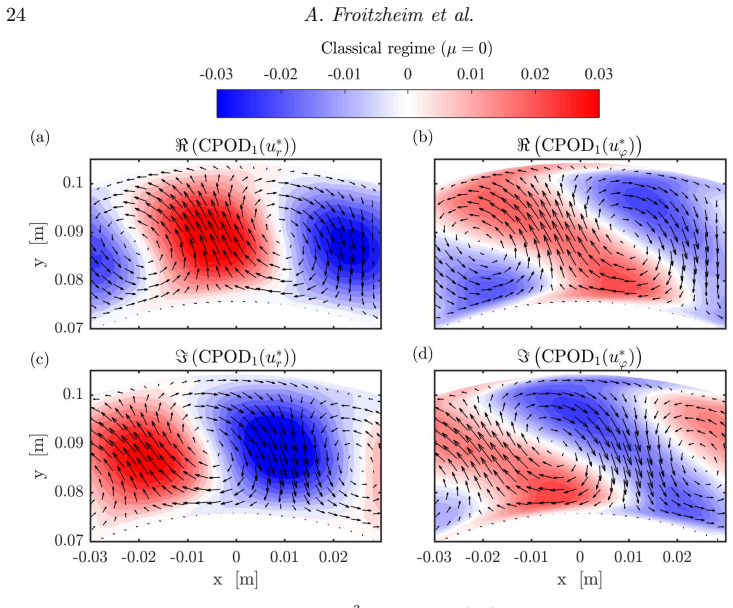
Two tools carry the argument. The first is the net convective angular-momentum flux, expressed as a quasi-Nusselt number $r^2\langle u'_r u'_\phi \rangle / J_{\rm lam}$, evaluated on cylindrical surfaces and at specific vortex positions; this localizes the transport. The second is complex proper orthogonal decomposition (CPOD), in which each velocity-fluctuation field is made complex with a Hilbert transform and then decomposed by singular value decomposition. In CPOD, a mode whose imaginary spatial pattern is azimuthally shifted from its real part represents a wave traveling around the cylinder; the time derivative of the mode's phase gives the wave frequency, and the azimuthal derivative of its spatial phase gives the wavenumber. The first CPOD mode is the one that shows a clean traveling-wave pattern, and the same mode's structure is compared with the known wavy Taylor vortex pattern. Azimuthal energy co-spectra serve as a third piece, identifying the plume scale and showing that the large-scale spectral peak vanishes when the rolls are absent.
What would settle it
A two-dimensional Fourier transform of the first-mode space-time field, with azimuth on one axis and time on the other, would settle the matter: one sharp ridge with frequency over wavenumber equal to the quoted phase speed confirms a single traveling wave, while multiple peaks or a broad smeared ridge would show that the complex-POD phase extraction averaged over several wave components.
Extended reading notes
Core claim
The central claim is that the organization of fully turbulent Taylor-Couette flow is set by large-scale Taylor rolls whose inflow and outflow bands are the main highways for angular momentum, and that these rolls are not axisymmetric: they carry azimuthally traveling waves. This is established for radius ratio 0.714 with pure inner-cylinder rotation in the classical regime and with counter-rotation at the torque maximum in the ultimate regime. The net convective Nusselt number, built from the correlated radial and azimuthal velocity fluctuations, peaks in the inflow and outflow; its local probability distribution has its most probable value at zero and exponential positive tails that grow with Reynolds number; and pre-multiplied azimuthal co-spectra place the underlying plumes at wavenumbers $k_\phi d \approx 10$ to $20$, strongest where the rolls pull fluid off the walls. The first complex-POD mode captures about 17 percent of the fluctuation energy in the classical case and about 12 percent in the ultimate case, shows real and imaginary parts azimuthally shifted by a quarter wavelength, and yields a wave frequency of 1.80 Hz in the classical regime and 3.67 Hz in the ultimate regime, an azimuthal wavenumber of about 9, and phase speeds of roughly $0.35\Delta\omega$ and $0.11\Delta\omega$. The similarity between these Nusselt-number distributions and those of heat flux in Rayleigh-Benard convection is presented as evidence that the same plume mechanism transports angular momentum in both flows.
Load-bearing premise
The traveling-wave result rests on the assumption that the strongest decomposition mode is a single coherent disturbance circling the cylinder; if that mode instead mixes several disturbances or contains a standing part, the quoted frequency, wavenumber, and speed are not well defined.
Editorial extensions
If this is right
- At torque-maximum rotation, global torque measurements alone understate the spatial concentration of transport: up to about 60 percent of the net convective flux occurs in the outflow band near the inner cylinder, so models of ultimate Taylor-Couette transport should treat the inflow and outflow bands as the controlling regions.
- Local Nusselt-number probability distributions peak at zero and develop exponential tails, implying that the time-averaged flux is carried by rare, strong plume events; statistical descriptions of the transport must reproduce this intermittency.
- Azimuthal traveling waves with wavenumber about 9 appear whenever Taylor rolls are present, in both the classical and ultimate regimes, and not when the rolls are absent, so the large-scale roll state is intrinsically three-dimensional rather than axisymmetric.
- Because the detected wave speeds are of the same order as the classical wavy Taylor vortex speeds, the wavy-vortex instability is a plausible continuation into the turbulent regime rather than an unrelated large-scale mode.
Reading between the lines
- If confirmed, the detected wave provides a candidate mechanism for setting the spanwise scale of large-scale superstructures in Taylor-Couette and related turbulent flows; checking whether the same $k_\phi \approx 9$ signature appears in direct numerical simulations at comparable parameters would test that idea.
- The wave was characterized only at the vortex center; a natural extension is to track the phase across several heights to test whether the wave is a rigidly traveling azimuthal modulation or a more complex three-dimensional pattern.
- Because the ultimate-regime phase speed is slower relative to the imposed shear, the wave may be a passive remnant of the roll structure rather than an active participant in the momentum transport; varying the rotation ratio at fixed shear Reynolds number while monitoring wave amplitude would separate roll strength from Reynolds-number effects.
Signed reviews
Editorial analysis
A structured set of objections, weighed in public.
Referee Report
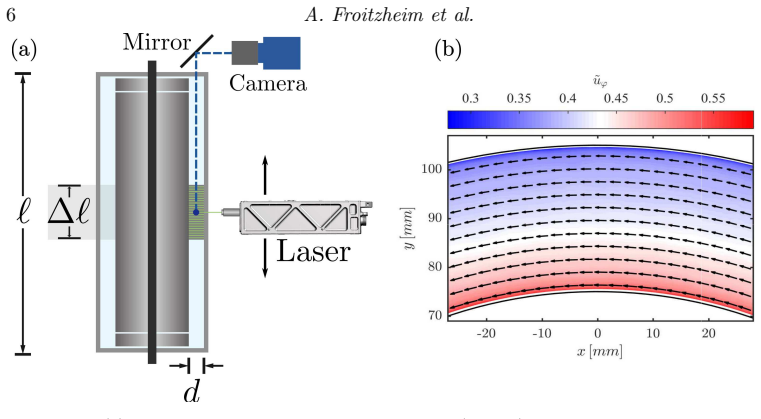
Summary. This experimental paper reports planar PIV measurements in horizontal planes of a Taylor-Couette facility with radius ratio η=0.714 and aspect ratio Γ=18.3, covering shear Reynolds numbers up to ReS=3.5×10^5 and rotation ratios µ=0 and µ=µmax. The authors validate their velocity statistics and torque results against literature data and DNS, then use the data to characterize the local angular momentum transport, the statistics of the net convective Nusselt number, azimuthal energy co-spectra, and large-scale flow organization. The two headline claims are that the local angular momentum transport is concentrated in the vortex inflow and outflow regions, and that a complex proper orthogonal decomposition reveals azimuthally traveling waves superimposed on turbulent Taylor vortices in both the classical and ultimate regimes, with wavenumber approximately 9 and phase speeds 0.35Δω and 0.11Δω, respectively. The paper also draws an analogy to Rayleigh-Bénard convection based on plume-like small-scale structures and exponential tails in the transport PDFs.
Significance. The transport-location claim is well supported: the meridional maps of the net convective Nusselt number, the joint PDFs of the radial and azimuthal velocity fluctuations, and the inflow/outflow contribution profiles form a coherent picture, and the global Nusselt numbers agree with independent torque measurements and DNS. The comparison of the PDFs to the product-of-Gaussians prediction is a reference normalization rather than a fitted model, so the statistics section is not circular. If the traveling-wave claim holds, the paper would provide experimental evidence of wavy-Taylor-vortex-like azimuthal waves in highly turbulent Taylor-Couette flow, a result of considerable interest to the rotating-turbulence and convection communities, and it would extend the TC-RB analogy. The main weakness is that the traveling-wave conclusion currently rests on the interpretation of a single CPOD mode that captures only 12–17% of the fluctuation energy, and the paper does not provide the mode diagnostics needed to exclude alternative interpretations.
major comments (3)
- [§7.2–7.3, Eqs. (7.5)–(7.6)] The traveling-wave claim, which is a headline result, is not yet fully established because the phase-based extraction of fw and k assumes that CPOD1 is a single quasi-monochromatic traveling wave. The paper reports only the averaged values fw=1.80 Hz, fw=3.67 Hz, and k≈9, but does not show that the temporal phase φ1(t) advances linearly in time, that the azimuthal phase profile Φ1(r=0.5,ϕ) is linear, or that the mode's azimuthal Fourier spectrum contains a single dominant wavenumber. This matters because CPOD1 captures only 17% (classical) and 12% (ultimate) of the fluctuation energy, and because §6.1 states that the limited azimuthal field of view prevents resolving the large-scale peak. I request that the authors add (i) the time trace of φ1(t) and its time derivative, (ii) the azimuthal profile of Φ1 at r≈0.5 and its derivative, (iii) the azimuthal wavenumber spectrum of CPOD1, and (iv) a statement of the angular extent of the PIV field of view. Without these diagnostics, the global wavenumber and phase speed are not well defined, and the result should be presented as a local traveling wave within the measured sector.
- [§4, Fig. 11] The quantitative statement that the vortex outflow contributes up to approximately 60% of the net convective transport in the inner gap region depends on the operational definition of the in- and outflow regions. The manuscript describes locating the in- and outflow by the extrema of the mean radial velocity profile and trimming the axial interval to one vortex pair by excluding the gray data points in Fig. 3e, but it does not specify how the axial bands assigned to the in- and outflow are chosen or how sensitive the resulting fractions are to that choice and to the number of heights included. Since this 60% figure is presented as a striking result, I ask the authors to provide a sensitivity test with respect to the band width and the axial averaging interval, or to soften the quantitative claim accordingly.
- [§7.3] The claim that azimuthally traveling waves are detected in the ultimate regime is currently based on a single flow state, case C4 at ReS=6.68×10^4 and µ=−0.36. The higher-Reynolds-number cases at µmax, namely C5 and C7, are not analyzed with the CPOD procedure, even though these are the cases for which the inflow/outflow transport asymmetry is strongest. To support the general statement 'in the ultimate regime,' the authors should either extend the CPOD analysis to the highest-Re µmax case or explicitly limit the claim to the specific Reynolds number studied in §7.3 and note this limitation in the abstract.
minor comments (8)
- [§7.1, Eq. (7.3)] The sentence 'the columns are assigned to the spatial grid points (1:M) and rows to the time signals (1:N)' contradicts the displayed matrix, where rows correspond to spatial points; please correct the dimension description.
- [References and §1] There are typographical errors in the references: 'Donelly' should be 'Donnelly' and 'Suanto et al.' appears to be a misspelling of 'Sutanto et al.'; also, the LaTeX control word 'greaterorequalslant' appears in the introduction and should be fixed.
- [§5, Fig. 12] The Gaussian-product prediction of Eq. (5.2) is evaluated using ρP from case C8 (ReS=3.51×10^5, µ=0); please state whether the shape comparison is robust to using another pure-inner-rotation case, since the predicted tail slope depends on ρP.
- [§6.1] The phrase 'the limited range of the azimuthal coordinate' is never quantified; please state the angular extent of the PIV field of view, because this directly affects the interpretation of the large-scale spectral peak and the CPOD results.
- [Figs. 18 and 21] The CPOD mode plots are shown without colorbars or quantitative scales; adding them would help the reader judge the mode amplitude and the relative strength of the radial and azimuthal components.
- [§7.3] The text states that the temporal power spectrum for the ultimate-regime case is 'not shown'; please include the spectrum or at least report the peak frequency and its width quantitatively in the text.
- [Table 2] The classical-regime phase speed is given as 0.35ω1 in the text and 0.35Δω in Table 2; the two expressions coincide for µ=0, but the notation should be unified to avoid confusion.
- [§8] The generalization from Taylor-Couette flow to pipe and channel flow is a speculation; please mark it as a hypothesis rather than a conclusion, or remove it from the summary.
Circularity Check
No significant circularity: the central claims are based on direct PIV measurements, standard complex-POD/SVD processing, and comparisons with external data, not on fitted parameters or self-referential definitions.
full rationale
The paper's two central claims are (i) local angular momentum transport is concentrated in Taylor-vortex in- and outflow regions where radial and azimuthal velocity fluctuations are strongly correlated, and (ii) azimuthally traveling waves are superimposed on turbulent Taylor vortices in both the classical and ultimate regimes. Neither claim reduces to an input by construction. The net convective Nusselt number is defined in Eq. (4.2) as Nu_c,net = r^2/J_lam <u'_φ u'_r>, so the statement that transport is largest where u'_r and u'_φ are highly correlated is an empirical result obtained from measured velocity fields, not a tautology. The in- and outflow contributions are computed from independently identified axial locations of the vortex, and the totals are benchmarked against torque measurements of Lewis & Swinney (1999) and DNS of Ostilla-Mónico et al. (2014c). The PDF analysis uses the Gaussian-product distribution of Eq. (5.2) as a reference shape for normalization; the paper deliberately uses one measured case (C8) as the reference rather than fitting a parameter to each dataset, and the comparison to the measured µ_max PDFs is a diagnostic, not a fit renamed as a prediction. The CPOD analysis in Sec. 7 follows the standard Hilbert-transform-plus-SVD procedure of Eqs. (7.1)-(7.6). The wave frequency f_w = ∂_t φ_1/(2π) and wavenumber k_φ,w = ∂_φ Φ_1 are extracted from the phase of the dominant mode after the decomposition; they are not imposed by the method, and the space-time diagrams and power spectra provide independent evidence of a propagating pattern. The comparison with wavy Taylor vortex flow uses external data from King et al. (1984) and Wang et al. (2005). Self-citations to Froitzheim et al. (2017), van der Veen et al. (2016a), and Harlander et al. (2011) concern the facility, the PIV configuration, and the CPOD algorithm provenance; they are not load-bearing for the physical conclusions. The skeptical concern that mode 1 may not be quasi-monochromatic is a robustness/interpretation issue, not a circularity: the reported wave parameters could be poorly defined if the mode is broadband, but the paper does not derive the wave's existence from the definition of the phase functions alone. No equation in the paper is equivalent to its own input by construction, and no fitted parameter is relabeled as a prediction. Score 0 is therefore appropriate.
Assumptions & free parameters
free parameters (1)
- PDF normalization reference case =
C8 (ReS=3.51e5, mu=0)
assumptions (4)
- standard math The discrete Fourier transform, Hilbert transform, and SVD used in the spectral and CPOD analyses are correctly applied to the Cartesian-to-polar interpolated velocity fields.
- domain assumption The flow is statistically stationary and homogeneous in the azimuthal direction, so temporal and azimuthal averages are representative.
- domain assumption The 23 measured heights with 4 mm spacing resolve the axial structure of the Taylor rolls and allow identification of vortex inflow, center, and outflow.
- ad hoc to paper The axial average is restricted to one vortex pair by excluding gray data points so that the interval starts and ends at a vortex center.
Cite this review
Pith. "Pith review of Statistics, plumes and azimuthally traveling waves in ultimate Taylor-Couette turbulent vortices." pith.science (2026). https://pith.science/paper/OBWWUA4O
@misc{pith2026190811796,
  author       = {Pith},
  title        = {Pith review of: Statistics, plumes and azimuthally traveling waves in ultimate Taylor-Couette turbulent vortices},
  year         = {2026},
  howpublished = {\url{https://pith.science/paper/OBWWUA4O}},
  note         = {Machine review of arXiv:1908.11796}
}
abstract
In this paper, we experimentally study the influence of large-scale Taylor rolls on the small-scale statistics and the flow organization in fully turbulent Taylor-Couette flow {for Reynolds numbers up to $\text{Re}_S=3\times 10^5$}. The velocity field in the gap confined by coaxial and independently rotating cylinders at a radius ratio of $\eta=0.714$ is measured using planar {particle image velocimetry} in horizontal planes at different cylinder heights. Flow regions with and without prominent Taylor vortices are compared. We show that the local angular momentum transport (expressed in terms of a Nusselt number) mainly takes place in the regions of the vortex in- and outflow, where the radial and azimuthal velocity components are highly correlated. The efficient momentum transfer is reflected in intermittent bursts, which becomes visible in the exponential tails of the probability density functions of the local Nusselt number. In addition, by calculating azimuthal energy co-spectra, small-scale plumes are revealed to be the underlying structure of these bursts. These flow features are very similar to the one observed in Rayleigh-B\'{e}nard convection, which emphasizes the analogies of these both systems. By performing a {complex proper orthogonal decomposition}, we remarkably detect azimuthally traveling waves superimposed on the turbulent Taylor vortices, not only in the classical but also in the ultimate regime. This very large-scale flow pattern{,} which is most pronounced at the axial location of the vortex center, is similar to the well-known wavy Taylor vortex flow{,} which has comparable wave speeds, but much larger azimuthal wave numbers.
Figures


Figures from the paper (18 more)




Reference graph
Works this paper leans on
-
[1]
, " * write output.state after.block = add.period write newline
ENTRY address author booktitle chapter edition editor howpublished institution journal key month note number organization pages publisher school series title type volume year eprint label extra.label sort.label short.list INTEGERS output.state before.all mid.sentence after.sentence after.block FUNCTION init.state.consts #0 'before.all := #1 'mid.sentence ...
-
[2]
write newline
" write newline "" before.all 'output.state := FUNCTION n.dashify 't := "" t empty not t #1 #1 substring "-" = t #1 #2 substring "--" = not "--" * t #2 global.max substring 't := t #1 #1 substring "-" = "-" * t #2 global.max substring 't := while if t #1 #1 substring * t #2 global.max substring 't := if while FUNCTION word.in bbl.in capitalize " " * FUNCT...
-
[3]
Andereck, C. D. , Liu, S. S. & Swinney, H. L. 1986 Flow regimes in a circular C ouette system with independently rotating cylinders. J. Fluid Mech. 164 , 155--83
work page 1986
-
[4]
Berkooz, G. , Holmes, P. & Lumley, J.L. 1993 The P roper O rthogonal D ecomposition in the A nalysis of T urbulent F lows. Annu. Rev. Fluid Mech. 25 , 539--75
work page 1993
-
[5]
, Salewski, Matthew & Eckhardt, B
Brauckmann, H.J. , Salewski, Matthew & Eckhardt, B. 2016 a\/ M omentum transport in T aylor- C ouette flow with vanishing curvature. J. Fluid Mech. 790 , 419--452
work page 2016
-
[6]
Brauckmann, H. J. & Eckhardt, B. 2013b Intermittent boundary layers and torque maxima in T aylor- C ouette flow. Phys.\ Rev.\ E 87 , 033004
-
[7]
Brauckmann, H. J. , Eckhardt, B. & Schumacher, J. 2016 b\/ Heat transport in R ayleigh- B \' e nard convection and angular momentum transport in T aylor- C ouette flow: a comparative study. Phil. Trans. R. Soc. A 375 , 20160079
work page 2016
-
[8]
Castaing, B. , Gunaratne, G. , Heslot, F. , Kadanoff, L. , Libchaber, A. , Thomae, S. , Wu, X. Z. , Zaleski, S. & Zanetti, G. 1989 Scaling of hard thermal turbulence in Rayleigh-B \'e nard convection . J. Fluid Mech. 204 , 1--30
work page 1989
Show all 63 references
-
[9]
Chu, C. R. , Parlange, M. B. , Katul, G. G. & Albertson, J. D. 1996 Probability density functions of turbulent velocity and temperature in the atmospheric surface layer. Water Resour. Res. 32 , 1681--1688
1996
-
[10]
1965 Transition in circular C ouette flow
Coles, D. 1965 Transition in circular C ouette flow. J. Fluid Mech. 21 , 385--425
1965
-
[11]
2007 Direct numerical simulation of turbulent T aylor- C ouette flow
Dong, S. 2007 Direct numerical simulation of turbulent T aylor- C ouette flow. J. Fluid Mech. 587 , 373--93
2007
-
[12]
Donnelly, R. J. 1991 Taylor- C ouette flow: the early days. Phys. Today. 44 , 32--39
1991
-
[13]
, Dauchot, O
Dubrulle, B. , Dauchot, O. , Daviaud, F. , Longaretti, P.-Y. , Richard, D. & Zahn, J.-P. 2005 S tability and turbulent transport in T aylor- C ouette flow from analysis of experimental data. Phys.\ Fluids 17 , 095103
2005
-
[14]
, Grossmann, S
Eckhardt, B. , Grossmann, S. & Lohse, D. 2007a Torque scaling in turbulent Taylor-Couette flow between independently rotating cylinders. Europhys. Lett. 78(2) , 24001
-
[15]
, Grossmann, S
Eckhardt, B. , Grossmann, S. & Lohse, D. 2007b Fluxes and energy dissipation in thermal convection and shear flows. J. Fluid Mech. 581 , 221--250
-
[16]
Emran, M. S. & Schumacher, J. 2008 Fine-scale statistics of temperature and its derivatives in convective turbulence. J. Fluid Mech. 611 , 13--34
2008
-
[17]
, Huisman, S
Ezeta, R. , Huisman, S. G. , Sun, C. & Lohse, D. 2017 Turbulence strength in ultimate T aylor- C ouette turbulence. J. Fluid Mech. 836 , 397--412
2017
-
[18]
Fardin, M. A. , Perge, C. & Taberlet, N. 2014 The hydrogen atom of fluid dynamics - introduction to the T aylor- C ouette flow for soft matter scientists . Soft Matt. 10 , 3523--3535
2014
-
[19]
, Merbold, S
Froitzheim, A. , Merbold, S. & Egbers, C. 2017 Velocity profiles, flow structures and scalings in a wide-gap turbulent T aylor- C ouette flow. J. Fluid Mech. 831 , 330--357
2017
-
[20]
, Huisman, S.G
van Gils, D.P.M. , Huisman, S.G. , Bruggert, G.-W. , Sun, C. & Lohse, D. 2011 Torque scaling in turbulent T aylor- C ouette flow with co- and counterrotating cylinders. Phys. Rev. Lett. 106 , 024502
2011
-
[21]
, Huisman, S.G
van Gils, D.P.M. , Huisman, S.G. , Grossmann, S. , Sun, C. & Lohse, D. 2012 Optimal T aylor- C ouette turbulence. J. Fluid. Mech. 706 , 118--149
2012
-
[22]
, Lohse, D
Grossmann, S. , Lohse, D. & Sun, C. 2016 High- R eynolds number T aylor- C ouette turbulence. Annu. Rev. Fluid Mech. 48 , 53--80
2016
-
[23]
, von Larcher, T
Harlander, U. , von Larcher, T. , Wang, Y. & Egbers, C. 2011 Piv- and ldv- measurements of baroclinic wave interactions in a thermally driven rotating annulus. Exp. Fluids 51 , 37--49
2011
-
[24]
& Katz, J
van Hout, R. & Katz, J. 2011 Measurements of mean flow and turbulence characteristics in high- R eynolds number counter-rotating T aylor- C ouette flow. Phys. Fluids 23 , 105102
2011
-
[25]
Huisman, S. G. , van Gils, D. P. M. , Grossmann, S. , Sun, C. & Lohse, D. 2012 Ultimate turbulent T aylor- C ouette turbulence . Phys. Rev. Lett. 108 , 024501
2012
-
[26]
Huisman, S. G. , Lohse, D. & Sun, C. 2013 a\/ Statistics of turbulent fluctuations in counter-rotating T aylor- C ouette flows. Phys. Rev. E 88 , 063001
2013
-
[27]
Huisman, S. G. , Scharnowski, S. , Cierpka, C. , K \"a hler, C. , Lohse, D. & Sun, C. 2013 b\/ Logarithmic boundary layers in strong Taylor-Couette turbulence . Phys. Rev. Lett. 110 , 264501
2013
-
[28]
Huisman, S. G. , van der Veen, R. C. A. , Bruggert, G.-W. , Lohse, D. & Sun, C. 2015 The boiling T wente T aylor- C ouette ( BTTC ) facility: Temperature controlled turbulent flow between independently rotating, coaxial cylinders . Rev. Sci. Instrum. 86 , 065108
2015
-
[29]
Huisman, S. G. , van der Veen, R. C. A. , Sun, C. & Lohse, D. 2014 Multiple states in highly turbulent Taylor-Couette flow . Nat. Commun. 5 , 3820
2014
-
[30]
2012 Cascades in wall-bounded turbulence
Jimenez, J. 2012 Cascades in wall-bounded turbulence . Ann. Rev. Fluid. Mech. 44 , 27--45
2012
-
[31]
King, G.P. , Li, Y. , Lee, W. & Swinney, H.L. 1984 Wave speeds in wavy T aylor-vortex flow. J. Fluid. Mech. 141 , 365--390
1984
-
[32]
Lathrop, D. P. , Fineberg, J. & Swinney, H. S. 1992 Transition to shear-driven turbulence in C ouette- T aylor flow. Phys.\ Rev.\ A 46 , 6390--405
1992
-
[33]
Lewis, G. S. & Swinney, H. L. 1999 Velocity structure functions, scaling and transitions in high- R eynolds-number C ouette- T aylor flow. Phys.\ Rev.\ E 59 , 5457--67
1999
-
[34]
Marple, S. L. 1999 Computing the discrete-time analytic signal via fft. IEEE Trans. Sig. Proc. 47(9) , 2600--2603
1999
-
[35]
, Peixinho, J
Mart\' i nez-Arias, B. , Peixinho, J. , Crumeyrolle, O. & Mutabazi, I. 2014 Effect of the number of vortices on the torque scaling in T aylor- C ouette flow. J. Fluid Mech. 748 , 756--767
2014
-
[36]
2019 Attached eddy model of wall turbulence
Marusic, Ivan & Monty, Jason P. 2019 Attached eddy model of wall turbulence . Annual Review of Fluid Mechanics 51 (1), null
2019
-
[37]
, Brauckmann, H
Merbold, S. , Brauckmann, H. J. & Egbers, C. 2013 Torque measurements and numerical determination in differentially rotating wide gap T aylor- C ouette flow. Phys.\ Rev.\ E 87 , 023014
2013
-
[38]
u r Str\
Merbold, S. , Froitzheim, A. & Egbers, Ch. 2014 Flow pattern and angular motion transport in a wide gap T aylor- C ouette flow. In Schriftenreihe aus dem Institut f\" u r Str\" o mungsmechanik.\/ , Str\" o mungstechnische Tagung\/ 10. Dresden
2014
-
[39]
, Stevens, R
Ostilla, R. , Stevens, R. J. A. M. , Grossmann, S. , Verzicco, R. & Lohse, D. 2013 Optimal T aylor- C ouette flow: direct numerical simulations. J. Fluid Mech. 719 , 14--46
2013
-
[40]
, Huisman, S
Ostilla-M\' o nico, R. , Huisman, S. G. , Janninik, T. J. G. , van Gils, D. P. M. , Verzicco, R. , Grossmann, S. & Lohse, D. 2014 a\/ Optimal T aylor- C ouette flow: radius ratio dependence. J. Fluid Mech. 747 , 1--29
2014
-
[41]
, van der Poel, E
Ostilla-M\' o nico, R. , van der Poel, E. P. , Verzicco, R. , Grossmann, S. & Lohse, D. 2014 b\/ Boundary layer dynamics at the transition between the classical and ultimate regime of T aylor- C ouette flow. Phys. Fluids 26 , 015114
2014
-
[42]
, van der Poel, E
Ostilla-M\' o nico, R. , van der Poel, E. P. , Verzicco, R. , Grossmann, S. & Lohse, D. 2014 c\/ Exploring the phase diagram of fully turbulent T aylor- C ouette flow. J. Fluid Mech. 761 , 1--26
2014
-
[43]
, Verzicco, R
Ostilla-M\' o nico, R. , Verzicco, R. , Grossmann, S. & Lohse, D. 2016 The near-wall region of highly turbulent Taylor-Couette flow. J. Fluid Mech. 788 , 95--117
2016
-
[44]
, Scheel, J
Pandey, A. , Scheel, J. D. & Schumacher, J. 2018 Turbulent superstructures in R ayleigh- B \' e nard convection. Nat. Commun. 9 , 2118
2018
-
[45]
Paoletti, M. S. & Lathrop, D. P. 2011 Angular momentum transport in turbulent flow between independently rotating cylinders. Phys.\ Rev.\ Lett. 106 , 024501
2011
-
[46]
Pfeffer, R. L. , Ahlquist, J. , Kung, R. , Chang, Y. & Li, G. 1990 A study of baroclinic wave behaviour over bottom topography using complex principal component analysis of experimental data. Atmos. Sci. 47 , 67--81
1990
-
[47]
, Ching, E
Procaccia, I. , Ching, E. S. C. , Constantin, P. , Kadanoff, L. P. , Libchaber, A. & Wu, X. Z. 1991 Transition to convective turbulence: The role of thermal plumes . Phys. Rev. A 44 , 8091--8102
1991
-
[48]
, Qiu, X.-L
Shang, X.-D. , Qiu, X.-L. , Tong, P. & Xia, K.-Q. 2004 Measurements of the local convective heat flux in turbulent R ayleigh- B \' e nard convection. Phys. Rev. 70 , 026308
2004
-
[49]
& Wagner, C
Shishkina, O. & Wagner, C. 2007 Local heat fluxes in turbulent R ayleigh- B \' e nard convection. Phys. Fluids 19 , 085107
2007
-
[50]
, McKeon, Beverley J
Smits, Alexander J. , McKeon, Beverley J. & Marusic, Ivan 2011 High-Reynolds number wall turbulence . Annu. Rev. Fluid Mech. 43 , 353--375
2011
-
[51]
Stevens, Richard J. A. M. , Blass, Alexander , Zhu, Xiaojue , Verzicco, Roberto & Lohse, Detlef 2018 Turbulent thermal superstructures in R ayleigh- B \'enard convection . Phys. Rev. Fluids 3 , 041501
2018
-
[52]
, Zheng, Q
Suanto, R.D. , Zheng, Q. & Yan, X.-H. 1998 Complex singular value decomposition analysis of equatorial waves in the pacific observed by topex/poseidon altimeter. J. Atmos. Oceanic Technol. 15 , 764--774
1998
-
[53]
, Brunton, S
Taira, K. , Brunton, S. L. , Dawson, S. T. M. , Rowley, C. W. , Colonius, T. , McKeon, B. J. , Schmidt, O. T. , Gordeyev, S. , Theofilis, V. & Ukeiley, L. S. 2017 Modal A nalysis of F luid F lows: A n O verview. AIAA 55(12) , 4013--4041
2017
-
[54]
1999 Quasi-periodic state and transition to turbulence in a rotating C ouette system
Takeda, Y. 1999 Quasi-periodic state and transition to turbulence in a rotating C ouette system. J. Fluid. Mech. 389 , 81--99
1999
-
[55]
1923 Stability of a viscous liquid contained between two rotating cylinders
Taylor, G.I. 1923 Stability of a viscous liquid contained between two rotating cylinders . Phil. Trans. Roy. Soc. London 223 , 289--343
1923
-
[56]
Thoroddsen, S. T. & van Atta, C. W. 1992 Exponential tails and skewness of density-gradient probability density functions in stably stratified turbulence . J. Fluid Mech. 244 , 547--566
1992
-
[57]
, Elsinga, G.E
Tokgoz, S. , Elsinga, G.E. , Delfos, R. & Westerweel, J. 2011 Experimental investigation of torque scaling and coherent structures in turbulent T aylor- C ouette flow. J. Phys.: Conf. Ser. 318 , 082018
2011
-
[58]
van der Veen, R. C. A. , Huisman, S. G. , Dung, O.-Y. , Tang, H. L. , Sun, C. & Lohse, D. 2016 a\/ Exploring the phase space of multiple states in highly turbulent Taylor-Couette flow . Phys. Rev. Fluids 1 , 024401
2016
-
[59]
van der Veen, R. C. A. , Huisman, S. G. , Merbold, S. , Harlander, U. , Egbers, C. , Lohse, D. & Sun, C. 2016 b\/ Taylor- C ouette turbulence at radius ratio 0.5: scaling, flow structures and plumes. J. Fluid Mech. 799 , 334--351
2016
-
[60]
Walden, R. W. & Donelly, R. J. 1979 Reemergent order of chaotic circular C ouette flow . Phys. Rev. Lett. 42 , 301--304
1979
-
[61]
, Olsen, M
Wang, L. , Olsen, M. G. , Dennis, R. & Vigil, R. D. 2005 Reappearance of azimuthal waves in turbulent T aylor- C ouette flow at large aspect ratio. Chem. Eng. Sci. 60 , 5555--5568
2005
-
[62]
1933 Turbulente str \"o mungen zwischen zwei rotierenden konaxialen Z ylindern
Wendt, F. 1933 Turbulente str \"o mungen zwischen zwei rotierenden konaxialen Z ylindern . Ingenieur-Archiv 4 , 577--595
1933
-
[63]
1989 Probability distributions in high- R ayleigh number B \' e nard convection
Yakhot, V. 1989 Probability distributions in high- R ayleigh number B \' e nard convection . Phys. Rev. Lett. 63 , 1965--1967
1989
Reviewed August 14, 2026 · model on record in the stance chip above.
Discussion (0). Continue with ORCID to comment.