Critical curve of loop percolation on the d-regular tree
Pith reviewed 2026-06-29 00:54 UTC · model grok-4.3
The pith
Loop percolation on the d-regular tree has an infinite cluster exactly when the loop intensity exceeds an implicit critical value depending on the killing parameter.
A machine-rendered reading of the paper's core claim, the machinery that carries it, and where it could break.
Core claim
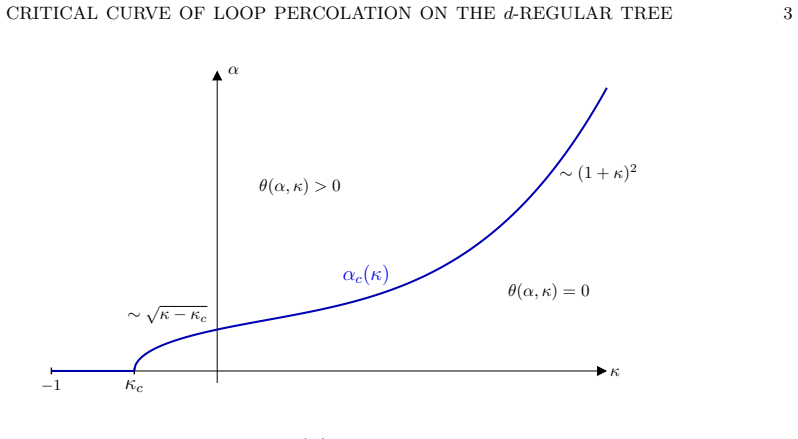
We obtain an implicit formula for the critical curve κ↦α_c(κ) for the percolation phase transition; the curve is positive if and only if κ>κ_c=2√(d-1)/d−1, differentiable away from κ_c, and has order √(κ−κ_c) as κ↓κ_c and order (1+κ)^2 as κ→∞. We show that for each κ>−1, an infinite cluster exists exactly when α>α_c(κ). Finally, we identify the near-critical behavior of the susceptibility and the percolation probability: for κ>κ_c, the critical exponents take the mean-field values, while for κ=κ_c, the phase transition is of a higher order with the percolation probability decaying quadratically in α−α_c.
What carries the argument
the survival probability of the branching-process recursion obtained from the Poisson loop ensemble together with the killing measure on the tree
If this is right
- For every κ > -1 an infinite cluster exists precisely when α exceeds α_c(κ).
- When κ exceeds the threshold the critical exponents are the standard mean-field values.
- Exactly at the threshold killing value the transition becomes higher-order, with percolation probability decaying quadratically above criticality.
- The critical curve remains positive only for κ larger than 2√(d-1)/d - 1 and is differentiable except at that point.
Where Pith is reading between the lines
- The same recursive structure may yield analogous implicit curves when the underlying graph is replaced by other regular or hyperbolic trees.
- Numerical solution of the implicit equation would allow explicit plots of the phase boundary for any fixed degree d.
- The change from mean-field to higher-order behavior at the threshold suggests a point where long loops begin to dominate the connectivity.
Load-bearing premise
The percolation transition is completely characterized by the survival probability of a branching-process recursion derived from the Poisson loop ensemble and the killing measure on the tree.
What would settle it
Monte Carlo sampling of the Poisson loop ensemble on large finite d-regular trees that shows the appearance or absence of macroscopic clusters at an intensity differing from the numerical solution of the implicit equation for α_c(κ).
Figures
read the original abstract
We consider clusters formed by a Poisson ensemble of random walk loops on the $d$-regular tree with an intensity parameter $\alpha>0$ and a killing parameter $\kappa>-1$; the latter penalizes ($\kappa > 0$) or favors ($\kappa <0$) the appearance of large loops. We obtain an implicit formula for the critical curve $\kappa\mapsto \alpha_c(\kappa)$ for the percolation phase transition; the curve is positive if and only if $\kappa>\kappa_c = \frac{2\sqrt{d-1}}{d}-1$, differentiable away from $\kappa_c$, and has order $\sqrt{\kappa-\kappa_c}$ as $\kappa\downarrow\kappa_c$ and order $(1+\kappa)^2$ as $\kappa\to\infty$. We show that for each $\kappa>-1$, an infinite cluster exists exactly when $\alpha>\alpha_c(\kappa)$. Finally, we identify the near-critical behavior of the susceptibility and the percolation probability: for $\kappa>\kappa_c$, the critical exponents take the mean-field values, while for $\kappa=\kappa_c$, the phase transition is of a higher order with the percolation probability decaying quadratically in $\alpha-\alpha_c$.
Editorial analysis
A structured set of objections, weighed in public.
Referee Report
Summary. The manuscript analyzes percolation in a Poisson ensemble of random walk loops on the d-regular tree, with intensity parameter α > 0 and killing parameter κ > -1. It derives an implicit formula for the critical curve κ ↦ α_c(κ), proves that an infinite cluster exists if and only if α > α_c(κ), establishes that α_c(κ) > 0 precisely when κ > κ_c = 2√(d-1)/d − 1 with differentiability away from κ_c and the stated square-root and quadratic asymptotics, and identifies mean-field critical exponents for κ > κ_c together with a higher-order transition (quadratic decay of the percolation probability) at κ = κ_c.
Significance. If the reduction to the branching-process recursion holds, the work supplies a precise, parameter-explicit characterization of the percolation transition for loop percolation on trees under a tunable killing measure. The explicit critical curve, its regularity and asymptotics, and the exponent analysis constitute a concrete advance in the study of loop soups and percolation on non-amenable graphs, with the tree structure allowing a fully rigorous branching-process treatment.
minor comments (1)
- [Introduction] The implicit equation defining α_c(κ) is referenced repeatedly but never displayed with an equation number in the provided abstract or summary; numbering it in the introduction or §2 would facilitate cross-references to the subsequent analysis of its properties.
Simulated Author's Rebuttal
We thank the referee for their careful reading of the manuscript and for the positive assessment and recommendation to accept. The summary accurately captures the main results on the implicit formula for the critical curve, the phase transition, regularity and asymptotics, and the critical exponents.
Circularity Check
No significant circularity; derivation self-contained
full rationale
The paper starts from the Poisson loop ensemble with killing on the d-regular tree and reduces the percolation transition to the survival probability of an explicitly derived branching-process recursion. The implicit formula for α_c(κ), its positivity threshold at κ_c, differentiability, and near-critical asymptotics are obtained by direct fixed-point analysis of that recursion. No fitted parameters are renamed as predictions, no self-citations are load-bearing for the central claim, and the tree geometry ensures the recursion captures all connectivity without external inputs. The derivation is therefore internally consistent with the model definition.
Axiom & Free-Parameter Ledger
axioms (2)
- standard math The loop ensemble is a Poisson point process with intensity measure given by the killed random-walk loop measure
- domain assumption Cluster connectivity on the tree is captured by a branching-process recursion whose extinction probability yields the critical curve
Reference graph
Works this paper leans on
-
[1]
Chang, Yinshan and Sapozhnikov, Artem , TITLE =. Probab. Theory Related Fields , FJOURNAL =. 2016 , NUMBER =. doi:10.1007/s00440-015-0624-x , URL =
-
[2]
Le Jan, Yves , TITLE =. 2011 , PAGES =. doi:10.1007/978-3-642-21216-1 , URL =
-
[3]
Le Jan, Yves , TITLE =. C. R. Math. Acad. Sci. Paris , FJOURNAL =. 2012 , NUMBER =. doi:10.1016/j.crma.2012.07.008 , URL =
-
[4]
Illinois J
Le Jan, Yves and Lemaire, Sophie , TITLE =. Illinois J. Math. , FJOURNAL =. 2013 , NUMBER =
2013
-
[5]
Flajolet, Philippe and Sedgewick, Robert , TITLE =. 2009 , PAGES =. doi:10.1017/CBO9780511801655 , URL =
-
[6]
Lyons, Russell and Peres, Yuval , TITLE =. 2016 , PAGES =. doi:10.1017/9781316672815 , URL =
-
[7]
Grimmett, Geoffrey , TITLE =. 1999 , PAGES =. doi:10.1007/978-3-662-03981-6 , URL =
-
[8]
Daley, D. J. and Vere-Jones, D. , TITLE =. 2008 , PAGES =. doi:10.1007/978-0-387-49835-5 , URL =
-
[9]
Woess, Wolfgang , TITLE =. 2000 , PAGES =. doi:10.1017/CBO9780511470967 , URL =
-
[10]
and Werner, Wendelin , TITLE =
Lawler, Gregory F. and Werner, Wendelin , TITLE =. Probab. Theory Related Fields , FJOURNAL =. 2004 , NUMBER =. doi:10.1007/s00440-003-0319-6 , URL =
-
[11]
Lawler, Gregory F. and Trujillo Ferreras, Jos\'e. Random walk loop soup , JOURNAL =. 2007 , NUMBER =. doi:10.1090/S0002-9947-06-03916-X , URL =
-
[12]
Sheffield, Scott and Werner, Wendelin , TITLE =. Ann. of Math. (2) , FJOURNAL =. 2012 , NUMBER =. doi:10.4007/annals.2012.176.3.8 , URL =
-
[13]
Sznitman, Alain-Sol , TITLE =. 2012 , PAGES =. doi:10.4171/109 , URL =
work page doi:10.4171/109 2012
-
[14]
Lupu, Titus , TITLE =. Ann. Probab. , FJOURNAL =. 2016 , NUMBER =. doi:10.1214/15-AOP1019 , URL =
-
[15]
Lupu, Titus , TITLE =. J. Eur. Math. Soc. (JEMS) , FJOURNAL =. 2019 , NUMBER =. doi:10.4171/JEMS/859 , URL =
-
[16]
Le Jan, Yves , TITLE =. 2024 , PAGES =. doi:10.1007/978-3-031-57923-3 , URL =
-
[17]
Chang, Yinshan , TITLE =. Stochastic Process. Appl. , FJOURNAL =. 2017 , NUMBER =. doi:10.1016/j.spa.2017.02.003 , URL =
-
[18]
Vogel, Quirin , TITLE =. Int. Math. Res. Not. IMRN , FJOURNAL =. 2026 , NUMBER =. doi:10.1093/imrn/rnag084 , URL =
-
[19]
Alves, Caio and Sapozhnikov, Artem , TITLE =. Electron. J. Probab. , FJOURNAL =. 2019 , PAGES =. doi:10.1214/19-ejp360 , URL =
-
[20]
Lupu, Titus , TITLE =. Electron. Commun. Probab. , FJOURNAL =. 2016 , PAGES =. doi:10.1214/16-ECP4571 , URL =
-
[21]
Statistical inference and simulation for spatial point processes , SERIES =
M. Statistical inference and simulation for spatial point processes , SERIES =. 2004 , PAGES =
2004
-
[22]
Lyons, Russell , TITLE =. Ann. Probab. , FJOURNAL =. 1992 , NUMBER =
1992
-
[23]
Werner, Wendelin , TITLE =. In and out of equilibrium 3. 2021 , ISBN =. doi:10.1007/978-3-030-60754-8\_33 , URL =
-
[24]
Drewitz, Alexander and Pr\'evost, Alexis and Rodriguez, Pierre-Fran cois , TITLE =. Invent. Math. , FJOURNAL =. 2023 , NUMBER =. doi:10.1007/s00222-022-01168-z , URL =
-
[25]
Cai, Zhenhao and Ding, Jian , TITLE =. Probab. Theory Related Fields , FJOURNAL =. 2025 , NUMBER =. doi:10.1007/s00440-024-01295-z , URL =
-
[26]
Chang, Yinshan and Du, Hang and Li, Xinyi , TITLE =. Bernoulli , FJOURNAL =. 2024 , NUMBER =. doi:10.3150/23-bej1716 , URL =
-
[27]
Local Quantum Theory , editor =
Symanzik, Kurt , title =. Local Quantum Theory , editor =
-
[28]
2023 , eprint =
Jego, Antoine and Lupu, Titus and Qian, Wei , title =. 2023 , eprint =
2023
-
[29]
Critical one-arm probability for the metric
Drewitz, Alexander and Pr. Critical one-arm probability for the metric. Probab. Theory Related Fields , year =. doi:10.1007/s00440-025-01392-7 , url =
-
[30]
2024 , eprint =
Cai, Zhenhao and Ding, Jian , title =. 2024 , eprint =
2024
-
[31]
2026 , eprint =
Jego, Antoine and Lupu, Titus , title =. 2026 , eprint =
2026
discussion (0)
Sign in with ORCID, Apple, or X to comment. Anyone can read and Pith papers without signing in.