REVIEW 5 major objections 6 minor 53 references
Time-integrated polarizations in GRB prompt phase via the Multi-window interpretation
T0 review · 5 major / 6 minor · reviewed 2026-08-12 · deepseek-v4-flash
Pith's one-line read The paper claims that synchrotron radiation in ordered large-scale magnetic fields can account for the time-integrated polarization of 22 of 23 gamma-ray bursts once the model parameters are inferred from simultaneous multi-window fits.
desk verdict This paper gives useful per-burst polarization predictions from 23-burst multi-window fits, but the central claim rests on hand-tuned parameters and weak upper-limit comparisons. read the letter →
The pith
A machine-rendered reading of the paper's core claim, the machinery that carries it, and where it could break.
The reading
What carries the argument
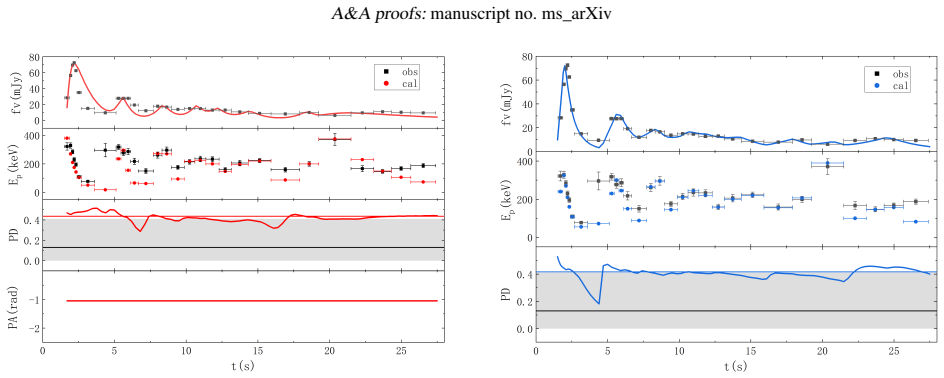
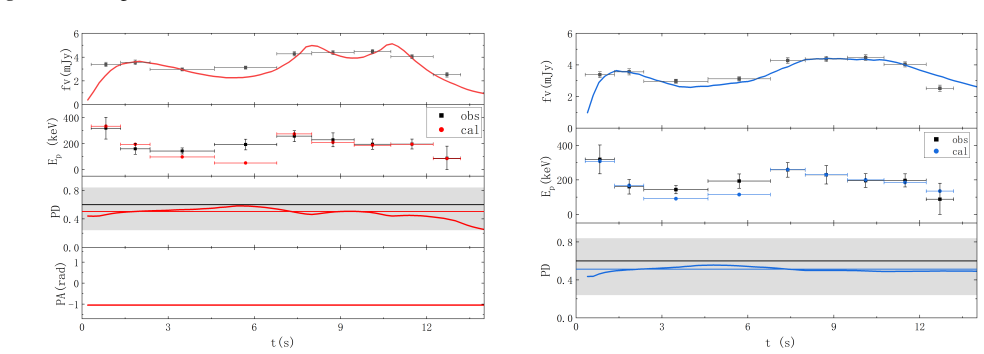
The machinery is a multi-shell synchrotron model with equal-arrival-time-surface (EATS) integration, meaning that each shell's emission is collected along the locus of points whose photons reach the observer at the same time. Each shell expands with bulk Lorentz factor $\Gamma(r)=\Gamma_0(r/r_0)^s$, with $s=1/3$ for aligned fields and $s=0$ for toroidal fields, in a magnetic field decaying as $B'(r)=B_0'(r/r_0)^{-1}$, and the electron Lorentz factor follows a radius-dependent power law that produces either hard-to-soft or intensity-tracking $E_p$ evolution. The predicted time-integrated polarization is $\mathrm{PD}_{cal,a}=\sqrt{\bar{Q}^2+\bar{U}^2}/\bar{F}$ for aligned fields and $\mathrm{PD}_{cal,t}=\bar{Q}/\bar{F}$ for toroidal fields, where the barred Stokes parameters are averaged over the $T_{90}$ interval and the detector energy band. The key mechanism is cancellation: when polarization angles rotate across shells or time bins, the Stokes $Q$ and $U$ contributions partially cancel and lower the integrated PD, and the aligned-field case encodes this with different field orientations $\delta$ in adjacent shells.
What would settle it
Re-fit one burst, for example GRB 170206A, with a Markov Chain Monte Carlo over the Table A.1 parameter ranges and compute the range of predicted time-integrated PD values. If the spread of that range approaches the roughly 5-percentage-point gap between the aligned- and toroidal-field predictions, then the claim that the predicted PDs are stable is falsified, because the quoted values would be just one point in a wide family.
Extended reading notes
Core claim
The central claim is that ordered large-scale magnetic fields, not tangled or random fields, are the rule in GRB prompt emission regions. Using a multi-shell synchrotron model whose parameters are inferred from the simultaneous fit of four observational windows, the paper predicts time-integrated polarization degrees of about 44% for aligned fields and 49% for toroidal fields. These agree with observed values within 1σ for 22 of 23 bursts; GRB 110721A is the only burst whose measured lower limit exceeds the model's upper limit. The three bursts with abrupt 90-degree polarization-angle rotations are reproduced only by the aligned-field case with different field orientations in adjacent shells, which the authors read as favoring magnetar central engines. The remaining special case, GRB 170206A, is interpreted as evidence for mixed magnetic fields.
Load-bearing premise
The load-bearing premise is that the many per-shell parameters, adjusted so the model reproduces each burst's light curve, spectral peak curve, and polarization curves, are tightly enough determined that the predicted time-integrated polarization is a real prediction; if the parameter degeneracy is wide, the quoted 44% and 49% values could be artifacts of the tuning.
Editorial extensions
If this is right
- If the claim is right, ordered large-scale magnetic fields dominate the prompt emission region of most GRBs, and low time-integrated PDs do not by themselves imply random fields.
- The three bursts with abrupt 90° PA rotations single out the aligned-field geometry, and if those measurements hold, those bursts likely have magnetar central engines.
- GRB 170206A is the one burst where the data require mixed fields, i.e., a combination of ordered and random magnetic components.
- Because the predicted average PDs differ by only about 5 percentage points between the two field geometries, time-integrated PD alone cannot distinguish them; time-resolved PA behavior is the discriminating observable.
- GRB 110721A is the single 1σ rejection of ordered-field synchrotron, so a higher-confidence polarization measurement of that burst would directly test the model.
Reading between the lines
- An implication the paper leaves implicit: bursts without resolved PA rotations should show systematically higher time-integrated PDs than the POLAR average of about 22%, so future detectors with smaller error bars can decide whether the low POLAR values are measurement limitations or genuine field disorder.
- The same fitting procedure could be calibrated on simulated bursts with known field geometry; no such calibration is reported, and it would quantify how much of the quoted 44% and 49% averages is driven by the parameter choice.
- If the aligned-field interpretation for the three PA-rotation bursts is correct, those bursts should also show other magnetar signatures, such as X-ray plateaus in their afterglows; checking that correlation is a direct astronomical test.
Signed reviews
Editorial analysis
A structured set of objections, weighed in public.
Referee Report
Summary. The paper presents a multi-window phenomenological modeling of 23 Fermi/GBM-detected GRBs that also have polarization measurements from GAP, POLAR, or AstroSat. Under a synchrotron radiation model with multiple emitting shells and either globally aligned or toroidal ordered magnetic fields, the authors tune per-shell parameters to reproduce observed light curves, E_p evolutions, and, where available, time-resolved polarization degree (PD) and polarization angle (PA) curves. They then compute time- and energy-integrated PDs (PDcal,a and PDcal,t) and compare them with observed time-integrated values. The main claim is that ordered-field synchrotron models can interpret the polarization data of 22 of the 23 bursts within 1σ, with the exception of GRB 170206A requiring mixed fields, and that the three bursts with abrupt 90° PA rotations favor aligned fields over toroidal fields.
Significance. If the predicted time-integrated PD values were robust, the paper would provide a substantial argument that large-scale ordered magnetic fields dominate GRB prompt emission regions, and that magnetar-type central engines are favored for the PA-rotation bursts. The compilation of 23 bursts with simultaneous light-curve, spectral, and polarization constraints is valuable, and the explicit treatment of the equal-arrival-time surface and time-resolved polarization is a step beyond earlier time-integrated estimates. However, the central quantitative claim currently rests on hand-tuned parameter sets without a demonstrated fitting statistic, error propagation, or sensitivity analysis, and for the PA-rotation bursts the low predicted PD is partly enforced by construction. The paper is therefore best viewed as a promising modeling framework with an important but not yet fully supported quantitative conclusion.
major comments (5)
- [§4.1, Table A.1, §5] The parameters in Table A.1 are presented as the result of multi-window fitting, but no fitting statistic, goodness-of-fit measure, parameter uncertainties, or covariance information is provided anywhere in the manuscript. The only robustness statement is the sentence in §5 that 'Although there is degeneracy between the parameters, the predicted time-integrated PDs with different sets of the parameters are roughly unchanged,' which is asserted without demonstration. Since the central claim depends on the predicted PDcal,a and PDcal,t values in Table 1, the authors should quantify the degeneracy, for example by sampling alternative parameter sets that fit the light curve and E_p curve equally well and showing the resulting spread in time-integrated PD.
- [§4.2, Table A.1, GRB 100826A/160821A/170114A] For the three bursts with observed abrupt PA rotations, the aligned-field orientations in adjacent shells are explicitly set to differ by 90° (δ values such as '-π/10+π/2', 'π/6+π/2') in order to reproduce the PA jumps. The resulting cancellation of polarized flux and the low time-integrated PD therefore follow by construction from the assumed flux ratio of the differently oriented shells. This makes the agreement with the observed time-integrated PD for these three bursts a consistency check of the assumed geometry rather than an independent prediction. A more convincing test would be to fit the light curve and E_p curve only, without the PA data, and then show that the PA curve and time-integrated PD are predicted correctly.
- [Abstract, Table 1, §5] The abstract and §5 state that only 1 of 23 bursts is inconsistent with the ordered-field predictions, but the paper's own text identifies GRB 110721A as having an observed 1σ lower limit (84+16−28) larger than its predicted upper limits (PDcal,a=49.79%, PDcal,t=51.85%), and GRB 170206A as requiring mixed fields because its observed PD is below the predicted upper limits. The counting of 'exceptions' is therefore ambiguous: is 170206A counted as consistent (because mixed fields are still ordered-plus-random) or as the one exception, and where does 110721A appear in the count? The authors should state explicitly how many bursts are consistent, how many are excluded at 1σ, and how the abstract's 'Except 1' should be read in light of these two cases.
- [§4.1, GRB 170127C] GRB 170127C is excluded from the sample because its low-energy photon spectral index αB is greater than zero, which makes the local synchrotron PD negative in the model's convention. This is a model-dependent selection criterion applied after the fact to one of the 24 multi-window bursts. The authors should report the observed polarization properties of GRB 170127C and discuss how its exclusion affects the 22/23 success rate; otherwise the sample selection is not fully transparent.
- [Table 1, §4.2, Figures 24–26] For the 20 bursts without PA-rotation observations, the predicted PDs are explicitly described as theoretical upper limits, and for 9 of those bursts the observed PDs are also upper limits. Comparing an upper limit with another upper limit, or with a low-significance measurement, does not constitute a strong test of the ordered-field hypothesis. The paper should quantify how many of the 22 'consistent' bursts actually have informative 1σ constraints (i.e., a reported best-fit value with a lower bound that excludes zero) and show the comparison separately for informative and non-informative cases.
minor comments (6)
- [Throughout] The manuscript contains numerous typographical errors, including 'polrization', 'indebate', 'efffect', 'di fferent', and 'V olume'; a careful language edit is needed.
- [§2, Table 1] The confidence levels are described as 1σ for PD values and 2σ for upper limits, but Table 1 does not distinguish which entries are 1σ measurements and which are 2σ upper limits except via the '<' symbol. A column or footnote making this explicit would avoid misreading.
- [§4.1, Figure 1] For GRB 100826A, the time-resolved polarization observations are not shown because the reported times were not UTC; the figure caption and text should state this more prominently so readers do not interpret the absence as a lack of time-resolved PA data.
- [§3, Eq. (4)] For the toroidal-fields case, the Stokes parameter U is set to zero by the choice of reference axis; the text should clarify that the PA is then defined relative to this axis and that an abrupt 90° PA change corresponds to a sign change of Q, since this is central to the later discussion of PA rotations.
- [§4.1, Table A.1] The table would be easier to use if column headers explicitly indicated which quantities are normalized values (e.g., γ0_ch versus γm_ch, r0 versus rm) and if the notes stated whether all shells share the same r_on/r_off and θ_j values, since these are set globally but not listed in the per-burst table.
- [§5] The statement that 'the results here should be more accurate' compared with Sui & Lan (2024) is presented without a quantitative measure of accuracy; given the absence of error bars on the fitted parameters, the claim should be softened or supported.
Circularity Check
The three PA-rotation bursts are constructed to cancel polarization via hand-set 90-degree field orientations, and the paper states that integrated PDs are 'customized' from fits to the PD/PA curves; the remaining bursts without time-resolved polarization retain genuine predictive content.
-
fitted input called prediction
[Section 4.2, paragraph 'PAs of the three bursts...'; Table A.1; Eq. (5)]
"To interpret such observations, the directions of the aligned magnetic fields in the adjacent shells with abrupt 90◦ PA rotation observation are assumed to be differently by 90◦. This assumption would lead to a reduction of the total polarized flux and hence of the final time-integrated PDs. The predicted values for the aligned-fields case are 21.87% for GRB 100826A, 5.44% for GRB 160821A and 11.68% for GRB 170114A, which are consistent with the observations, especially the observed best fit values."
In Table A.1, the δ column encodes the inserted rotations (e.g., GRB 100826A: −π/10 then −π/10+π/2; GRB 160821A: π/6 then π/6+π/2). Equation (5) sums Q and U over the shells; adjacent shells with 90°-different δ contribute Stokes components of opposite sign, so the integrated PD is reduced. The 'prediction' of 21.87%, 5.44% and 11.68% is therefore the direct consequence of an input chosen to reproduce the observed PA jump, not an independent test. The exact numerical values depend on flux weighting, but the qualitative success is by construction—the model was told to cancel.
-
fitted input called prediction
[Section 1 (Introduction), final paragraph; Eqs. (5)-(6)]
"More important, most of the key model parameters are inferred from the fitting of the light curves, the energy spectra and the polarization curves. The predicted time-integrated PD for each burst is customized."
The paper states that model parameters are inferred from the polarization curves and that the predicted integrated PD is 'customized' for each burst. For the four bursts with time-resolved PD/PA observations (100826A, 160821A, 170114A, 170206A), the PD and PA curves are among the inputs used to set the parameters, and Eqs. (5)-(6) define PDcal as time averages of the same Stokes parameters. Thus comparing PDcal with PDobs for these bursts is a consistency check on the fit, not an out-of-sample prediction. This is the fitted-input-called-prediction pattern; the inclusion of 170206A, where the model actually overpredicts, does not make the three matched cases independent.
full rationale
Circularity is partial but real. For the 19 bursts with no time-resolved polarization, PDcal is computed from parameters fixed by Fermi/GBM light curve and E_p fits; those PDcal values are genuine upper-limit predictions, and the comparison with PDobs is not circular. For the four bursts with time-resolved polarization, however, the paper explicitly uses PD and PA curves to infer the parameters, then quotes the time-integrated PD as a 'prediction.' Eq. (5) integrates the same Stokes parameters that were used as fit targets, so agreement is a fit diagnostic. For the three PA-rotation bursts this is compounded: δ values in Table A.1 are set to 90° different in adjacent shells precisely to reproduce the observed PA jumps, which by Eq. (5) suppresses the integrated PD. The claimed consistency of 21.87%, 5.44% and 11.68% is therefore largely by construction. The Sec. 5 assertion that degeneracy leaves PDcal unchanged is unquantified and cannot certify the hand-tuned parameters. The paper is not circular via self-citation: the model formulas in Wang et al. (2024) are borrowed as machinery, not as evidence. Overall, the headline '22/23 within 1σ' is partially inflated by three by-construction successes, so the score is 6.
Assumptions & free parameters
free parameters (13)
- Per-shell electron Lorentz factor normalization gamma0_ch/gamma_m_ch =
6e3 to 5e5 (Table A.1)
- Per-shell normalization radii r0/rm =
1e14 to 7e16 cm (Table A.1)
- Per-shell injection rate R_inj =
1e48 to 1e52 s^-1 (Table A.1)
- Per-shell injection time t0 =
Table A.1
- Aligned-field orientation delta per shell =
pi/6, -pi/10, with +/-pi/2 shifts for PA-rotation bursts (Table A.1)
- Bulk Lorentz factor Gamma0 for toroidal case =
30 to 200 (Table A.1); 250 fixed for aligned case
- Electron Lorentz index g =
-0.2 for i model, 1.0 for m model; -1.0 and -1.5 for GRB 170305A
- Magnetic field strength B0' =
30 G
- Magnetic field decay index b =
1.0
- Jet half-opening angle theta_j =
0.1 rad
- Radiation start/stop radii r_on/r_off =
1e14 cm / 3e16 cm (3e17 cm for two bursts)
- Viewing angle theta_V =
0 for aligned, 0.06 rad for toroidal
- Redshift z for bursts without measurement =
1
assumptions (8)
- domain assumption Synchrotron radiation in large-scale ordered magnetic fields is the emission mechanism for the GRB prompt phase.
- domain assumption Electrons are injected isotropically with a single energy, with Lorentz factor power-law evolution in radius (Uhm et al. 2018).
- domain assumption The magnetic field in each shell is large-scale ordered and decays as B'(r) = B0'(r/r0)^-b with b = 1.
- ad hoc to paper For bursts with observed abrupt 90-degree PA rotations, the aligned fields in adjacent shells differ in orientation by 90 degrees.
- ad hoc to paper For bursts without observed PA rotation, the aligned field direction is constant across shells.
- domain assumption On-axis geometry with viewing angles theta_V = 0 (aligned) and theta_V = 0.06 rad (toroidal) is representative.
- domain assumption Band function spectral shape with observed time-integrated alpha_B and beta_B applies to all time bins.
- ad hoc to paper For bursts without measured redshift, z = 1 is assumed.
Cite this review
Pith. "Pith review of Time-integrated polarizations in GRB prompt phase via the Multi-window interpretation." pith.science (2026). https://pith.science/paper/OCHB4D72
@misc{pith2026241109106,
  author       = {Pith},
  title        = {Pith review of: Time-integrated polarizations in GRB prompt phase via the Multi-window interpretation},
  year         = {2026},
  howpublished = {\url{https://pith.science/paper/OCHB4D72}},
  note         = {Machine review of arXiv:2411.09106}
}
abstract
The multi-window observations, including the light curve and the evolutions of the spectral peak energy ($E_p$), the polarization degree (PD) and the polarization angle (PA), are used to infer the model parameters to predict the time-integrated PD in gamma-ray burst (GRB) prompt phase. We select 23 GRBs co-detected by Fermi/GBM and polarization detectors (i.e., GAP, POLAR and AstroSat). In our multi-window fitting, the light curve, $E_p$ curve, PD curve and PA curve are interpreted simultaneously under the synchrotron radiation model in ordered magnetic fields (i.e., the aligned-fields case and the toroidal-fields case). For the bursts with abrupt PA rotations, the predicted time-integrated PD of the aligned-fields case roughly matches the corresponding observed best fit value, while it is higher for the toroidal-fields case. For the bursts without abrupt PA rotation(s), the predicted PDs of the aligned-fields case and the toroidal-fields case are comparable and could interpret the observational data equally well. For GRB 170206A, its observed time-resolved and time-integrated PDs are comparable and both smaller than our predicted upper limits in ordered magnetic fields. So mixed magnetic fields, i.e., the magnetic fields with both ordered and random components, should be reside in the radiation regions of this burst. Except 1 out of the total 23 bursts, the predicted time-integrated PDs, which are around $\sim44\%$ for the aligned-fields case and around $49\%$ for the toroidal-fields case, are consistent with the corresponding observed values. Therefore, consistent with the former study, the models with synchrotron radiation in ordered magnetic fields could interpret most of the current polrization data within $1\sigma$ error bar.
Figures


Figures from the paper (23 more)


Reference graph
Works this paper leans on
-
[1]
, " * write output.state after.block = add.period write newline
ENTRY address archiveprefix author booktitle chapter edition editor howpublished institution eprint journal key month note number organization pages publisher school series title type volume year label extra.label sort.label short.list INTEGERS output.state before.all mid.sentence after.sentence after.block FUNCTION init.state.consts #0 'before.all := #1 ...
-
[2]
write newline
" write newline "" before.all 'output.state := FUNCTION n.dashify 't := "" t empty not t #1 #1 substring "-" = t #1 #2 substring "--" = not "--" * t #2 global.max substring 't := t #1 #1 substring "-" = "-" * t #2 global.max substring 't := while if t #1 #1 substring * t #2 global.max substring 't := if while FUNCTION word.in bbl.in " " * FUNCTION format....
-
[3]
1993, American Institute of Physics
Band, D., Matteson, J., Ford, L., Schaefer, B., & Pendleton, G. 1993, American Institute of Physics
1993
-
[4]
M., Kole, M., Berlato, F., et al
Burgess, J. M., Kole, M., Berlato, F., et al. 2019, Astronomy & Astrophysics, 627, A105
work page 2019
-
[5]
2022, The Astrophysical Journal, 936, 12
Chattopadhyay, T., Gupta, S., Iyyani, S., et al. 2022, The Astrophysical Journal, 936, 12
work page 2022
-
[6]
2009, in American Institute of Physics Conference Series, Vol
Daigne , F., Bo s njak , Z ., & Dubus , G. 2009, in American Institute of Physics Conference Series, Vol. 1133, Gamma-ray Burst: Sixth Huntsville Symposium, ed. C. Meegan , C. Kouveliotou , & N. Gehrels (AIP), 288--293
2009
-
[7]
2002, Astronomy & Astrophysics, 387, 714
Drenkhahn, G. 2002, Astronomy & Astrophysics, 387, 714
work page 2002
- [8]
Show all 53 references
-
[9]
A., Band , D
Ford , L. A., Band , D. L., Matteson , J. L., et al. 1995, , 439, 307
1995
-
[10]
Gamma-ray astronomy Group , U. o. A. H. 2014, rmfit: Forward-folding spectral analysis software , Astrophysics Source Code Library, record ascl:1409.011
2014
-
[11]
2008, , 480, 305
Giannios , D. 2008, , 480, 305
2008
-
[12]
2020, , 491, 3343
Gill , R., Granot , J., & Kumar , P. 2020, , 491, 3343
2020
-
[13]
2021, Galaxies, 9, 82
Gill , R., Kole , M., & Granot , J. 2021, Galaxies, 9, 82
2021
-
[14]
2003, , 596, L17
Granot , J. 2003, , 596, L17
2003
-
[15]
2023, Astronomy & Astrophysics, 670, A160
Guan & Lan . 2023, Astronomy & Astrophysics, 670, A160
2023
-
[16]
D., Briggs , M
Kaneko , Y., Preece , R. D., Briggs , M. S., et al. 2006, , 166, 298
2006
-
[17]
D., Berlato, F., et al
Kole, M., Angelis, N. D., Berlato, F., et al. 2020, Astronomy & Astrophysics, 644, A124
2020
-
[18]
2019, , 870, 96
Lan , M.-X., Geng , J.-J., Wu , X.-F., & Dai , Z.-G. 2019, , 870, 96
2019
-
[19]
2021 a , , 909, 184
Lan , M.-X., Wang , H.-B., Xu , S., Liu , S., & Wu , X.-F. 2021 a , , 909, 184
2021
-
[20]
2018, , 860, 44
Lan , M.-X., Wu , X.-F., & Dai , Z.-G. 2018, , 860, 44
2018
-
[21]
2021 b , Research in Astronomy and Astrophysics, 21, 055
Lan , M.-X., Wu , X.-F., & Dai , Z.-G. 2021 b , Research in Astronomy and Astrophysics, 21, 055
2021
-
[22]
2006, New Journal of Physics, 8, 131
Lazzati , D. 2006, New Journal of Physics, 8, 131
2006
-
[23]
& Kargatis , V
Liang , E. & Kargatis , V. 1996, , 381, 49
1996
-
[24]
M., Aykutalp , A., & Johnson , J
Lloyd-Ronning , N. M., Aykutalp , A., & Johnson , J. L. 2019, , 488, 5823
2019
-
[25]
J., Hou , S
Lu , R. J., Hou , S. J., & Liang , E.-W. 2010, , 720, 1146
2010
-
[26]
2018, , 865, 153
Lu , R.-J., Liang , Y.-F., Lin , D.-B., et al. 2018, , 865, 153
2018
-
[27]
2012, , 756, 112
Lu , R.-J., Wei , J.-J., Liang , E.-W., et al. 2012, , 756, 112
2012
-
[28]
Lundman , C., Vurm , I., & Beloborodov , A. M. 2018, , 856, 145
2018
-
[29]
& Rees , M
M \'e sz \'a ros , P. & Rees , M. J. 2000, , 530, 292
2000
-
[30]
2010, in American Institute of Physics Conference Series, Vol
Murakami , T., Yonetoku , D., Sakashita , T., et al. 2010, in American Institute of Physics Conference Series, Vol. 1279, Deciphering the Ancient Universe with Gamma-ray Bursts, ed. N. Kawai & S. Nagataki (AIP), 227--230
2010
-
[31]
1992, , 395, L83
Narayan , R., Paczynski , B., & Piran , T. 1992, , 395, L83
1992
-
[32]
& Xu , G
Paczynski , B. & Xu , G. 1994, , 427, 708
1994
-
[33]
& Lazzati , D
Parsotan , T. & Lazzati , D. 2022, , 926, 104
2022
-
[34]
2020, , 896, 139
Parsotan , T., L \'o pez-C \'a mara , D., & Lazzati , D. 2020, , 896, 139
2020
-
[35]
W., Batsch , T., et al
Produit , N., Bao , T. W., Batsch , T., et al. 2018, Nuclear Instruments and Methods in Physics Research A, 877, 259
2018
-
[36]
Rees , M. J. & Meszaros , P. 1994, , 430, L93
1994
-
[37]
M., Lazzati , D., Salmonson , J
Rossi , E. M., Lazzati , D., Salmonson , J. D., & Ghisellini , G. 2004, , 354, 86
2004
-
[38]
2023, , 959, 13
Rouco Escorial , A., Fong , W., Berger , E., et al. 2023, , 959, 13
2023
-
[39]
2019, The Astrophysical Journal Letters, 882, L10
Sharma, V., Iyyani, S., Bhattacharya, D., et al. 2019, The Astrophysical Journal Letters, 882, L10
2019
-
[40]
C., Daigne, F., & Drenkhahn, G
Spruit, H. C., Daigne, F., & Drenkhahn, G. 2001, Astronomy & Astrophysics, 369, 694
2001
- [41]
-
[42]
1994, , 270, 480
Thompson , C. 1994, , 270, 480
1994
-
[43]
2009, The Astrophysical Journal, 698, 1042
Toma, K., Sakamoto, T., Zhang, B., et al. 2009, The Astrophysical Journal, 698, 1042
2009
-
[44]
L., Zhang, B., & Racusin, J
Uhm, Z. L., Zhang, B., & Racusin, J. 2018, The Astrophysical Journal, 869, 100
2018
-
[45]
A., Paciesas, W
von Kienlin, A., Meegan, C. A., Paciesas, W. S., et al. 2020, The Astrophysical Journal, 893, 46
2020
-
[46]
2024, , 972, 15
Wang , X., Lan , M.-X., Tang , Q.-W., Wu , X.-F., & Dai , Z.-G. 2024, , 972, 15
2024
-
[47]
2003, , 423, 388
Waxman , E. 2003, , 423, 388
2003
-
[48]
2011, , 63, 625
Yonetoku , D., Murakami , T., Gunji , S., et al. 2011, , 63, 625
2011
-
[49]
2012, The Astrophysical Journal Letters, 758, L1
Yonetoku, D., Murakami, T., Gunji, S., et al. 2012, The Astrophysical Journal Letters, 758, L1
2012
-
[50]
2011, The Astrophysical Journal, 743, L30
Yonetoku, D., Murakami, T., Gunji, S., et al. 2011, The Astrophysical Journal, 743, L30
2011
-
[51]
2006, in Society of Photo-Optical Instrumentation Engineers (SPIE) Conference Series, Vol
Yonetoku , D., Murakami , T., Masui , H., et al. 2006, in Society of Photo-Optical Instrumentation Engineers (SPIE) Conference Series, Vol. 6266, Space Telescopes and Instrumentation II: Ultraviolet to Gamma Ray, ed. M. J. L. Turner & G. Hasinger , 62662C
2006
-
[52]
& Yan , H
Zhang , B. & Yan , H. 2011, , 726, 90
2011
-
[53]
2019, Nature Astronomy, 3, 258
Zhang, S.-N., Kole, M., Bao, T.-W., et al. 2019, Nature Astronomy, 3, 258
2019
Reviewed August 12, 2026 · model on record in the stance chip above.
Discussion (0). Continue with ORCID to comment.