REVIEW 3 major objections 5 minor 30 references
Elimination of spectral blocking by ensuring rotation-free property of discretised pressure gradient within a spectral semi-implicit semi-Lagrangian global atmospheric model
T0 review · 3 major / 5 minor · reviewed 2026-08-14 · deepseek-v4-flash
Pith's one-line read Spectral blocking in the rotational winds of a global spectral model is traced to a discretised pressure gradient that is not curl-free, and is removed by computing the geopotential gradient spectrally.
desk verdict A parameter-free fix for spectral blocking in spectral SISL models, with a clean diagnosis and convincing evidence; the only real gap is the omitted NWP headline scores. read the letter →
The pith
A machine-rendered reading of the paper's core claim, the machinery that carries it, and where it could break.
The reading
What carries the argument
The load-bearing object is the rotation-free (curl-free) property of the horizontal pressure gradient on isobaric surfaces: in the continuous system $\nabla_\eta \times (-\nabla_\eta\Phi - R_d T_v \nabla_\eta \ln p)=0$ wherever the $\eta$ levels are isobaric, because the curl of any scalar gradient vanishes and the second term vanishes there. The Simmons–Burridge discrete expression evaluated with grid-space geopotential gradients does not inherit this property, because it combines multiple spectrally evaluated scalar gradients through level-dependent coefficients. The remedy is to make the discretisation mimetic for this one identity: compute $\Phi_k$ as a single grid-space scalar and evaluate $\nabla_\eta\Phi_k$ spectrally, so that $\nabla_\eta\times\nabla_\eta\Phi_k=0$ automatically, while the second term is identically zero on isobaric levels. The mechanism that turns the small spurious rotation into spectral blocking is nonlinear aliasing: high-wavenumber components beyond the linear-grid truncation fold back onto resolved scales and accumulate over many time steps.
What would settle it
A reader could run the model with the proposed fix and check whether upper-level spectral blocking still appears under a configuration where the pressure gradient is the only changed term; if blocking persists, another nonlinear term is at least partly responsible. More directly, a spectral budget of the high-wavenumber rotational kinetic energy tendency should show the pressure-gradient aliasing flux nearly vanishing with the new scheme and matching the accumulated blocking with the old scheme, and a result showing otherwise would refute the causal story.
Extended reading notes
Core claim
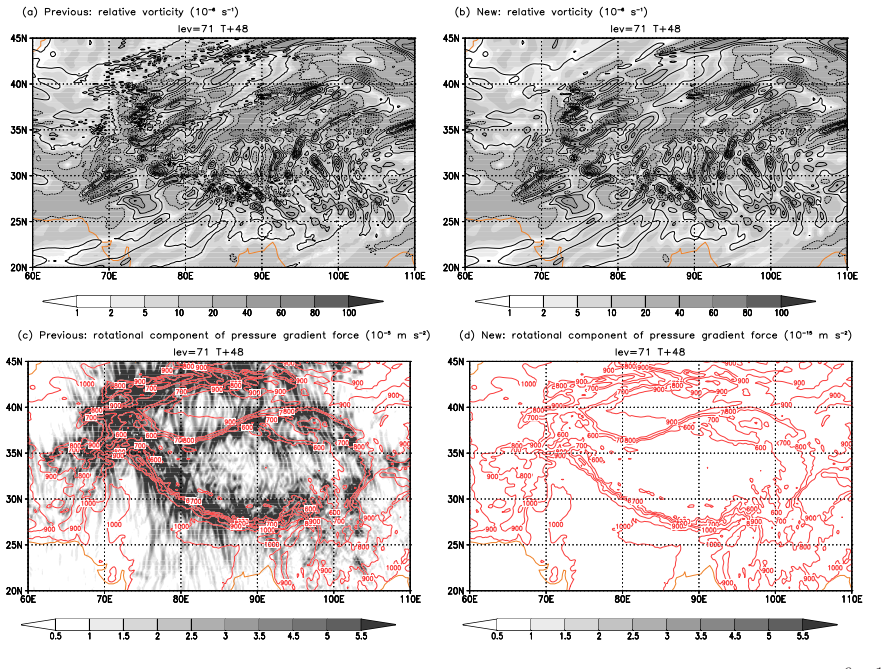
The central claim is that the standard implementation of the Simmons–Burridge vertical discretisation of the pressure gradient, in which the geopotential gradient $\nabla_\eta\Phi$ is expressed through spectrally evaluated gradients of temperature and surface pressure and evaluated in grid space, breaks the continuous identity $\nabla_p\times(-\nabla_p\Phi)=0$ on isobaric surfaces. Although each individual spectral scalar gradient is exactly curl-free, their nonlinear combination is not, and this numerical spurious rotation has high-wavenumber components beyond the linear-grid truncation limit. In a semi-implicit semi-Lagrangian model these components alias back onto the resolved spectrum and accumulate over time, producing the spectral blocking observed in the rotational kinetic energy spectra. The paper's fix computes the full-level geopotential $\Phi_k$ from the hydrostatic relation in grid space and then takes its horizontal gradient via a spectral transform, so the gradient part is exactly rotation-free and the remaining contribution from the vertical coordinate term vanishes on isobaric levels. With this change, the upper-level blocking disappears, the curl of the pressure gradient falls to machine precision, vorticity noise over orography is dramatically reduced, and the result holds without degrading forecast scores in cycled experiments.
Load-bearing premise
The argument assumes that the spurious high-wavenumber rotational component of the pressure gradient is what aliases back and accumulates into spectral blocking; the evidence is a comparison of model runs with and without the fix, not a term-by-term isolation of that aliasing flux.
Editorial extensions
If this is right
- Other spectral semi-implicit semi-Lagrangian models using the same pressure-gradient discretisation can remove upper-level rotational spectral blocking by adding one spectral transform for geopotential, with no new tunable parameters.
- At levels where the model coordinate is close to but not exactly isobaric, the blocking is greatly reduced but not fully eliminated, so some residual noise should be expected there.
- Cycled forecast experiments show neutral impact on standard scores and on first-guess fits to stratosphere-sensitive observations, so adopting the fix does not trade away forecast skill.
- The scheme was implemented in an operational global forecasting system, demonstrating that the additional transform cost is acceptable in practice.
Reading between the lines
- A direct extension of the paper's logic is that for grid-based dynamical cores, the pressure-gradient discretisation should be checked after all nonlinear combinations are formed, not just on individual gradient operators; otherwise a rotation-free gradient operator can still produce a rotational force.
- The residual blocking at near-isobaric levels suggests a fully pressure-based or isentropic vertical coordinate, or an additional mimetic correction, would be needed to remove the remaining noise; this is a natural follow-up experiment.
- A term-by-term budget of the high-wavenumber rotational kinetic energy tendency, comparing the old and new schemes, would confirm whether the aliasing flux from the pressure gradient is indeed the dominant accumulation mechanism rather than an accompanying symptom.
- The one-extra-transform cost could be reduced further by fusing the geopotential transform with an existing temperature transform, as the paper reports was done operationally, so the fix should scale to very high resolutions.
Signed reviews
Editorial analysis
A structured set of objections, weighed in public.
Referee Report
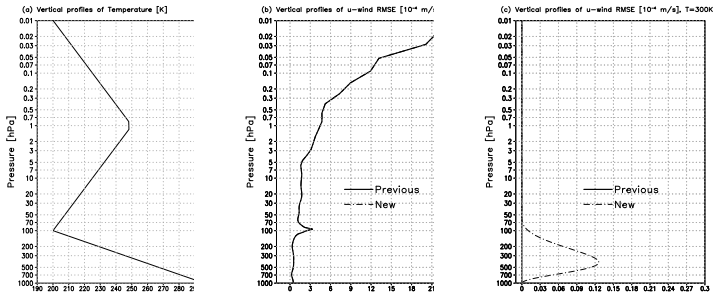
Summary. The manuscript identifies a mechanism for spectral blocking in the rotational wind component of a spectral semi-implicit semi-Lagrangian global atmospheric model. It argues that the Simmons and Burridge (1981) vertical discretisation of the horizontal pressure gradient, when evaluated with grid-space geopotential gradients, violates the continuous vector-calculus identity that the curl of a gradient is zero on isobaric levels. This spurious rotational component is nonlinear and, the authors argue, aliases to high wavenumbers and accumulates over time steps, producing the observed spectral blocking. The proposed remedy is to evaluate the full-level geopotential gradient spectrally, which restores the rotation-free property at machine precision. The paper presents idealised test results (resting atmosphere with orography, and the Jablonowski-Williamson steady-state test) and describes cycled NWP experiments, concluding that the new discretisation 'significantly reduce[s] the spectral blocking without harming forecast performance.' It also notes that the scheme was incorporated into JMA's operational system in May 2017.
Significance. If the central claim holds, the paper provides a clean, parameter-free fix for a practically important numerical problem: spectral blocking in a class of models used operationally. The rotor-free gradient construction is a concrete example of mimetic discretisation in an NWP context, and the paper correctly connects it to the disappearance of blocking in the rotational spectra, with the curl diagnostic dropping to machine precision. The proposed method has no tunable parameters, and the empirical comparison is a genuine before/after test within the same model, which strengthens the causal attribution. However, the strength of the 'without harming forecast performance' conclusion is currently limited by the absence of the actual forecast scores in the manuscript, a point the authors themselves acknowledge with repeated 'figures omitted' statements. The idealised tests show a measurable degradation in the Jablonowski-Williamson l2 error at higher resolutions, so the missing NWP verification is not a cosmetic gap.
major comments (3)
- [Section 5] This is a major comment. The central claim of the paper is the 'without harming' part, and it is unsupported in the current text.
- [Section 2] This is a major comment on the explanatory mechanism, though the practical fix may be sound.
- [Section 4.1] This is a major comment on the interpretation of an idealised experiment that the authors use to justify proceeding to full NWP tests.
minor comments (5)
- [Abstract] Minor presentation issue.
- [Section 1] Minor typo.
- [Figure 1] Clarity issue.
- [Figure 2] Potential inconsistency in figure caption.
- [Section 4.2] Notation clarity.
Circularity Check
No circularity: the rotation-free property is enforced by construction and its benefit is verified by independent model experiments, not assumed.
full rationale
The paper's central derivation is not circular. The rotation-free property of the proposed scheme follows directly from the spectral-gradient construction in Section 3: 'the absence of rotation on isobaric levels is automatically assured since the spectral evaluation of the horizontal gradient guarantees the identity ...'. The paper describes this as an assured property rather than as a prediction. The load-bearing empirical claims—that spectral blocking in rotational wind disappears and that forecast skill is not harmed—are tested against independent benchmarks (Jablonowski-Williamson steady-state test, resting-atmosphere maintenance test, and cycled NWP experiments), with no fitted parameters or tunable constants. Two evidentiary gaps are admitted by the manuscript, but neither is circular. Section 2 asserts, without a quantitative error budget, that high-wavenumber rotational noise 'alias[es] back onto the resolved high-wavenumber spectra ... and can accumulate over time steps'. Section 5 states that 'the update of pressure gradient discretisation only resulted in neutral impact in terms of all headline scores (figures omitted)', while the idealised tests show a 20-30% larger l2 error with the proposed method. These are missing-support issues in the causal explanation and verification, not steps in which an input is renamed as an output. Self-citations (Hotta and Ujiie 2018; Yonehara et al. 2018) are used only for model background or operational implementation and are not load-bearing for the mathematical or empirical argument. Therefore the paper receives no circularity score beyond the minimal 0-2 range; I assign 0.
Assumptions & free parameters
assumptions (4)
- standard math The curl of a scalar gradient is zero (curl of grad of any scalar field is zero).
- domain assumption On model levels where B(eta)=0, the eta-surfaces are isobaric and the term involving the gradient of log pressure vanishes.
- standard math Spherical-harmonic spectral evaluation of a horizontal gradient satisfies curl of grad of a scalar equals zero exactly at the discrete level.
- domain assumption The observed spectral blocking in JMA-GSM is dominated by aliasing from the pressure-gradient term rather than from other nonlinear terms.
Cite this review
Pith. "Pith review of Elimination of spectral blocking by ensuring rotation-free property of discretised pressure gradient within a spectral semi-implicit semi-Lagrangian global atmospheric model." pith.science (2026). https://pith.science/paper/ODVQMBMP
@misc{pith2026190811686,
  author       = {Pith},
  title        = {Pith review of: Elimination of spectral blocking by ensuring rotation-free property of discretised pressure gradient within a spectral semi-implicit semi-Lagrangian global atmospheric model},
  year         = {2026},
  howpublished = {\url{https://pith.science/paper/ODVQMBMP}},
  note         = {Machine review of arXiv:1908.11686}
}
abstract
The widely-adopted discretisation of the horizontal pressure gradient term formulated by Simmons and Burridge (1981) for atmospheric models on $\sigma$-$p$ hybrid vertical coordinate is found to incur spectral blocking for rotational wind components at high vertical levels when used in a spectral semi-Lagrangian model run on a linear grid. A remedy to this issue is proposed and tested using a spectral semi-implicit semi-Lagrangian hydrostatic primitive equations model. The proposed method removes aliasing errors at high wavenumbers by ensuring that the rotation-free property of the pressure gradient term on isobaric surface, a feature possessed by the continuous system, is preserved in the discretised system, which highlights the significance of mimetic discretisation within the context of numerical weather prediction models.
Figures

Reference graph
Works this paper leans on
-
[1]
Arakawa, A. (1966) Computational design for long-term numerical integration of the equations of fluid motion: Two-dimensional incompressional flow. part i. Journal of Computational Physics, 1, 119--143
work page 1966
-
[2]
B\' e nard, P., Vivoda, J., Masek, J., Smol\' i kov\' a , P., Yessad, K., Brozkova, R. and Geleyn, J.-F. (2010) Dynamical kernel of the Aladin-NH spectral limited-area model : Revised formulation and sensitivity experiments. Quarterly Journal of the Royal Meteorological Society, 136, 155--169
work page 2010
-
[3]
Boyd, J. P. (2001) Chebyshev and Fourier spectral methods. Dover Publications Inc., second revised edn
work page 2001
-
[4]
C \^ o t \' e , J. and Staniforth, A. (1988) A two-time-level semi-lagrangian semi-implicit scheme for spectral models. Monthly Weather Review, 116, 2003--2012
work page 1988
-
[5]
IFS Documentation---Cy45r1, 1--31
ECMWF (2018) Part iii: Dynamics and numerical procedures. IFS Documentation---Cy45r1, 1--31
work page 2018
-
[6]
Hortal, M. (2002) The development and testing of a new two-time-level semi-lagrangian scheme ( SETTLS ) in the ECMWF forecast model. Quarterly Journal of the Royal Meteorological Society, 128, 1671--1687
work page 2002
-
[7]
Hoskins, B. J. and Simmons, A. J. (1975) A multi-layer spectral model and the semi-implicit method. Quarterly Journal of the Royal Meteorological Society, 101, 637--655
work page 1975
-
[8]
Hotta, D. and Ujiie, M. (2018) A nestable, multigrid-friendly grid on a sphere for global spectral models based on Clenshaw--Curtis quadrature. Quarterly Journal of the Royal Meteorological Society, 144, 1382--1397
work page 2018
Show all 30 references
-
[9]
and Williamson, D
Jablonowski, C. and Williamson, D. L. (2006) A baroclinic instability test case for atmospheric model dynamical cores. Quarterly Journal of the Royal Meteorological Society, 132, 2943--2975
2006
-
[10]
JMA (2013) Outline of the operational numerical weather prediction at the Japan Meteorological Agency (March 2013) , Appendix to WMO Technical Progress Report on the Global Data-processing and Forecasting System (GDPFS) and Numerical Weather Prediction (NWP) Research . 188pp. ...
2013
-
[11]
and Matsumura, T
Katayama, K., Yoshimura, H. and Matsumura, T. (2005) Operational implementation of a new semi-lagrangian global nwp model at jma. CAS/JSC WGNE Research Activity on Atmospheric and Oceanic Modelling, 6.5--6.6
2005
-
[12]
(2011) A terrain-following coordinate with smoothed coordinate surfaces
Klemp, J. (2011) A terrain-following coordinate with smoothed coordinate surfaces. Monthly Weather Review, 139, 2163–2169
2011
-
[13]
P., Smolarkiewicz, P
K\"uhnlein, C., Deconinck, W., Klein, R., Malardel, S., Piotrowski, Z. P., Smolarkiewicz, P. K., Szmelter, J. and Wedi, N. P. (2019) Fvm 1.0: a nonhydrostatic finite-volume dynamical core for the ifs. Geoscientific Model Development, 12, 651--676
2019
-
[14]
and Hoskins, B
Lander, J. and Hoskins, B. J. (1997) Believable scales and parameterizations in a spectral transform model. Monthly Weather Review, 125, 292–303
1997
-
[15]
and Smolarkiewicz, P
Malardel, S., Wedi, N., Deconinck, W., Diamantakis, M., K\"uhnlein, C., Mozdzynski, G., Hamrud, M. and Smolarkiewicz, P. (2016) A new grid for the IFS . ECMWF Newsletter, 146, 23--28
2016
-
[16]
Orszag, S. A. (1970) Transform method for the calculation of vector-coupled sums: Application to the spectral form of the vorticity equation. Journal of the Atmospheric Sciences, 27, 890--895
1970
-
[17]
(1988) Application of the semi-lagrangian method to a spectral model of the shallow water equations
Ritchie, H. (1988) Application of the semi-lagrangian method to a spectral model of the shallow water equations. Monthly Weather Review, 116, 1587--1598
1988
-
[18]
(1981) A stable numerical integration scheme for the primitive meteorological equations
Robert, A. (1981) A stable numerical integration scheme for the primitive meteorological equations. Atmosphere and Ocean, 19, 35--46
1981
-
[19]
(2010) The derivation of the sigma pressure hybrid coordinate semi- Lagrangian model equations for the GFS
Sela, J. (2010) The derivation of the sigma pressure hybrid coordinate semi- Lagrangian model equations for the GFS . NCEP Office Note, No. 462, 31pp
2010
-
[20]
Simmons, A. J. and Burridge, D. M. (1981) An energy and angular-momentum conserving vertical finite-difference scheme and hybrid vertical coordinates. Monthly Weather Review, 109, 758--766
1981
-
[21]
and Thuburn, J
Staniforth, A. and Thuburn, J. (2012) Horizontal grids for global weather and climate prediction models: a review. Quarterly Journal of the Royal Meteorological Society, 138, 1--26
2012
-
[22]
(1991) On scalar and vector transform methods for global spectral models
Temperton, C. (1991) On scalar and vector transform methods for global spectral models. Monthly Weather Review, 119, 1303--1307
1991
-
[23]
and Dubos, T
Thuburn, J., Cotter, C. and Dubos, T. (2014) A mimetic, semi-implicit, forward-in-time, finite volume shallow water model: Comparison of hexagonal–icosahedral and cubed sphere grids. Geoscientific Model Development, 7, 909–929
2014
-
[24]
Wedi, N. P. (2014) Increasing horizontal resolution in numerical weather prediction and climate simulations: illusion or panacea? Philosophical Transactions of the Royal Society A: Mathematical, Physical and Engineering Sciences, 372, 20130289
2014
-
[25]
P., Hamrud, M
Wedi, N. P., Hamrud, M. and Mozdzynski, G. (2013) The ecmwf model: progress and challenges. Proceedings of ECMWF Annual Seminar 2013: Recent developments in numerical methods for atmosphere and ocean modelling., 1--14
2013
-
[26]
Wedi, N. P. and Smolarkiewicz, P. K. (2009) A framework for testing global non-hydrostatic models. Quarterly Journal of the Royal Meteorological Society, 135, 469--484
2009
-
[27]
and Shahrokhi, A
Weller, H. and Shahrokhi, A. (2014) Curl-free pressure gradients over orography in a solution of the fully compressible euler equations with implicit treatment of acoustic and gravity waves. Monthly Weather Review, 142, 4439–4457
2014
-
[28]
Williamson, D. L. and Olson, J. G. (1994) Climate simulations with a semi-lagrangian version of the ncar community climate model. 122, 1594--1610
1994
-
[29]
and Tokuhiro, T
Yonehara, H., Sekiguchi, R., Kanehama, T., Saitou, K., Kinami, T., Shimokobe, A., Hotta, D., R.Nagasawa, Sato, H., Ujiie, M., Kadowaki, T., Yabu, S., Yamada, K., Nakagawa, M. and Tokuhiro, T. (2018) Upgrade of JMA 's operational global NWP system. CAS/JSC WGNE Research Activit...
2018
-
[30]
and Kitoh, A
Yukimoto, S., Yoshimura, H., Hosaka, M., Sakami, T., Tsujino, H., Hirabara, M., Tanaka, T., Deushi, M., Obata, A., Nakano, H., Adachi, Y., Shindo, E., Yabu, S., Ose, T. and Kitoh, A. (2011) Meteorological Research Institute-Earth System Model Version 1 (MRI-ESM1)-- Model Descr...
2011
Reviewed August 14, 2026 · model on record in the stance chip above.
Discussion (0). Continue with ORCID to comment.