REVIEW 3 major objections 4 minor 26 references
Web Diagrams of Cluster Variables for Grassmannian Gr(4,8)
T0 review · 3 major / 4 minor · reviewed 2026-08-06 · deepseek-v4-flash
Pith's one-line read The paper classifies all non-elliptic webs with 12 black boundary vertices and derives explicit web diagrams and dual webs for every quadratic and cubic cluster variable in $C[Gr(4,8)]$.
desk verdict Useful first computation of web diagrams and dual webs for Gr(4,8) cluster variables, but the completeness of the underlying 32-web classification is asserted rather than shown. read the letter →
The pith
A machine-rendered reading of the paper's core claim, the machinery that carries it, and where it could break.
The reading
What carries the argument
The load-bearing objects are hourglass plabic graphs, the rotation-invariant web basis for $U_q(sl_4)$: planar bicolored graphs whose edges carry integer multiplicities drawn as twisted multi-strands, with all internal vertices of degree 4. The growth algorithm takes the lattice word of a semi-standard Young tableau and iteratively applies local rules to build such a graph, while promotion and evacuation of tableaux are realized as rotation and reflection of the graph. On the enumeration side, the key mechanism is sink-vertex contraction: contracting two adjacent boundary edges that meet at the same white internal vertex (a claw) turns a web with 12 black boundary vertices into one with 4 black and 4 white boundary vertices. Lam's compatibility condition then counts edge colorings of a web against the three Plücker coordinates of a monomial, and the immanant-map theorem identifies the uniquely compatible web as the dual web of the corresponding diagram.
What would settle it
Run an exhaustive computer search over all trivalent bipartite planar graphs with 12 boundary leaves, modulo rotation and reflection, keeping those with no contractible face bounded by four or fewer edges; if the number of equivalence classes is not 32, Theorem 4.9 is false. A cheaper check is to count the labeled webs in the 32 displayed classes and test whether the total is 462, matching the hook-length count for standard tableaux of shape $(3,3,3,3)$.
Extended reading notes
Core claim
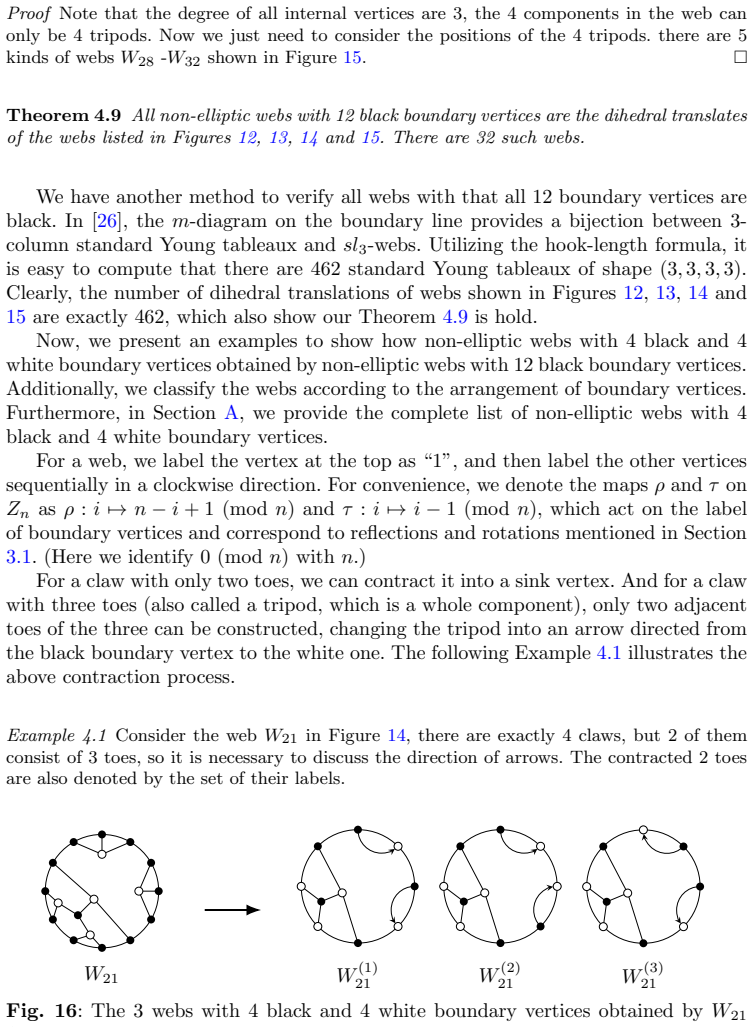
The central claim is Theorem 4.9: every non-elliptic web with 12 black boundary vertices is, up to rotation and reflection, one of 32 explicitly pictured webs. Contracting adjacent toes of claws in these webs gives 182 non-elliptic webs with 4 black and 4 white boundary vertices, organized by the eight possible boundary color arrangements. On the cluster algebra side, the paper takes 3 quadratic and 14 cubic representative cluster variables, writes each as a Plücker polynomial, and applies the growth algorithm to the associated semi-standard Young tableau to obtain an hourglass plabic graph, the web diagram. It then uses Lam's compatibility condition to find the non-elliptic web compatible with each monomial; by the immanant-map theorem these compatible webs are the dual webs of the diagrams. The result is a complete pictorial and tabular description of the web invariants and dual webs for all 120 quadratic and 174 cubic cluster variables in $C[Gr(4,8)]$, up to rotation, reflection, and relabeling of isolated vertices.
Load-bearing premise
The whole paper rests on the assumption that the case-by-case search over possible internal cycles, claw arrangements, and connected components in Lemmas 4.5–4.8 finds every possible non-elliptic web with 12 black boundary vertices; a missed configuration would change the 32-web list and the subsequent tables.
Editorial extensions
If this is right
- Every quadratic cluster variable in $C[Gr(4,8)]$ has a web diagram that is a rotation, reflection, or isolated-vertex relabeling of one of the three pictures in Table 1, and its dual web is one of the matchings or webs in Table 3.
- Every cubic cluster variable in $C[Gr(4,8)]$ has a web diagram that is a rotation or reflection of one of the 14 diagrams in Table 2, and its dual web is a rotation or reflection of one of the webs in Table 4.
- The compatible web for each representative is obtained as a signed combination of non-elliptic webs with multiplicities given by compatibility degrees, so the tables encode the full immanant preimage of each cluster variable.
- Promotion and evacuation act on the tableaux exactly as rotation and reflection act on hourglass graphs, so the diagrams and dual webs for any translate can be produced without repeating the computation.
- The 32-web classification is numerically checked by the count of 462 labeled webs, matching the number of standard Young tableaux of shape $(3,3,3,3)$.
Reading between the lines
- The 462 count suggests an explicit bijection between non-elliptic webs with 12 black boundary vertices and standard Young tableaux of shape $(3,3,3,3)$; the paper uses the count only as a verification and does not construct such a bijection.
- The same compatibility machinery could be run one step further to compute the twist of every quadratic and cubic $Gr(4,8)$ cluster variable as a dimer partition function, following the pattern already developed for $Gr(3,n)$ in the literature the paper builds on.
- The completeness of the 32-web list could be tested independently by a computer enumeration of trivalent bipartite planar graphs with 12 boundary leaves; if a 33rd equivalence class appeared, the dual-web tables in the appendix would need revision.
- The method is likely to extend to higher-degree invariants or larger Grassmannians, but the hand-verified case analysis would quickly need to be replaced by a mechanical enumeration as the number of boundary vertices grows.
Editorial analysis
A structured set of objections, weighed in public.
Referee Report
Summary. The paper computes explicit hourglass plabic web diagrams for three representative quadratic cluster variables and fourteen representative cubic cluster variables in the Grassmannian cluster algebra C[Gr(4,8)], claiming that all other quadratic and cubic cluster variables are obtained by dihedral translates. It then determines the dual webs compatible with these cluster variables using Lam's compatibility method. The main technical input is a classification, stated as Theorem 4.9, of all non-elliptic webs with 12 black boundary vertices into 32 webs up to dihedral translation, followed by a contraction procedure that allegedly yields 182 non-elliptic webs with 4 black and 4 white boundary vertices. The compatible webs are displayed in Tables 3 and 4, with the full list of 4+4 boundary webs in Appendix A.
Significance. If the classification and counts are correct, the paper provides the first explicit rotation-invariant web data and dual webs for the quadratic and cubic cluster variables in C[Gr(4,8)], extending the Gr(3,n) computations of Elkin, Musiker, and Wright. The computations are anchored in independent prior definitions rather than fitted parameters, and the final compatibility check against the web diagrams is a meaningful consistency result. However, the value of the paper rests on the completeness of the 32-web classification and the 182-web contraction count, and those points are currently asserted rather than rigorously demonstrated.
major comments (3)
- [Theorem 4.9 / Lemmas 4.5–4.8] The completeness of the 32-web classification is the load-bearing step, but the proofs of Lemmas 4.5–4.8 are case sketches. For example, in Lemma 4.5 the c=0 case asserts that 6 claws give one web, 5 claws give three webs, and 'less than 5 claws ... impossible', but the last assertion is not proven. Similar qualitative counts ('there are only 2 cases', 'there are 8 kinds', 'there are 5 kinds') in Lemmas 4.6–4.8 do not rule out further configurations. Please replace these sketches with a systematic enumeration (for example by connected components, cycle counts, and claw positions) or with machine-checked code, and state explicitly why the listed cases exhaust all possibilities.
- [Paragraph after Theorem 4.9] The verification that the dihedral translates of the 32 pictured webs are exactly 462 is asserted with the sentence 'Clearly, the number of dihedral translations of webs shown in Figures 12, 13, 14 and 15 are exactly 462' rather than demonstrated. Equality with the number of 3-column standard Young tableaux of shape (3,3,3,3) only verifies the total count if the orbit sizes of all 32 representatives under the dihedral group are computed and sum to 462, or if an explicit bijection to the 462 tableaux is supplied. Without that computation, the quoted total does not establish that the pictured representatives generate all orbits.
- [Section 4.1, contraction to 182 webs] The passage 'as long as it has at least 4 claws ... there are a total of 182 such webs up to dihedral translations' is not derived. The paper does not specify which of the 32 webs have at least four claws, how many distinct (4,4)-webs each contraction produces, or why every non-elliptic web with 4 black and 4 white boundary vertices arises from such a contraction. Since Table 4 and Appendix A depend directly on this count, please provide the full contraction analysis or a script that verifies both the 182-orbit count and the completeness of the eight boundary-condition types.
minor comments (4)
- [Section 4.1, internal references] In the proofs of Lemmas 4.5 and 4.6, the statements labeled Proposition 4.2 and Proposition 4.3 are referred to as 'Theorem 4.2' and 'Theorem 4.3'; please correct the cross-references.
- [Figure 15 caption] The caption of Figure 15 says '3 connected component' although Lemma 4.8 concerns webs with 4 connected components; the caption should read '4 connected components'.
- [Section 3.2, growth algorithm] In Algorithm 3.1, the phrase 'the letters 1, 2, 3, 4 represent a downward arrow, and the letters 1, 2, 3, 4 represent an upward arrow' appears to have a typo; the second list should presumably be overlined letters (or otherwise distinguished) as in the source [11].
- [Section 4.1, notation] In Proposition 4.3 the sentence 'Let W be a non-elliptic web with c cycles,.' contains stray punctuation; also the bullet list halves the inequalities for c≥5,6,7, so please clarify whether these are new results from the present paper or restatements from [14].
Circularity Check
No circularity: the paper's computations start from independent definitions, external cited methods, and an external enumeration count; the claimed classification and dual-web tables are computational outputs rather than inputs.
full rationale
The derivation chain is self-contained with respect to its own claims. Web diagrams are computed from Young tableaux via the externally cited growth algorithm of [11]; the cluster-variable counts and representatives come from [16] and dihedral symmetry; the compatible webs are obtained by applying Lam's compatibility framework [12] to an independent enumeration of non-elliptic webs, with the isomorphism between compatible webs and dual webs supplied by [13]. No parameter is fitted to a subset of the data and then renamed a prediction, no object is defined in terms of the quantity it is supposed to derive, and no load-bearing premise depends on a citation to the present authors' prior work. Theorem 4.9 is an enumeration claim supported by case analysis and an external count of 462 tableaux from Tymoczko's bijection [26]; even if that completeness argument is sketchy or the orbit-size check is asserted rather than shown, that is a rigor or correctness concern, not circularity.
Assumptions & free parameters
assumptions (5)
- domain assumption Theorem 3.1 from [11]: promotion permutations of rectangular standard Young tableaux equal trip permutations of fully reduced hourglass plabic graphs.
- domain assumption Theorem 2.2 from [13]: the immanant map is an isomorphism, so webs compatible with a Plucker polynomial are exactly the dual webs.
- ad hoc to paper The enumeration in Lemmas 4.5-4.8 is complete: every non-elliptic web with 12 black boundary vertices is a dihedral translate of one of the 32 pictured webs.
- ad hoc to paper All 174 cubic cluster variables are dihedral translates of the 14 representatives in Table 2.
- domain assumption The counts 120 and 174 for quadratic and cubic cluster variables in C[Gr(4,8)] are taken from [16].
Cite this review
Pith. "Pith review of Web Diagrams of Cluster Variables for Grassmannian Gr(4,8)." pith.science (2026). https://pith.science/paper/OECKNY4A
@misc{pith2026250718432,
  author       = {Pith},
  title        = {Pith review of: Web Diagrams of Cluster Variables for Grassmannian Gr(4,8)},
  year         = {2026},
  howpublished = {\url{https://pith.science/paper/OECKNY4A}},
  note         = {Machine review of arXiv:2507.18432}
}
abstract
Gaetz, Pechenik, Pfannerer, Striker, and Swanson introduced the concept of hourglass plabic graphs and provided a method for computing web diagrams and invariants corresponding to $4\times n$ Young tableaux, while Elkin, Musiker, and Wright applied Lam's method to explicitly compute the webs compatible with cluster variables in Gr(3,n) and their twists, namely, the preimages of the immanant map introduced by Fraser, Lam, and Le. In this paper, we use these two methods to compute both the web diagrams and the dual webs corresponding to quadratic and cubic cluster variables in the Grassmannian cluster algebra C[Gr(4,8)].
Figures
Reference graph
Works this paper leans on
-
[1]
Journal of the American mathematical society15(2), 497–529 (2002)
Fomin, S., Zelevinsky, A.: Cluster algebras I: foundations. Journal of the American mathematical society15(2), 497–529 (2002)
work page 2002
-
[2]
Proceedings of the London Mathematical Society92(2), 345–380 (2006)
Scott, J.S.: Grassmannians and cluster algebras. Proceedings of the London Mathematical Society92(2), 345–380 (2006)
work page 2006
-
[3]
arXiv preprint arXiv:math/0609764 (2006)
Postnikov, A.: Total positivity, grassmannians, and networks. arXiv preprint arXiv:math/0609764 (2006)
arXiv 2006
-
[4]
International Mathematics Research Notices (2008)
Talaska, K.: A formula for pl¨ ucker coordinates associated with a planar network. International Mathematics Research Notices (2008)
work page 2008
-
[5]
Advances in Mathematics122(1), 49–149 (1996)
Berenstein, A., Fomin, S., Zelevinsky, A.: Parametrizations of canonical bases and totally positive matrices. Advances in Mathematics122(1), 49–149 (1996)
work page 1996
-
[6]
Communications in Mathematical Physics341(3), 821–884 (2016)
Marsh, R.J., Scott, J.S.: Twists of pl¨ ucker coordinates as dimer partition functions. Communications in Mathematical Physics341(3), 821–884 (2016)
work page 2016
-
[7]
Proceedings of the London Mathematical Society115, 1014–1071 (2017)
Muller, G., Speyer, D.: The twist for positroid varieties. Proceedings of the London Mathematical Society115, 1014–1071 (2017)
work page 2017
-
[8]
Communications in Mathematical Physics180(1), 109–151 (1996) 30
Kuperberg, G.: Spiders for rank 2 lie algebras. Communications in Mathematical Physics180(1), 109–151 (1996) 30
work page 1996
Show all 26 references
-
[9]
Advances in Mathematics300, 717–787 (2016)
Fomin, S., Pylyavskyy, P.: Tensor diagrams and cluster algebras. Advances in Mathematics300, 717–787 (2016)
2016
-
[10]
Mathematische Zeitschrift296, 1539–1583 (2020)
Chang, W., Duan, B., Fraser, C., Li, J.R.: Quantum affine algebras and grassmannians. Mathematische Zeitschrift296, 1539–1583 (2020)
2020
-
[11]
preprint
Gaetz, C., Pechenik, O., Pfannerer, S., Striker, J., Swanson, J.P.: Rotation- invariant web bases from hourglass plabic graphs. preprint. arXiv preprint arxiv:2306.12501, 65 (2023)
2023 arXiv
-
[12]
Journal of the London Mathematical Society92(3), 633–656 (2015)
Lam, T.: Dimers, webs, and positroids. Journal of the London Mathematical Society92(3), 633–656 (2015)
2015
-
[13]
Transactions of the American Mathematical Society371(9), 6087–6124 (2019)
Fraser, C., Lam, T., Le, I.: From dimers to webs. Transactions of the American Mathematical Society371(9), 6087–6124 (2019)
2019
-
[14]
arXiv preprint arXiv:2305.15531 (2024)
Elkin, M., Musiker, G., Wright, K.: Twists of gr(3,n) cluster variables as double and triple dimer partition functions. arXiv preprint arXiv:2305.15531 (2024)
2024 arXiv
-
[15]
Journal of Algebraic Combinatorics38(4), 851–862 (2013)
Russell, H.M.: An explicit bijection between semistandard tableaux and non- ellipticsl 3 webs. Journal of Algebraic Combinatorics38(4), 851–862 (2013)
2013
-
[16]
Advances in Theoretical and Mathematical Physics 27(3), 797–828 (2023)
Cheung, M.W., Dechant, P.P., He, Y.H., Heyes, E., Hirst, E., Li, J.R.: Clustering cluster algebras with clusters. Advances in Theoretical and Mathematical Physics 27(3), 797–828 (2023)
2023
-
[17]
Modern Birkh¨ auser Classics
Lusztig, G.: Introduction to Quantum Groups. Modern Birkh¨ auser Classics. Birkh¨ auser, Boston, MA (2010)
2010
-
[18]
Transac- tions of the American Mathematical Society360(7), 3429–3472 (2008)
Berenstein, A., Zwicknagl, S.: Braided symmetric and exterior algebras. Transac- tions of the American Mathematical Society360(7), 3429–3472 (2008)
2008
-
[19]
Mathematische Annalen360(1–2), 351–390 (2014)
Cautis, S., Kamnitzer, J., Morrison, S.: Webs and quantum skew howe duality. Mathematische Annalen360(1–2), 351–390 (2014)
2014
-
[20]
University of California, Berkeley (2007)
Morrison, S.E.: A diagrammatic category for the representation theory ofU q(sln). University of California, Berkeley (2007)
2007
-
[21]
arXiv preprint arXiv:math/0310143 (2003)
Kim, D.: Graphical calculus on representations of quantum lie algebras. arXiv preprint arXiv:math/0310143 (2003)
2003 arXiv
-
[22]
Discrete Mathematics2(1), 73–94 (1972)
Sch¨ utzenberger, M.P.: Promotion des morphismes d’ensembles ordonnes. Discrete Mathematics2(1), 73–94 (1972)
1972
-
[23]
Combinatorial Theory4(2) (2024)
Gaetz, C., Pechenik, O., Pfannerer, S., Striker, J., Swanson, J.P.: Promotion permutations for tableaux. Combinatorial Theory4(2) (2024)
2024
-
[24]
arXiv preprint arXiv:2402.13978 (2024)
Gaetz, C., Pechenik, O., Pfannerer, S., Striker, J., Swanson, J.P.: Web bases in 31 degree two from hourglass plabic graphs. arXiv preprint arXiv:2402.13978 (2024)
2024 arXiv
-
[25]
Journal of Combinatorial Theory, Series A161, 1–28 (2019)
Patrias, R.: Promotion on generalized oscillating tableaux and web rotation. Journal of Combinatorial Theory, Series A161, 1–28 (2019)
2019
-
[26]
Journal of Algebraic Combinatorics35, 611–632 (2012) 32
Tymoczko, J.: A simple bijection between standard 3×ntableaux and irreducible webs for sl 3. Journal of Algebraic Combinatorics35, 611–632 (2012) 32
2012
Reviewed August 6, 2026 · model on record in the stance chip above.
Discussion (0). Continue with ORCID to comment.