Learning Alternating Real-Time Automata
Pith reviewed 2026-06-26 15:26 UTC · model grok-4.3
The pith
Alternating real-time automata accept the same languages as nondeterministic ones but with fewer states, and the AL*RTA algorithm learns them via membership and equivalence queries.
A machine-rendered reading of the paper's core claim, the machinery that carries it, and where it could break.
Core claim
Alternation improves succinctness of real-time automata without increasing their expressive power, and the AL*RTA procedure correctly learns any language accepted by an alternating real-time automaton from membership and equivalence queries.
What carries the argument
The AL*RTA algorithm, which adapts the state-construction and alternation-resolution steps from alternating finite automata learning to the timed constraints of real-time automata.
If this is right
- Any language accepted by a nondeterministic real-time automaton is also accepted by some alternating real-time automaton of equal or smaller size.
- The learning procedure returns a correct automaton after finitely many queries whenever the target is an alternating real-time automaton.
- In practice the returned automata are smaller than those produced by the nondeterministic learner on the same examples.
Where Pith is reading between the lines
- Smaller automata could reduce the cost of later verification or monitoring tasks that operate on the learned model.
- The extra queries required might be offset in domains where model size directly affects runtime performance.
- Similar alternation-based learning could be attempted for other timed models whose nondeterministic versions already have learning algorithms.
Load-bearing premise
The target language must be exactly the set of words accepted by some alternating real-time automaton, and the learner receives unrestricted membership and equivalence answers.
What would settle it
A concrete language accepted by an alternating real-time automaton for which AL*RTA either fails to terminate or returns an automaton that does not accept the language.
Figures
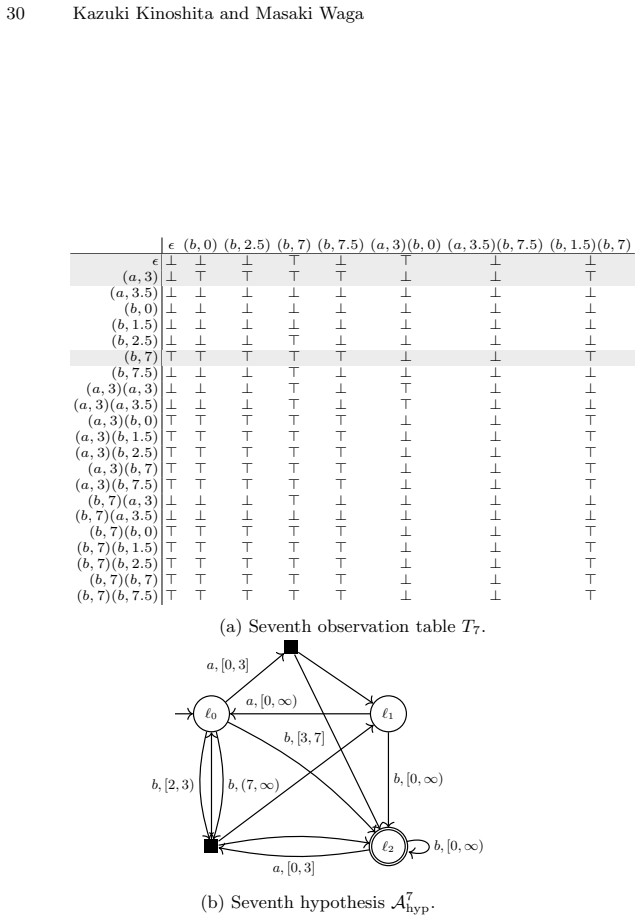
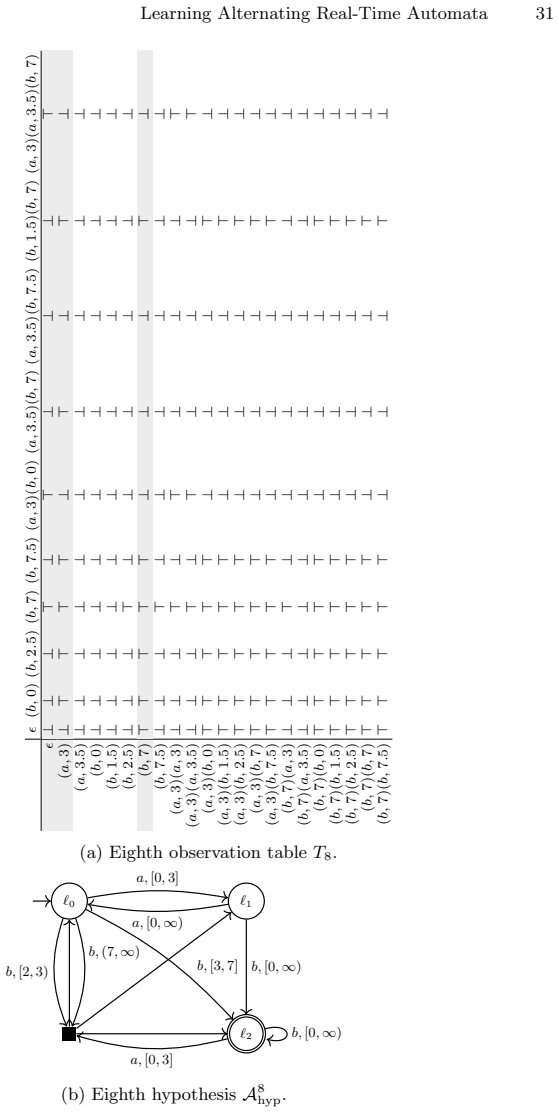
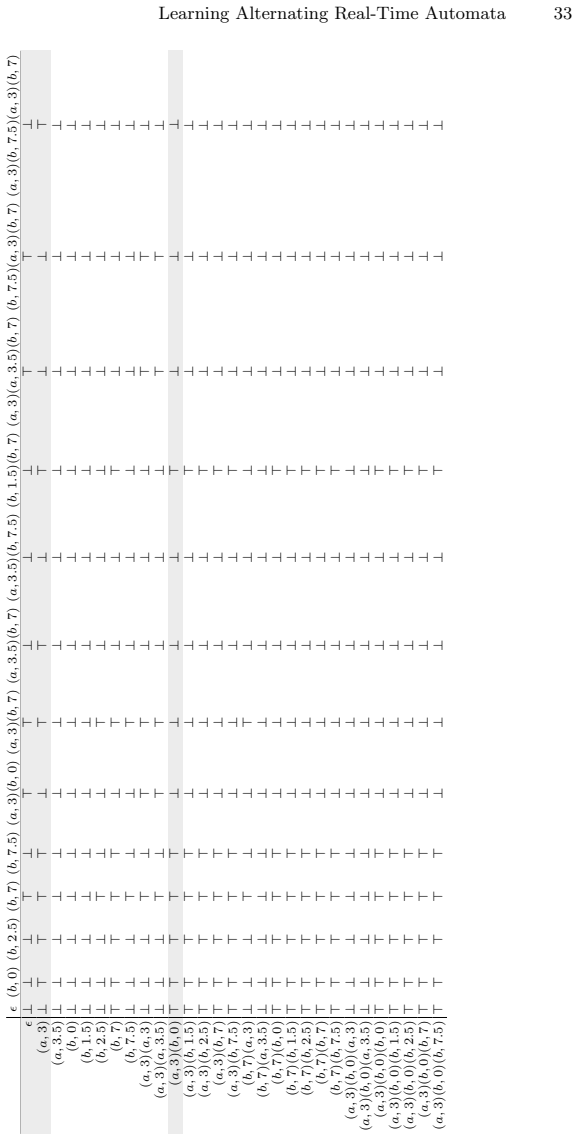
read the original abstract
We present the AL*RTA algorithm for learning alternating real-time automata (ARTAs) using membership and equivalence queries. AL*RTA combines ideas from AL*for learning alternating finite automata and NL*RTA for learning nondeterministic real-time automata. We first define ARTAs and show that alternation improves succinctness, although it does not increase expressive power. We then present AL*RTA and show its termination. Our empirical evaluation suggests that AL*RTA generally learns smaller automata than NL*RTA at the cost of more queries.
Editorial analysis
A structured set of objections, weighed in public.
Referee Report
Summary. The paper introduces alternating real-time automata (ARTAs) and presents the AL*RTA algorithm for actively learning them via membership and equivalence queries. It first defines ARTAs, proves that alternation yields strictly more succinct representations without increasing expressive power beyond nondeterministic real-time automata (NRTAs), establishes termination of AL*RTA by combining ideas from AL* and NL*RTA, and reports an empirical comparison in which AL*RTA produces smaller automata than NL*RTA at the expense of additional queries.
Significance. If the termination argument and empirical controls hold, the work extends query-based learning to alternating real-time models and supplies a concrete constructive procedure together with a direct head-to-head evaluation against NL*RTA. The succinctness result and the explicit termination claim are the primary technical contributions.
minor comments (3)
- [Abstract and Section 4] The abstract states that termination is shown, yet the main text should explicitly reference the section or lemma containing the termination argument so that readers can locate the proof without searching.
- [Empirical evaluation] The empirical section reports that AL*RTA learns smaller automata; the paper should state the precise benchmark suite, number of runs, and statistical controls (e.g., whether query counts are averaged over multiple random targets) to allow replication.
- [Preliminaries] Notation for the real-time constraints and the alternation operator should be introduced once with a small example before being used in the algorithm pseudocode.
Simulated Author's Rebuttal
We thank the referee for the constructive summary and for recommending minor revision. No specific major comments were provided in the report, so we have no point-by-point responses to address. We will incorporate any minor suggestions during revision if they are communicated.
Circularity Check
No significant circularity detected
full rationale
The paper introduces ARTAs by definition, combines known algorithms (AL* and NL*RTA) into AL*RTA, provides a termination argument for the new procedure, and reports an empirical comparison. No load-bearing step reduces a claimed result to a fitted parameter, self-definition, or self-citation chain; the termination proof and size/query trade-off are presented as independent constructive outcomes. This matches the default expectation for an algorithmic paper whose central claims remain self-contained against external benchmarks.
Axiom & Free-Parameter Ledger
axioms (1)
- domain assumption Standard definitions of alternating automata, real-time automata, membership queries, and equivalence queries from prior literature.
Reference graph
Works this paper leans on
-
[1]
GitHub: Leslieaj/NRTALearning.https://github.com/Leslieaj/NRTALearning, accessed: 2026-03-08
2026
-
[2]
Alur, R., Dill, D.L.: A theory of timed automata. Theor. Comput. Sci.126(2), 183–235 (1994),https://doi.org/10.1016/0304-3975(94)90010-8
-
[3]
In: TACAS (1)
An, J., Chen, M., Zhan, B., Zhan, N., Zhang, M.: Learning one-clock timed au- tomata. In: TACAS (1). pp. 444–462. Lecture Notes in Computer Science, Springer (2020)
2020
-
[4]
An, J., Wang, L., Zhan, B., Zhan, N., Zhang, M.: Learning real-time automata. Sci. China Inf. Sci.64(9) (2021)
2021
-
[5]
ACM Trans
An, J., Zhan, B., Zhan, N., Zhang, M.: Learning nondeterministic real-time au- tomata. ACM Trans. Embed. Comput. Syst.20(5s), 99:1–99:26 (2021)
2021
-
[6]
Angluin, D.: Learning regular sets from queries and counterexamples. Inf. Comput. 75(2), 87–106 (1987),https://doi.org/10.1016/0890-5401(87)90052-6
-
[7]
In: Yang, Q., Wooldridge, M.J
Angluin, D., Eisenstat, S., Fisman, D.: Learning regular languages via alternating automata. In: Yang, Q., Wooldridge, M.J. (eds.) Proceedings of the Twenty-Fourth International Joint Conference on Artificial Intelligence, IJCAI 2015, Buenos Aires, Argentina, July 25-31, 2015. pp. 3308–3314. AAAI Press (2015),http://ijcai. org/Abstract/15/466
2015
-
[8]
In: CAV (1)
Argyros, G., D’Antoni, L.: The learnability of symbolic automata. In: CAV (1). pp. 427–445. Lecture Notes in Computer Science, Springer (2018)
2018
-
[9]
Berndt, S., Liskiewicz, M., Lutter, M., Reischuk, R.: Learning resid- ual alternating automata. Inf. Comput.289(Part), 104981 (2022). https://doi.org/10.1016/J.IC.2022.104981
-
[10]
In: Boutilier, C
Bollig, B., Habermehl, P., Kern, C., Leucker, M.: Angluin-style learning of NFA. In: Boutilier, C. (ed.) IJCAI 2009, Proceedings of the 21st International Joint Conference on Artificial Intelligence, Pasadena, California, USA, July 11-17, 2009. pp. 1004–1009 (2009),http://ijcai.org/Proceedings/09/Papers/170.pdf
2009
-
[11]
In: QEST+FORMATS
Bruy` ere, V., Garhewal, B., P´ erez, G.A., Staquet, G., Vaandrager, F.W.: Active learning of mealy machines with timers. In: QEST+FORMATS. pp. 42–61. Lecture Notes in Computer Science, Springer (2025)
2025
-
[12]
Chandra, A.K., Kozen, D., Stockmeyer, L.J.: Alternation. J. ACM28(1), 114–133 (1981). https://doi.org/10.1145/322234.322243
-
[13]
In: POPL
D’Antoni, L., Veanes, M.: Minimization of symbolic automata. In: POPL. pp. 541–
-
[14]
Dima, C.: Real-time automata. J. Autom. Lang. Comb.6(1), 3–23 (2001)
2001
-
[15]
In: TACAS (1)
Drews, S., D’Antoni, L.: Learning symbolic automata. In: TACAS (1). pp. 173–189. Lecture Notes in Computer Science, Springer (2017)
2017
-
[16]
Fisman, D., Frenkel, H., Zilles, S.: Inferring symbolic automata. Log. Methods Comput. Sci.19(2) (2023). https://doi.org/10.46298/lmcs-19(2:5)2023
-
[17]
Grinchtein, O., Jonsson, B., Leucker, M.: Learning of event-recording automata. Theor. Comput. Sci.411(47), 4029–4054 (2010)
2010
-
[18]
In: ICFEM
Kogel, P., Kl¨ os, V., Glesner, S.: Learning mealy machines with local timers. In: ICFEM. pp. 47–64. Lecture Notes in Computer Science, Springer (2023)
2023
-
[19]
In: QEST+FORMATS
Kogel, P., Schwabe, W., Glesner, S.: Mmlt/ik: Efficiently learning mealy machines with local timers by using imprecise symbol filters. In: QEST+FORMATS. pp. 143–159. Lecture Notes in Computer Science, Springer (2024)
2024
-
[20]
Leiss, E.L.: Succinct representation of regular languages by boolean au- tomata. Theor. Comput. Sci.13, 323–330 (1981). https://doi.org/10.1016/S0304- 3975(81)80005-9 Learning Alternating Real-Time Automata 19
-
[21]
Leiss, E.L.: Succinct representation of regular languages by boolean automata II. Theor. Comput. Sci.38, 133–136 (1985). https://doi.org/10.1016/0304- 3975(85)90215-4
-
[22]
Rivest, R.L., Schapire, R.E.: Inference of finite automata using homing sequences. Inf. Comput.103(2), 299–347 (1993). https://doi.org/10.1006/INCO.1993.1021
-
[23]
Teng, Y., Chen, H., Mi, J., Zhang, M., An, J., Zhan, N.: Active learning of deter- ministic timed automata via timed classification tree. Sci. China Inf. Sci.68(12) (2025)
2025
-
[24]
In: HSCC
Teng, Y., Zhang, M., An, J.: Learning deterministic multi-clock timed automata. In: HSCC. pp. 6:1–6:11. ACM (2024)
2024
-
[25]
In: CAV (1)
Waga, M.: Active learning of deterministic timed automata with myhill-nerode style characterization. In: CAV (1). pp. 3–26. Lecture Notes in Computer Science, Springer (2023)
2023
-
[26]
DRTA size
Xu, R., An, J., Zhan, B.: Active learning of one-clock timed automata using constraint solving. In: ATVA. pp. 249–265. Lecture Notes in Computer Science, Springer (2022) A Omitted proofs A.1 Proof of Theorem 8 Theorem 8 (recalled).DRTAs and ARTAs have the same expressive power. Moreover, for any ARTA withnlocations, there is a DRTA rec- ognizing the same ...
2022
discussion (0)
Sign in with ORCID, Apple, or X to comment. Anyone can read and Pith papers without signing in.