REVIEW 3 major objections 4 minor 1 cited by
Estimation of Conditional Average Treatment Effects with High-Dimensional Data
T0 review · 3 major / 4 minor · reviewed 2026-08-14 · deepseek-v4-flash
Pith's one-line read Both full-sample and cross-fitting versions of a machine-learning-based estimator for reduced-dimensional conditional average treatment effects admit a uniform linear representation, giving pointwise normality and asymptotically valid…
desk verdict High-level CATE theory is solid and useful, but the lasso primitive conditions fail for the paper's own example and the unbounded Gaussian dictionary isn't covered. read the letter →
The pith
A machine-rendered reading of the paper's core claim, the machinery that carries it, and where it could break.
The reading
What carries the argument
The load-bearing object is a Neyman-orthogonal score $\psi(W;\eta)=\frac{D(Y-\mu(1,X))}{\pi(X)}+\mu(1,X)-\frac{(1-D)(Y-\mu(0,X))}{1-\pi(X)}-\mu(0,X)$. Its conditional expectation given $X_1=x_1$ identifies $\tau_0(x_1)$, and the Gateaux derivative with respect to the nuisance functions vanishes at the truth, so first-stage regularization bias does not contaminate the second stage. The second stage is a local linear regression of $\psi(W;\hat{\eta})$ onto $(1,X_1-x_1)$ with kernel weights $K_h(X_1-x_1)$, whose intercept estimates the CATE. The proofs hinge on high-level rate conditions for the nuisance estimation errors in kernel-weighted $L^2$ and $L^\infty$ norms, tied to the bandwidth, plus entropy control for the full-sample variant.
What would settle it
Construct a data-generating process satisfying unconfoundedness and overlap where the true propensity score and outcome means are deliberately chosen to require $s_\mu s_\pi \gg N h^d$ non-negligible dictionary coefficients; run the lasso-first-stage estimator and compute the uniform bands at the nominal 95% level. If the empirical coverage of the true $\tau_0$ across many replications stays below the nominal level and the discrepancy does not vanish as $N$ grows with $h$ chosen as the paper recommends, the approximate-sparsity route to the central theorem is refuted.
Extended reading notes
Core claim
On its own terms, the paper establishes that under unconfoundedness, overlap, smoothness, and bandwidth conditions, both the full-sample estimator $\hat{\tau}(x_1)$ and the cross-fitting estimator $\check{\tau}(x_1)$ satisfy $\hat{\tau}(x_1)-\tau_0(x_1) = (P_N-P)[\frac{1}{h^d f(x_1)}(\psi(W,\eta_0)-\tau_0(X_1))K_h(X_1-x_1)] + R_\tau(x_1)$ uniformly over the target interval, with $\sup_{x_1} |R_\tau(x_1)|=o_p((\log N \cdot N h^d)^{-1/2})$, where $\psi$ is the Neyman-orthogonal doubly robust score. This implies $\sqrt{N h^d}(\hat{\tau}(x_1)-\tau_0(x_1))/\sigma_N(x_1)\to N(0,1)$ pointwise and, via the multiplier bootstrap, uniform confidence bands of the correct asymptotic level (Theorems 3.1 and 4.2). The paper also provides primitive conditions under which first-stage lasso satisfies the high-level rates, essentially requiring approximate sparsity of the nuisance functions in a growing dictionary.
Load-bearing premise
The argument collapses if the first-stage machine-learning estimates of the propensity score and the outcome regressions do not converge to the truth fast enough in kernel-weighted average error and in uniform error—in lasso terms, if the true nuisance functions are not approximately sparse in the chosen dictionary with sparsity indices small relative to $N h^d$.
Editorial extensions
If this is right
- Researchers can form pointwise approximate normal intervals for the CATE at a fixed covariate value without knowing the functional form of the propensity score or outcome regressions.
- The multiplier bootstrap provides uniform confidence bands, so hypotheses about the whole CATE curve—for example, that it is constant or monotone—can be tested at the stated level.
- Because cross-fitting drops the entropy condition, the split-sample variant tolerates a wider range of machine-learning first stages than the full-sample variant.
- The rate $\sqrt{N h^d}$ is the usual nonparametric rate, so the dimension of the conditioning variable $X_1$ must stay small; the control dimension $p$ can be much larger than $N$.
- For lasso first stages, the theory gives a sparsity-index condition ($s_\mu s_\pi \log^2(p\vee N)\log N/(N h^d)=o(1)$) that practitioners can consult when choosing the dictionary.
Reading between the lines
- Not in the paper but a plausible extension: the same uniform-band machinery can test shape restrictions, such as monotonicity of CATE in age, directly against the nonparametric estimate.
- Not in the paper: under cross-fitting, the first-stage estimator only needs its error rates, not its entropy, so other structured learners are admissible whenever their known $L^2$ and $L^\infty$ rates satisfy Assumption 3.3.
- Not in the paper: the practical power of the bands is governed by the density of $X_1$; edge regions will dominate the sup-statistic, so reporting the band together with the density of $X_1$ is a natural empirical addition.
Signed reviews
Editorial analysis
A structured set of objections, weighed in public.
Referee Report
Summary. The paper proposes two estimators for a reduced-dimensional conditional average treatment effect (CATE) function under unconfoundedness when the covariate vector is high-dimensional. Both estimators combine a first-stage machine-learning estimate of the nuisance functions (outcome regressions and propensity score) with a second-stage local linear regression of an orthogonal score on the low-dimensional variable of interest. The first variant estimates all stages on the full sample; the second uses K-fold cross-fitting. The paper states high-level rate and complexity conditions under which both estimators admit a uniform linear representation, yielding pointwise normality and asymptotically valid uniform confidence bands based on the multiplier bootstrap. A lasso first stage is treated as a leading example with primitive conditions, and the method is illustrated with simulations and an empirical application to maternal smoking and birth weight.
Significance. If the main theorems are correct, the paper is a useful extension of AHL (2015) and LOW (2017) to settings where the nuisance functions are estimated by regularized or other machine-learning methods, and it provides a computationally feasible uniform-inference procedure. The supplement contains detailed proofs of Theorems 3.1, 3.2, 4.1, and 4.2, and the Monte Carlo evidence shows coverage close to nominal levels in both strictly and approximately sparse designs. These are real strengths. However, the paper's central claim that lasso is a verified leading example depends on Section 3.2, and that section currently contains an internal inconsistency and omits a required L-infinity condition. The significance of the paper would be fully established only after the lasso bridge is corrected.
major comments (3)
- [Section 3.2, displays (17)-(18) and following paragraph] The claimed sufficient conditions for the lasso first stage are internally inconsistent with the paper's own example. With q=4, p=O(N^lambda), zeta=O(N^{1/4}) and max(s_mu,s_pi)=o(sqrt(N h^d)), the second condition in display (18) requires zeta^2(s_mu+s_pi)^2 log(p∨N) log(N)=o(N^{1/2}). Substituting h=N^{-H}, the left-hand side is of order o(N^{3/2-H}) up to log factors, which is not o(N^{1/2}) for any H<1/2. The third condition in (18) has the same obstruction: with zeta=N^{1/4} and s=o(sqrt(N h^d)), zeta^2 s^4 log^3/(N^{2-2/q}h^d) is not o(1) for q=4 and H<1/2. Since the paper recommends h proportional to N^{-2/7} (so H=2/7) for d=1, the example does not verify that lasso satisfies Assumption 3.2. This is load-bearing because Section 3.2 is the bridge from the high-level assumptions to the paper's 'leading example' lasso.
- [Section 3.2, paragraph on Assumption 3.3] The reduction of Assumption 3.3 to the product-sparsity condition sqrt(s_pi s_mu) log(p)/(N h^d)=o((log(N)N h^d)^{-1/2}) omits the L-infinity condition delta_{2n}=o((log n)^{-1}) contained in Assumption 3.3. Using the L-infinity rate in display (17), this condition requires zeta^2(s_mu^2+s_pi^2) log(p∨N)/N = o((log N)^{-2}), equivalently zeta^2(s_mu+s_pi)^2 log^3(p∨N)/N = o(1) up to log factors. This is stronger than the stated product condition unless zeta is bounded. The paper's claim that 'Assumption 3.3 holds under substantially weaker sparsity conditions' is therefore not established as written.
- [Section 3.2, Assumption 3.5(ii), and Supplement I.1] The lasso rate bounds in Section 3.2 rely on the dictionary bound zeta=max_j ||b_j(X)||_{P,infinity} being finite, but the simulation DGPs in the supplement generate X from N(0,I_p) or N(0,Sigma), for which zeta=infinity for dictionaries containing the raw regressors. No truncation or sub-Gaussian alternative is stated. Consequently the Monte Carlo results and the empirical application do not fall under the stated lasso conditions, and the paper's assertion that lasso satisfies Assumptions 3.2 and 3.3 in these designs is not substantiated. A random-sample or truncation-based treatment of the unbounded-regressor case would be needed.
minor comments (4)
- [Abstract] The text reads 'Belloni at al. (2017)'; this should be 'Belloni et al. (2017)'.
- [Section 4, paragraph after Theorem 4.1] The sentence 'sqrt(Nh^d)(hat tau_b(x1)-hat tau_0(x1)) converges in distribution' appears to contain a typo: the centering should be the full-sample estimate hat tau(x1), not the true function tau_0(x1), to match the displayed theorem and the bootstrap procedure.
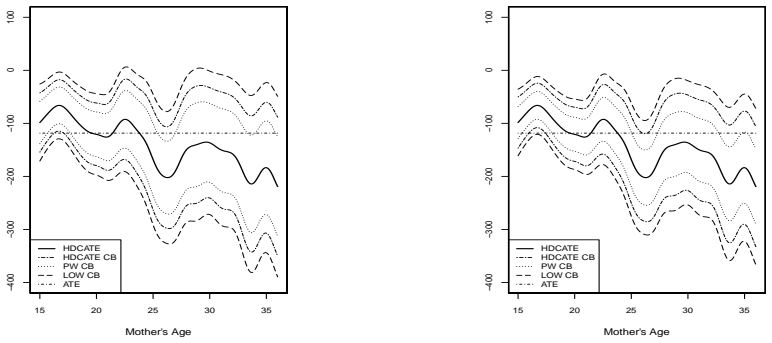
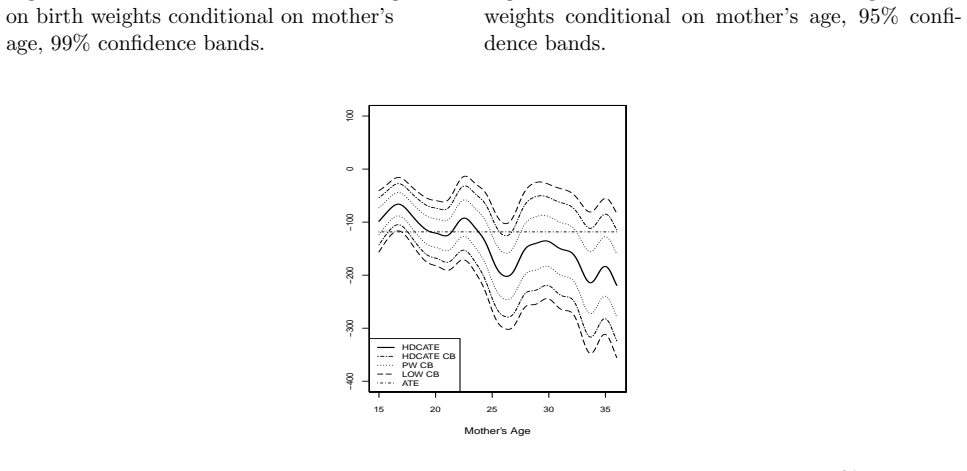
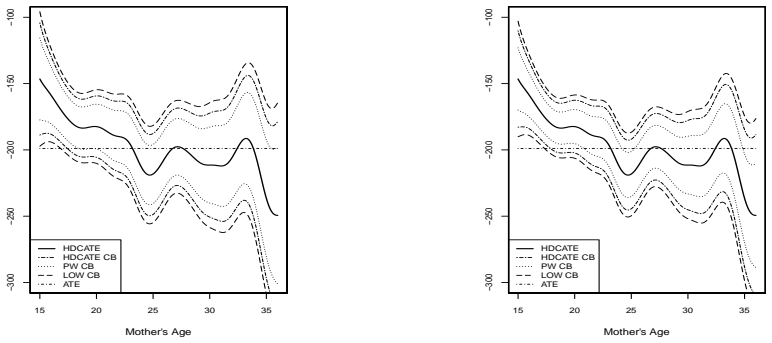
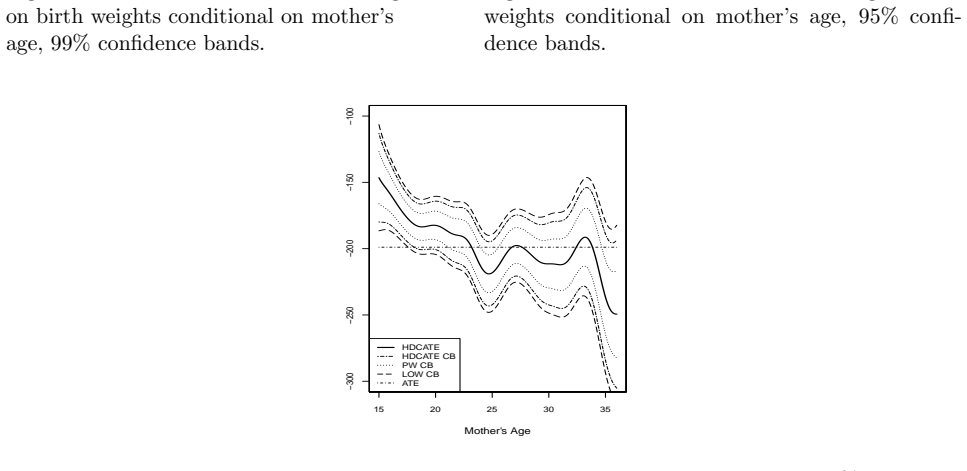
- [Section 5, Figures 1-3] The text refers to 'Figures 7, 8 and 9' when discussing the main-text estimates; the figures in Section 5 are numbered 1-3. The figure cross-references should be corrected.
- [Supplement, Section C] The local-constant supplement says 'Under the conditions for delta_1N, delta_2N, and delta_4N in Assumptions 3.2 and 3.3... we can derive the first-order linear expansions.' It would be helpful to state explicitly that the delta_3N condition is not needed for the local-constant version, as the text later indicates.
Circularity Check
No significant circularity: the central linear-representation theorem is proved from stated high-level rate assumptions, and the lasso bridge is a primitive sufficient-condition discussion rather than a fitted input renamed as a prediction.
full rationale
The paper's derivation chain is self-contained. The estimators are defined from a Neyman-orthogonal moment condition in Section 2, and Theorem 3.1 derives the linear representation of tau-hat and tau-check from the high-level rate Assumptions 3.2 and 3.3; the conclusion is not assumed as an input. Section 3.2 then supplies primitive lasso conditions, and whatever gap the skeptic identifies in those sufficient conditions is a correctness or verification concern, not a circularity: the lasso rates are not fitted parameters that are later relabeled as predictions. The citations to AHL and LOW are prior-art context and provide the reduced-dimensional CATE target, but the paper's proofs do not rely on those papers as evidence for its asymptotic claims. AHL includes two of the present authors, yet it is an externally published benchmark and the citation is not a uniqueness theorem or an unverified load-bearing premise. Simulations and the empirical application are illustrative checks against external data-generating designs, not circular confirmations. Overall, the central claim retains independent content and no step reduces, by definition or by self-citation, to its own inputs.
Assumptions & free parameters
free parameters (1)
- Bandwidth h =
1.06 * sigma_hat_x1 * N^{-2/7} for d=1
assumptions (6)
- domain assumption Unconfoundedness: (Y(1),Y(0)) ⊥ D | X (Assumption 2.1(i))
- domain assumption Overlap: 0 < C ≤ π0(X) ≤ 1-C < 1 almost surely (Assumption 2.1(iii))
- domain assumption Moment condition: E|Y(j)|^q < ∞ for q ≥ 4 (Assumption 2.1(ii))
- domain assumption Smoothness and regularity of f, τ0, kernel, and bandwidth (Assumption 3.1)
- domain assumption High-level first-stage rate conditions (Assumptions 3.2 and 3.3)
- standard math Multiplier bootstrap multipliers have sub-exponential tails with Eξ = Varξ = 1 (Assumption 4.1)
Cite this review
Pith. "Pith review of Estimation of Conditional Average Treatment Effects with High-Dimensional Data." pith.science (2026). https://pith.science/paper/OGYXJPO5
@misc{pith2026190802399,
  author       = {Pith},
  title        = {Pith review of: Estimation of Conditional Average Treatment Effects with High-Dimensional Data},
  year         = {2026},
  howpublished = {\url{https://pith.science/paper/OGYXJPO5}},
  note         = {Machine review of arXiv:1908.02399}
}
read the original abstract
Given the unconfoundedness assumption, we propose new nonparametric estimators for the reduced dimensional conditional average treatment effect (CATE) function. In the first stage, the nuisance functions necessary for identifying CATE are estimated by machine learning methods, allowing the number of covariates to be comparable to or larger than the sample size. The second stage consists of a low-dimensional local linear regression, reducing CATE to a function of the covariate(s) of interest. We consider two variants of the estimator depending on whether the nuisance functions are estimated over the full sample or over a hold-out sample. Building on Belloni at al. (2017) and Chernozhukov et al. (2018), we derive functional limit theory for the estimators and provide an easy-to-implement procedure for uniform inference based on the multiplier bootstrap. The empirical application revisits the effect of maternal smoking on a baby's birth weight as a function of the mother's age.
Figures


Figures from the paper (3 more)
Forward citations
Cited by 1 Pith paper
-
Nonparametric estimation of causal heterogeneity under high-dimensional confounding
The paper derives coupled convergence conditions under which a two-step estimator with machine-learned nuisance parameters consistently estimates group average treatment effects in high-dimensional settings, and shows...
Reference graph
Works this paper leans on
-
[1]
Abrevaya, J., Y.-C. Hsu, and R. P. Lieli (2015). Estimating conditional average treatment effects. Journal of Business & Economic Statistics\/ 33\/ (4), 485--505
work page 2015
-
[2]
Ai, C. and X. Chen (2003). Efficient estimation of models with conditional moment restrictions containing unknown functions . Econometrica\/ 71\/ (6), 1795--1843
work page 2003
-
[3]
Almond, D. and J. Currie (2011). Killing me softly: The fetal origins hypothesis. Journal of Economic Perspectives\/ 25\/ (3), 153--172
work page 2011
-
[4]
Begun, J. M., W. Hall, W.-M. Huang, and J. A. Wellner (1983). Information and asymptotic efficiency in parametric-nonparametric models. The Annals of Statistics\/ 11\/ (2), 432--452
work page 1983
-
[5]
Belloni, A., V. Chernozhukov, I. Fern \'a ndez-Val, and C. Hansen (2017). Program evaluation with high-dimensional data. Econometrica\/ 85\/ (1), 233--298
work page 2017
-
[6]
Belloni, A., V. Chernozhukov, and C. Hansen (2014a). High-dimensional methods and inference on structural and treatment effects. Journal of Economic Perspectives\/ 28\/ (2), 29--50
work page 2014
-
[7]
Belloni, A., V. Chernozhukov, and C. Hansen (2014b). Inference on treatment effects after selection among high-dimensional controls. The Review of Economic Studies\/ 81\/ (2), 608--650
work page 2014
-
[8]
Bickel, P., C. Klaassen, Y. Ritov, and J. Wellner (1993). Efficient and Adaptive Estimation for Semiparametric Models . Springer-Verlag New York
work page 1993
Show all 51 references
-
[9]
Devereux, and K
Black, S., P. Devereux, and K. Salvanes (2007). From the cradle to the labor market? the effect of birth weight on adult outcomes. The Quarterly Journal of Economics\/ 122\/ (1), 409--439
2007
-
[10]
Calonico, S., M. D. Cattaneo, and M. H. Farrell (2018). On the effect of bias estimation on coverage accuracy in nonparametric inference. Journal of the American Statistical Association\/ 113\/ (522), 767--779
2018
-
[11]
Chetverikov, M
Chernozhukov, V., D. Chetverikov, M. Demirer, E. Duflo, C. Hansen, and W. Newey (2017). Double/debiased/neyman machine learning of treatment effects. American Economic Review Papers and Proceedings\/ 107\/ (5), 261--65
2017
-
[12]
Chetverikov, M
Chernozhukov, V., D. Chetverikov, M. Demirer, E. Duflo, C. Hansen, W. Newey, and J. Robins (2018). Double/debiased machine learning for treatment and structural parameters. The Econometrics Journal\/ 21\/ (1), C1--C68
2018
-
[13]
Chetverikov, and K
Chernozhukov, V., D. Chetverikov, and K. Kato (2014a). Anti-concentration and honest, adaptive confidence bands. The Annals of Statistics\/ 42\/ (5), 1787--1818
2014
-
[14]
Chetverikov, and K
Chernozhukov, V., D. Chetverikov, and K. Kato (2014b). Gaussian approximation of suprema of empirical processes. The Annals of Statistics\/ 42\/ (4), 1564--1597
2014
-
[15]
Chernozhukov, V. and V. Semenova (2019). Simultaneous inference for best linear predictor of the conditional average treatment effect and other structural functions. Working paper, Department of Economics, MIT\/
2019
-
[16]
Fan, J. (1992). Design-adaptive nonparametric regression. Journal of the American statistical Association\/ 87\/ (420), 998--1004
1992
-
[17]
Fan, J. (1993). Local linear regression smoothers and their minimax efficiencies. The Annals of Statistics\/ 21\/ (1), 196--216
1993
-
[18]
Fan, J. and I. Gijbels (1992). Variable bandwidth and local linear regression smoothers. The Annals of Statistics\/ 20\/ (4), 2008--2036
1992
-
[19]
Farrell, M. H. (2015). Robust inference on average treatment effects with possibly more covariates than observations. Journal of Econometrics\/ 189\/ (1), 1--23
2015
-
[20]
Farrell, M. H., T. Liang, and S. Misra (2018). Deep neural networks for estimation and inference. arXiv preprint arXiv:1809.09953\/
2018 arXiv
-
[21]
Firpo, S. (2007). Efficient semiparametric estimation of quantile treatment effects. Econometrica\/ 75\/ (1), 259--276
2007
-
[22]
Hahn, J. (1998). On the role of the propensity score in efficient semiparametric estimation of average treatment effects. Econometrica\/ 66\/ (2), 315--331
1998
-
[23]
Hirano, K., G. W. Imbens, and G. Ridder (2003). Efficient estimation of average treatment effects using the estimated propensity score. Econometrica\/ 71\/ (4), 1161--1189
2003
-
[24]
Imbens, G. W. and J. M. Wooldridge (2009). Recent developments in the econometrics of program evaluation. Journal of economic literature\/ 47\/ (1), 5--86
2009
-
[25]
Kennedy, E. H., Z. Ma, M. D. McHugh, and D. S. Small (2017). Non-parametric methods for doubly robust estimation of continuous treatment effects. Journal of the Royal Statistical Society: Series B (Statistical Methodology)\/ 79\/ (4), 1229--1245
2017
-
[26]
Kramer, M. S. (1987). Intrauterine growth and gestational duration determinants. Pediatrics\/ 80\/ (4), 502--511
1987
-
[27]
Lechner, M. (2019). Modified causal forests for estimating heterogeneous causal effects. arXiv preprint arXiv:1812.09487\/
2019 arXiv
-
[28]
Okui, and Y.-J
Lee, S., R. Okui, and Y.-J. Whang (2017). Doubly robust uniform confidence band for the conditional average treatment effect function. Journal of Applied Econometrics\/ 32\/ (7), 1207--1225
2017
-
[29]
Lee, Y.-Y. (2018). Partial mean processes with generated regressors: Continuous treatment effects and nonseparable models. arXiv preprint arXiv: 1811.00157\/
2018 arXiv
-
[30]
Li, Q. and J. S. Racine (2007). Nonparametric Econometrics: Theory and Practice . Princeton University Press
2007
-
[31]
Luedtke, A. R. and M. J. van der Laan ( 2016 a). Statistical inference for the mean outcome under a possibly non-unique optimal treatment strategy. The Annals of Statistics\/ 44\/ (2), 713
2016
-
[32]
Luedtke, A. R. and M. J. van der Laan ( 2016 b). Super-learning of an optimal dynamic treatment rule. The International Journal of Biostatistics\/ 12\/ (1), 305--332
2016
-
[33]
Newey, W. K. (1994a). The asymptotic variance of semiparametric estimators. Econometrica\/ 62\/ (6), 1349--1382
1994
-
[34]
Newey, W. K. (1994b). Kernel estimation of partial means and a general variance estimator. Econometric Theory\/ 10\/ (2), 1--21
1994
-
[35]
Nie, X. and S. Wager (2017). Quasi-oracle estimation of heterogeneous treatment effects. arXiv preprint arXiv: 1712.04912\/
2017 arXiv
-
[36]
Pfanzagl, J. (1990). Estimation in Semiparametric Models . Springer
1990
-
[37]
Robins, J. M. (2004). Optimal structural nested models for optimal sequential decisions. In Proceedings of the second Seattle Symposium in Biostatistics , pp.\ 189--326. Springer
2004
-
[38]
Robins, J. M., L. Li, R. Mukherjee, E. T. Tchetgen, and A. van der Vaart (2017). Minimax estimation of a functional on a structured high-dimensional model. The Annals of Statistics\/ 45\/ (5), 1951--1987
2017
-
[39]
Robins, J. M. and A. Rotnitzky (1995). Semiparametric efficiency in multivariate regression models with missing data. Journal of the American Statistical Association\/ 90\/ (429), 122--129
1995
-
[40]
Rosenbaum, P. R. and D. B. Rubin (1983). The central role of the propensity score in observational studies for causal effects. Biometrika\/ 70\/ (1), 41--55
1983
-
[41]
Silverman, B. W. (1986). Density Estimation for Statistics and Data Analysis . Chapman and Hall
1986
-
[42]
Ura, and Y
Su, L., T. Ura, and Y. Zhang (2019). Non-separable models with high-dimensional data. Journal of Econometrics\/ 212\/ (2), 646--677
2019
-
[43]
Tsiatis, A. (2007). Semiparametric Theory and Missing Data . Springer Science & Business Media
2007
-
[44]
van der Laan , M. and J. M. Robins (2003). Unified Methods for Censored Longitudinal Data and Causality . Springer Science & Business Media
2003
-
[45]
van der Laan , M. and S. Rose (2011). Targeted learning: causal inference for observational and experimental data . Springer Science & Business Media
2011
-
[46]
van der Laan , M. and D. Rubin (2006). Targeted maximum likelihood learning. The International Journal of Biostatistics\/ 2\/ (1)
2006
-
[47]
van der Laan, M. J. (2013). Targeted learning of an optimal dynamic treatment, and statistical inference for its mean outcome. U.C. Berkeley Division of Biostatistics Working Paper Series. Working Paper 317.\/
2013
-
[48]
van der Vaart, A. W. (2000). Asymptotic Statistics , Volume 3. Cambridge University Press
2000
-
[49]
van der Vaart, A. W. and J. A. Wellner (1996). Weak Convergence and Empirical Processes: With Applications to Statistics . Springer
1996
-
[50]
Wager, S. and S. Athey (2018). Estimation and inference of heterogeneous treatment effects using random forests. Journal of the American Statistical Association\/ 113\/ (523), 1228--1242
2018
-
[51]
Zimmert, M. and M. Lechner (2019). Nonparametric estimation of causal heterogeneity under high-dimensional confounding. arXiv preprint arXiv:1908.08779\/
2019 arXiv
Reviewed August 14, 2026 · model on record in the stance chip above.
Discussion (0). Continue with ORCID to comment.