The role of mass transfer efficiency in stability criteria: Implementation in SEVN and a test on blue stragglers and binary compact objects
Pith reviewed 2026-06-30 03:48 UTC · model grok-4.3
The pith
A new stability criterion for Roche-lobe overflow that includes non-conservative mass and angular momentum loss permits stable transfer at higher donor-to-accretor mass ratios.
A machine-rendered reading of the paper's core claim, the machinery that carries it, and where it could break.
Core claim
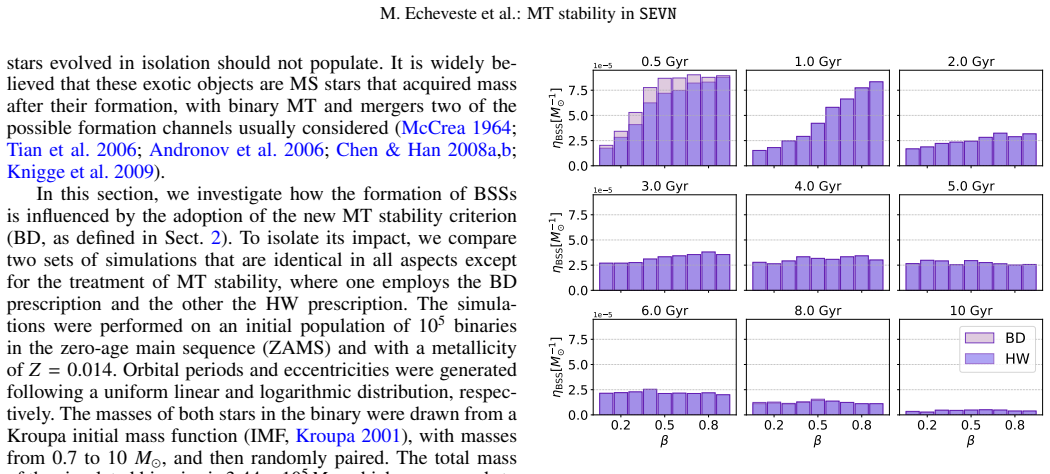
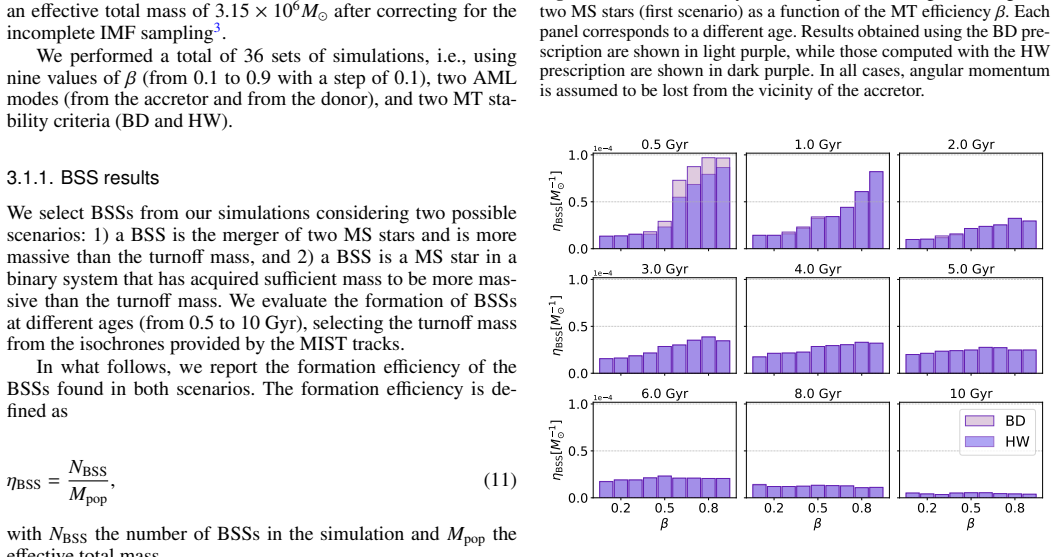
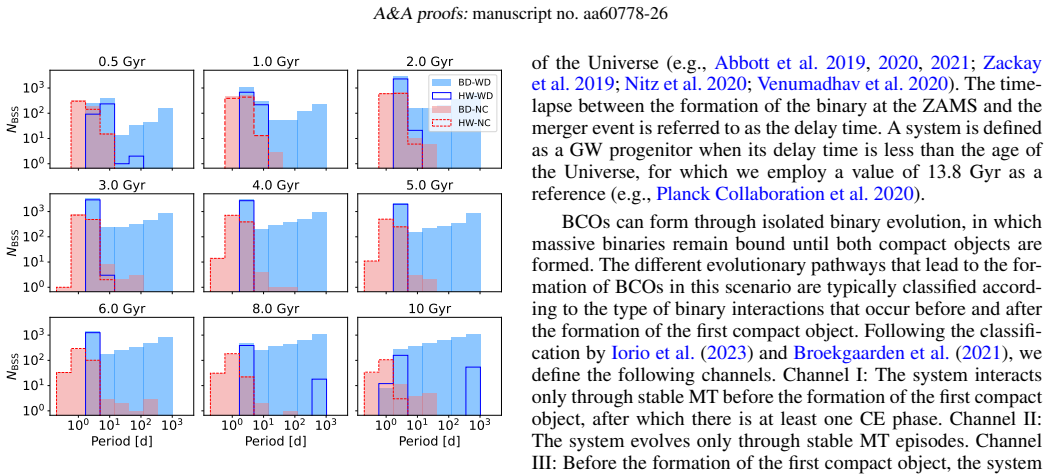
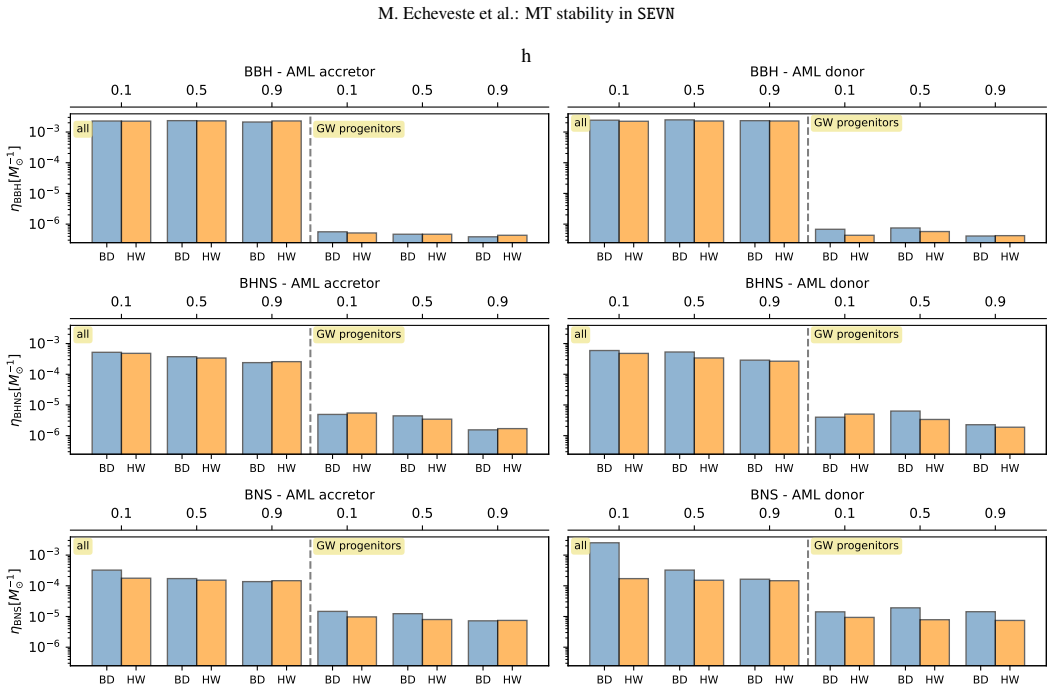
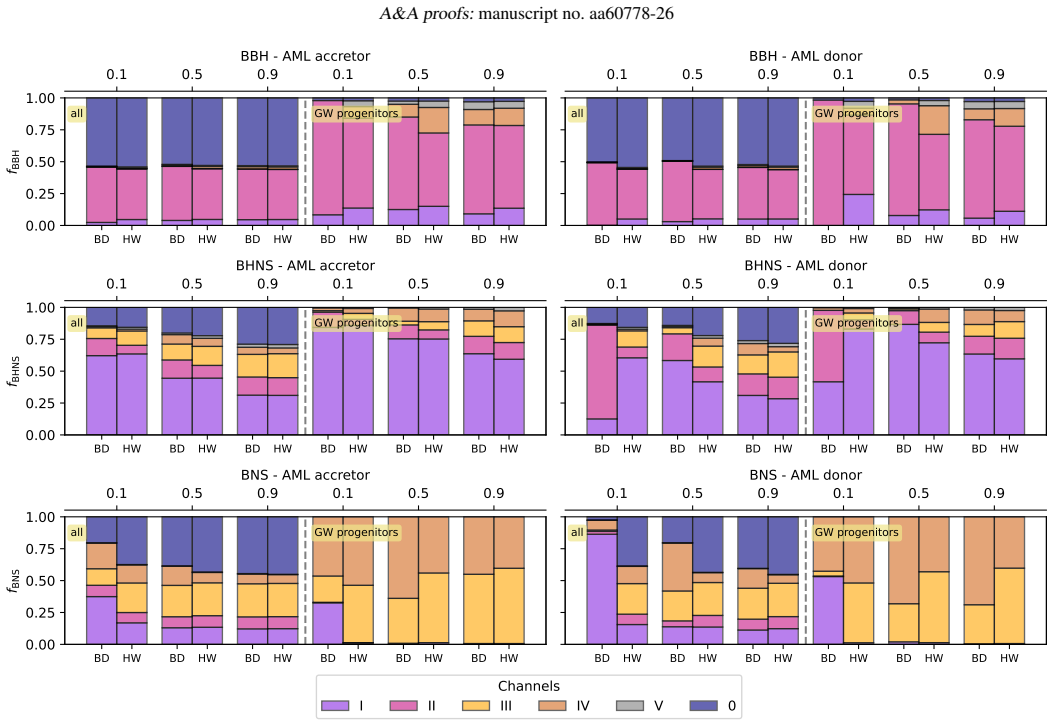
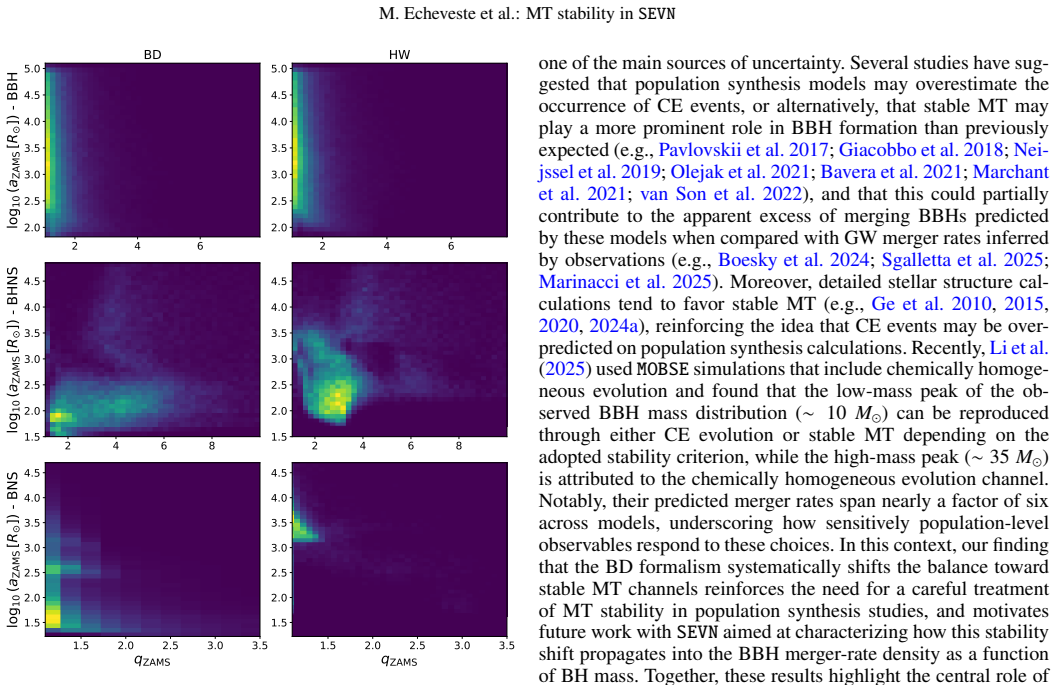
We derive an expression for the response of the Roche-lobe radius to mass loss in the general case where the mass and angular momentum of the system are not conserved. On the basis of this formulation, we construct a new mass transfer stability criterion that modifies the standard approach only through the Roche-lobe response term. Population synthesis simulations with SEVN show that the new criterion allows stable mass transfer in binaries with higher donor-to-accretor mass ratios, leading to an overall increase in the predicted number of blue stragglers and promoting their formation in wider orbits. For binary compact objects the impact varies across system types, with the strongest effect
What carries the argument
The modified Roche-lobe response term that accounts for simultaneous mass and angular-momentum loss in the mass-transfer stability criterion.
If this is right
- Stable mass transfer occurs at higher donor-to-accretor mass ratios than before.
- The total number of blue stragglers increases and their typical formation orbits become wider.
- Differences between predicted and observed blue-straggler populations are reduced.
- Channels involving stable mass transfer contribute more to neutron-star binaries and to some gravitational-wave progenitors when mass-transfer efficiency is low.
Where Pith is reading between the lines
- The same stability change could revise formation rates for other populations that rely on stable mass transfer, such as cataclysmic variables.
- Orbital-period measurements of field blue stragglers would provide a direct test of the wider-orbit prediction.
- The efficiency dependence implies that different mass-loss prescriptions could further shift the boundary between stable and unstable transfer.
Load-bearing premise
Modifying only the Roche-lobe response term while leaving every other part of the standard stability formalism unchanged is sufficient to capture the effect of non-conservative mass and angular-momentum loss on stability.
What would settle it
A direct comparison of the observed number and orbital-period distribution of blue stragglers in open clusters against the numbers produced by SEVN runs that use the new stability criterion versus the old one.
Figures
read the original abstract
Context: The stability of mass transfer through Roche-lobe overflow plays a key role in shaping the outcome of binary interactions. However, the criterion for mass transfer stability remains one of the main open questions in the theory of binary evolution. Aims: We develop a mass transfer stability prescription that accounts for mass and angular momentum loss, and implement it in the population synthesis code SEVN. We assess its impact relative to the standard formalism used in SEVN, using blue stragglers and binary compact objects as illustrative cases. Methods: We derive an expression for the response of the Roche-lobe radius to mass loss in the general case where the mass and angular momentum of the system are not conserved. On the basis of this formulation, we construct a new mass transfer stability criterion that modifies the standard approach only through the Roche-lobe response term. Results: Population synthesis simulations with SEVN show that the new criterion allows stable mass transfer in binaries with higher donor-to-accretor mass ratios, leading to an overall increase in the predicted number of blue stragglers and promoting their formation in wider orbits. This contributes to reconciling the differences between theory and observations. For binary compact objects, the impact of the new stability criterion varies across system types, with the strongest effects occurring in binaries containing at least one neutron star. In particular, for low mass transfer efficiency, the new criterion enhances the contribution of channels involving stable mass transfer and leads to a larger number of systems, including gravitational wave progenitors. Conclusion: The inclusion of a new, simple, yet more consistent prescription for mass transfer stability has proven that refining this criterion can significantly improve our understanding of the formation channels of specific stellar populations.
Editorial analysis
A structured set of objections, weighed in public.
Referee Report
Summary. The manuscript derives a generalized expression for the Roche-lobe radius response (d ln R_RL / d ln M_donor) that incorporates non-conservative mass-loss efficiency β and angular-momentum loss parameter γ. This single modified term is inserted into the standard stability criterion (ζ_donor < ζ_RL) without changes to the donor response or other formalism, and the resulting prescription is implemented in the SEVN population-synthesis code. Tests on blue stragglers and binary compact objects show that the new criterion permits stable mass transfer at higher donor-to-accretor mass ratios, increasing the predicted number of blue stragglers (especially in wider orbits) and altering formation channels for compact-object binaries, particularly those containing neutron stars under low mass-transfer efficiency.
Significance. If the central assumption holds, the work supplies a simple, parameter-light way to include non-conservative effects in stability criteria and demonstrates measurable impact on two observationally relevant populations. The SEVN implementation and the explicit focus on blue-straggler counts and gravitational-wave progenitors provide a concrete, falsifiable test of the prescription. Credit is due for the reproducible population-synthesis comparison and for isolating the effect to a single term rather than introducing new free parameters.
major comments (3)
- [§2] §2 (derivation of generalized ζ_RL): the manuscript replaces only the conservative Roche-lobe response while retaining the standard ζ_donor < ζ_RL threshold and the usual treatment of orbital angular-momentum loss; no explicit test is shown that coupled effects of instantaneous β on the effective mass ratio and on the specific angular momentum carried away do not require additional corrections to the stability condition itself.
- [Results (blue stragglers)] Results on blue stragglers (population-synthesis section): the reported increase in blue-straggler numbers and the shift to wider orbits are presented without comparison to detailed binary-evolution calculations or stellar-structure models that solve the full non-conservative mass-transfer problem; this validation step is load-bearing for the claim that the modified criterion reconciles theory and observations.
- [Results (binary compact objects)] Compact-object results: the statement that the strongest effects occur in neutron-star binaries and that stable-mass-transfer channels are enhanced is given without quantitative error analysis or sensitivity runs on β and γ, making it impossible to judge whether the reported changes exceed the uncertainties already present in SEVN.
minor comments (2)
- [§2] Notation for β and γ should be defined at first use and kept consistent with the standard literature (e.g., β as accreted fraction, γ as specific angular-momentum loss factor).
- [Figures] Figure captions for the population-synthesis histograms should state the exact values of β and γ adopted in each run and whether the same random seeds were used for the conservative and non-conservative cases.
Simulated Author's Rebuttal
We thank the referee for their constructive and detailed report. We address each major comment below, proposing revisions where they strengthen the manuscript without altering its core claims.
read point-by-point responses
-
Referee: [§2] §2 (derivation of generalized ζ_RL): the manuscript replaces only the conservative Roche-lobe response while retaining the standard ζ_donor < ζ_RL threshold and the usual treatment of orbital angular-momentum loss; no explicit test is shown that coupled effects of instantaneous β on the effective mass ratio and on the specific angular momentum carried away do not require additional corrections to the stability condition itself.
Authors: The derivation begins from the general expression for Roche-lobe radius under non-conservative mass transfer (β and γ) and yields a modified d ln R_RL / d ln M_donor that already folds in the instantaneous effects on orbital separation and mass ratio. The stability threshold is retained as ζ_donor < ζ_RL because this remains the definition of dynamical stability once the Roche-lobe response is correctly generalized; the orbital angular-momentum loss is handled by the existing SEVN equations. We therefore maintain that no further correction to the threshold is required. To clarify this point we will expand the discussion at the end of §2 with a short paragraph explaining why the coupled effects are captured within the present formulation. revision: partial
-
Referee: [Results (blue stragglers)] Results on blue stragglers (population-synthesis section): the reported increase in blue-straggler numbers and the shift to wider orbits are presented without comparison to detailed binary-evolution calculations or stellar-structure models that solve the full non-conservative mass-transfer problem; this validation step is load-bearing for the claim that the modified criterion reconciles theory and observations.
Authors: The study is a population-synthesis exploration whose purpose is to quantify the population-level consequences of the new criterion inside SEVN. Direct comparison with full non-conservative binary-evolution calculations would indeed provide stronger validation, but lies outside the scope of the present work. We will add an explicit limitations paragraph in the discussion section acknowledging this point and identifying it as desirable future work. The claim that the new criterion contributes to reconciling theory and observations is accordingly softened to reflect the population-synthesis nature of the evidence. revision: partial
-
Referee: [Results (binary compact objects)] Compact-object results: the statement that the strongest effects occur in neutron-star binaries and that stable-mass-transfer channels are enhanced is given without quantitative error analysis or sensitivity runs on β and γ, making it impossible to judge whether the reported changes exceed the uncertainties already present in SEVN.
Authors: We already explore the low-efficiency regime explicitly, but agree that a systematic sensitivity study is needed. In the revised manuscript we will add a dedicated subsection presenting results for a grid of β and γ values, together with a quantitative comparison of the induced changes against the dominant uncertainties already present in SEVN (common-envelope efficiency, supernova kicks, etc.). revision: yes
Circularity Check
No significant circularity; derivation of generalized Roche-lobe response is independent of its inputs
full rationale
The paper states it derives an expression for d ln R_RL / d ln M_donor incorporating mass-loss efficiency β and angular-momentum loss parameter γ, then substitutes this single modified term into the existing stability threshold ζ_donor < ζ_RL while leaving donor response and other formalism unchanged. No quoted step reduces the new criterion to a fitted parameter, self-citation chain, or tautological redefinition. The abstract and provided context contain no load-bearing self-citations or ansatzes smuggled via prior work by the same authors. This matches the default expectation of a self-contained derivation against external benchmarks.
Axiom & Free-Parameter Ledger
Reference graph
Works this paper leans on
-
[1]
P., Abbott, R., Abbott, T
Abbott, B. P., Abbott, R., Abbott, T. D., et al. 2020, The Astrophysical Journal Letters, 892, L3
2020
-
[2]
P., Abbott, R., Abbott, T
Abbott, B. P., Abbott, R., Abbott, T. D., et al. 2019, Phys. Rev. X, 9, 031040
2019
-
[3]
D., Abraham, S., et al
Abbott, R., Abbott, T. D., Abraham, S., et al. 2021, Phys. Rev. X, 11, 021053
2021
-
[4]
2023, MNRAS, 525, 933
Agrawal, P., Hurley, J., Stevenson, S., et al. 2023, MNRAS, 525, 933
2023
-
[5]
2020, MNRAS, 497, 4549
Agrawal, P., Hurley, J., Stevenson, S., Szécsi, D., & Flynn, C. 2020, MNRAS, 497, 4549
2020
-
[6]
Andrews, J. J., Bavera, S. S., Briel, M., et al. 2024, arXiv e-prints, arXiv:2411.02376
-
[7]
H., & Terndrup, D
Andronov, N., Pinsonneault, M. H., & Terndrup, D. M. 2006, ApJ, 646, 1160
2006
-
[8]
2010, MNRAS, 402, 371
Banerjee, S., Baumgardt, H., & Kroupa, P. 2010, MNRAS, 402, 371
2010
-
[9]
S., Fragos, T., Zevin, M., et al
Bavera, S. S., Fragos, T., Zevin, M., et al. 2021, A&A, 647, A153
2021
-
[10]
2002, ApJ, 572, 407
Belczynski, K., Kalogera, V ., & Bulik, T. 2002, ApJ, 572, 407
2002
-
[11]
A., et al
Belczynski, K., Kalogera, V ., Rasio, F. A., et al. 2008, ApJS, 174, 223
2008
-
[12]
E., et al
Belczynski, K., Klencki, J., Fields, C. E., et al. 2020, A&A, 636, A104
2020
-
[13]
P., Broekgaarden, F
Boesky, A. P., Broekgaarden, F. S., & Berger, E. 2024, ApJ, 976, 24
2024
-
[14]
2020, ApJ, 898, 71
Breivik, K., Coughlin, S., Zevin, M., et al. 2020, ApJ, 898, 71
2020
-
[15]
2018, ApJ, 854, L1
Breivik, K., Kremer, K., Bueno, M., et al. 2018, ApJ, 854, L1
2018
-
[16]
2012, MNRAS, 427, 127
Bressan, A., Marigo, P., Girardi, L., et al. 2012, MNRAS, 427, 127
2012
-
[17]
S., Berger, E., Neijssel, C
Broekgaarden, F. S., Berger, E., Neijssel, C. J., et al. 2021, MNRAS, 508, 5028
2021
-
[18]
L., & Rasio, F
Chatterjee, S., Rodriguez, C. L., & Rasio, F. A. 2017, ApJ, 834, 68
2017
-
[19]
R., Bailes, M., & Broekgaarden, F
Chattopadhyay, D., Stevenson, S., Hurley, J. R., Bailes, M., & Broekgaarden, F. 2021, MNRAS, 504, 3682
2021
-
[20]
2015, MNRAS, 452, 1068
Chen, Y ., Bressan, A., Girardi, L., et al. 2015, MNRAS, 452, 1068
2015
-
[21]
2016, ApJ, 823, 102
Choi, J., Dotter, A., Conroy, C., et al. 2016, ApJ, 823, 102
2016
-
[22]
Claeys, J. S. W., Pols, O. R., Izzard, R. G., Vink, J., & Verbunt, F. W. M. 2014, A&A, 563, A83
2014
-
[23]
2023, MNRAS, 525, 2891
Costa, G., Mapelli, M., Iorio, G., et al. 2023, MNRAS, 525, 2891
2023
-
[24]
G., Bressan, A., et al
Costa, G., Shepherd, K. G., Bressan, A., et al. 2025, A&A, 694, A193 De Donder, E. & Vanbeveren, D. 2004, New A Rev., 48, 861 de Mink, S. E., Pols, O. R., & Hilditch, R. W. 2007, A&A, 467, 1181
2025
-
[25]
& Toonen, S
Dorozsmai, A. & Toonen, S. 2024, MNRAS, 530, 3706
2024
-
[26]
& Escobar, G
Echeveste, M. & Escobar, G. J. 2026, AAA Workshop Series 14, in press
2026
-
[27]
Eggleton, P. P. 1983, ApJ, 268, 368
1983
-
[28]
J., Izzard, R
Eldridge, J. J., Izzard, R. G., & Tout, C. A. 2008, MNRAS, 384, 1109
2008
-
[29]
Eldridge, J. J. & Stanway, E. R. 2016, MNRAS, 462, 3302
2016
-
[30]
J., Stanway, E
Eldridge, J. J., Stanway, E. R., Xiao, L., et al. 2017, PASA, 34, e058
2017
-
[31]
Escobar, G. J. & Echeveste, M. 2026, AAA Workshop Series 14, in press
2026
-
[32]
J., Bavera, S
Fragos, T., Andrews, J. J., Bavera, S. S., et al. 2023, ApJS, 264, 45
2023
-
[33]
L., Belczynski, K., Wiktorowicz, G., et al
Fryer, C. L., Belczynski, K., Wiktorowicz, G., et al. 2012, ApJ, 749, 91 Article number, page 12 of 13 M. Echeveste et al.: MT stability inSEVN
2012
- [34]
-
[35]
S., Webbink, R
Ge, H., Hjellming, M. S., Webbink, R. F., Chen, X., & Han, Z. 2010, ApJ, 717, 724
2010
-
[36]
A., Chen, X., et al
Ge, H., Tout, C. A., Chen, X., et al. 2022, ApJ, 933, 137
2022
-
[37]
A., Chen, X., et al
Ge, H., Tout, C. A., Chen, X., et al. 2023, ApJ, 945, 7
2023
-
[38]
F., Chen, X., & Han, Z
Ge, H., Webbink, R. F., Chen, X., & Han, Z. 2015, ApJ, 812, 40
2015
-
[39]
F., Chen, X., & Han, Z
Ge, H., Webbink, R. F., Chen, X., & Han, Z. 2020, ApJ, 899, 132
2020
-
[40]
M., Latham, D
Geller, A. M., Latham, D. W., & Mathieu, R. D. 2015, AJ, 150, 97
2015
-
[41]
Geller, A. M. & Mathieu, R. D. 2011, Nature, 478, 356
2011
-
[42]
Geller, A. M. & Mathieu, R. D. 2012, AJ, 144, 54
2012
-
[43]
& Mapelli, M
Giacobbo, N. & Mapelli, M. 2018, MNRAS, 480, 2011
2018
-
[44]
& Mapelli, M
Giacobbo, N. & Mapelli, M. 2020, ApJ, 891, 141
2020
-
[45]
2018, MNRAS, 474, 2959
Giacobbo, N., Mapelli, M., & Spera, M. 2018, MNRAS, 474, 2959
2018
-
[46]
M., Mathieu, R
Gosnell, N. M., Mathieu, R. D., Geller, A. M., et al. 2015, ApJ, 814, 163
2015
-
[47]
Hjellming, M. S. & Webbink, R. F. 1987, ApJ, 318, 794
1987
-
[48]
R., Pols, O
Hurley, J. R., Pols, O. R., Aarseth, S. J., & Tout, C. A. 2005, MNRAS, 363, 293
2005
-
[49]
R., Pols, O
Hurley, J. R., Pols, O. R., & Tout, C. A. 2000, MNRAS, 315, 543
2000
-
[50]
R., Tout, C
Hurley, J. R., Tout, C. A., & Pols, O. R. 2002, MNRAS, 329, 897
2002
-
[51]
2023, MNRAS, 524, 426
Iorio, G., Mapelli, M., Costa, G., et al. 2023, MNRAS, 524, 426
2023
-
[52]
2013, A&A Rev., 21, 59
Ivanova, N., Justham, S., Chen, X., et al. 2013, A&A Rev., 21, 59
2013
-
[53]
G., Dray, L
Izzard, R. G., Dray, L. M., Karakas, A. I., Lugaro, M., & Tout, C. A. 2006, A&A, 460, 565
2006
-
[54]
G., Glebbeek, E., Stancliffe, R
Izzard, R. G., Glebbeek, E., Stancliffe, R. J., & Pols, O. R. 2009, A&A, 508, 1359
2009
-
[55]
G., Preece, H., Jofre, P., et al
Izzard, R. G., Preece, H., Jofre, P., et al. 2018, MNRAS, 473, 2984
2018
-
[56]
G., Tout, C
Izzard, R. G., Tout, C. A., Karakas, A. I., & Pols, O. R. 2004, MNRAS, 350, 407
2004
-
[57]
G., & Chruslinska, M
Klencki, J., Nelemans, G., Istrate, A. G., & Chruslinska, M. 2021, A&A, 645, A54
2021
-
[58]
G., & Pols, O
Klencki, J., Nelemans, G., Istrate, A. G., & Pols, O. 2020, A&A, 638, A55
2020
-
[59]
2009, Nature, 457, 288
Knigge, C., Leigh, N., & Sills, A. 2009, Nature, 457, 288
2009
-
[60]
2022, MNRAS, 515, 1228
Korol, V ., Belokurov, V ., & Toonen, S. 2022, MNRAS, 515, 1228
2022
-
[61]
2020, A&A, 638, A153
Korol, V ., Toonen, S., Klein, A., et al. 2020, A&A, 638, A153
2020
-
[62]
S., Rui, N
Kremer, K., Ye, C. S., Rui, N. Z., et al. 2020, ApJS, 247, 48
2020
-
[63]
2001, MNRAS, 322, 231
Kroupa, P. 2001, MNRAS, 322, 231
2001
-
[64]
U., Tauris, T
Kruckow, M. U., Tauris, T. M., Langer, N., Kramer, M., & Izzard, R. G. 2018, MNRAS, 481, 1908
2018
-
[65]
2024, MNRAS, 527, 9480
Lecroq, M., Charlot, S., Bressan, A., et al. 2024, MNRAS, 527, 9480
2024
-
[66]
Leiner, E. M. & Geller, A. 2021, ApJ, 908, 229
2021
-
[67]
2025, Phys
Li, L., Lü, G., Zhu, C., et al. 2025, Phys. Rev. D, 112, 103005
2025
-
[68]
2023, A&A, 669, A82
Li, Z., Chen, X., Ge, H., Chen, H.-L., & Han, Z. 2023, A&A, 669, A82
2023
-
[69]
J., van der Sluys, M
Loveridge, A. J., van der Sluys, M. V ., & Kalogera, V . 2011, ApJ, 743, 49
2011
-
[70]
2017, MNRAS, 472, 2422
Mapelli, M., Giacobbo, N., Ripamonti, E., & Spera, M. 2017, MNRAS, 472, 2422
2017
-
[71]
2020, ApJ, 888, 76
Mapelli, M., Spera, M., Montanari, E., et al. 2020, ApJ, 888, 76
2020
-
[72]
Marchant, P., Pappas, K. M. W., Gallegos-Garcia, M., et al. 2021, A&A, 650, A107 Marín Pina, D., Rastello, S., Gieles, M., et al. 2024, A&A, 688, L2
2021
-
[73]
2025, arXiv e-prints, arXiv:2510.06311
Marinacci, F., Baldi, M., Iorio, G., et al. 2025, arXiv e-prints, arXiv:2510.06311
-
[74]
Mathieu, R. D. & Geller, A. M. 2009, Nature, 462, 1032
2009
-
[75]
McCrea, W. H. 1964, MNRAS, 128, 147
1964
-
[76]
2024, A&A, 690, A106
Mestichelli, B., Mapelli, M., Torniamenti, S., et al. 2024, A&A, 690, A106
2024
-
[77]
J., Vigna-Gómez, A., Stevenson, S., et al
Neijssel, C. J., Vigna-Gómez, A., Stevenson, S., et al. 2019, MNRAS, 490, 3740
2019
-
[78]
R., Portegies Zwart, S
Nelemans, G., Yungelson, L. R., Portegies Zwart, S. F., & Verbunt, F. 2001, A&A, 365, 491
2001
-
[79]
D., Wood, P
Nie, J. D., Wood, P. R., & Nicholls, C. P. 2012, MNRAS, 423, 2764
2012
-
[80]
H., Dent, T., Davies, G
Nitz, A. H., Dent, T., Davies, G. S., et al. 2020, The Astrophysical Journal, 891, 123
2020
discussion (0)
Sign in with ORCID, Apple, or X to comment. Anyone can read and Pith papers without signing in.