Chromospheric magnetic field extrapolations reveal the flux-rope configuration of a solar filament
Pith reviewed 2026-06-27 12:07 UTC · model grok-4.3
The pith
Chromospheric vector magnetograms recover the flux-rope configuration of a solar filament that photosphere-only extrapolations misidentify.
A machine-rendered reading of the paper's core claim, the machinery that carries it, and where it could break.
Core claim
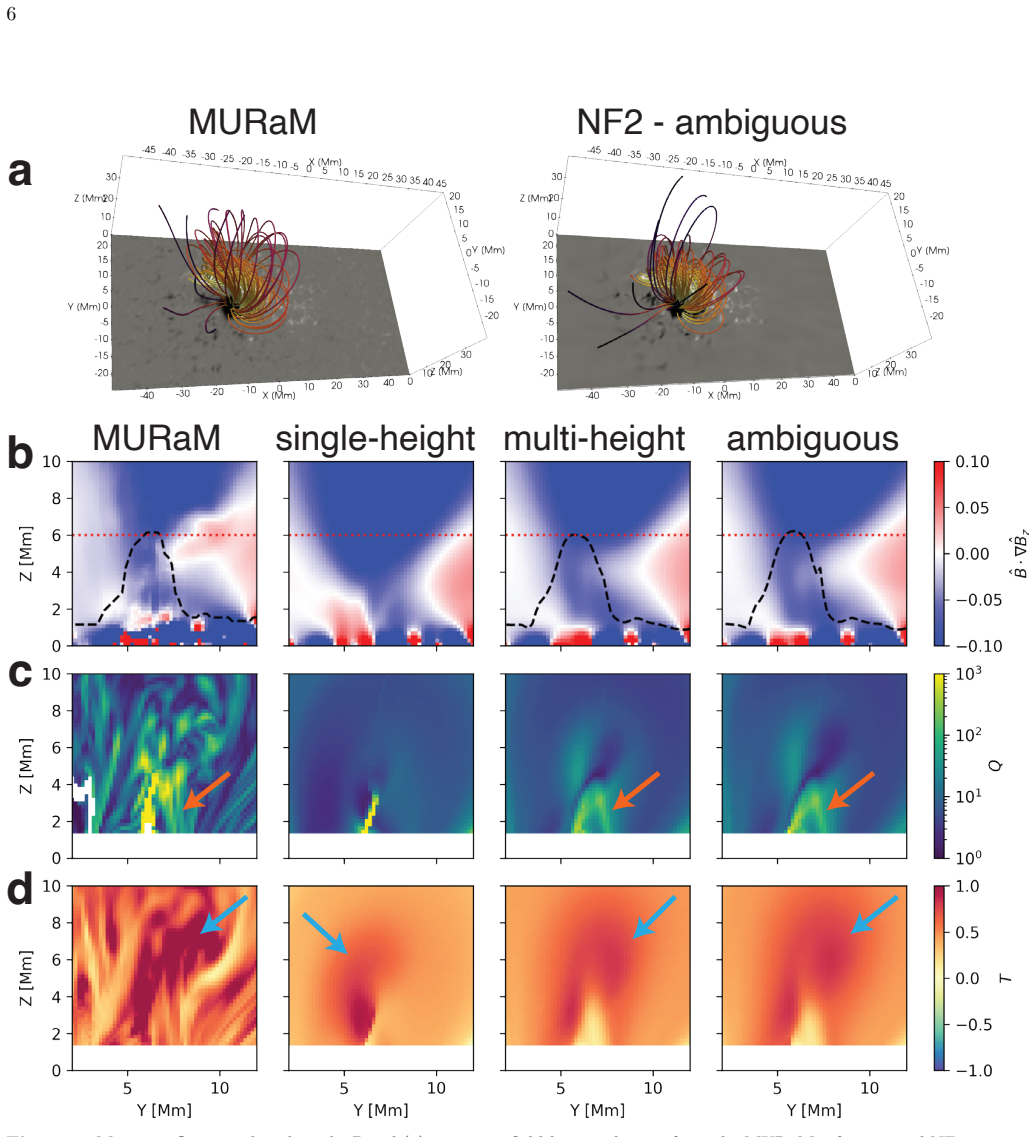
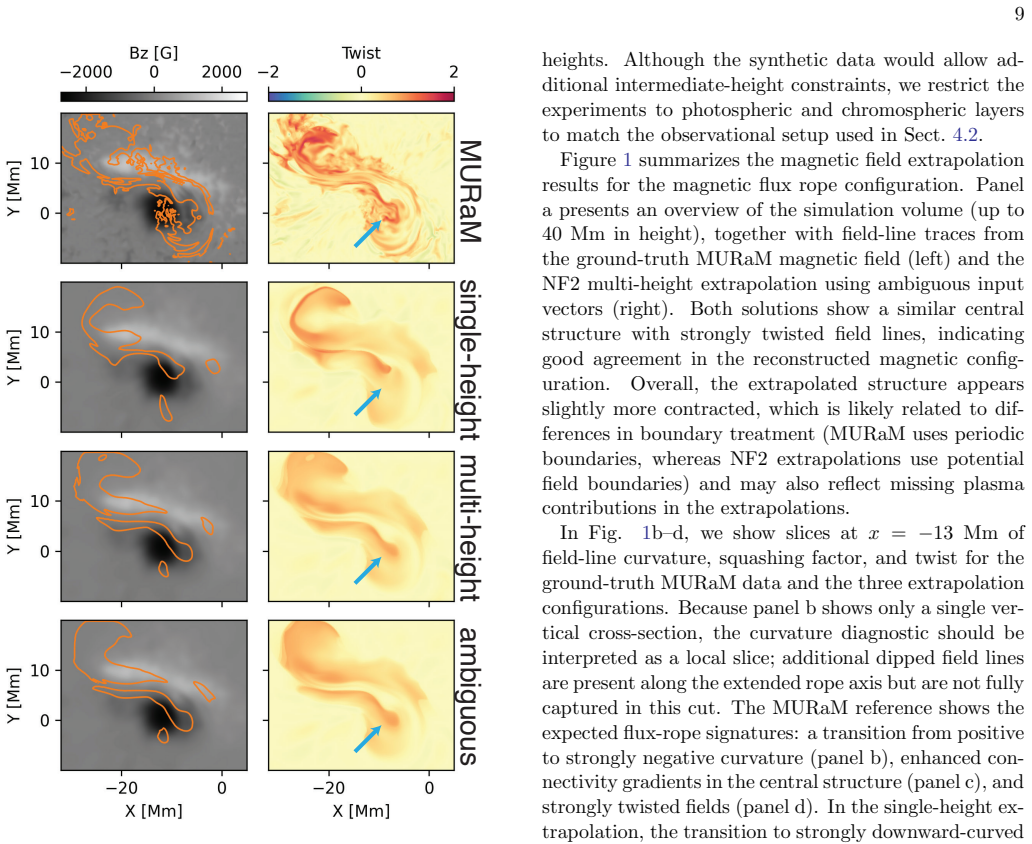
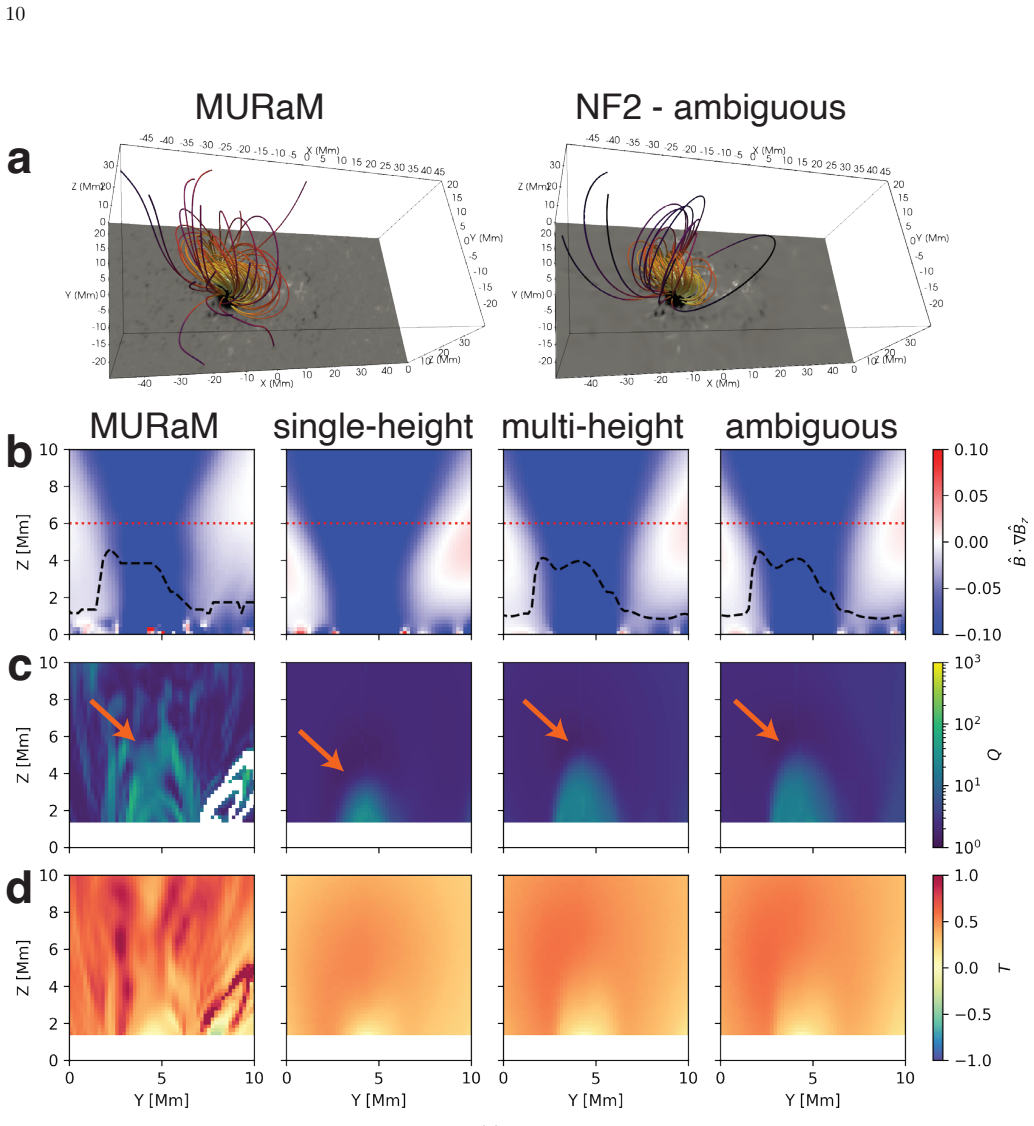
The central claim is that a unified multi-height optimization incorporating chromospheric vector magnetograms, while accounting for variable formation heights and the 180° azimuthal ambiguity, recovers the three-dimensional pre-eruptive magnetic configuration of a filament as a flux rope, whereas photosphere-only extrapolations do not.
What carries the argument
The multi-height optimization framework that merges photospheric and chromospheric vector magnetograms into one extrapolation while handling variable formation heights and the 180° azimuthal ambiguity.
If this is right
- Filament channels can be classified as flux ropes or sheared arcades before eruption with higher reliability.
- Instability thresholds for solar eruptions become testable using observed vector fields at two atmospheric heights.
- Magnetic energy storage in active regions can be diagnosed more precisely from combined photospheric-chromospheric data.
- The method supplies improved boundary conditions for modeling the onset of coronal mass ejections.
Where Pith is reading between the lines
- The same multi-height approach could be tested on quiescent filaments or prominences to check whether the flux-rope preference holds outside active regions.
- Routine chromospheric vector observations from future telescopes would allow statistical studies of how often pre-eruptive configurations are ropes versus arcades.
- The framework might resolve similar height ambiguities in extrapolations of other coronal structures such as sigmoids or coronal loops.
Load-bearing premise
The radiative magnetohydrodynamic simulations used for testing are representative of actual solar conditions and the optimization introduces no systematic bias from variable formation heights or ambiguity resolution.
What would settle it
Direct comparison of the extrapolated pre-eruptive field lines with the observed magnetic topology immediately after a filament eruption, checking whether the rope structure and its twist match the measured post-eruption changes.
Figures
read the original abstract
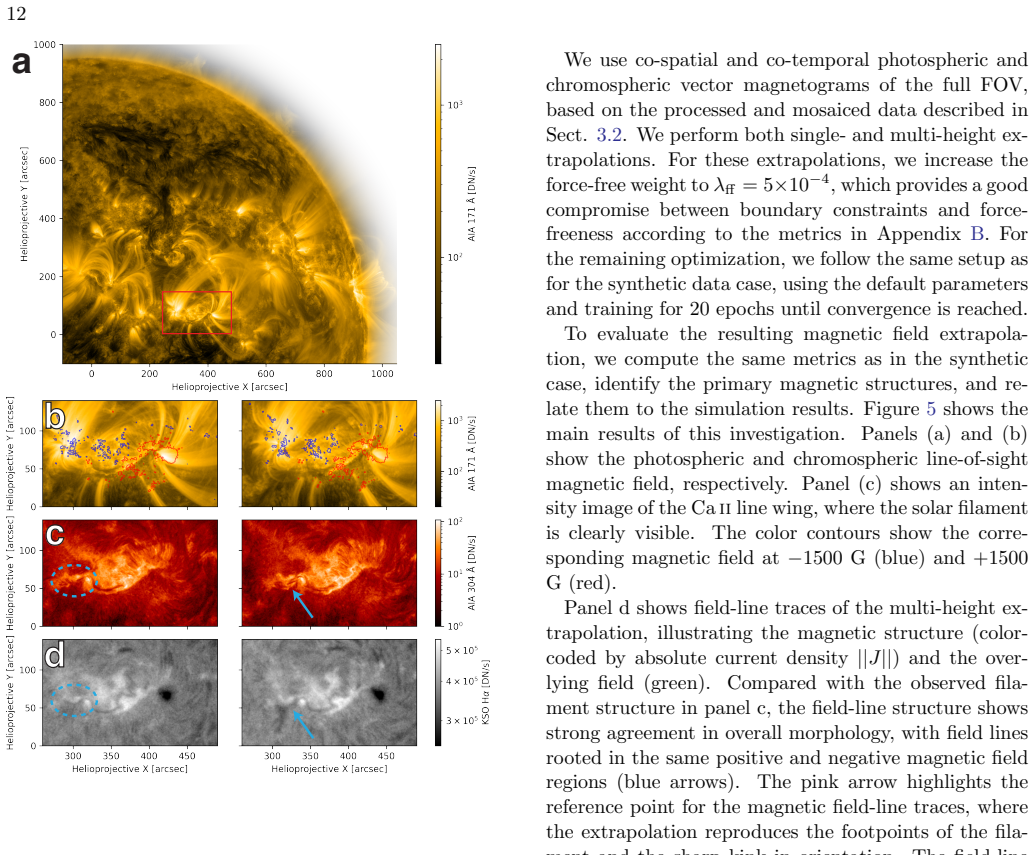
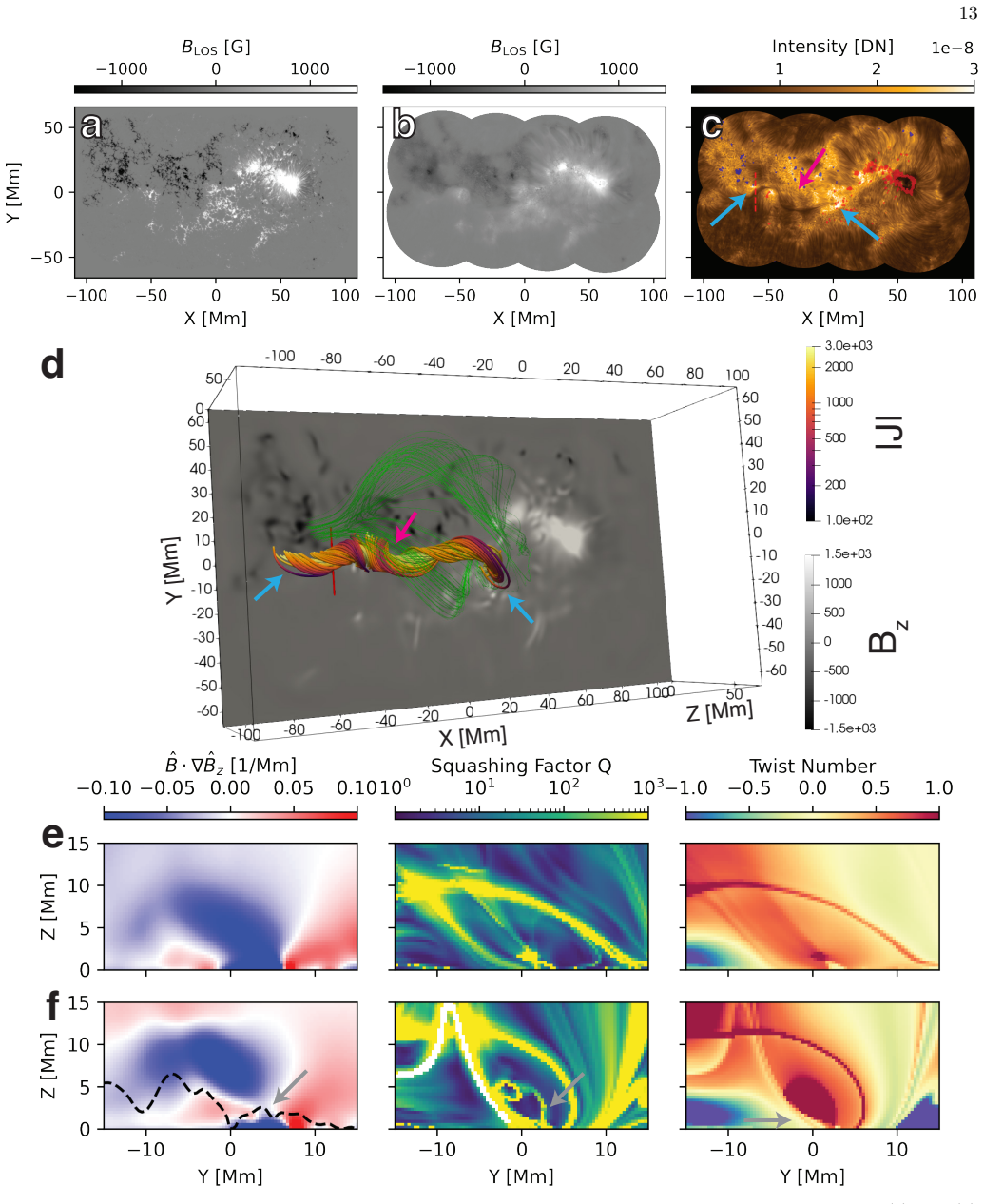
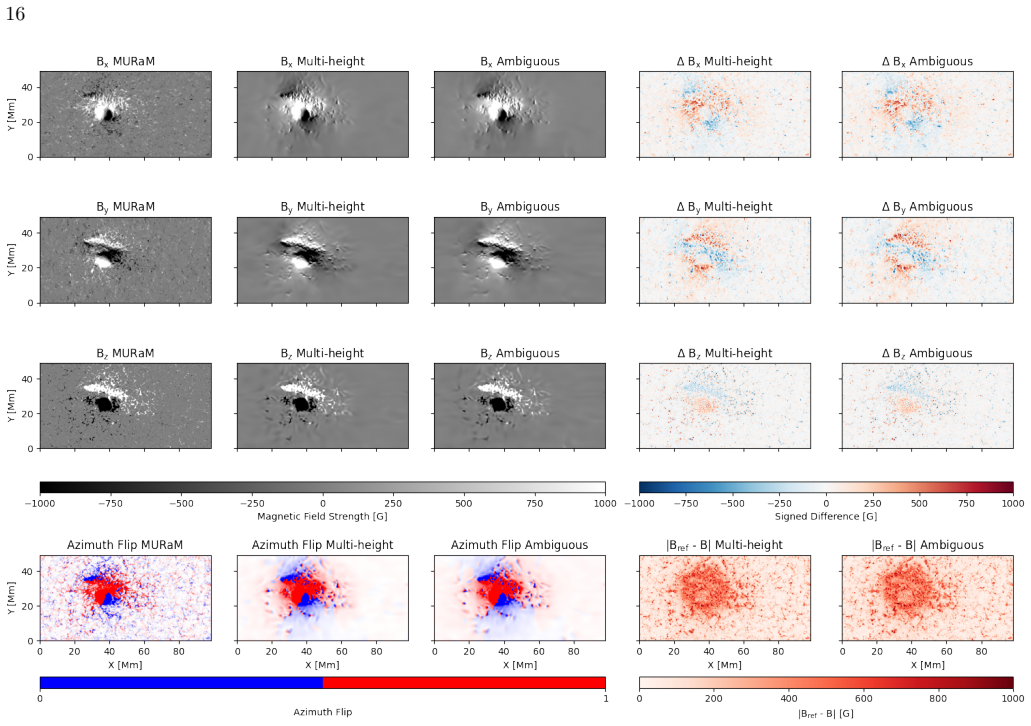
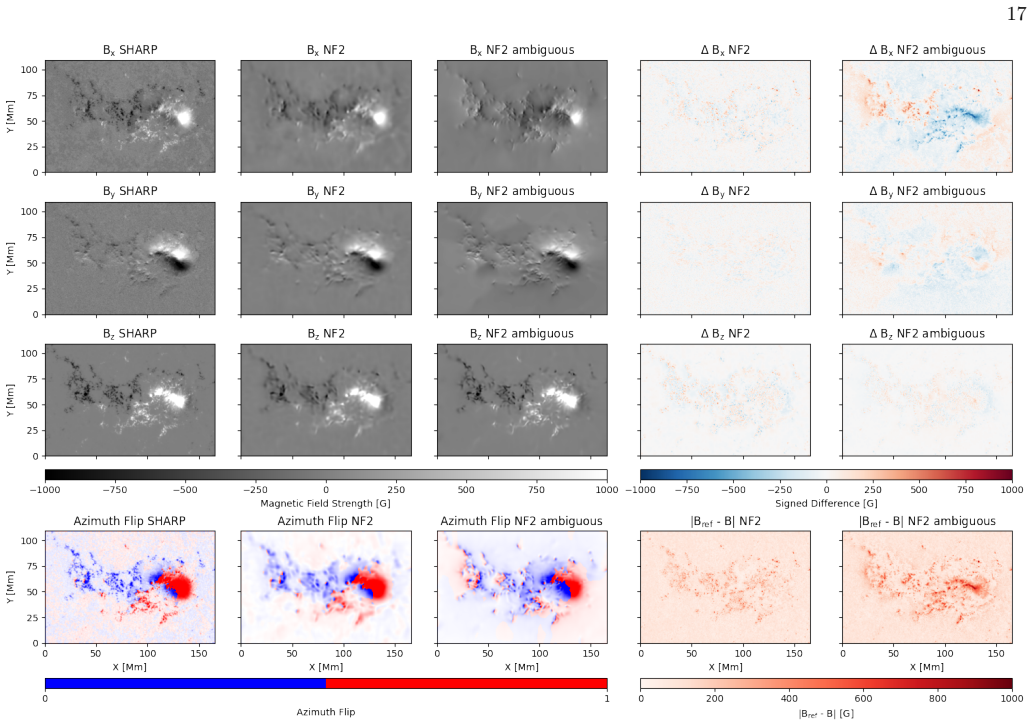
Solar eruptions are powered by the release of magnetic energy stored in the lower solar atmosphere, but the pre-eruptive magnetic configuration of filament channels remains difficult to determine. A central question is whether this energy is stored in a pre-existing magnetic flux rope or in a sheared arcade that forms a flux rope only during eruption. Resolving this ambiguity is critical for identifying instability thresholds and eruption triggers, yet photosphere-based extrapolations often provide insufficient constraints on the three-dimensional coronal field. Here, we introduce a data-driven magnetic field extrapolation framework that combines photospheric and chromospheric vector magnetograms in a unified multi-height optimization, while accounting for variable chromospheric formation heights and the 180{\deg} azimuthal ambiguity. Tests with radiative magnetohydrodynamic simulations show that photosphere-only extrapolations can misidentify the pre-eruptive magnetic configuration, whereas chromospheric vector constraints recover the three-dimensional structure substantially more accurately. Applied to multi-line spectropolarimetric observations of an active region filament obtained with the Swedish Solar Telescope, the method reveals a reconstructed magnetic field consistent with a pre-eruptive flux-rope configuration. These results show that chromospheric vector magnetic measurements can provide decisive constraints on filament magnetic configuration and open a path toward diagnosing magnetic-energy storage and instability in eruptive solar active regions.
Editorial analysis
A structured set of objections, weighed in public.
Referee Report
Summary. The paper introduces a unified multi-height magnetic field extrapolation framework that incorporates both photospheric and chromospheric vector magnetograms while accounting for variable chromospheric formation heights and the 180° azimuthal ambiguity. RMHD simulation tests indicate that photosphere-only extrapolations can misidentify pre-eruptive configurations, whereas adding chromospheric constraints recovers the 3D structure more accurately. Application to Swedish Solar Telescope multi-line spectropolarimetric observations of an active-region filament yields a reconstructed field consistent with a pre-eruptive flux-rope topology.
Significance. If validated, the method offers a practical route to tighter constraints on filament magnetic energy storage and instability thresholds, addressing a long-standing limitation of photosphere-only extrapolations. The provision of simulation benchmarks that directly compare recovery accuracy with and without chromospheric data, together with an observational demonstration on real multi-height data, constitutes a concrete strength.
major comments (2)
- [Simulation tests] Simulation tests section: the headline claim that chromospheric vector constraints recover pre-eruptive flux-rope topology where photosphere-only extrapolations fail rests on RMHD benchmarks, yet no quantitative error metrics (vector correlation, topology invariants, or height-dependent discrepancy) are reported in the abstract or summary of results; without these, the magnitude of the claimed accuracy gain cannot be assessed.
- [Methods / multi-height optimization] Multi-height optimization description: the assertion that the scheme correctly incorporates variable chromospheric formation heights and resolves the 180° ambiguity without introducing systematic topology bias is central to transferring the simulation results to the observational case, but the manuscript provides no dedicated sensitivity tests or bias diagnostics (e.g., controlled ambiguity flips or height-weight variations) that would confirm absence of systematic error.
minor comments (2)
- [Abstract] Abstract: the phrase 'substantially more accurately' is used without accompanying numerical values; a brief quantitative statement would strengthen the summary.
- [Methods] Notation for formation-height weighting parameters should be defined explicitly at first use and kept consistent across equations and figures.
Simulated Author's Rebuttal
We thank the referee for the constructive comments and positive assessment of the work's significance. We address each major comment below.
read point-by-point responses
-
Referee: [Simulation tests] Simulation tests section: the headline claim that chromospheric vector constraints recover pre-eruptive flux-rope topology where photosphere-only extrapolations fail rests on RMHD benchmarks, yet no quantitative error metrics (vector correlation, topology invariants, or height-dependent discrepancy) are reported in the abstract or summary of results; without these, the magnitude of the claimed accuracy gain cannot be assessed.
Authors: We agree that quantitative metrics would allow a clearer assessment of the improvement. The revised manuscript adds vector correlation coefficients, mean angular error, and topology recovery fractions (e.g., percentage of correctly oriented field lines) to the simulation tests section and updates the abstract to report the specific gains (approximately 25-40% improvement in vector correlation depending on height). revision: yes
-
Referee: [Methods / multi-height optimization] Multi-height optimization description: the assertion that the scheme correctly incorporates variable chromospheric formation heights and resolves the 180° ambiguity without introducing systematic topology bias is central to transferring the simulation results to the observational case, but the manuscript provides no dedicated sensitivity tests or bias diagnostics (e.g., controlled ambiguity flips or height-weight variations) that would confirm absence of systematic error.
Authors: We acknowledge that explicit sensitivity diagnostics strengthen the case. The revised methods section now includes a dedicated subsection with controlled tests: (i) varying chromospheric formation heights by ±100 km and (ii) systematic 180° ambiguity flips on subsets of pixels. These confirm that the recovered flux-rope topology remains stable with no detectable systematic bias in the simulation ground-truth comparisons. revision: yes
Circularity Check
No significant circularity; derivation relies on external RMHD benchmarks and independent observations
full rationale
The paper introduces a unified multi-height extrapolation framework that incorporates chromospheric vector data, variable formation heights, and 180° ambiguity resolution. Its central claim—that chromospheric constraints recover pre-eruptive flux-rope topology where photosphere-only methods fail—is validated through tests on radiative MHD simulations (external to the method) and application to Swedish Solar Telescope multi-line observations. No equations reduce the output topology to a fitted input by construction, no self-citation chains bear the load-bearing premise, and no ansatz or uniqueness theorem is smuggled in. The result is a data-driven reconstruction whose accuracy is assessed against independent simulation ground truth, rendering the derivation self-contained.
Axiom & Free-Parameter Ledger
free parameters (1)
- multi-height optimization weights
axioms (2)
- domain assumption The coronal magnetic field satisfies a force-free or similar equilibrium condition suitable for extrapolation from boundary data.
- domain assumption Chromospheric vector magnetograms can be treated as reliable boundary constraints once formation-height variability and 180° ambiguity are accounted for.
Reference graph
Works this paper leans on
-
[1]
Amari, T., Luciani, J. F., Mikic, Z., & Linker, J. 1999, ApJL, 518, L57, doi: 10.1086/312053
-
[2]
Antiochos, S. K., Dahlburg, R. B., & Klimchuk, J. A. 1994, ApJL, 420, L41, doi: 10.1086/187158 Astropy Collaboration, Robitaille, T. P., Tollerud, E. J., et al. 2013, A&A, 558, A33, doi: 10.1051/0004-6361/201322068 Astropy Collaboration, Price-Whelan, A. M., Sip˝ ocz, B. M., et al. 2018, AJ, 156, 123, doi: 10.3847/1538-3881/aabc4f Astropy Collaboration, P...
-
[3]
Aulanier, G., DeVore, C. R., & Antiochos, S. K. 2002, ApJL, 567, L97, doi: 10.1086/339436
-
[4]
Aulanier, G., T¨ or¨ ok, T., D´ emoulin, P., & DeLuca, E. E. 2010, ApJ, 708, 314, doi: 10.1088/0004-637X/708/1/314
-
[5]
Barnes, W. T., Bobra, M. G., Christe, S. D., et al. 2020, The Astrophysical Journal, 890, 68 Bjørgen, J. P., Leenaarts, J., Rempel, M., et al. 2019, A&A, 631, A33, doi: 10.1051/0004-6361/201834919
-
[6]
Bobra, M. G., Sun, X., Hoeksema, J. T., et al. 2014, SoPh, 289, 3549, doi: 10.1007/s11207-014-0529-3
-
[7]
2023, ApJL, 950, L3, doi: 10.3847/2041-8213/acda2e da Silva Santos, J
Chen, F., Rempel, M., & Fan, Y. 2023, ApJL, 950, L3, doi: 10.3847/2041-8213/acda2e da Silva Santos, J. M., Dunnington, E., Jarolim, R.,
-
[8]
2025, ApJ, 985, 157, doi: 10.3847/1538-4357/adcf23 de la Cruz Rodr´ ıguez, J
Danilovic, S., & Criscuoli, S. 2025, ApJ, 985, 157, doi: 10.3847/1538-4357/adcf23 de la Cruz Rodr´ ıguez, J. 2019, A&A, 631, A153, doi: 10.1051/0004-6361/201936635 de Wijn, A. G., Casini, R., Carlile, A., et al. 2022, SoPh, 297, 22, doi: 10.1007/s11207-022-01954-1
-
[9]
DeVore, C. R., & Antiochos, S. K. 2000, ApJ, 539, 954, doi: 10.1086/309275
-
[10]
Downs, C., Linker, J. A., Caplan, R. M., et al. 2025, Science, 388, 1306, doi: 10.1126/science.adq0872 19 Erd´ elyi, R., Kors´ os, M. B., Huang, X., et al. 2022, Journal of Space Weather and Space Climate, 12, 2, doi: 10.1051/swsc/2021025
-
[11]
2012, ApJ, 758, 60, doi: 10.1088/0004-637X/758/1/60
Fan, Y. 2012, ApJ, 758, 60, doi: 10.1088/0004-637X/758/1/60
-
[12]
2017, ApJ, 844, 26, doi: 10.3847/1538-4357/aa7a56
Fan, Y. 2017, ApJ, 844, 26, doi: 10.3847/1538-4357/aa7a56
-
[13]
Fan, Y., & Gibson, S. E. 2004, ApJ, 609, 1123, doi: 10.1086/421238
-
[14]
2022, in Society of Photo-Optical Instrumentation Engineers (SPIE) Conference Series, Vol
Woodruff, R. 2022, in Society of Photo-Optical Instrumentation Engineers (SPIE) Conference Series, Vol. 12181, Space Telescopes and Instrumentation 2022: Ultraviolet to Gamma Ray, ed. J.-W. A. den Herder, S. Nikzad, & K. Nakazawa, 121813R, doi: 10.1117/12.2630386
-
[15]
Gibson, S. E. 2018, Living Reviews in Solar Physics, 15, 7, doi: 10.1007/s41116-018-0016-2
-
[16]
Gibson, S. E., Kucera, T. A., Rastawicki, D., et al. 2010, ApJ, 724, 1133, doi: 10.1088/0004-637X/724/2/1133
-
[17]
2018, SSRv, 214, 46, doi: 10.1007/s11214-017-0462-5 Guit´ e, L.-S., Strugarek, A., & Charbonneau, P
Veronig, A. 2018, SSRv, 214, 46, doi: 10.1007/s11214-017-0462-5 Guit´ e, L.-S., Strugarek, A., & Charbonneau, P. 2025, A&A, 694, A74, doi: 10.1051/0004-6361/202452381
-
[18]
2024, Reviews of Modern Plasma Physics, 8, 29, doi: 10.1007/s41614-024-00167-2
Guo, Y., Guo, J., Ni, Y., et al. 2024, Reviews of Modern Plasma Physics, 8, 29, doi: 10.1007/s41614-024-00167-2
-
[19]
SOLIS-VSM Solar Vector Magnetograms
Henney, C. J., Keller, C. U., & Harvey, J. W. 2006, in Astronomical Society of the Pacific Conference Series, Vol. 358, Solar Polarization 4, ed. R. Casini & B. W. Lites, 92, doi: 10.48550/arXiv.astro-ph/0612584
work page internal anchor Pith review Pith/arXiv arXiv doi:10.48550/arxiv.astro-ph/0612584 2006
-
[20]
2026, RobertJaro/NF2: NF2 v0.4.1, v0.4.1 Zenodo, doi: 10.5281/zenodo.20533552
Jarolim, R. 2026, RobertJaro/NF2: NF2 v0.4.1, v0.4.1 Zenodo, doi: 10.5281/zenodo.20533552
-
[21]
2023, Nature Astronomy, doi: 10.1038/s41550-023-02030-9
Podladchikova, T. 2023, Nature Astronomy, doi: 10.1038/s41550-023-02030-9
-
[22]
2024a, ApJL, 963, L21, doi: 10.3847/2041-8213/ad2450
Jarolim, R., Tremblay, B., Rempel, M., et al. 2024a, ApJL, 963, L21, doi: 10.3847/2041-8213/ad2450
-
[23]
2024b, ApJL, 976, L12, doi: 10.3847/2041-8213/ad8914
Rempel, M. 2024b, ApJL, 976, L12, doi: 10.3847/2041-8213/ad8914
-
[24]
2025, ApJS, 277, 54, doi: 10.3847/1538-4365/adbaea
Jeon, M., Jeong, H.-J., Moon, Y.-J., Kang, J., & Kusano, K. 2025, ApJS, 277, 54, doi: 10.3847/1538-4365/adbaea
-
[25]
2022, The Innovation, 3
Jiang, C., Feng, X., Guo, Y., & Hu, Q. 2022, The Innovation, 3
2022
-
[26]
2016, Research in Astronomy and Astrophysics, 16, 15, doi: 10.1088/1674-4527/16/1/015
Jiang, C.-W., & Feng, X.-S. 2016, Research in Astronomy and Astrophysics, 16, 15, doi: 10.1088/1674-4527/16/1/015
-
[27]
2025, in 2025 IEEE Aerospace Conference, IEEE, 1–9 Kors´ os, M
Kalinowski, W., Porter, B., Dissly, R., et al. 2025, in 2025 IEEE Aerospace Conference, IEEE, 1–9 Kors´ os, M. B., Jarolim, R., Erd´ elyi, R., et al. 2024, ApJ, 962, 171, doi: 10.3847/1538-4357/ad18bd Kors´ os, M. B., Georgoulis, M. K., Gyenge, N., et al. 2020, ApJ, 896, 119, doi: 10.3847/1538-4357/ab8fa2
-
[28]
2019, ApJ, 874, 126, doi: 10.3847/1538-4357/ab08e9
Kuridze, D., Mathioudakis, M., Morgan, H., et al. 2019, ApJ, 874, 126, doi: 10.3847/1538-4357/ab08e9
-
[29]
Lemen, J. R., Title, A. M., Akin, D. J., et al. 2012, SoPh, 275, 17, doi: 10.1007/s11207-011-9776-8
-
[30]
Metcalf, T. R., Jiao, L., McClymont, A. N., Canfield, R. C., & Uitenbroek, H. 1995, ApJ, 439, 474, doi: 10.1086/175188
-
[31]
552(2):833--848, doi:10.1086/320559
Moore, R. L., Sterling, A. C., Hudson, H. S., & Lemen, J. R. 2001, ApJ, 552, 833, doi: 10.1086/320559
-
[32]
2020, A&A, 642, A210, doi: 10.1051/0004-6361/202038754
Yadav, R. 2020, A&A, 642, A210, doi: 10.1051/0004-6361/202038754
-
[33]
J., Christe, S., Freij, N., et al
Mumford, S. J., Christe, S., Freij, N., et al. 2020, SunPy, v1.1.4 Zenodo, doi: 10.5281/zenodo.3871057
-
[34]
2020, A&A, 642, A109, doi: 10.1051/0004-6361/202038832 Orozco Su´ arez, D., Bellot Rubio, L
Zhang, J. 2020, A&A, 642, A109, doi: 10.1051/0004-6361/202038832 Orozco Su´ arez, D., Bellot Rubio, L. R., V¨ ogler, A., & Del Toro Iniesta, J. C. 2010, A&A, 518, A2, doi: 10.1051/0004-6361/200913421 Orozco Su´ arez, D., & Del Toro Iniesta, J. C. 2007, A&A, 462, 1137, doi: 10.1051/0004-6361:20066201
-
[35]
2014, Living Reviews in Solar Physics, 11, 1, doi: 10.12942/lrsp-2014-1
Parenti, S. 2014, Living Reviews in Solar Physics, 11, 1, doi: 10.12942/lrsp-2014-1
-
[36]
2019, in Advances in Neural Information Processing Systems 32, ed
Paszke, A., Gross, S., Massa, F., et al. 2019, in Advances in Neural Information Processing Systems 32, ed. H. Wallach, H. Larochelle, A. Beygelzimer, F. d'Alch´ e-Buc, E. Fox, & R. Garnett (Curran
2019
-
[37]
2020, SSRv, 216, 131, doi: 10.1007/s11214-020-00757-9
Patsourakos, S., Vourlidas, A., T¨ or¨ ok, T., et al. 2020, SSRv, 216, 131, doi: 10.1007/s11214-020-00757-9
-
[38]
Pesnell, W. D., Thompson, B. J., & Chamberlin, P. C. 2012, Solar Physics, 275, 3, doi: 10.1007/s11207-011-9841-3
-
[39]
Pietrow, A. G. M., Kiselman, D., de la Cruz Rodr´ ıguez, J., et al. 2020, A&A, 644, A43, doi: 10.1051/0004-6361/202038750 P¨ otzi, W., Veronig, A., Jarolim, R., et al. 2021, Solar Physics, 296, 164
-
[40]
2020, ApJ, 903, 129, doi: 10.3847/1538-4357/abb8d2
Prasad, A., Dissauer, K., Hu, Q., et al. 2020, ApJ, 903, 129, doi: 10.3847/1538-4357/abb8d2
-
[41]
Thalmann, J. K. 2025, A&A, 701, A249, doi: 10.1051/0004-6361/202555860
-
[42]
2017, ApJ, 834, 10, doi: 10.3847/1538-4357/834/1/10
Rempel, M. 2017, ApJ, 834, 10, doi: 10.3847/1538-4357/834/1/10 20
-
[43]
Rempel, M., Chintzoglou, G., Cheung, M. C. M., Fan, Y., & Kleint, L. 2023, ApJ, 955, 105, doi: 10.3847/1538-4357/aced4d Sanchez Almeida, J., & Lites, B. W. 1992, ApJ, 398, 359, doi: 10.1086/171861
-
[44]
A., Petrie, G., Kuhn, J., et al
Schad, T. A., Petrie, G., Kuhn, J., et al. 2024, Science Advances, 10, eadq1604, doi: 10.1126/sciadv.adq1604
-
[45]
Scharmer, G. B., Bjelksjo, K., Korhonen, T. K., Lindberg, B., & Petterson, B. 2003, in Society of Photo-Optical Instrumentation Engineers (SPIE) Conference Series, Vol. 4853, Innovative Telescopes and Instrumentation for Solar Astrophysics, ed. S. L. Keil & S. V. Avakyan, 341–350, doi: 10.1117/12.460377
-
[46]
B., Narayan, G., Hillberg, T., et al
Scharmer, G. B., Narayan, G., Hillberg, T., et al. 2008, ApJL, 689, L69, doi: 10.1086/595744
-
[47]
2024, Reviews of Modern Plasma Physics, 8, 27, doi: 10.1007/s41614-024-00166-3
Schmieder, B., Guo, J., & Poedts, S. 2024, Reviews of Modern Plasma Physics, 8, 27, doi: 10.1007/s41614-024-00166-3
-
[48]
Schou, J., Scherrer, P. H., Bush, R. I., et al. 2012, SoPh, 275, 229, doi: 10.1007/s11207-011-9842-2
-
[49]
Solanki, S. K. 2003, A&A Rv, 11, 153, doi: 10.1007/s00159-003-0018-4
-
[50]
2020, Advances in Neural Information Processing Systems, 33, 7537
Tancik, M., Srinivasan, P., Mildenhall, B., et al. 2020, Advances in Neural Information Processing Systems, 33, 7537
2020
-
[51]
Titov, V. S. 2007, ApJ, 660, 863, doi: 10.1086/512671
-
[52]
S., & D´ emoulin, P
Titov, V. S., & D´ emoulin, P. 1999, A&A, 351, 707
1999
-
[53]
S., Hornig, G., & D´ emoulin, P
Titov, V. S., Hornig, G., & D´ emoulin, P. 2002, Journal of Geophysical Research (Space Physics), 107, 1164, doi: 10.1029/2001JA000278
-
[54]
Tomczyk, S., McIntosh, S. W., Keil, S. L., et al. 2007, Science, 317, 1192, doi: 10.1126/science.1143304 van Ballegooijen, A. A., & Martens, P. C. H. 1989, ApJ, 343, 971, doi: 10.1086/167766
-
[55]
Vourlidas, A., Lynch, B. J., Howard, R. A., & Li, Y. 2013, SoPh, 284, 179, doi: 10.1007/s11207-012-0084-8
-
[56]
2021, Living Reviews in Solar Physics, 18, 1, doi: 10.1007/s41116-020-00027-4
Wiegelmann, T., & Sakurai, T. 2021, Living Reviews in Solar Physics, 18, 1, doi: 10.1007/s41116-020-00027-4
-
[57]
2025, ApJ, 993, 146, doi: 10.3847/1538-4357/ae0f90
Yang, H., Liu, Z., Zuo, P., et al. 2025, ApJ, 993, 146, doi: 10.3847/1538-4357/ae0f90
-
[58]
2024, Science, 386, 76, doi: 10.1126/science.ado2993
Yang, Z., Tian, H., Tomczyk, S., et al. 2024, Science, 386, 76, doi: 10.1126/science.ado2993
-
[59]
Yang, Z., Bethge, C., Tian, H., et al. 2020, Science, 369, 694, doi: 10.1126/science.abb4462 Yelles Chaouche, L., Kuckein, C., Mart´ ınez Pillet, V., &
-
[60]
2012, ApJ, 748, 23, doi: 10.1088/0004-637X/748/1/23
Moreno-Insertis, F. 2012, ApJ, 748, 23, doi: 10.1088/0004-637X/748/1/23
-
[61]
2022, ApJ, 937, 26, doi: 10.3847/1538-4357/ac8d61
Zhang, P., Chen, J., Liu, R., & Wang, C. 2022, ApJ, 937, 26, doi: 10.3847/1538-4357/ac8d61
-
[62]
2024, Space Weather, 22, e2024SW003875, doi: 10.1029/2024SW003875
Zhao, J., & Feng, X. 2024, Space Weather, 22, e2024SW003875, doi: 10.1029/2024SW003875
discussion (0)
Sign in with ORCID, Apple, or X to comment. Anyone can read and Pith papers without signing in.