REVIEW 3 major objections 4 minor 1 cited by
The quenching and morphological evolution of central galaxies is facilitated by the feedback-driven expulsion of circumgalactic gas
T0 review · 3 major / 4 minor · reviewed 2026-08-14 · deepseek-v4-flash
Pith's one-line read Two major galaxy simulations agree that AGN feedback quenches galaxies by expelling the circumgalactic gas that would otherwise fuel star formation.
desk verdict Solid cross-simulation confirmation of the f_CGM correlations with galaxy properties; the causal 'expulsion' mechanism is honestly flagged as inferred, not demonstrated. read the letter →
The pith
A machine-rendered reading of the paper's core claim, the machinery that carries it, and where it could break.
The reading
What carries the argument
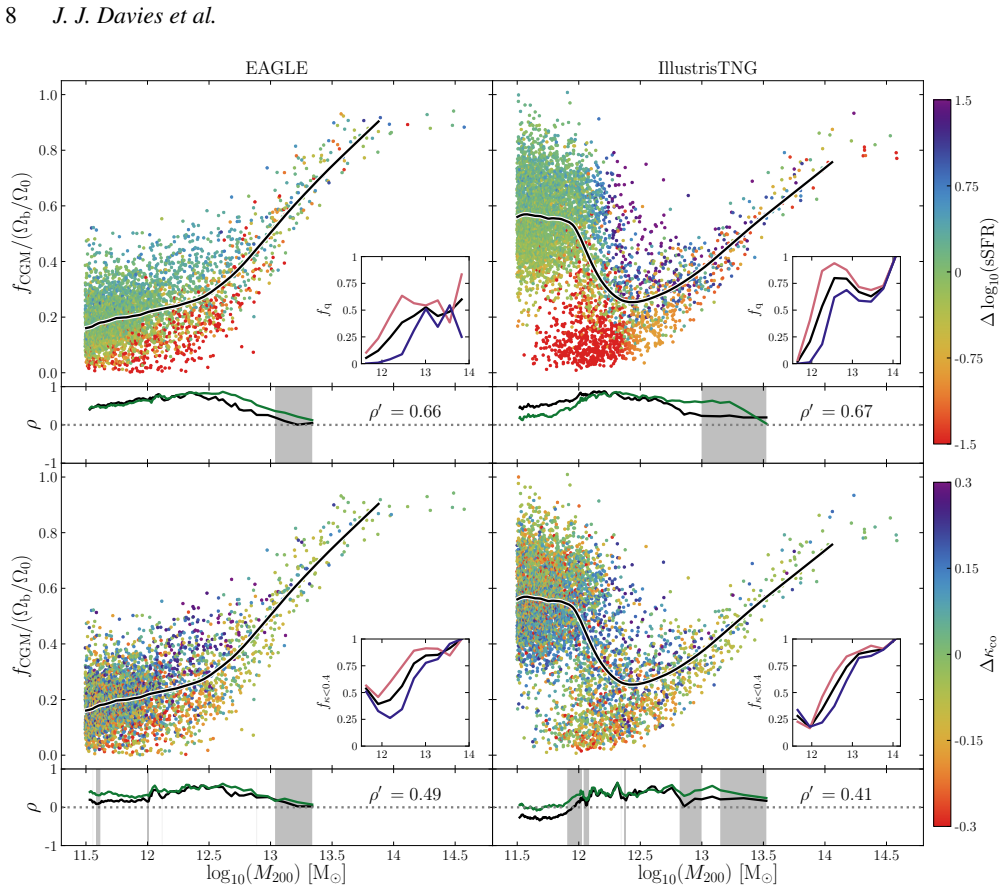
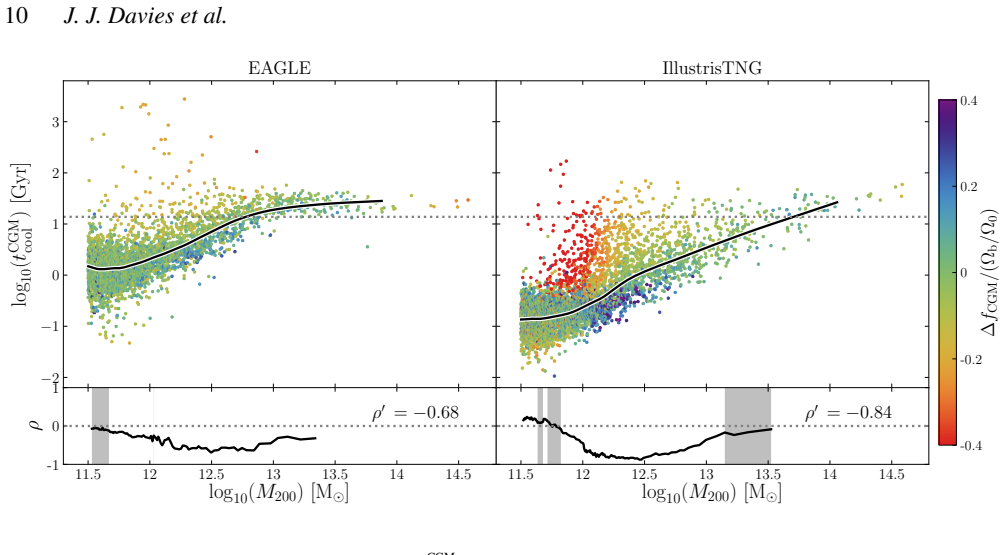
The load-bearing object is the circumgalactic medium mass fraction $f_{\rm CGM} \equiv M_{\rm CGM}/M_{200}$, the mass of non-star-forming gas within $r_{200}$ divided by halo mass, and the scatter about the median $f_{\rm CGM}$--$M_{200}$ relation at fixed halo mass. The paper measures how residuals in that scatter correlate with residuals in black-hole mass, specific star formation rate, kinematic morphology ($\kappa_{\rm co}$, the fraction of stellar kinetic energy in co-rotation), and CGM radiative cooling time $t_{\rm cool}$. The mechanism carrying the argument is feedback-driven expulsion: AGN feedback ejects the efficiently-cooling component of the CGM, raising the remaining gas's cooling time, so that gas that would have replenished the interstellar medium is no longer available, starving the disc of fuel and leaving it vulnerable to disruption into a spheroid.
What would settle it
Observe $\sim L^\star$ galaxies at fixed stellar or halo mass and measure their hot CGM mass fraction (via X-ray surface brightness or thermal Sunyaev-Zel'dovich stacking) against specific star formation rate and kinematic morphology; if gas-poor haloes do not preferentially host quenched, spheroidal galaxies, the core correlation fails. Alternatively, distinguish the two simulations' divergent predictions: IllustrisTNG predicts a strong anti-correlation between $f_{\rm CGM}$ and present-day black-hole accretion rate (AGN luminosity) at $M_{200} \simeq 10^{12}\,M_\odot$, while EAGLE predicts none; high-resolution X-ray observations of CGM around galaxies with known AGN activity would settle which feedback channel is physical.
Extended reading notes
Core claim
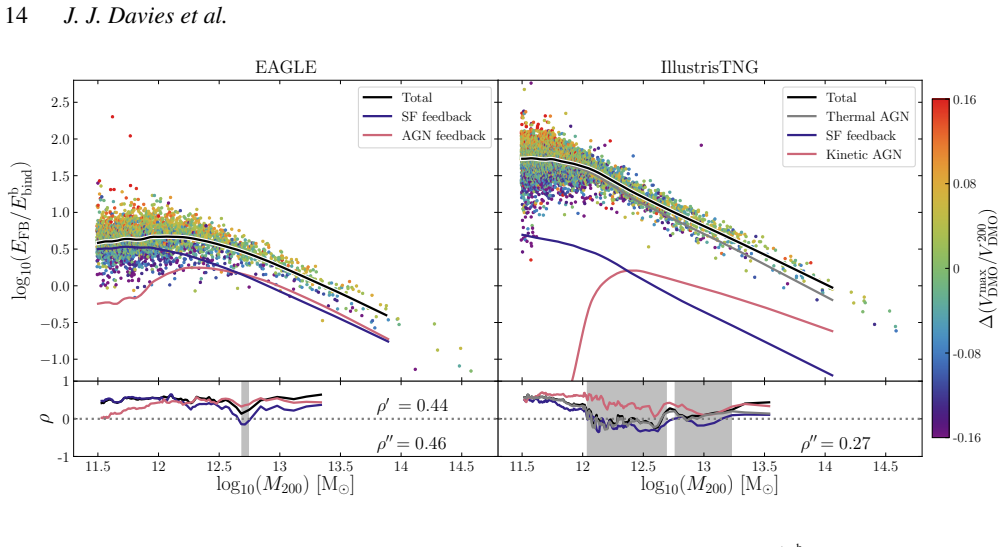
The central claim is that in both EAGLE and IllustrisTNG, the scatter in CGM mass fraction at fixed halo mass is not noise: it encodes whether the central galaxy is star-forming and disc-like or quenched and spheroidal, and this connection is causal, running through AGN feedback. In both simulations, haloes whose central black hole has injected more feedback energy relative to the binding energy of halo baryons have lower $f_{\rm CGM}$, elevated CGM cooling times, and central galaxies with lower specific star formation rates and less rotational support. The paper further claims that haloes that collapsed early and are more concentrated at fixed mass produce more efficient BH feedback --- in EAGLE because the BH reaches high accretion rates sooner, in IllustrisTNG because it crosses the calibrated pivot mass for switching from thermal to kinetic AGN injection sooner. The shared conclusion is that expulsion of rapidly-cooling CGM gas is a crucial step in producing quenched, early-type galaxies.
Load-bearing premise
The argument assumes that the scatter in CGM gas fraction at fixed halo mass is caused by AGN feedback actually expelling gas, rather than being a by-product of galaxy quenching, of the halo's accretion history, or of the particular subgrid feedback recipes; the paper itself notes that it does not track fluid elements to verify the expulsion in either simulation.
Editorial extensions
If this is right
- At fixed halo mass, low $f_{\rm CGM}$ is a marker for quenched, weakly-rotating galaxies and high $f_{\rm CGM}$ for star-forming discs, with the strongest separation near $L^\star$.
- Haloes that formed early and are intrinsically more concentrated at a given mass are predicted to have lower CGM mass fractions and more quenched centrals, an assembly-bias signature.
- IllustrisTNG predicts a strong present-day anti-correlation between $f_{\rm CGM}$ and black-hole accretion rate (AGN luminosity) near $M_{200} \simeq 10^{12}\,M_\odot$, while EAGLE predicts no such correlation; future X-ray or Sunyaev-Zel'dovich observations of hot CGM can discriminate between these scenarios.
- In both simulations the CGM cooling time is systematically longer in gas-poor haloes, and galaxies with longer CGM cooling times have lower specific star formation rates and less rotational support.
- The expulsion of efficiently-cooling CGM operates across the whole sampled halo mass range, not only at $L^\star$.
Reading between the lines
- If the causal chain is right, observable CGM tracers such as O VI and C IV column densities should anticorrelate with quenched fraction at fixed stellar mass, turning $f_{\rm CGM}$ into a practical observational proxy for the feedback state of a halo.
- The two simulations disagree on when and how the expulsion happens (early, accretion-rate-driven in EAGLE; later, kinetic-mode-driven in IllustrisTNG), so the real behaviour may lie between; a simulation that tracks individual gas parcels through feedback events would test the expulsion assumption directly.
- Assembly bias could imprint on galaxy morphology through this channel: early-forming haloes would not only be more concentrated but also preferentially host ellipticals, a connection that could be probed in large surveys by stacking gas fractions against large-scale environment.
- The morphological link may be indirect --- expulsion mainly removes the fuel that would rebuild discs --- which predicts that morphological transformation lags quenching, and that post-quenching disc regrowth is suppressed.
Signed reviews
Editorial analysis
A structured set of objections, weighed in public.
Referee Report
Summary. The paper examines the connection between the circumgalactic medium (CGM) and the quenching and morphological evolution of central galaxies in the EAGLE and IllustrisTNG cosmological simulations. Using the mass fraction of non-star-forming gas within r200 (fCGM) and residual correlations at fixed halo mass, the authors report that, in both simulations, scatter in fCGM correlates strongly with central black hole mass, specific star formation rate, and kinematic morphology, with the strongest correlations near L* halo masses. They interpret these correlations as evidence that AGN feedback expels efficiently-cooling circumgalactic gas, thereby elevating the CGM cooling time, starving the galaxy of fuel, and facilitating both quenching and morphological transformation. The paper also connects scatter in fCGM to halo concentration and formation time via the cumulative energy injected by efficient feedback relative to halo binding energy. The analysis is correlational; the explicit claim that feedback preferentially expels rapidly-cooling gas is deferred to a companion paper for EAGLE and is not directly demonstrated for IllustrisTNG.
Significance. If the causal interpretation holds, the paper identifies a concrete physical channel linking AGN feedback, CGM thermodynamics, and galaxy quenching, with testable predictions such as the opposite signs of the fCGM versus AGN accretion-rate correlation in EAGLE and TNG. The correlational results are a useful addition to the literature: the analysis is careful in its use of matched dark-matter-only haloes, residual statistics with significance masking, and robustness checks such as measuring fCGM within 0.3 r200. The fCGM and galaxy properties are independent outputs of the simulations, and the CGM was not a calibration target, so the correlations are emergent rather than fitted. However, the paper's central mechanistic claim—that expulsion of efficiently-cooling gas is the crucial causal step—is not established by the evidence presented here, and the abstract's 'consensus' phrasing overstates the direct support for that specific mechanism.
major comments (3)
- [Section 4.1, Fig. 3] The comparison of cooling-time CDFs between CGM-rich and CGM-poor stacks does not demonstrate that feedback preferentially expels efficiently-cooling gas. Because the radiative cooling time scales approximately as tcool ∝ u/(n_H^2 Λ), and the CGM-poor haloes have lower fCGM and therefore lower characteristic gas densities, their gas has longer cooling times by construction. The authors themselves acknowledge this ('The differing cooling times of the gas-rich and gas-poor samples stem almost entirely from their necessarily different characteristic CGM densities'), so the 'paucity of efficiently-cooling gas' is a density-driven consequence rather than evidence for cooling-time-selective expulsion. The subsequent concession that explicit demonstration would require tracking fluid elements with high temporal resolution confirms that the expulsive, cooling-time-selective mechanism is not directly shown in either simulation; for TNG it is imported from the EAGLE-only companion paper O19. Since this mechanism is the paper's title-level claim, the evidence is insufficient as presented.
- [Sections 3, 4, and 6] The causal direction of the fCGM versus sSFR and morphology correlations is asserted rather than tested. The paper interprets low fCGM as the cause of quenching via starvation, but the correlations are equally consistent with quenching causing low fCGM (e.g., through reduced gas accretion or consumption) or with a common cause such as halo assembly bias. The caveat in Section 3 that the existence of correlations 'does not imply that both correlations necessarily emerge as a direct response to the same physical mechanism' is appropriate, but it is not carried into the abstract or the concluding Section 6, which adopt strong causal language. A concrete test, such as examining whether the fCGM-sSFR correlation persists in simulations with heating-only (preventative) feedback or with AGN feedback disabled, would be needed to substantiate the causal interpretation.
- [Abstract and Section 6] The claim of 'consensus from these state-of-the-art simulations that the expulsion of efficiently-cooling gas from the CGM is a crucial step' overstates the evidence. The two simulations show different mechanisms (fixed-efficiency AGN heating in EAGLE versus a calibrated kinetic-mode pivot mass in TNG), different fCGM(M200) relations, and different present-day correlations with BH accretion rate (Fig. 1). Direct evidence for expulsion exists only for EAGLE (in the companion paper O19); for TNG the paper presents solely present-day correlations. The abstract and summary should be softened to 'consistent with' the expulsion scenario, with an explicit reference to the Section 4.1 caveat, unless the authors add direct fluid-element tracking or a comparable test for TNG.
minor comments (4)
- [Section 2.4] There is a typographical issue in the sentence 'V olumetric net radiative cooling rates are specified in the publicly-available TNG snapshots' — the word 'Volumetric' has a stray space.
- [Section 3, Fig. 1] The phrase 'the sub-panels here confirm' is vague; specifying 'the lower panels' would help the reader locate the relevant panels.
- [Section 5, Figs. 6 and 7] The notation ρ′′ is used in the figure captions before it is defined in the main text; define it at first use in the text.
- [Section 2.5, Eq. (6)] The expression for E_AGN in EAGLE includes the contribution from BH seed mass, which is acknowledged, but this limitation is easy to miss; consider stating it explicitly in the text near the equation.
Circularity Check
No significant circularity: the fCGM correlations are emergent outputs of simulations whose CGM properties were not calibration targets, and the Section 4.1 cooling-time caveat is explicitly disclosed rather than hidden.
full rationale
The paper's derivation chain is: run two independently calibrated cosmological simulations, measure fCGM and galaxy properties, then correlate residuals at fixed halo mass. Neither EAGLE nor TNG was calibrated to reproduce the fCGM-sSFR, fCGM-κco, or fCGM-MBH scatter relations; EAGLE's calibration explicitly excluded gas properties ('The gaseous properties of galaxies and their haloes were not considered during the calibration and may be considered predictions of the simulations'). The TNG calibration considered some group-scale gas fractions, but not the fixed-mass scatter correlations that form the paper's core results, so these are not fitted inputs renamed as predictions. The main potential concern is the causal 'expulsion of efficiently-cooling gas' wording. Section 4.1 explicitly concedes both the density degeneracy ('The differing cooling times of the gas-rich and gas-poor samples stem almost entirely from their necessarily different characteristic CGM densities (since Λ∝ n_H^2)') and the absence of fluid tracking ('An explicit demonstration that feedback preferentially expels rapidly-cooling gas would require the detailed tracking of fluid elements with high temporal resolution, which is beyond the scope of this study'). This is an honest limitation on the causal interpretation, not a circular step: the cooling-time elevation is computed from the simulation outputs and the caveat is stated in the same section. The expulsive mechanism is imported from the companion paper O19 by overlapping authors, but the present paper does not define any fitted quantity in terms of O19, and the correlational content of this paper is independently measured from both simulations. The calibrated TNG pivot mass is disclosed as calibrated ('effectively making the choice of 10^8 M_sun a calibrated parameter'), so its imprint on the fCGM mass scale is presented as an explanation rather than a parameter-free prediction. No equation in the paper reduces to its own input; no fitted parameter is renamed as a prediction.
Assumptions & free parameters
free parameters (4)
- fAGN (EAGLE AGN feedback efficiency) =
0.015
- fAGN,thm and fAGN,kin (TNG AGN feedback efficiencies) =
0.02 and 0.2 (maximum)
- TNG kinetic-mode pivot mass =
10^8 Msun (chi0=0.002)
- sSFR and kappa_co classification thresholds =
sSFR < 10^-11 yr^-1; kappa_co < 0.4
assumptions (4)
- domain assumption The EAGLE and TNG subgrid feedback models faithfully represent the unresolved physics of AGN and stellar feedback.
- ad hoc to paper The companion results D19 and O19 are taken as valid evidence for causality.
- domain assumption Halo matching between hydrodynamical and DMO runs is bijective and unbiased.
- domain assumption The CGM is defined as all non-star-forming gas within r200, which is a meaningful observational proxy.
Cite this review
Pith. "Pith review of The quenching and morphological evolution of central galaxies is facilitated by the feedback-driven expulsion of circumgalactic gas." pith.science (2026). https://pith.science/paper/OI2Y7VYL
@misc{pith2026190811380,
  author       = {Pith},
  title        = {Pith review of: The quenching and morphological evolution of central galaxies is facilitated by the feedback-driven expulsion of circumgalactic gas},
  year         = {2026},
  howpublished = {\url{https://pith.science/paper/OI2Y7VYL}},
  note         = {Machine review of arXiv:1908.11380}
}
abstract
We examine the connection between the properties of the circumgalactic medium (CGM) and the quenching and morphological evolution of central galaxies in the EAGLE and IllustrisTNG simulations. The simulations yield very different median CGM mass fractions, $f_{\rm CGM}$, as a function of halo mass, $M_{200}$, with low-mass haloes being significantly more gas-rich in IllustrisTNG than in EAGLE. Nonetheless, in both cases scatter in $f_{\rm CGM}$ at fixed $M_{200}$ is strongly correlated with the specific star formation rate and the kinematic morphology of central galaxies. The correlations are strongest for $\sim L^\star$ galaxies, corresponding to the mass scale at which AGN feedback becomes efficient. This feedback elevates the CGM cooling time, preventing gas from accreting onto the galaxy to fuel star formation, and thus establishing a preference for quenched, spheroidal galaxies to be hosted by haloes with low $f_{\rm CGM}$ for their mass. In both simulations, $f_{\rm CGM}$ correlates negatively with the host halo's intrinsic concentration, and hence with its binding energy and formation redshift, primarily because early halo formation fosters the rapid early growth of the central black hole (BH). This leads to a lower $f_{\rm CGM}$ at fixed $M_{200}$ in EAGLE because the BH reaches high accretion rates sooner, whilst in IllustrisTNG it occurs because the central BH reaches the mass threshold at which AGN feedback is assumed to switch from thermal to kinetic injection earlier. Despite these differences, there is consensus from these state-of-the-art simulations that the expulsion of efficiently-cooling gas from the CGM is a crucial step in the quenching and morphological evolution of central galaxies.
Figures


Figures from the paper (4 more)


Forward citations
Cited by 1 Pith paper
-
Mass--size evolution and the emerging passive--density relation revealed by JWST/NIRCam in the Spiderweb protocluster
In the Spiderweb protocluster, passive fraction rises with local density to ~60% while passive mass–size intercepts sit between field and cluster values, indicating advanced quenching but ongoing size growth.
Reference graph
Works this paper leans on
-
[1]
write newline
" write newline "" before.all 'output.state := FUNCTION fin.entry write newline FUNCTION new.block output.state before.all = 'skip after.block 'output.state := if FUNCTION new.sentence output.state after.block = 'skip output.state before.all = 'skip after.sentence 'output.state := if if FUNCTION not #0 #1 if FUNCTION and 'skip pop #0 if FUNCTION or pop #1...
-
[2]
N., et al., 2016, arXiv e-prints, https://ui.adsabs.harvard.edu/abs/2016arXiv161002743A p
Abazajian K. N., et al., 2016, arXiv e-prints, https://ui.adsabs.harvard.edu/abs/2016arXiv161002743A p. arXiv:1610.02743
arXiv 2016
-
[3]
Ade P., et al., 2019, @doi [ ] 10.1088/1475-7516/2019/02/056 , https://ui.adsabs.harvard.edu/abs/2019JCAP...02..056A 2019, 056
-
[4]
Allen S. W., Schmidt R. W., Fabian A. C., 2002, @doi [ ] 10.1046/j.1365-8711.2002.05601.x , https://ui.adsabs.harvard.edu/#abs/2002MNRAS.334L..11A 334, L11
arXiv 2002
-
[5]
Anderson M. E., Gaspari M., White S. D. M., Wang W., Dai X., 2015, @doi [ ] 10.1093/mnras/stv437 , http://adsabs.harvard.edu/abs/2015MNRAS.449.3806A 449, 3806
-
[6]
Balogh M. L., Pearce F. R., Bower R. G., Kay S. T., 2001, @doi [ ] 10.1111/j.1365-2966.2001.04667.x , https://ui.adsabs.harvard.edu/abs/2001MNRAS.326.1228B 326, 1228
arXiv 2001
-
[7]
Barai P., Murante G., Borgani S., Gaspari M., Granato G. L., Monaco P., Ragone-Figueroa C., 2016, @doi [ ] 10.1093/mnras/stw1389 , https://ui.adsabs.harvard.edu/abs/2016MNRAS.461.1548B 461, 1548
-
[8]
Barret D., et al., 2016, in Space Telescopes and Instrumentation 2016: Ultraviolet to Gamma Ray. p. 99052F ( @eprint arXiv 1608.08105 ), @doi 10.1117/12.2232432
arXiv 2016
Show all 126 references
-
[9]
Bechtold J., Crotts A. P. S., Duncan R. C., Fang Y., 1994, @doi [ ] 10.1086/187688 , https://ui.adsabs.harvard.edu/abs/1994ApJ...437L..83B 437, L83
1994 doi
-
[10]
M., et al., 2019, @doi [ ] 10.1093/mnras/stz774 , https://ui.adsabs.harvard.edu/abs/2019MNRAS.486...21B 486, 21
Bielby R. M., et al., 2019, @doi [ ] 10.1093/mnras/stz774 , https://ui.adsabs.harvard.edu/abs/2019MNRAS.486...21B 486, 21
2019 doi
-
[11]
R., Kraft R
Bogd \'a n \'A ., Forman W. R., Kraft R. P., Jones C., 2013, @doi [ ] 10.1088/0004-637X/772/2/98 , http://adsabs.harvard.edu/abs/2013ApJ...772...98B 772, 98
2013 doi
-
[12]
R., Kraft R
Bogd \'a n \'A ., Bourdin H., Forman W. R., Kraft R. P., Vogelsberger M., Hernquist L., Springel V., 2017, @doi [ ] 10.3847/1538-4357/aa9523 , https://ui.adsabs.harvard.edu/#abs/2017ApJ...850...98B 850, 98
2017 doi
-
[14]
M., Schaye J., 2010, @doi [ ] 10.1111/j.1745-3933.2010.00832.x , https://ui.adsabs.harvard.edu/#abs/2010MNRAS.405L...1B 405, L1
Booth C. M., Schaye J., 2010, @doi [ ] 10.1111/j.1745-3933.2010.00832.x , https://ui.adsabs.harvard.edu/#abs/2010MNRAS.405L...1B 405, L1
2010
-
[16]
Borthakur S., et al., 2015, @doi [ ] 10.1088/0004-637X/813/1/46 , https://ui.adsabs.harvard.edu/abs/2015ApJ...813...46B 813, 46
2015 doi
-
[18]
G., Schaye J., Frenk C
Bower R. G., Schaye J., Frenk C. S., Theuns T., Schaller M., Crain R. A., McAlpine S., 2017, @doi [ ] 10.1093/mnras/stw2735 , https://ui.adsabs.harvard.edu/#abs/2017MNRAS.465...32B 465, 32
2017 doi
-
[19]
N., et al., 2016, @doi [ ] 10.3847/0004-637X/832/2/124 , https://ui.adsabs.harvard.edu/abs/2016ApJ...832..124B 832, 124
Burchett J. N., et al., 2016, @doi [ ] 10.3847/0004-637X/832/2/124 , https://ui.adsabs.harvard.edu/abs/2016ApJ...832..124B 832, 124
2016 doi
-
[20]
Chabrier G., 2003, @doi [Publications of the Astronomical Society of the Pacific] 10.1086/376392 , https://ui.adsabs.harvard.edu/abs/2003PASP..115..763C 115, 763
2003 doi
-
[21]
Cicone C., et al., 2015, @doi [ ] 10.1051/0004-6361/201424980 , https://ui.adsabs.harvard.edu/abs/2015A&A...574A..14C 574, A14
2015 doi
-
[22]
Cicone C., Maiolino R., Marconi A., 2016, @doi [ ] 10.1051/0004-6361/201424514 , https://ui.adsabs.harvard.edu/abs/2016A&A...588A..41C 588, A41
2016 doi
-
[23]
G., 2018, @doi [ ] 10.1093/mnras/sty1229 , https://ui.adsabs.harvard.edu/abs/2018MNRAS.478.3994C 478, 3994
Clauwens B., Schaye J., Franx M., Bower R. G., 2018, @doi [ ] 10.1093/mnras/sty1229 , https://ui.adsabs.harvard.edu/abs/2018MNRAS.478.3994C 478, 3994
2018 doi
-
[24]
S., 1979, @doi [Journal of the American Statistical Association] 10.1080/01621459.1979.10481038 , 74, 829
Cleveland W. S., 1979, @doi [Journal of the American Statistical Association] 10.1080/01621459.1979.10481038 , 74, 829
1979
-
[25]
A., Schaye J., Clauwens B., Bower R
Correa C. A., Schaye J., Clauwens B., Bower R. G., Crain R. A., Schaller M., Theuns T., Thob A. C. R., 2017, @doi [ ] 10.1093/mnrasl/slx133 , https://ui.adsabs.harvard.edu/\#abs/2017MNRAS.472L..45C 472, L45
2017 doi
-
[26]
A., Schaye J., Trayford J
Correa C. A., Schaye J., Trayford J. W., 2019, @doi [ ] 10.1093/mnras/stz295 , https://ui.adsabs.harvard.edu/abs/2019MNRAS.484.4401C 484, 4401
2019 doi
-
[29]
A., et al., 2015, @doi [ ] 10.1093/mnras/stv725 , http://adsabs.harvard.edu/abs/2015MNRAS.450.1937C 450, 1937
Crain R. A., et al., 2015, @doi [ ] 10.1093/mnras/stv725 , http://adsabs.harvard.edu/abs/2015MNRAS.450.1937C 450, 1937
2015 doi
-
[30]
A., et al., 2017, @doi [ ] 10.1093/mnras/stw2586 , https://ui.adsabs.harvard.edu/abs/2017MNRAS.464.4204C 464, 4204
Crain R. A., et al., 2017, @doi [ ] 10.1093/mnras/stw2586 , https://ui.adsabs.harvard.edu/abs/2017MNRAS.464.4204C 464, 4204
2017 doi
-
[33]
E., Bregman J
Dai X., Anderson M. E., Bregman J. N., Miller J. M., 2012, @doi [ ] 10.1088/0004-637X/755/2/107 , http://adsabs.harvard.edu/abs/2012ApJ...755..107D 755, 107
2012 doi
-
[35]
J., Crain R
Davies J. J., Crain R. A., McCarthy I. G., Oppenheimer B. D., Schaye J., Schaller M., McAlpine S., 2019, @doi [ ] 10.1093/mnras/stz635 , https://ui.adsabs.harvard.edu/abs/2019MNRAS.485.3783D 485, 3783
2019 doi
-
[36]
B., Impey C
Dinshaw N., Foltz C. B., Impey C. D., Weymann R. J., Morris S. L., 1995, @doi [ ] 10.1038/373223a0 , https://ui.adsabs.harvard.edu/abs/1995Natur.373..223D 373, 223
1995 doi
-
[38]
Dubois Y., Gavazzi R., Peirani S., Silk J., 2013, @doi [ ] 10.1093/mnras/stt997 , https://ui.adsabs.harvard.edu/abs/2013MNRAS.433.3297D 433, 3297
2013 doi
-
[39]
Durier F., Dalla Vecchia C., 2012, @doi [ ] 10.1111/j.1365-2966.2011.19712.x , https://ui.adsabs.harvard.edu/#abs/2012MNRAS.419..465D 419, 465
2012
-
[40]
Faucher-Gigu \`e re C.-A., Lidz A., Zaldarriaga M., Hernquist L., 2009, @doi [ ] 10.1088/0004-637X/703/2/1416 , https://ui.adsabs.harvard.edu/abs/2009ApJ...703.1416F 703, 1416
2009 doi
-
[41]
J., Korista K
Ferland G. J., Korista K. T., Verner D. A., Ferguson J. W., Kingdon J. B., Verner E. M., 1998, @doi [Publications of the Astronomical Society of the Pacific] 10.1086/316190 , https://ui.adsabs.harvard.edu/abs/1998PASP..110..761F 110, 761
1998 doi
-
[42]
S., McCarthy I
Font A. S., McCarthy I. G., Le Brun A. M. C., Crain R. A., Kelvin L. S., 2017, @doi [ ] 10.1017/pasa.2017.50 , https://ui.adsabs.harvard.edu/abs/2017PASA...34...50F 34, e050
2017 doi
-
[43]
B., et al., 2016, @doi [ ] 10.1093/mnras/stw595 , http://adsabs.harvard.edu/abs/2016MNRAS.459.1745F 459, 1745
Ford A. B., et al., 2016, @doi [ ] 10.1093/mnras/stw595 , http://adsabs.harvard.edu/abs/2016MNRAS.459.1745F 459, 1745
2016 doi
-
[44]
Gnat O., Sternberg A., 2007, @doi [ ] 10.1086/509786 , https://ui.adsabs.harvard.edu/abs/2007ApJS..168..213G 168, 213
2007 doi
-
[45]
H., Sivanandam S., Zabludoff A
Gonzalez A. H., Sivanandam S., Zabludoff A. I., Zaritsky D., 2013, @doi [ ] 10.1088/0004-637X/778/1/14 , https://ui.adsabs.harvard.edu/#abs/2013ApJ...778...14G 778, 14
2013 doi
-
[46]
P., Hill J
Greco J. P., Hill J. C., Spergel D. N., Battaglia N., 2015, @doi [ ] 10.1088/0004-637X/808/2/151 , https://ui.adsabs.harvard.edu/#abs/2015ApJ...808..151G 808, 151
2015 doi
-
[47]
M., Tran J
Haardt F., Madau P., 2001, in Neumann D. M., Tran J. T. V., eds, Clusters of Galaxies and the High Redshift Universe Observed in X-rays. p. 64 ( @eprint arXiv astro-ph/0106018 )
2001 arXiv
-
[48]
H \"a ring N., Rix H.-W., 2004, @doi [ ] 10.1086/383567 , https://ui.adsabs.harvard.edu/abs/2004ApJ...604L..89H 604, L89
2004 doi
-
[49]
M., Alexander D
Harrison C. M., Alexander D. M., Mullaney J. R., Swinbank A. M., 2014, @doi [ ] 10.1093/mnras/stu515 , https://ui.adsabs.harvard.edu/abs/2014MNRAS.441.3306H 441, 3306
2014 doi
-
[50]
A., Puchwein E., Shen S., Sijacki D., 2018, @doi [ ] 10.1093/mnras/sty1780 , https://ui.adsabs.harvard.edu/abs/2018MNRAS.479.5385H 479, 5385
Henden N. A., Puchwein E., Shen S., Sijacki D., 2018, @doi [ ] 10.1093/mnras/sty1780 , https://ui.adsabs.harvard.edu/abs/2018MNRAS.479.5385H 479, 5385
2018 doi
-
[51]
F., et al., 2006, @doi [ ] 10.1086/507069 , https://ui.adsabs.harvard.edu/abs/2006ApJ...651...61H 651, 61
Hennawi J. F., et al., 2006, @doi [ ] 10.1086/507069 , https://ui.adsabs.harvard.edu/abs/2006ApJ...651...61H 651, 61
2006 doi
-
[52]
F., 2013, @doi [ ] 10.1093/mnras/sts210 , http://adsabs.harvard.edu/abs/2013MNRAS.428.2840H 428, 2840
Hopkins P. F., 2013, @doi [ ] 10.1093/mnras/sts210 , http://adsabs.harvard.edu/abs/2013MNRAS.428.2840H 428, 2840
2013 doi
-
[53]
F., Hernquist L., Cox T
Hopkins P. F., Hernquist L., Cox T. J., Di Matteo T., Martini P., Robertson B., Springel V., 2005, @doi [ ] 10.1086/432438 , https://ui.adsabs.harvard.edu/abs/2005ApJ...630..705H 630, 705
2005 doi
-
[54]
F., Cox T
Hopkins P. F., Cox T. J., Younger J. D., Hernquist L., 2009, @doi [ ] 10.1088/0004-637X/691/2/1168 , https://ui.adsabs.harvard.edu/abs/2009ApJ...691.1168H 691, 1168
2009 doi
-
[55]
B., Bryan G
Hummels C. B., Bryan G. L., Smith B. D., Turk M. J., 2013, @doi [ ] 10.1093/mnras/sts702 , https://ui.adsabs.harvard.edu/#abs/2013MNRAS.430.1548H 430, 1548
2013 doi
-
[56]
V., 2011, @doi [ ] 10.1088/0004-637X/734/2/92 , https://ui.adsabs.harvard.edu/abs/2011ApJ...734...92J 734, 92
Jahnke K., Macci \`o A. V., 2011, @doi [ ] 10.1088/0004-637X/734/2/92 , https://ui.adsabs.harvard.edu/abs/2011ApJ...734...92J 734, 92
2011 doi
-
[57]
H., Burkert A., Naab T., 2009, @doi [ ] 10.1088/0004-637X/707/2/L184 , https://ui.adsabs.harvard.edu/abs/2009ApJ...707L.184J 707, L184
Johansson P. H., Burkert A., Naab T., 2009, @doi [ ] 10.1088/0004-637X/707/2/L184 , https://ui.adsabs.harvard.edu/abs/2009ApJ...707L.184J 707, L184
2009 doi
-
[58]
King A., 2003, @doi [ ] 10.1086/379143 , https://ui.adsabs.harvard.edu/abs/2003ApJ...596L..27K 596, L27
2003 doi
-
[59]
Kormendy J., Richstone D., 1995, @doi [ ] 10.1146/annurev.aa.33.090195.003053 , https://ui.adsabs.harvard.edu/abs/1995ARA
1995
-
[60]
Lacey C., Cole S., 1994, @doi [ ] 10.1093/mnras/271.3.676 , https://ui.adsabs.harvard.edu/#abs/1994MNRAS.271..676L 271, 676
1994 doi
-
[61]
Lakhchaura K., Truong N., Werner N., 2019, @doi [Monthly Notices of the Royal Astronomical Society: Letters] 10.1093/mnrasl/slz114 , 488, L134–L142
2019 doi
-
[62]
N., Wang Q
Li J.-T., Bregman J. N., Wang Q. D., Crain R. A., Anderson M. E., 2016, @doi [ ] 10.3847/0004-637X/830/2/134 , https://ui.adsabs.harvard.edu/#abs/2016ApJ...830..134L 830, 134
2016 doi
-
[63]
N., Wang Q
Li J.-T., Bregman J. N., Wang Q. D., Crain R. A., Anderson M. E., Zhang S., 2017, @doi [The Astrophysical Journal Supplement Series] 10.3847/1538-4365/aa96fc , https://ui.adsabs.harvard.edu/#abs/2017ApJS..233...20L 233, 20
2017 doi
-
[64]
J., Stanford S
Lin Y.-T., Mohr J. J., Stanford S. A., 2004, @doi [ ] 10.1086/421714 , https://ui.adsabs.harvard.edu/#abs/2004ApJ...610..745L 610, 745
2004 doi
-
[65]
A., Eisenhardt P
Lin Y.-T., Stanford S. A., Eisenhardt P. R. M., Vikhlinin A., Maughan B. J., Kravtsov A., 2012, @doi [ ] 10.1088/2041-8205/745/1/L3 , https://ui.adsabs.harvard.edu/abs/2012ApJ...745L...3L 745, L3
2012 doi
-
[66]
Lopez S., et al., 2018, @doi [ ] 10.1038/nature25436 , https://ui.adsabs.harvard.edu/abs/2018Natur.554..493L 554, 493
2018 doi
-
[67]
H., Schellenberger G., 2015, @doi [ ] 10.1051/0004-6361/201423954 , https://ui.adsabs.harvard.edu/abs/2015A&A...573A.118L 573, A118
Lovisari L., Reiprich T. H., Schellenberger G., 2015, @doi [ ] 10.1051/0004-6361/201423954 , https://ui.adsabs.harvard.edu/abs/2015A&A...573A.118L 573, A118
2015 doi
-
[68]
Magorrian J., et al., 1998, @doi [ ] 10.1086/300353 , https://ui.adsabs.harvard.edu/abs/1998AJ....115.2285M 115, 2285
1998 doi
-
[69]
Maiolino R., et al., 2012, @doi [ ] 10.1111/j.1745-3933.2012.01303.x , https://ui.adsabs.harvard.edu/abs/2012MNRAS.425L..66M 425, L66
2012
-
[70]
A., Schaller M., Bower R., Theuns T., 2017, @doi [ ] 10.1093/mnras/stw2884 , https://ui.adsabs.harvard.edu/abs/2017MNRAS.465.2381M 465, 2381
Matthee J., Schaye J., Crain R. A., Schaller M., Bower R., Theuns T., 2017, @doi [ ] 10.1093/mnras/stw2884 , https://ui.adsabs.harvard.edu/abs/2017MNRAS.465.2381M 465, 2381
2017 doi
-
[71]
McAlpine S., et al., 2016, @doi [Astronomy and Computing] 10.1016/j.ascom.2016.02.004 , https://ui.adsabs.harvard.edu/#abs/2016A&C....15...72M 15, 72
2016 doi
-
[72]
G., Harrison C
McAlpine S., Bower R. G., Harrison C. M., Crain R. A., Schaller M., Schaye J., Theuns T., 2017, @doi [ ] 10.1093/mnras/stx658 , https://ui.adsabs.harvard.edu/abs/2017MNRAS.468.3395M 468, 3395
2017 doi
-
[73]
G., Schaye J., Bower R
McCarthy I. G., Schaye J., Bower R. G., Ponman T. J., Booth C. M., Dalla Vecchia C., Springel V., 2011, @doi [ ] 10.1111/j.1365-2966.2010.18033.x , https://ui.adsabs.harvard.edu/\#abs/2011MNRAS.412.1965M 412, 1965
2011
-
[74]
G., Schaye J., Bird S., Le Brun A
McCarthy I. G., Schaye J., Bird S., Le Brun A. M. C., 2017, @doi [ ] 10.1093/mnras/stw2792 , https://ui.adsabs.harvard.edu/abs/2017MNRAS.465.2936M 465, 2936
2017 doi
-
[75]
R., Tremblay G
McDonald M., Gaspari M., McNamara B. R., Tremblay G. R., 2018, @doi [ ] 10.3847/1538-4357/aabace , https://ui.adsabs.harvard.edu/abs/2018ApJ...858...45M 858, 45
2018 doi
-
[76]
R., Nulsen P
McNamara B. R., Nulsen P. E. J., 2007, @doi [ ] 10.1146/annurev.astro.45.051806.110625 , https://ui.adsabs.harvard.edu/abs/2007ARA&A..45..117M 45, 117
2007 arXiv
-
[77]
arXiv:1209.3114
Merloni A., et al., 2012, arXiv e-prints, https://ui.adsabs.harvard.edu/abs/2012arXiv1209.3114M p. arXiv:1209.3114
2012 arXiv
-
[78]
D., Schaye J., Bower R
Mitchell P. D., Schaye J., Bower R. G., Crain R. A., 2019, arXiv e-prints, https://ui.adsabs.harvard.edu/abs/2019arXiv191009566M
2019
-
[79]
P., Naab T., White S
Moster B. P., Naab T., White S. D. M., 2013, @doi [ ] 10.1093/mnras/sts261 , http://adsabs.harvard.edu/abs/2013MNRAS.428.3121M 428, 3121
2013 doi
-
[80]
F., et al., 2004, @doi [ ] 10.1111/j.1365-2966.2004.07586.x , http://adsabs.harvard.edu/abs/2004MNRAS.349.1039N 349, 1039
Navarro J. F., et al., 2004, @doi [ ] 10.1111/j.1365-2966.2004.07586.x , http://adsabs.harvard.edu/abs/2004MNRAS.349.1039N 349, 1039
2004
-
[81]
Nelson D., et al., 2015, @doi [Astronomy and Computing] 10.1016/j.ascom.2015.09.003 , https://ui.adsabs.harvard.edu/abs/2015A
2015 doi
-
[82]
Nelson D., et al., 2018a, @doi [ ] 10.1093/mnras/stx3040 , https://ui.adsabs.harvard.edu/abs/2018MNRAS.475..624N 475, 624
-
[83]
Nelson D., et al., 2018b, @doi [ ] 10.1093/mnras/sty656 , https://ui.adsabs.harvard.edu/abs/2018MNRAS.477..450N 477, 450
-
[84]
Nelson D., et al., 2019, @doi [Computational Astrophysics and Cosmology] 10.1186/s40668-019-0028-x , https://ui.adsabs.harvard.edu/abs/2019ComAC...6....2N 6, 2
2019 doi
-
[85]
D., 2018, @doi [ ] 10.1093/mnras/sty1918 , https://ui.adsabs.harvard.edu/abs/2018MNRAS.480.2963O 480, 2963
Oppenheimer B. D., 2018, @doi [ ] 10.1093/mnras/sty1918 , https://ui.adsabs.harvard.edu/abs/2018MNRAS.480.2963O 480, 2963
2018 doi
-
[86]
D., Schaye J., 2013a, @doi [ ] 10.1093/mnras/stt1043 , https://ui.adsabs.harvard.edu/abs/2013MNRAS.434.1043O 434, 1043
Oppenheimer B. D., Schaye J., 2013a, @doi [ ] 10.1093/mnras/stt1043 , https://ui.adsabs.harvard.edu/abs/2013MNRAS.434.1043O 434, 1043
-
[87]
D., Schaye J., 2013b, @doi [ ] 10.1093/mnras/stt1150 , https://ui.adsabs.harvard.edu/abs/2013MNRAS.434.1063O 434, 1063
Oppenheimer B. D., Schaye J., 2013b, @doi [ ] 10.1093/mnras/stt1150 , https://ui.adsabs.harvard.edu/abs/2013MNRAS.434.1063O 434, 1063
-
[88]
D., et al., 2016, @doi [ ] 10.1093/mnras/stw1066 , https://ui.adsabs.harvard.edu/abs/2016MNRAS.460.2157O 460, 2157
Oppenheimer B. D., et al., 2016, @doi [ ] 10.1093/mnras/stw1066 , https://ui.adsabs.harvard.edu/abs/2016MNRAS.460.2157O 460, 2157
2016 doi
-
[89]
D., Segers M., Schaye J., Richings A
Oppenheimer B. D., Segers M., Schaye J., Richings A. J., Crain R. A., 2018, @doi [ ] 10.1093/mnras/stx2967 , https://ui.adsabs.harvard.edu/abs/2018MNRAS.474.4740O 474, 4740
2018 doi
-
[90]
D., et al., 2019, arXiv e-prints, https://ui.adsabs.harvard.edu/abs/2019arXiv190405904O
Oppenheimer B. D., et al., 2019, arXiv e-prints, https://ui.adsabs.harvard.edu/abs/2019arXiv190405904O
2019
-
[91]
\"O zel F., 2018, @doi [Nature Astronomy] 10.1038/s41550-018-0548-3 , https://ui.adsabs.harvard.edu/abs/2018NatAs...2..608O 2, 608
2018 doi
-
[92]
Y., 2007, @doi [ ] 10.1086/522774 , https://ui.adsabs.harvard.edu/abs/2007ApJ...671.1098P 671, 1098
Peng C. Y., 2007, @doi [ ] 10.1086/522774 , https://ui.adsabs.harvard.edu/abs/2007ApJ...671.1098P 671, 1098
2007 doi
-
[93]
Pillepich A., et al., 2018a, @doi [ ] 10.1093/mnras/stx2656 , https://ui.adsabs.harvard.edu/abs/2018MNRAS.473.4077P 473, 4077
-
[94]
Pillepich A., et al., 2018b, @doi [ ] 10.1093/mnras/stx3112 , https://ui.adsabs.harvard.edu/abs/2018MNRAS.475..648P 475, 648
-
[95]
Planck Collaboration et al., 2013, @doi [ ] 10.1051/0004-6361/201220941 , https://ui.adsabs.harvard.edu/#abs/2013A&A...557A..52P 557, A52
2013 doi
-
[96]
Planck Collaboration et al., 2014, @doi [ ] 10.1051/0004-6361/201321591 , http://adsabs.harvard.edu/abs/2014A
2014 doi
-
[97]
Planck Collaboration et al., 2016, @doi [ ] 10.1051/0004-6361/201525830 , https://ui.adsabs.harvard.edu/abs/2016A&A...594A..13P 594, A13
2016 doi
-
[98]
L., Ragone-Figueroa C., Dolag K., 2014, @doi [ ] 10.1093/mnras/stt2141 , https://ui.adsabs.harvard.edu/abs/2014MNRAS.438..195P 438, 195
Planelles S., Borgani S., Fabjan D., Killedar M., Murante G., Granato G. L., Ragone-Figueroa C., Dolag K., 2014, @doi [ ] 10.1093/mnras/stt2141 , https://ui.adsabs.harvard.edu/abs/2014MNRAS.438..195P 438, 195
2014 doi
-
[99]
W., Croston J
Pratt G. W., Croston J. H., Arnaud M., B \"o hringer H., 2009, @doi [ ] 10.1051/0004-6361/200810994 , https://ui.adsabs.harvard.edu/abs/2009A
2009 doi
-
[101]
Qu Y., et al., 2017, @doi [ ] 10.1093/mnras/stw2437 , https://ui.adsabs.harvard.edu/abs/2017MNRAS.464.1659Q 464, 1659
2017 doi
-
[102]
H., Rai c evi \'c M., Schaye J., 2013, @doi [ ] 10.1093/mnras/stt066 , https://ui.adsabs.harvard.edu/abs/2013MNRAS.430.2427R 430, 2427
Rahmati A., Pawlik A. H., Rai c evi \'c M., Schaye J., 2013, @doi [ ] 10.1093/mnras/stt066 , https://ui.adsabs.harvard.edu/abs/2013MNRAS.430.2427R 430, 2427
2013 doi
-
[103]
A., Oppenheimer B
Rahmati A., Schaye J., Crain R. A., Oppenheimer B. D., Schaller M., Theuns T., 2016, @doi [ ] 10.1093/mnras/stw453 , https://ui.adsabs.harvard.edu/abs/2016MNRAS.459..310R 459, 310
2016 doi
-
[104]
S., Cox T
Robertson B., Bullock J. S., Cox T. J., Di Matteo T., Hernquist L., Springel V., Yoshida N., 2006, @doi [ ] 10.1086/504412 , https://ui.adsabs.harvard.edu/abs/2006ApJ...645..986R 645, 986
2006 doi
-
[105]
M., et al., 2015, @doi [ ] 10.1093/mnras/stv2056 , https://ui.adsabs.harvard.edu/#abs/2015MNRAS.454.1038R 454, 1038
Rosas-Guevara Y. M., et al., 2015, @doi [ ] 10.1093/mnras/stv2056 , https://ui.adsabs.harvard.edu/#abs/2015MNRAS.454.1038R 454, 1038
2015 doi
-
[106]
Rupke D. S. N., Veilleux S., 2011, @doi [ ] 10.1088/2041-8205/729/2/L27 , https://ui.adsabs.harvard.edu/abs/2011ApJ...729L..27R 729, L27
2011 doi
-
[107]
Schaller M., et al., 2015, @doi [ ] 10.1093/mnras/stv1067 , https://ui.adsabs.harvard.edu/abs/2015MNRAS.451.1247S 451, 1247
2015 doi
-
[108]
Schaye J., 2004, @doi [ ] 10.1086/421232 , https://ui.adsabs.harvard.edu/abs/2004ApJ...609..667S 609, 667
2004 doi
-
[111]
Schaye J., et al., 2015, @doi [ ] 10.1093/mnras/stu2058 , http://adsabs.harvard.edu/abs/2015MNRAS.446..521S 446, 521
2015 doi
-
[112]
C., Oppenheimer B
Segers M. C., Oppenheimer B. D., Schaye J., Richings A. J., 2017, @doi [ ] 10.1093/mnras/stx1633 , https://ui.adsabs.harvard.edu/abs/2017MNRAS.471.1026S 471, 1026
2017 doi
-
[113]
Sembolini F., et al., 2016, @doi [ ] 10.1093/mnras/stw800 , https://ui.adsabs.harvard.edu/abs/2016MNRAS.459.2973S 459, 2973
2016 doi
-
[114]
Sijacki D., Springel V., Di Matteo T., Hernquist L., 2007, @doi [ ] 10.1111/j.1365-2966.2007.12153.x , https://ui.adsabs.harvard.edu/abs/2007MNRAS.380..877S 380, 877
2007
-
[115]
J., 1998, , https://ui.adsabs.harvard.edu/abs/1998A&A...331L...1S 331, L1
Silk J., Rees M. J., 1998, , https://ui.adsabs.harvard.edu/abs/1998A&A...331L...1S 331, L1
1998
-
[116]
Soltan A., 1982, @doi [ ] 10.1093/mnras/200.1.115 , https://ui.adsabs.harvard.edu/abs/1982MNRAS.200..115S 200, 115
1982 doi
-
[119]
Springel V., Hernquist L., 2003, @doi [ ] 10.1046/j.1365-8711.2003.06206.x , https://ui.adsabs.harvard.edu/abs/2003MNRAS.339..289S 339, 289
2003
-
[120]
Springel V., White S. D. M., Tormen G., Kauffmann G., 2001, @doi [ ] 10.1046/j.1365-8711.2001.04912.x , http://adsabs.harvard.edu/abs/2001MNRAS.328..726S 328, 726
2001
-
[122]
Springel V., et al., 2018, @doi [ ] 10.1093/mnras/stx3304 , https://ui.adsabs.harvard.edu/abs/2018MNRAS.475..676S 475, 676
2018 doi
-
[123]
Stevens A. R. H., et al., 2019, @doi [ ] 10.1093/mnras/sty3451 , https://ui.adsabs.harvard.edu/abs/2019MNRAS.483.5334S 483, 5334
2019 doi
-
[124]
T., Keeney B
Stocke J. T., Keeney B. A., Danforth C. W., Shull J. M., Froning C. S., Green J. C., Penton S. V., Savage B. D., 2013, @doi [ ] 10.1088/0004-637X/763/2/148 , https://ui.adsabs.harvard.edu/abs/2013ApJ...763..148S 763, 148
2013 doi
-
[126]
M., Donahue M., Jones C., Forman W., Vikhlinin A., 2009, @doi [ ] 10.1088/0004-637X/693/2/1142 , https://ui.adsabs.harvard.edu/abs/2009ApJ...693.1142S 693, 1142
Sun M., Voit G. M., Donahue M., Jones C., Forman W., Vikhlinin A., 2009, @doi [ ] 10.1088/0004-637X/693/2/1142 , https://ui.adsabs.harvard.edu/abs/2009ApJ...693.1142S 693, 1142
2009 doi
-
[127]
A., et al., 2019, arXiv e-prints, https://ui.adsabs.harvard.edu/abs/2019arXiv190602747T p
Terrazas B. A., et al., 2019, arXiv e-prints, https://ui.adsabs.harvard.edu/abs/2019arXiv190602747T p. arXiv:1906.02747
2019 arXiv
-
[128]
Thob A. C. R., et al., 2019, @doi [ ] 10.1093/mnras/stz448 , https://ui.adsabs.harvard.edu/\#abs/2019MNRAS.485..972T 485, 972
2019 doi
-
[129]
R., Pontzen A., Anderson L., Bellovary J., 2017, @doi [ ] 10.1093/mnras/stx1160 , https://ui.adsabs.harvard.edu/abs/2017MNRAS.470.1121T 470, 1121
Tremmel M., Karcher M., Governato F., Volonteri M., Quinn T. R., Pontzen A., Anderson L., Bellovary J., 2017, @doi [ ] 10.1093/mnras/stx1160 , https://ui.adsabs.harvard.edu/abs/2017MNRAS.470.1121T 470, 1121
2017 doi
-
[130]
Tumlinson J., et al., 2013, @doi [ ] 10.1088/0004-637X/777/1/59 , https://ui.adsabs.harvard.edu/abs/2013ApJ...777...59T 777, 59
2013 doi
-
[131]
S., Werk J
Tumlinson J., Peeples M. S., Werk J. K., 2017, @doi [ ] 10.1146/annurev-astro-091916-055240 , https://ui.adsabs.harvard.edu/abs/2017ARA
2017 doi
-
[132]
L., Schaye J., Steidel C
Turner M. L., Schaye J., Steidel C. C., Rudie G. C., Strom A. L., 2014, @doi [ ] 10.1093/mnras/stu1801 , https://ui.adsabs.harvard.edu/abs/2014MNRAS.445..794T 445, 794
2014 doi
-
[133]
S., Van Speybroeck L., 2006, @doi [ ] 10.1086/500288 , https://ui.adsabs.harvard.edu/abs/2006ApJ...640..691V 640, 691
Vikhlinin A., Kravtsov A., Forman W., Jones C., Markevitch M., Murray S. S., Van Speybroeck L., 2006, @doi [ ] 10.1086/500288 , https://ui.adsabs.harvard.edu/abs/2006ApJ...640..691V 640, 691
2006 doi
-
[134]
Vogelsberger M., Genel S., Sijacki D., Torrey P., Springel V., Hernquist L., 2013, @doi [ ] 10.1093/mnras/stt1789 , https://ui.adsabs.harvard.edu/abs/2013MNRAS.436.3031V 436, 3031
2013 doi
-
[135]
M., Balogh M
Voit G. M., Balogh M. L., Bower R. G., Lacey C. G., Bryan G. L., 2003, @doi [ ] 10.1086/376499 , https://ui.adsabs.harvard.edu/abs/2003ApJ...593..272V 593, 272
2003 doi
-
[136]
M., Kay S
Voit G. M., Kay S. T., Bryan G. L., 2005, @doi [ ] 10.1111/j.1365-2966.2005.09621.x , https://ui.adsabs.harvard.edu/abs/2005MNRAS.364..909V 364, 909
2005
-
[137]
Wang W., White S. D. M., Mandelbaum R., Henriques B., Anderson M. E., Han J., 2016, @doi [ ] 10.1093/mnras/stv2809 , http://adsabs.harvard.edu/abs/2016MNRAS.456.2301W 456, 2301
2016 doi
-
[138]
Weinberger R., et al., 2017, @doi [ ] 10.1093/mnras/stw2944 , https://ui.adsabs.harvard.edu/abs/2017MNRAS.465.3291W 465, 3291
2017 doi
-
[139]
Weinberger R., et al., 2018, @doi [ ] 10.1093/mnras/sty1733 , https://ui.adsabs.harvard.edu/abs/2018MNRAS.479.4056W 479, 4056
2018 doi
-
[140]
Wiersma R. P. C., Schaye J., Smith B. D., 2009a, @doi [ ] 10.1111/j.1365-2966.2008.14191.x , https://ui.adsabs.harvard.edu/#abs/2009MNRAS.393...99W 393, 99
2008
-
[141]
Wiersma R. P. C., Schaye J., Theuns T., Dalla Vecchia C., Tornatore L., 2009b, @doi [ ] 10.1111/j.1365-2966.2009.15331.x , https://ui.adsabs.harvard.edu/#abs/2009MNRAS.399..574W 399, 574
2009
-
[142]
van de Voort F., Schaye J., 2012, @doi [ ] 10.1111/j.1365-2966.2012.20949.x , http://adsabs.harvard.edu/abs/2012MNRAS.423.2991V 423, 2991
2012
Reviewed August 14, 2026 · model on record in the stance chip above.
Discussion (0). Continue with ORCID to comment.