REVIEW 3 major objections 4 minor 1 cited by
Forecasting 21-cm power spectrum sensitivity to dark Matter-baryon scattering
T0 review · 3 major / 4 minor · reviewed 2026-08-15 · deepseek-v4-flash
Pith's one-line read The 21-cm power spectrum can improve dark matter-baryon scattering limits by more than an order of magnitude.
desk verdict Clean, well-scoped Fisher forecast of HERA's 21-cm power-spectrum sensitivity to dark matter-baryon scattering, but the n=-4 headline numbers rest on an omitted frictional-heating term whose effect the authors concede but do not quantify. read the letter →
The pith
A machine-rendered reading of the paper's core claim, the machinery that carries it, and where it could break.
The reading
What carries the argument
The load-bearing object is the spherically averaged 21-cm power spectrum, $\Delta^2_{21}(k,z)$, with per-bin uncertainties from a model of HERA's thermal noise and foregrounds. The Fisher information matrix takes derivatives of that spectrum with respect to the dark matter mass $m_\chi$, cross-section normalization $\sigma_0$, and five astrophysical parameters, and inverts them to get projected error contours. Physically, the chain runs from modified initial conditions (altered baryon temperature and dark matter-baryon bulk velocity) through a semi-numerical simulation of Ly-$\alpha$ coupling, X-ray heating, and reionization to the brightness-temperature fluctuations. The input cross-section is a power law in relative velocity, $\sigma(v)=\sigma_0 v^n$, with $n=-4$ (Coulomb-like) and $n=0$ (velocity-independent) as the two benchmark cases.
What would settle it
Recompute the $n=-4$ forecast with the frictional heating term (proportional to the square of the dark matter-baryon relative bulk velocity) included in the simulation's thermal evolution. If the 95% upper limit at $m_\chi=10$ MeV moves from the optimistic value of $\log_{10}(\sigma_0/\mathrm{cm}^2)\approx -45.19$ to above $\approx -44$, the core claim of an order-of-magnitude improvement in that cooling-dominated regime would fail.
Extended reading notes
Core claim
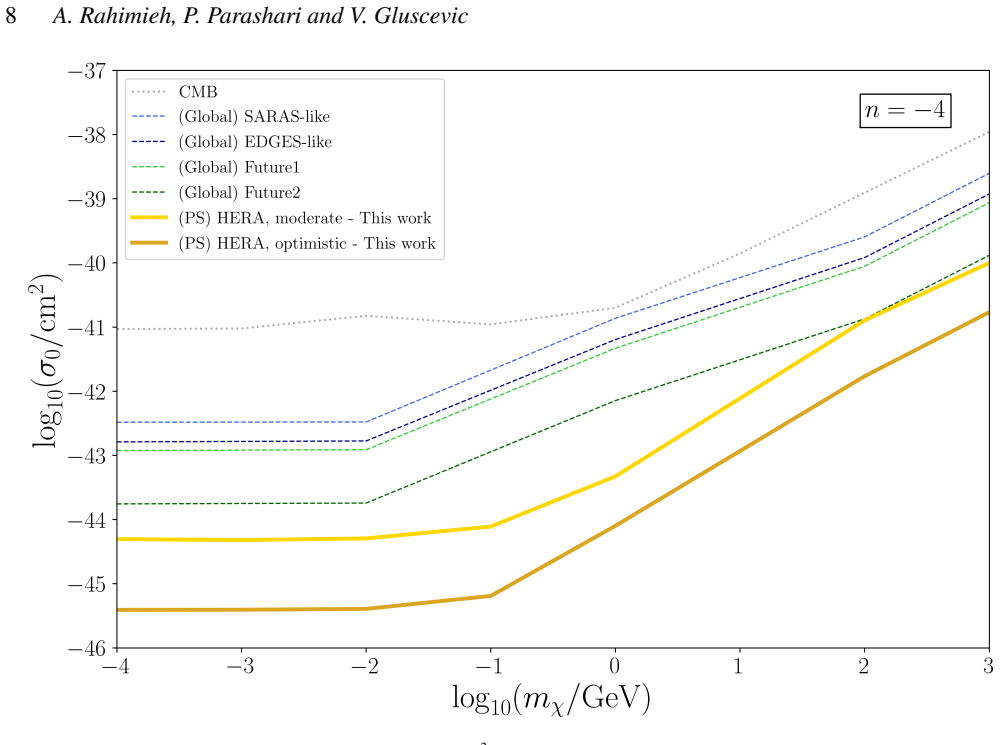
The central claim is that the 21-cm power spectrum, not just its sky-averaged global signal, carries a sharp imprint of dark matter-baryon elastic scattering, and HERA can exploit it. For a velocity-independent cross-section ($n=0$) the scattering delays structure formation and shifts the power-spectrum peak to higher frequencies, while for a Coulomb-like cross-section ($n=-4$) it cools gas in low-relative-velocity patches and amplifies fluctuations during Cosmic Dawn. The authors forecast 95% upper limits on $\log_{10}(\sigma_0/\mathrm{cm}^2)$ as low as $-45.41$ for $n=-4$ at a dark matter mass of 10 MeV under optimistic HERA assumptions, improving over current CMB bounds by at least two orders of magnitude for $n=-4$ and over Milky Way satellite bounds by more than an order of magnitude for $n=0$. They also find that the cross-section is essentially uncorrelated with star formation efficiency and ionizing escape fraction, but is positively correlated with X-ray luminosity in the $n=-4$ case.
Load-bearing premise
The forecast rests on the simulation's omission of frictional heating from the damping of the relative bulk velocity between dark matter and baryons; including that heating could counteract the drag-induced cooling that drives the claimed $n=-4$ sensitivity, especially at dark matter masses below a few GeV, and would likely make the projected limits less stringent.
Editorial extensions
If this is right
- Projected HERA 95% limits reach $\log_{10}(\sigma_0/\mathrm{cm}^2)\approx -45.4$ for $n=-4$ at 10 MeV in the optimistic foreground scenario, below current CMB and satellite bounds.
- For $n=0$, HERA power-spectrum forecasts beat Milky Way satellite abundance constraints by over an order of magnitude and global-signal forecasts by at least a factor of five.
- The $n=-4$ cross-section is positively correlated with X-ray luminosity, so accurate X-ray modeling is needed to avoid biasing dark matter inferences.
- Star formation efficiency, escape fraction, and their power-law slopes do not correlate strongly with the cross-section, so the dark matter constraint is relatively robust to those astrophysical uncertainties.
- The improvement comes from using the full redshift and scale information in the power spectrum rather than the sky-averaged signal alone.
Reading between the lines
- If frictional heating from bulk-velocity damping were included, the $n=-4$ low-mass sensitivity could weaken in exactly the regime where the largest claimed improvement lies; the paper's own discussion flags this possibility.
- Marginalizing over Population-III star parameters, which the paper fixes, could introduce additional degeneracies and broaden the projected contours, potentially reducing the stated improvement factors.
- The same Fisher pipeline could be applied to other upcoming interferometers or to combined datasets, where extra $k$-coverage and redshift range might push sensitivity further.
- A joint fit to both the velocity index $n$ and $\sigma_0$, rather than fixing $n$, would test whether the power spectrum can actually distinguish Coulomb-like from velocity-independent scattering.
Signed reviews
Editorial analysis
A structured set of objections, weighed in public.
Referee Report
Summary. This manuscript presents Fisher-matrix forecasts of the sensitivity of HERA 21-cm power-spectrum measurements to dark matter-baryon scattering, for cross sections parametrized as σ(v)=σ0 v^n with n=0 and n=-4. The authors use the 21cmFirstCLASS simulation pipeline to generate 21-cm power spectra, a 21cmSense-based noise model for two foreground scenarios (moderate and optimistic), and marginalize over six Population-II astrophysical parameters while fixing Population-III parameters. They report 95% upper-limit forecasts on log10 σ0 as a function of dark-matter mass (Figs. 5 and 6; Table 2), and compare them with CMB bounds, Milky Way satellite bounds, and their own global 21-cm forecasts (Rahimieh et al. 2025). The main quantitative claims are that HERA can improve on global-signal forecasts by at least a factor of five for n=0 and by more than an order of magnitude for n=-4, and can surpass current CMB and satellite constraints. An important caveat is acknowledged in Section 4: the simulation omits frictional heating from the damping of the DM-baryon relative bulk velocity.
Significance. If the forecasts are correct, the paper would make a useful case for 21-cm power-spectrum observations as a probe of DM-baryon interactions, extending the companion global-signal analysis and providing quantitative target constraints for HERA. The work uses public simulation and noise codes, and it is honest in flagging the main modelling limitation. However, the central quantitative claims rest on two issues that are not fully resolved: the Fisher parameterization at the σ0=0 fiducial is ambiguous, and the omitted frictional heating term is acknowledged to be relevant precisely in the n=-4 regime that drives the headline improvement. Because these issues affect the reported numbers themselves, rather than only their interpretation, the paper is not yet ready for publication in its present form.
major comments (3)
- [§3.2, Table 1, Table 2] The fiducial model sets σ0=0 (CDM), yet the results are presented as 95% upper limits on log10(σ0). Please state explicitly whether the Fisher derivatives in Eq. (6) are taken with respect to σ0 or log10 σ0. If the latter, the Fisher information at σ0=0 vanishes identically because ∂O/∂(log10 σ0) = σ0 ∂O/∂σ0 = 0 at the fiducial point, so the quoted limits cannot come from that parameterization. If the former, the conversion from a linear Gaussian error on σ0 to a 95% upper limit on log10(σ0) is a non-Gaussian transformation that must be described, and the entries of Table 2 should be checked under that transformation. This ambiguity is load-bearing because the headline improvement factors over global-signal forecasts and CMB/satellite bounds are derived from these numbers.
- [§4, final paragraph] The paper concedes that 21cmFirstCLASS omits frictional heating from the damping of the DM-baryon relative bulk velocity (the term proportional to V_χb^2), and states that this could 'partially counteract the drag-induced cooling in the n=-4 case' and 'mildly broadening the contours', but no quantitative support is given. Because the Fisher derivatives are evaluated at σ0=0, the linear response of this omitted heating term to σ0 contributes to the derivative that sets the projected upper limits; the omission is therefore a first-order effect on the forecast, not a subleading correction that only matters at large σ0. The n=-4 forecasts are driven by cooling-generated power-spectrum enhancement at low DM masses (Figs. 1 and 5, Table 2), which is exactly the regime (m_χ of order or below a few GeV, σ0 ≳ 10^-41 cm^2) where the paper itself says frictional heating becomes important. I ask the authors to either include the term, quantify its impact with an approximate calculation, or explicitly restrict the headline claims to the model without frictional heating. As it stands, the claimed factor-of-five and order-of-magnitude improvements are not robust.
- [§3.2, §5] All Population-III parameters are fixed at their fiducial values, and the paper itself states that marginalizing over them 'could potentially broaden the uncertainties and relax our constraints'. Since the 21-cm power spectrum at Cosmic Dawn is sensitive to Population-III star formation (Hirano & Bromm 2018 is cited in this context), the abstract's unconditional claim that HERA 'can significantly improve sensitivity' is stronger than the evidence presented. The authors should either include Population-III marginalization, quantify the broadening with a sensitivity test, or qualify the abstract and conclusions accordingly.
minor comments (4)
- [§3.1] The text says the simulation is 'discretized into grid cells with a spatial resolution of 128 Mpc', which contradicts the later statement of 'approximately 1 Mpc' resolution and would not support convergence at k≈0.5 Mpc^-1; presumably '128^3 grid cells' is meant, and the wording should be corrected.
- [§4 versus §5, Abstract] The sign of the correlation between σ0 and X-ray luminosity in the n=-4 case is inconsistent: the abstract and Section 4 describe a positive correlation, while Section 5 says 'the X-ray luminosity ... is negatively correlated with the cross-section of interaction only in the Coulomb-like case'.
- [Table 2] Dark-matter mass entries use inconsistent capitalization ('kev', 'Mev', 'Gev'); these should be keV, MeV, GeV.
- [Abstract, §4] The abstract's phrase 'improvement over global signal forecasts' overgeneralizes the comparison: Section 4 notes that the HERA n=0 forecasts are comparable to the 'Future 1' and 'Future 2' global-signal scenarios, and the factor-of-five claim is specifically relative to the EDGES-like scenario. The baseline should be named in the abstract and conclusions.
Circularity Check
No significant circularity; forecasts are derived from public simulations and independent noise models, with the companion-paper global baseline used only for comparison.
full rationale
The derivation chain is self-contained: simulated 21-cm power spectra are produced with the public code 21cmFirstCLASS (Flitter & Kovetz 2024a,b), the Fisher matrix derivatives are evaluated at a LambdaCDM fiducial (sigma0=0) with respect to the declared parameter set, and the forecast noise is computed independently with 21cmSense for HERA configurations. No parameter is fitted to a target result and then relabeled as a prediction; the upper-limit numbers in Table 2 follow directly from Eq. 6 and the stated noise model. The only self-citation is Rahimieh et al. (2025), used as the global 21-cm comparison baseline; this is a comparison against an externally published forecast, not an input to the Fisher calculation, and the paper explicitly notes its fixed-foreground assumptions and that marginalizing foregrounds could change it. The admitted omission of frictional heating in 21cmFirstCLASS is a physical limitation and correctness risk, not circular reasoning: the forecast could change, but it would not reduce to its input by construction. No circular step is exhibited in the paper.
Assumptions & free parameters
free parameters (8)
- log10(f*_II) fiducial =
-1.25
- alpha*_II fiducial =
0.5
- log10(fesc_II) fiducial =
-1.35
- alpha_esc_II fiducial =
-0.3
- L_X_II fiducial =
40.5
- Foreground wedge buffer angle (moderate scenario) =
0.1 radians
- Integration time and duty cycle =
540 days at 6 hours per night
- Receiver temperature =
100 K
assumptions (6)
- domain assumption 21cmFirstCLASS correctly computes the 21-cm power spectrum with dark matter-baryon scattering
- standard math Fisher matrix formalism gives a valid approximation of parameter uncertainties near the fiducial model
- domain assumption Dark matter-baryon scattering cross-section follows sigma(v) = sigma0 v^n with n = -4 or n = 0
- ad hoc to paper Population-III astrophysical parameters can be held fixed at default fiducial values
- ad hoc to paper Frictional heating from dark matter-baryon relative velocity damping can be neglected
- domain assumption The baryon target density is set to rho_b and the effective target mass to the mean baryon mass
invented entities (1)
-
No new entity
Cite this review
Pith. "Pith review of Forecasting 21-cm power spectrum sensitivity to dark Matter-baryon scattering." pith.science (2026). https://pith.science/paper/OIQ5IHNU
@misc{pith2026250820507,
  author       = {Pith},
  title        = {Pith review of: Forecasting 21-cm power spectrum sensitivity to dark Matter-baryon scattering},
  year         = {2026},
  howpublished = {\url{https://pith.science/paper/OIQ5IHNU}},
  note         = {Machine review of arXiv:2508.20507}
}
abstract
We explore the potential of upcoming 21-cm interferometric observations to probe interacting dark matter (IDM). We focus on scenarios where the dark matter-baryon scattering cross-section scales as $\sigma(v) =\sigma_{0} v^n$, with $\sigma_{0}$ being the normalization constant, $v$ the relative velocity between dark matter and baryons, and $n$ characterizing the velocity dependence. Specifically, we emphasize two cases: Coulomb-like interaction ($n = -4$) and velocity-independent interaction ($n = 0$). Using detailed simulations of the 21-cm power spectrum and the Fisher matrix formalism, we forecast the sensitivity of the Hydrogen Epoch of Reionization Array (HERA), which targets the frequency range 50-225 MHz, to both IDM and astrophysical parameters. We marginalize over key astrophysical uncertainties, including star formation efficiency, ionizing photon escape fraction, and X-ray luminosity. Our results demonstrate that 21-cm power spectrum measurements can significantly improve sensitivity to IDM cross-section, with at least a factor of five improvement over global signal forecasts for the $n=0$ case, and more than an order of magnitude enhancement for the $n=-4$ scenario. These forecasts also significantly improve upon the existing bounds from cosmic microwave background and Milky Way satellite abundance observations. Our analysis also shows that the IDM cross-section exhibits no correlation with the parameters associated with star formation efficiency and ionizing photon escape fraction of Population-II stars. However, we find that the Coulomb-like cross-section is positively correlated with X-ray luminosity. Our results highlight the critical role of accounting for astrophysical uncertainties in obtaining robust inferences of dark matter-baryon interactions from future 21-cm power spectrum observations.
Figures


Figures from the paper (3 more)


Forward citations
Cited by 1 Pith paper
-
Dark Secrets of Baryons: Illuminating Dark Matter-Baryon Interactions with JWST
JWST ultraviolet luminosity function data currently provide the strongest upper limits on velocity-dependent (∝v^{-2}) dark matter–proton scattering for sub-GeV dark matter.
Reference graph
Works this paper leans on
-
[1]
Abdalla E., et al., 2022, @doi [JHEAp] https://doi.org/10.48550/arXiv.2203.06142 , 34, 49
-
[2]
Abdurashidova T. H. C. Z., et al., 2023, @doi [ApJ] 10.3847/1538-4357/acaf50 , 945, 124
-
[3]
Adi T., Flitter J., Kovetz E. D., 2025, @doi [Phys. Rev. D] 10.1103/PhysRevD.111.043515 , 111, 043515
-
[4]
Aghanim N., et al., 2020, @doi [A&A] https://doi.org/10.1051/0004-6361/201833910 , 641, A6
-
[5]
Ali-Ha\" moud Y., Chluba J., Kamionkowski M., 2015, @doi [Phys. Rev. Lett.] 10.1103/PhysRevLett.115.071304 , 115, 071304
-
[6]
Barkana R., 2018, @doi [Nature] https://doi.org/10.1038/nature25791 , 555, 71
-
[7]
Barkana R., Loeb A., 2005, @doi [ApJ] 10.1086/430599 , 624, L65
-
[8]
J., Redigolo D., Volansky T., 2018, @doi [Phys
Barkana R., Outmezguine N. J., Redigolo D., Volansky T., 2018, @doi [Phys. Rev. D] 10.1103/PhysRevD.98.103005 , 98, 103005
Show all 91 references
-
[9]
J., 2023, @doi [Phys
Barkana R., Fialkov A., Liu H., Outmezguine N. J., 2023, @doi [Phys. Rev. D] 10.1103/PhysRevD.108.063503 , 108, 063503
2023 doi
-
[10]
S., Mertens F., 2021, @doi [JATIS] 10.1117/1.jatis.8.1.011007 , 8
Barry N., Bernardi G., Greig B., Kern N. S., Mertens F., 2021, @doi [JATIS] 10.1117/1.jatis.8.1.011007 , 8
2021 doi
-
[11]
C., Kahlhoefer F., Lesgourgues J., Schöneberg N., 2021, @doi [JCAP] 10.1088/1475-7516/2021/02/019 , 2021, 019
Becker N., Hooper D. C., Kahlhoefer F., Lesgourgues J., Schöneberg N., 2021, @doi [JCAP] 10.1088/1475-7516/2021/02/019 , 2021, 019
2021 doi
-
[12]
L., et al., 2003, @doi [ApJS] 10.1086/377253 , 148, 1
Bennett C. L., et al., 2003, @doi [ApJS] 10.1086/377253 , 148, 1
2003 doi
-
[13]
D., 2018, @doi [Phys
Berlin A., Hooper D., Krnjaic G., McDermott S. D., 2018, @doi [Phys. Rev. Lett.] 10.1103/PhysRevLett.121.011102 , 121, 011102
2018 doi
-
[14]
K., Gluscevic V., 2018, @doi [Phys
Boddy K. K., Gluscevic V., 2018, @doi [Phys. Rev. D] 10.1103/PhysRevD.98.083510 , 98, 083510
2018 doi
-
[15]
K., Gluscevic V., Poulin V., Kovetz E
Boddy K. K., Gluscevic V., Poulin V., Kovetz E. D., Kamionkowski M., Barkana R., 2018, @doi [Phys. Rev. D] 10.1103/PhysRevD.98.123506 , 98, 123506
2018 doi
-
[16]
K., Krnjaic G., Moltner S., 2022, @doi [Phys
Boddy K. K., Krnjaic G., Moltner S., 2022, @doi [Phys. Rev. D] 10.1103/PhysRevD.106.043510 , 106, 043510
2022 doi
-
[17]
Boehm C., Schaeffer R., 2005, @doi [A&A] https://doi.org/10.1051/0004-6361:20042238 , 438, 419
2005 doi
-
[18]
D., Rogers A
Bowman J. D., Rogers A. E., Monsalve R. A., Mozdzen T. J., Mahesh N., 2018, @doi [Nature] https://doi.org/10.1038/nature25792 , 555, 67
2018 doi
-
[19]
O., et al., 2019, preprint (arXiv:1902.06147 https://arxiv.org/abs/1902.06147)
Burns J. O., et al., 2019, preprint (arXiv:1902.06147 https://arxiv.org/abs/1902.06147)
2019 arXiv
-
[20]
J., 2002, @doi [Phys
Chen X., Hannestad S., Scherrer R. J., 2002, @doi [Phys. Rev. D] 10.1103/PhysRevD.65.123515 , 65, 123515
2002 doi
-
[21]
S., Sethi S., 2021, @doi [ApJL] 10.3847/2041-8213/abfcc7 , 913, L24
Chowdhury A., Kanekar N., Das B., Dwarakanath K. S., Sethi S., 2021, @doi [ApJL] 10.3847/2041-8213/abfcc7 , 913, L24
2021 doi
-
[22]
H., Markevitch M., Randall S
Clowe D., Bradac M., Gonzalez A. H., Markevitch M., Randall S. W., Jones C., Zaritsky D., 2006, @doi [ApJL] 10.1086/508162 , 648, L109
2006 doi
-
[23]
R., et al., 2017, @doi [ASP] 10.1088/1538-3873/129/974/045001 , 129, 045001
DeBoer D. R., et al., 2017, @doi [ASP] 10.1088/1538-3873/129/974/045001 , 129, 045001
2017 doi
-
[24]
Driskell T., et al., 2022, @doi [Phys. Rev. D] 10.1103/PhysRevD.106.103525 , 106, 103525
2022 doi
-
[25]
Dvorkin C., Blum K., Kamionkowski M., 2014, @doi [Phys. Rev. D] 10.1103/PhysRevD.89.023519 , 89, 023519
2014 doi
-
[26]
W., et al., 2019, @doi [AJ] 10.3847/1538-3881/ab2629 , 158, 84
Eastwood M. W., et al., 2019, @doi [AJ] 10.3847/1538-3881/ab2629 , 158, 84
2019 doi
-
[27]
J., et al., 2005, @doi [ApJ] 10.1086/466512 , 633, 560
Eisenstein D. J., et al., 2005, @doi [ApJ] 10.1086/466512 , 633, 560
2005 doi
-
[28]
Escudero M., Lopez-Honorez L., Mena O., Palomares-Ruiz S., Villanueva-Domingo P., 2018, @doi [JCAP] 10.1088/1475-7516/2018/06/007 , 2018, 007
2018 doi
-
[29]
M., 2012, @doi [ ] 10.1111/j.1365-2966.2012.21318.x , https://ui.adsabs.harvard.edu/abs/2012MNRAS.424.1335F 424, 1335
Fialkov A., Barkana R., Tseliakhovich D., Hirata C. M., 2012, @doi [ ] 10.1111/j.1365-2966.2012.21318.x , https://ui.adsabs.harvard.edu/abs/2012MNRAS.424.1335F 424, 1335
2012
-
[30]
Fialkov A., Barkana R., Cohen A., 2018, @doi [Phys. Rev. Lett.] 10.1103/PhysRevLett.121.011101 , 121, 011101
2018 doi
-
[31]
B., 1959, @doi [ApJ] 10.1086/146653 , 129, 536
Field G. B., 1959, @doi [ApJ] 10.1086/146653 , 129, 536
1959 doi
-
[32]
S., Dolag K., Garny M., Gluscevic V., Groth F., Nadler E
Fischer M. S., Dolag K., Garny M., Gluscevic V., Groth F., Nadler E. O., 2025, preprint (arXiv:2504.12393 https://arxiv.org/abs/2504.12393)
2025 arXiv
-
[33]
D., 2024a, @doi [Phys
Flitter J., Kovetz E. D., 2024a, @doi [Phys. Rev. D] 10.1103/PhysRevD.109.043512 , 109, 043512
-
[34]
D., 2024b, @doi [Phys
Flitter J., Kovetz E. D., 2024b, @doi [Phys. Rev. D] 10.1103/PhysRevD.109.043513 , 109, 043513
-
[35]
R., 2006, @doi [MNRAS] 10.1111/j.1365-2966.2006.10725.x , 371, 867
Furlanetto S. R., 2006, @doi [MNRAS] 10.1111/j.1365-2966.2006.10725.x , 371, 867
2006
-
[36]
R., Oh S
Furlanetto S. R., Oh S. P., Briggs F. H., 2006, @doi [Phys. Rep.] 10.1016/j.physrep.2006.08.002 , 433, 181
2006 doi
-
[37]
Garsden H., et al., 2021, @doi [MNRAS] 10.1093/mnras/stab1671 , 506, 5802
2021 doi
-
[38]
K., 2018, @doi [Phys
Gluscevic V., Boddy K. K., 2018, @doi [Phys. Rev. Lett.] 10.1103/PhysRevLett.121.081301 , 121, 081301
2018 doi
-
[39]
Gluscevic V., et al., 2019, preprint (arXiv:1903.05140 https://arxiv.org/abs/1903.05140)
2019 arXiv
-
[40]
M., An R., Gluscevic V., 2023, @doi [ApJL] 10.3847/2041-8213/acdb63 , 954, L8
He A., Ivanov M. M., An R., Gluscevic V., 2023, @doi [ApJL] 10.3847/2041-8213/acdb63 , 954, L8
2023 doi
-
[41]
Hinshaw G., et al., 2013, @doi [ApJS] 10.1088/0067-0049/208/2/19 , 208, 19
2013 doi
-
[42]
Hirano S., Bromm V., 2018, @doi [Monthly Notices of the Royal Astronomical Society: Letters] 10.1093/mnrasl/sly132 , 480, L85
2018 doi
-
[43]
D., Poulin V., Gluscevic V., Boddy K
Kovetz E. D., Poulin V., Gluscevic V., Boddy K. K., Barkana R., Kamionkowski M., 2018, @doi [Phys. Rev. D] 10.1103/PhysRevD.98.103529 , 98, 103529
2018 doi
-
[44]
K., Madhavacheril M
Li Z., Gluscevic V., Boddy K. K., Madhavacheril M. S., 2018a, @doi [Phys. Rev. D] 10.1103/PhysRevD.98.123524 , 98, 123524
-
[45]
Li W., et al., 2018b, @doi [ApJ] 10.3847/1538-4357/aad3c3 , 863, 170
-
[46]
Li Z., et al., 2023, @doi [JCAP] 10.1088/1475-7516/2023/02/046 , 2023, 046
2023 doi
-
[47]
Lin Y., Gao Y., 2023, preprint (arXiv:2311.11584 https://arxiv.org/abs/2311.11584)
2023 arXiv
-
[48]
R., 2018, @doi [Phys
Liu H., Slatyer T. R., 2018, @doi [Phys. Rev. D] 10.1103/PhysRevD.98.023501 , 98, 023501
2018 doi
-
[49]
J., Redigolo D., Volansky T., 2019, @doi [Phys
Liu H., Outmezguine N. J., Redigolo D., Volansky T., 2019, @doi [Phys. Rev. D] 10.1103/PhysRevD.100.123011 , 100, 123011
2019 doi
-
[50]
K., Nadler E
Maamari K., Gluscevic V., Boddy K. K., Nadler E. O., Wechsler R. H., 2021, @doi [ApJL] 10.3847/2041-8213/abd807 , 907, L46
2021 doi
-
[51]
J., 1997, @doi [ApJ] 10.1086/303549 , 475, 429
Madau P., Meiksin A., Rees M. J., 1997, @doi [ApJ] 10.1086/303549 , 475, 429
1997 doi
-
[52]
A., Muñoz J
Mason C. A., Muñoz J. B., Greig B., Mesinger A., Park J., 2023, @doi [MNRAS] 10.1093/mnras/stad2145 , 524, 4711
2023 doi
-
[53]
Massey R., Kitching T., Richard J., 2010, @doi [Reports on Progress in Physics] 10.1088/0034-4885/73/8/086901 , 73, 086901
2010 doi
-
[54]
D., Yu H.-B., Zurek K
McDermott S. D., Yu H.-B., Zurek K. M., 2011, @doi [Phys. Rev. D] 10.1103/PhysRevD.83.063509 , 83, 063509
2011 doi
-
[55]
Mesinger A., Furlanetto S., Cen R., 2011, @doi [MNRAS] 10.1111/j.1365-2966.2010.17731.x , 411, 955
2011
-
[56]
R., Boehm C., Wong Y
Mosbech M. R., Boehm C., Wong Y. Y., 2023, @doi [JCAP] 10.1088/1475-7516/2023/03/047 , 2023, 047
2023 doi
-
[57]
B., Cyr-Racine F.-Y., 2021, @doi [Phys
Mu\ noz J. B., Cyr-Racine F.-Y., 2021, @doi [Phys. Rev. D] 10.1103/PhysRevD.103.023512 , 103, 023512
2021 doi
-
[58]
B., Kovetz E
Mu\ noz J. B., Kovetz E. D., Ali-Ha\" moud Y., 2015, @doi [Phys. Rev. D] 10.1103/PhysRevD.92.083528 , 92, 083528
2015 doi
-
[59]
B., Dvorkin C., Loeb A., 2018, @doi [Phys
Mu\ noz J. B., Dvorkin C., Loeb A., 2018, @doi [Phys. Rev. Lett.] 10.1103/PhysRevLett.121.121301 , 121, 121301
2018 doi
-
[60]
B., Loeb A., 2018, preprint (arXiv:1802.10094 https://arxiv.org/abs/1802.10094)
Munoz J. B., Loeb A., 2018, preprint (arXiv:1802.10094 https://arxiv.org/abs/1802.10094)
2018 arXiv
-
[61]
B., Qin Y., Mesinger A., Murray S
Muñoz J. B., Qin Y., Mesinger A., Murray S. G., Greig B., Mason C., 2022, @doi [MNRAS] 10.1093/mnras/stac185 , 511, 3657
2022 doi
-
[62]
O., Gluscevic V., Boddy K
Nadler E. O., Gluscevic V., Boddy K. K., Wechsler R. H., 2019, @doi [ApJL] 10.3847/2041-8213/ab1eb2 , 878, L32
2019 doi
-
[63]
O., et al., 2021, @doi [Phys
Nadler E. O., et al., 2021, @doi [Phys. Rev. Lett.] 10.1103/PhysRevLett.126.091101 , 126, 091101
2021 doi
-
[64]
V., Sarnaaik D., Boddy K
Nguyen D. V., Sarnaaik D., Boddy K. K., Nadler E. O., Gluscevic V., 2021, @doi [Phys. Rev. D] 10.1103/PhysRevD.104.103521 , 104, 103521
2021 doi
-
[65]
Ooba J., Tashiro H., Kadota K., 2019, @doi [JCAP] 10.1088/1475-7516/2019/09/020 , 2019, 020
2019 doi
-
[66]
Rev.] https://doi.org/10.1016/j.newar.2022.101659 , 95, 101659
Perivolaropoulos L., Skara F., 2022, @doi [New Astron. Rev.] https://doi.org/10.1016/j.newar.2022.101659 , 95, 101659
2022
-
[67]
C., et al., 2013, @doi [The Astronomical Journal] 10.1088/0004-6256/145/3/65 , 145, 65
Pober J. C., et al., 2013, @doi [The Astronomical Journal] 10.1088/0004-6256/145/3/65 , 145, 65
2013 doi
-
[68]
C., et al., 2014, @doi [ApJ] 10.1088/0004-637X/782/2/66 , 782, 66
Pober J. C., et al., 2014, @doi [ApJ] 10.1088/0004-637X/782/2/66 , 782, 66
2014 doi
-
[69]
R., Loeb A., 2012, @doi [Rep
Pritchard J. R., Loeb A., 2012, @doi [Rep. Prog. Phys.] 10.1088/0034-4885/75/8/086901 , 75, 086901
2012 doi
-
[70]
Rahimieh A., Parashari P., An R., Driskell T., Mirocha J., Gluscevic V., 2025, preprint (arXiv:2505.03148 https://arxiv.org/abs/2505.03148)
2025
-
[71]
Refregier A., 2003, @doi [ARA&A] https://doi.org/10.1146/annurev.astro.41.111302.102207 , 41, 645
2003
-
[72]
K., Dvorkin C., Peiris H
Rogers K. K., Dvorkin C., Peiris H. V., 2022, @doi [Phys. Rev. Lett.] 10.1103/PhysRevLett.128.171301 , 128, 171301
2022 doi
- [73]
-
[74]
F., Sánchez A
Schöneberg N., Abellán G. F., Sánchez A. P., Witte S. J., Poulin V., Lesgourgues J., 2022, @doi [Phys. Rep.] https://doi.org/10.1016/j.physrep.2022.07.001 , 984, 1
2022 doi
-
[75]
L., Boddy K
Short K., Bernal J. L., Boddy K. K., Gluscevic V., Verde L., 2022, preprint (arXiv:2203.16524 https://arxiv.org/abs/2203.16524)
2022 arXiv
-
[76]
R., Kamionkowski M., 2004, @doi [Phys
Sigurdson K., Doran M., Kurylov A., Caldwell R. R., Kamionkowski M., 2004, @doi [Phys. Rev. D] 10.1103/PhysRevD.70.083501 , 70, 083501
2004 doi
-
[77]
Singh S., et al., 2022, @doi [Nature Astronomy] https://doi.org/10.1038/s41550-022-01610-5 , 6, 607
2022 doi
-
[78]
R., Wu C.-L., 2018, @doi [Phys
Slatyer T. R., Wu C.-L., 2018, @doi [Phys. Rev. D] 10.1103/PhysRevD.98.023013 , 98, 023013
2018 doi
-
[79]
R., Padmanabhan N., Finkbeiner D
Slatyer T. R., Padmanabhan N., Finkbeiner D. P., 2009, @doi [Phys. Rev. D] 10.1103/PhysRevD.80.043526 , 80, 043526
2009 doi
-
[80]
F., et al., 1992, @doi [ ] 10.1086/186504 , 396, L1
Smoot G. F., et al., 1992, @doi [ ] 10.1086/186504 , 396, L1
1992 doi
-
[81]
Sofue Y., Rubin V., 2001, @doi [ARA&A] 10.1146/annurev.astro.39.1.137 , 39, 137
2001 doi
-
[82]
W., Liu H., Mu\ noz J
Sun Y., Foster J. W., Liu H., Mu\ noz J. B., Slatyer T. R., 2025, @doi [Phys. Rev. D] 10.1103/PhysRevD.111.043015 , 111, 043015
2025 doi
-
[83]
Tegmark M., et al., 2004, @doi [Phys. Rev. D] 10.1103/PhysRevD.69.103501 , 69, 103501
2004 doi
-
[84]
Rep.] https://doi.org/10.1016/j.physrep.2017.11.004 , 730, 1
Tulin S., Yu H.-B., 2018, @doi [Phys. Rep.] https://doi.org/10.1016/j.physrep.2017.11.004 , 730, 1
2018 doi
-
[85]
R., 2021, preprint (arXiv:2112.00707 https://arxiv.org/abs/2112.00707)
Xu X., Farrar G. R., 2021, preprint (arXiv:2112.00707 https://arxiv.org/abs/2112.00707)
2021 arXiv
-
[86]
L., Dvorkin C., Chael A., 2018, @doi [Phys
Xu W. L., Dvorkin C., Chael A., 2018, @doi [Phys. Rev. D] 10.1103/PhysRevD.97.103530 , 97, 103530
2018 doi
-
[87]
Zentner A., Dandavate S., Slone O., Lisanti M., 2022, @doi [JCAP] 10.1088/1475-7516/2022/07/031 , 2022, 031
2022 doi
-
[88]
Zwicky F., 2009, @doi [GRG] https://doi.org/10.1007/s10714-008-0707-4 , 41, 207
2009 doi
-
[89]
Zygelman B., 2005, @doi [ ] 10.1086/427682 , https://ui.adsabs.harvard.edu/abs/2005ApJ...622.1356Z 622, 1356
2005 doi
-
[90]
P., et al., 2013, @doi [A&A] 10.1051/0004-6361/201220873 , 556, A2
van Haarlem M. P., et al., 2013, @doi [A&A] 10.1051/0004-6361/201220873 , 556, A2
2013 doi
-
[91]
write newline
" write newline "" before.all 'output.state := FUNCTION fin.entry write newline FUNCTION new.block output.state before.all = 'skip after.block 'output.state := if FUNCTION new.sentence output.state after.block = 'skip output.state before.all = 'skip after.sentence 'output.stat...
Reviewed August 15, 2026 · model on record in the stance chip above.
Discussion (0). Continue with ORCID to comment.