REVIEW 2 major objections 6 minor 34 references
Efficient Learning of Vehicle Controller Parameters via Multi-Fidelity Bayesian Optimization: From Simulation to Experiment
T0 review · 2 major / 6 minor · reviewed 2026-08-07 · deepseek-v4-flash
Pith's one-line read A multi-fidelity Bayesian optimizer tunes a vehicle controller with a handful of real test-track runs.
desk verdict Solid simulation study; field validation is a single favorable draw that doesn't prove the multi-fidelity transfer. read the letter →
The pith
A machine-rendered reading of the paper's core claim, the machinery that carries it, and where it could break.
The reading
What carries the argument
The carrying object is the AR1 auto-regressive multi-fidelity Gaussian process, defined recursively by $g_h(\xi)=\rho_{h-1}g_{h-1}(\xi)+\delta_h(\xi)$, with $g_{h-1}(\xi)$ independent of the GP bias $\delta_h(\xi)$. For two fidelity levels this says the true, real-world cost is a scaled copy of the simulation cost plus a correction term. The AR1 surrogate is trained once on low-fidelity data, then used inside expected-improvement Bayesian optimization with only high-fidelity updates during field tests; this is what allows the optimizer to start from a good region and reach a competitive controller in the first real query.
What would settle it
Collect a paired data set of simulated and true costs over a broad parameter grid on a test vehicle, fit the AR1 model, and compare its held-out prediction error with a nonlinear multi-fidelity model; if the nonlinear model consistently wins and the AR1 residuals show curvature, the linearity assumption is falsified. A cheaper check is to rerun the field experiment with a deliberately poor simulation model, for example a 50% tire-force perturbation; if AR1GP-BO no longer beats single-fidelity Bayesian optimization within the first few queries, the transfer benefit depends on the linearity holding.
Extended reading notes
Core claim
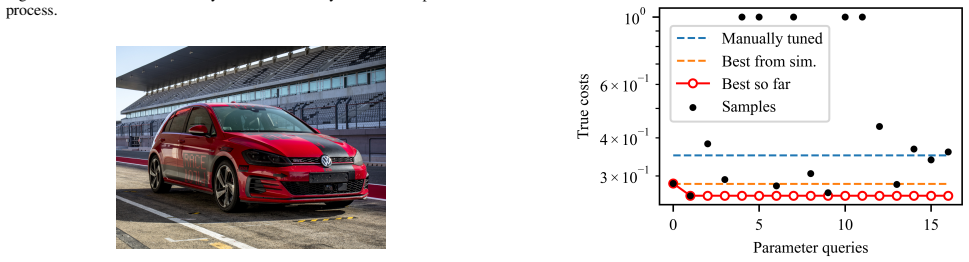
The central claim is that an auto-regressive multi-fidelity Gaussian process, fed with existing low-fidelity data, lets Bayesian optimization transfer knowledge from simulation to a real vehicle without any new low-fidelity evaluations during the physical tests. The paper states the high-fidelity cost as a linear function of the low-fidelity cost plus an independent GP bias, so the real experiments can concentrate on a small number of high-value parameter queries. Across three simulated perturbed-vehicle studies, AR1GP-BO converged to a simple regret around $10^{-2}$ within 10 queries, outperforming a nonlinear multi-fidelity baseline and a single-fidelity GP baseline. On a test vehicle, 17 parameter queries were performed; the first query achieved a true cost of $0.258$, below the manually tuned cost of $0.351$ and the best simulation-only cost of $0.282$, and the method did so while preserving the two-stage simulation-then-validation workflow.
Load-bearing premise
The load-bearing premise is that the real-world cost is a linear rescaling of the simulation cost plus an independent correction; if the true simulation-to-reality map is strongly nonlinear, the surrogate can point the optimizer at the wrong parameters.
Editorial extensions
If this is right
- If the claim holds, automotive teams can keep the two-stage V-model but replace most manual real-world tuning with automatic simulation-informed optimization.
- The number of expensive test-track runs needed to find a good controller can drop to a handful; in the reported case a single query already improved on manual tuning.
- The method inherits a clear dependence on low-fidelity accuracy: perturbing the simulation model by 10% slows convergence, though it still beats a single-fidelity baseline.
- Because some queried parameters led to failed laps, the paper's own outlook is that safe Bayesian optimization must be added before the approach is deployed on systems where instability is dangerous.
Reading between the lines
- Beyond the paper's experiments, the same transfer logic should apply to any black-box controller whose simulation model captures the dominant dynamics; the natural next test is adapting the AR1 scale and bias parameters online as real data accumulate.
- A direct, testable extension is to fit both AR1 and a nonlinear multi-fidelity model to paired simulation and field costs and compare predictive residuals; if the residuals are strongly nonlinear near handling limits, a nonlinear correction would be needed for deployment at the tire friction limit.
- The one-real-query result is a statistical accident of a single field test, not a guaranteed property; the more robust claim to carry forward is that simulation-pretrained AR1GP-BO reduces the number of real queries needed to reach a fixed regret, which is what the simulation studies demonstrate.
Editorial analysis
A structured set of objections, weighed in public.
Referee Report
Summary. The paper proposes a two-stage multi-fidelity Bayesian optimization framework for tuning a vehicle trajectory tracking controller. In the first stage, a standard GP-based BO gathers low-fidelity (simulation) data. In the second stage, an auto-regressive AR1 GP surrogate fuses this fixed low-fidelity data set with a small number of high-fidelity (real-vehicle) evaluations, and expected-improvement BO selects new controller parameters without requiring further simulations. The approach is validated in simulation with three model-perturbation scenarios and on a test vehicle with 17 real-world queries, where the first query is reported to already achieve a lower true cost than both a manually tuned controller and the best simulation-only parameters.
Significance. The proposed workflow is practically relevant because it preserves the conventional two-stage V-model development process and avoids the continuous low-fidelity evaluations required by many multi-fidelity BO methods. The simulation study is a genuine strength: it uses three perturbation cases, five independent trials, and meaningful baselines (NARGP-BO and SFGP-BO), and the AR1GP-BO convergence advantage is clearly demonstrated in Fig. 4. The real-world experiment on a production test vehicle is also a valuable contribution. However, as detailed in the major comments, the field evidence does not currently establish the paper's headline claim about real-world sample efficiency, and the AR1 linearity assumption is not validated against the collected data.
major comments (2)
- [Section V, Fig. 8, Table III] The real-world validation rests entirely on a single sequence of 17 queries on one vehicle and one track, with no repeated trials, no confidence intervals, and no comparison run using a baseline method in the field. The paper states in Section V that "the first tested parameter is determined based on only the low-fidelity data set since high-fidelity data are not available in the first run"; that first query already yields the best true cost in Table III (0.258), and the subsequent 16 queries do not improve on it. Consequently, the field experiment cannot separate the contribution of the AR1 multi-fidelity update from a simulation-only acquisition, and the abstract's claim of achieving high-quality performance with "very few real-world experiments" is not independently supported by the field data. The simulation studies in Fig. 4 support the mechanism, but the field claim needs either repeated runs, measurement-noise characterization, or a matched real-world comparison against SFGP-BO or NARGP-BO.
- [Section III-B, Eq. (7); Fig. 7] The AR1 model assumes g_h(x) = rho * g_{h-1}(x) + delta_h(x), i.e., a linear relationship between the simulation cost and the real-world cost. This assumption is never tested against the collected field data. Fig. 7 shows substantial scatter between simulated and true costs, and the paper itself notes the "fidelity difference between simulations and field tests." If the sim-to-real map is strongly nonlinear, the AR1 surrogate could place queries in misleading regions. A concrete way to address this is to compare leave-one-out or cross-validated predictive performance of AR1 versus NARGP on the 17 field-test points, or to run both surrogates in repeated real-world trials.
minor comments (6)
- [Section V, paragraph 1] The text says "we adopt the same implementation as described in IV-B," but the implementation details (Matérn-5/2 kernel, Gamma prior, normalization) appear in Section IV-A before the "Results" subsection; the cross-reference should be corrected.
- [Table I, row 3] The entry "D×103%" is ambiguous; it should be written as "D multiplied by 1.03" or "D increased by 3%" to avoid confusion with a factor of 103 percent.
- [Section IV-A and Section V] The number of low-fidelity evaluations used for the real-world experiment is not stated; specify how many simulation queries form the low-fidelity data set in Section V, because this number is important for interpreting the cost of the overall workflow.
- [Table III and Section V] The manually tuned controller is described as suboptimal, but no information is given about the effort, number of iterations, or expertise behind the manual tuning baseline; reporting this context would make the comparison more meaningful.
- [Fig. 7 and Fig. 8] Each point in these figures appears to be a single measurement with no error bars or repeated runs; the captions should state this explicitly to avoid over-interpreting point estimates.
- [Reference [22]] Reference [22] lists "M. Temper" while the author list of the paper uses "Maximilian Templer"; the spelling should be corrected.
Circularity Check
No circular reasoning: AR1GP-BO is benchmarked against independent baselines and an external test-track experiment; self-citations are not load-bearing.
full rationale
The paper's central claim is that multi-fidelity Bayesian optimization with an AR1 Gaussian process surrogate reduces the number of real-world experiments needed for vehicle controller tuning. The AR1 model in Eq. (7) is a standard Kennedy-O'Hagan construction, not a restatement of the target result. Its hyperparameters, including the scaling factor rho and the bias GP, are inferred via evidence maximization from data, not fixed to force the observed outcome. The simulation studies compare AR1GP-BO against NARGP-BO and single-fidelity SFGP-BO on perturbed-vehicle test problems, giving independent baselines; the low-fidelity data are generated from different perturbed models and are not constructed to match the high-fidelity optimum. The real-world experiment is an external benchmark: low-fidelity data come from nominal-model simulations, high-fidelity data from the actual test vehicle, and the first query is explicitly selected with no high-fidelity data, so its success cannot be a fitted high-fidelity prediction. The paper also honestly states that it cannot be confirmed whether the best observed cost is the global minimum. The only self-citations are background references or the description of the control system and trajectory planner, none of which supply a load-bearing uniqueness theorem or ansatz. The field validation being a single unreplicated run is a legitimate evidence-strength concern, but it is not circularity: no equation or fitted parameter reduces by construction to the claimed result.
Assumptions & free parameters
free parameters (3)
- Cost function weights [w1, w2, w3] =
[1, 3, 0.03]
- Heuristic failure cost =
0.5 (simulation), 1.0 (experiment)
- Noise variance box constraint =
[1e-5, 2e-4]
assumptions (5)
- standard math Gaussian process regression formulas (Eq. 6) and the AR1 recursion (Eq. 7) are valid and applicable to the cost function J(theta).
- domain assumption The single-track vehicle model with magic formula tires (Eqs. 2-3) captures the trajectory tracking dynamics well enough that simulation cost correlates with real-world cost.
- ad hoc to paper The cost function (Eq. 15) with weights [1, 3, 0.03] is an adequate scalarization of controller performance.
- ad hoc to paper Failed laps receive a fixed penalty cost (0.5 in simulation, 1.0 in experiments) instead of a measured value.
- standard math GP hyperparameters inferred by evidence maximization generalize to unseen data.
Cite this review
Pith. "Pith review of Efficient Learning of Vehicle Controller Parameters via Multi-Fidelity Bayesian Optimization: From Simulation to Experiment." pith.science (2026). https://pith.science/paper/OIT2ICR4
@misc{pith2026250608719,
  author       = {Pith},
  title        = {Pith review of: Efficient Learning of Vehicle Controller Parameters via Multi-Fidelity Bayesian Optimization: From Simulation to Experiment},
  year         = {2026},
  howpublished = {\url{https://pith.science/paper/OIT2ICR4}},
  note         = {Machine review of arXiv:2506.08719}
}
read the original abstract
Parameter tuning for vehicle controllers remains a costly and time-intensive challenge in automotive development. Traditional approaches rely on extensive real-world testing, making the process inefficient. We propose a multi-fidelity Bayesian optimization approach that efficiently learns optimal controller parameters by leveraging both low-fidelity simulation data and a very limited number of real-world experiments. Our approach significantly reduces the need for manual tuning and expensive field testing while maintaining the standard two-stage development workflow used in industry. The core contribution is the integration of an auto-regressive multi-fidelity Gaussian process model into Bayesian optimization, enabling knowledge transfer between different fidelity levels without requiring additional low-fidelity evaluations during real-world testing. We validate our approach through both simulation studies and realworld experiments. The results demonstrate that our method achieves high-quality controller performance with only very few real-world experiments, highlighting its potential as a practical and scalable solution for intelligent vehicle control tuning in industrial applications.
Figures


Figures from the paper (3 more)


Reference graph
Works this paper leans on
-
[1]
Impact of digital trans- formation on the automotive industry,
C. Llopis-Albert, F. Rubio, and F. Valero, “Impact of digital trans- formation on the automotive industry,”Technological Forecasting and Social Change, vol. 162, p. 120343, 2021
work page 2021
-
[2]
Intelligent Vehicle Sys- tems: Applications and New Trends,
O. Gusikhin, D. Filev, and N. Rychtyckyj, “Intelligent Vehicle Sys- tems: Applications and New Trends,” inInformatics in Control Automation and Robotics: Selected Papers from the International Conference on Informatics in Control Automation and Robotics 2006, 2008, pp. 3–14
work page 2006
-
[3]
The new V-Model of VDI 2206 and its validation,
I. Graessler and J. Hentze, “The new V-Model of VDI 2206 and its validation,”at - Automatisierungstechnik, vol. 68, no. 5, pp. 312–324, 2020
work page 2020
-
[4]
D. E. Smith and J. M. Starkey, “Effects of Model Complexity on the Performance of Automated Vehicle Steering Controllers: Model Development, Validation and Comparison,”Vehicle System Dynamics, vol. 24, no. 2, pp. 163–181, 1995
work page 1995
-
[5]
Advanced driver assistance systems: Objective and subjective perfor- mance evaluation,
R. A. Auckland, W. J. Manning, O. M. Carsten, and A. H. Jamson, “Advanced driver assistance systems: Objective and subjective perfor- mance evaluation,”Vehicle System Dynamics, vol. 46, pp. 883–897, 2008
work page 2008
-
[6]
Optimum Settings for Automatic Controllers,
J. G. Ziegler and N. B. Nichols, “Optimum Settings for Automatic Controllers,”Transactions of the American Society of Mechanical Engineers, vol. 64, no. 8, pp. 759–765, 1942
work page 1942
-
[7]
Iterative feedback tuning: theory and applications,
H. Hjalmarsson, M. Gevers, S. Gunnarsson, and O. Lequin, “Iterative feedback tuning: theory and applications,”IEEE Control Systems Magazine, vol. 18, no. 4, pp. 26–41, 1998
1998
-
[8]
PID tuning using extremum seeking: online, model-free performance optimization,
N. Killingsworth and M. Krstic, “PID tuning using extremum seeking: online, model-free performance optimization,”IEEE Control Systems Magazine, vol. 26, no. 1, pp. 70–79, 2006
work page 2006
Show all 34 references
-
[9]
Genetic tuning of digital PID controllers,
B. Porter and A. H. Jones, “Genetic tuning of digital PID controllers,” Electronics Letters, vol. 28, no. 9, pp. 843–844, 1992
1992
-
[10]
A particle swarm optimization approach for optimum design of PID controller in A VR system,
Z.-L. Gaing, “A particle swarm optimization approach for optimum design of PID controller in A VR system,”IEEE Transactions on Energy Conversion, vol. 19, no. 2, pp. 384–391, 2004
2004
-
[11]
Data-Efficient Autotuning With Bayesian Optimization: An Industrial Control Study,
M. Neumann-Brosig, A. Marco, D. Schwarzmann, and S. Trimpe, “Data-Efficient Autotuning With Bayesian Optimization: An Industrial Control Study,”IEEE Transactions on Control Systems Technology, vol. 28, no. 3, pp. 730–740, 2020
2020
-
[12]
Learning Energy-Efficient Trajectory Planning for Robotic Manipulators Using Bayesian Optimization,
P. Holzmann, M. Pfefferkorn, J. Peters, and R. Findeisen, “Learning Energy-Efficient Trajectory Planning for Robotic Manipulators Using Bayesian Optimization,” inEuropean Control Conference, 2024, pp. 1374–1379
2024
-
[13]
Stability- informed Bayesian Optimization for MPC Cost Function Learning,
S. Hirt, M. Pfefferkorn, A. Mesbah, and R. Findeisen, “Stability- informed Bayesian Optimization for MPC Cost Function Learning,” in Conference on Nonlinear Model Predictive Control, 2024, to appear
2024
-
[14]
Time-Series-Informed Closed-loop Learning for Sequential Decision Making and Control,
S. Hirt, L. Theiner, and R. Findeisen, “Time-Series-Informed Closed-loop Learning for Sequential Decision Making and Control,” arXiv:2412.02423, 2024
2024
-
[15]
Safe Learning-Based Optimization of Model Predictive Control: Application to Battery Fast-Charging,
S. Hirt, A. H ¨ohl, J. Pohlodek, J. Schaeffer, M. Pfefferkorn, R. D. Braatz, and R. Findeisen, “Safe Learning-Based Optimization of Model Predictive Control: Application to Battery Fast-Charging,” in American Control Conference, 2025
2025
-
[16]
Automatic Gait Optimization with Gaussian Process Regression,
D. J. Lizotte, T. Wang, M. H. Bowling, D. Schuurmanset al., “Automatic Gait Optimization with Gaussian Process Regression,” in International Joint Conference on Artificial Intelligence, vol. 7, 2007, pp. 944–949
2007
-
[17]
Gaussian Process Bandit Optimisation with Multi-Fidelity Evalua- tions,
K. Kandasamy, G. Dasarathy, J. B. Oliva, J. Schneider, and B. P ´oczos, “Gaussian Process Bandit Optimisation with Multi-Fidelity Evalua- tions,” inAdvances in Neural Information Processing Systems, vol. 29, 2016
2016
-
[18]
Virtual vs. real: Trading off simulations and physical experiments in reinforcement learning with Bayesian optimization,
A. Marco, F. Berkenkamp, P. Hennig, A. P. Schoellig, A. Krause, S. Schaal, and S. Trimpe, “Virtual vs. real: Trading off simulations and physical experiments in reinforcement learning with Bayesian optimization,” inIEEE International Conference on Robotics and Automation (ICRA...
2017
-
[19]
Recent advances in Bayesian optimization,
X. Wang, Y . Jin, S. Schmitt, and M. Olhofer, “Recent advances in Bayesian optimization,”ACM Computing Surveys, vol. 55, no. 13s, pp. 1–36, 2023
2023
-
[20]
Pacejka,Tire and Vehicle Dynamics, 2nd ed
H. Pacejka,Tire and Vehicle Dynamics, 2nd ed. Elsevier, 2005
2005
-
[21]
Zeitoptimale Trajektorienplanung f ¨ur automatisiertes Fahren bis in den fahrdynamischen Grenzbereich,
I. Gundlach, “Zeitoptimale Trajektorienplanung f ¨ur automatisiertes Fahren bis in den fahrdynamischen Grenzbereich,” Ph.D. dissertation, Technische Universit¨at Darmstadt, 2020
2020
-
[22]
Learning Delta Policies For Automated Driving Via Reinforcement Learning,
M. Temper, J. Kaste, P. Hochrein, and B. Mennenga, “Learning Delta Policies For Automated Driving Via Reinforcement Learning,” in Proceedings of the 30th Aachen Colloquium Sustainable Mobility, 2017
2017
-
[23]
C. E. Rasmussen and C. K. I. Williams,Gaussian Processes for Machine Learning, 2nd ed. The MIT press, 2006
2006
-
[24]
Predicting the Output from a Complex Computer Code When Fast Approximations Are Available,
M. C. Kennedy and A. O’Hagan, “Predicting the Output from a Complex Computer Code When Fast Approximations Are Available,” Biometrika, vol. 87, no. 1, pp. 1–13, 2000
2000
-
[25]
Recursive co-kriging model for Design of Computer experiments with multiple levels of fidelity,
L. Le Gratiet and J. Garnier, “Recursive co-kriging model for Design of Computer experiments with multiple levels of fidelity,”Interna- tional Journal for Uncertainty Quantification, vol. 4, no. 5, pp. 365– 386, 2014
2014
-
[26]
Nonlinear information fusion algorithms for data-efficient multi-fidelity modelling,
P. Perdikaris, M. Raissi, A. Damianou, N. D. Lawrence, and G. E. Kar- niadakis, “Nonlinear information fusion algorithms for data-efficient multi-fidelity modelling,”Proceedings of the Royal Society A: Math- ematical, Physical and Engineering Sciences, vol. 473, no. 2198, p. 2...
2017
-
[27]
Garnett,Bayesian Optimization
R. Garnett,Bayesian Optimization. Cambridge University Press, 2023
2023
-
[28]
Gaussian Pro- cess Regression: Active Data Selection and Test Point Rejection,
S. Sambu, M. Wallat, T. Graepel, and K. Obermayer, “Gaussian Pro- cess Regression: Active Data Selection and Test Point Rejection,” in Proceedings of the IEEE-INNS-ENNS International Joint Conference on Neural Networks, vol. 3, 2000, pp. 241–246
2000
-
[29]
BoTorch: A Framework for Efficient Monte- Carlo Bayesian Optimization,
M. Balandat, B. Karrer, D. R. Jiang, S. Daulton, B. Letham, A. G. Wilson, and E. Bakshy, “BoTorch: A Framework for Efficient Monte- Carlo Bayesian Optimization,” inAdvances in Neural Information Processing Systems 33, vol. 33, 2020, pp. 21 524–21 538
2020
-
[30]
Practical Bayesian Op- timization of Machine Learning Algorithms,
J. Snoek, H. Larochelle, and R. P. Adams, “Practical Bayesian Op- timization of Machine Learning Algorithms,” inAdvances in Neural Information Processing Systems, vol. 25, 2012
2012
-
[31]
Emukit: A Python toolkit for decision making under uncertainty,
A. Paleyes, M. Mahsereci, and N. D. Lawrence, “Emukit: A Python toolkit for decision making under uncertainty,” inPython in Science Conference, 2023, pp. 68–75
2023
-
[32]
Safe learning of regions of attraction for uncertain, nonlinear systems with Gaussian processes,
F. Berkenkamp, R. Moriconi, A. P. Schoellig, and A. Krause, “Safe learning of regions of attraction for uncertain, nonlinear systems with Gaussian processes,” inIEEE 55th Conference on Decision and Control (CDC), 2016, pp. 4661–4666
2016
-
[33]
Safe Bayesian Optimization Using Interior-Point Methods—Applied to Personalized Insulin Dose Guidance,
D. Krishnamoorthy and F. J. Doyle, “Safe Bayesian Optimization Using Interior-Point Methods—Applied to Personalized Insulin Dose Guidance,”IEEE Control Systems Letters, vol. 6, pp. 2834–2839, 2022
2022
-
[34]
Safe and Stable Closed- Loop Learning for Neural-Network-Supported Model Predictive Con- trol,
S. Hirt, M. Pfefferkorn, and R. Findeisen, “Safe and Stable Closed- Loop Learning for Neural-Network-Supported Model Predictive Con- trol,” inConference on Decision and Control, 2024
2024
Reviewed August 7, 2026 · model on record in the stance chip above.
Discussion (0). Continue with ORCID to comment.