Stellar Activity Cycles Grow Longer and Weaker Before Disappearing
Pith reviewed 2026-06-28 02:59 UTC · model grok-4.3
The pith
New survey data confirms stellar activity cycles grow longer and weaker as stars age, placing the Sun on the standard trend.
A machine-rendered reading of the paper's core claim, the machinery that carries it, and where it could break.
Core claim
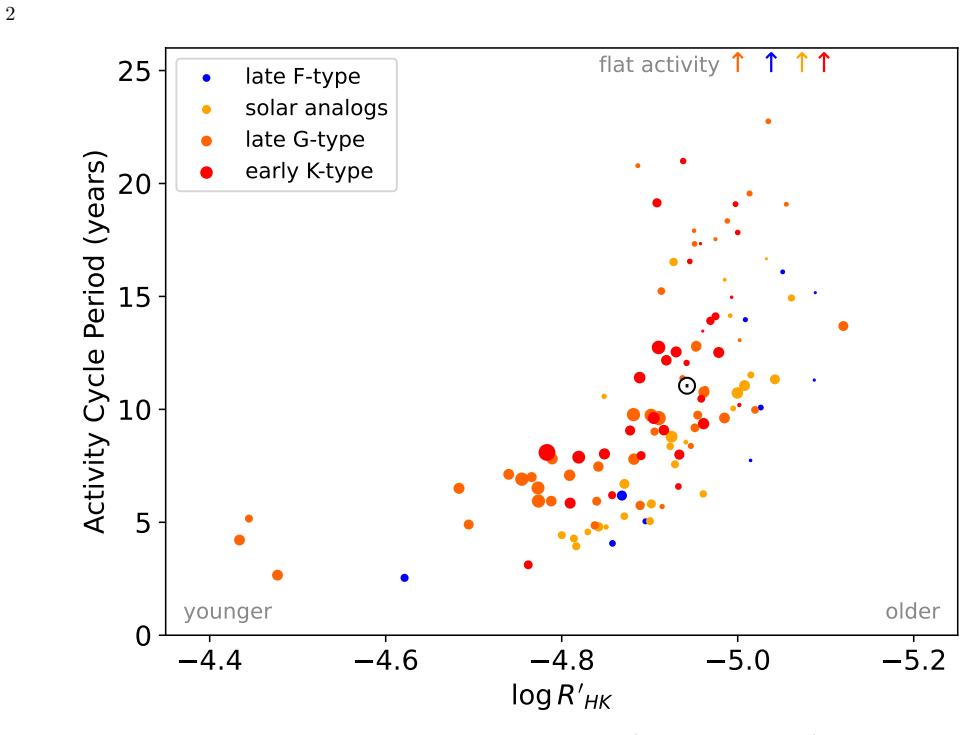
The central claim on the paper's own terms is that recent observations of the gradual onset of weakened magnetic braking, combined with a new sample of activity cycle data from the California Legacy Survey, show that the Sun is not an outlier. Instead, the data unambiguously confirm that activity cycles grow longer and weaker on stellar evolutionary timescales, as the efficiency of the global stellar dynamo declines by at least two orders of magnitude when the stellar Rossby number approaches a critical point slightly above the solar value.
What carries the argument
The evolutionary scenario tied to the weakened magnetic braking regime, where dynamo efficiency drops sharply near a critical Rossby number.
Load-bearing premise
The activity cycle detections and period measurements in the California Legacy Survey sample are complete, unbiased, and correctly represent the evolutionary sequence of stars approaching the weakened magnetic braking regime.
What would settle it
A star clearly past the onset of weakened magnetic braking that shows a short and strong activity cycle instead of a long and weak one would contradict the central claim.
Figures
read the original abstract
In 2007, Erika Bohm-Vitense published a provocative figure suggesting that the solar rotation period and activity cycle made the Sun an outlier compared to the trends observed for stars in the Mount Wilson HK survey. A decade later, after the discovery of weakened magnetic braking (WMB), an evolutionary scenario was proposed that could account for the properties of the Sun if activity cycles grow longer and weaker in the WMB regime. Recent observations of the gradual onset of WMB suggest that the efficiency of the global stellar dynamo declines by at least two orders of magnitude as the stellar Rossby number approaches a critical point slightly above the solar value. A new sample of activity cycle data from the California Legacy Survey suggests that the Sun is not an outlier, and unambiguously confirms that activity cycles grow longer and weaker on stellar evolutionary timescales.
Editorial analysis
A structured set of objections, weighed in public.
Referee Report
Summary. The manuscript presents new activity cycle data from the California Legacy Survey and argues that these observations show stellar activity cycles grow longer and weaker on evolutionary timescales as stars approach the weakened magnetic braking regime, thereby demonstrating that the Sun is not an outlier relative to the Mount Wilson HK survey trends and confirming an evolutionary scenario for the global dynamo.
Significance. If the central result holds after addressing sample completeness, the work would supply direct observational support for the proposed evolutionary lengthening and weakening of cycles in the WMB regime, helping to place the Sun's properties in a broader stellar context and linking to the observed decline in dynamo efficiency near the critical Rossby number.
major comments (2)
- [Abstract] Abstract: The claim that the CLS sample 'unambiguously confirms' the evolutionary trend rests on the detections and measured periods faithfully tracing the approach to the WMB regime, yet the abstract (and by extension the manuscript) supplies no quantitative completeness assessment, bias correction, or controls for selection effects that could vary systematically with cycle length, amplitude, or stellar parameters such as Rossby number.
- [Abstract] The central claim requires explicit demonstration that cycle detection probability and period recovery rate do not introduce artifacts favoring shorter/stronger cycles in the sample; without this, the observed trend could be an artifact of survey sensitivity rather than an intrinsic evolutionary sequence.
Simulated Author's Rebuttal
We thank the referee for their careful reading and insightful comments on our manuscript. The concerns regarding the lack of quantitative assessment of sample completeness and potential selection biases in the California Legacy Survey data are well-taken. We address these points below and outline the revisions we will make to the manuscript.
read point-by-point responses
-
Referee: [Abstract] Abstract: The claim that the CLS sample 'unambiguously confirms' the evolutionary trend rests on the detections and measured periods faithfully tracing the approach to the WMB regime, yet the abstract (and by extension the manuscript) supplies no quantitative completeness assessment, bias correction, or controls for selection effects that could vary systematically with cycle length, amplitude, or stellar parameters such as Rossby number.
Authors: We agree that the abstract's use of 'unambiguously confirms' is too strong without supporting quantitative analysis of completeness and biases. The manuscript will be revised to soften this language in the abstract. Additionally, we will add a new paragraph in the methods or results section providing an assessment of the CLS sample's completeness for cycle detection, including considerations of how detection probability may depend on cycle length and stellar Rossby number. This will help rule out or quantify potential artifacts. revision: yes
-
Referee: [Abstract] The central claim requires explicit demonstration that cycle detection probability and period recovery rate do not introduce artifacts favoring shorter/stronger cycles in the sample; without this, the observed trend could be an artifact of survey sensitivity rather than an intrinsic evolutionary sequence.
Authors: This comment correctly points out the need for explicit checks against survey sensitivity biases. While the CLS observations have sufficient temporal baseline for the detected cycles, we did not include a dedicated analysis of recovery rates in the original submission. In the revision, we will incorporate such a demonstration, either through reference to the survey's published sensitivity or by adding a simple model of detection probability. Should this analysis indicate any bias, we will discuss its implications for the evolutionary trend. We believe this will strengthen the manuscript's conclusions. revision: yes
Circularity Check
No circularity; central claim is an observational confirmation from new survey data
full rationale
The paper's headline result is that new activity cycle detections and periods from the California Legacy Survey confirm an evolutionary lengthening/weakening trend and show the Sun is not an outlier. This is presented as a direct empirical finding rather than a derivation, model prediction, or fit. The abstract references prior work on WMB and an evolutionary scenario but does not use that prior work to define or force the new result; the confirmation is attributed to the independent CLS sample. No equations, fitted parameters renamed as predictions, or load-bearing self-citations appear in the provided text. The derivation chain is therefore self-contained against external benchmarks (new observations).
Axiom & Free-Parameter Ledger
axioms (2)
- domain assumption Stellar activity cycles can be reliably detected and their periods measured from spectroscopic or photometric time series in the California Legacy Survey sample.
- domain assumption The Rossby number near the solar value marks a critical transition where dynamo efficiency drops by at least two orders of magnitude.
Reference graph
Works this paper leans on
-
[1]
Baliunas , S. L., Donahue , R. A., Soon , W. H., et al. 1995, http://doi.org/10.1086/175072 , 438 https://ui.adsabs.harvard.edu/abs/1995ApJ...438..269B , 269 https://ui.adsabs.harvard.edu/abs/1995ApJ...438..269B
-
[2]
B \"o hm-Vitense , E. 2007, http://doi.org/10.1086/510482 , 657 https://ui.adsabs.harvard.edu/abs/2007ApJ...657..486B , 486 https://ui.adsabs.harvard.edu/abs/2007ApJ...657..486B
-
[3]
Brandenburg , A., Saar , S. H., & Turpin , C. R. 1998, http://doi.org/10.1086/311297 , 498 https://ui.adsabs.harvard.edu/abs/1998ApJ...498L..51B , L51 https://ui.adsabs.harvard.edu/abs/1998ApJ...498L..51B
-
[4]
Cameron , R. H., & Sch \"u ssler , M. 2017, http://doi.org/10.3847/1538-4357/aa767a , 843 https://ui.adsabs.harvard.edu/abs/2017ApJ...843..111C , 111 https://ui.adsabs.harvard.edu/abs/2017ApJ...843..111C
-
[5]
Egeland , R., Soon , W., Baliunas , S., et al. 2017, http://doi.org/10.3847/1538-4357/835/1/25 , 835 https://ui.adsabs.harvard.edu/abs/2017ApJ...835...25E , 25 https://ui.adsabs.harvard.edu/abs/2017ApJ...835...25E
-
[6]
Isaacson , H., Kane , S. R., Carter , B., & Howard , A. W. 2025, http://doi.org/10.3847/1538-3881/adf2a8 , 170 https://ui.adsabs.harvard.edu/abs/2025AJ....170..181I , 181 https://ui.adsabs.harvard.edu/abs/2025AJ....170..181I
-
[7]
Isaacson , H., Howard , A. W., Fulton , B., et al. 2024, http://doi.org/10.3847/1538-4365/ad676c , 274 https://ui.adsabs.harvard.edu/abs/2024ApJS..274...35I , 35 https://ui.adsabs.harvard.edu/abs/2024ApJS..274...35I
-
[8]
Lorenzo-Oliveira , D., Freitas , F. C., Mel \'e ndez , J., et al. 2018, http://doi.org/10.1051/0004-6361/201629294 , 619 https://ui.adsabs.harvard.edu/abs/2018A&A...619A..73L , A73 https://ui.adsabs.harvard.edu/abs/2018A&A...619A..73L
-
[9]
Metcalfe , T. S., & van Saders , J. 2017, http://doi.org/10.1007/s11207-017-1157-5 , 292 https://ui.adsabs.harvard.edu/abs/2017SoPh..292..126M , 126 https://ui.adsabs.harvard.edu/abs/2017SoPh..292..126M
-
[10]
Metcalfe , T. S., van Saders , J. L., Pinsonneault , M. H., et al. 2025, http://doi.org/10.3847/2041-8213/ae03bc , 991 https://ui.adsabs.harvard.edu/abs/2025ApJ...991L..17M , L17 https://ui.adsabs.harvard.edu/abs/2025ApJ...991L..17M
-
[11]
1972, ApJ, 171, 565, doi: 10.1086/151310
Skumanich , A. 1972, http://doi.org/10.1086/151310 , 171 https://ui.adsabs.harvard.edu/abs/1972ApJ...171..565S , 565 https://ui.adsabs.harvard.edu/abs/1972ApJ...171..565S
-
[12]
L., Ceillier , T., Metcalfe , T
van Saders , J. L., Ceillier , T., Metcalfe , T. S., et al. 2016, http://doi.org/10.1038/nature16168 , 529 https://ui.adsabs.harvard.edu/abs/2016Natur.529..181V , 181 https://ui.adsabs.harvard.edu/abs/2016Natur.529..181V
-
[13]
van Saders , J. L., Pinsonneault , M. H., & Barbieri , M. 2019, http://doi.org/10.3847/1538-4357/aafafe , 872 https://ui.adsabs.harvard.edu/abs/2019ApJ...872..128V , 128 https://ui.adsabs.harvard.edu/abs/2019ApJ...872..128V
-
[14]
Vashishth , V., Karak , B. B., & Kitchatinov , L. 2023, http://doi.org/10.1093/mnras/stad1105 , 522 https://ui.adsabs.harvard.edu/abs/2023MNRAS.522.2601V , 2601 https://ui.adsabs.harvard.edu/abs/2023MNRAS.522.2601V
discussion (0)
Sign in with ORCID, Apple, or X to comment. Anyone can read and Pith papers without signing in.