SpikON: A Dual-Parallel and Efficient Accelerator for Online Spiking Neural Networks Learning
Pith reviewed 2026-07-01 00:46 UTC · model grok-4.3
The pith
SpikON co-design cuts online SNN training latency by 32 percent and energy by 35 percent while delivering up to 27 times higher throughput on edge hardware.
A machine-rendered reading of the paper's core claim, the machinery that carries it, and where it could break.
Core claim
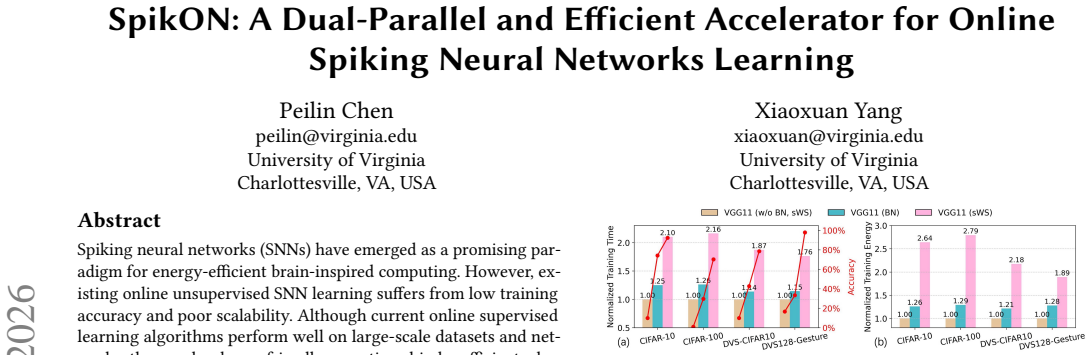
SpikON establishes that combining learnable threshold through time, scaled weight centralization through time, cascade computation reuse, and a dual-parallel SNN accelerator produces an end-to-end online supervised learning system that reduces training latency by 32.2 percent and energy by 35.0 percent relative to baseline algorithms while preserving accuracy, and that the full co-design reaches 7.2 times (11.5 times) training throughput (energy efficiency) versus an edge Apple M4 GPU and 26.8 times (15.8 times) versus a TPU-like accelerator.
What carries the argument
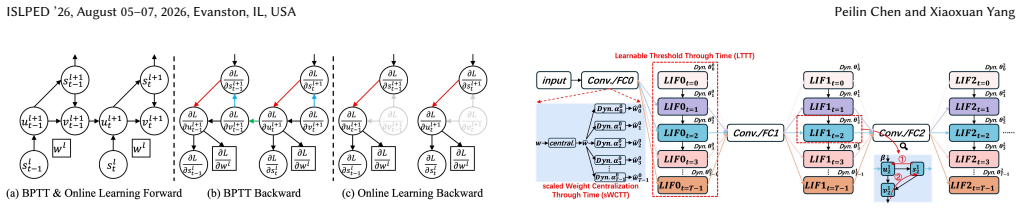
The dual-parallel engine paired with the cascade computation reuse scheme, which enables concurrent forward-backward passes and temporal reuse across timesteps in the SNN accelerator.
If this is right
- Online supervised SNN training becomes practical on power-limited edge devices rather than requiring cloud GPUs.
- Training energy per sample falls by roughly one-third, directly extending battery life for on-device learning applications.
- The same dataflow and reuse scheme can be ported to other neuromorphic accelerators without changing the learning algorithm.
- Scalability improves because the co-design removes the previous mismatch between algorithm operations and hardware primitives.
- End-to-end latency from data arrival to updated weights shrinks enough to support real-time adaptation loops.
- pith_inferences=[
Load-bearing premise
The new learnable threshold and scaled weight centralization techniques preserve accuracy on large-scale datasets while still allowing the hardware speedups.
What would settle it
Accuracy on a standard large-scale image classification benchmark drops when the learnable threshold through time and scaled weight centralization through time are applied instead of conventional fixed-threshold training.
Figures


read the original abstract
Spiking neural networks (SNNs) have emerged as a promising paradigm for energy-efficient brain-inspired computing. However, existing online unsupervised SNN learning suffers from low training accuracy and poor scalability. Although current online supervised learning algorithms perform well on large-scale datasets and networks, the non-hardware-friendly operations hinder efficient edge deployment. In this work, we propose SpikON, the first algorithm-hardware co-design framework for efficient and scalable end-to-end online supervised SNN learning. We first propose the learnable threshold through time and scaled weight centralization through time techniques to address the inefficiency of traditional algorithms. Moreover, to reduce latency and energy consumption, we introduce the novel training dataflow and cascade computation reuse scheme for SNNs that allows concurrent forward-backward computation and temporal reuse across timesteps. We further design the dedicated SNN accelerator with a dual-parallel engine and customized SIMD-based SNN core for efficient end-to-end online learning. Experiments show that the SpikON algorithm achieves 32.2% and 35.0% reductions in training latency and energy consumption over the baseline, without sacrificing accuracy. Moreover, the SpikON co-design achieves 7.2x (11.5x) and 26.8x (15.8x) training throughput (energy efficiency) compared with the edge Apple M4 GPU and TPU-like accelerator, respectively. The code is available at https://github.com/peilin-chen/SpikON.
Editorial analysis
A structured set of objections, weighed in public.
Referee Report
Summary. The manuscript presents SpikON, an algorithm-hardware co-design for end-to-end online supervised spiking neural network (SNN) learning on edge devices. It introduces two algorithmic techniques—learnable threshold through time and scaled weight centralization through time—to improve training efficiency, along with a novel training dataflow featuring cascade computation reuse that enables concurrent forward-backward passes and temporal reuse across timesteps. These are paired with a dedicated accelerator architecture using a dual-parallel engine and customized SIMD-based SNN core. The work claims 32.2% and 35.0% reductions in training latency and energy over a baseline without accuracy loss, plus 7.2× (11.5×) and 26.8× (15.8×) gains in throughput (energy efficiency) versus an edge Apple M4 GPU and a TPU-like accelerator, respectively. Code is released at a public GitHub repository.
Significance. If the accuracy-preservation claim holds on large-scale datasets, the co-design would represent a meaningful advance for practical deployment of online SNN training at the edge, bridging algorithmic improvements with hardware specialization. The open-sourced code is a clear strength that supports reproducibility and further community validation.
major comments (2)
- [Experiments] Experiments section (accuracy tables): The central claim that the learnable-threshold and scaled-weight-centralization techniques plus cascade reuse 'preserve accuracy' on large-scale datasets while delivering the 32.2 % / 35.0 % latency/energy savings is load-bearing. Explicit quantitative accuracy deltas versus prior online supervised SNN baselines must be reported for every evaluated network and dataset (including the largest ones) to substantiate the premise; absence of these numbers leaves the justification for both the algorithmic savings and the hardware co-design unverified.
- [§4] §4 (hardware dataflow): The dual-parallel engine and cascade reuse scheme are motivated by the algorithmic techniques; if accuracy degrades on the largest datasets, the reported speedups over GPU/TPU baselines lose their supporting rationale. The manuscript should include an ablation isolating the contribution of each technique to both accuracy and the measured throughput/energy figures.
minor comments (2)
- [Abstract] Abstract and §1: The performance numbers are stated without reference to the specific datasets, network depths, or number of timesteps used; adding these details would improve clarity.
- [§3] Notation: The definitions of 'learnable threshold through time' and 'scaled weight centralization through time' should be given with explicit update equations in the algorithmic section to allow direct comparison with prior online SNN rules.
Simulated Author's Rebuttal
We thank the referee for the constructive feedback. We address the two major comments point-by-point below and will revise the manuscript accordingly to strengthen the experimental validation.
read point-by-point responses
-
Referee: [Experiments] Experiments section (accuracy tables): The central claim that the learnable-threshold and scaled-weight-centralization techniques plus cascade reuse 'preserve accuracy' on large-scale datasets while delivering the 32.2 % / 35.0 % latency/energy savings is load-bearing. Explicit quantitative accuracy deltas versus prior online supervised SNN baselines must be reported for every evaluated network and dataset (including the largest ones) to substantiate the premise; absence of these numbers leaves the justification for both the algorithmic savings and the hardware co-design unverified.
Authors: We agree that explicit quantitative accuracy deltas are necessary to fully substantiate the claims. Although the manuscript states that accuracy is preserved, the tables do not currently include direct numerical deltas versus prior online supervised SNN baselines for all networks and datasets. In the revision we will add these explicit comparisons (accuracy deltas) for every evaluated network and dataset, including the largest ones, to verify that the reported latency and energy savings occur without accuracy loss. revision: yes
-
Referee: [§4] §4 (hardware dataflow): The dual-parallel engine and cascade reuse scheme are motivated by the algorithmic techniques; if accuracy degrades on the largest datasets, the reported speedups over GPU/TPU baselines lose their supporting rationale. The manuscript should include an ablation isolating the contribution of each technique to both accuracy and the measured throughput/energy figures.
Authors: We acknowledge that an ablation study isolating each technique would strengthen the justification for the hardware co-design. The current manuscript does not contain such an ablation. In the revised version we will add an ablation analysis that quantifies the individual contributions of learnable threshold through time, scaled weight centralization through time, and cascade computation reuse to both accuracy and the measured throughput/energy figures, thereby confirming that the speedups are supported by accuracy-preserving algorithmic improvements. revision: yes
Circularity Check
No significant circularity; empirical engineering claims rest on experimental results independent of self-referential inputs.
full rationale
The paper proposes algorithmic techniques (learnable threshold through time, scaled weight centralization through time) and a dual-parallel hardware accelerator with cascade reuse, reporting latency/energy reductions and speedups versus baselines and commercial hardware. These are presented as engineering artifacts validated by experiments on datasets, with no equations, derivations, or self-citations that reduce any claimed prediction or result to fitted parameters or prior inputs by construction. The abstract and structure contain no load-bearing mathematical steps that loop back to the same data or definitions, making the work self-contained against external benchmarks.
Axiom & Free-Parameter Ledger
Reference graph
Works this paper leans on
-
[1]
Arnon Amir, Brian Taba, David Berg, Timothy Melano, Jeffrey McKinstry, Carmelo Di Nolfo, Tapan Nayak, Alexander Andreopoulos, Guillaume Garreau, Marcela Mendoza, et al. 2017. A low power, fully event-based gesture recogni- tion system. InProceedings of the IEEE conference on computer vision and pattern recognition. 7243–7252
2017
-
[2]
Apple. 2025. Apple introduces M4 chip - apple. https://www.apple.com/ newsroom/2024/05/apple-introduces-m4-chip/. Accessed: October 2025
2025
-
[3]
Niladrish Chatterjee, Mike O’Connor, Donghyuk Lee, Daniel R Johnson, Stephen W Keckler, Minsoo Rhu, and William J Dally. 2017. Architecting an energy-efficient dram system for gpus. In2017 IEEE International Symposium on High Performance Computer Architecture (HPCA). IEEE, 73–84
2017
- [4]
-
[5]
Mike Davies, Narayan Srinivasa, Tsung-Han Lin, Gautham Chinya, Yongqiang Cao, Sri Harsha Choday, Georgios Dimou, Prasad Joshi, Nabil Imam, Shweta Jain, et al. 2018. Loihi: A neuromorphic manycore processor with on-chip learning. Ieee Micro38, 1 (2018), 82–99
2018
-
[6]
Jason K Eshraghian, Max Ward, Emre O Neftci, Xinxin Wang, Gregor Lenz, Girish Dwivedi, Mohammed Bennamoun, Doo Seok Jeong, and Wei D Lu. 2023. Training spiking neural networks using lessons from deep learning.Proc. IEEE111, 9 (2023), 1016–1054
2023
-
[7]
Wei Fang, Yanqi Chen, Jianhao Ding, Zhaofei Yu, Timothée Masquelier, Ding Chen, Liwei Huang, Huihui Zhou, Guoqi Li, and Yonghong Tian. 2023. Spiking- jelly: An open-source machine learning infrastructure platform for spike-based intelligence.Science Advances9, 40 (2023), eadi1480
2023
-
[8]
Ahmed Hasssan, Jian Meng, and Jae-Sun Seo. 2024. Spiking neural network with learnable threshold for event-based classification and object detection. In2024 International Joint Conference on Neural Networks (IJCNN). IEEE, 1–8
2024
-
[9]
Paul Hübner, Andong Hu, Ivy Peng, and Stefano Markidis. 2025. Apple vs. oranges: Evaluating the apple silicon m-series socs for hpc performance and efficiency. In 2025 IEEE International Parallel and Distributed Processing Symposium Workshops (IPDPSW). IEEE, 45–54
2025
-
[10]
Sergey Ioffe and Christian Szegedy. 2015. Batch normalization: Accelerating deep network training by reducing internal covariate shift. InInternational conference on machine learning. pmlr, 448–456
2015
-
[11]
Haiyan Jiang, Giulia De Masi, Huan Xiong, and Bin Gu. 2024. Ndot: Neuronal dynamics-based online training for spiking neural networks. InForty-first Inter- national Conference on Machine Learning
2024
-
[12]
Youngeun Kim and Priyadarshini Panda. 2021. Revisiting batch normalization for training low-latency deep spiking neural networks from scratch.Frontiers in neuroscience15 (2021), 773954
2021
-
[13]
Alex Krizhevsky, Geoffrey Hinton, et al. 2009. Learning multiple layers of features from tiny images. (2009)
2009
-
[14]
Yann LeCun, Léon Bottou, Yoshua Bengio, and Patrick Haffner. 2002. Gradient- based learning applied to document recognition.Proc. IEEE86, 11 (2002), 2278– 2324
2002
-
[15]
Hongmin Li, Hanchao Liu, Xiangyang Ji, Guoqi Li, and Luping Shi. 2017. Cifar10- dvs: an event-stream dataset for object classification.Frontiers in neuroscience11 (2017), 244131
2017
-
[16]
Sixu Li, Zhaomin Zhang, Ruixin Mao, Jianbiao Xiao, Liang Chang, and Jun Zhou
-
[17]
A fast and energy-efficient SNN processor with adaptive clock/event- driven computation scheme and online learning.IEEE Transactions on Circuits and Systems I: Regular Papers68, 4 (2021), 1543–1552
2021
-
[18]
Jesus L Lobo, Javier Del Ser, Albert Bifet, and Nikola Kasabov. 2020. Spiking neural networks and online learning: An overview and perspectives.Neural Networks121 (2020), 88–100
2020
-
[19]
Ruixin Mao, Lin Tang, Xingyu Yuan, Ye Liu, and Jun Zhou. 2024. Stellar: Energy- efficient and low-latency snn algorithm and hardware co-design with spatiotem- poral computation. In2024 IEEE International Symposium on High-Performance Computer Architecture (HPCA). IEEE, 172–185
2024
-
[20]
Qingyan Meng, Mingqing Xiao, Shen Yan, Yisen Wang, Zhouchen Lin, and Zhi-Quan Luo. 2023. Towards memory-and time-efficient backpropagation for training spiking neural networks. InProceedings of the IEEE/CVF international conference on computer vision. 6166–6176
2023
-
[21]
Emre O Neftci, Hesham Mostafa, and Friedemann Zenke. 2019. Surrogate gradi- ent learning in spiking neural networks: Bringing the power of gradient-based optimization to spiking neural networks.IEEE Signal Processing Magazine36, 6 (2019), 51–63
2019
-
[22]
Nvidia. 2025. NVIDIA ampere architecture - nvidia. https://www.nvidia.com/en- us/data-center/ampere-architecture/. Accessed: October 2025
2025
-
[23]
Nvidia. 2025. NVIDIA System Management Interface program - nvidia. https: //docs.nvidia.com/deploy/nvidia-smi/index.html. Accessed: October 2025
2025
-
[24]
GC Qiao, SG Hu, JJ Wang, CM Zhang, TP Chen, Ning Ning, Qi Yu, and Yang Liu
-
[25]
A neuromorphic-hardware oriented bio-plausible online-learning spiking neural network model.IEEE Access7 (2019), 71730–71740
2019
- [26]
-
[27]
Nitin Rathi and Kaushik Roy. 2021. Diet-snn: A low-latency spiking neural network with direct input encoding and leakage and threshold optimization. IEEE Transactions on Neural Networks and Learning Systems34, 6 (2021), 3174– 3182
2021
-
[28]
Ali Siddique, Mang I Vai, and Sio Hang Pun. 2023. A low cost neuromorphic learning engine based on a high performance supervised SNN learning algorithm. Scientific Reports13, 1 (2023), 6280
2023
-
[29]
Karen Simonyan and Andrew Zisserman. 2014. Very deep convolutional networks for large-scale image recognition.arXiv preprint arXiv:1409.1556(2014)
work page internal anchor Pith review Pith/arXiv arXiv 2014
-
[30]
Congyi Sun, Haohan Sun, Jin Xu, Jianing Han, Xinyuan Wang, Xinyu Wang, Qinyu Chen, Yuxiang Fu, and Li Li. 2022. An energy efficient STDP-based SNN architecture with on-chip learning.IEEE Transactions on Circuits and Systems I: Regular Papers69, 12 (2022), 5147–5158
2022
-
[31]
Synopsys. [n. d.]. Design compiler - synopsys. https://www.synopsys.com/ implementation-and-signoff/rtl-synthesis-test/dc-ultra.html. Accessed: October 2025
2025
-
[32]
Pai-Yu Tan, Cheng-Wen Wu, and Juin-Ming Lu. 2021. An improved STBP for training high-accuracy and low-spike-count spiking neural networks. In2021 Design, Automation & Test in Europe Conference & Exhibition (DATE). IEEE, 575– 580
2021
-
[33]
Siqi Wang, Tee Hiang Cheng, and Meng-Hiot Lim. 2022. LTMD: learning im- provement of spiking neural networks with learnable thresholding neurons and moderate dropout.Advances in Neural Information Processing Systems35 (2022), 28350–28362
2022
-
[34]
Mingqing Xiao, Qingyan Meng, Zongpeng Zhang, Di He, and Zhouchen Lin
-
[35]
Online training through time for spiking neural networks.Advances in neural information processing systems35 (2022), 20717–20730
2022
-
[36]
Bojian Yin, Federico Corradi, and Sander M Bohté. 2023. Accurate online training of dynamical spiking neural networks through forward propagation through time.Nature Machine Intelligence5, 5 (2023), 518–527
2023
-
[37]
Ruokai Yin, Youngeun Kim, Di Wu, and Priyadarshini Panda. 2024. Loas: Fully temporal-parallel dataflow for dual-sparse spiking neural networks. In2024 57th IEEE/ACM International Symposium on Microarchitecture (MICRO). IEEE, 1107– 1121
2024
-
[38]
Ruokai Yin, Abhishek Moitra, Abhiroop Bhattacharjee, Youngeun Kim, and Priyadarshini Panda. 2022. Sata: Sparsity-aware training accelerator for spik- ing neural networks.IEEE Transactions on Computer-Aided Design of Integrated Circuits and Systems42, 6 (2022), 1926–1938
2022
-
[39]
Hanle Zheng, Yujie Wu, Lei Deng, Yifan Hu, and Guoqi Li. 2021. Going deeper with directly-trained larger spiking neural networks. InProceedings of the AAAI conference on artificial intelligence, Vol. 35. 11062–11070
2021
discussion (0)
Sign in with ORCID, Apple, or X to comment. Anyone can read and Pith papers without signing in.