REVIEW 3 major objections 5 minor 32 references
Cleo: A Transparent and Controllable Chatbot for Conversational Commerce
T0 review · 3 major / 5 minor · reviewed 2026-08-07 · deepseek-v4-flash
Pith's one-line read Cleo shows that a hybrid architecture—deterministic, auditable ranking plus constrained language generation—can make conversational product advice transparent and controllable.
desk verdict Cleo is a credible hybrid demo with a genuinely auditable ranker, but the 'constrained generation' claim overreaches—it is prompt-gated, not actually constrained. read the letter →
The pith
A machine-rendered reading of the paper's core claim, the machinery that carries it, and where it could break.
The reading
What carries the argument
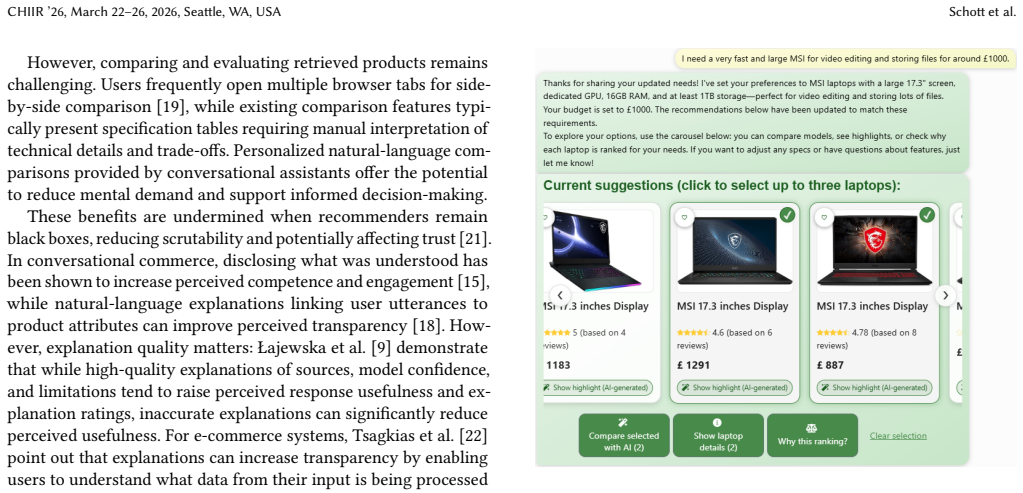
The mechanism that carries the argument is the strict separation between a deterministic, auditable Ranker and a constrained AI Manager, orchestrated by a Conversation Manager. The Ranker is a rule-based scoring engine that loads the 3,638-item laptop catalog, applies categorical filters (brand, GPU type), and computes numeric losses for price, RAM, storage, and screen size; it produces both the ranking and the per-attribute values displayed in the 'Why this ranking?' modal. The AI Manager is an LLM used only for two tasks: structured extraction of user requirements into a JSON state, and natural-language generation of responses, highlights, and comparisons. A sanitizer between the two enforces unit conversion, catalog-aligned discrete values, and rejection of invalid updates, ensuring that what the LLM extracts is directly queryable by the Ranker. This separation is what makes the system's decisions inspectable and its text grounded.
What would settle it
Collect a set of natural-language product requirement utterances, have human annotators write the intended JSON requirement state for each, run Cleo's extraction pipeline on the same utterances, and compare the two: if a substantial share of extractions diverge from human annotation (for example, 'casual gaming' not yielding the expected dedicated GPU and 32GB RAM), the transparency guarantee fails at the input stage, regardless of how inspectable the downstream ranking is.
Extended reading notes
Core claim
Cleo's central claim is that a conversational recommender can be both fluid and inspectable if the LLM is confined to expression while a separate deterministic component decides. The Ranker first enforces categorical filters for brand and GPU type, then computes per-attribute numeric losses for price, RAM, storage, and screen size, ranking laptops by ascending total loss with rating and price as tie-breakers. The AI Manager never invents specifications: it formats deterministic rule outputs into bullet points, and its mapping of vague needs to concrete attributes (for example, 'casual gaming' to a dedicated GPU and 32GB RAM) is prompted with few-shot examples and passed through a sanitizer that converts units and enforces catalog constraints. Because the ranking-explanation modal uses the same loss computations as the Ranker, users can inspect exactly why each laptop was placed where it was. The pattern is claimed to deliver controllability (users steer by stating requirements), transparency (decisions are auditable), and decision support (grounded comparisons) without sacrificing conversational naturalness.
Load-bearing premise
The entire transparency and controllability chain rests on the LLM's structured extraction step faithfully turning natural-language utterances into the JSON requirement state; if that extraction silently drops, misreads, or overwrites a requirement, the auditable loss values will faithfully explain the wrong ranking.
Editorial extensions
If this is right
- A user who taps 'Why this ranking?' sees, for each laptop, which filters were satisfied and which numeric losses produced the score, so the system's reasoning is inspectable at the attribute level.
- Expressing a need such as 'video editing' updates a structured requirement state and triggers a real-time re-ranking whose outcome can be traced to that specific update.
- Because highlights and comparisons are generated from hard-coded rules before the LLM formats them, the system is unlikely to recommend based on hallucinated specifications or persuasive filler.
- The same hybrid pattern is portable to any product domain described by structured attributes, which the paper identifies as a direct extension.
- The open-source implementation positions Cleo as a testbed for comparing hybrid, LLM-only, and traditional faceted interfaces in future user studies.
Reading between the lines
- This suggests the next decisive measurement for the authors is the accuracy of the LLM extraction step: every downstream audit inherits whatever that step understood, and the paper reports no failure analysis for it.
- The same auditable-ranking division could transfer to other high-stakes recommendation settings, such as job or loan matching, where users need to verify why an option was surfaced.
- The architecture already supports counterfactual steering—asking 'what if I relaxed screen size?'—which the authors list as future work; providing it would make the controllability claim directly testable by users.
Editorial analysis
A structured set of objections, weighed in public.
Referee Report
Summary. The paper presents Cleo, a chatbot for conversational laptop shopping. It proposes a hybrid architecture in which a Conversation Manager alternates between an LLM-based AI Manager (structured requirement extraction and natural-language response generation) and a deterministic Ranker over a catalog of 3,638 laptops. Requirements are extracted as JSON via few-shot prompting, sanitized, and then used by the Ranker to apply categorical filters and numeric loss functions over price, RAM, storage, and screen size; the resulting scores are shown in a 'Why this ranking?' modal. Single-item highlights and multi-item comparisons are produced by hard-coded rules that compare specifications to requirements, with the LLM formatting the rule output into natural language. The paper claims transparency (auditable ranking), controllability (separation of ranking from generation), decision support (comparisons and highlights), and an extensible open-source experimental system, and describes a planned CHIIR live demonstration. No user study or automatic evaluation is reported.
Significance. If the central claims hold, Cleo is a valuable design pattern for conversational recommender systems: the deterministic ranking core is genuinely auditable, the loss-by-attribute explanation is model-intrinsic, and the use of hard-coded rule output for highlights and comparisons is a concrete, non-black-box way to keep generated content tied to catalog evidence. The system is also a practical experimental artifact, described in enough detail to be reimplemented, with a commitment to release the source code. The paper is honest about the absence of user studies and lists three concrete evaluation plans. The major gap is that the headline property of 'constrained' generation is only prompt-level in the described architecture; as written, the system does not demonstrate the claimed mitigation of hallucinated or persuasive content.
major comments (3)
- [Abstract, §3.5, §3.6] The claim that the LLM generates descriptions 'constrained to catalog evidence' is not supported by the implementation described. In §3.5 and §3.6, generation is prompt-based with few-shot examples, and nothing in the architecture prevents the LLM from emitting a specification or persuasive sentence that is not in the rule output. There is no output schema validation, no decoding constraint, no post-generation fact-check, and no sanitizer for generated text analogous to the extraction sanitizer in §3.3. Since the paper itself cites [14,25] for the fact that instruction-following is not guaranteed, 'constrained' and 'mitigating the risk of hallucinated or persuasive content' should either be backed by an implemented verifier (e.g., checking every numeric or entity mention in the generated text against the ranked evidence) or softened to 'prompt-grounded' throughout, with the mitigation framed as an intended design property that still requires evaluation.
- [§3.3] The entire decision pipeline inherits the correctness of the LLM's structured extraction, but the paper reports no accuracy or failure analysis for this step. The sanitizer corrects unit errors, catalog misalignment, and invalid brand updates, but it cannot repair a semantic mis-extraction such as a dropped requirement or a wrongly mapped phrase like 'casual gaming' in the few-shot example. If extraction is wrong, the loss values shown in the 'Why this ranking?' modal are a transparent explanation of a ranking the user did not ask for. To make the transparency claim load-bearing, the authors should either report extraction accuracy on a representative utterance test set, or explicitly state that transparency holds conditional on correct extraction and add a system confirmation of the interpreted requirements before ranking.
- [§4] The conclusion says Cleo 'demonstrates' transparency and controllability, but the evidence in the paper is a system description plus a planned live demo. The absence of a user study is acceptable for a demo paper, but the wording overstates what has been shown. Please rephrase the conclusion and abstract to distinguish between system capability claims (implemented, inspectable ranking) and behavioral claims (users can actually audit, hallucination risk is reduced), which require the proposed studies.
minor comments (5)
- [§3.5, §3.6] The specific LLM (model name, version, sampling parameters) is never stated; please provide this information for reproducibility.
- [§3.4] The formula for the total loss is not given; the modal legend should specify how the weighted sum is computed and how ties are broken beyond the stated rating/price rule.
- [§3.3] The mapping 'casual gaming' to {"gpu":"dedicated","ram":32} is presented as a fact but is a hand-set policy; please mark it as an illustrative requirement mapping and provide the full prompt in an appendix or supplement.
- [§2.3] The paper should state whether the 'Why this ranking?' explanation is refreshed after every conversational turn and whether the loss values are recomputed in real time.
- [References] Reference [13] is a Medium blog post; consider replacing it with a more archival source on conversational commerce if one is available.
Circularity Check
No significant circularity: the system's ranking and generation claims are not derived from fitted data or self-citation.
full rationale
This paper does not present a predictive derivation or fitted result that could be circular. The ranking core is deterministic: categorical filters and numeric loss functions operate over 3,638 laptop specifications, with loss weights noted as rigid design parameters rather than quantities fitted to outcome data. Ranking explanations intentionally reuse the same loss computations as the ranker, but that is an architectural choice for model-intrinsic transparency, not a prediction claimed to be independently derived. The closest candidate, the claim that a 'constrained LLM generates grounded descriptions constrained to catalog evidence,' is implemented only via prompts and few-shot examples and is therefore an unvalidated mechanism claim, not a circular reduction: it does not define the constraint in terms of the output it is supposed to explain. The self-citations ([18], [19]) support peripheral background claims about disclosure effects and users opening multiple browser tabs, and they do not carry the central architecture claim. No equation equates an input to an output by construction, and no fitted parameter is renamed as a prediction. The absence of hallucination-constraint verification is a correctness risk, not a circularity, so the appropriate circularity score is 0.
Assumptions & free parameters
free parameters (5)
- price loss weight =
not disclosed
- RAM loss weight =
not disclosed
- storage loss weight =
not disclosed
- screen size loss weight =
not disclosed
- few-shot need mapping (e.g., 'casual gaming') =
dedicated GPU, 32 GB RAM
assumptions (4)
- domain assumption A user's product need can be expressed as a fixed set of structured attributes: brand, GPU type, price, RAM, storage, and screen size.
- domain assumption LLM-based structured extraction, after sanitization, recovers the user's intended requirements accurately enough for ranking.
- ad hoc to paper Prompt-level constraints plus RAG-style grounding keep generated text faithful to catalog evidence and prevent hallucinated or persuasive content.
- domain assumption Numeric loss values shown in the 'Why this ranking?' modal are interpretable by users and do not create excessive mental workload.
Cite this review
Pith. "Pith review of Cleo: A Transparent and Controllable Chatbot for Conversational Commerce." pith.science (2026). https://pith.science/paper/OK2EBXMO
@misc{pith2026260806068,
  author       = {Pith},
  title        = {Pith review of: Cleo: A Transparent and Controllable Chatbot for Conversational Commerce},
  year         = {2026},
  howpublished = {\url{https://pith.science/paper/OK2EBXMO}},
  note         = {Machine review of arXiv:2608.06068}
}
read the original abstract
We demonstrate Cleo, a transparent and controllable conversational product advisor that addresses the challenges of opacity, unpredictability of LLMs, and the complexity of comparisons in conversational commerce. With our chatbot system, we make four contributions: First, we introduce transparency by prompting the LLM to reflect on interpreted user needs, while an auditable ranking mechanism reveals loss values per attribute, explaining ranking decisions. Second, we propose controllability through a hybrid architecture separating deterministic ranking from language generation. A ranker applies categorical filters and numeric loss functions over 3,638 product specifications. Meanwhile, a constrained LLM generates grounded descriptions constrained to catalog evidence, thus mitigating the risk of hallucinated or persuasive content. Third, we provide decision support in the form of natural-language comparisons and a highlights feature. These aim to reduce mental workload by contextualizing specifications relative to user needs. Fourth, we contribute an extensible experimental system for IR and HCI researchers, as well as practitioners of conversational search and recommendation. Unlike traditional faceted search or opaque LLM-only recommenders, our approach allows for fluid conversation while maintaining algorithmic transparency. In a live demonstration, attendees will experience information needs elicitation and reflection, conversational refinement with real-time re-ranking, inspection of per-attribute loss explanations, and AI-generated multi-item comparisons. The system aims to advance the design of transparent and controllable conversational systems that provide support for decision-making during online product search.
Figures


Figures from the paper (1 more)

Reference graph
Works this paper leans on
-
[1]
Bruce Croft
Mohammad Aliannejadi, Hamed Zamani, Fabio Crestani, and W. Bruce Croft
-
[2]
Janarthanan Balakrishnan and Yogesh K. Dwivedi. 2021. Conversational com- merce: entering the next stage of AI-powered digital assistants.Annals of Opera- tions Research(12 Apr 2021). doi:10.1007/s10479-021-04049-5
-
[3]
Jiawei Chen, Hongyu Lin, Xianpei Han, and Le Sun. 2024. Benchmarking large language models in retrieval-augmented generation. InProceedings of the Thirty- Eighth AAAI Conference on Artificial Intelligence and Thirty-Sixth Conference on Innovative Applications of Artificial Intelligence and Fourteenth Symposium on Ed- ucational Advances in Artificial Intel...
2024
-
[4]
Li Chen and Pearl Pu. 2012. Critiquing-based recommenders: survey and emerg- ing trends.User Model. User-adapt Interact.22, 1-2 (April 2012), 125–150
work page 2012
-
[5]
Chongming Gao, Wenqiang Lei, Xiangnan He, Maarten de Rijke, and Tat-Seng Chua. 2021. Advances and challenges in conversational recommender systems: A survey.AI Open2 (2021), 100–126. doi:10.1016/j.aiopen.2021.06.002
-
[6]
David Gefen, Elena Karahanna, and Detmar W. Straub. 2003. Trust and TAM in Online Shopping: An Integrated Model.MIS Quarterly27, 1 (2003), 51–90. http://www.jstor.org/stable/30036519
arXiv 2003
-
[7]
Trey Grainger, Doug Turnbull, and Max Irwin. 2025.AI-Powered Search. Simon and Schuster
work page 2025
-
[8]
Dietmar Jannach, Ahtsham Manzoor, Wanling Cai, and Li Chen. 2021. A Survey on Conversational Recommender Systems.ACM Comput. Surv.54, 5, Article 105 (May 2021), 36 pages. doi:10.1145/3453154
doi:10.1145/3453154 2021
Show all 32 references
-
[9]
Weronika Łajewska, Damiano Spina, Johanne Trippas, and Krisztian Balog. 2024. Explainability for Transparent Conversational Information-Seeking. InProceed- ings of the 47th International ACM SIGIR Conference on Research and Development in Information Retrieval(Washington DC, U...
2024
- [10]
-
[11]
Jianghao Lin, Xinyi Dai, Yunjia Xi, Weiwen Liu, Bo Chen, Hao Zhang, Yong Liu, Chuhan Wu, Xiangyang Li, Chenxu Zhu, Huifeng Guo, Yong Yu, Ruiming Tang, and Weinan Zhang. 2025. How Can Recommender Systems Benefit from Large Language Models: A Survey.ACM Trans. Inf. Syst.43, 2, A...
2025 doi
-
[12]
Wisniewski, Jin-Hee Cho, Sang Won Lee, Ruoxi Jia, and Lifu Huang
Minqian Liu, Zhiyang Xu, Xinyi Zhang, Heajun An, Sarvech Qadir, Qi Zhang, Pamela J. Wisniewski, Jin-Hee Cho, Sang Won Lee, Ruoxi Jia, and Lifu Huang
-
[13]
Chris Messina. 2024. Conversational commerce. When the point of sale comes to the. . . | by Chris Messina | Chris Messina | Medium. https://medium.com/chris- messina/conversational-commerce-92e0bccfc3ff. Accessed: 2024-02-15
2024
-
[14]
Long Ouyang, Jeff Wu, Xu Jiang, Diogo Almeida, Carroll L. Wainwright, Pamela Mishkin, Chong Zhang, Sandhini Agarwal, Katarina Slama, Alex Ray, John Schul- man, Jacob Hilton, Fraser Kelton, Luke Miller, Maddie Simens, Amanda Askell, Peter Welinder, Paul Christiano, Jan Leike, a...
2022
-
[15]
Andrea Papenmeier and Elin Anna Topp. 2023. Ah, Alright, Okay! Communicat- ing Understanding in Conversational Product Search. InProceedings of the 5th International Conference on Conversational User Interfaces(Eindhoven, Nether- lands)(CUI ’23). Association for Computing Mach...
2023
-
[16]
Filip Radlinski and Nick Craswell. 2017. A Theoretical Framework for Conversa- tional Search. InProceedings of the 2017 Conference on Conference Human Infor- mation Interaction and Retrieval(Oslo, Norway)(CHIIR ’17). Association for Com- puting Machinery, New York, NY, USA, 11...
2017
-
[17]
Alexander Rogiers, Sander Noels, Maarten Buyl, and Tijl De Bie. 2024. Persuasion with Large Language Models: a Survey. arXiv:2411.06837 [cs.CL] https://arxiv. org/abs/2411.06837
2024 arXiv
-
[18]
Kevin Schott, Andrea Papenmeier, Daniel Hienert, and Dagmar Kern. 2024. What Did I Say Again? Relating User Needs to Search Outcomes in Conversational Commerce. InProceedings of Mensch Und Computer 2024(Karlsruhe, Germany) (MuC ’24). Association for Computing Machinery, New Yo...
2024
-
[19]
Kevin Schott, Andrea Papenmeier, Daniel Hienert, and Dagmar Kern. 2025. Click-Click-Add – Product Search Strategies in Online Shopping.Proceed- ings of the Association for Information Science and Technology62, 1 (2025), 621–633. arXiv:https://asistdl.onlinelibrary.wiley.com/do...
2025 doi
-
[20]
Fengfei Sun, Ningke Li, Kailong Wang, and Lorenz Goette. 2025. Large Language Models are overconfident and amplify human bias. arXiv:2505.02151 [cs.SE] https://arxiv.org/abs/2505.02151
2025
-
[21]
Nava Tintarev and Judith Masthoff. 2012. Evaluating the effectiveness of expla- nations for recommender systems.User Model. User-adapt Interact.22, 4-5 (Oct. 2012), 399–439. doi:10.1007/s11257-011-9117-5
2012 doi
-
[22]
Manos Tsagkias, Tracy Holloway King, Surya Kallumadi, Vanessa Murdock, and Maarten de Rijke. 2021. Challenges and research opportunities in eCommerce search and recommendations.SIGIR Forum54, 1, Article 2 (feb 2021), 23 pages. doi:10.1145/3451964.3451966
2021
-
[23]
2018.Conversational Commerce – A New Era for Service Business Development?Springer Fachmedien Wiesbaden, Wiesbaden, 81–100
Sven Tuzovic and Stefanie Paluch. 2018.Conversational Commerce – A New Era for Service Business Development?Springer Fachmedien Wiesbaden, Wiesbaden, 81–100. doi:10.1007/978-3-658-22426-4_4
2018 doi
-
[24]
Kalro, and Dinesh Sharma
Preeti Virdi, Arti D. Kalro, and Dinesh Sharma. 2020. Online decision aids: the role of decision-making styles and decision-making stages.International Journal of Retail & Distribution Management48, 6 (01 Jan 2020), 555–574. doi:10.1108/IJRDM- 02-2019-0068
2020 doi
-
[25]
Zhichao Wang, Bin Bi, Shiva Kumar Pentyala, Kiran Ramnath, Sougata Chaudhuri, Shubham Mehrotra, Zixu, Zhu, Xiang-Bo Mao, Sitaram Asur, Na, and Cheng
-
[26]
Bingbing Wen, Chenjun Xu, Bin HAN, Robert Wolfe, Lucy Lu Wang, and Bill Howe. 2024. From Human to Model Overconfidence: Evaluating Confidence Dynamics in Large Language Models. InNeurIPS 2024 Workshop on Behavioral Machine Learning. https://openreview.net/forum?id=y9UdO5cmHs
2024
-
[27]
Tessa Withorn. 2025. Google AI Overviews Are Here to Stay: A Call to Teach AI Literacy.College & Research Libraries News86, 5 (2025), 214. doi:10.5860/crln.86. 5.214
2025 doi
-
[28]
Bruce Croft
Yongfeng Zhang, Xu Chen, Qingyao Ai, Liu Yang, and W. Bruce Croft. 2018. Towards Conversational Search and Recommendation: System Ask, User Respond. InProceedings of the 27th ACM International Conference on Information and Knowledge Management(Torino, Italy)(CIKM ’18). Associa...
2018
-
[29]
Yang Zhang, Hanlei Jin, Dan Meng, Jun Wang, and Jinghua Tan. 2025. A Comprehensive Survey on Process-Oriented Automatic Text Summarization with Exploration of LLM-Based Methods. arXiv:2403.02901 [cs.AI] https: //arxiv.org/abs/2403.02901
2025
-
[2019]
InProceedings of the 42nd International ACM SIGIR Confer- ence on Research and Development in Information Retrieval(Paris, France)(SI- GIR’19)
Asking Clarifying Questions in Open-Domain Information-Seeking Conversations. InProceedings of the 42nd International ACM SIGIR Confer- ence on Research and Development in Information Retrieval(Paris, France)(SI- GIR’19). Association for Computing Machinery, New York, NY, USA,...
-
[2024]
arXiv:2407.16216 [cs.CL] https://arxiv.org/abs/2407.16216
A Comprehensive Survey of LLM Alignment Techniques: RLHF, RLAIF, PPO, DPO and More. arXiv:2407.16216 [cs.CL] https://arxiv.org/abs/2407.16216
-
[2025]
arXiv:2504.10430 [cs.CL] https://arxiv.org/abs/2504
LLM Can be a Dangerous Persuader: Empirical Study of Persuasion Safety in Large Language Models. arXiv:2504.10430 [cs.CL] https://arxiv.org/abs/2504. 10430
Reviewed August 7, 2026 · model on record in the stance chip above.
Discussion (0). Continue with ORCID to comment.